Bulk smart dunning for 50k+ subscriptions: Enterprise recovery guide

Smart dunning at enterprise scale uses AI-driven retry scheduling, multi-gateway routing, and automated outreach to recover failed payments across 50,000+ subscriptions. Modern platforms can cut time-to-collect by 26% while machine learning models analyze payment behavior to optimize retry timing and improve collection rates, turning a 1% recovery improvement into tens of thousands in annual revenue.
Key Facts
• Failed payments cost subscription businesses an estimated $129 billion in 2025, with involuntary churn representing up to 30% of total customer churn
• Enterprise smart dunning combines AI-powered analysis of payment behavior with automated workflows and optimal retry timing to recover revenue at scale
• A single $50 monthly subscription failure risks $1,727.50 in total cost when factoring in lifetime value, acquisition costs, and operational burden
• Leading platforms achieve 65-70% recovery rates and 12% average revenue lift through intelligent retry logic and multi-gateway orchestration
• Acquiring new customers costs up to five times more than retaining existing ones, making payment recovery critical for unit economics
• SOC 2 Type II compliance and fraud detection capabilities are essential for enterprise-grade recovery platforms handling sensitive financial data
Smart dunning separates thriving subscription businesses from those bleeding revenue to failed payments. When you manage 50,000 or more subscribers, even a 1% improvement in recovery can translate into tens of thousands of dollars in annual revenue. This guide walks enterprise teams through every component of a bulk smart dunning strategy, from AI-driven retry scheduling to compliance safeguards, so you can turn past-due invoices into retained customers and predictable cash flow.
What is smart dunning at enterprise scale—and why does it matter?
Dunning is the process of communicating with subscribers about past-due invoices. Smart dunning elevates that process with machine learning, dynamic retry logic, and payment orchestration tools that choose the optimal moment, method, and gateway for each transaction.
At enterprise scale, the stakes multiply. Subscription businesses risk losing 7.2% of subscribers each month due to involuntary churn, which stems from credit card declines, expired cards, and soft errors rather than customer dissatisfaction. When you operate at 50,000 or more subscriptions, that percentage represents thousands of customers and significant lifetime value walking out the door.
A successful decline management strategy ensures billing information stays current through account updater services and, when declines do occur, minimizes involuntary churn with dynamic retry logic and smart dunning. Modern platforms like Zuora allow for dynamic retries using alternative payment methods based on a priority list, enhancing payment success rates without manual intervention.
For enterprises juggling Chargebee, Zuora, Stripe, or in-house billing systems, smart dunning means fewer engineering hours spent on retry rules and more revenue flowing back into the business.
The hidden cost of failed payments at scale
Failed payments extract far more than the face value of a missed invoice.
"Involuntary churn can represent up to 30% of total customer churn for subscription businesses."
When a $50 monthly subscription fails, you do not simply lose $50. If the average customer stays for 24 months, that single failure puts $1,200 in expected lifetime value at risk. Factor in customer acquisition costs averaging $205 for SaaS companies, operational burden (customer service reps spend 15 to 20 minutes on each payment failure inquiry), and lost expansion revenue (15 to 40% of growth comes from existing customers), and the total real cost climbs to $1,727.50 per failed payment.
Across the industry, subscription companies could lose an estimated $129 billion in 2025 due to involuntary churn. That figure underscores why enterprises with large subscriber bases cannot afford static retry schedules.
Key takeaway: Every unrecovered payment compounds into lost lifetime value, wasted acquisition spend, and strained support teams.
Core components of an enterprise smart dunning stack
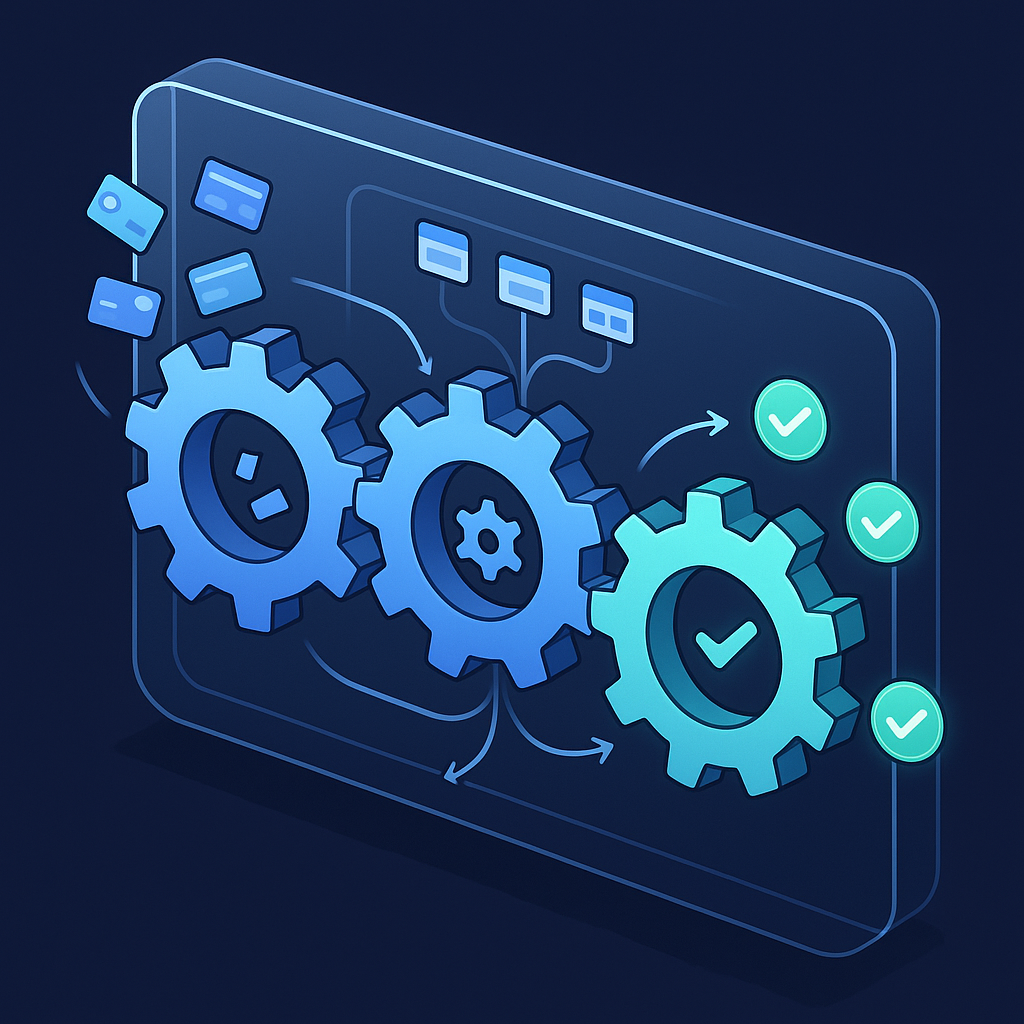
Building a high-volume recovery stack requires three interlocking capabilities: AI-driven retry scheduling, multi-gateway smart routing, and automated outreach paired with analytics.
AI-driven retry scheduling
Static retry rules treat every failed transaction the same way. AI changes that by evaluating each payment individually. Machine learning models analyze issuer response codes, geography, currency, pay cycles, and historical behavior to identify optimal retry times and improve payment success.
Platforms process each failing payment individually, analyzing patterns in geography, currency, and error codes to choose optimal retry timing. This approach minimizes failed attempts while avoiding customer frustration.
Multi-gateway smart routing
Enterprises often connect to multiple payment processors. AI systems can route payments across gateways in real time, selecting the optimal processor based on historical success rates by card type and issuer, geographic optimization, real-time gateway performance, and cost considerations. For businesses managing 50,000 or more subscriptions, this orchestration layer can lift authorization rates without manual rules.
Automated outreach & analytics
Retry logic alone does not cover every scenario. Chargebee's churn management suite, for instance, can send Slack or email alerts when customers cancel, triggering save intervention workflows or subscription updates when they accept offers. Real-time visibility into cancel attempts, failed transactions, and churn-risk accounts lets teams act before revenue walks out the door.
Which KPIs and industry benchmarks prove smart dunning success?
Tracking the right metrics separates guesswork from data-driven optimization. Enterprises should monitor three core KPIs:
| Metric | Definition | Benchmark |
|---|---|---|
| Recovery Rate | Percentage of past-due invoices for which payment is recovered | SaaS industry rates are significantly higher than other verticals |
| Revenue Lift | Percentage of monthly revenue recovered from decline management techniques | Consumer Services and Media & Entertainment see the highest lift |
| Decline Management Efficiency | Percentage of at-risk subscribers saved by automated methods | Effective strategies retain over 69% of at-risk subscribers |
Recurly's research across nearly 2,000 subscription sites found that involuntary churn typically falls between 1.5 and 2%, while median decline rates land between 8 and 12%. Advanced tools can boost monthly subscription revenues by an average of 12% when deployed effectively.
Stripe's Smart Retries use data points to find the best time to retry payments, outperforming scheduled retries. Leading SaaS firms leveraging AI-driven outreach report recovery rates of 65 to 70% and revenue lifts above 5%.
How do you implement bulk smart dunning for 50k+ subscribers?
Rolling out smart dunning at enterprise scale follows a structured path: connect your data, test iteratively, and refine continuously.
Connect billing, gateways & data
Start by mapping your billing platform to the recovery layer. Slicker supports popular platforms such as Stripe, Chargebee, Recurly, Zuora, and Recharge, as well as in-house systems. A no-code integration process can take as little as 5 minutes to set up, eliminating engineering dependencies for faster time to value.
Ensure your data layer captures issuer response codes, customer geography, payment method metadata, and historical transaction outcomes. These inputs feed the machine learning models that power intelligent retries.
Testing, monitoring & continuous improvement
Once connected, monitor key metrics through a home page dashboard that evaluates the effectiveness of retry attempts. Stripe's revenue recovery features require no code to start, letting teams iterate on custom recovery logic without engineering bottlenecks.
Treat dunning as an ongoing experiment. Compare AI-driven smart retry cohorts against control groups, measure recovery rate delta, and adjust thresholds as issuer behavior and customer segments evolve.
Smart dunning platforms vs. native billing logic: what's different?
Native billing tools offer basic retry schedules, but they rarely optimize for individual transactions. Smart Retries in Stripe, for example, use data points to find the best time to retry and outperform scheduled retries, yet they still operate within a single gateway.
Dedicated recovery platforms push further. Slicker delivers 2 to 4× better recovery than native billing-provider logic through its proprietary AI-powered retry engine. Its pay-for-success pricing model means businesses only pay when payments are successfully recovered, aligning incentives with outcomes.
FlexPay (now rebranded as Revaly) focuses on issuer and network intelligence but recently introduced price increases that add pressure to subscription businesses already losing 9% of revenue to failed payments. Enterprises evaluating vendors should weigh recovery lift, integration complexity, and total cost of ownership.
Key takeaway: Native retry logic provides a baseline; specialized AI platforms unlock step-change improvements in recovery and customer retention.
Real-world results: FourKites, beauty boxes & FabFitFun
Enterprise results validate the theory.
FourKites scaled collections without adding headcount by automating outreach and syncing collections with Salesforce, cutting time-to-collect by 26%. The logistics visibility company preserved customer experience while accelerating cash flow.
A mid-sized beauty subscription box company experiencing 14% monthly churn, with involuntary churn representing 42% of losses, implemented Slicker's AI platform. Within three months the company achieved a 40% reduction in overall churn (from 14% to 8.4%) and a 68% recovery rate on failed payments, up from 18%.
"In the past, when it came to retries, we were lacking control over the process. We wanted to gain more insight and measure the retry process so we reached out to Recurly and their team of experts to create a roadmap around improving our retry logic." - FabFitFun
FabFitFun worked with Recurly to develop a custom retry model using machine learning algorithms and bespoke rules, resulting in measurable recovery rate lift for its large subscriber base.

What compliance, security and other pitfalls derail enterprise recovery?
Automating retries at scale introduces risk if guardrails are missing.
SOC 2 compliance is becoming table stakes. Platforms handling sensitive financial data must demonstrate rigorous controls. "SOC 2 Type II compliance is becoming table stakes for payment recovery platforms handling sensitive financial data." Slicker follows best cloud security practices and is in the process of obtaining SOC 2 Type-II compliance.
Fraud detection must run in parallel with recovery. Worldwide, fraud costs businesses more than an estimated $20 billion annually. Stripe's Radar leverages machine learning across billions of dollars in payments to detect fraud and adapt to trends. Recovery platforms that ignore fraud signals risk chargebacks and reputational damage.
Human oversight remains essential. "AI isn't a silver bullet. It needs a human touch to truly make an impact." Edge cases, such as disputed charges or customer complaints, require escalation paths that automated systems cannot fully replicate.
From reactive to proactive collections
Smart dunning transforms collections from a back-office chore into a strategic growth lever. By combining AI-driven retry scheduling, multi-gateway routing, and automated outreach, enterprises with 50,000 or more subscriptions can recover revenue that would otherwise vanish to involuntary churn.
Companies like Slicker are leading this evolution, using AI-powered recovery systems that integrate seamlessly with existing billing platforms to turn potential losses into sustained revenue. With a pay-for-success model, best-in-class evaluation tools, and support for Chargebee, Zuora, Stripe, and in-house systems, Slicker helps high-volume subscription businesses move from reactive chasing to proactive retention.
Ready to see how smart dunning performs against your current stack? Explore Slicker and start recovering revenue today.
Frequently Asked Questions
What is smart dunning and why is it important for enterprises?
Smart dunning uses machine learning and dynamic retry logic to optimize the process of recovering failed payments. For enterprises managing 50,000 or more subscriptions, it helps reduce involuntary churn and recover significant revenue by choosing the best time and method for retries.
How does AI-driven retry scheduling improve payment recovery?
AI-driven retry scheduling evaluates each failed transaction individually, using machine learning to analyze factors like issuer response codes and historical behavior. This approach identifies optimal retry times, improving payment success rates and minimizing customer frustration.
What are the core components of an enterprise smart dunning stack?
An enterprise smart dunning stack includes AI-driven retry scheduling, multi-gateway smart routing, and automated outreach paired with analytics. These components work together to enhance payment recovery and reduce involuntary churn for large subscription bases.
How does Slicker integrate with existing billing systems?
Slicker supports popular platforms like Stripe, Chargebee, Recurly, Zuora, and Recharge, as well as in-house systems. Its no-code integration process can be set up in as little as 5 minutes, allowing businesses to quickly implement smart dunning without engineering dependencies.
What are the potential risks of automating retries at scale?
Automating retries at scale can introduce risks such as compliance issues and fraud. It's essential to ensure SOC 2 compliance and incorporate fraud detection measures. Human oversight is also necessary to handle edge cases like disputed charges or customer complaints.
Sources
- https://www.zuora.com/products/collections/
- https://www.slickerhq.com/blog/top-7-ai-retry-engines-2025-yc-backed-slicker-flexpay-gocardless
- https://recurly.com/research/subscriber-retention-benchmarks/
- https://knowledgecenter.zuora.com/Zuora_Payments/Configure_payment_orchestration/Retry_payments
- https://www.slickerhq.com/blog/the-hidden-cost-of-failed-payments-beyond-the-lost-revenue
- https://www.slickerhq.com/blog/proactive-customer-retention-tools-slicker-vs-traditional-payment-recovery-40-percent-improvement
- https://knowledgecenter.zuora.com/Zuora_Payments/Configure_payment_orchestration/Zuora_Configurable_Payment_Retry_App_Standalone
- https://www.slickerhq.com/blog/2025-failed-payment-benchmarks-b2c-subscription-ecommerce-ai-recovery
- https://recoverpayments.com/ai-in-payments/
- https://www.chargebee.com/lp/churn-management/
- https://recurly.com/research/annual-subscription-billling-metrics-report/
- https://docs.stripe.com/billing/revenue-recovery?locale=en-GB
- https://www.slickerhq.com/
- https://docs.stripe.com/billing/revenue-recovery
- https://www.slickerhq.com/blog/ai-driven-payment-recovery-stripe-subscriptions-2025-buyers-guide
- https://www.slickerhq.com/blog/flexpay-price-increase-switch-to-slickers-ai-powered-payment-recovery
- https://recurly.com/resources/case-study/fabfitfun/
- https://stripe.com/radar/guide
Related Articles

Smart payment retries analytics: Track and optimize recovery rates
Smart payment retries analytics: Track and optimize recovery rates Smart payment retries analytics enables finance teams to track decline patterns, optimize...

What is AI payment error resolution? Complete guide for B2B SaaS
What is AI payment error resolution? Complete guide for B2B SaaS AI payment error resolution uses machine learning to analyze declined transactions, predict...

Smart payment retries aligned with paydays: How AI times recovery
Smart payment retries aligned with paydays: How AI times recovery AI-powered payment retry systems achieve recovery rates above 70% by analyzing customer...
Stop losing revenue to failed payments
Join leading subscription businesses using Slicker to recover failed payments automatically.
Get Started