Smart payment retries for high-volume subscriptions: Scale guide

Smart payment retries use AI to analyze failed transactions individually and schedule retries when approval is highest, recovering 20-50% more revenue than batch approaches. For high-volume subscriptions processing millions of monthly retries, this precision matters enormously as 10-15% of subscription revenue disappears annually due to payment failures.
At a Glance
- Failed payments cost subscription businesses an estimated $129 billion in 2025 through involuntary churn
- 24% of recurring payments fail, with 56% due to insufficient funds
- Visa's 2025 VAMP thresholds reduce dispute tolerance from 0.9% to 0.5%, penalizing excessive retry attempts
- AI-powered systems like Slicker deliver 2-4× better recovery than native billing platforms
- Subscriptions recovered through intelligent retries continue for an average of seven additional months
- Modern AI engines integrate with existing billing infrastructure without requiring system replacement
Smart payment retries use machine learning to analyze each failed transaction individually, scheduling the next attempt when approval odds are highest. For high-volume subscription businesses, this distinction matters enormously: the global subscription industry is projected to reach a market value of $1.5 trillion by 2025, yet subscription companies could lose an estimated $129 billion in 2025 due to involuntary churn alone.
When every decline can cost thousands in lost lifetime value, the difference between batch logic and AI-driven retry tactics becomes a strategic imperative. This guide examines why scale demands smarter approaches, where legacy platforms like FlexPay hit their limits, and how modern AI retry engines can recover substantially more revenue while keeping you compliant with tightening card network rules.
Why "smart payment retries" matter when every decline costs thousands
Failed payments represent a critical revenue leak that subscription businesses cannot afford to ignore. Industry research shows that 10-15% of subscription revenue disappears annually due to payment failures such as expired cards and insufficient funds. More troubling still, recurring payments for subscriptions fail 24% of the time, and many of these are recoverable soft declines.
Smart payment retries differ from traditional batch approaches in three key ways:
- Individualized timing: Each transaction gets a retry schedule based on decline reason, customer history, and payday signals.
- Contextual awareness: The system considers geography, issuer behavior, and historical approval patterns.
- Continuous optimization: Machine learning models refine strategies as new data flows in.
Companies that switch from batch-based to intelligent, individualized retry strategies typically see a 20-50% increase in recovered revenue. At enterprise scale, that lift translates directly into millions of dollars retained.
Key takeaway: Smart retries treat each failed payment as a unique recovery opportunity, not a line item in a batch queue.
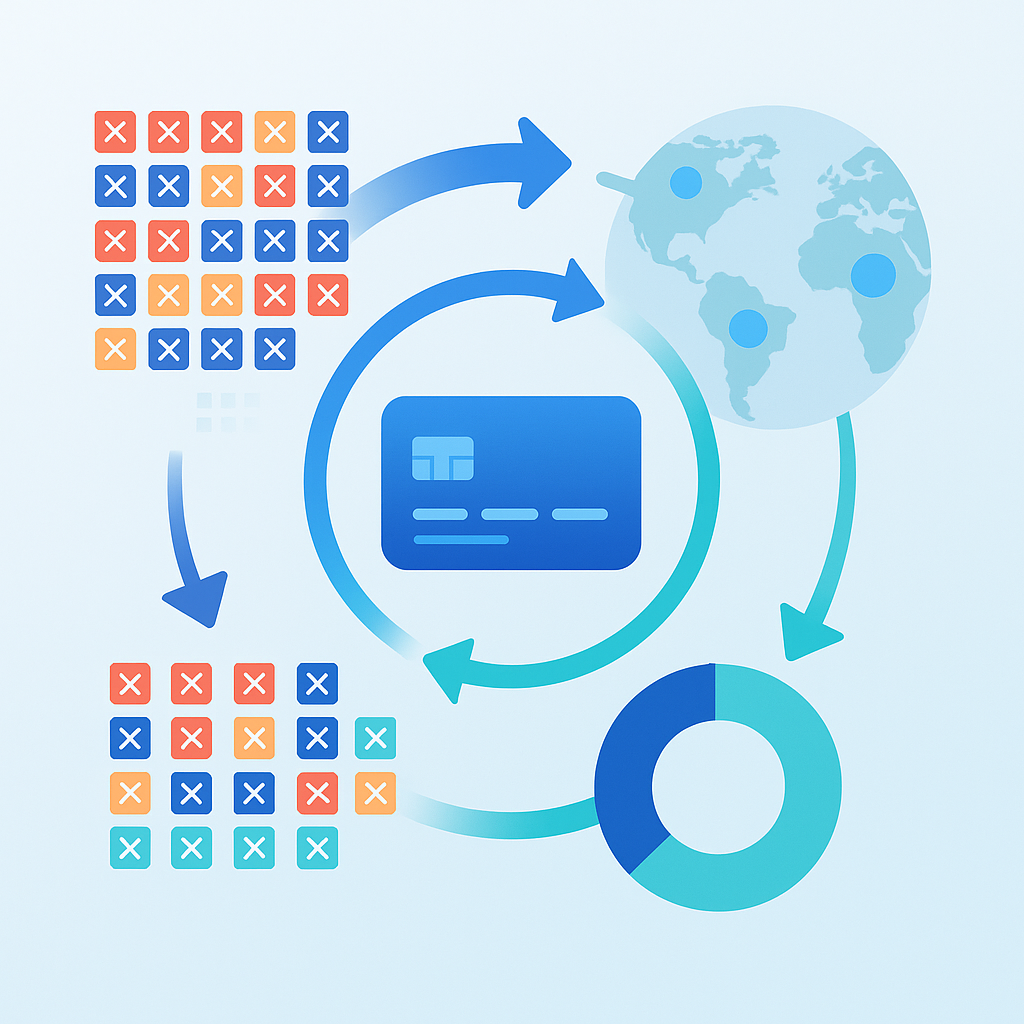
What makes scaling past 10 M retries so hard?
Once monthly retry volumes climb into the tens of millions, brute-force batch logic breaks down. Three factors combine to make scale exceptionally difficult:
| Challenge | Why it matters at scale |
|---|---|
| Error code diversity | There are over 70 error codes across card networks, each requiring different handling |
| Regional variation | Retry strategies vary by region (North America, Europe, LatAm) due to local regulations and practices |
| Insufficient funds dominance | 56% of merchant-initiated transaction failures stem from insufficient funds, compared to 18% for customer-initiated payments |
As one industry analysis puts it: "Recurring transaction retries are ineffective without considering the diverse parameters. And, there are too many parameters to be considered." — Juspay
Batch systems apply identical retry logic to all failed payments. They cannot adapt to the nuances of individual customers, regional pay cycles, or issuer-specific quirks. At high volume, this rigidity compounds into significant revenue leakage.
Key takeaway: Scale exposes the limitations of one-size-fits-all retry schedules; only systems that process each transaction individually can navigate the complexity.
Where does FlexPay break at enterprise scale?
FlexPay positions itself as an enterprise-grade solution with machine learning models trained on a dataset "equaling 7% of all US annual transactions". That scale of training data is substantial for the US market. However, merchants hitting very high volumes have reported friction in several areas.
Transparency gaps: FlexPay recently introduced an Invoice Reconciliation report to give merchants greater visibility into how fees connect to recovered transactions. The need for this update suggests that billing transparency was previously a pain point for finance teams managing large portfolios.
Stripe-specific constraints: FlexPay has added new configuration options to give merchants more control over how the platform handles failed payments on Stripe subscriptions. These options address edge cases like failed payments at subscription creation and cancellation delay calculations. For merchants with complex billing logic, these workarounds add configuration overhead.
Throughput considerations: When retry volumes exceed 10 million monthly attempts, reporting latency and portal-based workflows can become bottlenecks. Merchants with in-house billing systems or those using Chargebee or Zuora may find that FlexPay's Stripe-centric integrations require additional engineering effort.
None of these limitations render FlexPay unusable, but they represent friction points that enterprise-scale merchants should evaluate against their specific stack and volume profile.
How do modern AI retry engines outperform batch logic?
AI-powered payment recovery systems represent a fundamental shift from generic retry schedules. Machine learning engines analyze each failed payment individually, considering dozens of variables to determine the optimal recovery strategy.
The architecture of modern AI retry engines includes several key components:
- Real-time decision engine: Evaluates decline codes, customer payment history, and issuer signals in milliseconds.
- Multi-gateway routing: Automatically selects the best payment gateway when a recurring payment fails.
- Fraud filtering: AI can detect fraud in real-time and potentially reduce fraud losses by up to 40%.
- Timing optimization: Pagos Copilot, for example, synthesizes transaction data to surface insights like best times to retry based on historical approval success.
The performance difference is substantial. Subscriptions recovered through intelligent retry systems continue on average for seven more months, demonstrating the long-term value of effective payment recovery.
Key takeaway: AI engines process each transaction individually rather than following generic decline-code rules, delivering measurably higher recovery and longer customer retention.
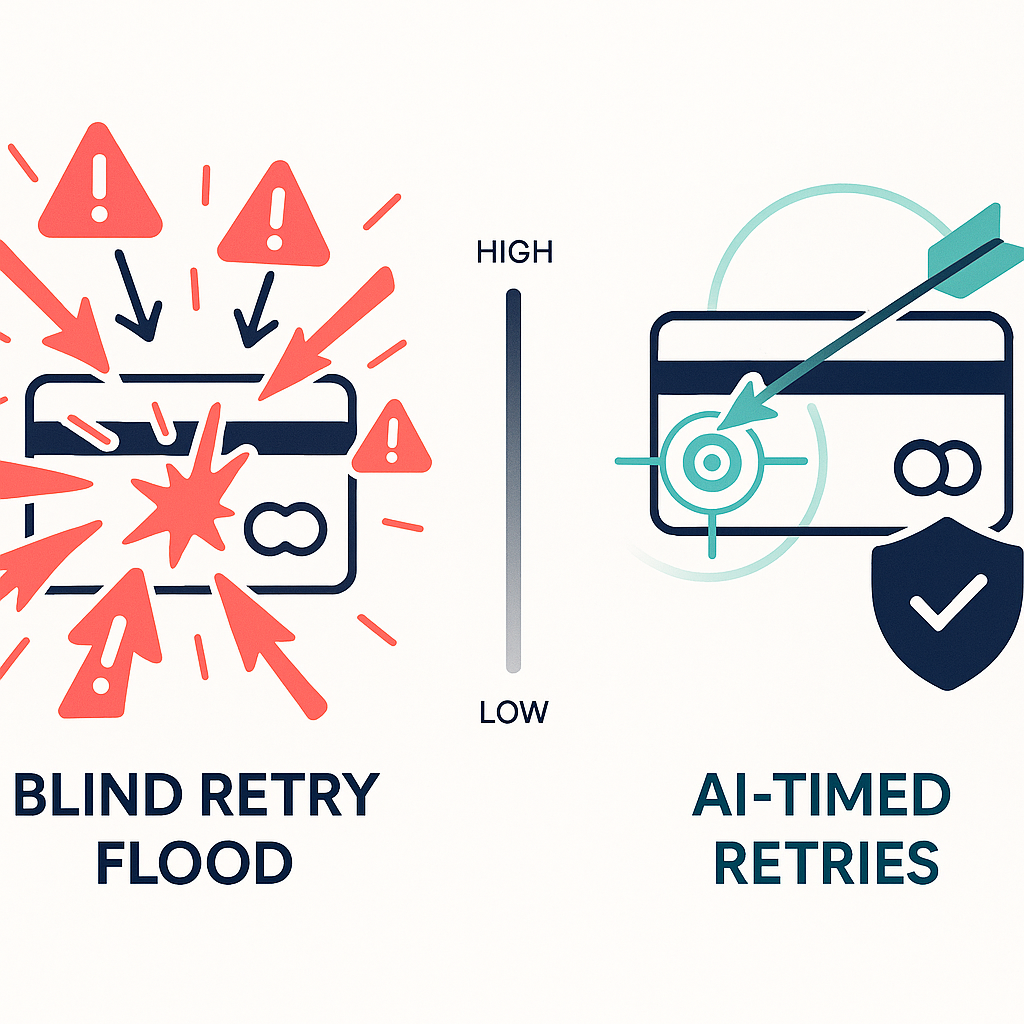
Why 2025 Visa VAMP thresholds punish blind retry floods
Starting April 1, 2025, Visa is consolidating its three separate monitoring programs into a unified Visa Acquirer Monitoring Program (VAMP) with dramatically tighter dispute thresholds.
The most impactful change for subscription businesses is the reduction in dispute tolerance from 0.9% to 0.5%. This "above-standard" threshold creates immediate compliance pressure for businesses already battling involuntary churn.
VAMP introduces two critical metrics:
| Metric | Threshold | Consequence |
|---|---|---|
| VAMP Ratio | Above 1.5% (2025), tightening to 0.9% (2026) | Higher fees, reduced processing capabilities, or account termination |
| VAMP Enumeration Ratio | More than 20% of transactions flagged as excessive retries | Enforcement action |
Blind retry floods, where batch systems hammer the same card repeatedly, now carry explicit penalties. Merchants that don't follow Visa's rules face higher fees, reduced processing capabilities, or even termination of their merchant accounts.
The solution lies in AI-powered recovery systems that can navigate these constraints while maintaining or improving approval rates. Intelligent retry engines naturally stay within VAMP thresholds because they only retry when the probability of approval justifies the attempt.
Slicker vs. FlexPay vs. Stripe Smart Retries: performance at 10× volume
When evaluating retry engines for high-volume subscription businesses, three platforms represent distinct approaches:
| Platform | Differentiator | Recovery claim | Pricing model |
|---|---|---|---|
| Slicker | YC-backed, multi-gateway routing | 2-4× better than native billing | Pay-per-recovery |
| FlexPay | Large US transaction dataset | Proprietary ML models | Custom pricing |
| Stripe Smart Retries | Native to Stripe Billing | 8 tries within 2 weeks default | Included with Stripe Billing |
Stripe Smart Retries uses AI to choose optimal retry times within a fixed window. It works well for Stripe-native merchants but cannot automatically retry payments when hard decline codes are returned.
Recurly's Intelligent Retries employs machine learning to determine optimal retry timing, with retries ceasing after 7 declines, 20 total attempts, or 60 days since invoice creation.
Slicker processes each failed payment individually and schedules intelligent, data-backed retries. The platform integrates with existing payment rails, works across Chargebee, Zuora, and in-house billing systems, and operates on a pay-for-success model where merchants only pay for recovered revenue.
For high-volume merchants processing 10× typical volumes, the ability to route across multiple gateways and adapt to non-Stripe billing systems becomes a critical differentiator. Slicker's best-in-class evaluation platform and integration flexibility make it particularly suited for complex enterprise stacks.
How to roll out an AI retry engine without ripping out billing?
The good news: modern AI retry engines are designed to sit on top of existing billing infrastructure rather than replace it. Here's how to implement one without major re-architecture:
Step 1: Audit your current retry logic
Document your existing retry schedules, dunning workflows, and decline handling. In just over a decade, billing in SaaS has gone from simple recurring payments to complex, data-driven workflows. Understanding your baseline is essential for measuring improvement.
Step 2: Map your integration points
Solutions like Juspay work across acquirers/PSPs, subscription providers, and various payment methods. Identify whether your AI engine will:
- Receive webhook notifications of failed payments
- Query your billing system for transaction context
- Push retry instructions back to your payment gateway
Step 3: Run parallel testing
Most AI retry engines operate as a parallel path, handling recurring transactions independently with minimal effort on the merchant's part. Stripe Billing can automatically retry failed payments while you test an overlay solution.
Step 4: Measure incrementally
Track recovery rate lift, average retry attempts per transaction, and customer lifetime extension. Studies from SaaS Capital and Bessemer's 2025 Cloud Report highlight that subscription management systems with automated billing recover up to 25% more revenue from failed payments.
Step 5: Expand gateway routing
Once baseline performance is established, enable multi-gateway routing to capture additional recovery from issuer-specific declines.
Recover more, risk less: scale smart retries in 2025
For high-volume subscription businesses, smart payment retries have moved from nice-to-have optimization to operational necessity. Tightening Visa VAMP thresholds, the complexity of 70+ error codes, and regional payment variations all demand AI-driven approaches.
Key takeaways from this guide:
- Batch retry logic breaks at scale; individualized strategies recover 20-50% more revenue.
- FlexPay offers strong US market coverage but may present integration friction for non-Stripe, high-volume merchants.
- VAMP compliance now penalizes blind retry floods, making intelligent timing essential.
- Modern AI engines deliver 2-4× better recovery than native billing systems while extending customer lifetime by seven months on average.
At Slicker, we've built our revenue recovery platform around the principle that every failed payment deserves a customized recovery approach. Our AI engine sits on top of existing billing and payment systems to reduce involuntary churn, integrates with Chargebee, Zuora, and in-house stacks, and operates on a pay-for-success model. For subscription businesses ready to scale their retry strategy, that combination of integration flexibility and aligned incentives makes the difference between recovered revenue and preventable loss.
Frequently Asked Questions
What are smart payment retries?
Smart payment retries use machine learning to analyze each failed transaction individually, scheduling retries when approval odds are highest, thus optimizing revenue recovery for subscription businesses.
Why do high-volume subscription businesses need smart payment retries?
High-volume subscription businesses face significant revenue loss from failed payments. Smart retries offer individualized recovery strategies, increasing recovered revenue by 20-50% compared to traditional batch methods.
What challenges do businesses face when scaling payment retries?
Scaling payment retries involves handling diverse error codes, regional variations, and high volumes, which batch systems struggle with. AI-driven systems adapt to these complexities, improving recovery rates.
How does FlexPay compare to modern AI retry engines?
FlexPay offers substantial US market coverage but may present integration challenges for non-Stripe, high-volume merchants. Modern AI engines provide more flexible, individualized retry strategies, enhancing recovery.
How can businesses implement AI retry engines without overhauling their billing systems?
AI retry engines can integrate with existing billing systems by auditing current logic, mapping integration points, running parallel tests, and expanding gateway routing, minimizing disruption while enhancing recovery.
Sources
- https://www.slickerhq.com/blog/soft-decline-retry-strategies-saas-cfos-q3-2025-guide
- https://www.slickerhq.com/blog/top-7-ai-retry-engines-2025-yc-backed-slicker-flexpay-gocardless
- https://slashdot.org/software/failed-payment-recovery/
- https://www.slickerhq.com/blog/visa-2025-vamp-thresholds-subscription-payment-recovery-ai-routing-tactics
- https://juspay.io/blog/juspay-aiops-solution-to-reduce-passive-churn
- https://primer.io/blog/payment-retry-strategies
- https://documentation.flexpay.io/changelog
- https://documentation.flexpay.io/changelog/additional-billing-logic-for-stripe-subscriptions
- https://pagos.ai/use-cases/retry-strategy
- https://flexpay.io/resources/subscription-merchant-guide-adapting-your-payment-recovery-to-visas-new-vamp-standards/
- https://stripe.com/docs/billing/revenue-recovery/smart-retries
- https://docs.recurly.com/docs/retry-logic
- https://flexprice.io/blog/how-to-automate-subscription-billing-workflows
- https://www.slickerhq.com/
Related Articles

Dunning Letter: Definition, Best Practices & Examples (May 2026)
At high-volume subscription companies, payment failures translate directly to revenue leakage. A dunning letter formalizes your recovery request in writing,...
Dunning Management: How to Build a Recovery Process That Actually Works (May 2026)
Your retry schedule is probably wrong. Most dunning management systems retry failed payments on a fixed cadence without checking why the card declined, which...
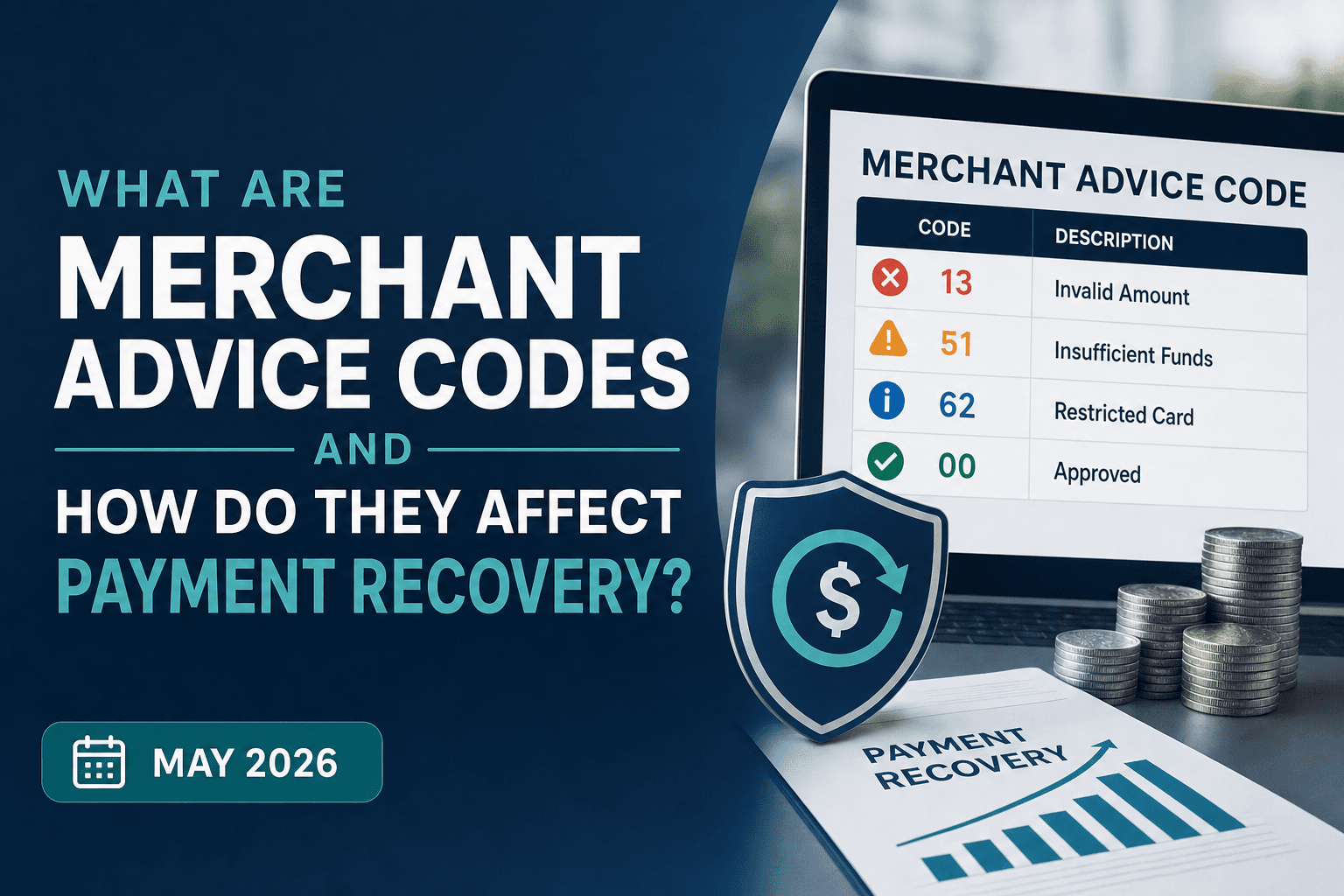
What Are Merchant Advice Codes and How Do They Affect Payment Recovery? (May 2026)
Your payment gateway receives visa response codes and merchant advice codes with every declined authorization. One identifies why the transaction failed. The...
Stop losing revenue to failed payments
Join leading subscription businesses using Slicker to recover failed payments automatically.
Get Started