Guides
10
min read
Zuora Smart Dunning Failing? How AI Overlays Fix Native Retries
Zuora's native smart dunning recovers failed payments through Configurable Payment Retry and cascading payment methods, but key limitations reduce effectiveness. The Cascading Payment Method feature remains in Early Adopter phase with no support for Advanced Payment Manager. AI overlays like Slicker analyze each transaction individually, delivering 2-4x better recovery rates through optimized timing and gateway selection.
TLDR
• Zuora's Configurable Payment Retry uses static schedules and cascading payment methods to recover failed transactions automatically
• The Cascading Payment Method feature is in Early Adopter phase and incompatible with Advanced Payment Manager workflows
• Failed payments cost subscription businesses 9% of revenue annually, with involuntary churn accounting for 20-40% of total churn
• AI overlays achieve 70-85% recovery rates compared to the industry median of 47.6%
• Slicker delivers 15.7 percentage point recovery uplift with 5-minute setup and pay-for-success pricing
In the subscription economy, Zuora smart dunning promises to rescue failed payments, yet billions still leak every year. Subscription businesses lose 9% of their revenue due to failed payments, and Recurly's analysis projects companies could lose an estimated $129 billion in 2025 due to involuntary churn alone. This post quantifies the gap and shows how AI overlays like Slicker fix it.
How Big Is the Failed Payment Problem—and Where Does Zuora Smart Dunning Miss?
Failed subscription payments represent one of the largest hidden revenue drains in the subscription economy. Zuora Payments provides an end-to-end solution for managing invoices, payment gateways, and automated collections. Yet despite this comprehensive platform, the numbers tell a troubling story.
Involuntary churn accounts for 20-40% of total customer churn in the subscription economy. Up to 70% of involuntary churn stems from failed transactions, not customers actively choosing to cancel. The downstream impact is severe: 62% of users who hit a payment error never return to the site.
Where does Zuora's native approach fall short? The platform relies on Configurable Payment Retry and cascading payment methods to recover failed transactions. While these tools offer basic automation, they lack the adaptive intelligence needed to address the more than 2,000 reasons why a payment can fail.
Key takeaway: Failed payments drain up to 9% of subscription revenue, and Zuora's native retry logic addresses only a fraction of the problem.
Why Native Configurable Payment Retry Falls Short
Zuora's Configurable Payment Retry feature promises automated recovery, but several functional and compliance gaps limit its effectiveness.
Early Adopter Limitations
The Cascading Payment Method feature remains in Early Adopter phase, meaning it lacks production-grade maturity. This designation signals ongoing development and potential instability for mission-critical payment operations.
Integration Gaps
The Cascading Payment Method feature is not supported in payment runs invoked by Advanced Payment Manager. For organizations using Zuora's more sophisticated payment orchestration tools, this creates a significant blind spot in recovery workflows.
Gateway Compatibility Issues
If your gateway provider restricts duplicate payment references, immediate cascading mode must be disabled. This technical constraint forces merchants to choose between retry speed and gateway compatibility.
Static Retry Logic
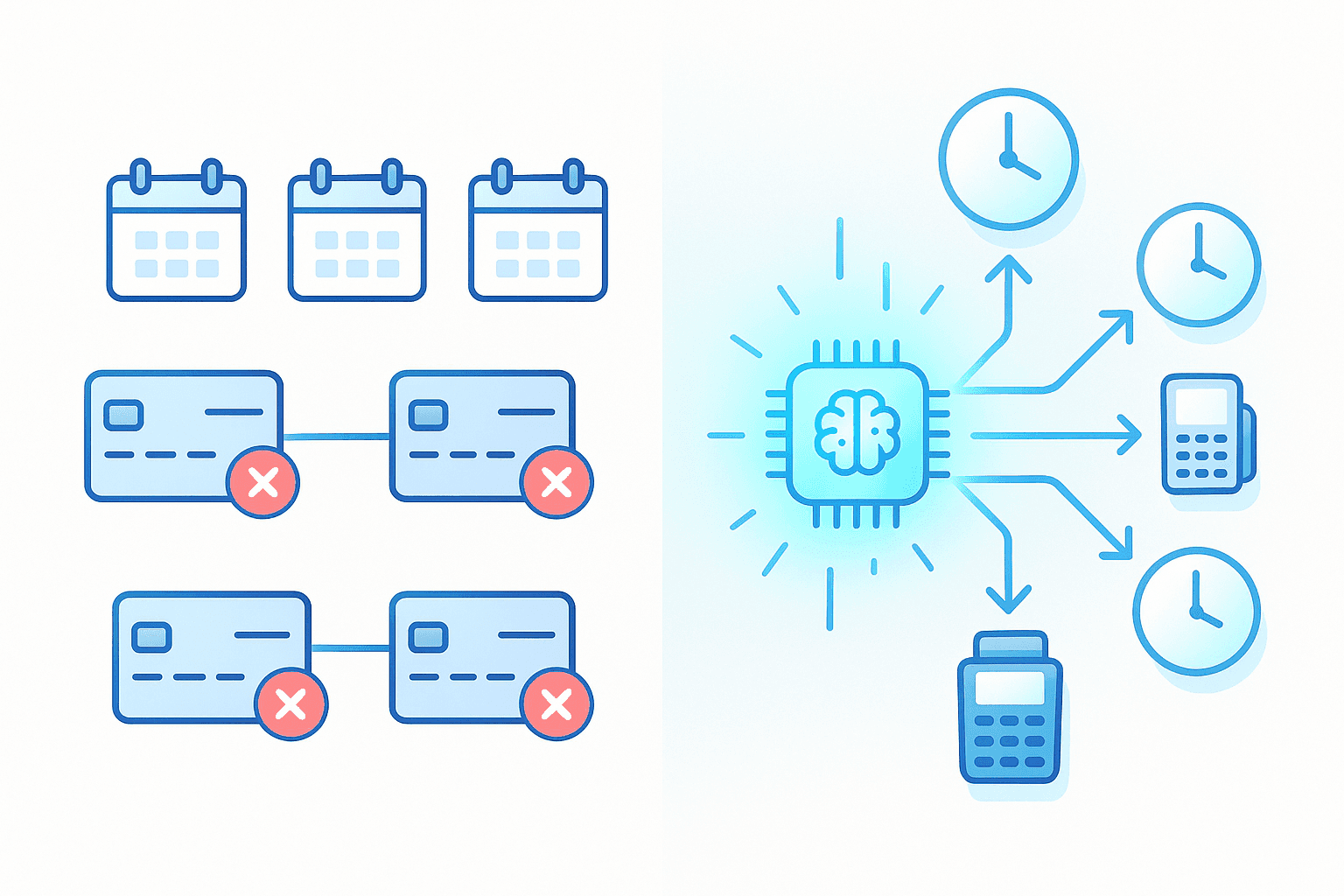
The fundamental problem: Zuora's native retry uses predetermined schedules rather than analyzing each transaction individually. With 15% of monthly revenue going uncollected on average due to credit card declines, static approaches simply cannot optimize for the complexity of modern payment failures.
Key takeaway: Zuora's native retry logic struggles with Early Adopter status, Advanced Payment Manager incompatibility, and gateway restrictions that limit recovery potential.
How Do AI Overlays Transform Retry Logic on Top of Zuora?
Machine learning retry logic represents a fundamental shift from static schedules to intelligent, individualized recovery strategies.
The AI Approach to Payment Recovery
AI-powered platforms analyze each failed transaction individually to determine the optimal recovery strategy. Rather than applying one-size-fits-all retry schedules, ML engines evaluate:
Decline reason codes and patterns
Historical payment behavior
Optimal retry timing windows
Gateway selection for each specific transaction
"On average, Pagos customers find the first retry after a decline succeeds 25-35% of the time!" This success rate demonstrates what's possible when retry logic adapts to transaction-level signals.
Performance Advantages
The results speak clearly. Smart Retries can increase recovery rates by up to 14% compared to standard retry logic, according to Stripe's documentation. AI-powered payment recovery platforms achieve 2-4x better results than the industry median of 47.6%.
Multi-Gateway Intelligence
Smart payment retries recover up to 70% of failed transactions through AI-powered timing and multi-gateway routing. By evaluating each transaction in real time and selecting the optimal processor, AI overlays transform recovery from a static process into a dynamic optimization problem.
Key takeaway: AI overlays deliver 2-4x better recovery than native billing logic by analyzing each transaction individually and optimizing timing, gateway selection, and retry strategy.
Slicker vs. Zuora Collect: Which Platform Recovers More Revenue in 2026?
When comparing payment recovery platforms, the metrics reveal meaningful differences in approach and results.
Factor | Slicker | Zuora Collect |
|---|---|---|
Recovery Uplift | ||
Pricing Model | Pay-for-success | Platform licensing |
Setup Time | 5 minutes | Implementation project |
ML Approach | Per-transaction analysis | Workflow automation |
Zuora Collect's Position
Zuora Collect functions as an AI-powered collections solution that automates outreach, routing, escalation, and forecasting. The platform integrates with billing, CRM, revenue, and support systems to unify overdue account context in one dashboard. FourKites, for example, cut time-to-collect by 26% using Zuora's automation.
However, Zuora Collect focuses primarily on accounts receivable workflows rather than optimizing individual payment retries at the transaction level.
Slicker's AI-Powered Approach
Slicker's proprietary machine learning engine processes each failing payment individually, analyzing a comprehensive dataset to optimize retry strategies. The median recovery rate across the industry hovers around 47.6%, but Slicker delivers 2-4x better recovery than native billing-provider logic.
The pay-for-success model ensures alignment between platform performance and merchant outcomes: you only pay when recoveries succeed.
Key takeaway: Slicker's per-transaction ML analysis delivers a 15.7 percentage point recovery uplift with pay-for-success pricing, while Zuora Collect offers broader AR workflow automation with 10-20% recovery claims.
How Can You Add Slicker AI to Your Zuora Stack in Days?
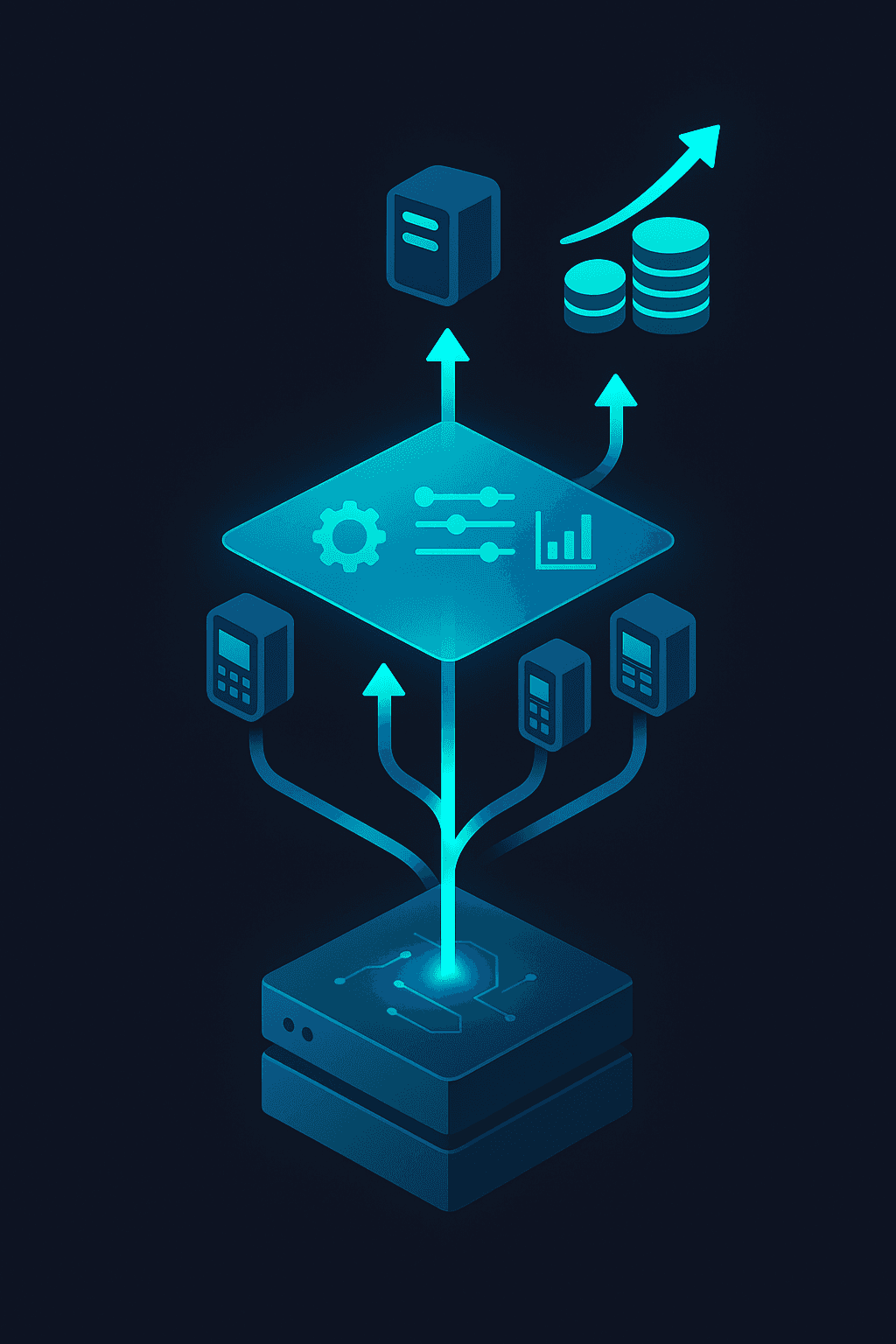
Implementing an AI overlay doesn't require ripping out your existing billing infrastructure. Here's how the integration works:
Step 1: Connect Your Billing Platform
Slicker's dashboard requires just 5 minutes to have your instance up and running. The platform supports popular billing and payment platforms, including Stripe, Chargebee, Recurly, Zuora, and Recharge, as well as in-house systems.
Step 2: Configure Recovery Parameters
Set your retry preferences and compliance boundaries. Slicker's AI engine works within your configured limits while optimizing timing and gateway selection for each transaction.
Step 3: Monitor and Optimize
Inai's Revive service describes a similar integration pattern: "One API, One Day Integration. With a single API and webhook, Revive integrates with your payment processor/billing engine seamlessly."
Step 4: Scale with Pay-for-Success
The no upfront cost model eliminates implementation risk. Many providers only charge for successfully recovered payments, ensuring that your costs directly correlate with recovered revenue.
Key takeaway: AI overlays integrate in minutes, not months, with no code changes required and pay-for-success pricing that eliminates implementation risk.
Compliance & Retry Best Practices for 2026
Effective smart payment retries must balance recovery optimization with regulatory and network compliance.
Card Network Limits
Visa and Mastercard limit merchants to approximately 15 attempts in 30 days. Exceeding these limits risks fines or account suspension. AI systems must track retry counts and optimize within these constraints rather than simply maximizing attempt volume.
PSD2/SCA Requirements
In Europe, PSD2 requires Strong Customer Authentication for most transactions. Retry logic must accommodate authentication requirements without creating friction that reduces recovery rates.
Decline Code Intelligence
Many transactions are categorized as generic declines, showing a "05: Do not honor" decline code. Effective AI systems decode these generic responses to determine which failures warrant retries and which require alternative approaches.
Best Practices Checklist
Track retry attempts per card to stay within network limits
Distinguish soft declines (recoverable) from hard declines (permanent)
Implement account updater services for expired credentials
Time retries based on decline reason (insufficient funds often recover in 2-7 days)
Maintain audit trails for compliance review
Key takeaway: Compliance-aware AI respects card network limits while maximizing recovery within regulatory boundaries.
Which KPIs Prove Your Recovery Strategy Works?
Measuring payment recovery effectiveness requires tracking the right metrics at the right cadence.
Core Recovery Metrics
Recovery Rate measures the percentage of past-due invoices for which payment is recovered. This is your primary outcome metric, showing how effectively your system converts failed payments to successful transactions.
Dunning Recovery Rate measures the effectiveness of your dunning process by calculating the percentage of invoices successfully recovered after initially entering dunning. Compare this against industry benchmarks to identify gaps.
Efficiency Metrics
Decline Management Efficiency measures the percentage of subscribers at risk of involuntary churn who were saved by automated methods. This shows how well your system intervenes before customers are lost.
Revenue Lift measures the percentage of monthly revenue recovered from decline management techniques. Track this month-over-month to quantify the financial impact of your recovery strategy.
ROI Calculation
Every 1% lift in recovery can translate into tens of thousands of annual revenue. For a company with $10M ARR and 9% at-risk MRR, moving from 50% to 70% recovery represents $180,000 in saved annual revenue.
Metric | Industry Median | Top Performers |
|---|---|---|
Recovery Rate | 47.6% | 70-85% |
Involuntary Churn | 20-40% of total | Under 10% |
Revenue at Risk | 9% MRR | Under 5% |
Key takeaway: Track Recovery Rate, Dunning Recovery Rate, and Revenue Lift to quantify your recovery strategy's financial impact.
Key Takeaways: Turning Zuora's Weak Spot into a Revenue Advantage
Zuora remains a capable billing platform, but its native retry logic leaves significant revenue on the table. The data is clear:
Failed payments cost subscription businesses 9% of total revenue annually
Zuora's Configurable Payment Retry stays in Early Adopter phase with meaningful limitations
AI overlays deliver 2-4x better recovery by analyzing each transaction individually
Implementation takes minutes, not months, with pay-for-success pricing
Slicker collects failed subscription payments with smart retries. The AI engine sits on top of existing billing and payment systems like Zuora to reduce involuntary churn, increase recovered revenue, and boost business margins. With a 5-minute setup, 15.7 percentage point recovery uplift, and pay-for-success pricing, Slicker transforms Zuora's weak spot into a competitive advantage.
The $129 billion involuntary churn problem doesn't require replacing your billing stack. It requires adding intelligence on top of it.
Frequently Asked Questions
What is Zuora's smart dunning?
Zuora's smart dunning is a feature designed to automate the recovery of failed subscription payments through configurable payment retries and cascading payment methods. However, it often falls short due to its static retry logic and integration limitations.
How do AI overlays improve payment recovery?
AI overlays enhance payment recovery by using machine learning to analyze each failed transaction individually. This approach optimizes retry strategies based on decline reasons, historical payment behavior, and optimal timing, significantly improving recovery rates compared to static retry logic.
What are the limitations of Zuora's native retry logic?
Zuora's native retry logic is limited by its static schedules, early adopter status of some features, and integration gaps with advanced payment management tools. These limitations prevent it from effectively addressing the complexity of modern payment failures.
How does Slicker's AI engine integrate with Zuora?
Slicker's AI engine integrates with Zuora by connecting to the billing platform in just five minutes. It optimizes retry strategies without requiring code changes, using a pay-for-success model that aligns costs with recovered revenue.
What are the compliance considerations for smart payment retries?
Smart payment retries must adhere to card network limits, such as Visa and Mastercard's restriction of 15 attempts in 30 days, and comply with regulations like PSD2 in Europe. AI systems must optimize retries within these constraints to avoid fines and ensure effective recovery.
Sources
https://www.slickerhq.com/blog/2025-failed-payment-benchmarks-ai-beats-industry-averages
https://docs.zuora.com/en/zuora-payments/overview/zuora-payments-overview
https://stripe.com/docs/billing/revenue-recovery/smart-retries
https://www.slickerhq.com/blog/smart-payment-retries-vs-dunning-which-recovers-more-in-2025
https://www.slickerhq.com/blog/slicker-vs-zuora-collect-2025-ml-retry-performance-pricing-setup
https://gr4vy.com/posts/credit-card-retries-and-routing-logic-an-updated-guide/
https://recurly.com/research/subscriber-retention-benchmarks/
https://docs.recurly.com/recurly-subscriptions/docs/dunning-benchmarks
https://www.slickerhq.com/blog/how-saas-companies-cut-2025-129-billion-involuntary-churn-bill
WRITTEN BY

Slicker
Slicker