AI Payment Recovery When 502 Errors Break Your Script Sep 2026

AI-powered payment recovery systems use machine learning to analyze decline patterns and optimize retry timing, typically achieving 20-50% higher recovery rates than static retry scripts. These services handle 502 errors and other failures automatically through intelligent routing and retry strategies, eliminating the need for custom infrastructure while recovering 25-35% of payments on first retry.
Key Facts
• Failed payments cause subscription businesses to lose 10-15% of annual revenue, with 45% of customers never manually retrying after a decline
• Static retry scripts fail catastrophically when encountering 502 errors or network issues, lacking the context to distinguish recoverable from permanent failures
• Building reliable payment recovery requires handling idempotency, state management, exponential backoff, and compliance standards like SOC 2 Type II
• AI engines analyze billions of transactions to determine optimal retry timing based on decline codes, issuer patterns, and customer behavior
• Modern services offer 5-minute no-code setup with pay-for-success pricing models, charging only for successfully recovered payments
• Stripe's AI recovered $6 billion in falsely declined transactions with 70% greater precision and 35% fewer retry attempts
Failed payments are a silent revenue killer. Every month, subscription businesses watch as expired cards, insufficient funds, and mysterious gateway timeouts chip away at their monthly recurring revenue (MRR). When your home-grown retry script encounters a 502 error at 2 AM, there is no graceful recovery. The transaction fails, the customer churns, and the revenue vanishes.
The scale of this problem is staggering. Industry research shows that 10-15% of subscription revenue disappears annually due to payment failures such as expired cards and insufficient funds. Even worse, 45% of consumers will not manually retry a payment following its failure. If your system does not recover these transactions automatically, that revenue is gone for good.
This is where AI-powered payment recovery enters the picture. Instead of rigid scripts that crumble under network pressure, machine learning engines analyze issuer responses, network conditions, and customer history in real time to schedule intelligent retries. The result is a 20--50% increase in recovered revenue without the engineering headaches of maintaining brittle infrastructure.
Why do 502 errors (and other gremlins) turn failed payments into lost revenue?
Payment failures happen far more often than most teams realize. A 502 Bad Gateway error means your retry script received an invalid response from the upstream server. But that is just one flavor of the many gremlins lurking in the payment stack.
Consider the numbers. Card declines, bank rejections, and soft errors wipe out up to 4% of MRR in high-growth subscription businesses. Over half of US shoppers had their payment declined during an online purchase in 2023, and the downstream effects cascade quickly into involuntary churn.
The problem compounds because failed payments rarely receive the attention they deserve. Engineering teams put new features ahead of maintaining retry logic. Meanwhile, failed payments cost your business thousands, even hundreds of thousands of dollars annually.
When a static retry script encounters transient network issues like 502 errors, it typically retries blindly at fixed intervals. This approach ignores critical context:
- Was the failure a soft decline that will likely succeed tomorrow?
- Is the issuer experiencing temporary outages?
- Has this customer's card been updated through network tokenization?
Without these signals, your script is essentially guessing. That guesswork translates directly into lost revenue and frustrated customers who never intended to cancel.
Key takeaway: HTTP-layer failures like 502 errors are symptoms of a deeper problem. Static retry scripts lack the intelligence to distinguish recoverable failures from permanent declines, costing subscription businesses up to 4% of their MRR.
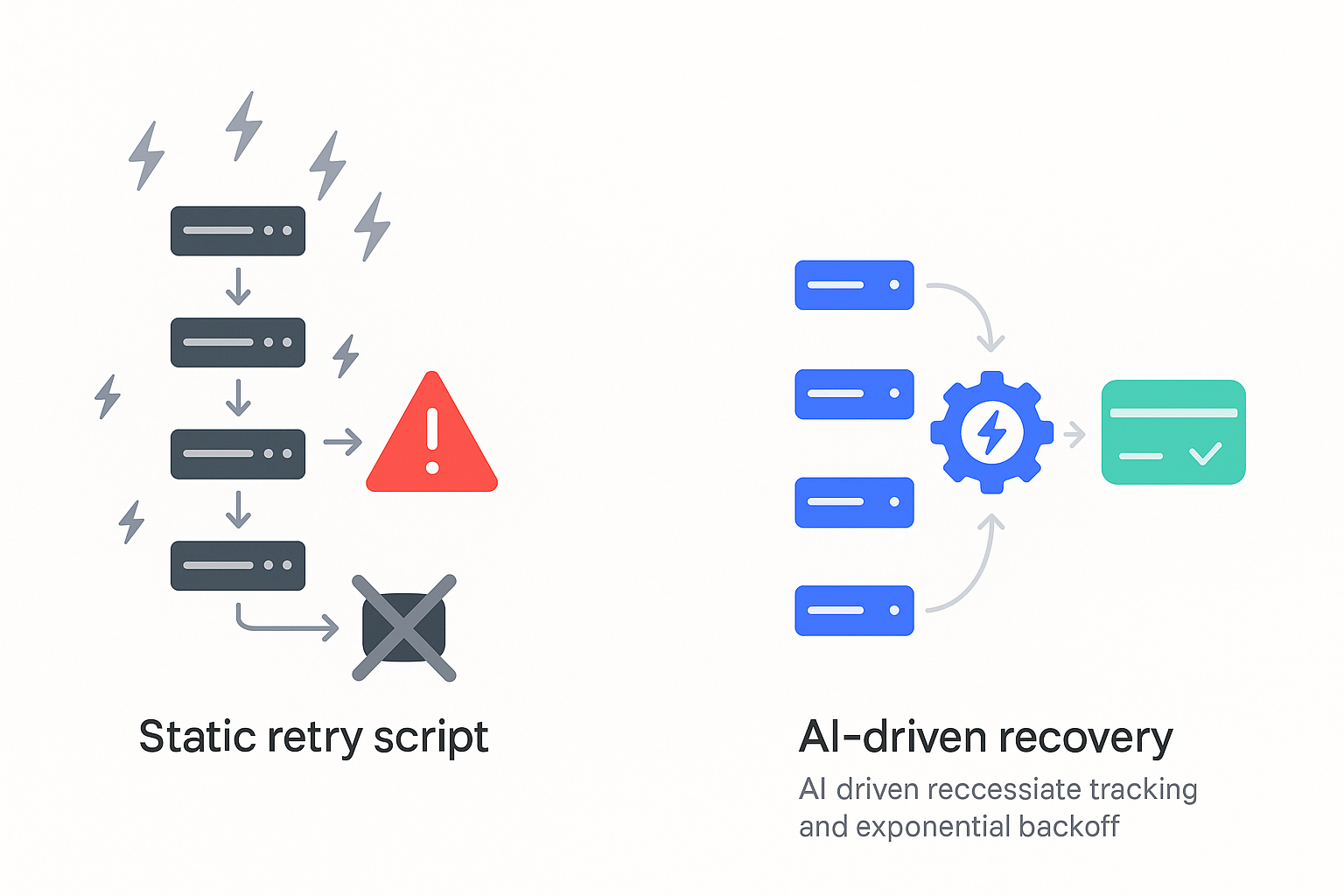
Home-grown retry scripts: from 502 chaos to idempotency headaches
Building your own payment retry system sounds straightforward until you actually try it. The technical challenges extend far beyond handling 502 errors.
The transient versus permanent error problem
Not all failures are created equal. server errors return 5xx HTTP codes, indicating problems on the payment processor's side. These are often transient and worth retrying. But content errors return 4xx codes, signaling that retrying the same request will never succeed.
Your script must correctly classify each failure type. Get it wrong in one direction, and you waste resources on hopeless retries. Get it wrong in the other, and you abandon transactions that would have succeeded with patience.
The idempotency minefield
Transient error conditions are those scenarios where retrying the same request at a later point would likely result in a successful outcome. But here is the catch: if your retry logic lacks proper idempotency controls, you risk charging customers twice.
Idempotency is a web API design principle defined as the ability to apply the same operation multiple times without changing the result beyond the first try. Implementing this correctly requires:
- Generating and tracking idempotency keys for every POST request
- Building a state machine to track payment lifecycle
- Handling edge cases where the initial request succeeded but the response was lost
The 24/7 monitoring burden
Payment failures do not respect business hours. When your retry script breaks at midnight, you need someone available to fix it. As the engineering wisdom goes, "everything fails eventually". The question is whether you have the infrastructure and on-call rotation to respond.
A well-thought-out retry strategy can mean the difference between recovering failed payments and frustrating your users. But designing a dependable retry mechanism requires expertise in:
Challenge | Engineering Requirement |
|---|---|
Status tracking | Database schema for payment states |
Retry timing | Exponential backoff implementation |
Queue management | Retry queues and dead letter queues |
Duplicate prevention | Exactly-once delivery semantics |
Most teams underestimate this complexity. They build a simple cron job, encounter their first 502 cascade, and realize they have signed up for a full-time infrastructure project.
Build vs. buy: what's the true cost of a resilient payment-recovery engine?
The build versus buy decision for payment recovery involves far more than comparing license fees to engineering salaries. The hidden costs accumulate quickly.
The data science requirement
Effective retry timing requires machine learning models trained on massive datasets. Recurly's intelligent retry logic uses data from billions of transactions to increase the chances of successful payments. Can your team replicate this with your transaction volume alone?
Building comparable models requires:
- Data scientists to design and train algorithms
- Infrastructure for model training and deployment
- Continuous monitoring for model drift as issuer behavior changes
The compliance overhead
Payment systems touch sensitive financial data. Any solution you build must meet SOC 2 Type II compliance standards, which are becoming table stakes for payment recovery services handling sensitive financial data. The audit process alone consumes months of engineering and legal resources.
Regulatory requirements vary by payment method and geography. For example, SEPA payments can only be retried twice, in compliance with SEPA regulations. Building a system that respects these constraints across all your payment methods adds considerable complexity.
The embedded AI advantage
Gartner research indicates that by 2026, more than 80% of enterprises will have used generative AI APIs or deployed GenAI-enabled applications, up from less than 1% today. This trend suggests that buying AI-powered solutions will increasingly outperform building from scratch.
The same research predicted that through 2025, 30% of generative AI projects would be abandoned after proof of concept due to poor data quality, inadequate risk controls, escalating costs, or unclear business value. Payment recovery is not a core competency for most subscription businesses. Outsourcing it to specialists makes strategic sense.
For a closer look at implementation considerations, see our guide on how to implement AI-powered payment recovery.
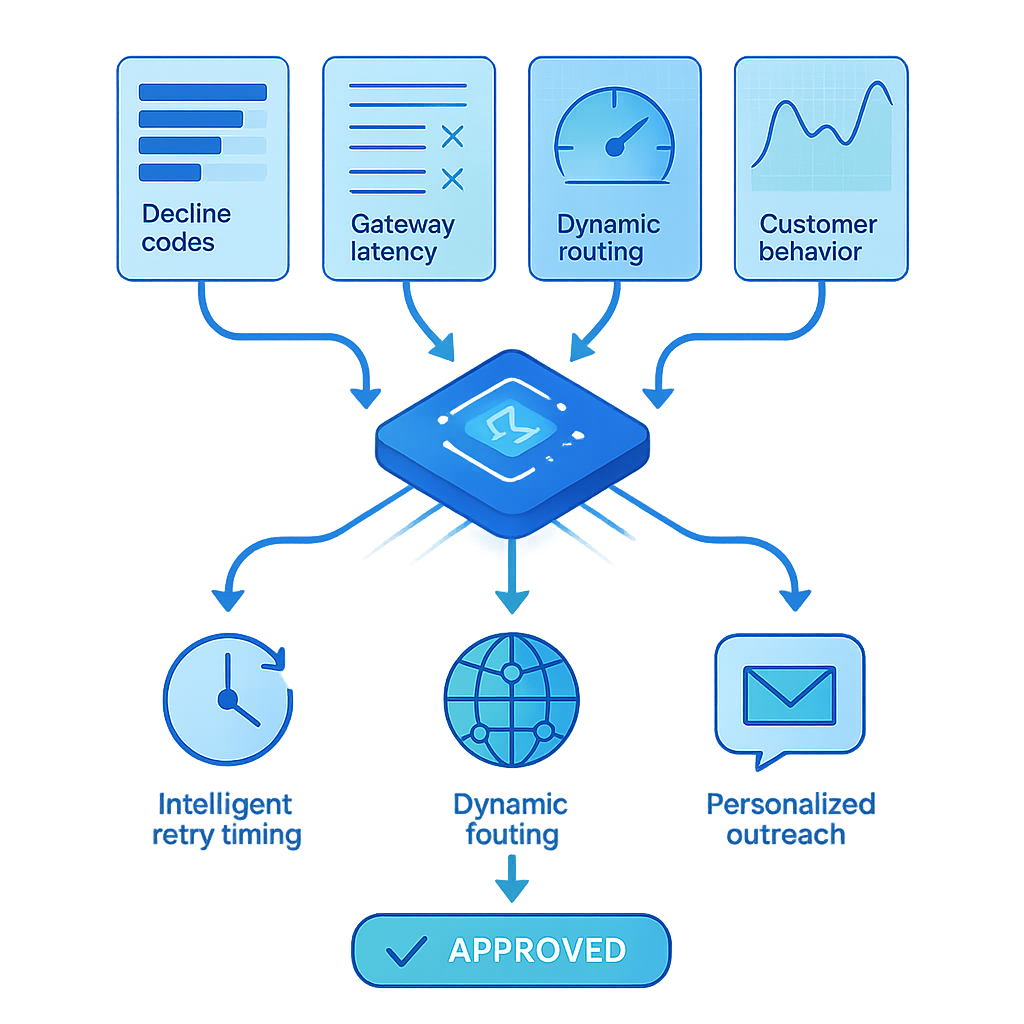
Inside an AI retry engine: how do data signals, smart retries and multi-gateway routing work?
AI-powered payment recovery differs fundamentally from static retry scripts. Instead of following fixed rules, these systems learn from each transaction to optimize future attempts.
Intelligent retry timing
Traditional dunning follows rigid schedules. "Traditional dunning is like fishing with a bent stick hoping for a bite," as Payoptify describes it. "AI-powered recovery is like having smart sonar and an automated fishing fleet working for you 24/7."
AI dunning is strategic: it uses data to pinpoint the best retry times, personalizes outreach across channels customers actually use, and gracefully handles multiple payment gateways. The system analyzes:
- Historical success rates by hour and day of week
- Decline code patterns from specific issuers
- Customer payment behavior over time
Multi-gateway routing
Not all payment processors are equal. Approval rates vary widely based on card type, geography, and even the time of day. AI retry engines can route transactions through whichever gateway offers the highest success probability at that moment.
Slicker's AI engine schedules and retries failed payments at optimal times, drawing on industry expertise and dozens of parameters. The engine dynamically determines if an error is retryable, taking into account differences between different issuers and historical performance.
Decline code intelligence
The first retry matters most. On average, Pagos customers find first retries succeed 25--35% of the time. But only if you retry the right transactions at the right time.
AI engines decode decline reasons to understand which failures are recoverable:
- Insufficient funds: Retry after payroll dates
- Temporary hold: Retry within hours
- Lost/stolen card: Do not retry at all
- Network timeout: Retry immediately through alternate gateway
Learn more about these mechanisms in our article on how AI enhances payment recovery.
ROI math: how much extra revenue can smart retries unlock?
The financial impact of upgrading from static scripts to AI-powered recovery is substantial and measurable.
Recovery rate improvements
Companies that switch from batch-based to intelligent, individualized retry strategies typically see: 20--50% increase in recovered revenue. This is not a marginal improvement. For a business losing $100,000 monthly to failed payments, that translates to $20,000--$50,000 in additional recovered revenue every month.
Slicker customers usually see between 10 and 20 percentage point increase in the number of recovered payments. On a base recovery rate of 30%, that means jumping to 40--50% recovery, nearly doubling the money saved from involuntary churn.
The compounding effect on LTV
Recovered customers do not stop at one more invoice. They continue their subscriptions, often for months or years. Every 1% lift in recovery can translate into tens of thousands of annual revenue.
Stripe's Adaptive Acceptance results
For context on what is possible at scale, Stripe's AI-powered Adaptive Acceptance recovered a record-high $6 billion in falsely declined transactions, reflecting a 60% year-over-year increase in the retry success rate. Their new AI model achieves 70% greater precision in identifying legitimate transactions that have been falsely declined while reducing retry attempts by 35%.
Fewer retries with higher success rates means lower processing costs and happier issuers.
What the numbers say heading into late 2026
The case for AI-powered payment recovery has grown considerably sharper this year. Recurly's 2026 State of Subscriptions report puts the scale of the problem in stark relief: the software vertical alone recovered $155 million through payment recovery tooling in the past year, with digital media adding another $100 million. Across the entire subscription economy, an estimated $129 billion in revenue was at risk from failed payments in 2025.
Adoption of AI for this problem is accelerating fast. By early 2026, 40% of subscription companies had adopted AI for revenue recovery and churn prediction, up from a fraction of that just two years prior, as static retry logic proved progressively less competitive against smarter issuers and more complex decline patterns.
The vertical-specific data is equally striking. A Baremetrics benchmark covering 119 U.S. subscription businesses (May 2026) found that those companies collectively recovered more than $1.24 million in failed payments in a single month, and 95% saw their recovery tool pay for itself within the first month. For subscription box businesses in particular, SubJolt's 2026 churn benchmarks put the share of total churn attributable to failed payments as high as 68%, nearly double the generic 35 to 45% range cited in earlier analyses.
The implication is direct: the gap between what a static retry script recovers and what an AI engine recovers is widening, not narrowing. Businesses still relying on home-grown retry logic in late 2026 are not standing still; they are falling behind.
What the numbers say heading into late 2026
The case for AI-powered payment recovery has grown considerably sharper this year. Recurly's 2026 State of Subscriptions report puts the scale of the problem in stark relief: the software vertical alone recovered $155 million through payment recovery tooling in the past year, with digital media adding another $100 million. Across the entire subscription economy, an estimated $129 billion in revenue was at risk from failed payments in 2025.
Adoption of AI for this problem is accelerating fast. By early 2026, 40% of subscription companies had adopted AI for revenue recovery and churn prediction, up from a fraction of that just two years prior, as static retry logic proved progressively less competitive against smarter issuers and more complex decline patterns.
The vertical-specific data is equally striking. A May 2026 Baremetrics benchmark covering 119 U.S. subscription businesses found that those companies collectively recovered more than $1.24 million in failed payments in a single month, and 95% saw their recovery tool pay for itself within the first month. For subscription box businesses in particular, SubJolt's 2026 churn benchmarks put the share of total churn attributable to failed payments as high as 68%, nearly double the generic 35 to 45% range cited in earlier analyses.
The implication is direct: the gap between what a static retry script recovers and what an AI engine recovers is widening, not narrowing. Businesses still relying on home-grown retry logic in late 2026 are not standing still; they are falling behind.
Reducing involuntary churn in 2026: account updaters, network tokens, and smart retry rules
AI-powered retries are only one layer of a complete involuntary churn defense. SaaS businesses that recover the most revenue in 2026 combine intelligent retries with upstream card-update infrastructure and issuer-compliant retry rules, so fewer payments fail in the first place.
Account updater services
Card-network account updater programs (Visa Account Updater, Mastercard Automatic Billing Updater) push refreshed card numbers and expiry dates to merchants before a renewal even attempts to charge. Stripe, Adyen, and Braintree all support account updater natively. Activating it typically eliminates 10-20% of soft declines caused by expired or reissued cards, failures that would otherwise flow into your retry queue.
Network tokenization
Network tokens replace raw card numbers with a payment-network-issued token that automatically updates when the underlying card changes. Adyen's recurring-payment documentation and Stripe's network token docs both report higher authorization rates for tokenized credentials versus raw PANs. For high-volume SaaS billers, tokenization is the single highest-ROI card-credential investment available in 2026.
Visa and Mastercard retry rules
Both networks now impose excessive retry penalties on merchants who blindly hammer declined transactions. Visa's retry rules cap retries at 15 attempts over 30 days for most decline codes; certain hard-decline codes (e.g., "Do Not Retry") prohibit any further attempt. Violating these rules triggers per-transaction fines and can damage your issuer relationships. A dedicated AI retry engine enforces these constraints automatically, whereas a static cron job almost certainly does not.
Layering AI retries on top
The most effective involuntary churn stack in 2026 looks like this: (1) network tokenization to minimize initial declines, (2) account updater to refresh stale credentials before the charge fires, and (3) an AI retry engine (like Slicker) to recover the failures that still slip through, scheduling each attempt at the optimal moment without violating network retry caps. Each layer targets a different failure mode; none of them alone is sufficient.
Slicker vs. FlexPay, GoCardless & others--who comes out on top?
The AI retry engine market includes several well-known players. Here is how they compare.
FlexPay
FlexPay positions itself as an enterprise solution with multiple integration options, including API and access to 40+ CRMs, allowing quick setup without disrupting existing billing. Their product uses both "Invisible Recovery" for payments that can be recovered without customer involvement and "Engaged Recovery" for situations requiring customer action.
However, FlexPay's enterprise focus means complex onboarding and custom pricing that may not suit smaller subscription businesses.
GoCardless Success+
GoCardless Success+ claims up to 70% recovery rates for certain failure types. The service excels at direct debit payments, drawing on its bank-to-bank payment expertise.
The limitation is scope. GoCardless focuses on direct debit, which may leave gaps if your business relies heavily on card payments.
Slicker
Slicker takes a different approach with its pay-for-success pricing model that aligns incentives perfectly. You only pay for successfully recovered payments, eliminating the risk of paying for a solution that does not deliver.
The service's proprietary AI engine processes each failed payment individually and schedules intelligent, data-backed retries instead of blindly following generic decline-code rules. Multi-gateway routing directs transactions through whichever processor offers the best approval odds.
For a full side-by-side comparison, see our top 7 AI retry engines analysis.
Integration & compliance: getting live in minutes, not months
Modern AI recovery services have dramatically simplified deployment. The days of multi-month integration projects are over.
Rapid deployment
The service supports popular billing and payment systems, such as Stripe, Chargebee, Recurly, Zuora, and Recharge, as well as in-house systems.
Compliance standards
SOC 2 Type II compliance is becoming table stakes for payment recovery services handling sensitive financial data. When reviewing solutions, verify their compliance certifications and data handling practices.
Regional regulations add complexity. SEPA retries by Recurly support automatic re-attempts of SEPA Direct Debit payments that fail due to insufficient funds, but within strict limits. Recurly keeps retry attempts within the bounds of SEPA rules, offering peace of mind to merchants.
Pricing models
Traditional SaaS pricing charges you whether the solution works or not. Pay-for-success models like Slicker's align vendor incentives with customer outcomes. The vendor only wins when you recover revenue you would otherwise have lost.
Stop firefighting 502s--let AI recover revenue for you
Failed payments will always happen. Cards expire, banks have outages, and network glitches occur at the worst possible times. The question is not whether you will face these challenges, but whether you are equipped to handle them intelligently.
Static retry scripts served their purpose in simpler times. But the complexity of modern payment infrastructure, the diversity of failure modes, and the sophistication of issuer behavior have outpaced what home-grown solutions can handle. Every 502 error that crashes your script represents revenue walking out the door.
AI-powered payment recovery converts this from a reactive firefight into a systematic revenue optimization process. Machine learning models trained on billions of transactions know when to retry, which gateway to use, and when to give up. They handle compliance automatically and integrate with your existing stack in minutes.
Slicker built its revenue recovery service around the principle that every failed payment deserves a customized recovery approach. With a 4-month pilot, first month free and pay-for-success pricing, there is no risk in uncovering how much revenue you have been leaving on the table.
Your engineering team has better things to do than maintaining payment retry infrastructure. Let them build your product while Slicker handles the recovery.
Frequently Asked Questions
What are the best alternatives to Churn Buster for AI-powered dunning and payment retries in 2026?
The leading Churn Buster alternatives for AI-powered dunning and payment retries in 2026 include Slicker, FlexPay, ProfitWell Retain, FlyCode, and GoCardless Success+. Slicker stands apart with a pay-for-success pricing model (you only pay for recovered payments) and an AI engine that routes each failed transaction through the gateway with the best approval odds. FlexPay targets enterprise billers with 40+ CRM integrations and both invisible and engaged recovery paths. ProfitWell Retain (part of Paddle) combines dunning automation with cancellation-flow optimization. FlyCode focuses on adaptive payment retry logic using machine learning trained on subscription billing data. GoCardless Success+ specializes in direct-debit recovery and claims up to 70% recovery rates for certain failure types. All five are meaningfully more capable than static retry scripts or the basic dunning included in platforms like Stripe Billing or Chargebee.
What causes week-on-week spikiness in payment recovery rates, and how do you track more consistent metrics?
Recovery rate spikiness is expected, not anomalous, and understanding why makes the metric far easier to interpret. The four main drivers are: (1) billing-cycle clustering, where a disproportionate share of your subscription renewals concentrate on the 1st and 15th of the month, creating natural spikes in both new failures and retried recoveries; (2) issuer batch behavior, where card issuers process their own internal queues on weekly or semi-monthly cycles, meaning a batch of previously declined cards becomes chargeable again all at once; (3) payroll timing, where insufficient-funds declines resolve in clusters after typical payroll dates (every other Friday in the US, monthly in most of Europe); and (4) seasonal card-refresh patterns, where card reissuances cluster around annual card expiry dates or large-scale issuer security refreshes, temporarily inflating both decline volume and subsequent recoveries. To track more consistent metrics, shift from weekly recovery rate to a rolling 28-day recovery rate (recovered payments ÷ total failed payments in the same 28-day window). This smooths billing-cycle clustering while remaining responsive enough to detect real changes in AI model performance. For week-over-week reporting, normalize by cohort: measure each batch of failed payments from the day they failed, and report what percentage resolved within 7, 14, and 30 days. This cohort view is far less noisy than a calendar-week snapshot and makes it easy to tell whether a dip in a given week is a real performance change or simply a quiet renewal week.
What causes 502 errors in payment retry scripts?
A 502 Bad Gateway error occurs when a retry script receives an invalid response from the upstream server, often due to network issues or server overloads. These errors can lead to failed transactions and lost revenue if not handled intelligently.
Stripe Smart Retries vs. a dedicated payment recovery service: which recovers more revenue?
Stripe Smart Retries is a solid baseline -- it uses Stripe's network data to schedule retries at higher-probability windows and integrates with Stripe Billing at no extra cost. However, it only operates within the Stripe ecosystem and applies a single model trained on Stripe's aggregate transaction data. A dedicated service like Slicker goes further: it applies an ensemble of AI models tuned to your specific issuer mix, card types, and billing patterns; routes retries across multiple gateways (Stripe and beyond); enforces Visa/Mastercard retry rules to avoid network penalties; and charges only for payments it actually recovers. Stripe's own published data shows Adaptive Acceptance recovered $6 billion in falsely declined transactions -- impressive at scale, but that model is optimized for authorization acceptance broadly, not for subscription retry timing in particular. Dedicated services consistently report 10 to 20 percentage-point lifts in recovery rate over baseline retry logic, including Smart Retries, because they combine issuer-specific timing intelligence with multi-gateway routing that Stripe alone cannot provide.
How can AI improve payment recovery from failed transactions?
AI-powered payment recovery uses machine learning to analyze transaction data and optimize retry strategies. It schedules retries based on issuer responses, network conditions, and customer history, increasing the chances of successful payment recovery by 20-50%.
What are the best failed payment recovery tools for subscription businesses in 2026?
The top failed payment recovery tools for subscription businesses in 2026 are: Slicker (pay-for-success AI retries, multi-gateway routing, 5-minute no-code setup); FlexPay (enterprise-grade invisible and engaged recovery, 40+ CRM integrations); GoCardless Success+ (best-in-class for direct-debit recovery, up to 70% recovery on eligible failures); ProfitWell Retain / Paddle Retain (dunning plus cancellation-flow optimization for Paddle-billed businesses); Churn Buster (email-centric dunning sequences with card-update prompts); Chargebee Smart Dunning (built-in dunning automation inside the Chargebee billing system); and Recurly's intelligent retry logic (trained on billions of transactions across Recurly's merchant network). For most SaaS and subscription businesses not already locked into a single billing system, a dedicated AI recovery engine with pay-for-success pricing, where the vendor only earns when you recover revenue, offers the strongest risk-adjusted ROI.
What technical and contractual safeguards should enterprises require from payment recovery vendors to manage GDPR subprocessor risk?
Enterprises operating under GDPR should require four things from any payment recovery vendor acting as a subprocessor. First, a signed Data Processing Agreement (DPA) that names the specific sub-subprocessors (cloud infrastructure, analytics vendors) the recovery platform relies on, with documented transfer mechanisms (Standard Contractual Clauses or adequacy decisions) for any data leaving the EEA. Second, liability clauses that are proportionate to the value of the contract -- a vendor whose tool touches cardholder data should accept meaningful indemnification for data breaches they cause, not merely liability capped at one month's fees. Third, evidence of cyber insurance at a coverage level consistent with the volume of transactions processed (typically $5M–$25M for mid-market SaaS billers). Fourth, a current SOC 2 Type II report issued within the last 12 months -- this is the baseline audit evidence that the vendor's controls are operating continuously, rather than existing only on paper. Slicker meets SOC 2 Type II standards and provides a DPA on request. Before signing with any recovery vendor, ask for all four documents; a vendor unable to produce them within 48 hours is a red flag for enterprise procurement.
What are the challenges of building a payment retry system in-house?
Building an in-house payment retry system involves handling complex issues like transient vs. permanent errors, idempotency, and 24/7 monitoring. These require considerable engineering resources and expertise, often making it more practical to use specialized AI solutions.
Does Slicker require the merchant to have the customer's payment method stored on file to perform recovery?
Yes: Slicker operates on payment credentials that already exist in your billing system (Stripe, Chargebee, Recurly, Zuora, Recharge, or an in-house system). The AI engine schedules and routes retries using the stored payment method token; it does not collect or store new card details directly. Recovery works within your existing PCI compliance perimeter and does not require customers to re-enter payment information for the retry to fire. Where Slicker adds credential-refresh capability is through its support for network tokenization and account updater integrations: if your billing system supports Visa Account Updater or Mastercard Automatic Billing Updater, Slicker can trigger a credential refresh before the retry attempt, which eliminates a meaningful share of soft declines caused by expired or reissued cards. For merchants not yet using network tokens or account updater, the retry engine still operates on the raw PAN token stored in the billing system; it simply cannot pre-refresh stale credentials before the attempt. In practice, activating account updater on your Stripe or Chargebee account before deploying Slicker typically yields a 10 to 20% reduction in the retry queue size, because expired-card failures resolve before they need to be retried at all.
How does AI-powered payment retry logic work for subscription businesses?
AI-powered payment retry logic works by replacing fixed retry schedules with a machine learning model that decides -- for each individual failed transaction -- whether to retry, when, through which gateway, and how many times. The model is trained on billions of historical transactions and reads signals including: the specific decline code returned by the issuer, the time of day and day of week with the highest historical approval rate for that issuer, whether the customer has a payroll pattern that suggests funds will be available soon, and whether the card credentials can be refreshed via network tokenization or account updater before the retry fires. Platforms like Slicker, Recurly, and RevenueCat (via its Stripe integration) all implement variants of this logic. The key difference from Stripe Smart Retries or a basic cron job is that dedicated AI engines apply issuer-specific and customer-specific timing -- rather than a generic network-wide model -- and route retries across multiple payment processors to find the path with the best approval odds at that moment. The result is typically a 20–50% increase in recovered revenue compared with static batch retry scripts.
How do you prove a recovered payment was genuinely incremental, not self-recovered or customer-initiated?
This is the attribution problem every payment recovery vendor quietly sidesteps. A payment that resolves 48 hours after a decline could have been recovered by the retry tool, by the customer noticing a failed-payment email and updating their card, or by the card issuer lifting a temporary hold with no action from anyone. Without a control group, you cannot separate these. The correct method is AABB (A/A/B/B) testing: randomly split your failed payment population into a treatment cohort (handled by the AI retry engine) and a holdout cohort (no automated retry). The incremental recovery rate is the difference between the two groups' resolution rates, measured in dollars, not percentage points, and with a stated p-value so you know the result is statistically meaningful and not noise. When assessing data exports from a recovery vendor, look for three fields: recovery_source (automated retry, card update, customer-initiated, issuer reversal), holdout_flag (whether the transaction was in the control group), and incremental_flag (vendor's attribution model output). If a vendor's export does not include a holdout flag or cannot tell you the size of their control group, their reported recovery rate is gross, not incremental, a meaningful distinction when the fee is calculated on recovered revenue. Slicker's clinical-grade AABB testing methodology is designed to isolate incremental lift on your own transaction data.
Can we get automated reports that explain what drove changes in payment recovery performance without manual analysis?
Yes -- automated performance reporting is a standard expectation for any enterprise-grade recovery platform. Slicker's dashboard surfaces the key drivers of week-over-week changes in recovery rate: movements in decline code mix (e.g., a spike in insufficient-funds codes versus expired-card codes), changes in retry success rate by gateway, and cohort-level resolution curves that show whether a dip is a real model-performance issue or a billing-cycle timing artifact. At the account level, the platform provides exportable reports segmented by decline reason, card type, geography, and retry attempt number -- so your finance or payments team can answer attribution questions without pulling raw transaction logs. For teams that need scheduled delivery, Slicker supports report subscriptions via email or webhook, and the API exposes all recovery metrics in structured JSON so you can pipe data directly into your BI tool (Looker, Tableau, Metabase, or equivalent). The specific fields most useful for automated root-cause analysis are: decline_code_distribution (week-over-week delta), retry_success_rate_by_attempt, gateway_approval_rate, and incremental_recovery_rate (lift over the holdout cohort). If a vendor cannot provide at least the first three automatically -- without requiring you to request a custom CSV from their support team -- that is a meaningful practical gap for a business running high-volume subscription billing.
How does Slicker's AI engine enhance payment recovery?
How can we measure the true impact of pausing or turning off a payment recovery service?
Pausing a recovery service is the most intuitive way to test its value — but it is also the most expensive if done naively, because every day the tool is off is a day of failed payments that may not be recoverable later. The structured approach is a time-boxed holdout experiment: rather than pausing the entire service, route a random 10–20% of new failed payments to a no-retry holdout group for 30 days while the remaining 80–90% continue through the AI engine. Compare the 30-day resolution rate between the two cohorts. The percentage-point gap — adjusted for the natural self-resolution rate you observe in the holdout — is your incremental lift. If a 30-day holdout is too long for your finance cycle, look at your vendor's existing AABB test data: a platform running ongoing split tests should be able to show you a rolling 90-day p-value for lift on your own account. If you do pause the full service, track your collections rate (recovered payments ÷ total failed payments) weekly for 4 weeks before and 4 weeks after, controlling for seasonal payment spikes (month-end, billing-cycle clustering). A meaningful drop — typically 10–20 percentage points for businesses previously running AI retries — is causal evidence of impact. Beware of simple before/after comparisons without a control: recovery rates fluctuate week over week due to issuer behavior, card portfolio mix, and billing-cycle timing, which is why a concurrent holdout is always more reliable than a sequential pause.
What compliance standards should payment recovery services meet?
Payment recovery services should meet SOC 2 Type II compliance standards to handle sensitive financial data securely. Meeting this standard confirms that the service adheres to strict data protection and privacy regulations, providing peace of mind for businesses.
Sources
- https://www.slickerhq.com/blog/top-7-ai-retry-engines-2025-yc-backed-slicker-flexpay-gocardless
- https://pagos.ai/use-cases/retry-strategy
- https://docs.recurly.com/docs/retry-logic
- https://stripe.com/blog/ai-enhancements-to-adaptive-acceptance
- https://checkout.com/blog/payment-retries-guide
- https://docs.stripe.com/error-low-level
- https://dev.marketplacer.com/playbooks/general/retrying
- https://medium.com/javarevisited/how-to-handle-payment-retries-in-system-design-c599c13af880
- https://docs.recurly.com/docs/sepa-retries
- https://www.gartner.com/en/articles/the-cio-s-guide-to-generative-ai-building-a-genai-business-case-and-use-case-portfolio
- https://www.slickerhq.com/blog/how-to-implement-ai-powered-payment-recovery-to-mi-00819b74
- https://www.payoptify.com/blog/is-your-dunning-strategy-stuck-in-the-past-the-case-for-ai-powered-recovery
- https://www.slickerhq.com/
- https://www.slickerhq.com/blog/how-ai-enhances-payment-recovery
- https://www.slickerhq.com/blog/one-size-fails-all-the-case-against-batch-payment-retries
- https://www.revaly.co/
Related Articles

Build vs Buy: Payment Retry Logic Deep Dive (September 2026)
Your engineering team can build retry logic. The harder question is whether they should. The gap between a basic retry schedule and something that actually...

Where 20% More Payment Recovery Comes From (Sep 2026)
A 20% recovery uplift sounds like a headline until you try to figure out what it actually means for your baseline. Relative improvement, absolute percentage...
2026 Revenue Recovery Playbook for Subscription Businesses
Failed payments are responsible for somewhere between 20 and 40% of subscription churn across the industry. Those subscribers never chose to leave. A good...
Stop losing revenue to failed payments
Join leading subscription businesses using Slicker to recover failed payments automatically.
Get Started