Best AI Dunning Tools for Subscription Recovery October 2026

AI-driven payment recovery and dunning logic are two coordinated layers (not the same thing), and real AI dunning solutions optimize the retry layer first, resolving soft declines silently before a single customer-facing communication ever fires. That distinction matters because every failure the retry layer recovers is a failure that never reaches your dunning queue, never strains a customer relationship, and never risks a cancellation. If your current tool retries every failure the same way regardless of why the charge failed, you're burning attempts on transactions that were never going to succeed, pushing recoverable customers into a dunning sequence they didn't need to see.
TLDR:
- AI dunning tools use card network signals and behavioral data to recover failed payments automatically.
- Tools ranked on recovery performance, retry intelligence, integrations, transparency, and pricing model.
- Slicker achieves 70%+ recovery rates on recoverable failures, with average time to recovery under 24 hours.
- Most competitors use fixed retry schedules instead of AI models that adapt to issuer behavior.
- Slicker analyzes dozens of variables per failed transaction to predict optimal retry windows.
What Are AI Dunning Tools?
AI dunning tools are software systems that use AI models and intelligent retry logic to automatically recover failed subscription payments before they become lost customers.
Payment retries and dunning are related but distinct: a retry is the technical act of resubmitting a failed charge to the payment gateway, while dunning is the broader workflow (including customer communications) that activates when retries alone cannot resolve the failure. AI tools optimize both layers independently, then coordinate them so each failed payment takes the shortest possible path to recovery.

Standard dunning works on a fixed schedule: retry on day 3, send a generic email, hope for the best. AI dunning tools operate differently, reading multiple signals per transaction to inform every decision, a distinction covered in depth in smart dunning versus rules-based recovery. Key inputs include:
- Payment patterns and historical failure behavior
- Customer behavioral signals like login activity and engagement trends
- Card network codes and issuer-specific data that reveal why a charge actually failed
- Geography, card type, and billing system context
The goal is to convert failed payments into recovered revenue without any manual intervention required, reducing involuntary churn. Industry research consistently shows 20 to 40% of subscription churn is involuntary (driven by payment failures, not customer intent) and failed transactions account for roughly 9% of subscription revenue lost each year. A SaaS business at $10M ARR with a typical 7 to 8% payment failure rate risks roughly $700,000 to $800,000 in annual revenue exposure without an active recovery system in place.
Native Platform Dunning vs. Dedicated Tools
Most billing platforms include built-in recovery logic: Stripe Smart Retries, Chargebee's retry rules, and Recurly's Revenue Recovery are rule-based systems that apply broad network-level signals to retry scheduling. They improve on fixed calendars, but they lack per-account behavioral modeling and offer no holdout-tested lift measurement against your own transaction data.
That gap matters in practice. Native tools cannot adapt retry timing to individual cardholder history, don't resolve issuer-level signals with the same granularity as a dedicated model, and provide no way to verify how much incremental revenue they actually recover versus a no-retry baseline.
Dedicated tools become worth the added cost once a subscription business crosses roughly $1M ARR with decline rates above 5%. At that volume, the incremental recovery lift from AI-optimized retry logic and AABB-verified performance reporting typically more than offsets the fee.
How AI Retry Logic and Dunning Logic Work Together

Phase 1: The Invisible Retry Layer (Days 0-3)
Before any customer sees a failed payment notification, AI models work silently to resolve the failure on their behalf. When a charge fails, the payment gateway returns a decline code ("Insufficient Funds," "Do Not Honor," "Card Expired") and the AI reads that code immediately to classify the failure as soft or hard. Soft declines signal a temporary condition: a momentarily depleted account, a bank-side hold, a processor timeout. Hard declines signal permanent problems that retrying cannot fix.
Soft declines enter an AI-optimized retry queue where timing is predicted, not guessed. The model draws on issuer behavior patterns, time-of-day success rates, and the individual card's historical payment data to identify the highest-probability recovery window for that specific card and issuer. This phase runs entirely within your existing billing infrastructure, layering intelligence on top of native retry logic without disrupting the systems already in place.
Running in parallel is Account Updater: card network programs (Visa Account Updater, Mastercard Automatic Billing Updater) that push refreshed credentials to merchants automatically when a card is replaced or renewed. A subset of hard declines caused by expired or replaced cards can be resolved this way, through credential refresh, not customer action. This is distinct from retry logic: retries handle timing and issuer behavior; Account Updater handles stale credentials. Slicker, Vindicia, and Butter all include Account Updater integrations as part of their recovery stack.
Phase 2: The Dunning Communication Layer (Days 3+)
Dunning (the customer-facing workflow of emails, SMS, and in-app prompts) only activates when the silent retry phase fails to recover the payment. At that point, AI dunning sequences take over, adapting messaging channel, tone, and send timing based on customer engagement signals and subscription value. A high-LTV (lifetime value) subscriber who has not opened recent emails gets a different outreach than a newer customer who engages regularly.
Hard declines skip the retry phase entirely. A stolen card or closed account routes directly to card-update dunning communications, because no retry will succeed, and correctly mapping each failure reason to the right recovery path is the foundation of an effective dunning cadence. The two layers also share data continuously: retry outcomes inform dunning message urgency, and how a subscriber responds to dunning outreach can feed back into retry decisions for future failures.
How to Measure Whether Your Dunning Setup Is Working
Involuntary churn rate is the percentage of total churn driven by payment failures, not deliberate cancellation. It matters because passive churn is recoverable (unlike voluntary cancellation), and a well-tuned dunning setup should keep this below 1% monthly. If it's running higher, the retry or communication layer is underperforming.
Recovery rate is the percentage of failed payments successfully collected within the recovery window. This is the headline metric for any dunning tool, and the benchmark that matters: recovery rates vary by subscriber mix; your own historical baseline is the most reliable benchmark. Slicker's validated deployments reach 70%+ on recoverable soft declines.
Retry success rate is the percentage of retried transactions that authorize on reattempt, ideally broken out by decline code category. AI-optimized timing measurably outperforms static retry schedules by matching retry windows to issuer behavior patterns instead of a fixed calendar.
Authorization rate at renewal is the percentage of recurring charges that succeed on the first attempt at the next billing cycle. A rising rate signals healthy card data and effective Account Updater usage upstream, meaning fewer failures enter the recovery layer at all.
How We Ranked AI Dunning Tools
Not every tool deserves the label "AI." To separate genuine intelligence from glorified cron jobs, we scored each tool across five criteria:
- Recovery performance: What percentage of failed payments does the tool actually recover, and can it prove that number with real data instead of self-reported benchmarks?
- Retry intelligence: Does it use AI models to decide when and whether to retry, or does it follow a fixed schedule regardless of failure type?
- Integration breadth: How many billing systems and payment processors does it connect to out of the box?
- Transparency: Can the tool verify its ROI claims against your actual transaction data, instead of industry averages? Most dunning vendors publish recovery rate claims based on self-reported aggregates or cherry-picked cohorts, not holdout-controlled tests against a customer's own data. Look for AABB testing, where a randomized control group of failed payments is withheld from the tool so lift can be measured against a true baseline.
- Pricing model: Is it performance-based, meaning you pay on recovered revenue, or a flat fee regardless of outcomes?
These criteria are not arbitrary. Passive churn is a recoverable revenue problem, and the tools you choose to fight it should be held to a measurable standard. Industry decline rate data puts average decline rates at approximately 13% across subscription businesses, making recovery rate the defining metric.
Best Overall AI Dunning Tool: Slicker
Slicker is purpose-built for high-volume subscription businesses that need more than a basic retry scheduler. Its AI models analyze dozens of variables per failed transaction, including card network signals, issuer behavior patterns, time-of-day trends, and customer payment history, to determine the optimal retry window with precision that static rule sets cannot match.
Recovery rates on recoverable soft declines consistently reach 70% or higher in validated deployments, verified through AABB (A/B/B holdout) testing against each customer's own transaction data. The average time-to-recovery sits under 24 hours, a figure drawn from live case study results across Slicker's customer base. That speed matters: the longer a payment stays failed, the higher the risk of voluntary cancellation compounding your passive churn problem.
What Sets Slicker Apart
Beyond retry logic, Slicker runs intelligent dunning sequences that adapt messaging, timing, and channel based on subscriber segment and failure type. There is no one-size-fits-all cadence here.
- Intelligent payday retry scheduling uses AI models trained on billions of transaction signals to identify the highest-probability recovery window for each individual card and issuer combination.
- Adaptive dunning sequences adjust email timing, tone, and frequency based on customer lifetime value, subscription tier, and prior engagement with dunning outreach.
- Real-time decline classification separates soft declines from hard declines automatically, routing each failure to the appropriate recovery path without manual intervention. For example, an Insufficient Funds or Do Not Honor code routes to AI-timed retry logic, while a Stolen Card or Account Closed code bypasses retries entirely and triggers a card-update communication sequence instead.
- Revenue impact reporting ties every recovered payment back to net revenue retained, giving finance leaders a clear read on dunning ROI without digging through raw payment logs.
Slicker integrates directly with Stripe, and setup takes minutes, not weeks. For subscription businesses losing revenue to payment failures today, the path to recovery is measurably shorter with a purpose-built tool.
Vindicia
Vindicia has been in the subscription billing space for over two decades, giving it deep roots in enterprise recurring revenue management. Its retention suite, Vindicia Retain, uses behavioral data and payment intelligence (account updater services, intelligent retry logic, and targeted subscriber communications) to reduce involuntary churn at multiple touchpoints.
That strength in legacy enterprise infrastructure can work against teams that need fast deployment or real-time AI decisioning. Implementation timelines typically run several weeks, and its retry model does not offer AABB-verified recovery reporting, making it harder to measure incremental lift against your own transaction data.
Best for: Large enterprises with complex billing arrangements and a multi-month procurement cycle who need a proven vendor with deep recurring revenue roots. Watch out for: Weeks-long implementation timelines and no AABB-verified lift reporting mean you cannot measure incremental recovery against your own data.
Revaly
Revaly is a newer entrant in the dunning space, built with a focus on mid-market SaaS companies that want automated retry logic without heavy engineering lift. The tool offers rule-based retry scheduling and basic email dunning sequences through a no-code interface.
Its retry logic follows fixed schedules instead of adapting to real-time card network signals or individual account behavior: no predictive modeling, no adaptive timing, no issuer-level intelligence. For subscription businesses processing high payment volumes, that rigidity translates directly into preventable revenue loss.
Best for: Early-stage teams that need basic dunning running fast with minimal setup and no engineering lift. Watch out for: Fixed retry schedules with no AI modeling or issuer-level intelligence hit performance ceilings quickly as transaction volume scales.
Butter
Butter focuses on card updater services and basic retry logic, automatically refreshing expired or replaced card details through network programs, then retrying on a fixed schedule. For smaller subscription businesses with low transaction volume, the simplicity is the appeal.
Its retry logic follows static rules with no AI-driven timing, meaning it cannot adapt to individual cardholder behavior, bank response patterns, or optimal retry windows.
Best for: Smaller subscription businesses whose primary failure driver is expired or replaced cards, not soft declines. Watch out for: Static retry rules with no contextual intelligence mean high-volume operations will hit its ceiling quickly.
FlyCode
FlyCode is a dunning and recovery tool built for subscription brands on Shopify's billing infrastructure. Its retry engine applies rule-based scheduling in place of predictive AI modeling, so retries follow fixed timing patterns instead of adapting to individual card behavior or issuer signals.
Best for: Shopify-native ecommerce subscription brands that need a lightweight recovery layer without engineering lift. Watch out for: Rule-based scheduling with no issuer-level intelligence becomes a constraint faster than expected as billing complexity and transaction volume grow.
Churnkey
Churnkey focuses on cancellation flows and failed payment recovery, positioning itself as a retention tool that sits at the moment a subscription is about to end. You get customizable email sequences, account pause options, and a cancel flow builder that presents targeted offers before a customer churns, basics that early-stage SaaS companies can configure quickly.
There is no AI-driven retry logic that adapts to issuer behavior, card network signals, or time-of-day patterns. Recovery outcomes depend on timing rules you set manually, which means recoverable revenue stays on the table as your subscriber base scales.
Best for: Early-stage SaaS companies that need cancellation-flow tooling and basic dunning sequences with minimal configuration overhead. Watch out for: No AI-driven retry logic means recovery outcomes depend on manual timing rules, leaving recoverable revenue unrealized at scale.
Feature Comparison Table of AI Dunning Tools
Here's how each solution stacks up across the features that matter most for passive churn reduction.
Feature | Slicker | Vindicia | Revaly | Butter | FlyCode | Churnkey |
|---|---|---|---|---|---|---|
AABB Testing | Yes | No | No | No | No | No |
No-Code Integration | Yes | No | No | No | Yes | Yes |
Multi-Gateway Routing | Yes | Yes | Yes | Yes | No | No |
Ensemble AI Models | Yes | No | No | No | No | No |
Chargebee Integration | Yes | No | No | No | No | No |
Zuora Integration | Yes | Yes | Yes | No | No | No |
Setup Time | 5 minutes | Weeks | Weeks | Weeks | 10 minutes | Minutes |
Pricing Model | Performance-based | Performance-based (10-15%) | Performance-based (higher %) | Performance-based (higher %) | Attribution-based | Subscription from $249/mo |
Works Within Existing Infrastructure | Yes | Yes | No | No | Yes | Yes |
Direct Debit Support (ACH, SEPA, BACS) | Yes | Yes | Yes | Limited | No | Limited |
When to Choose Each Tool
If you run a high-volume subscription SaaS and need verified AI retry intelligence, choose Slicker. Its ensemble AI models adapt per card and issuer, and every recovery claim is validated through AABB testing against your own transaction data, not industry averages.
If you are a large enterprise with legacy billing infrastructure and a multi-month procurement cycle, choose Vindicia. Its deep roots in enterprise recurring revenue management make it a credible fit, though expect a weeks-long implementation timeline.
If you are an early-stage team that needs basic dunning running fast with minimal setup, choose Churnkey or Revaly. Churnkey offers no-code configuration; Revaly requires setup but onboards quickly, with the understanding that rule-based retry logic will hit performance ceilings as volume scales.
If you are a Shopify-native ecommerce subscription brand, choose FlyCode. It is purpose-built for that billing environment and integrates without engineering lift.
If your primary failure driver is expired or replaced cards instead of soft declines, choose Butter. Its card updater focus directly targets that failure type, though its retry logic offers limited intelligence beyond that narrow use case.
Why Slicker Is the Best AI Dunning Tool
Slicker was built for high-volume subscription businesses that can't afford to lose revenue to failed payments.
How Slicker Recovers More Revenue
Key capabilities include:
- Smart retry scheduling that adapts per customer instead of following a fixed cadence, so you stop burning retry attempts on windows that statistically won't convert.
- Intelligent payment routing that moves transactions to the path most likely to succeed before a decline even happens.
- Automated, personalized dunning outreach that adjusts messaging tone and timing based on each subscriber's behavior history.
- Real-time revenue recovery dashboards so your finance team sees exactly what's being recovered and where revenue is still at risk.
Why It Wins for CFOs and Heads of Retention
Slicker is built for the finance and retention leaders running high-volume subscriptions, not for ops teams managing one-off billing exceptions. Every decision the AI makes is traceable, auditable, and tied directly to recovered revenue, giving you the business case your CFO needs without extra analytical work.
How to Reduce Involuntary Churn for SaaS Subscription Businesses in 2026
Involuntary churn (revenue lost because a payment failed, not because a customer chose to leave) is the most recoverable category of churn in any subscription business. In 2026, the gap between SaaS companies that tackle it systematically and those that rely on basic billing tooling has widened considerably. A smart retry strategy for recurring payments is where that gap starts to close. Here is the framework that separates high-performing retention programs from ones that leave money on the table.
Layer 1: Maximize Silent Recovery Before Any Customer Sees a Failure
The first line of defense is entirely invisible to your subscribers. AI-driven retry logic analyzes card network signals, issuer behavior patterns, and historical account data to identify the highest-probability recovery window for each failed charge, then retries silently within that window. Failures recovered here never enter your dunning queue, never generate a friction-laden email, and never put a customer relationship at risk. This is where Slicker operates: its validated recovery rates (70%+ on soft declines, under 24 hours to recovery) are covered in the tool comparison above.
Layer 2: Deploy Account Updater and Network Tokens to Prevent Failures Before They Occur
Account updater services (available through Visa, Mastercard, and Amex networks) automatically refresh expired or replaced card credentials before a charge even fires. Network tokens go a step further, replacing raw card numbers with issuer-managed tokens that update automatically across reissue events. Together, these tools eliminate a substantial share of hard declines that AI retries cannot resolve, and because they act upstream of the retry layer, every failure they prevent is one that requires zero recovery effort.
Layer 3: Use Dunning Communication as a Precision Tool, Not a Broadcast
Dunning emails and in-app prompts should only fire for failures that automated retries and account updaters could not silently resolve. At that point, timing, channel, and message tone matter enormously. High-LTV (lifetime value) subscribers at risk of churning warrant a different outreach than a brand-new subscriber whose card expired. AI-powered dunning sequences like those Slicker runs adapt cadence and messaging based on subscriber segment, failure type, and prior engagement history, instead of blasting a generic update-your-card email to everyone.
Layer 4: Monitor Retry Compliance to Avoid Network Penalties
Card networks including Visa and Mastercard enforce retry rules that cap the number of retry attempts permitted within a given window. Excessive retries, common with naive fixed-schedule tools, trigger fines, flag your merchant ID, and in severe cases result in card acceptance restrictions. For a full breakdown of these costs, see our explainer on hard decline retry penalties. A purpose-built AI recovery system tracks these limits automatically, so your retry strategy stays aggressive enough to recover revenue without accumulating network penalties that cost more than the failures they were meant to fix.
Layer 5: Measure Recovery Performance Against a Real Control Group
Self-reported recovery rate benchmarks from vendors are nearly meaningless without a control group. The only number that matters is how much additional revenue a tool recovers versus your baseline, and that figure requires a properly designed AABB test run against your own transaction data. Slicker runs this test as standard, reporting recovered dollars, statistical significance, and p-values so your CFO can assess the ROI with the same rigor applied to any other growth investment.
Final Thoughts on Selecting AI Dunning Technology
The subscription economy runs on retained revenue, and passive churn reduction separates growing businesses from stagnant ones. AI-driven retry logic recovers revenue that fixed schedules miss, giving you a measurable edge over competitors still using basic dunning. Your billing infrastructure deserves the same level of intelligence you apply to every other growth lever.
Connect with us to audit your current dunning performance and identify recovery opportunities you're missing today.
FAQ
What are the best practices for dunning emails that actually get customers to update their payment info?
The highest-performing dunning email programs share five characteristics. First, they send fewer emails, because AI retry logic resolves the majority of soft declines silently before any customer-facing message fires, so only genuinely unrecoverable failures ever reach the email layer. Second, they personalize by segment: a high-LTV subscriber who has been with you for three years gets a different tone than a trial convert whose first card attempt failed. Third, they lead with value, not alarm, reminding the subscriber what they stand to lose access to instead of threatening suspension. Fourth, they time sends around behavioral signals: if a subscriber logs in daily, an in-app prompt will outperform an email; if they're lapsed, an SMS may surface faster. Fifth, they include a frictionless payment update path, a single-click card update link that pre-fills as much account context as possible. Dunning emails that require a customer to log in, go to billing, and manually re-enter card details have measurably lower completion rates. The underlying principle: dunning communication is a precision tool, not a broadcast. Every email that goes to a subscriber whose failure could have been recovered silently is an unnecessary relationship tax.
Which AI dunning tool should I choose if I need integration with Chargebee or Zuora?
Slicker is the only option that offers native Chargebee integration with a five-minute setup, and also supports Zuora for enterprise billing needs. Vindicia and Revaly support Zuora but require weeks-long implementation timelines.
What are the best alternatives to Churn Buster for AI-powered dunning and payment retries in 2026?
Churn Buster is a dunning communication tool focused on email sequences and card update flows for Stripe-based subscription businesses. Teams looking for alternatives typically fall into two categories: those who need deeper AI retry intelligence beyond email-only recovery, and those who need broader billing system support beyond Stripe. For AI-first retry logic with adaptive timing and AABB-verified recovery rates, Slicker is the strongest alternative. It handles both the silent retry layer and dunning communications, integrates with Stripe, Chargebee, and Zuora, and operates on performance-based pricing so you pay on recovered revenue instead of a flat monthly fee. For teams whose primary need is email and in-app dunning sequences with a fast setup, Churnkey covers similar ground to Churn Buster with a subscription starting at $249/month. For enterprise billing environments requiring multi-gateway retry logic and deeper system integration, Vindicia Retain offers a comparable enterprise-grade approach but with multi-week implementation timelines. The key distinction worth testing in any migration: does your new tool optimize the silent retry layer independently of the dunning communication layer, or does it treat every failed payment as an immediate trigger for customer-facing outreach? Tools that collapse those two layers into one typically underperform on overall recovery rate.
How do I decide between a performance-based dunning tool and a flat subscription model?
Performance-based pricing (like Slicker, Vindicia, or Butter) ties your costs directly to recovered revenue, reducing risk if results underperform. Flat subscription models (like Churnkey starting at $249/month) provide cost predictability but charge regardless of recovery outcomes. For high-volume subscription businesses, performance-based models typically deliver better ROI because you only pay when the tool actually recovers failed payments.
How do I handle failed ACH and direct debit payments differently from failed card payments?
Failed ACH, SEPA, and BACS direct debit payments require a fundamentally different recovery approach than failed card charges, for three reasons. First, return timelines are longer: a card decline resolves in seconds at the point of authorization, while an ACH return can take 2-5 business days to arrive, and SEPA returns can take up to 8 weeks for certain dispute types. That delay compresses your recovery window considerably. By the time you know a charge failed, the subscriber may have already noticed a lapsed access message. Second, the failure taxonomy is different: direct debit returns use bank-specific return codes (R01 for insufficient funds, R02 for account closed, R10 for unauthorized) instead of card network decline codes, and recovery logic needs to interpret those codes correctly to determine whether a retry is appropriate or whether a new authorization is required. R01 returns can often be retried; R10 returns indicate a potential authorization dispute and should not be retried without re-confirmation from the subscriber. Third, retry rules differ by rail: Nacha's rules for ACH limit retry attempts to two for the same payment after an R01 return, and Mastercard's recurring transaction rules apply differently to card-on-file transactions than to direct debit mandates. Slicker's direct debit support, covering ACH, SEPA, and BACS, handles return-code classification and retry compliance natively, routing each failed direct debit to the appropriate recovery path based on the return code received instead of applying the same retry logic used for card declines.
What recovery rate should I expect from an AI dunning tool?
Top-tier AI dunning tools like Slicker consistently recover 70% or higher of recoverable failures, with average time-to-recovery under 24 hours. Rule-based tools typically achieve measurably fewer recoveries because they follow fixed schedules instead of adapting retry timing to individual card behavior, issuer patterns, and network signals.
Can AI dunning tools work alongside my existing billing system's retry logic?
Yes. Slicker works within your existing billing infrastructure without replacing your current retry configuration. Instead of overriding your billing system's native logic, AI dunning tools layer on top of it, running smarter retry decisions in parallel and only escalating to customer-facing dunning sequences when automated retries cannot recover the payment. Your existing infrastructure stays intact while gaining a higher-intelligence recovery layer above it.
What data signals and integrations does Slicker need to run its retry engine, including the Mastercard partnership and billing system data requirements?
Slicker's retry engine draws on three categories of input to determine whether to retry, when, and on which gateway path.
Billing system signals arrive via webhook or API integration with your billing platform (Stripe, Chargebee, Zuora, or Recurly). The minimum required events are invoice.payment_failed, charge.failed, and invoice status updates. From these, the engine reads the decline code, the invoice amount, the billing cycle position, and the subscription tier: inputs that feed failure classification and urgency scoring. No access to payout accounts, product catalog, or pricing configuration is required.
Card network signals come from two sources. Decline Category Codes (DCCs) and Merchant Advice Codes (MACs) are returned by Visa and Mastercard alongside each authorization response and tell the retry engine whether to retry immediately, retry after a delay, or route to a card-update communication sequence instead. Slicker's planned Mastercard partnership (in development, Q2) is intended to provide access to Mastercard's retry recommendation layer: a network-level signal that will augment the MACs with issuer-specific timing data. Visa delivers comparable signals through Visa's Compelling Evidence and retry rule framework, which Slicker reads natively.
Behavioral and account-level signals include subscriber login activity, prior dunning engagement history, and subscription tenure: inputs used to score dunning communication urgency and sequence timing. These are pulled from your billing system's customer object and, where you have a CRM or product analytics integration, can be enriched with in-product activity data. The integration requires no custom data pipeline: Slicker reads these signals from the customer and subscription records already present in your billing platform. Setup for Stripe-native configurations takes under five minutes; Chargebee and Zuora integrations follow the same webhook-plus-restricted-key model with a comparable setup footprint.
How does AI-driven retry logic interact with my billing system's built-in dunning rules?
AI retry logic and your billing system's native dunning rules operate as complementary layers, not competing systems. Your billing provider (Stripe, Chargebee, Zuora) applies its own retry schedule first. AI tools like Slicker sit above that layer, analyzing decline codes and behavioral signals to predict higher-probability retry windows that your provider's fixed schedule would miss. If the AI retry layer recovers the payment, the dunning communication sequence never fires, which reduces subscriber friction and protects customer relationships.
Stripe Smart Retries vs. a dedicated payment recovery system: which recovers more revenue?
Stripe Smart Retries applies machine learning to retry timing for failed Stripe charges, a meaningful improvement over fixed retry schedules. For businesses processing entirely through Stripe with modest failure volumes, it provides a recovery baseline at no additional cost. However, it has structural limitations that become material at scale. Stripe Smart Retries operates only on Stripe-native charges and cannot optimize recovery across multiple payment processors or billing platforms. Its retry logic is trained on Stripe's global transaction data instead of your specific subscriber base, meaning it applies population-level patterns instead of account-level behavioral signals. It also does not run controlled AABB testing against your transaction data, so you cannot measure how much incremental revenue it recovers versus a no-retry baseline. You are trusting Stripe's general improvement claim instead of measuring your own lift. A dedicated platform like Slicker runs ensemble AI models trained on your specific billing context, applies issuer-level timing intelligence per card and per geography, optimizes the dunning communication layer independently, and verifies every recovery claim through AABB testing with statistical significance reporting. In head-to-head measurement against businesses that switched from Stripe Smart Retries alone, dedicated platforms consistently deliver incremental recovery lift, because the model is tuned to your data, not the global average. The practical decision rule: if you process exclusively through Stripe and your monthly failed payment volume is low, Stripe Smart Retries is a reasonable starting point. If you process meaningful recurring revenue across multiple gateways or billing platforms, or if your CFO needs a provable ROI number, a dedicated recovery platform will return measurably more revenue.
Which tool works best for SaaS companies just starting to tackle passive churn?
FlyCode and Churnkey offer faster setup for early-stage teams (10 minutes or less), but their rule-based retry logic hits performance ceilings quickly as transaction volume scales. Slicker provides the same fast setup (five minutes) while delivering AI-driven retry intelligence that scales with your revenue, making it a better long-term choice even for companies in early growth stages.
How can I monitor invoice recovery performance in Slicker after a dunning window change, and what visibility tools exist beyond the A/B test dashboard?
After a dunning window change (extending or compressing the recovery period, adjusting retry cadence, or modifying communication sequence timing), three monitoring surfaces give you the signal you need to assess impact before the next billing cycle closes.
Invoice-level recovery logs in Slicker's dashboard show the disposition of every failed invoice in real time: which recovery path it was routed to (AI retry queue, card-update communication sequence, or hard-decline bypass), how many retry attempts fired, which attempt succeeded, and the elapsed time from first failure to recovery. Filter by the date of your window change to isolate the cohort affected and compare recovery rate and time-to-recovery against the prior period's baseline. This view is available without AABB testing infrastructure and updates as retries resolve, so you're not waiting for a billing cycle to close to see early directional signal.
Decline code distribution reports let you check whether your window change inadvertently shifted the mix of failures being retried. A dunning window extension, for example, can pull in invoices that were previously written off before recovery completed; but if that tail cohort is disproportionately hard declines, you're adding retry attempts with near-zero conversion probability. The decline code breakdown surfaces this immediately so you can tighten the window or add a hard-decline filter before the cost compounds.
The AABB holdout dashboard is the definitive measure of whether the window change improved incremental recovery, but it requires a full billing cycle to accumulate statistical significance. For faster day-to-day feedback, Slicker's customer success team can run a pre/post cohort comparison on your account's transaction data within 48 hours of a window change, comparing recovery rate, average retry attempts per invoice, and time-to-recovery across matched cohorts. This is not a substitute for AABB-verified lift measurement, but it gives finance and retention teams an early read on whether the change is moving in the right direction before committing to it as the permanent configuration. Reach out to your Slicker account team to request a cohort comparison after any material dunning window adjustment.
How do Slicker retries work alongside Stripe Billing, and what configuration settings need to be aligned to avoid conflicts?
Slicker layers on top of Stripe Billing's native retry logic instead of replacing it, but the two layers must be deliberately coordinated to avoid double-retrying the same failed charge and triggering Visa or Mastercard excessive-retry penalties. The key configuration steps are: (1) Disable or minimize Stripe's built-in Smart Retry cadence for the invoice types Slicker is managing. Leaving both active on the same invoice means the same card gets retried by two systems on overlapping schedules, compounding network penalty risk and depleting retry attempts on low-probability windows. (2) Align Slicker's retry window with your Stripe dunning period. Stripe marks invoices as uncollectible after a configurable number of days; Slicker needs sufficient runway before that cutoff to run its full AI-optimized retry sequence. (3) Configure Slicker's webhook listeners to receive Stripe's invoice.payment_failed and charge.failed events so the AI model can classify each decline code in real time and route the failure to the appropriate recovery path. (4) For Stripe Billing customers using subscription pause or grace-period logic, confirm that Slicker's recovery window does not extend past the grace period cutoff, which would cause the subscription to lapse before recovery completes. Setup typically takes under five minutes for Stripe-native configurations, and Slicker's implementation team walks through these alignment steps during onboarding to confirm there are no gaps or overlaps between the two retry layers.
How does Slicker handle data privacy, GDPR compliance, and PII when processing payment data as a third-party sub-processor?
Slicker operates as a data processor under GDPR, meaning it processes personal data only on documented instructions from the data controller (your business) and is bound by a Data Processing Agreement (DPA) that governs retention periods, sub-processor disclosures, and deletion obligations. On PII minimization: Slicker's retry logic operates primarily on tokenized payment identifiers, decline codes, and behavioral signals instead of raw cardholder data, so the PII surface area is deliberately narrow. For dunning email sequences, Slicker requires access to the subscriber's email contact and subscription status (the minimum necessary to send a targeted card-update communication), and this use is covered under the legitimate interest or contract performance lawful bases that most subscription businesses already rely on for transactional emails. Raw PII from payment processor API calls is not persisted in Slicker's system databases or logs beyond the processing window required for retry decisioning; identifiers are hashed or tokenized before any long-term storage. Payment credentials flow through your existing PCI-compliant infrastructure; Slicker is not PCI certified. Enterprise customers with stricter data residency or anonymization requirements (for example, those operating under internal policies that prohibit sharing non-anonymized subscriber records with sub-processors) can configure Slicker to receive pseudonymized identifiers and match them against your own subscriber records for dunning dispatch, keeping PII within your own infrastructure. For a full technical and legal review, Slicker provides a standard DPA and a data flow diagram on request during the procurement process.
What are the trade-offs between building a PII-stripping proxy and relying on a vendor's DPA for data protection?
Both approaches solve the same underlying problem of limiting a third-party vendor's exposure to raw subscriber PII, but they distribute the risk and engineering burden very differently. A PII-stripping proxy (an internal service that intercepts outbound API calls to Slicker and replaces raw identifiers with pseudonymous tokens before they leave your infrastructure) gives your security team direct, technical control: no PII crosses the boundary by architecture, by contract alone, and you are not relying on a vendor's internal controls to honor its DPA commitments. The trade-off is engineering overhead. Building, maintaining, and auditing a proxy adds implementation cost, and any mapping table that links your tokens back to real subscriber records must itself be secured and access-controlled. Relying on a vendor's DPA is faster to implement and moves contractual liability to the processor, but the protection is only as strong as the vendor's actual compliance posture, audit history, and sub-processor chain. For most mid-market SaaS companies, a well-scoped DPA with a reputable processor, combined with Slicker's architecture of tokenized identifiers and minimal PII retention, provides a proportionate and audit-defensible position without proxy engineering. Enterprise teams operating under strict data sovereignty mandates or internal security policies that prohibit any PII leaving their perimeter should consider the proxy approach. Slicker supports pseudonymized integration modes that make this technically feasible without degrading retry intelligence.
What should a SaaS revenue operations team track to measure involuntary churn recovery in 2026?
Revenue operations teams need a recovery measurement stack that goes beyond raw recovery rate. The four metrics that matter most in 2026 are: net MRR (monthly recurring revenue) recovered from involuntary churn (the dollar figure your dunning and retry stack returned to the P&L each month, broken out from voluntary cancellations so finance can see the true recovery contribution); recovery rate by decline type (soft declines, hard declines, and direct debit returns tracked separately, because collapsing them masks where your retry logic is underperforming); retry success rate by issuer and card type (isolating which banks and card networks are consistently difficult to recover gives your payments team specific targets for timing optimization); and involuntary churn rate as a percentage of total churn (benchmark below 1% monthly; if it's running higher, the silent retry layer is leaving recoverable revenue on the table before dunning communications even fire).
Two execution-level metrics round out the RevOps dashboard: average time-to-recovery (how many hours elapse between a failure and a successful retry; Slicker's benchmark is under 24 hours, and anything above 48 hours meaningfully increases voluntary cancellation risk as subscribers notice lapsed access) and dunning communication completion rate (the percentage of subscribers who reach the email or in-app layer and successfully update their payment method, segmented by subscriber tenure and LTV (lifetime value)). For teams running AABB-verified recovery tools like Slicker, a seventh metric is available: incremental lift with statistical significance: the p-value-backed delta between recovered revenue in the treatment group versus the holdout control, reported per billing cycle. This is the only number a CFO should accept as proof that a recovery tool is adding value and not simply counting transactions that would have succeeded anyway.
What are the risks of giving a third-party payment recovery platform access to your Stripe account and customer data, and what happens to that data if you stop using the platform?
Connecting a third-party recovery platform to your Stripe account via OAuth or restricted API key creates two categories of risk: access scope during the relationship, and data disposition after it ends.
During the relationship, the practical risk is over-permissioned access. A platform that requests full Stripe account access (read/write on customers, charges, invoices, and payout settings) has far more reach than it needs to run retry logic. Slicker operates on a restricted key that covers the specific read and write scopes required for retry decisioning and dunning dispatch: failed charge events, invoice status, and customer contact records. It does not request access to payout accounts, bank account details, or Stripe Dashboard settings. Before connecting any recovery platform, audit the OAuth scopes or restricted key permissions being requested and reject anything that extends beyond charge retry, invoice read, and customer email access.
On offboarding, the questions to ask before signing are: (1) What is the retention period for transaction data processed through the platform? (2) Does the vendor commit to deletion within a defined window after contract termination, or does it retain data under a license-to-use clause? (3) Are secondary data artifacts (model training signals, aggregated behavioral patterns built from your transaction history) covered by the deletion obligation or carved out? Slicker's DPA specifies a 90-day post-termination retention window for transactional data and commits to deletion on written request within that window. Secondary model signals used for retry optimization are anonymized and decoupled from customer identifiers before any long-term retention, so they cannot be re-linked to your subscriber records after offboarding. To revoke access cleanly: rotate the API key or revoke the OAuth grant in your Stripe Dashboard immediately on termination, then send the written deletion request to Slicker's DPO. Revoking the Stripe credential does not automatically trigger deletion of data already processed; the written request is the correct mechanism under GDPR Article 17.
What are the best practices for retrying failed subscription payments without hurting your merchant reputation?
Excessive or poorly timed retries are one of the fastest ways to damage your merchant standing with card networks and issuing banks, and the penalties range from escalating fees to card acceptance restrictions that compound your payment failure problem. The practices that protect your merchant reputation while maximizing recovery are straightforward, but most fixed-schedule retry tools ignore them entirely.
Respect network retry limits. Visa's retry rules cap the number of authorization attempts for a given card and transaction at 15 over 30 days, with no more than one attempt per day after the first decline for most decline categories (per Visa's current retry framework; verify the latest limits at Visa's developer documentation, as network rules are updated periodically). Mastercard applies similar caps under its excessive retry program, with penalties that can reach tens of dollars per excess transaction, escalating for repeat violations (verify current rates at Mastercard's developer documentation, as figures are updated periodically). A naively scheduled retry tool that hammers the same card every 24 hours on a fixed calendar will breach these limits on high-failure-rate subscriber cohorts.
Classify before you retry. Hard declines (stolen cards, closed accounts, do-not-honor responses from the issuer) should not be retried. Retrying a hard decline wastes an authorization attempt, signals poor merchant behavior to the issuer, and accumulates against your network retry quotas without any realistic chance of success. AI retry logic like Slicker's classifies each failure by decline code in real time and routes hard declines directly to card-update dunning communications instead of the retry queue.
Time retries to issuer behavior, not your billing calendar. Issuers process account replenishments, payroll credits, and fund transfers at predictable windows: typically early-week mornings in the subscriber's local timezone. A retry fired at 11pm on a Friday against an account that replenishes on Monday morning fails unnecessarily and consumes a network retry quota. AI models trained on issuer-level timing patterns identify these windows and concentrate retries where authorization probability is highest, which means fewer total attempts needed to recover the same revenue.
Use Decline Category Codes (DCCs) and Merchant Advice Codes (MACs). Visa and Mastercard both issue machine-readable codes alongside decline responses that tell merchants whether to retry, when to retry, or whether the cardholder must contact their bank before any retry will succeed. Many fixed-schedule tools ignore these codes entirely. A well-built retry system reads DCCs and MACs per transaction and respects the network's own guidance on appropriate retry behavior, which both protects merchant standing and improves overall recovery performance.
How can we investigate why 3DS authentication challenges are not being shown to customers during checkout?
3DS challenges going missing (where the authentication popup or redirect should fire but doesn't) typically trace to one of four places. Start with your Stripe Radar rules: an overly permissive rule that exempts too many transactions from 3DS can silently suppress challenges for card types or BIN ranges that your issuer expects to authenticate. Pull the Payment Intent logs in the Stripe Dashboard and filter for payment_intent.payment_failed events with a requires_action status that never resolved; those are transactions where the challenge was triggered but not surfaced to the customer, often because the front-end didn't handle the next_action redirect correctly.
Second, check your Stripe.js integration. The confirmCardPayment or handleCardAction call must be made in the same user-gesture event stack as the form submit; if there's an async gap (a network call, a state update) between the button click and the Stripe.js call, some mobile browsers will block the popup as a non-user-initiated window and the challenge never displays. Third, review your payment_method_options.card.request_three_d_secure parameter. If it's set to automatic and the issuer is marking the card as low-risk, Stripe may skip the challenge entirely via a frictionless flow. That's expected behavior for frictionless 3DS2, not a bug, but it looks like a missing challenge if you're not distinguishing between frictionless and challenge flows in your logs. Finally, for recurring charges in particular: 3DS is not triggered on subsequent MIT (merchant-initiated transaction) charges, only on CIT (customer-initiated transaction) flows. If your subscription renewal charges are being processed as MITs and you're expecting 3DS challenges on those, the fix is upstream. Confirm the initial CIT collected the 3DS authentication and stored the network_transaction_id, which exempts subsequent MITs from challenge requirements under Strong Customer Authentication rules. Slicker's retry engine operates on the MIT layer and does not re-trigger 3DS on retried subscription charges; the SCA exemption applied at the original authorization carries through the retry sequence.
What AI payment recovery platforms work for e-commerce subscription businesses in 2026?
E-commerce subscription businesses (particularly those running on Shopify, WooCommerce, or direct-to-consumer billing stacks) face a payment recovery environment somewhat different from pure SaaS. Average order values are often lower, subscriber tenure is shorter, and the mix of hard declines from one-time shoppers converting to subscriptions tends to run higher than in B2B or productivity SaaS. The platforms worth considering in 2026 fall into three categories.
For Shopify-native brands: FlyCode. FlyCode is purpose-built for Shopify's billing infrastructure, integrates without engineering lift, and gets basic retry logic running in roughly 10 minutes. It uses rule-based scheduling instead of predictive AI modeling, which is a meaningful limitation as order volume grows, but for brands in early growth stages whose primary failure driver is simple timing mismatches, it covers the use case.
For card-expiry-heavy failure profiles: Butter. Butter focuses on card updater services and basic retry logic, automatically refreshing expired or replaced card credentials through Visa and Mastercard network programs before retrying. E-commerce subscriptions with a high proportion of debit cards (which expire and get reissued more frequently than credit cards) see disproportionate benefit from this approach. The limitation is that Butter's retry logic beyond card updating is static, so soft declines driven by timing or temporary insufficient funds recover at rates typical of a fixed schedule, not an AI-optimized one.
For higher-volume e-commerce subscriptions that need real AI recovery: Slicker. Slicker's ensemble AI models adapt retry timing per individual card and issuer, classify failures by decline code in real time, and coordinate silent retries with dunning communication sequences, all within your existing billing infrastructure. For subscription e-commerce brands crossing $1M ARR with decline rates above 5%, the incremental recovery lift from AI-optimized retry logic versus a rule-based alternative is measurable in dollars, not percentages. Setup takes five minutes against Stripe, and performance is verified through AABB holdout testing against your own transaction data, not industry benchmarks. Slicker's pricing is performance-based, meaning you pay on recovered revenue, an alignment that matters when you're comparing platforms whose self-reported recovery claims can't be independently verified.
Related Articles
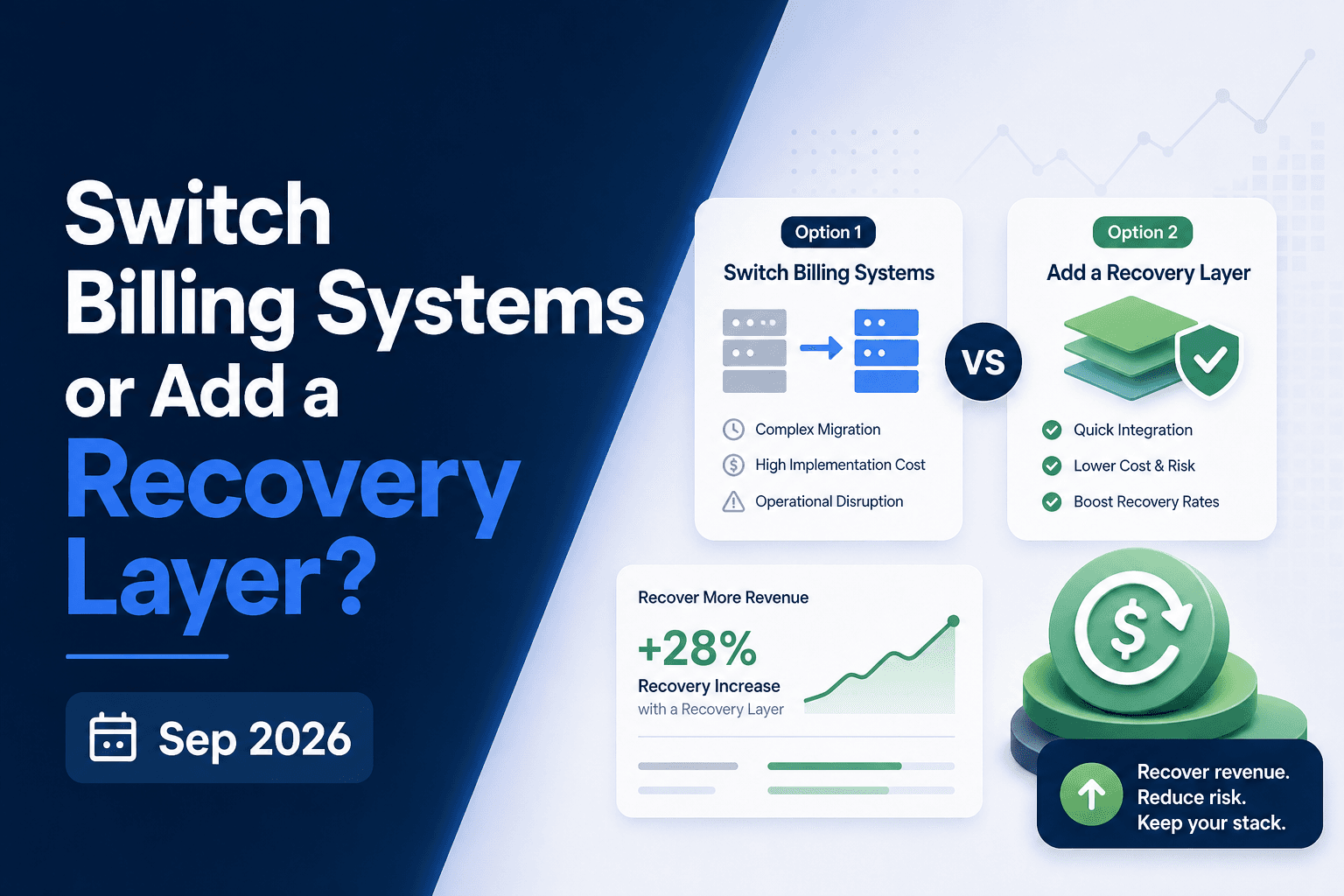
Billing Migration vs Recovery Layer: The Right Call October 2026
Switching billing systems feels like the right move when revenue collection starts breaking down. Sometimes it is. But soft declines, weak retry logic, and...
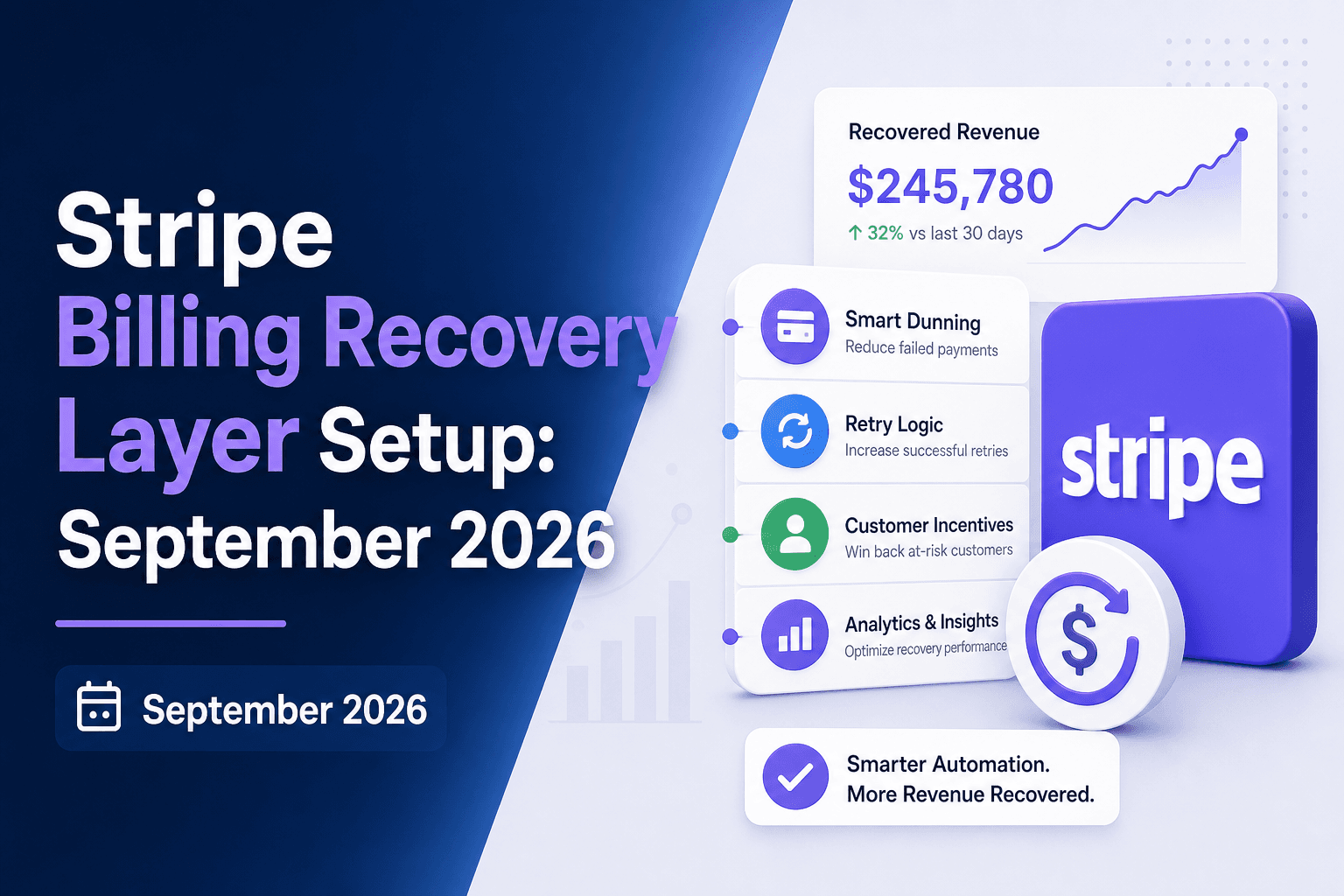
Stripe Billing Recovery Layer Setup Time: October 2026
Adding a recovery layer on top of Stripe Billing sounds like the kind of thing that goes on a quarterly roadmap and gets delayed twice. For most teams, it's...
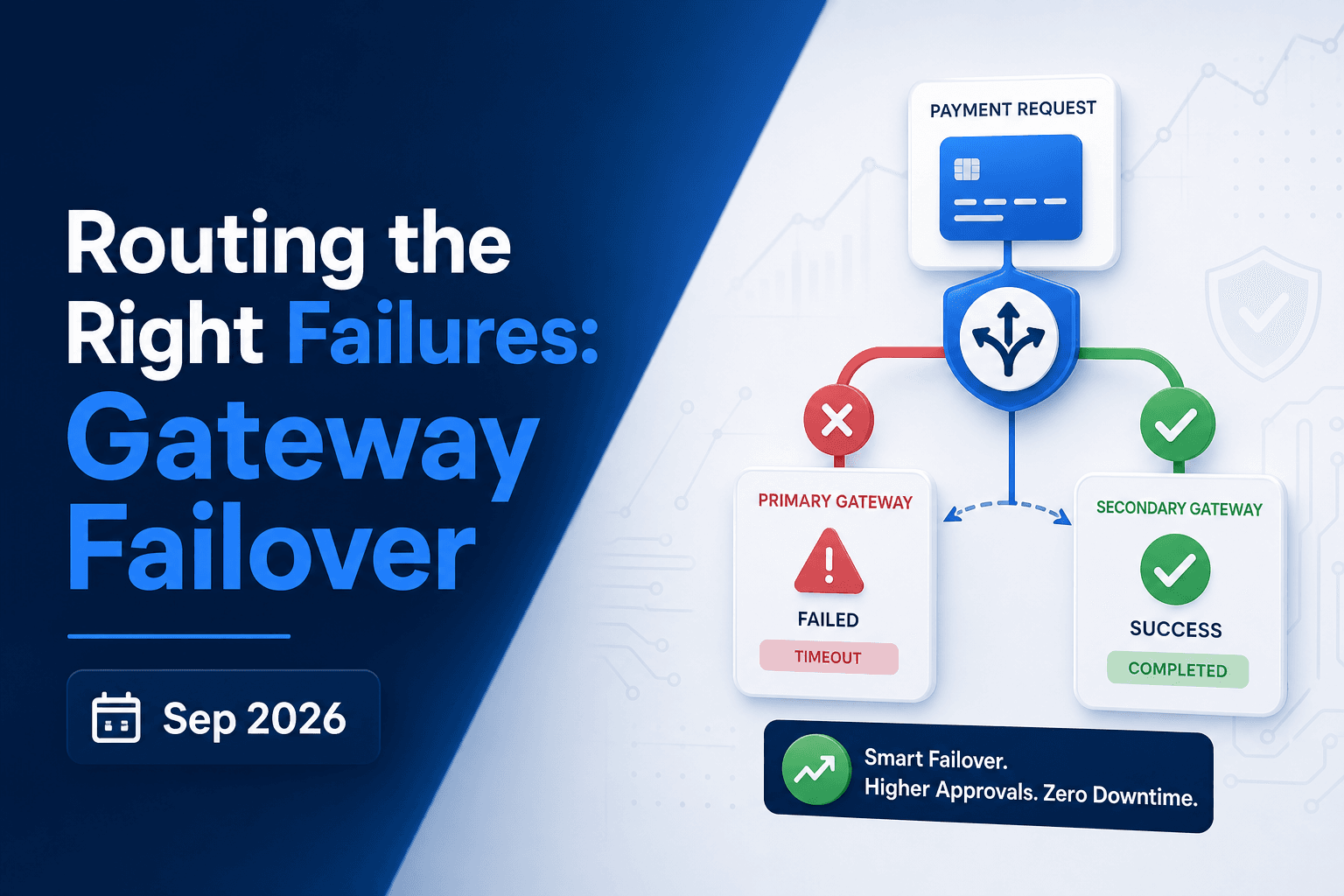
Gateway Failover: Routing the Right Failures October 2026
A gateway outage and an issuer decline look identical in your failed payment count, but they call for completely different responses. Rerouting an issuer...
Stop losing revenue to failed payments
Join leading subscription businesses using Slicker to recover failed payments automatically.
Get Started