Subscription Revenue Recovery Guide: October 2026
When was the last time you actually calculated how much revenue your business loses to failed payments before a single customer actively cancels? For most subscription businesses, that number is somewhere around 9% of annual recurring revenue (ARR), according to PYMNTS research, and most of it is sitting there waiting to be recovered. This guide covers the full picture of revenue recovery for subscription businesses: what it is, how automated retries work, when dunning takes over, how to stay compliant with card network retry rules, and how to measure performance in a way that actually reflects recovered dollars, beyond open rates or click-throughs.
TLDR:
- Failed payments cost subscription businesses roughly 9% of revenue yearly; a $10M annual recurring revenue (ARR) company loses $900,000 before a single customer chooses to cancel.
- Involuntary churn accounts for nearly half of all subscription cancellations, making failed payment recovery the largest recoverable monthly recurring revenue (MRR) leak most finance teams underestimate.
- Classifying declines correctly matters: retrying a hard decline burns attempts and signals poor merchant behavior to issuers; skipping a soft decline leaves already-earned MRR on the table.
- Visa caps retries at 15 attempts per card within 30 days; exceeding that triggers fines starting at $25 per excessive retry per Visa's published retry fee schedule, compounding fast at scale.
- Slicker runs smart retries on autopilot first, then sends hyper-personalized recovery emails from your own domain, with every result measured via clinical-grade AABB (A/B/B) testing on your own data.
What Revenue Recovery Means for Subscription Businesses
For subscription businesses, revenue recovery refers to the process of recapturing payments that failed on the first attempt, before those failures escalate into canceled accounts. When a card is declined, the customer rarely intends to cancel. The subscription continues to exist in their mind even as your billing system logs a failure. Left unaddressed, that gap between intent and payment becomes involuntary churn: revenue lost not because a customer chose to leave, but because a transaction didn't go through.
This is meaningfully different from voluntary churn. Voluntary churn requires winning back a customer who made a conscious decision. Involuntary churn requires only that you recover a payment from someone who still wants your product. The recovery math is far more favorable, which is why subscription businesses treat failed payment recovery as a direct line to protecting monthly recurring revenue (MRR).
Recovery happens in two stages. First, automated retries attempt to collect payment without any customer involvement. Second, if the payment error requires action from the customer (an expired card, for example), dunning communications step in as the fallback. The order matters: silent recovery comes first, customer outreach comes second. That sequence directly protects monthly recurring revenue (MRR) without adding friction.
The Scale of Revenue Lost to Failed Payments
Subscription businesses lose roughly 9% of revenue to failed payments each year, according to a PYMNTS payment recovery study. For a company generating $10M in annual recurring revenue (ARR), that is $900,000 walking out the door before a single customer actively decides to cancel.
The problem compounds because most of this loss is invisible. Failed payments trigger involuntary churn, where subscribers lose access not because they chose to leave, but because a transaction silently declined. Industry data suggests involuntary churn accounts for nearly half of all subscription cancellations, making it the single largest recoverable revenue leak most finance teams are underestimating.
Soft Declines vs. Hard Declines: The Classification That Shapes Every Recovery Decision
Every failed payment gets classified as either a soft decline or a hard decline, and that distinction drives every retry decision that follows.
Soft declines are temporary. The card is valid, the customer intends to pay, but something situational blocked the transaction: insufficient funds, a bank velocity limit, a network timeout. These are recoverable with soft decline smart retries timed to the customer's cash flow cycle.
Hard declines are permanent. The card is stolen, closed, or flagged for fraud. No retry will succeed. The only path forward is getting the customer to act: updating their payment method or confirming their account.
Soft Decline | Hard Decline | |
|---|---|---|
Nature | Temporary failure | Permanent rejection |
Common causes | Insufficient funds, bank velocity limit, network timeout | Stolen card, closed account, fraud flag |
Card validity | Card is valid | Card is invalid or blocked |
Recovery path | Smart retry timed to cash flow cycle | Customer must act (update payment method) |
Risk of retrying | Low: a well-timed retry often succeeds | High: wastes attempts, damages issuer standing, and can trigger fines |
Conflating the two wastes money and goodwill. Retrying a hard decline irritates your bank, burns retry attempts, and signals poor merchant behavior to issuers. Skipping a retriable soft decline means leaving already-earned MRR on the table. Getting the classification right is where recovery either compounds or collapses.
Smart Retry Strategies: Recovering Revenue Without Contacting the Customer
Automated retries are the first line of defense in failed payment recovery, and for good reason: they require zero customer interaction, create no friction, and work invisibly in the background.
The timing and logic behind each retry attempt matters far more than most billing teams realize. Retrying too soon after a soft decline often hits the same low-balance or processor-busy condition. Retrying too late loses the window when the card is most likely to succeed.
There are a few principles that separate high-performing retry logic from generic scheduled attempts:
- Retry timing should account for cardholder pay cycles. A card declined for insufficient funds on the 5th of the month may clear cleanly after the 15th, when most payday deposit retries land.
- Decline codes carry signal. A soft decline on a prepaid card calls for different retry behavior than a temporary processor timeout on a credit card.
- Frequency caps protect your relationship with the issuer. Repeated failed attempts on the same card within a short window can trigger fraud flags, making future recovery harder.
Slicker's AI models weigh these variables together, tuning smart retry schedules by issuer, card type, geography, and historical outcome data. The result is recovery that happens on autopilot, with no engineering lift required on your end.
Card Network Retry Rules and the Cost of Non-Compliance
After repeated failed payments, card networks impose retry restrictions that carry real financial consequences. Visa and Mastercard payment retry rules both cap retry attempts on declined transactions, and merchants who exceed those limits face fines starting around $25 per excessive retry and escalating with volume.
Why These Rules Exist
Networks introduced retry limits to reduce unnecessary authorization traffic and protect issuers from being flooded with requests on cards that will not approve. For subscription businesses running high transaction volumes, non-compliance can quietly accumulate into meaningful fines before anyone notices.
What the Rules Require
- Visa limits merchants to 15 retry attempts within 30 days on a declined card, after which further retries are prohibited until the next billing cycle begins.
- Mastercard limits merchants to 10 retry attempts within 24 hours on soft declines, with additional caps by decline type, and tracks excessive retries at the merchant ID level.
- Fines are assessed per transaction above the limit, meaning a large subscriber base amplifies exposure fast.
Staying compliant requires retry logic that tracks attempt counts per card, respects cooling-off periods, and distinguishes hard declines (where retrying is futile and prohibited) from soft declines (where a well-timed retry may succeed). Businesses relying on basic billing tools often lack this granularity, leaving them exposed to fines while also wasting retries on cards that will never approve.
Dunning: When Automated Recovery Is Not Enough
When automated retries exhaust their options, dunning management steps in. Dunning refers to the structured sequence of customer communications sent to recover a failed payment, typically through email, SMS, or in-app messaging.
Dunning works best when the payment failure requires direct customer action. A stolen card, an expired card, or an outdated billing detail cannot be resolved silently. The customer must intervene, and dunning is how you prompt that.
A few principles that separate effective dunning from generic "update your payment info" blasts:
- Frame every message around what the customer stands to lose, not around the mechanics of the failed charge. Customers respond to service continuity, not payment terminology.
- Personalize communications to the specific failure reason. The message for an expired card should differ from the message for a stolen card.
- Send from your own domain and brand. Recovery emails arriving from a third-party sender erode trust and reduce response rates.
- Time outreach strategically around known pay cycles, since a customer who just got paid is more likely to act.
Done right, dunning preserves the customer relationship while closing the gap that silent retry logic cannot. The goal is recovery without friction, and every touchpoint should reinforce that the subscription's value is worth keeping.
How to Measure Revenue Recovery Performance
Four metrics define a complete picture of recovery performance.
- Initial failure rate: the percentage of recurring charges that fail on first attempt, giving you a baseline for sizing the problem against involuntary churn benchmarks. Industry data puts the average soft decline rate at roughly 15% of recurring payments; anything above that range is worth auditing for card updater enrollment gaps and poorly timed retries.
- Recovery rate: the share of failed payments that eventually resolve, through retries, dunning, or both. Smart retry systems consistently recover 70-85% of soft declines; fixed retry schedules typically land between 40-60%, so this metric tells you directly how much your retry logic is leaving on the table.
- Time-to-recovery: the days between failure and resolution, where longer windows mean extended service interruptions and delayed cash flow. Keeping median time-to-recovery under 5 days preserves cash flow without over-retrying on cards that need more time to clear.
- Recovery mix: how much recovery came from silent automated retries versus customer-facing dunning outreach. A higher share of silent recoveries points to healthy retry logic; if more than half of all recoveries require customer action, your automated retry layer is likely missing soft declines that could be collected without any outreach.
Calculating incremental lift from any recovery intervention requires isolating a treatment group from a control group and measuring recovered dollars, not open rates or click-throughs.
A Structural Trap in Recovery Reporting
Invoice-level and transaction-level reporting produce different recovery counts for identical underlying performance. A single invoice with multiple failed attempts can surface as multiple recovered transactions, inflating the headline number. Without distinguishing between the two, a vendor can obscure weak results behind favorable counting conventions. Always confirm which reporting methodology your provider uses before drawing conclusions from their failed-payment analytics dashboard KPIs.
Vetting Revenue Recovery Solutions: What to Ask Before Committing
Before signing any contract with a revenue recovery vendor, the questions you ask upfront will determine whether you get a partner or a liability.
Here are the key things to pressure-test:
- How is performance actually measured? Any vendor can claim recovery improvements. Ask whether results are proven through controlled testing with statistical significance on your own data, not aggregated benchmarks from other customers.
- What does the pricing model look like? Performance-based pricing aligns incentives, but check whether fees apply to payments that would have recovered anyway without intervention.
- How does the solution handle your existing billing infrastructure? Verify that setup requires no engineering lift and works within your current stack.
- What compliance certifications are in place? Confirm SOC 2 status and understand how payment credentials are handled if the vendor is not yet PCI compliant.
- Can you exit if results disappoint? A vendor confident in their results will offer a structured pilot with clear exit terms instead of locking you into a long-term contract before proof of value is confirmed.
The right vendor proves value on your data before asking for your commitment.
How Slicker Recovers Failed Subscription Payments
Slicker takes a silent-first approach to failed payment recovery: automated smart retries fire before any customer ever sees a dunning email. An ensemble of AI models analyzes card type, issuer behavior, decline code, and billing history to pick the retry moment most likely to succeed, with no engineering lift required from your team.
When a payment does require customer action (an expired or stolen card, for instance), Slicker sends hyper-personalized recovery emails from your own domain, framed around the value the subscriber would lose, focusing on the relationship over the mechanics of the failed transaction.
Every variable is tested through clinical-grade AABB testing in payment recovery, so recovery gains are measured against your own data with statistical significance before you commit.
Final Thoughts on Stopping Involuntary Churn Before It Costs You
Failed payments are not a billing quirk. They are a measurable revenue leak that compounds quietly until someone does the math. The good news is recovery happens before most customers even realize there was a problem, as long as your retry logic and dunning sequence are set up to work together. Connect with Slicker to see what a structured recovery pilot would look like for your subscriber base.
FAQ
What is the difference between soft declines and hard declines in subscription payment recovery?
Soft declines are temporary failures where the card is valid but something situational blocked the transaction, such as insufficient funds or a network timeout; these are recoverable through well-timed smart retries. Hard declines are permanent rejections like stolen cards or closed accounts where no retry will succeed and customer action is the only path forward. Getting this classification right is the foundation of any recovery strategy, because retrying a hard decline wastes attempts, damages your standing with issuers, and can trigger card network penalties.
How do Slicker's AI-powered smart retries compare to the built-in retry logic in Stripe or Chargebee?
Billing platforms like Stripe and Chargebee use fixed, rule-based retry schedules that apply the same logic to every failed payment regardless of card type, issuer, or geography. Per Slicker's AI documentation, the retry engine weighs over 40 variables per transaction, including payday cycles by region, issuer behavior patterns, and time-of-day authorization windows, to pick the single moment most likely to succeed for that specific card. Slicker can also run alongside Stripe Smart Retries, complementing them without replacing them, with AABB testing measuring the incremental lift on your own transaction data before you commit.
How do I know if a revenue recovery vendor's performance claims are actually reliable?
Ask whether results are proven through controlled testing on your own data with statistical significance, not aggregated benchmarks from other customers. Slicker uses clinical-grade AABB testing, borrowed from crossover drug trial design, that splits your failed payments 50/50 between a control group and a treatment group and measures recovered dollars with p-values and confidence intervals. If Slicker does not outperform your existing setup with statistical significance, you do not pay.
What card network retry rules apply to subscription businesses, and what happens if you exceed them?
Visa limits merchants to 15 retry attempts within 30 days on a declined card, while Mastercard restricts retries to defined windows with caps by decline type and tracks excessive retries at the merchant ID level. Fines start around $25 per excessive retry and scale with transaction volume, meaning a large subscriber base can accumulate meaningful penalties before anyone notices. Compliant retry logic must track attempt counts per card, respect cooling-off periods, and stop immediately on hard declines where further attempts are both futile and prohibited.
When should dunning emails be sent during a subscription payment recovery sequence?
Dunning should only fire when the payment failure requires direct customer action, such as an expired card or a stolen card, where no automated retry will succeed. Silent automated retries take priority; customer outreach is the fallback, not the default. When dunning is necessary, each message should be sent from your own domain, framed around the service value the subscriber would lose, and personalized to the specific failure reason, not delivered as a generic payment-update request.
Related Articles
Stripe Billing Recovery Layer Setup Time: October 2026
Adding a recovery layer on top of Stripe Billing sounds like the kind of thing that goes on a quarterly roadmap and gets delayed twice. For most teams, it's...
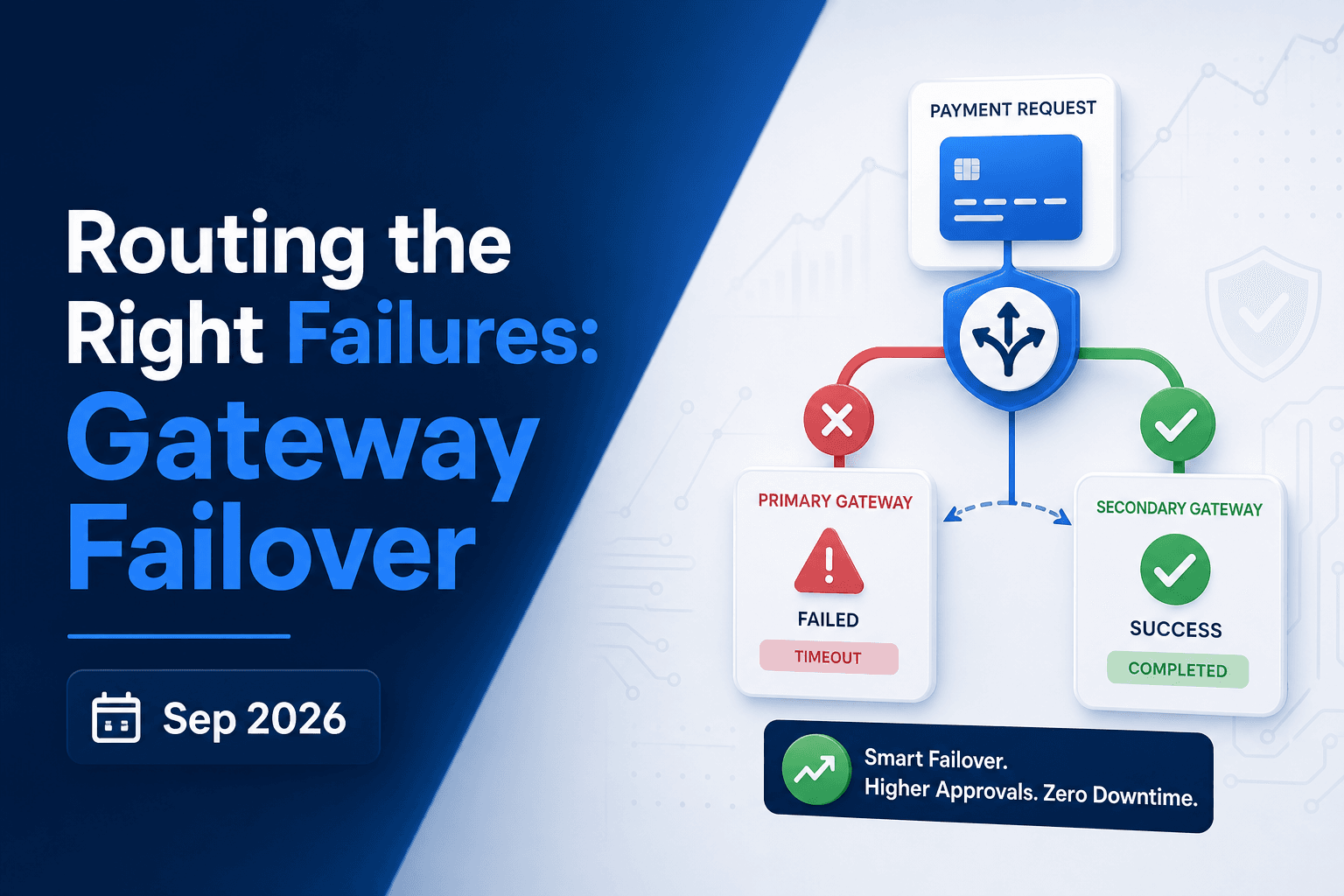
Gateway Failover: Routing the Right Failures October 2026
A gateway outage and an issuer decline look identical in your failed payment count, but they call for completely different responses. Rerouting an issuer...

Stripe Dunning Configuration Guide (September 2026)
A surprising share of the subscribers leaving your list every month never chose to cancel. Their payment failed, your retry window ran out, and Stripe...
Stop losing revenue to failed payments
Join leading subscription businesses using Slicker to recover failed payments automatically.
Get Started