Best Payment Recovery Platforms for Recurly Users in June 2026
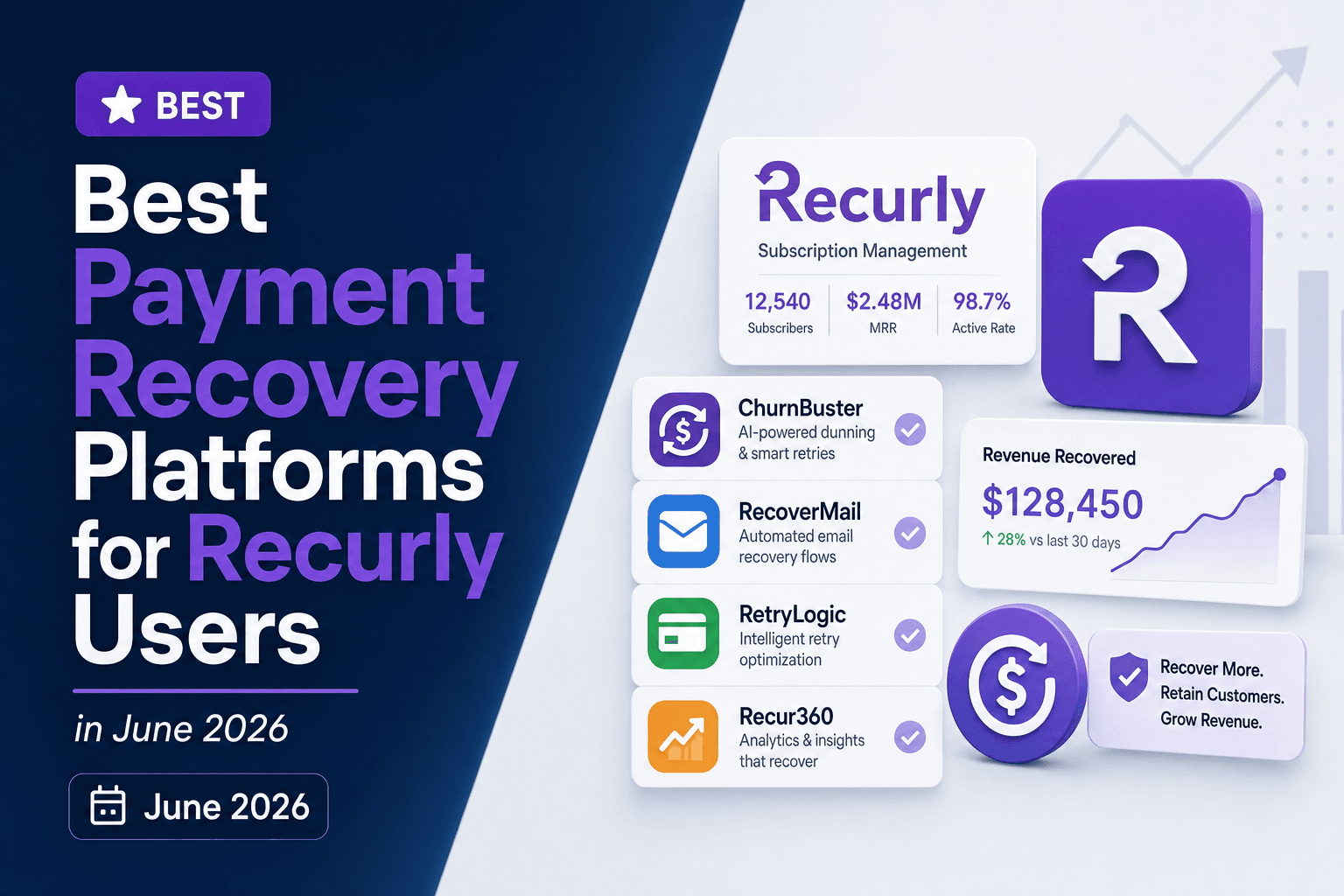
If you're using Recurly for subscription billing, you already know its dunning capabilities stop at basic scheduled retries and templated emails. When payment failures start adding up, that approach leaves real revenue on the table.
Recurly failed payments need recovery logic that accounts for issuer timing, card type, and the specific reason a charge declined, not a one-size-fits-all retry schedule. The best Recurly dunning software integrates without engineering lift, runs silent recovery first, and only surfaces customer communication when the failure genuinely requires their input. We tested the platforms that work with Recurly and ranked them on integration ease, retry intelligence, dunning personalization, and whether they can actually prove incremental recovery before you commit.
TLDR:
- Recurly's default retry logic applies fixed schedules and generic dunning, leaving recovery revenue on the table for high-volume subscription businesses.
- Most recovery tools rely on rule-based retries and lack AABB testing, so you can't verify whether gains are real or noise in your data.
- AI-powered smart retries lift recovery rates 20 to 50% by optimizing timing per issuer, card type, and decline code.
- Slicker integrates with Recurly in ~5 minutes with zero engineering lift and proves value through AABB testing before you pay.
What Is Payment Recovery for Recurly Users?
For subscription businesses running high transaction volumes, that gap costs real money: industry data shows 50% of churn stems from failed payments, and the majority of those failures are recoverable with smarter logic.
Payment recovery for Recurly users means layering smarter logic on top of what Recurly already does: retrying declined transactions at the right moment based on issuer behavior, card type, and decline code, then reaching customers with targeted messaging only when the failure actually requires their action.
How We Ranked Payment Recovery Solutions for Recurly
Not every payment recovery tool integrates cleanly with Recurly, and fewer still can prove they actually work. Here's what we weighted when ranking each option:

- Integration with Recurly: no-code setup vs. custom engineering required
- Retry intelligence: rule-based schedules vs. AI-powered timing by issuer, card type, and decline code
- Dunning personalization: generic outreach vs. failure-specific messaging tied to the actual failure reason
- Performance validation: transparent testing with statistical proof vs. unverifiable vendor claims
- Pricing structure: performance-based (pay on recovery) vs. flat fees regardless of results
- Multi-gateway support: ability to route retries across processors to lift authorization rates
These criteria reflect what matters at scale: provable revenue impact, minimal setup burden, and recovery logic that adapts to your specific transaction mix instead of applying a one-size approach across all failure types.
Best Overall Payment Recovery for Recurly Users: Slicker
Slicker is purpose-built for subscription businesses running on Recurly, and it sits in a category of its own when you stack it against the alternatives.
Where most Recurly's default dunning uses fixed schedules and generic email blasts, Slicker runs an ensemble of AI models that analyzes each failed payment individually, factoring in decline code, issuer behavior, card type, geography, and subscriber history before deciding whether to retry, when, and how. Industry data shows average transaction failure rates of 7.9%, but that baseline misses the opportunity. Slicker's AABB testing shows a 20 to 50% lift in recovery rates over standard retry logic, measured on your own traffic through clinical-grade AABB testing before you commit to anything.

Silent recovery comes first. Slicker retries soft declines silently. Dunning emails only fire when the error genuinely requires customer action, like an expired or stolen card, and those emails go out under your brand, from your domain, anchored to the specific reason the payment failed.
Setup takes about five minutes with no engineering required, and the four-month pilot starts with the first month free. You keep recovering revenue on your existing Recurly infrastructure, and Slicker proves its value in your own data before you pay full price.
Vindicia
Vindicia has been in the subscription billing space for over two decades, and its Retain product targets enterprise-level involuntary churn recovery. It works primarily through a network-based account updater and what the company calls "cognitive retry logic," which uses historical transaction data to inform retry timing.
The trade-off is scale and complexity. Vindicia is built for large enterprises, and that shows in both the pricing structure and the onboarding timeline. Smaller or mid-market subscription businesses often find the implementation overhead difficult to support.
There is also a transparency gap worth noting. Vindicia does not offer AABB testing with statistical significance before you commit, which makes it harder to verify whether recovery gains are real or noise in your data.
- Account updating through network-level card data is the core recovery mechanism, so results depend heavily on issuer relationships and data freshness.
- Retry logic is rule-based by default, with limited public documentation on how cognitive adjustments are applied across different card types, geographies, or decline codes.
- Reporting tends to be aggregate, making it harder to isolate the incremental lift attributable to Vindicia versus your baseline retry behavior.
For a Head of Payments choosing vendors on provable revenue impact, the absence of a rigorous testing methodology before contract commitment is a real constraint. You're being asked to trust the outcome instead of measuring it first on your own data.
Revaly
Revaly is a payment recovery tool built for subscription businesses, with a focus on failed payment retries and basic dunning workflows. It integrates with billing systems including Recurly via API, with setup typically taking a few hours and no dedicated onboarding engineer required. Pricing is flat-fee monthly, not performance-based, so you pay regardless of recovery results.
Where Revaly falls short is in how it proves value. Retry logic is largely rule-based, applying fixed schedules rather than optimizing timing per card type, issuer, or decline code. There is no AABB testing methodology to verify whether recovery gains are real or simply coincidental. For a CFO assessing vendors, that's a meaningful gap: you're asked to trust reported lift numbers without a controlled comparison against your own baseline.
Revaly suits smaller teams that need a straightforward dunning setup, but high-volume subscription businesses managing substantial MRR will likely outgrow it. At scale, the absence of per-transaction retry intelligence and any form of performance validation before commitment are the two gaps most likely to cost recoverable revenue.
Tools Not Compatible with Recurly: Butter and FlyCode
Two tools that appear frequently in payment recovery searches are not compatible with Recurly and are worth addressing directly to save evaluation time.
Butter is built exclusively for Shopify merchants. It works by intercepting failed subscription payments and presenting customers with an in-app recovery flow rather than a dunning email sequence. There is no Recurly connector, no API bridge, and no workaround that preserves its core recovery logic outside the Shopify ecosystem. If your subscription stack runs on Recurly, Butter is not an option.
FlyCode is an AI-powered payment recovery tool built exclusively for Stripe users. If your subscription billing runs through Recurly, FlyCode is not compatible and cannot be used in your stack. Like Butter, it surfaces in broad dunning software searches despite having no path to Recurly integration.
Both tools may be worth revisiting if you ever migrate off Recurly to their respective native platforms, but for Recurly-based billing, neither is a viable option.
Churnkey
Churnkey positions itself as a cancellation-flow and retention tool first, with dunning added as a secondary capability. For Recurly users dealing primarily with involuntary churn from failed payments, that ordering matters.
Its dunning features cover basic retry scheduling and email sequences, but the retry logic is rule-based, not AI-driven. There is no per-subscriber optimization across variables like card type, issuer, or geography, and no AABB testing to verify whether its retry rules actually outperform your current setup.
Churnkey's strength is voluntary churn: pause offers, discount flows, and exit surveys. If failed payment recovery is your primary gap, that strength does not transfer.
Feature Comparison Table of Payment Recovery Solutions for Recurly
Here is a feature comparison table of the leading payment recovery options available to Recurly users as of June 2026.
Solution | Retry Logic | Dunning Emails | AABB Testing | Recurly Integration | Setup Time |
|---|---|---|---|---|---|
Slicker | AI-powered smart retries with ensemble models | Hyper-personalized, brand-owned, failure-reason-specific | Yes, with statistical significance before commitment | Native, no-code | ~5 minutes |
Churn Buster | Rule-based retries | Templated sequences | No | Native | Low |
Recurly Built-In | Basic scheduled retries | Generic update prompts | No | Native | None |
Butter | Smart retries | Limited | No | API-based | Moderate |
FlyCode | AI retries | Minimal | No | API-based | Moderate |
The gap that matters most for finance leaders is the AABB testing column. Without it, you cannot know whether a recovery tool is outperforming your baseline or simply taking credit for payments that would have cleared anyway. Recovered dollars with no statistical proof are just an unverifiable vendor claim: that is exactly the posture Slicker is built to replace.
Why Slicker Is the Best Payment Recovery Solution for Recurly Users
Slicker was built to close the gap that Recurly leaves open: recovering failed payments that basic retry logic misses.
Where Recurly applies fixed retry schedules, Slicker runs an ensemble of AI models that analyze issuer behavior, card type, geography, and decline codes in real time to decide the optimal retry moment for each transaction individually. Slicker's AABB testing proves 20 to 50% recovery rate uplift over standard logic on your own data, with statistical significance before you pay.
Setup requires zero engineering lift and connects to Recurly in roughly five minutes. Automated silent recovery runs first; customer-facing dunning emails, sent from your domain in your brand voice, activate only when the decline genuinely requires customer action.
The 4-month pilot starts with the first month free.
Final Thoughts on Recurly Payment Recovery Tools
The right payment recovery tool for Recurly users is the one that proves its value on your own data before you pay for it. Generic retry schedules and templated dunning emails leave real revenue on the table, and the only way to know whether a recovery solution actually works is to measure it against your baseline with statistical rigor. Run the test on your traffic and see what the lift looks like when AI analyzes each failed payment individually instead of treating them all the same.
FAQ
How do payment recovery tools compare for Recurly subscriptions?
The gap comes down to proof methodology and retry intelligence. Slicker uses AI-powered smart retries with clinical-grade AABB testing that proves incremental lift on your own data before commitment. Vindicia relies on network-level account updating without pre-commitment testing. Revaly and Churnkey run rule-based retry schedules with no statistical validation. Only one vendor lets you measure the revenue difference with p-values before you pay.
What is the average improvement in failed payment rates when using AI?
In Slicker's AABB testing, AI-powered retry engines lift recovery rates 20 to 50% over standard retry logic. The range reflects differences in card type distribution (debit vs. credit), issuer geography, and baseline retry timing. Industry data suggests rule-based tools that apply fixed schedules across all decline types typically recover 15 to 25% fewer failed payments than AI engines that optimize timing per transaction.
Can I run Slicker's payment recovery alongside Recurly's built-in retry logic?
Yes. Slicker's AABB testing methodology splits your failed payments 50/50 between Recurly's existing retry logic (control group) and Slicker's AI-powered retry optimization (treatment group), then measures the incremental revenue difference with statistical significance. This proves whether Slicker outperforms your baseline before you pay full price.
What's the difference between retry intelligence and dunning emails for recovering failed Recurly payments?
Retry intelligence recovers payments silently by automatically retrying soft declines at optimal moments based on card type, issuer behavior, and decline code, without contacting the customer. Dunning emails are the fallback, sent only when the decline requires customer action (expired card, stolen card). Leading with silent recovery protects customer experience while maximizing recovery rates.
Which payment recovery tool is best for small vs. high-volume Recurly businesses?
For high-volume subscription businesses (typically >$50k MRR), Slicker delivers measurable ROI through AI-powered retry optimization and AABB-tested performance validation. Smaller businesses may find Revaly or Churnkey sufficient if basic rule-based retries and standard dunning templates meet their needs, though neither proves incremental lift through controlled testing before commitment.
Related Articles

2026 Revenue Recovery Playbook for Subscription Businesses
Failed payments are responsible for somewhere between 20 and 40% of subscription churn across the industry. Those subscribers never chose to leave. A good...
Retry Old Card or Wait for CAU? A Sep 2026 Guide
Card account updater retry logic sounds straightforward until you're staring at a mixed queue of expired cards, insufficient funds declines, and closed...

Defining Failed Payment Recovery for Subscription Businesses September 2026
Most subscription finance teams are solving the wrong problem. When a card declines and the account eventually closes, that loss lands in the churn column next...
Stop losing revenue to failed payments
Join leading subscription businesses using Slicker to recover failed payments automatically.
Get Started