Code 51 Declines: Insufficient Funds Recovery Playbook (August 2026)
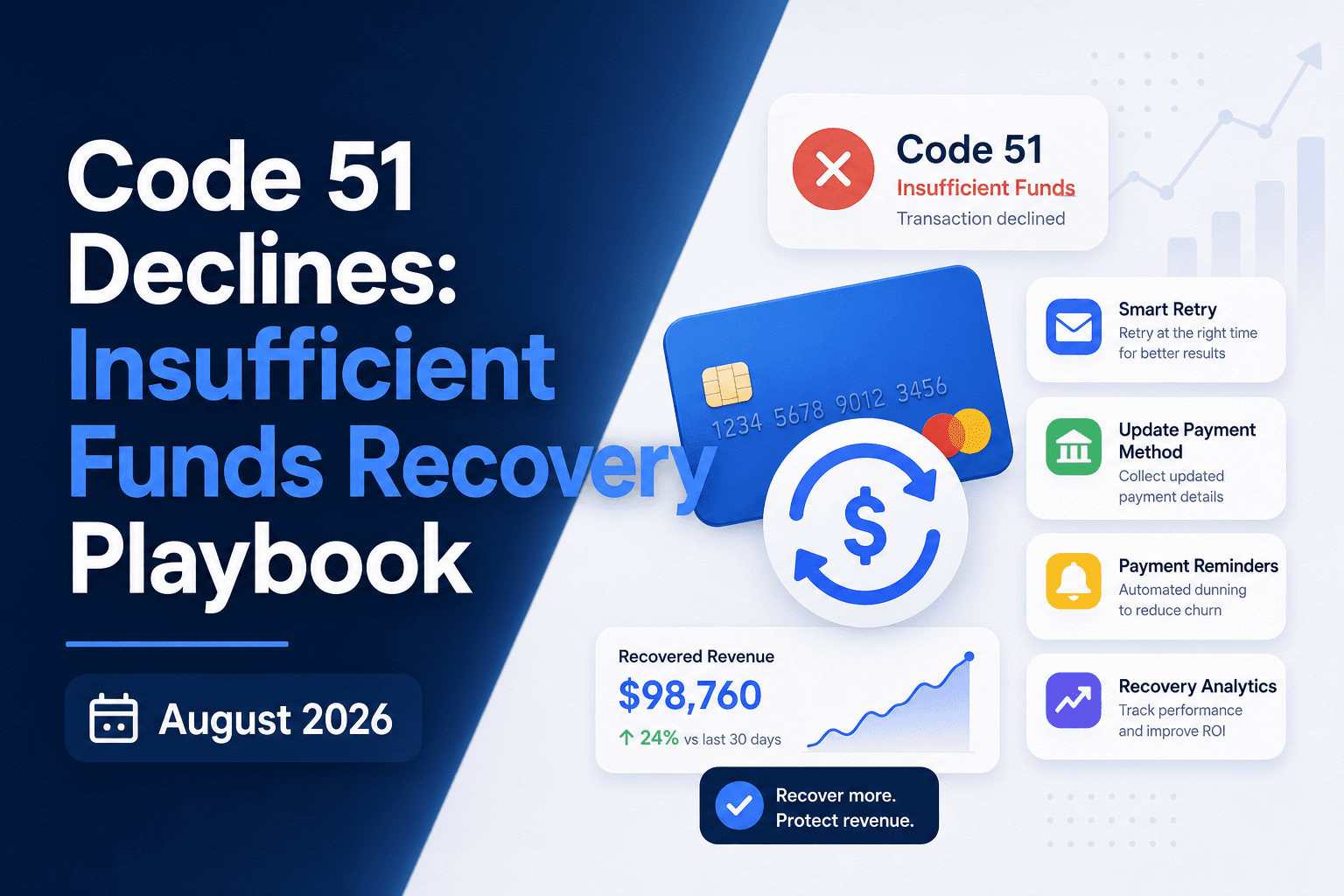
Not every failed payment means a lost customer, and code 51 is probably the clearest example of that. Your subscriber's card is fine; their balance was just low at the moment you charged. Getting that payment recovered comes down to knowing when to retry, how often you're allowed to, and what the issuer's response is actually telling you.
TLDR:
- Decline code 51 is a soft decline: the card is valid, funds are temporarily low, and a well-timed retry usually recovers the payment.
- Code 51 can fire even when a cardholder has money; pending holds reduce available balance before posted balance updates.
- Visa caps retries at 15 per 30 days; Mastercard allows 1 per day up to 10. Violations run $0.25 each and risk merchant account suspension.
- MAC codes paired with code 51 determine your next move: MAC 02 means retry later, MAC 03 means stop and move to dunning.
- Slicker times retries around geography-specific pay cycles, recovering code 51 declines silently without subscriber contact.
What Decline Code 51 Means
Decline code 51 is the issuing bank's response when a transaction exceeds what a cardholder actually has available. The signal originates at the card network and the cardholder's bank; Stripe surfaces it as insufficient_funds, which is simply the gateway's translation of that upstream message.
The code applies to debit cards with low balances, prepaid cards that have exhausted their stored value, and credit cards against their limit. One distinction matters here: available balance and posted balance often diverge. Pending transactions and temporary holds reduce available funds before they clear, so a card can return code 51 even when the posted balance looks adequate. That gap is why retrying insufficient funds declines a few days later frequently succeeds.
Why Code 51 Dominates Payment Failure Volume
Industry data shows roughly 15% of all recurring payment attempts are declined, and insufficient funds declines account for a disproportionate share of that volume. For subscription businesses, this skews even higher: prepaid cards, tight pay cycles, and billing dates misaligned with deposit schedules all stack the odds against a clean authorization. The downstream effect on passive churn recovery is measurable and material.
The timing mismatch is the core problem. Most subscription billers run charges on fixed calendar dates regardless of when their subscribers actually get paid, which means a material portion of code 51 declines are structurally predictable and preventable with smarter retry logic.
Code 51 Is a Soft Decline: Why That Distinction Is Everything
The soft/hard distinction determines what happens next. A soft decline signals that the underlying card and account are valid; the problem is temporary and will likely resolve on its own. Code 51 almost always fits this profile: the account exists, the card is active, and funds will replenish.
Hard declines are structurally different. A stolen card or closed account requires the cardholder to act on the payment instrument itself; retrying is both futile and, in some cases, penalized by card networks.
One nuance worth knowing: a small share of code 51 responses mask underlying hard declines. A permanently frozen card can return insufficient funds on the first attempt, and repeated failures over several days without recovery is usually how this reveals itself.
That classification governs every decision downstream: retry eligibility, timing strategy, and whether to contact the subscriber at all. For code 51, the answer is to retry at the right time. Customer outreach is the fallback, deployed only if automated recovery fails, because involving the subscriber when the issue will self-correct creates unnecessary friction.
Why Code 51 Appears Even When the Cardholder Has Money
Cardholders sometimes see a code 51 decline even when their account balance looks sufficient. Several factors can trigger this.
The Gap Between Available and Posted Balance
Banks distinguish between a posted balance and an available balance. Pending transactions, holds, and processing delays reduce what the issuer will authorize, even if the displayed balance appears healthy. A $200 subscription attempt can fail when $190 of a $500 balance is tied up in pending holds.
Prepaid and Debit Card Constraints
Prepaid cards and debit accounts operate with tighter real-time limits. Daily spending caps, merchant category restrictions, or partial reloads can leave an account technically solvent but functionally short for a given charge.
Timing and Billing Cycle Misalignment
Retry attempts that land before a paycheck clears or after a month-end drawdown window hit accounts at their lowest point. The card network sees insufficient funds at that moment regardless of what the cardholder earns.
Each of these scenarios produces the same code 51 response, but the recovery path differs. A pending-hold situation often resolves within 24 to 72 hours. A prepaid card shortfall may require the cardholder to reload before any retry succeeds. Billing cycle misalignment responds best to timing-aware retry logic that targets days when funds are statistically more likely to be present.
Network Retry Rules and Penalties for Code 51
Card networks impose strict retry rules on issuers and merchants after a code 51 decline, and violating them carries real financial consequences.
Visa and Mastercard both cap retries on declined transactions. The Visa and Mastercard payment retry rules differ in their caps: Visa allows a maximum of 15 retry attempts within 30 days for a given card and merchant, while Mastercard enforces a tighter limit: no more than one retry per day, up to 10 retries over 30 days. Exceed those thresholds and you risk excessive retry fees, which typically run $0.25 per violation, plus potential suspension of your merchant account. PayPal's retry compliance guide details how these fees are structured by region and decline category.
Rule | Visa | Mastercard |
|---|---|---|
Max retries per 30-day window | 15 attempts | 10 attempts |
Daily retry cap | No daily cap | 1 per day |
Fee per violation | $0.25 | $0.25 |
Penalty for repeated violations | Merchant account suspension | Merchant account suspension |
Why Networks Enforce These Limits
The rules exist to protect issuers from retry flooding. When a payment processor hammers a declined card repeatedly, it generates noise that obscures genuine fraud signals and creates unnecessary load on issuing bank systems. Networks treat aggressive retry behavior as a compliance violation, not a billing quirk.
For subscription businesses running high volumes, the math compounds quickly. A few thousand accounts hitting code 51 in a single billing cycle, each retried aggressively, can generate hundreds of violations before your team even sees the data.
The practical takeaway: spacing retries intelligently across the 30-day window keeps you compliant and preserves the attempts you actually need. Burning through your retry budget on day one leaves no runway for the timing windows where recovery is genuinely more likely.
Merchant Advice Codes That Shape Code 51 Retry Decisions
When a card issuer returns decline code 51, it often pairs that response with a Merchant Advice Code (MAC) that tells you exactly what to do next. MACs are a Mastercard construct (Visa does not publish a comparable set), so they appear on Mastercard-network transactions only. Ignoring merchant advice codes and payment recovery signals means guessing at retry logic; reading them turns a vague "insufficient funds" into a concrete action.
The MACs Most Relevant to Code 51
Not every decline code 51 carries a MAC, but when one appears, these are the codes you are most likely to see:
- MAC 01 (New account information available): The card has been replaced or the account updated. A retry without collecting new payment details will fail again, so route the subscriber to a payment update flow before any reattempt.
- MAC 02 (Try again later): The issuer is signaling a temporary shortfall. This is the green light for smart retry scheduling, ideally timed around the subscriber's next expected deposit.
- MAC 03 (Do not try again): The account is closed or permanently blocked. Retrying wastes authorization attempts, triggers a $0.10 Mastercard penalty fee per retry attempt made after receiving this code, and can damage your merchant standing. Move directly to dunning.
When No MAC Is Returned
Many issuers, particularly smaller banks and credit unions, do not attach MACs consistently. In those cases, the decline code 51 alone carries the decision weight. Your retry logic should default to treating the decline as a temporary shortfall and apply timing heuristics based on the subscriber's geography and likely pay cycle, instead of abandoning recovery entirely.
Optimal Retry Timing for Code 51 Declines by Geography
Q3 2025 data on the optimal retry cadence for soft declines shows recoverable revenue is either captured or permanently lost based on timing. Because "insufficient funds" often reflects a temporary cash-flow gap, not a fundamentally uncreditworthy account, when you retry matters as much as whether you retry.
Timing Windows by Region
Different geographies have distinct pay cycles that should anchor your retry schedule:
- US subscribers: paydays cluster around the 1st and 15th of the month, with direct deposit clearing overnight. Intelligent payday retries within 24 to 48 hours of those dates captures funds before discretionary spending depletes the account.
- UK and Western Europe: weekly pay is more common than in the US, so a shorter retry window of 5 to 7 days keeps you aligned with replenishment cycles across a broader portion of your subscriber base.
- Australia: fortnightly pay cycles are standard, so spacing retries roughly 14 days apart, timed to common payday windows, improves your odds meaningfully.
General Timing Principles
Beyond regional pay cycles, a few mechanics apply across geographies. Early-morning retries (before 9 AM local time) tend to perform better because account balances are checked before the day's spend begins. Avoiding weekends reduces failed attempts on accounts where employer deposits haven't settled yet. After three failed attempts with no recovery, the probability of success on subsequent retries drops sharply enough that continued attempts risk triggering issuer-level restrictions on your merchant ID.
How Code 51 Contributes to Involuntary Churn in Subscription Businesses
Code 51 is a soft decline, which means the card on file is still active and the account holder still intends to pay. The failure is a cash-flow timing issue, not a relationship issue. That distinction matters enormously for subscription businesses, because most of these subscribers will have sufficient funds within days. Research from GoCardless on involuntary churn estimates that up to 40% of subscription churn stems from avoidable payment failures, the majority of which are recoverable with the right retry approach.
When a renewal hits at the wrong moment and the retry logic is rigid, a paying customer silently exits the book. That is involuntary churn: revenue lost not because someone cancelled, but because the billing attempt arrived at the wrong time.
Why Fixed Retry Schedules Make It Worse
Most billing infrastructure retries on a fixed schedule regardless of decline reason, and smart retries beat fixed retry schedules for code 51 in particular. Retrying too early, before the next paycheck posts, produces another decline and increases the risk of the card issuer flagging the merchant for excessive retries.
Smart retry systems read the decline reason, cross-reference account-level signals like estimated pay cadence and historical payment patterns, and time the next attempt to land when funds are statistically more likely to be available. The soft decline retry playbook shows smart retry systems consistently recover 70 to 85% of soft declines, while fixed retry schedules typically land between 40 and 60%. For a subscription business with meaningful monthly recurring revenue (MRR), that gap represents real dollars that have already been earned.
The Merchant Playbook for Handling Code 51 Declines
When a code 51 hits, the right response depends on whether the customer has a path to resolution or not.
For soft declines where the account may simply be temporarily low, a single well-timed retry often recovers the payment without any customer contact. Timing matters: retrying within 24 to 72 hours, when a paycheck or scheduled transfer is likely to have cleared, outperforms retries fired immediately or at arbitrary intervals.
If the account shows a persistent pattern of insufficient funds, silent retries alone won't be enough. That's when targeted outreach makes sense, framed around the service value at risk, not the payment failure itself.
A few principles to guide your response:
- Reserve customer-facing communication for cases where the payment history suggests the issue won't self-resolve, keeping friction low for everyone else.
- Match retry timing to your subscriber base's pay cycle. US biweekly or semi-monthly earners and UK monthly salary recipients need different windows.
- Track recovery rate by attempt number as part of your subscription payment retry strategy. Most recoverable code 51 declines resolve on the first or second retry; a third attempt rarely changes the outcome and may trigger issuer flags.
Recovery rates for code 51 vary by subscriber mix and billing infrastructure, so your own historical baseline is the most reliable reference point, more so than any industry-wide figure.
How Slicker Recovers Code 51 Declines for Subscription Businesses
Slicker approaches code 51 differently from fixed retry schedules. Instead of retrying at arbitrary intervals, Slicker reads the issuer response, account-level signals, and timing patterns to decide whether a retry has a reasonable chance of succeeding before attempting it.
For insufficient funds declines, the recovery logic accounts for likely replenishment windows: payroll cycles, pay dates by geography, and historical account behavior. Smart payment retries aligned with paydays mean a subscriber paid biweekly in the US gets a different retry window than one on a monthly salary cycle in the UK.
Recovery happens silently, without contacting the subscriber unless the decline signals a problem that requires their action. Code 51 rarely does. Your subscriber never sees a disruption; the charge simply clears when conditions improve.
Recovery rates vary by subscriber mix and billing infrastructure, so your own historical baseline is the most reliable reference point for what to expect.
Final Thoughts on Decline Code 51 and Subscription Revenue Recovery
The gap between a code 51 decline and a recovered payment is usually measured in days, not decisions by your subscriber. Your retry timing, your awareness of regional pay cycles, and your compliance with network retry limits are what determine whether that revenue comes back. Connect with the Slicker team to see what a timing-aware recovery approach looks like for your billing setup.
FAQ
What's the best retry timing strategy for Stripe error 51 (insufficient funds) declines?
Retry timing depends on your subscriber's geography and pay cycle. US subscribers see funds clear overnight around the 1st and 15th, so retrying within 24 to 48 hours of those dates captures balances before discretionary spend depletes them. UK and Western European subscribers on monthly salaries respond better to retries within 48 hours of month-end payroll windows. Early-morning attempts before 9 AM local time outperform daytime retries because account balances are checked before the day's spend begins.
How do I know whether to retry a decline code 51 or contact the subscriber?
Retry first, silently. Decline code 51 is a soft decline, meaning the card is valid and the account will likely replenish on its own. Automated retries timed to payday windows resolve most insufficient funds declines without any subscriber involvement. Reserve customer-facing outreach for cases where the payment history shows repeated failures with no recovery, which signals a prepaid card shortfall or persistent cash-flow issue that automation alone cannot fix.
Can Slicker recover insufficient funds declines that Stripe Smart Retries misses?
Yes, and the gap is structural. Stripe Smart Retries operates on a fixed retry schedule regardless of decline reason, meaning it fires attempts at arbitrary intervals instead of timing them to the subscriber's actual pay cycle. Slicker reads the issuer response, cross-references geographic payday data, and schedules the retry for the window when funds are statistically most likely to have cleared. Industry data shows smart retry systems consistently recover 70 to 85% of soft declines, while fixed retry schedules typically land between 40 and 60%. Slicker also decouples the retry cadence from the dunning email cadence, a structural constraint in Stripe Smart Retries that increases spam risk when both fire on the same schedule.
What Merchant Advice Codes should I watch for alongside a decline code 51 response?
MACs are a Mastercard construct (Visa does not publish a comparable set), so these codes appear on Mastercard-network transactions only. The three most relevant are MAC 02 (try again later, the green light for scheduled retry), MAC 01 (account information needs updating before any retry will succeed, which means routing to a payment update flow first), and MAC 03 (do not retry, move directly to dunning; note that Mastercard charges a $0.10 penalty fee for each retry attempt made after a MAC 03 is returned). Many smaller banks and credit unions do not attach MACs consistently, so when no MAC accompanies the code 51 response, default to treating it as a temporary shortfall and apply payday-aligned timing heuristics for the subscriber's geography instead of abandoning recovery.
What are the card network retry limits for insufficient funds declines and what happens if I exceed them?
Visa caps retries at 15 attempts within 30 days per card and merchant. Mastercard allows no more than one retry per day, up to 10 retries over 30 days. Exceeding these thresholds triggers excessive retry fees, typically $0.25 per violation, and repeated violations risk merchant account suspension. For subscription businesses with thousands of code 51 declines in a single billing cycle, burning through the retry budget on early attempts with poor timing leaves no runway for the windows where recovery is genuinely more likely, compounding both the compliance risk and the revenue loss.
Related Articles

2026 Revenue Recovery Playbook for Subscription Businesses
Failed payments are responsible for somewhere between 20 and 40% of subscription churn across the industry. Those subscribers never chose to leave. A good...

Retry Old Card or Wait for CAU? A Sep 2026 Guide
Card account updater retry logic sounds straightforward until you're staring at a mixed queue of expired cards, insufficient funds declines, and closed...

Defining Failed Payment Recovery for Subscription Businesses September 2026
Most subscription finance teams are solving the wrong problem. When a card declines and the account eventually closes, that loss lands in the churn column next...
Stop losing revenue to failed payments
Join leading subscription businesses using Slicker to recover failed payments automatically.
Get Started