Top Failed Payment Recovery Tools for E-Commerce Subscriptions (May 2026 Update)
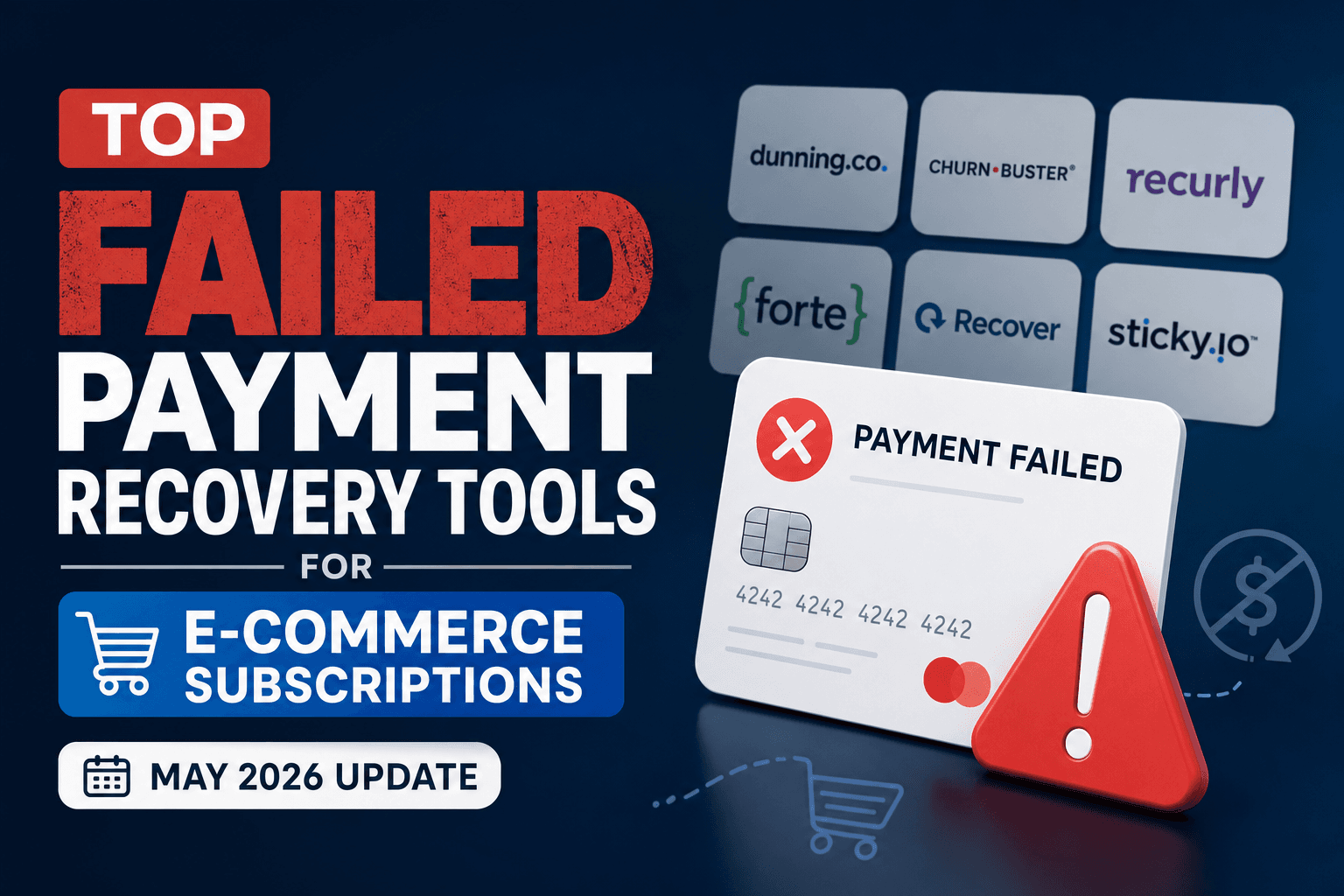
Failed payments drain roughly 9% of monthly recurring revenue, per PYMNTS research, often before finance teams spot the leak. Subscription companies could lose over $129B annually to payment failures alone. Most of those declines are soft failures that could be recovered with the right retry timing, but legacy billing tools send one retry at 24 hours and call it done. Modern Slicker and similar AI-powered tools push recovery rates from the standard 20% baseline to up to 70% by analyzing decline codes, card network signals, and issuer patterns in real time. We analyzed six solutions on measurable recovery lift, retry intelligence, dunning depth, and pricing clarity to identify which tools actually work at scale.
Key Takeaways:
- Failed payment recovery tools recover declined subscription transactions before they become churn.
- Most tools recover 20-30% of failed payments using rule-based retries on fixed schedules.
- AI-driven retry logic can recover up to 70% of failed payments by optimizing timing per transaction.
- Only one tool offers A/B testing infrastructure to prove recovery lift with statistical significance.
- Slicker uses ensemble AI models that analyze card network signals and issuer behavior to recover up to 70% of failed payments.
What Are Failed Payment Recovery Tools for E-Commerce Subscriptions?
Failed payment recovery tools are software solutions that automatically detect, retry, and recover declined subscription transactions before they result in involuntary churn. For e-commerce subscription businesses, where recurring billing is the revenue backbone, even a modest decline rate can quietly drain thousands of dollars monthly through involuntary churn.
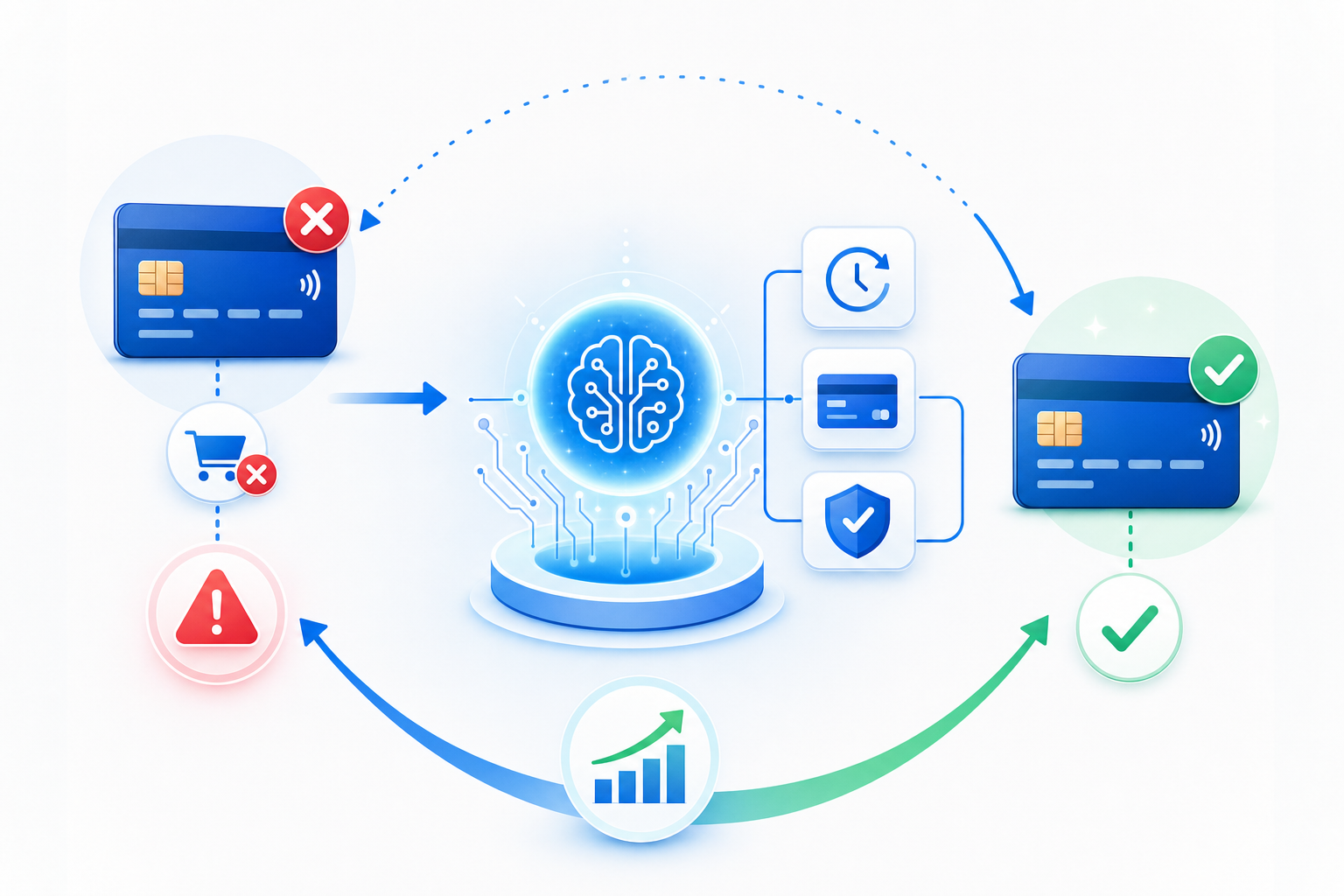
These tools combine smart retry logic, dunning workflows, and customer communication sequences to recover revenue that would otherwise be lost. No manual intervention needed; they run in the background, catching failed payments at scale.
The core problem they solve: card declines are rarely permanent. Soft declines are caused by temporary issues like insufficient funds or bank-side friction, making them recoverable with the right retry timing.
How We Evaluated Failed Payment Recovery Tools
We scored each tool across four weighted areas:
- Recovery rate improvement over baseline. We looked for documented lift above the 20–30% industry baseline for rule-based retries, focusing on verifiable case study data or independently reported outcomes rather than vendor-supplied benchmarks.
- Retry logic sophistication. Fixed schedules that apply the same timing to every decline were scored lower than tools that adapt retry windows based on decline code, card type, issuer behavior, or Merchant Advice Codes. Full AI model ensembles scored highest.
- Dunning customization depth. We assessed whether tools could personalize communication by failure reason, subscriber tenure, and subscription value — and whether emails send from the merchant's own domain or a third-party address.
- Pricing transparency and incentive alignment. Performance-based pricing tied to recovered revenue scored higher than flat-fee or opaque models. We also assessed whether vendors offered any statistical proof of lift before commitment.
Real-world performance data was weighted above vendor claims throughout. Sources included verified customer reviews on G2 and Capterra, published case studies, independent payment-industry benchmarks, and direct product testing where available. Tools were only included if they serve e-commerce subscription businesses at meaningful scale and have verifiable results on involuntary churn reduction.

Best Overall Failed Payment Recovery Tool: Slicker
Slicker is purpose-built for high-volume subscription e-commerce, and it sets the bar for what failed payment recovery should look like in 2026. Where legacy billing tools send a single retry on a fixed schedule, Slicker runs an ensemble of AI models that analyze dozens of variables per transaction, including card network signals, issuer behavior patterns, and customer payment history, to choose the optimal retry time, amount, and method.
The results speak for themselves. Slicker customers recover up to 70% of failed payments, and the average subscriber sees a 30–50% reduction in involuntary churn within the first 90 days.
What Sets Slicker Apart
- Recovery rates reach up to 70%, far above the industry baseline of 20–30% for rule-based retry logic.
- AI models retrain continuously on new decline data, so recovery performance improves over time without manual intervention.
- Slicker layers in intelligent dunning sequences alongside smart retries, so you're not sending generic reminder emails while silently failing on the payment side.
- The setup is lightweight. Most teams are live within a few days, with no engineering overhaul required.
Slicker is the strongest fit for subscription box companies and D2C brands processing high transaction volumes where even a 1% lift in recovery translates directly into meaningful recurring revenue.
Vindicia
Vindicia Retain entered the market in 2003 and was acquired by Amdocs in 2016. It combines AI-assisted recovery targeting up to 50% of failed transactions across multiple payment processors with broader subscription management capabilities.
What They Offer
- AI-assisted recovery targeting up to 50% of failed transactions
- Integration with multiple payment processors and billing systems
- Subscription management alongside payment recovery
- Self-serve performance monitoring dashboard
Good for: enterprise businesses already inside the Amdocs ecosystem, or high-volume operations that value vendor longevity over recovery precision.
Where it falls short: Vindicia lacks thorough financial reporting, making it hard to measure actual performance lift. There is no built-in A/B testing to prove incremental uplift with statistical significance, API integration creates real engineering overhead, and retry logic is rule-based rather than continuously learning.
Churnkey
Churnkey focuses on cancellation flows and pause offers instead of payment recovery itself. It helps subscription businesses reduce voluntary churn by presenting targeted retention offers when customers try to cancel. For teams dealing with failed payments, Churnkey does offer a basic dunning module, but payment recovery is secondary to its core cancellation-prevention feature set. If your primary problem is involuntary churn from declined cards, Churnkey may solve only part of the challenge.
FlyCode
FlyCode targets small to mid-size e-commerce businesses with AI-driven payment recovery built around Shopify and Stripe.
Here's what they offer:
- AI-powered dunning that combines AI models with payment logic and authorization data
- Automated retry sequences and email recovery campaigns
- Analytics for tracking payment failure patterns
FlyCode suits small DTC brands running entirely on Shopify and Stripe who need basic dunning automation without enterprise complexity. The hard ceiling is that only those two integrations are supported, ruling out multi-gateway setups, custom billing systems, and direct debits like ACH, SEPA, and BACS. Retry logic ignores network-level error codes and Merchant Advice Codes, and there is no AABB testing, so you have no statistical proof that recovery is actually improving. High-volume operations will outgrow it quickly.
Revaly
Revaly is a dunning and failed payment recovery tool built for subscription businesses. It focuses on automated retry logic and customer-facing payment update flows to recover revenue lost to involuntary churn.
What Revaly Does Well
- Revaly offers customizable retry schedules that let you adjust timing and frequency based on decline type, giving you more control than fixed-interval tools.
- Its hosted payment update pages reduce friction for customers updating expired or failed cards, which can lift self-cure rates.
- The tool integrates with major subscription billing systems, making it relatively straightforward to deploy for mid-market teams.
Where Revaly Falls Short
Revaly's retry logic relies on rule-based scheduling rather than AI models that adapt in real time to issuer behavior, card network signals, or account-level risk. For high-volume subscription operations, that gap matters. Static rules cannot respond to the kind of granular decline data that separates a 40% recovery rate from a 65% one.
Butter
Butter focuses on failed payment recovery for subscription businesses, using smart retry logic and automated dunning sequences to recover revenue that would otherwise be lost to card declines. The tool integrates with Stripe and Recurly, making it a reasonable fit for teams already on those billing stacks.
Where Butter earns its keep is in reducing passive churn from expired or declined cards. It sends automated email sequences and retries payments on a schedule designed to maximize recovery without overloading customers with requests.
That said, Butter's retry logic is largely rule-based, which limits how much it can adapt to individual card behavior or issuer patterns in real time.
Feature Comparison Table of Failed Payment Recovery Tools
Side-by-side, the gaps between tools become hard to ignore.
Feature | Slicker | Vindicia | Churnkey | FlyCode | Revaly | Butter |
|---|---|---|---|---|---|---|
AABB Testing / Statistical Proof | Yes | No | No | No | No | No |
Ensemble AI Models | Yes | No | No | No | No | No |
No-Code Integration | Yes | No | No | Yes | No | No |
Multi-Gateway Routing | Yes | Yes | No | No | Yes | No |
Payments Stay on Your Stack | Yes | Yes | Yes | Yes | No | No |
Direct Debit Support (ACH/SEPA/BACS) | Yes | Yes | No | No | Yes | No |
Hyper-Personalized Dunning | Yes | No | No | No | No | No |
Performance-Based Pricing | Yes | Yes | No | No | Yes | Yes |
Integration with Chargebee/Zuora | Yes | Yes | Yes | No | Yes | No |
The column that separates Slicker from every other tool here is AABB testing. Every competitor asks you to trust their recovery claims. Slicker proves them with statistical significance before you sign anything.
Why Slicker Is the Best Failed Payment Recovery Tool for E-Commerce Subscriptions
Slicker was built from the ground up for high-volume e-commerce subscription businesses that can't afford to lose revenue to failed payments. Where most recovery tools send a generic retry after 24 hours and hope for the best, Slicker's AI models analyze dozens of variables in real time, including decline codes, card network signals, issuer behavior patterns, and customer payment history, to determine the optimal retry window for each individual transaction.
The result is recovery rates that outperform rule-based systems by a wide margin. Slicker customers consistently see 20–50% lifts in recovered revenue compared to their previous retry logic.
What Sets Slicker Apart
Several capabilities separate Slicker from the field:
- Intelligent retry scheduling that adapts per-transaction rather than applying blanket timing rules across your entire subscriber base, so high-value customers get prioritized treatment without manual configuration.
- Decline code interpretation that goes beyond surface-level responses, reading issuer-specific signals to distinguish a temporarily frozen card from a permanently closed account.
- Dunning sequences that adjust cadence and messaging based on subscriber tenure, subscription value, and payment history, reducing cancellations driven by friction.
- A/B testing infrastructure built directly into the product, so your team can run controlled experiments on retry logic and dunning copy without engineering support.
Slicker integrates with the billing and subscription management tools e-commerce teams already use, keeping implementation time short and disruption minimal.
Final Thoughts on Recovering Failed Subscription Payments
Most subscription businesses accept 20-30% recovery rates because that's what their billing system delivers out of the box, but soft declines are far more recoverable than that baseline suggests. Slicker becomes a competitive advantage when your retry logic adapts to each transaction instead of applying blanket timing rules. High-volume operations can't afford to leave 40-50% of recoverable revenue unrecovered every month.
According to Loopwork's subscription revenue analysis, each recovered payment represents an average of seven additional months of subscription revenue, making high-performance recovery tools a direct LTV investment.
The gap between rule-based systems and intelligent ones is measurable within 90 days.
FAQ
Which failed payment recovery tool works best for small subscription businesses vs. enterprise operations?
For small to mid-size businesses running on Shopify and Stripe, FlyCode offers basic dunning automation with minimal setup. Enterprise operations processing high transaction volumes across multiple gateways need Slicker's AI-powered recovery, which handles complex billing stacks and delivers 20-50% higher recovery rates through adaptive retry logic.
How do I choose between a tool with fixed retry schedules vs. AI-driven timing?
Fixed schedules apply the same retry timing to every decline, ignoring card-specific signals and issuer behavior. AI-driven tools analyze decline codes, card network data, and customer payment history to determine optimal retry windows per transaction. If you're processing over $50k MRR, the revenue difference between these approaches typically justifies the investment in AI-powered recovery within 30-60 days.
Can I prove a payment recovery tool actually improves performance before committing?
Most vendors provide only their own performance claims without independent verification. Slicker runs AABB testing (clinical trial methodology) that splits your payment traffic 50/50 between your current solution and Slicker's AI models, then measures actual dollars recovered with statistical significance. If the test doesn't show measurable improvement, you don't pay.
What's the difference between dunning-focused tools and full payment recovery platforms?
Dunning tools like Churnkey send automated emails when payments fail but offer limited retry intelligence. Full recovery platforms combine smart retry logic, multi-gateway routing, and dunning sequences to recover payments both automatically (through optimized retries) and manually (through customer action). For subscription businesses where industry estimates put the share of soft (retryable) declines at 60-80% of total failures, dunning alone leaves significant revenue on the table — the majority of those declines can be recovered through smarter retry timing without any customer contact.
When should I switch from my billing platform's built-in payment recovery to a specialized tool?
If you're losing more than 5% of recurring revenue to involuntary churn, or if your current recovery rate sits below 40%, built-in billing tools are likely costing you money. Built-in solutions use generic retry schedules that don't adapt to card type, issuer patterns, or network-level decline signals. Specialized recovery tools with AI models typically lift recovery rates by 4-10 percentage points, which translates to $200k-$2M+ annual revenue recovery for businesses doing $4M-$50M in subscription revenue (per Slicker customer case data and benchmarks).
Related Articles
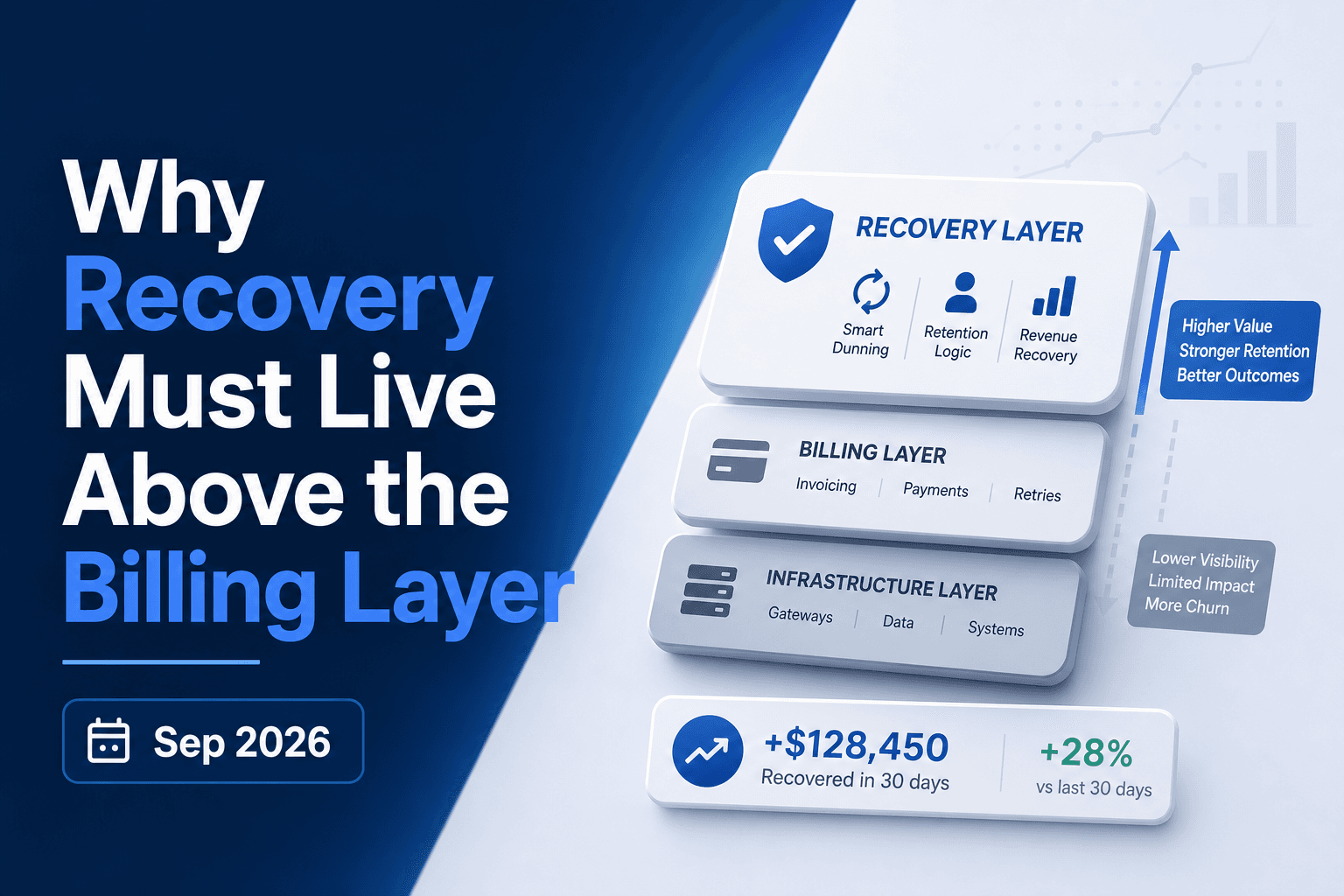
Why Payment Recovery Must Live Above Billers October 2026
A payment fails. Your biller retries it three days later, then again at seven, then at fourteen. What the biller never checks is whether the issuer sent a...
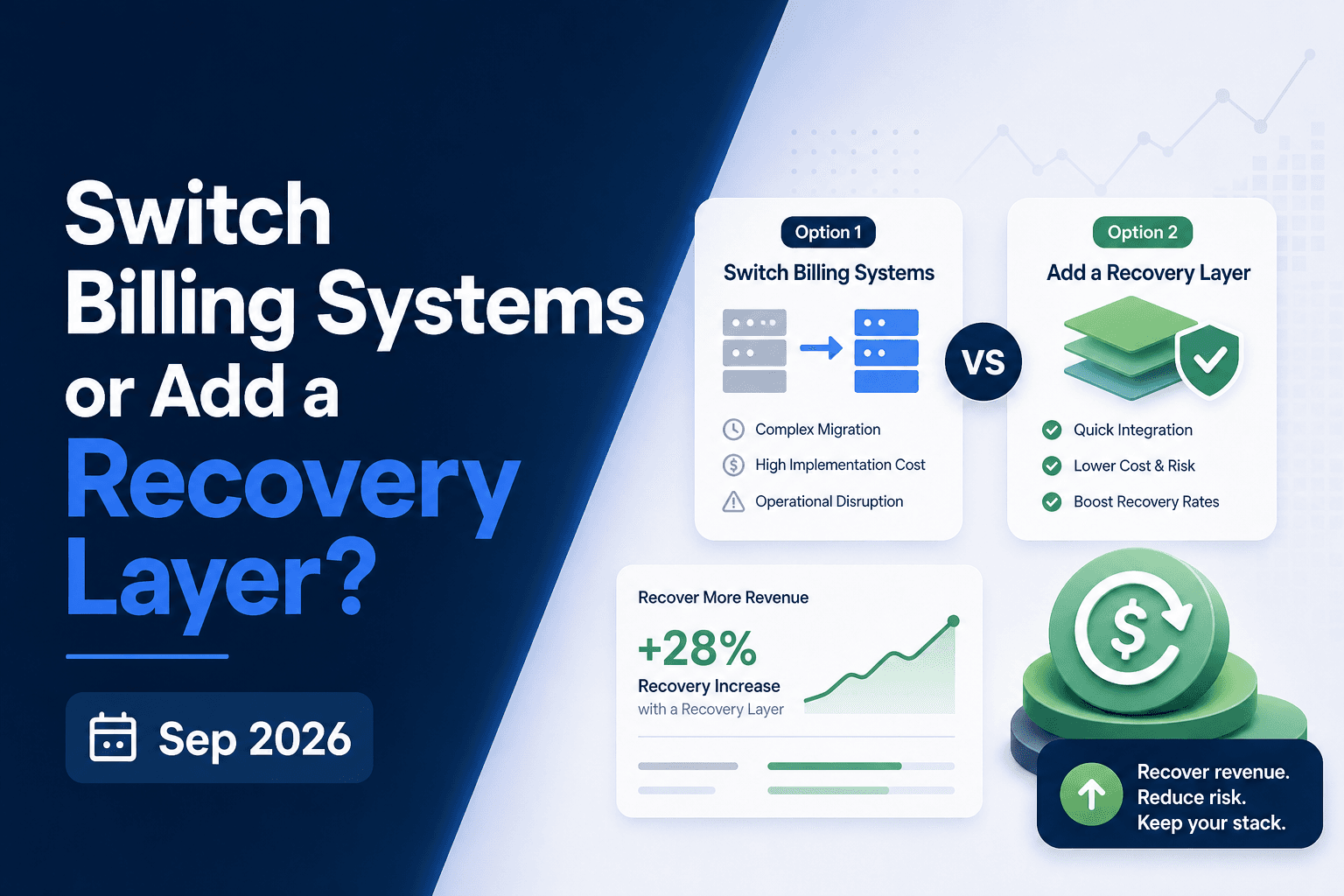
Billing Migration vs Recovery Layer: The Right Call October 2026
Switching billing systems feels like the right move when revenue collection starts breaking down. Sometimes it is. But soft declines, weak retry logic, and...
Stripe Billing Recovery Layer Setup Time: October 2026
Adding a recovery layer on top of Stripe Billing sounds like the kind of thing that goes on a quarterly roadmap and gets delayed twice. For most teams, it's...
Stop losing revenue to failed payments
Join leading subscription businesses using Slicker to recover failed payments automatically.
Get Started