Top Involuntary Churn Prevention Tools for B2B Subscription Businesses in May 2026
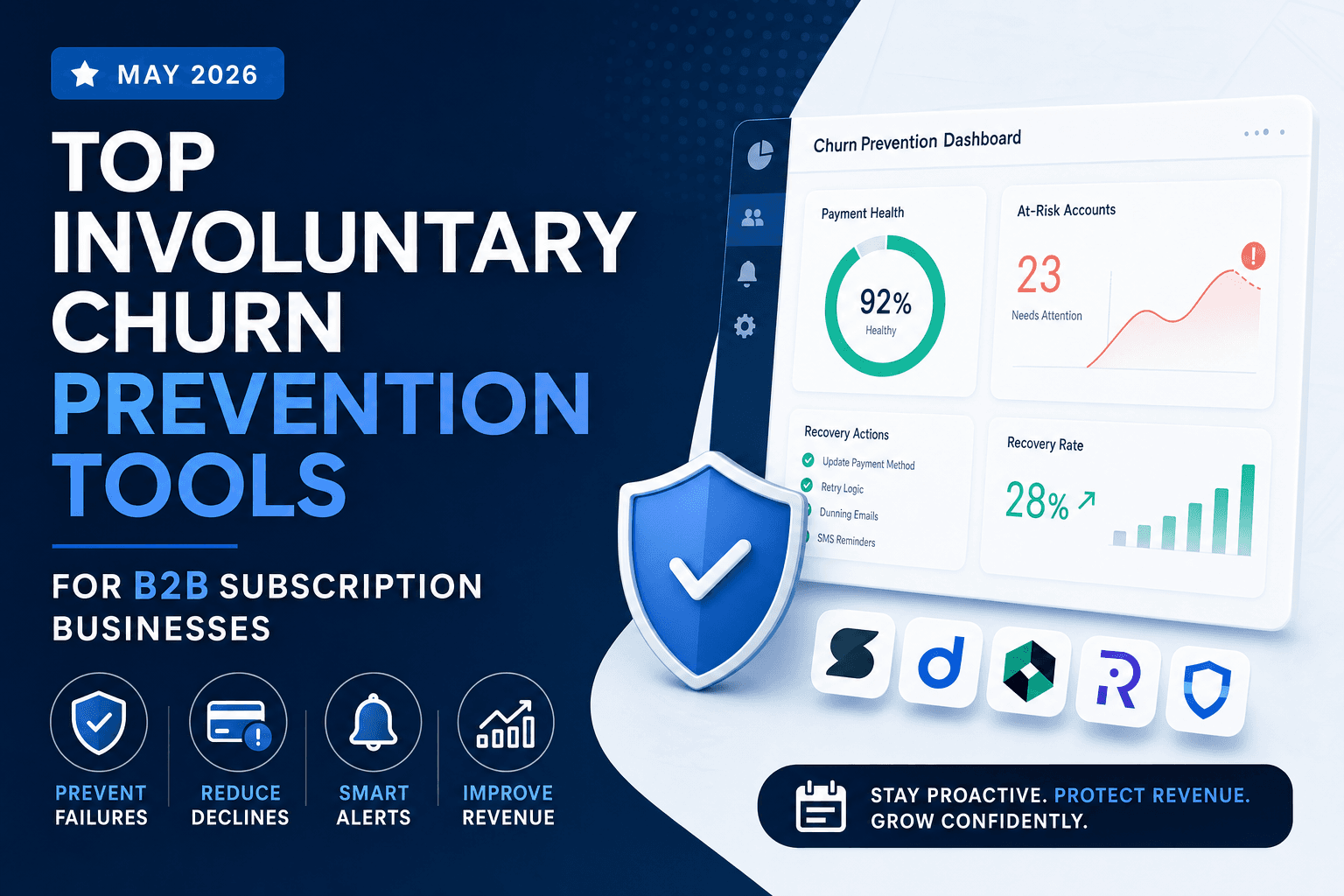
Failed payments look identical to voluntary cancellations on your dashboard, but they require completely different responses. Research shows 20-40% of all subscription churn is involuntary, and a PYMNTS survey found 9% of subscription revenue is lost to failed payments — revenue from customers who never chose to leave. When you factor in lost expansion, referrals, and renewals from those accounts, the compounding cost runs deep. Involuntary churn prevention for B2B has become competitive enough that you can now choose between tools offering 30% recovery rates with static retry logic and those delivering 40%+ recoveries using AI models that adapt to card network signals, decline codes, and account history. We ranked six options based on documented recovery performance, retry intelligence, compatibility with invoices and ACH, and how easily they connect to Stripe, Chargebee, or Zuora.
TLDR:
- Involuntary churn drives 20-40% of total churn; a PYMNTS survey found 9% of subscription revenue is lost to failed payments.
- Top tools rank by recovery rate performance, retry logic, B2B billing compatibility, and integration depth.
- AI-driven retry timing outperforms static schedules, with leading tools hitting 40%+ recovery rates.
- Slicker offers AABB testing to verify performance against your current setup before you pay.
What is Involuntary Churn Prevention for B2B Subscription Businesses?
Most billing systems log a failed payment the same way they log a cancellation: revenue gone, subscriber inactive. But involuntary churn is fundamentally recoverable. The customer never chose to leave; a card network, an issuer, or a payment timing mismatch pushed them out. That distinction changes the entire recovery approach: voluntary cancellations require product and relationship work, while involuntary churn requires payment intelligence applied at the moment of failure.
Involuntary churn drives 20-40% of total churn across subscription businesses, and a PYMNTS survey found that 9% of subscription revenue is lost to failed payments. Research shows B2B SaaS monthly churn averages 3.5%, with involuntary churn accounting for roughly 0.8 percentage points of that figure, consistent with the 20-40% share of total churn. That 0.8 percentage points sounds minor until you account for compounding over 12 months and the downstream loss of expansion revenue, referrals, and renewals from accounts that never should have churned.

Involuntary churn prevention covers the tools, processes, and logic that recover those failed payments before a customer realizes anything went wrong.
How We Ranked B2B Involuntary Churn Prevention Tools
To rank these tools, we assessed them across four criteria that matter most to finance and retention leaders at high-volume B2B subscription businesses.

- Recovery rate performance: What percentage of failed payments does the tool actually recover? AI-driven tools in this category reach 40%+ recovery rates, while static rules-based tools average around 30%. Tools performing at the higher end of that range scored highest.
- Retry logic sophistication: Does the tool use AI models that adapt to decline codes, card network signals, and account-level behavior?
- B2B billing compatibility: Can it handle invoices, ACH, multi-seat contracts, and net payment terms common in B2B contexts?
- Integration depth: How well does it connect with existing billing infrastructure like Stripe, Chargebee, or Zuora without heavy engineering lift?
Best Overall Involuntary Churn Prevention Tool: Slicker
Slicker is purpose-built for B2B subscription businesses that can't afford to lose revenue to failed payments. Where generic billing tools apply one-size-fits-all retry logic, Slicker's AI models analyze payment failure signals across your entire customer base to determine the optimal retry timing, amount, and method for each individual transaction.
What Sets Slicker Apart for B2B
B2B payment failures carry stakes that dwarf typical B2C scenarios. A single failed invoice can represent tens of thousands of dollars in annual recurring revenue. Slicker accounts for this by treating each account with the weight it deserves.
Key capabilities include:
- Intelligent retry scheduling that reads card network signals, issuer behavior patterns, and account-level history to time retries when recovery probability is highest
- Dunning sequences calibrated for B2B relationships, where preserving the customer relationship matters as much as recovering the payment
- Real-time decline code interpretation that routes each failure to the right recovery path without manual intervention
- Reporting dashboards built for finance leaders who need to track recovered revenue, recovery rates, and payment health across their book of business
Who Slicker Is Built For
Slicker fits high-volume B2B SaaS and subscription companies where involuntary churn is a recurring revenue leak, not an occasional edge case. If your team is manually chasing failed payments or relying on static retry schedules, Slicker's AI models replace that guesswork with data-driven recovery that compounds over time.
Vindicia
Vindicia has been a fixture in subscription billing since the early 2000s, and its involuntary churn recovery product, Vindicia Retain, is one of the more recognized names in the space. The tool uses account updater integrations and a rules-based retry engine to recover failed payments, with reported recovery rates hovering around 30% for most enterprise deployments.
Where Vindicia earns its keep is in regulated industries. Its compliance infrastructure is built for telco, media, and financial services companies that face strict data handling requirements. If your business operates under heavy regulatory scrutiny, that matters.
The tradeoffs are real, though. Vindicia Retain relies on static retry logic rather than AI-driven timing optimization, which means recovery rates tend to lag behind newer entrants. Implementation timelines are measured in months, not weeks, and pricing reflects an enterprise contract model that can feel mismatched for mid-market SaaS companies watching churn eat into net revenue retention.
Revaly
Revaly, formerly FlexPay, rebranded in late 2025 around a category it calls Payment Performance Management. The scope now includes pre-authorization optimization: enriching transaction data before submission and routing to authorization paths more likely to succeed, alongside the original post-decline recovery capabilities from FlexPay. Issuer partnerships give Revaly some upstream influence on authorization decisions.
The catch is infrastructure risk. Revaly frequently routes payments outside your existing billing stack, introducing third-party dependencies. There is no rigorous A/B testing against your current setup, so the actual performance delta cannot be verified with statistical certainty. For finance leaders who need auditable proof of ROI before signing a contract, that gap is disqualifying: without verified results on your own payment data, any recovery claim is a benchmark, not a proof.
Butter
Butter's AI retry models, using a Payments Score to predict success probability and an Outreach module to select the recovery channel: email, SMS, silent retry, or phone call. Integration covers Stripe, Braintree, and custom in-house billing systems, with performance-based pricing.
The limitations accumulate fast. No-code support for Chargebee or Zuora isn't available, so implementation requires engineering resources most B2B finance teams can't spare. Reporting depth is also thin relative to what a Head of Payments needs to track recovery performance across segments.
FlyCode
FlyCode is a payment recovery tool built specifically for subscription businesses, with a focus on failed payment retries and dunning automation. It targets involuntary churn by running intelligent retry logic across declined transactions, attempting to recover revenue that would otherwise be written off.
The tool integrates with Stripe and Paddle, making it accessible to SaaS companies already running on those billing stacks.
FlyCode's retry engine adjusts timing and frequency based on decline reason codes, a topic covered in depth in our guide to AI-powered retry engines.
The gaps become apparent at the B2B billing layer. FlyCode has no no-code integration with Chargebee or Zuora, which means finance teams running either platform must involve engineering to get it live — an overhead that delays time-to-value and ties up resources. There is no support for ACH, SEPA, or BACS direct debits, which cuts off a significant share of B2B payment volume where wire and bank-transfer failures are common. Reporting is also thin: FlyCode does not surface the segment-level recovery breakdowns or processor-performance comparisons that a Head of Payments needs to track performance across a B2B book of business.
It suits early-stage or mid-market B2B teams that want focused passive churn reduction without the overhead of a broader revenue recovery suite.
Churnkey
Churnkey focuses on cancellation flow optimization and win-back campaigns, making it a reasonable fit for B2B SaaS teams that want to reduce voluntary churn at the moment a customer decides to leave. Its core offering lets you build customizable offboarding flows that surface targeted offers, pauses, or discounts before a subscriber cancels.
Where Churnkey falls short for involuntary churn is meaningful. Its payment recovery features are limited compared to dedicated retry engines, and it lacks the AI-driven decline code analysis that separates passive churn tools built specifically for B2B billing complexity.
Feature Comparison Table of Involuntary Churn Prevention Tools
Not every gap shows up in a vendor pitch. Side-by-side, the differences become harder to ignore.
Feature | Slicker | Vindicia | Revaly | Butter | FlyCode | Churnkey |
|---|---|---|---|---|---|---|
AABB/Clinical-Grade Testing | Yes | No | No | No | No | No |
Ensemble AI Models | Yes | No | Yes | Yes | No | No |
Network-Level Error Analysis | Yes | No | Yes | No | No | No |
No-Code Integration | Yes | No | No | No | Yes | Yes |
Multi-Gateway Routing | Yes | No | Yes | No | No | No |
Direct Debit Support (ACH/SEPA/BACS) | Yes | Yes | Yes | No | No | No |
Dunning from Your Domain | Yes | No | No | No | Yes | Yes |
Chargebee Integration | Yes | No | No | No | No | Yes |
Zuora Integration | Yes | No | No | No | No | No |
Performance-Based Pricing | Yes | Yes | Yes | Yes | Yes | No |
External Payment Routing | No | No | Yes | Yes | No | No |
Why Slicker is the Best Involuntary Churn Prevention Tool for B2B SaaS
No other tool in this comparison asks to be tested before you pay. That's the AABB methodology: split traffic, stratified randomization, and statistical significance applied to your own payment data. If Slicker doesn't outperform your current setup with verifiable results, you owe nothing.
For CFOs and Heads of Payments who need auditable proof before signing a contract, that zero-risk entry point changes the decision entirely. AI models and performance-based pricing tied directly to recovered revenue complete the picture. Every other tool reviewed here tackles pieces of the involuntary churn problem. Slicker tackles all of it, and unlike any of them, it proves the value first.
Final Thoughts on B2B Subscription Churn Prevention
Static retry schedules were built for a world where payment failures didn't represent tens of thousands in ARR. That world doesn't exist anymore. Your involuntary churn rate compounds monthly, and generic billing tools treat every decline the same way regardless of card network signals, issuer patterns, or account history. B2B subscription churn tools that recover 40%+ of failed payments do it by adapting to your customer base in real time, testing performance before charging you, and integrating without engineering lift. The math on recovered revenue speaks louder than any sales pitch.
FAQ
Which involuntary churn prevention tool works best for mid-market B2B SaaS companies?
Slicker offers the fastest implementation path with no-code integration and performance-based pricing that scales with your business, while Vindicia suits enterprise teams with heavy compliance requirements who can absorb longer implementation timelines. For mid-market teams that need proven ROI before commitment, Slicker's AABB testing provides statistical certainty that other tools don't offer.
How do I choose between AI-driven and rules-based retry tools?
AI-driven tools like Slicker and Butter adapt retry timing based on decline codes, card network signals, and account behavior, typically recovering 40%+ of failed payments. Rules-based tools like Vindicia apply static schedules regardless of failure context, averaging 30% recovery rates. If your monthly failed payment volume exceeds $50k, the performance gap between the two approaches compounds quickly.
Can I test a recovery tool against my current billing system before switching?
Only Slicker offers AABB testing that splits traffic between your existing setup and their recovery engine, measuring statistical significance before you commit to a contract. Other vendors rely on historical benchmarks or post-deployment comparisons that can't isolate their actual performance impact on your specific payment mix.
What integrations do I need if my billing stack uses Chargebee or Zuora?
Slicker, Churnkey, and Vindicia support direct Chargebee integration, while only Slicker and Vindicia connect to Zuora without custom development. Butter and FlyCode require engineering resources to integrate with either platform, adding weeks to implementation timelines that finance teams typically can't absorb.
When should I prioritize involuntary churn recovery over voluntary retention campaigns?
If involuntary churn represents more than 0.5% of your monthly churn rate, fixing failed payments delivers faster ROI than most voluntary retention efforts. Recovery tools can be implemented in days with zero engineering lift, while voluntary churn programs require product changes, customer success resources, and months to show impact.
Related Articles
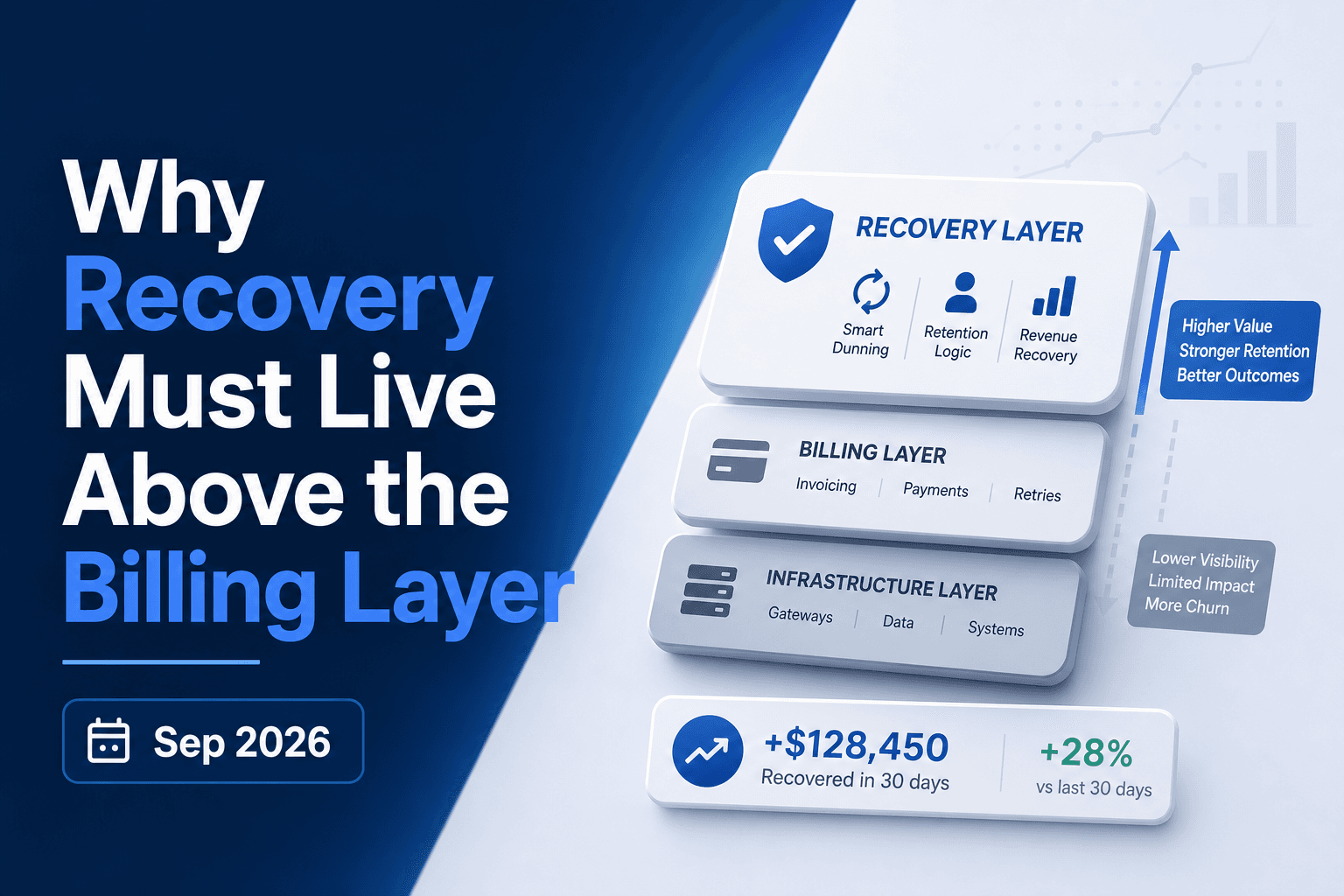
Why Payment Recovery Must Live Above Billers October 2026
A payment fails. Your biller retries it three days later, then again at seven, then at fourteen. What the biller never checks is whether the issuer sent a...
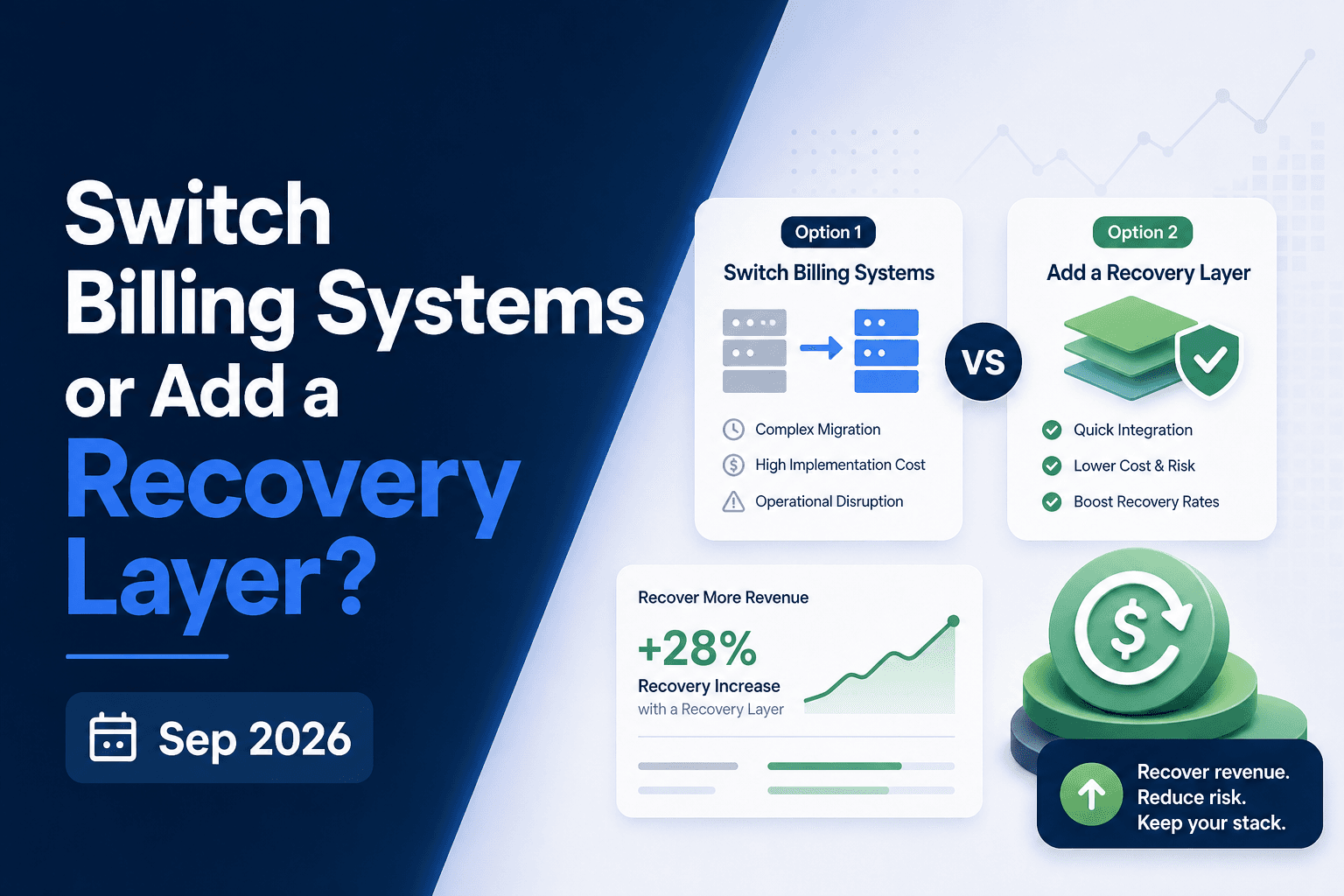
Billing Migration vs Recovery Layer: The Right Call October 2026
Switching billing systems feels like the right move when revenue collection starts breaking down. Sometimes it is. But soft declines, weak retry logic, and...
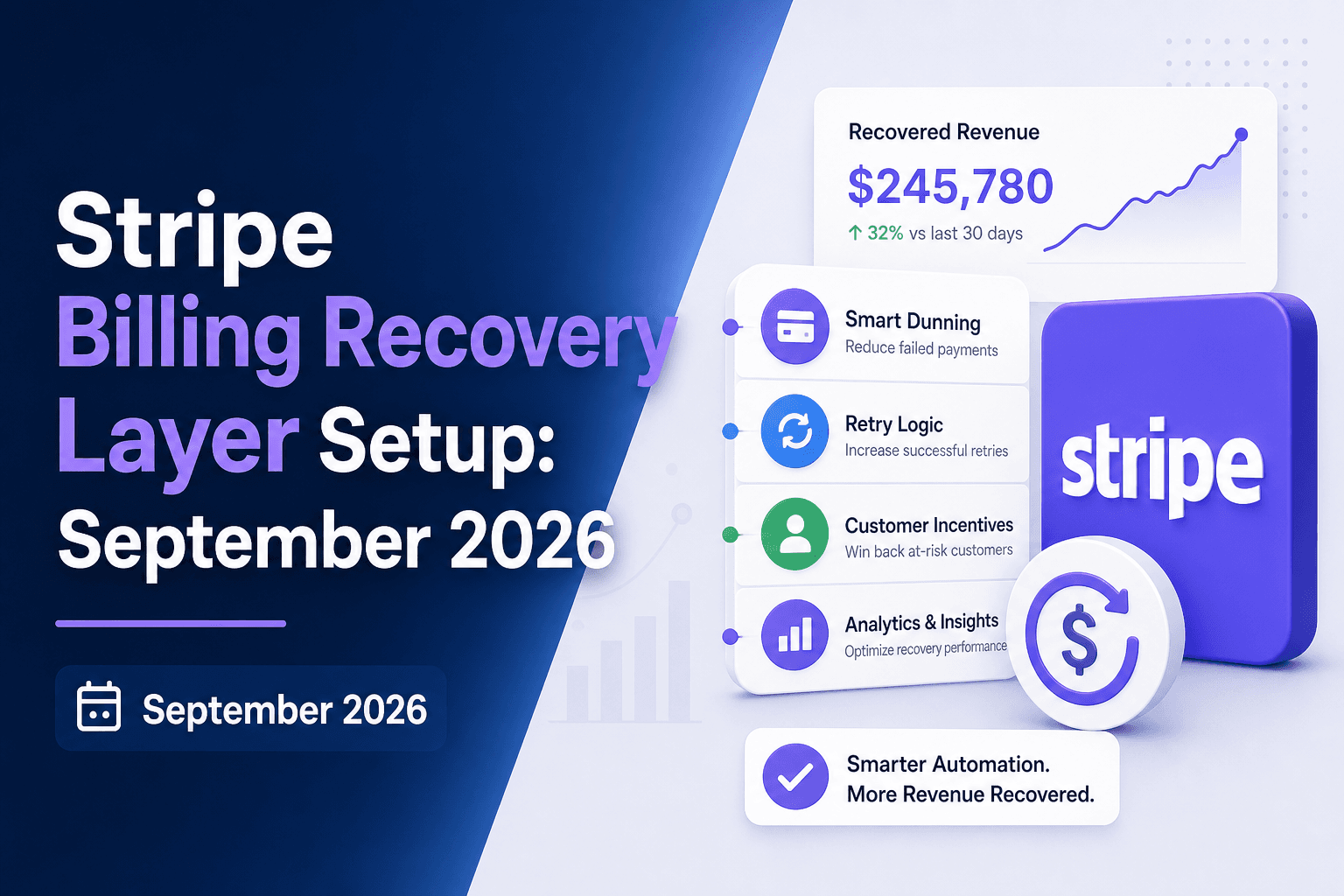
Stripe Billing Recovery Layer Setup Time: October 2026
Adding a recovery layer on top of Stripe Billing sounds like the kind of thing that goes on a quarterly roadmap and gets delayed twice. For most teams, it's...
Stop losing revenue to failed payments
Join leading subscription businesses using Slicker to recover failed payments automatically.
Get Started