Top Multi-Gateway Payment Routing Tools for Subscription Businesses (June 2026 Update)
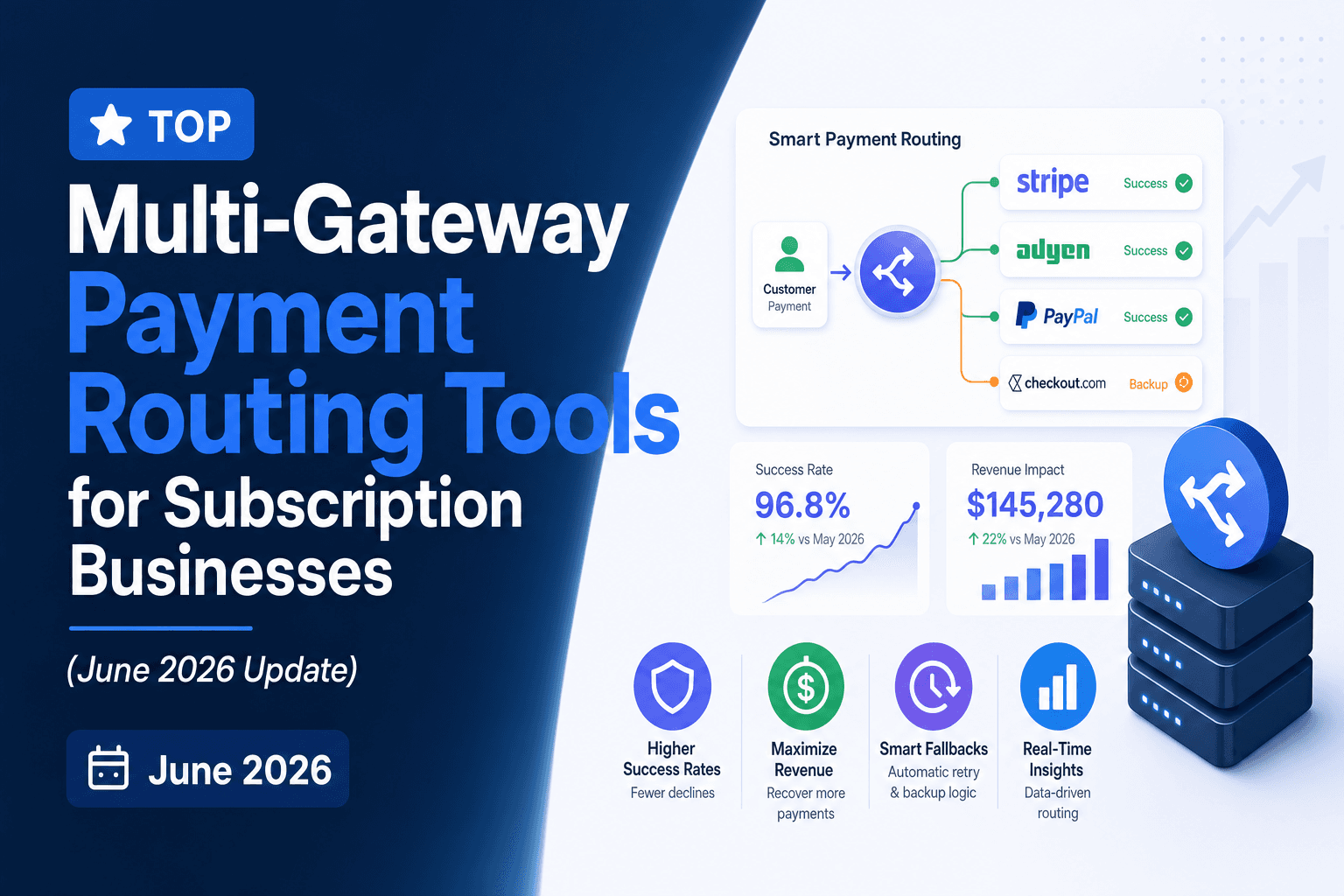
Your payment gateway works fine until it doesn't, and when 15% of recurring charges fail, the cost of sticking with a single processor adds up fast. Multi-gateway payment routing gives you a way out: your billing system picks the gateway most likely to approve each transaction based on card type, geography, and real-time decline patterns, then automatically fails over to a backup processor if the first attempt doesn't clear. For subscription businesses, that difference shows up as fewer involuntary churns and more recovered revenue without anyone on your team lifting a finger. The comparison below breaks down which tools handle gateway routing and failed payment recovery with the least friction and the most proof.
TLDR:
- Industry data shows 15% of recurring payments are declined, many recoverable with smarter routing.
- Multi-gateway routing sends each transaction to the processor most likely to approve it.
- Most tools lack AABB testing, so you can't verify recovery lift on your own data before committing.
- Slicker proves results via clinical-grade AABB testing with statistical significance and ~5-minute setup.
What Is Multi-Gateway Payment Routing for Subscription Businesses?
Multi-gateway payment routing lets subscription businesses send each transaction through the processor most likely to approve it. Instead of every charge running through a single gateway, your billing system analyzes each payment in real time and selects the optimal route based on factors like card type, issuing bank, geography, and historical decline patterns.

For subscription companies, this matters because involuntary churn (revenue lost when a valid customer's payment fails, not because they chose to cancel) is directly tied to how well your infrastructure handles declines. Industry data shows roughly 15% of recurring payments are declined, and many are soft declines that a smarter routing decision could have recovered silently, without any customer-facing friction.
The core mechanics involve three layers:
- Routing rules that assign transactions to a gateway based on real-time signals like BIN (Bank Identification Number) data, currency, and card scheme.
- Failover logic that automatically reroutes a failed charge to a secondary processor before the customer ever sees a decline.
- Retry optimization that determines when and how to re-attempt soft declines using issuer behavior patterns.
When these layers work together, the result is fewer failed payments reaching the customer, more revenue recovered on autopilot, and a measurable reduction in involuntary churn without requiring engineering effort to maintain.
How We Ranked Multi-Gateway Payment Routing Tools
Each tool was assessed using publicly available information, with criteria built around how subscription finance teams and payment managers actually make infrastructure decisions. The following factors drove the rankings.
- Integration complexity: how quickly can a non-engineering team deploy the tool against existing billing infrastructure, without requiring custom dev work?
- Multi-gateway orchestration: does the tool route intelligently across processors based on real-time signals, or only fail over reactively when a gateway goes down?
- Retry logic depth: does recovery adapt per issuer, card type, and geography, or run on static schedules regardless of context?
- Statistical validation: can the vendor prove incremental lift on your own transaction data, with methodology you can audit?
- Billing system compatibility: native support for Chargebee, Zuora, Stripe Billing, and Recurly.
- Dunning capabilities: are customer communications tied to the specific failure reason, or generic payment-update requests?
- Pricing transparency: is cost tied directly to recovered revenue, or obscured behind flat fees and tiered upsells?
Best Overall Multi-Gateway Payment Routing Tool: Slicker
Slicker is purpose-built for subscription businesses that lose revenue to failed payments. Instead of bolting retry logic onto a billing tool, it deploys an ensemble of AI models that analyzes card type, issuer behavior, geography, and decline code to decide whether to retry, when, and at what amount.
Where most tools guess, Slicker proves. Every deployment runs on clinical-grade AABB testing: your traffic splits 50/50, measured against a control group, and results are reported with a p-value. If Slicker does not beat your baseline with statistical significance, you do not pay.
Setup requires zero engineering lift and takes roughly five minutes. Slicker sits on your existing billing infrastructure, so payment credentials stay within your PCI-compliant rails throughout.
Vindicia
Vindicia has been a fixture in subscription billing for over two decades, with roots in media and entertainment. Its Retain product handles failed payment recovery through a combination of account updater services, retry logic, and customer outreach.
The tool does the basics well enough, but its retry logic is largely rule-based, not AI-driven. For subscription businesses processing high volumes, that gap matters. Rule-based retries treat every failed payment the same way, ignoring card type, issuer behavior, time of day, and subscriber history.
Vindicia's recovery rates are not independently verified through AABB testing, so there's no statistical proof of what your specific program would recover.
- Retry logic follows fixed schedules with limited personalization by decline type or subscriber profile.
- No published AABB testing methodology, making it difficult to verify incremental recovery lift on your own data.
- Built for larger enterprise contracts, with pricing and implementation timelines that reflect that.
For subscription businesses that need provable, statistically verified recovery performance instead of category-average estimates, the absence of rigorous testing is a real limitation.
FlyCode
FlyCode is an AI-powered payment recovery tool built for subscription businesses, focusing on smart retry logic and failed payment recovery.
What FlyCode Does Well
- Smart retry scheduling that adapts based on decline codes, reducing the likelihood of permanent churn from recoverable failures.
- A relatively quick integration path for teams already running on Stripe or Braintree.
- Dunning email sequences that can be configured per failure type, moving beyond generic "update your card" messaging.
Where FlyCode Falls Short
FlyCode's retry logic, while AI-assisted, operates from a single model instead of an ensemble approach. For high-volume subscription businesses, that distinction matters: a single model trained on broad data is less precise than one tuned to your specific billing patterns, issuer mix, and geography.
There is also no published methodology for how FlyCode measures its own recovery impact. Without something equivalent to AABB testing with statistical significance, you are accepting vendor-reported numbers without a way to verify them against your own baseline.
Factor | FlyCode |
|---|---|
Retry intelligence | AI-assisted, single model |
Integration | Stripe, Braintree |
Recovery measurement | No published test methodology |
Engineering lift | Low |
Dunning personalization | Failure-type configurable |
For businesses that need auditable proof of recovery uplift, the lack of a controlled testing framework leaves a meaningful gap.
Revaly
Revaly positions itself as a failed payment recovery tool built for subscription businesses, with a focus on smart retry logic and basic dunning sequences. It connects to billing systems like Stripe and Recurly to intercept declined transactions and attempt recovery through scheduled retries.
Where Revaly falls short is depth. Its retry logic follows rule-based schedules instead of AI-driven decision-making, which means it applies the same retry cadence across different card types, issuers, and decline reasons. For high-volume subscription businesses, that one-size approach leaves recoverable revenue on the table.
Revaly also lacks AABB testing, so you cannot verify whether its retry logic actually outperforms your baseline before committing.
Butter
Butter focuses on failed payment recovery for subscription businesses, with particular strength in customer-facing dunning flows. It offers smart retries and branded email sequences designed to re-engage subscribers before they churn involuntarily.
Where Butter stands out is in its email customization layer. Teams can tailor messaging by decline reason, giving customers relevant context instead of a generic "update your payment info" prompt. That specificity tends to improve conversion on customer-action-required failures like expired or stolen cards.
That said, Butter's retry logic is less configurable than tools built for multi-gateway routing, and it lacks multi-gateway support. For subscription businesses routing volume across several gateways to reduce decline rates, Butter covers only part of the recovery picture.
Feature Comparison Table of Multi-Gateway Payment Routing Tools
Here is a side-by-side look at how each tool performs across the criteria that matter most for subscription payment recovery.
Feature | Slicker | Vindicia | FlyCode | Revaly | Butter |
|---|---|---|---|---|---|
AABB Testing with Statistical Validation | Yes | No | No | No | No |
No-Code Integration (5-Minute Setup) | Yes | No | Yes | No | No |
Multi-Gateway Routing Intelligence | Yes | No | No | Yes | Yes |
Works on Existing Payment Infrastructure | Yes | Yes | Yes | No | No |
AI-Powered Retry Timing | Yes | Yes | Yes | Yes | Yes |
Zuora No-Code Integration | Yes | No | No | No | No |
Multi-Payment-Method Orchestration | Yes | No | No | No | No |
Performance-Based Pricing | Yes | Yes | Yes | Yes | Yes |
Zero Engineering Lift Required | Yes | No | No | No | No |
Transparent ROI Proof Before Commitment | Yes | No | No | No | No |
A few rows here tell the whole story. Every tool in this list offers AI-powered retry timing in some form, and most tie pricing to performance. The real differentiators are the rows where Slicker stands alone: AABB testing with statistical validation, zero engineering lift, and transparent ROI proof before any commitment. Those three features reflect a fundamentally different bar for accountability.
Why Slicker Is the Best Multi-Gateway Payment Routing Tool
Slicker is purpose-built for subscription businesses that lose revenue to failed payments, and it stands apart from generic routing tools through one core principle: every decision is proven on your own data before you commit.
Most multi-gateway routing setups reduce failed payment recovery to a timing question. Slicker treats it as a statistical problem. Its ensemble of AI models analyzes variables across geography, issuer behavior, card type, and decline code to decide whether to retry, which gateway to route through, and when. Across Slicker client deployments, recovery rate lifts of 20 to 50% have been measured through clinical-grade AABB testing with statistical significance on each customer's own transaction data, not estimated from aggregate benchmarks.

Setup requires zero engineering lift and takes roughly five minutes. Slicker runs on your existing billing infrastructure, so payment credentials stay inside your PCI-compliant stack. The company has achieved SOC 2 Type 2 compliance.
The result: involuntary churn drops, MRR you already earned stops walking out the door, and the proof lives in your own revenue data.
Final Thoughts on Payment Gateway Optimization for Subscriptions
Payment gateway optimization for subscriptions isn't about routing every transaction through the cheapest processor or hoping retry schedules work themselves out over time. It's about treating each failed payment as a statistical problem with a provable solution. You already earned that revenue, the customer already said yes, and the difference between recovering it or losing it comes down to whether your routing logic adapts to card type, issuer behavior, and geography in real time. Reach out if you want to see what AABB-tested recovery looks like on your own billing data before making any commitment.
FAQ
How does AI reduce failed payment rates in subscription billing?
AI models analyze card type, issuer behavior, geography, and decline code to decide whether to retry, when, and through which gateway. In Slicker client deployments, AABB testing on each customer's own transaction data has shown recovery rate lifts that vary based on existing infrastructure, decline mix, and issuer profile.
What's the best way to retry failed payments automatically without engineering work?
Multi-gateway routing tools like Slicker sit on your existing billing infrastructure and handle retry logic on autopilot. Setup takes roughly five minutes with zero engineering lift, and the system routes transactions through the processor most likely to approve each charge based on real-time signals.
Can payment routing tools work alongside my billing system's built-in retry features?
Yes. Payment recovery tools operate on your existing billing infrastructure and run alongside native retry logic from platforms like Stripe Billing or Chargebee. AABB testing splits your failed payments 50/50 to measure incremental lift: half recover through your current system (control group), half through AI models (treatment group), with results reported as a p-value so you verify exact uplift on your own data.
What transaction volume makes multi-gateway payment routing worth the investment?
For subscription businesses processing above $50k MRR with involuntary churn rates in the 5 to 10% range, performance-based pricing typically pays off: a 20 to 50% recovery-rate uplift on failed payments translates to hundreds of thousands in annual recovered revenue. Below that threshold, ROI depends on your specific decline patterns and subscriber lifetime value.
Related Articles

2026 Revenue Recovery Playbook for Subscription Businesses
Failed payments are responsible for somewhere between 20 and 40% of subscription churn across the industry. Those subscribers never chose to leave. A good...
Retry Old Card or Wait for CAU? A Sep 2026 Guide
Card account updater retry logic sounds straightforward until you're staring at a mixed queue of expired cards, insufficient funds declines, and closed...

Defining Failed Payment Recovery for Subscription Businesses September 2026
Most subscription finance teams are solving the wrong problem. When a card declines and the account eventually closes, that loss lands in the churn column next...
Stop losing revenue to failed payments
Join leading subscription businesses using Slicker to recover failed payments automatically.
Get Started