Smart Automatic Payment Retry Best Practices for Subscription Businesses in June 2026
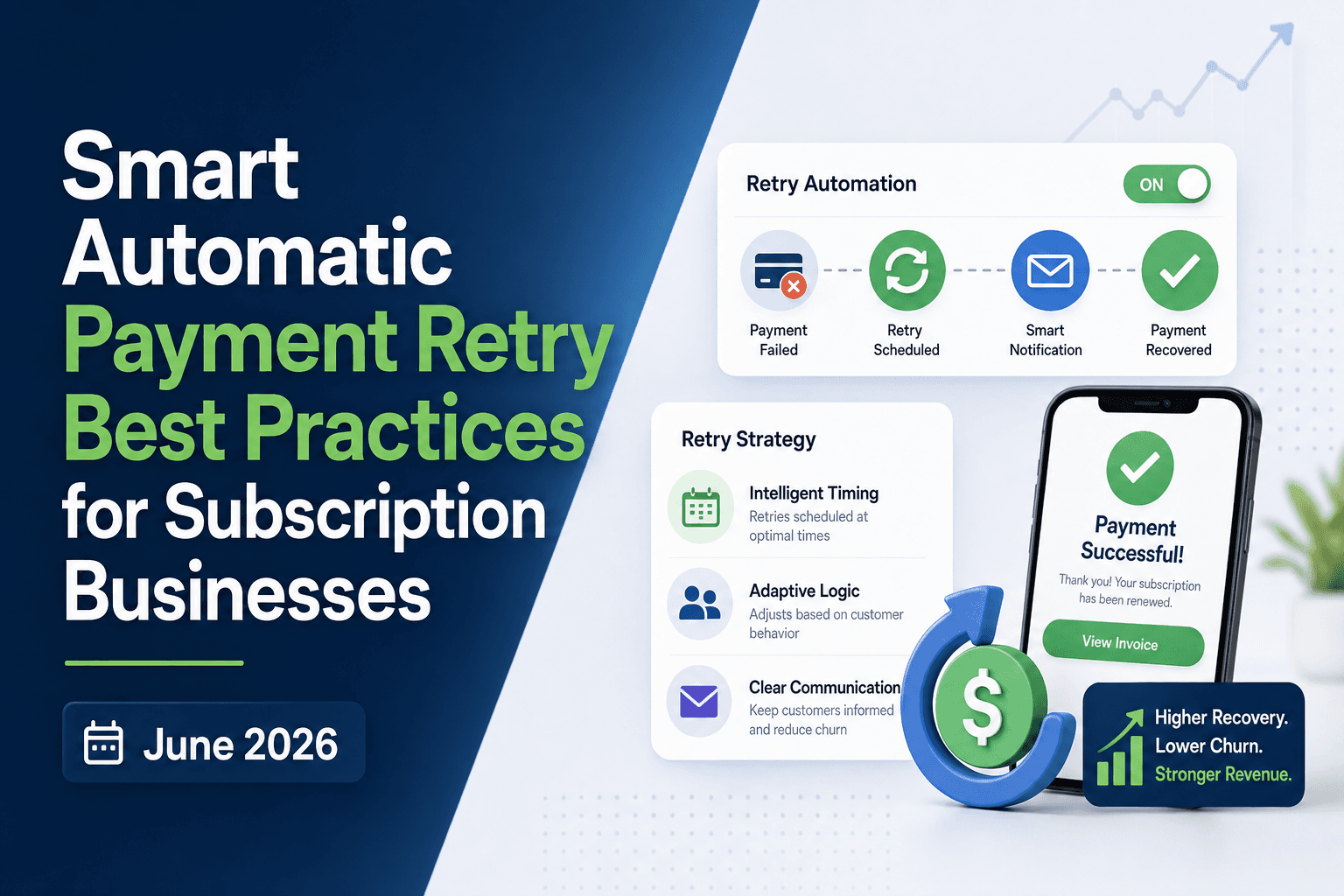
Most subscription businesses lose 15% of their recurring revenue to payment declines, and the majority of that is recoverable if you retry at the right time with the right logic. The default approach treats all failures identically: retry in three days, retry again a week later, then escalate to customer communication and accept the churn. That leaves real money on the table because soft declines caused by insufficient funds will clear after payday, but only if your retry strategy knows when payday happens for your customer base. Hard declines tied to stolen or expired cards will never resolve on retry, so every attempt you waste on them is one you could have spent on a recoverable transaction. Automatic payment retry best practices in 2026 come down to classification, timing, and compliance: reading decline codes to separate retryable failures from permanent blocks, layering geographic payday windows into your retry schedule, and staying inside card network attempt limits so penalty fees don't erase the revenue you recover. Here's the retry strategy framework subscription businesses are using to lift recovery rates without engineering lift or customer friction.
TLDR:
- Industry data shows 15% of recurring payments decline at any given time, mostly soft declines that resolve with smart retries.
- Visa caps retry attempts at 15 per card in 30 days; Mastercard allows 10. Exceeding limits triggers penalty fees.
- Align retry timing to regional pay cycles (US 1st/15th, Western Europe month-end, Russia 5th/20th, Australia Thursdays).
- Smart retry logic that reads decline codes, issuer behavior, and payday patterns drives measurable recovery rate uplift over fixed schedules.
- Slicker's ensemble of AI models analyzes card type, issuer behavior, and decline codes to decide retry timing, validated through AABB testing before you commit.
Why Failed Payments Happen in Subscription Businesses
Subscription payment failures fall into two categories: soft declines and hard declines. Soft declines are temporary, often caused by insufficient funds, issuer-side friction, or network timeouts, and they frequently resolve on retry. Hard declines signal a permanent block: a stolen card, a closed account, or an expired credential that the customer must update themselves.
Industry data shows 15% of payments decline at any given time. Most of that is soft decline territory, which means a well-timed retry recovers real revenue with zero customer involvement required.
Hard Declines vs. Soft Declines: How to Classify Retryable Failures
Not every failed payment deserves a retry. Retrying the wrong decline codes wastes retry attempts, risks merchant ID (MID) flagging, and can permanently damage your processor relationship.
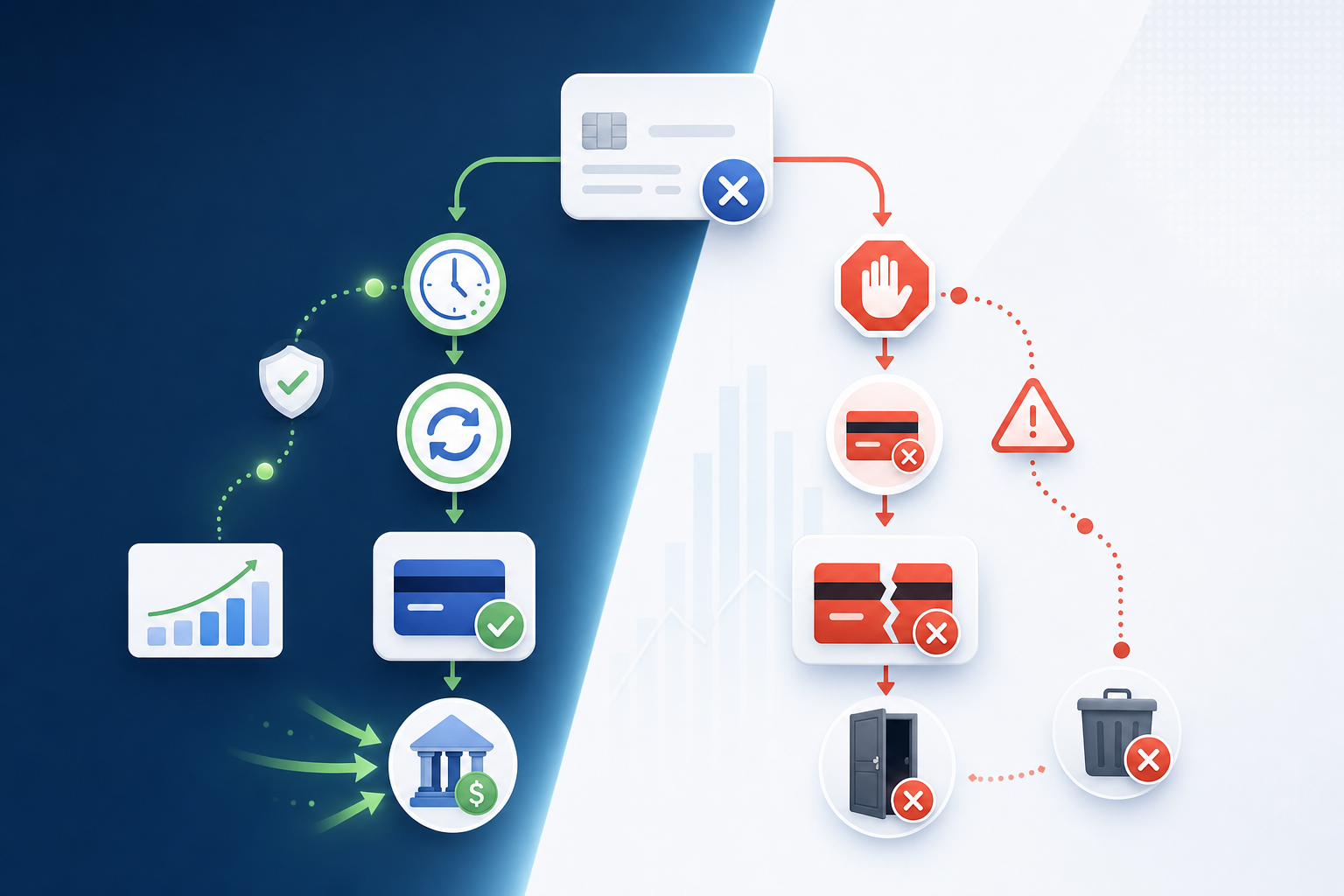
Soft Declines: Retry These
Soft declines are temporary authorization failures where the underlying issue may resolve on its own. Common causes include insufficient funds, temporary bank holds, or network timeouts.
- Insufficient funds (code 51): retry after a few days, ideally around the customer's payday window
- Do not retry (code 05): often misclassified as soft; always check issuer context before retrying
- Temporary unavailability (code 91): retry within hours, as these are typically processor-side outages
Hard Declines: Stop Immediately
Hard declines signal a permanent issue. Retrying them burns goodwill and flags your MID for excessive retries.
- Stolen and lost card codes: stop all retries and route to dunning that prompts the customer to add a new payment method
- Invalid account (code 62): the card number no longer exists; no retry will succeed
Getting this classification right is the foundation of any sound retry strategy. Every retry wasted on a hard decline is one that could have gone toward a recoverable soft decline, protecting both your recovery rate and your processor standing.
Understanding Merchant Advice Codes and When to Retry
Merchant Advice Codes (MACs) are standardized codes that card networks send back with declined transactions to tell you exactly why a payment failed and whether retrying makes sense.
Not every decline is the same. A soft decline on insufficient funds is worth retrying after a payday window. A hard decline on a stolen card is not; retrying wastes attempts and risks triggering fraud flags.
Card Network Retry Limits and Penalty Fees
Exceeding card network retry limits is one of the fastest ways to trigger penalty fees and MID (merchant ID) termination. Visa and Mastercard both cap retry attempts on declined transactions, and violations carry fines that compound quickly at high transaction volumes.
Retry Limits by Network
The major networks each set their own rules:
- Visa limits merchants to 15 retry attempts within 30 days for a given card and amount.
- Mastercard caps retries at 10 attempts per 30-day period, with stricter rules for certain decline codes.
- Exceeding these thresholds can result in per-transaction fines and escalating scrutiny from your acquirer.
Compliance requires tracking retries at the card level across your entire customer base, not merely subscription-level counts.
Optimal Retry Timing: Payday Patterns and Geographic Considerations
Retry timing is one of the most overlooked levers in a payment recovery strategy, yet it has an outsized effect on success rates. Retrying at the wrong moment, say, mid-month when a customer's account is running low, virtually guarantees another decline.

Geographic Payday Windows by Region
Different markets have distinct pay cycles that your retry logic should respect:
- US: Retry on the 1st and 15th, or the Friday before when those dates fall on a weekend, since most salaried employees receive deposits within 24 hours of payroll processing.
- Western Europe: Retry at the end of the calendar month, typically the 25th through the last day, when monthly salary transfers clear across most EU banking systems.
- Australia: Retry on Thursdays, as weekly pay cycles are widespread and Thursday is the most common deposit day.
Layering regional payday timing onto your retry schedule means you are retrying when funds are most likely present, independent of when your billing cycle fires.
Region | Primary Payday Window | Optimal Retry Days | Weekend Adjustment Rule |
|---|---|---|---|
United States | Bi-monthly on 1st and 15th of each month | Retry on the 1st and 15th, targeting the day deposits clear | When payday falls on weekend, retry the Friday before since deposits process within 24 hours of payroll |
Western Europe | Monthly salary transfers at end of calendar month | Retry between 25th and last day of month when transfers clear across EU banking systems | Month-end deposits typically process regardless of weekend timing across most EU banks |
Australia | Weekly pay cycles common across workforce | Retry on Thursdays when weekly deposits most frequently clear | Thursday is the dominant deposit day regardless of which week of the month |
Smart Retry Logic vs. Static Retry Schedules
Static retry schedules guess. Smart retry logic learns.
A fixed retry schedule treats every failed payment the same: retry on day 3, day 7, day 14, regardless of why the payment failed, who the customer is, or what their bank is likely to do next. That rigidity leaves recoverable revenue on the table.
Smart retry logic reads the decline code, card type, issuer behavior, and account history before deciding whether to retry at all, and if so, when. Soft declines like "insufficient funds" have a recoverable path. Hard declines like a reported stolen card do not; retrying them wastes attempts and risks further flags on your merchant ID.
Why timing and context change everything
Not all retry windows are equal, and the difference between a Tuesday morning and a Friday afternoon can determine whether a payment clears.
- Retrying too soon after a soft decline often produces the same result, burning one of your limited retry attempts without improving your odds.
- Retrying after a customer's likely pay cycle (end of month for salaried workers, mid-month for bi-weekly pay schedules) meaningfully increases clearance rates.
- Issuer-specific behavior varies enough that a one-size retry cadence routinely underperforms against logic tuned to the specific bank.
The compounding effect is real: better timing, better context-reading, and decline-code-aware routing together drive the recovery rate uplift that separates AI-powered smart retries from static schedules.
Dunning Management: When Customer Communication Is Required
When automated retries can't resolve a payment failure, customer communication becomes necessary. Hard declines tied to stolen or expired cards require the subscriber to take action, and a well-timed, value-focused message can recover that revenue without friction.
What Effective Dunning Looks Like
Dunning works best when messages are sent from your own domain, reference the specific failure reason, and frame the ask around service continuity instead of the payment itself. A subscriber who sees a message about losing access to something they value is far more likely to act than one who receives a generic "update your card" prompt.
Keep your dunning sequence lean: most recoverable cases resolve within the first two to three touchpoints.
Account Updater Services and Prevention Strategies
Account Updater services are one of the most underused prevention tools in subscription billing. Networks like Visa and Mastercard automatically push updated card credentials to merchants before a customer even realizes their card expired, stopping the decline before it happens.
Pairing Account Updater with a smart retry strategy covers both ends of the problem: prevention reduces the volume of failures entering your retry queue, while intelligent retries recover the ones that slip through.
Key prevention strategies worth building into your stack
- Account Updater enrollment through your payment processor gives you access to credential refreshes on a rolling basis, reducing expiry-related declines without any customer involvement.
- BIN-level monitoring lets you detect when a card issuer is generating higher-than-normal decline rates, so you can adjust retry behavior before it hurts recovery across a whole card cohort.
- Tokenization keeps stored credentials valid across card reissues, particularly useful when issuers do mass reissues after data breaches.
The business case is straightforward: every decline prevented is a retry you never have to run, which means less retry cost, less customer friction, and more recovered MRR sitting in your account instead of your queue.
Measuring Recovery Performance: Metrics That Matter
Recovery performance lives or dies by the metrics you track. Most subscription businesses watch payment success rate and call it done, but that single number hides the full picture.
The metrics worth tracking
- Recovery rate by decline code tells you which failure types your retry logic actually handles well, exposing gaps a blended success rate would obscure.
- Revenue recovered per cohort shows whether your retries are winning back high-LTV subscribers or just low-value accounts.
- Time-to-recovery measures how many days elapse between the first decline and a successful charge, directly affecting DSO and cash flow.
- Retry attempt distribution reveals if you're over-retrying on hard declines and burning goodwill with customers whose cards can't recover without action.
Tracking these together gives you a complete read on retry health and connects every adjustment back to recovered MRR.
Testing and Optimization: AB Testing Your Retry Strategy
Most retry strategies go live and never get questioned again. That's a costly assumption. The only way to know whether your retry logic is actually recovering more revenue is to test it against a control with statistical rigor.
A/B testing your retry strategy means splitting payment retry traffic between two configurations and measuring recovered dollars instead of retry attempt counts. Run tests long enough to reach statistical significance, typically 4 to 8 weeks depending on your transaction volume.
What to Test
Once you have a baseline, test these variables:
- Retry timing intervals, since shifting from fixed schedules to day-of-week or time-of-day targeting can lift recovery rates measurably.
- Retry attempt count per decline type, because soft declines and hard declines warrant entirely different retry depths.
- Sequence logic per card type or issuer, as authorization behavior varies considerably across BINs and geographies.
The goal is isolating one variable per test so results stay interpretable. Stacking multiple changes at once makes it impossible to know what drove the outcome.
Measuring What Actually Matters
Track recovered revenue per cohort, not surface metrics like retry rate. A retry strategy that attempts more transactions but recovers fewer dollars is worse, not better. Tie every test result back to MRR impact to keep optimization grounded in real business outcomes.
How Slicker's AI-Powered Retry Logic Recovers Revenue for Subscription Businesses
Slicker's retry logic goes beyond fixed schedules. An ensemble of AI models analyzes dozens of variables per transaction (card type, issuer behavior, geographic patterns, and historical decline codes) to decide whether to retry, when, and at what frequency.
Recovery happens silently, without customer involvement, on your existing billing infrastructure with no engineering lift required. Setup takes roughly five minutes.
When silent recovery isn't enough (because a card is expired or stolen), Slicker routes to hyper-personalized dunning emails sent from your own domain, framed around the service value at risk instead of the payment failure itself.
Every strategy is validated through clinical-grade AABB testing with statistical significance before you commit, so you can verify recovery rate uplift on your own data, not on vendor claims.
Final Thoughts on Recovering Revenue From Failed Payments
Failed-payment recovery is not a set-it-and-forget-it billing feature. It is a revenue recovery function that either works or does not, and the only way to know is to test it against a control with statistical rigor. Smart retry logic tunes timing, reads decline codes, and routes based on issuer behavior instead of guessing. The difference shows up in your MRR. Contact us to measure how much recoverable revenue your current retry logic is missing.
FAQ
Can I build a payment retry strategy without engineering resources?
Yes. No-code integration with supported billing platforms (Stripe Billing, Chargebee, Recurly, Zuora, Recharge) takes roughly five minutes using API keys, and smart retry logic deploys immediately without custom development or engineering involvement required.
Automatic payment retry best practices vs static retry schedules: what's the difference?
Static schedules retry every failed payment on the same fixed intervals regardless of decline reason, card type, or customer context. Best practices in 2026 mean reading the specific decline code, issuer behavior, and cardholder pay cycle before deciding whether to retry at all, then timing each attempt to match when funds are most likely available.
When should I stop retrying a failed payment?
Stop immediately on hard declines: stolen cards (code 41), lost cards (code 43), invalid accounts (code 62), and any Merchant Advice Code instructing "do not retry." Retrying these wastes attempts, risks processor penalties, and can flag your merchant ID for excessive retry behavior.
What retry timing works best for different geographies?
US subscribers clear on the 1st and 15th (or the Friday before when those fall on weekends), Western Europe at month-end (25th through last day), and Australia on Thursdays when weekly pay cycles deposit. Aligning retries to regional payday windows lifts recovery rates measurably compared to fixed intervals.
How do I measure whether my retry strategy is actually recovering revenue?
Track recovered revenue per cohort and recovery rate by decline code, not surface metrics like total retry attempts. A/B test any strategy change for 4 to 8 weeks to reach statistical significance, isolating one variable per test so you can tie results directly to MRR impact instead of guessing what drove the outcome.
Related Articles

Where 20% More Payment Recovery Comes From (Sep 2026)
A 20% recovery uplift sounds like a headline until you try to figure out what it actually means for your baseline. Relative improvement, absolute percentage...

2026 Revenue Recovery Playbook for Subscription Businesses
Failed payments are responsible for somewhere between 20 and 40% of subscription churn across the industry. Those subscribers never chose to leave. A good...

Retry Old Card or Wait for CAU? A Sep 2026 Guide
Card account updater retry logic sounds straightforward until you're staring at a mixed queue of expired cards, insufficient funds declines, and closed...
Stop losing revenue to failed payments
Join leading subscription businesses using Slicker to recover failed payments automatically.
Get Started