Best Failed Payment Recovery Tools for Chargebee Users (June 2026 Update)
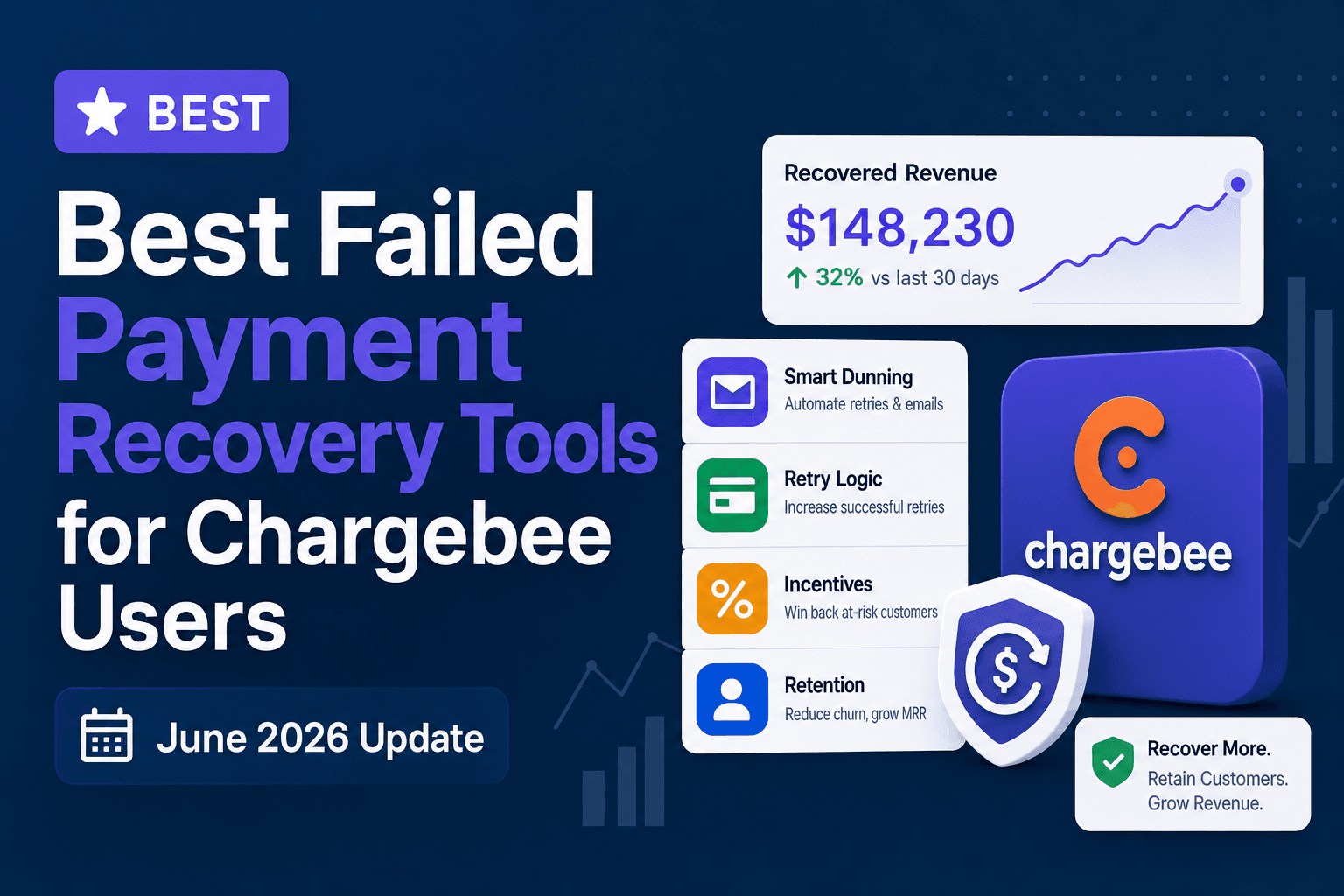
Most subscription CFOs running Chargebee know the tool handles billing cleanly, but native Chargebee dunning leaves money on the table. Fixed retry schedules miss the window where a soft decline would have cleared, and generic payment-update emails don't tell the customer why their card failed or what they're about to lose. Specialized Chargebee payment recovery tools add adaptive AI retry logic, personalized dunning tied to the decline code, and statistical proof you can verify before locking into a contract. We ranked the options based on integration effort, retry intelligence, transparency on recovery lift, and pricing structure so you can see which tools actually move the needle on involuntary churn.'}
TLDR:
- Chargebee's native dunning uses fixed retry schedules; recovery tools add AI timing and smarter logic.
- Most tools lack AABB testing, so you can't verify recovery lift on your own subscriber data.
- Silent automated retries recover more than customer-facing dunning alone.
- Slicker uses AI models to decide retry timing per transaction and proves results with AABB testing.
- Setup takes ~5 minutes with no engineering work; pilot starts with one free month, then three paid.
What Are Failed Payment Recovery Tools for Chargebee?
Failed payment recovery tools extend what Chargebee's built-in dunning does by adding smarter retry logic, AI-driven timing, and deeper customer communication. Chargebee handles billing well, but its native failed payment handling is rule-based and static. These third-party tools sit on top of your existing Chargebee setup and work to recover declined transactions before they become involuntary churn, which is revenue lost from payment failures, not cancellations. Industry data suggests roughly 29% of churn is involuntary, making payment recovery a material revenue issue for most subscription businesses.
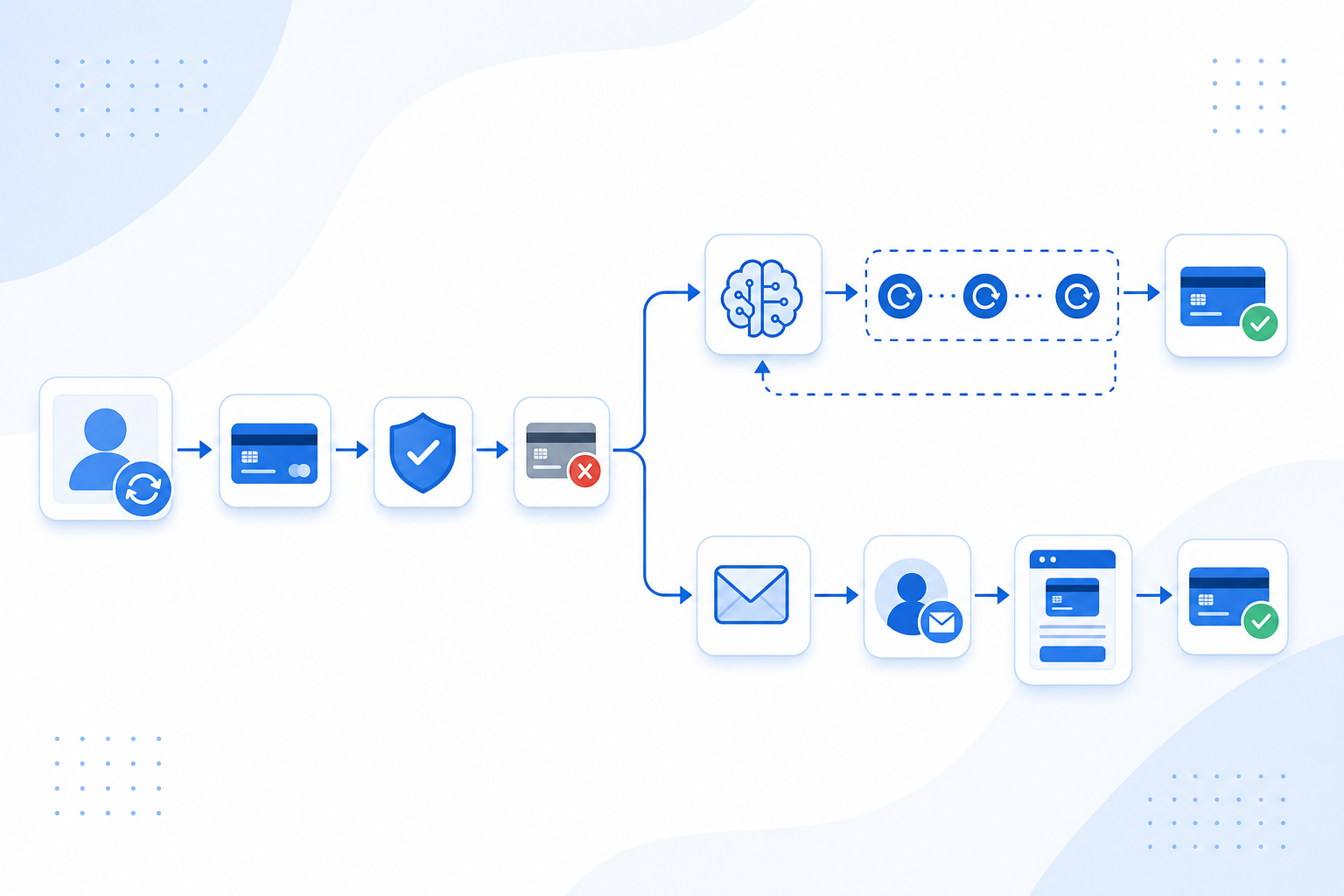
Most tools in this category focus on two recovery layers: silent retries (reattempting the charge without customer involvement) and dunning sequences (emails prompting customers to update payment info when the error requires their action). soft vs. hard decline retry strategies instead of applying a one-size-fits-all retry schedule.
How We Ranked Failed Payment Recovery Tools for Chargebee
We assessed each tool using publicly available information across five criteria focused on what Chargebee users actually care about when comparing recovery solutions.
- Integration with Chargebee: how cleanly the tool connects to Chargebee's billing stack and how much setup effort is involved.
- Retry intelligence: whether the tool applies static retry rules or adaptive AI logic that responds to error type, card issuer, and geography.
- Dunning quality: whether outreach is a generic payment-update request or personalized to the specific failure reason.
- Transparency and proof: whether vendors validate performance claims with statistical evidence, or rely on unverified benchmarks.
- Pricing structure: performance-based fees versus flat rates, and total cost of ownership across different recovery volumes.
No hands-on testing was conducted. All assessments draw from vendor documentation, verified user reviews, and publicly disclosed capabilities.
Best Overall Failed Payment Recovery Tool for Chargebee: Slicker
Slicker is purpose-built for subscription businesses that run billing through Chargebee and need to recover more failed payments without adding engineering overhead.
Unlike Chargebee's fixed retry schedules, Slicker runs an ensemble of AI models that analyzes each failed transaction individually. It weighs issuer behavior, card type, geography, decline code, and customer history to decide retry timing and amount. Customers typically see a 20 to 50% lift in recovery rates over standard retry logic, measured on their own data through clinical-grade AABB testing.
Setup takes roughly five minutes with no engineering work required. Payment credentials flow through your existing Chargebee infrastructure, so there's no PCI scope to worry about. Slicker has achieved SOC 2 Type 2 compliance.
The pilot structure is four months: the first month is free, followed by three paid months with the option to cancel anytime. If Slicker doesn't beat your control with statistical significance, you're not locked in.
For Chargebee users dealing with involuntary churn, Slicker separates soft declines (retriable errors like insufficient funds) from hard declines (non-retriable errors like stolen cards) and routes each case appropriately. Silent automated recovery runs first. Customer-facing dunning is the fallback, sent from your own domain with messaging tied to the specific failure reason, framing what the subscriber stands to lose (the service, the access) beyond the mechanical fact that a payment failed.
Vindicia
Vindicia has been in the subscription billing space for over two decades, and its retain product is built around failed payment recovery. It offers retry logic, account updater integrations, and customer communications: the standard toolkit for reducing involuntary churn.
Where Vindicia struggles is in proving its impact on your specific subscriber base. aggregate recovery benchmarks across their client pool, not as statistically validated results drawn from your own traffic. For a CFO assessing vendor ROI, that gap matters. You want to know what the lift is on your data, not an average across industries.
Vindicia also carries the overhead typical of enterprise billing vendors: longer implementation timelines, professional services requirements, and pricing structures that assume a substantial contract commitment before you see results.
If you're a high-volume subscription business that needs rigorous, data-backed proof of recovery lift before locking into a contract, Vindicia's model asks you to commit first and measure later.
Revaly
Revaly is a dedicated failed payment recovery tool built for subscription businesses. It sits outside your billing system and focuses on retry logic and dunning sequences, giving it more flexibility than Chargebee's native dunning.
Where Revaly falls short is in how it measures results. There is no statistically validated AABB testing, so you cannot verify whether its retry logic is actually outperforming what you had before. You are taking the vendor's word for it, which is exactly the kind of "trust us" pattern that costs finance teams real money when the numbers don't hold up.
Revaly also lacks the AI-driven retry personalization that separates modern recovery tools from legacy ones. Retry timing and sequencing are largely rule-based, with limited ability to adapt to issuer behavior, card type, or geography.
Butter
Butter focuses on payment retry logic and basic dunning for subscription businesses, positioning itself as a lightweight alternative to billing-native recovery tools. It offers automated retries and customer-facing payment update flows, but lacks the statistical rigor that high-volume subscription companies need to verify actual recovery gains.
There is no AABB testing with statistical significance, so you cannot confirm whether Butter's retry schedules are genuinely outperforming your baseline. For a CFO tracking recovered MRR, that gap in proof matters. You're operating on assumed improvement instead of measured uplift against a controlled sample of your own traffic.
Butter also does not offer smart retry performance by issuer and geography, which limits recovery performance on complex decline patterns.
FlyCode
FlyCode is an AI-powered failed payment recovery tool that integrates with Chargebee and other billing systems. It focuses on smart retry logic and payment optimization to help subscription businesses recover revenue from failed transactions.
What FlyCode Does Well
- FlyCode offers AI-driven retry scheduling that analyzes payment failure patterns to determine optimal retry timing, which can improve recovery rates compared to fixed retry schedules.
- The tool provides decline code analysis to categorize failures and route them toward the most appropriate recovery action.
- FlyCode integrates with Chargebee without requiring major engineering resources, making it accessible for teams that want to move quickly.
Where FlyCode Falls Short
- FlyCode lacks AABB testing with statistical significance, so you cannot verify whether its retry logic is actually outperforming your previous setup on your own data.
- Recovery performance claims are difficult to validate independently, which is a real concern for finance teams that need provable revenue impact before committing budget.
- Dunning customization is more limited compared to tools that let you personalize messaging based on the specific failure reason, such as a stolen card versus insufficient funds.
For Chargebee users who want measurable, statistically validated recovery results and not a black-box retry engine, FlyCode may leave too many questions unanswered at the end of the quarter.
Churnkey
Churnkey positions itself as a cancellation-flow tool that has expanded into failed payment recovery. It intercepts customers at the moment of cancellation and, separately, sends dunning sequences when payments fail.
The recovery approach leans heavily on customer-facing communication over silent retry logic. For subscription businesses processing high volumes, that means a larger share of recoveries depend on customers taking action, which tends to recover fewer payments than automated retries alone.
If your primary need is recovering failed payments and not preventing cancellations, you may find the tool better suited to churn prevention than payment retry optimization.
Feature Comparison Table of Failed Payment Recovery Tools for Chargebee
Here's how each tool stacks up across the capabilities that matter most for Chargebee payment recovery.
Feature | Slicker | Vindicia | Revaly | Butter | FlyCode | Churnkey |
|---|---|---|---|---|---|---|
No-Code Chargebee Integration | Yes | No | No | No | Yes | Yes |
AABB Statistical Testing | Yes | No | No | No | No | No |
AI-Powered Smart Retries | Yes | Yes | Yes | Yes | Yes | No |
Dunning Email Personalization | Yes | Yes | No | Yes | No | Yes |
Silent Automated Recovery | Yes | Yes | Yes | Yes | Yes | No |
SOC 2 Type 2 Compliant | Yes | Yes | No | No | No | No |
Free Pilot Available | Yes | No | No | No | No | No |
The table above reflects what separates tools that genuinely recover more revenue from those that simply run retries on a schedule. AABB statistical testing is the clearest dividing line: without it, you cannot verify whether a tool is outperforming your baseline or just adding noise to your billing infrastructure.
Why Slicker Is the Best Failed Payment Recovery Tool for Chargebee
Slicker is purpose-built for exactly the revenue leak that Chargebee's native dunning leaves unaddressed. Where Chargebee retries on fixed schedules, Slicker runs an ensemble of AI models that reads issuer signals, card type, geography, and decline code in real time to decide whether to retry, when, and at what amount. Customers recover roughly 20% more failed payments than they do with standard retry logic, proven on their own data through clinical-grade AABB testing with statistical significance before any commitment is made.

Setup requires zero engineering lift and takes about five minutes. Slicker layers directly onto your existing Chargebee infrastructure with no code changes required. The pilot starts with the first month free, followed by three paid months with the option to cancel anytime.
How Slicker Recovers What Chargebee Misses
Recovery runs silently and automatically in the background. Customer-facing dunning emails are only triggered when the decline code requires customer action, such as a stolen or expired card. When those emails do go out, they come from your domain, your brand voice, and reference the specific reason for the failure, not a generic "update your payment method" message.
- Smart retries analyze over 40 variables per transaction, including issuer behavior patterns and soft versus hard decline signals, to select the retry window with the highest probability of success.
- AABB testing splits your traffic and measures recovered dollars with statistical significance, so the uplift is verified against your own subscriber base, not a vendor benchmark.
- SOC 2 Type 2 compliance is live. Payment credentials flow through your existing PCI-compliant infrastructure, so no credentials touch Slicker's systems directly.
Final Thoughts on Recovering Failed Payments in Chargebee
The difference between a generic retry schedule and AI-driven recovery logic is the difference between hoping a payment goes through and knowing when it will. Chargebee gives you the billing infrastructure, but recovery requires a layer of intelligence that reads issuer signals, card type, and geography in real time. If you're losing MRR to involuntary churn and want to see what statistically validated recovery looks like on your own subscriber base, contact us and we'll set up a pilot that proves the lift before you commit beyond the free first month.
FAQ
Which Chargebee payment recovery tool is better for high-volume subscription businesses?
Slicker is built for high-volume subscription companies that need statistically proven recovery lift before committing to a contract. It uses AABB testing to verify actual performance on your own traffic, while alternatives like Vindicia, Revaly, and Butter rely on aggregate benchmarks or unverified vendor claims.
How do I choose the best failed payment recovery tool for my Chargebee setup?
Start by checking whether the tool can prove its recovery lift with statistical significance on your own data, beyond industry averages. Then assess whether it separates soft declines from hard declines, personalizes dunning to the specific failure reason, and integrates with Chargebee without engineering work.
Can I test a payment recovery tool against my current Chargebee dunning setup before paying?
Yes, with Slicker. The pilot structure runs for four months: the first month is free while AABB testing measures actual recovery performance against your baseline, followed by three paid months with the option to cancel anytime. Other vendors typically require commitment before you can verify results.
What's the difference between AI-powered smart retries and Chargebee's built-in retry logic?
Chargebee's native retry logic follows fixed schedules that treat all failures the same. AI-powered smart retries analyze issuer behavior, card type, geography, and decline codes in real time to decide whether to retry, when, and at what amount, typically recovering 20 to 50% more failed payments than rule-based systems.
Related Articles
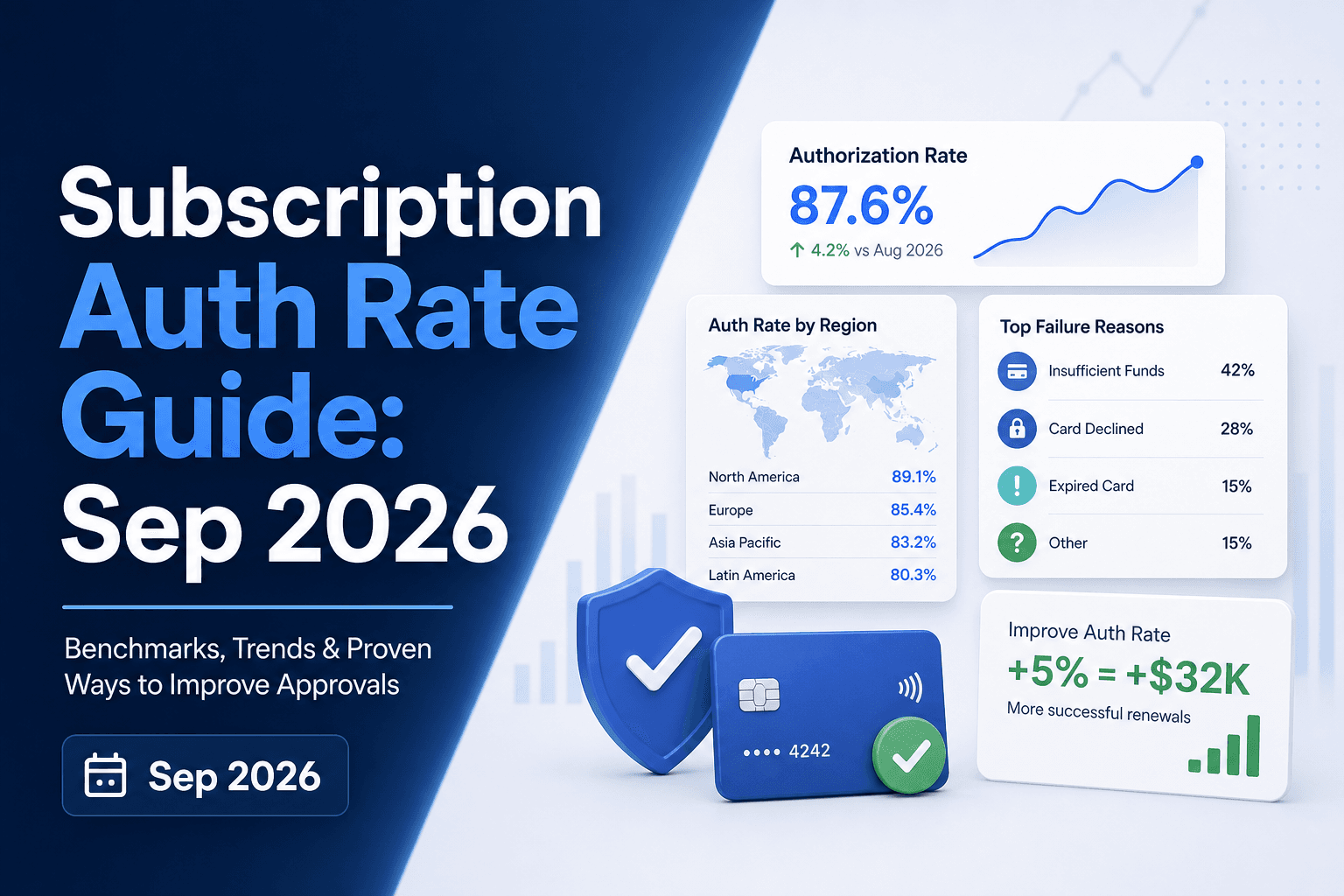
Authorization Rate in Subscription Billing: October 2026
There's a number sitting in your payments data that most finance and retention teams never report on separately: the share of renewal charges your issuing...
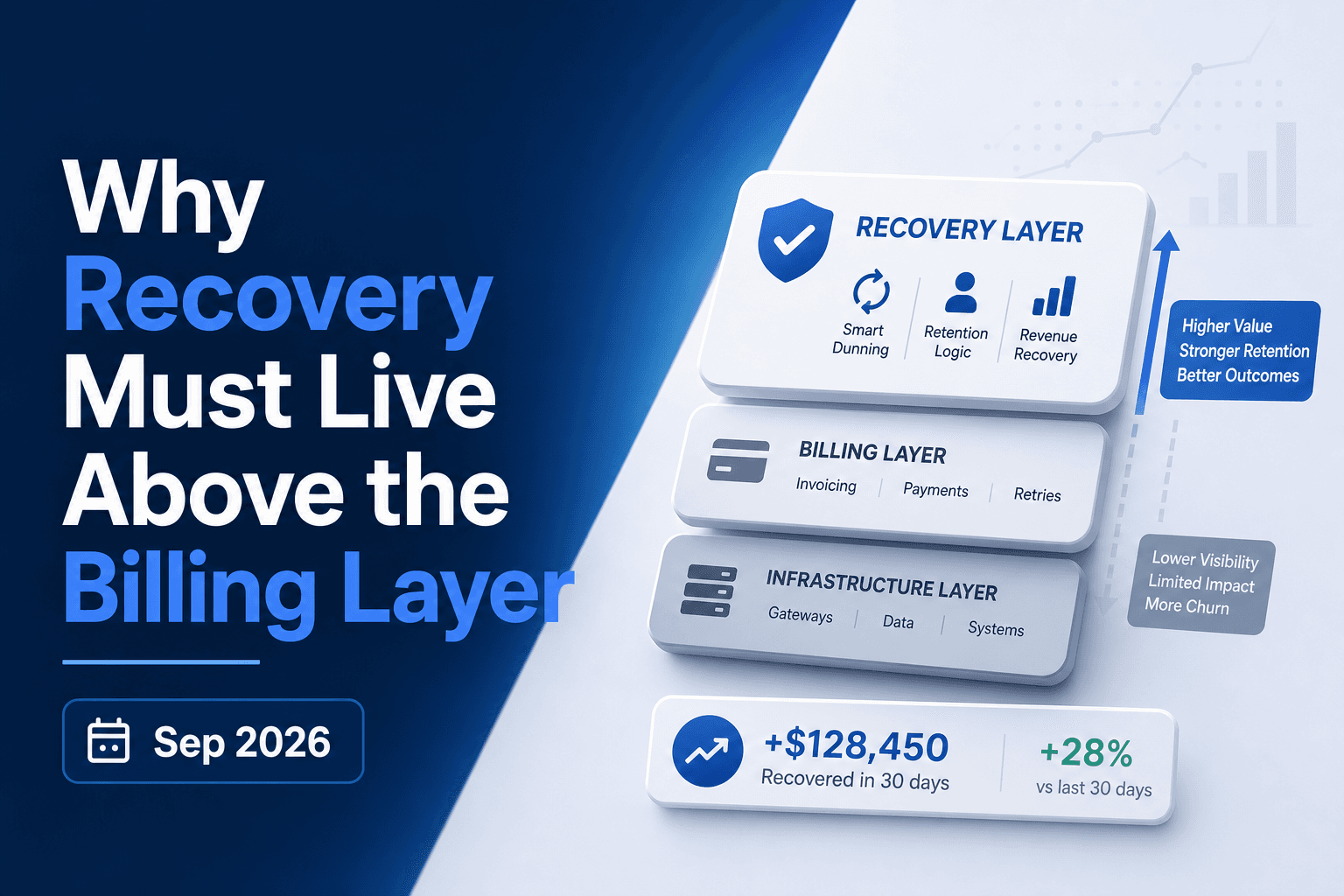
Why Payment Recovery Must Live Above Billers October 2026
A payment fails. Your biller retries it three days later, then again at seven, then at fourteen. What the biller never checks is whether the issuer sent a...
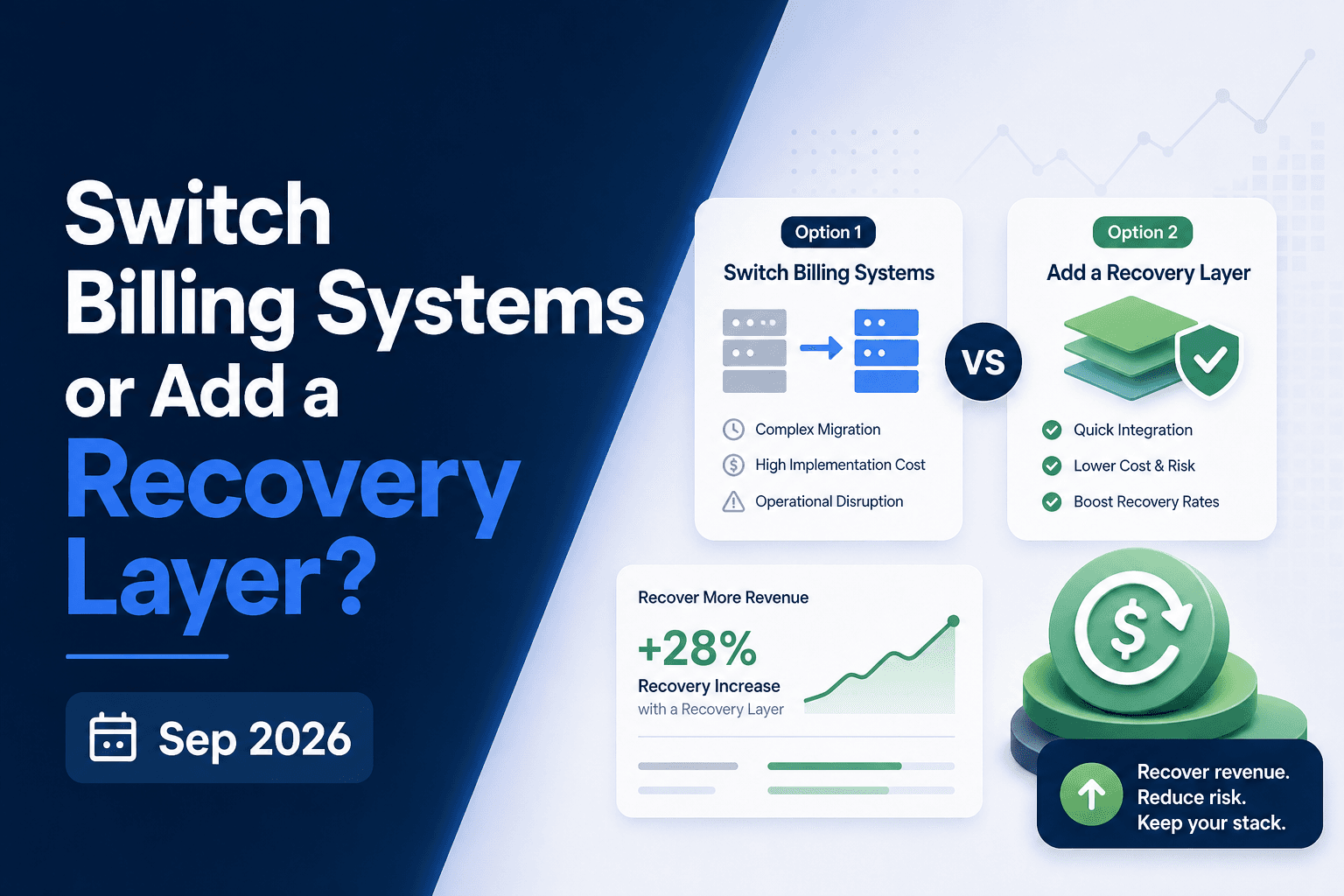
Billing Migration vs Recovery Layer: The Right Call October 2026
Switching billing systems feels like the right move when revenue collection starts breaking down. Sometimes it is. But soft declines, weak retry logic, and...
Stop losing revenue to failed payments
Join leading subscription businesses using Slicker to recover failed payments automatically.
Get Started