Annual Recurring Revenue: CFO's Calculation Guide October 2026
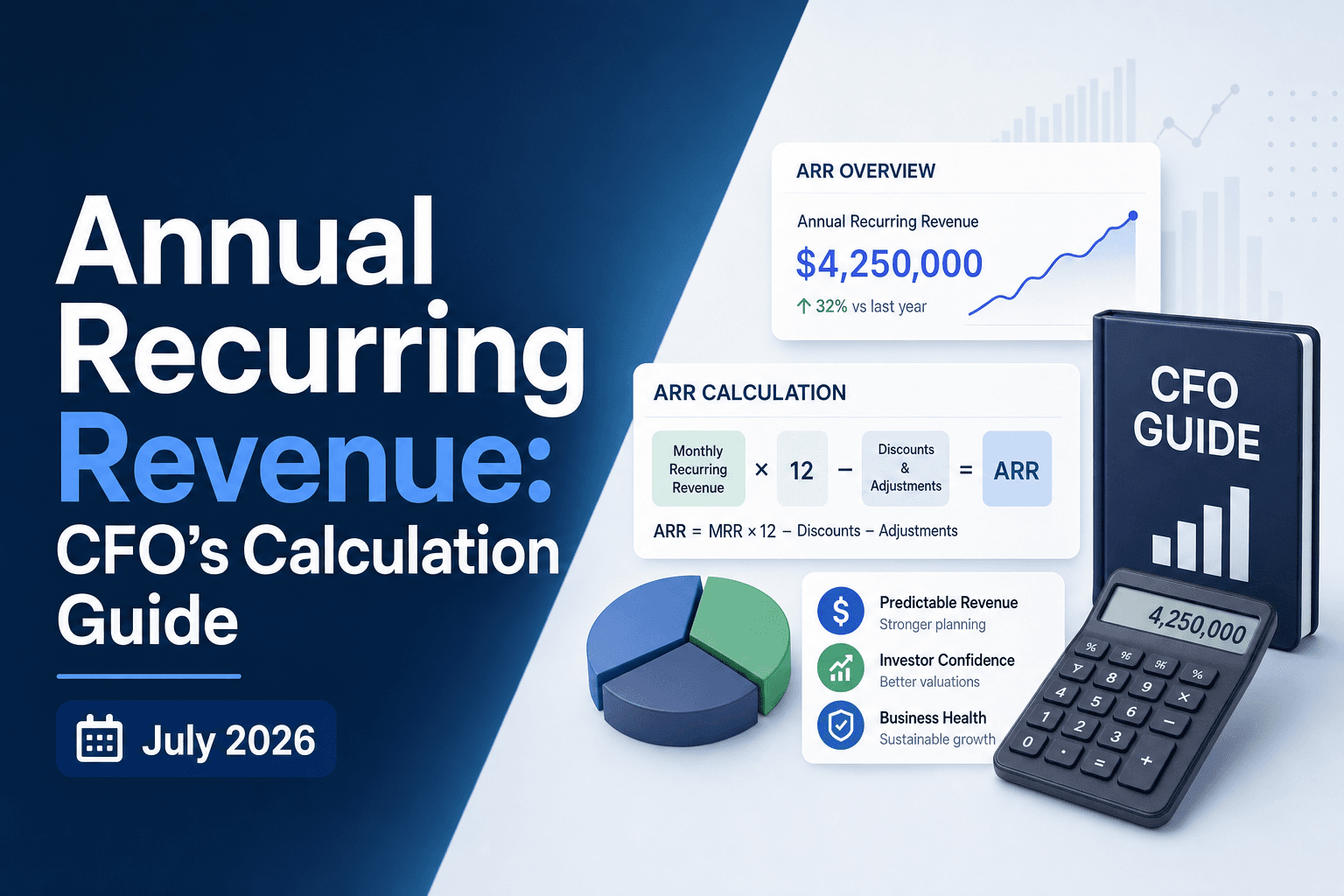
When a CFO says ARR and an investor hears annual run rate, the same business can look 20% bigger or smaller depending on whose definition wins. Annual recurring revenue, or ARR, is one of the most referenced metrics in SaaS and one of the most inconsistently calculated. The ARR formula itself is straightforward: MRR times 12, or annualized contract value from signed agreements. The hard part is what you include, what you leave out, and how you keep that definition consistent across your billing system, your CRM, and your board reporting. This guide covers all of it.
TLDR:
- ARR counts only contracted, recurring subscription revenue; one-time fees and usage overages stay out of the calculation.
- Calculate ARR two ways: MRR x 12, or (total contract value / contract length in months) x 12.
- SaaS valuation multiples of 5x to 15x ARR are priced on revenue quality, growth rate, and net revenue retention (NRR) above 120%.
- Involuntary churn (payment failures that cancel subscriptions without customer intent) erodes ARR silently and never appears in cancellation reports.
- Slicker retries failed payments using AI that reads issuer signals and timing patterns, recovering ARR that billing systems would otherwise lose.
What Annual Recurring Revenue (ARR) Is
Annual Recurring Revenue (ARR) is the total subscription revenue a company expects to collect over a 12-month period, normalized to a yearly figure. It counts only recurring, contracted revenue: base subscriptions, recurring add-ons, and any annual price adjustments. One-time fees, professional services, and usage charges that aren't guaranteed each period stay out of the calculation.
ARR is the north star metric for subscription businesses because it converts the noise of monthly billing cycles into a single, comparable number that reflects the true scale and health of the business. Investors, boards, and acquirers all anchor to it.
The ARR Formula: Two Methods for Calculating It
Two methods exist for calculating ARR, and which one you use depends on what data you have available.
Method 1: From MRR
If you already track monthly recurring revenue (MRR), the conversion is straightforward:
- ARR = MRR x 12
Method 2: From Contract Value
If you work from signed contracts, calculate ARR directly:
- ARR = (Total contract value / Contract length in months) x 12
For example, a $36,000 two-year contract yields $18,000 in ARR, not $36,000, because only one year's worth of recurring value counts.
Both methods should produce the same number for a healthy, well-tracked book of business. If they diverge, that gap usually signals a data hygiene problem worth investigating before your next board review.
What Counts in ARR (and What to Exclude)
Recurring revenue only qualifies for ARR when it is contractually committed and repeating on a predictable schedule. One-time setup fees, professional services charges, and usage-based overages that fluctuate month to month stay out of the calculation. So does revenue from contracts shorter than 12 months unless you normalize them to an annual figure.
What belongs in ARR:
- Subscription base fees that renew automatically, whether billed monthly, quarterly, or annually, as long as the customer has an active contract.
- Committed minimum seats or tiers, even if the customer occasionally exceeds them, because the minimum is the guaranteed recurring portion.
- Price increases locked into multi-year agreements, counted from the effective date of the new rate.
What to exclude:
- Non-recurring professional services, onboarding fees, or one-time implementation charges, since they do not repeat and would inflate your ARR beyond what investors or acquirers will credit.
- Pure consumption-based revenue with no contractual floor, because it cannot be predicted with confidence a year out.
- Churned or canceled contracts, which should be removed from ARR the moment the cancellation is effective, not at the end of a billing cycle.
Getting these boundaries right matters because ARR feeds directly into valuation multiples. Investors apply ARR multiples expecting the number to represent durable, contractually secured cash flow, not a best-case revenue projection.
ARR vs. Monthly Recurring Revenue (MRR)
ARR and MRR measure the same underlying business health, just at different time scales. MRR captures your recurring revenue in a given month, while ARR annualizes that figure. The relationship is straightforward: ARR = MRR × 12.
When to Use Each Metric
The right metric depends on your billing cadence and reporting audience.
- MRR suits companies with monthly billing cycles or high contract velocity, where month-over-month changes carry real signal for the team.
- ARR is the standard for board reporting, investor conversations, and valuation discussions, where annual scale matters more than monthly fluctuations.
- Companies with a mix of monthly and annual contracts typically track both, cross-checking them to catch discrepancies between booked and recognized revenue.
Neither metric is more accurate than the other. ARR gives you the annual picture; MRR gives you the granular view. Finance teams that rely on only one risk missing the story the other tells.
ARR vs. Revenue vs. Annual Run Rate
Three terms that sound interchangeable can produce wildly different numbers on the same business, so CFOs need a clear line between them.
ARR counts only subscription revenue that is contractually committed and repeating. Revenue, in the accounting sense, includes everything recognized under ASC 606 or IFRS 15 in a given period: one-time setup fees, professional services, usage overages, and hardware. ARR strips all of that out. A company can post $10M in GAAP revenue while carrying only $7M in ARR if a large chunk of that revenue is non-recurring.
Annual run rate is a separate concept entirely. It takes a short observation window, typically one month or one quarter, and annualizes it. Run rate formula: current month MRR multiplied by 12, or current quarter revenue multiplied by 4. Run rate is a forward projection, not a count of contracted value. ARR, by contrast, reflects what is already under contract.
Why the Distinction Matters for Investors and Operators
Metric | What it measures | Includes one-time revenue | Forward-looking? |
|---|---|---|---|
ARR | Contracted recurring subscription value | No | No |
GAAP Revenue | All recognized revenue in the period | Yes | No |
Annual Run Rate | Annualized recent revenue pace | Yes | Yes |
Conflating run rate with ARR is a common error in board decks. Run rate can spike in a quarter where a large services engagement closes, making growth look stronger than the underlying subscription base actually is. Investors pricing a SaaS multiple want ARR, not run rate, because ARR reflects the durable, contractual revenue base that supports a valuation.
CARR vs. ARR: Understanding the Forward-Looking Metric
Committed ARR (CARR) captures the revenue locked in from signed contracts, even if billing hasn't started yet. Where ARR reflects what you're currently collecting, CARR shows what's contractually guaranteed to come in.
For SaaS CFOs assessing pipeline health, CARR is the more forward-looking figure. A company might show $8M ARR today but $11M CARR if it has $3M in signed, not-yet-live contracts. That gap matters when forecasting hiring plans, runway, or investor reporting.
The key distinction:
- ARR counts active, billing subscriptions in the current period
- CARR includes signed contracts not yet generating revenue, giving a fuller picture of near-term revenue certainty
CARR is most useful during high-growth phases when your sales team is closing faster than your onboarding team can activate accounts.
ARR Growth Rate Benchmarks by Company Stage
Benchmarks shift as companies scale, so the right ARR growth rate depends heavily on your stage. Seed and early-stage startups are generally expected to grow ARR 2x to 3x year over year. Series A and B companies typically target 100% to 150% annual growth. Growth-stage companies raising Series C and beyond are often measured against the "T2D3" rule: triple ARR twice, then double it three times consecutively.
At scale, the bar drops but the absolute dollars grow. Public SaaS companies with over $100M ARR averaging around 20% to 40% annual growth are often considered healthy by public market standards.
Where Retention Sits Inside These Numbers
Growth rate benchmarks can flatter or mislead depending on how much revenue is quietly leaving through involuntary churn rate (payment failures that cancel subscriptions without the customer intending to leave). A company posting 80% ARR growth on paper may be running a materially worse business than one posting 60% growth with tight net revenue retention. Investors and CFOs who look past the top-line ARR figure to net ARR added, churn-adjusted ARR, and net revenue retention (NRR) get a cleaner read on whether growth is real or partially offset by preventable loss.
ARR Valuation: How Investors and Acquirers Price Subscription Revenue
Investors price subscription businesses on ARR multiples, making your ARR figure one of the most consequential numbers in any fundraise or acquisition conversation.
What Drives ARR Multiples
SaaS companies have historically traded at 5x to 15x ARR in public markets, with high-growth private companies commanding even higher multiples during peak cycles. Three factors move that multiple most:
- Growth rate: companies growing ARR at 50%+ annually consistently attract premium multiples because forward ARR compounds the base valuation.
- Net Revenue Retention (NRR): NRR above 120% signals that existing customers expand faster than they churn, which compounds ARR without incremental acquisition spend.
- Revenue quality: investors discount ARR that includes high churn, one-time fees, or non-recurring services bundled into the figure.
ARR vs. Revenue in Valuation Contexts
Acquirers and investors prefer ARR over GAAP revenue for one reason: ARR reflects forward cash flow, while recognized revenue reflects the past. A company with $10M ARR and 30% growth is priced on where revenue is heading, not where it has been.
This gap widens when deferred revenue is large. If annual contracts are billed upfront, GAAP revenue recognition spreads that cash over 12 months, but ARR captures the full contracted value immediately, giving a cleaner picture of business scale.
The Four Levers That Drive ARR Growth
New customer acquisition, expansion revenue, price increases, and churn reduction are the four levers every SaaS CFO can pull to grow ARR.
New Customer Acquisition
Each net-new logo converts a bookings number into recurring revenue. The ARR impact is straightforward: contracted annual contract value (ACV) flows directly into your ARR figure the moment the subscription goes live.
Expansion Revenue
Seat additions, usage overages, and upsells from existing customers often carry higher margins than new-logo deals because customer acquisition cost (CAC) is near zero. A $50K account that expands to $80K adds $30K to ARR without a single new sales cycle.
Price Increases
Cohort-based price increases on renewing contracts lift ARR without adding headcount or marketing spend. Even a 5% annual increase compounding across your base moves the ARR number materially over a three-year horizon.
Churn Reduction
Lost ARR from cancellations and involuntary churn (failed payments that go unrecovered) subtracts directly from your growth. Recovering even a fraction of lost MRR each month compounds into measurable ARR preservation by year-end.
ARR Reporting: Definitions, Consistency, and Common Mistakes
ARR reporting sounds straightforward until your auditors, investors, and finance team all arrive at different numbers from the same contracts. Consistency in definition is where most companies stumble.
The most common mistakes CFOs encounter:
- Counting one-time fees as recurring revenue inflates ARR and misleads valuation models. Professional services, setup fees, and non-recurring add-ons belong outside the ARR figure entirely.
- Including churned customers in the ARR base until the contract officially expires overstates retention health and distorts net revenue retention calculations.
- Mixing bookings with recognized revenue creates apples-to-oranges comparisons, particularly when reporting to investors who expect ARR to reflect only active, contracted recurring revenue.
Bookings vs. Billed vs. Recognized Revenue
These three numbers will never match, and that is expected. Bookings reflect signed contract value. Billed revenue is what has been invoiced. Recognized revenue follows accounting rules, typically spread over the service period under ASC 606. ARR sits closest to bookings in spirit, but only captures the annualized recurring portion of active contracts, not total contract value.
Getting these definitions locked and documented before your next fundraise or audit will save substantial reconciliation time and prevent the credibility damage that comes from restating ARR mid-process.
How Slicker Protects the ARR Line from Involuntary Churn
ARR tells you what you've earned on paper. Involuntary churn is what quietly erodes it. When a payment fails and a subscriber lapses before the card is retried successfully, that ARR doesn't show up in any cancellation report. It simply disappears.
Slicker sits between your billing system and that revenue leak. It retries failed payments using AI that reads issuer signals, timing patterns, and subscriber-level data to find the right moment for each card. Silent recovery happens first. Customer-facing dunning only fires when the error code confirms the subscriber must act.
Every dollar recovered is ARR that stays on the books, which keeps your valuation multiple working in your favor.
Final Thoughts on Annual Recurring Revenue
A well-calculated ARR number gives you clarity on where your business actually stands, and it gives investors something durable to price. Keeping your definition tight, your churn low, and your expansion revenue growing is the work that moves the number over time. Reach out to Slicker to see how recovering failed payments fits into your ARR growth picture.
FAQ
What is the difference between ARR, CARR, and annual run rate for a SaaS startup?
ARR counts revenue from active, billing subscriptions in the current period; Committed ARR (CARR) includes signed contracts not yet generating revenue, giving a fuller picture of near-term revenue certainty; and annual run rate annualizes a short observation window (current month MRR multiplied by 12, or current quarter revenue multiplied by 4) without requiring any contracted commitment. A startup closing deals faster than its onboarding team can activate accounts will see CARR run well above ARR, while a company in a strong quarter for one-time services deals may show a run rate that flatters the underlying subscription base.
Can ARR be higher than GAAP revenue for a subscription business?
Yes. When annual contracts are billed upfront, ARR captures the full contracted recurring value immediately, while GAAP revenue recognition spreads that same cash across 12 months under ASC 606, meaning ARR will exceed recognized revenue in any period where deferred revenue is large. The reverse is also possible: a company with substantial professional services or one-time fees will report higher GAAP revenue than ARR, because those non-recurring items belong in recognized revenue but are excluded from the annual recurring revenue definition entirely.
What is the annual recurring revenue formula, and what counts as recurring for the calculation?
The annual recurring revenue formula is either MRR multiplied by 12, or (total contract value divided by contract length in months) multiplied by 12. Only contractually committed, automatically renewing revenue qualifies: base subscription fees, committed minimum seat tiers, and price increases locked into multi-year agreements from their effective date. One-time setup fees, professional services charges, and consumption-based revenue with no contractual floor must be excluded, because ARR feeds directly into valuation multiples and investors expect the figure to represent durable, contracted cash flow.
How does involuntary churn from failed payments affect ARR valuation multiples?
Involuntary churn, where a payment fails and a subscriber lapses before recovery succeeds, erodes ARR without appearing in any cancellation report: the revenue disappears with no trace of a voluntary cancellation. Because investors apply ARR multiples expecting the number to represent durable, contractually secured cash flow, a base quietly shrinking from unrecovered payment failures will depress net revenue retention (NRR) below 100%, which compresses the multiple applied to the ARR figure at fundraise or acquisition. Recovering failed payments with a tool like Slicker keeps that ARR on the books and keeps NRR healthy, which directly supports the valuation multiple.
How do bookings, billed revenue, and recognized revenue differ from annual recurring revenue?
Bookings reflect the total signed contract value at the moment of close; billed revenue is what has been invoiced; recognized revenue follows ASC 606 accounting rules and spreads that value across the service period; and ARR captures only the annualized recurring portion of active contracts, excluding total contract value, one-time fees, and non-recurring items. These three numbers will never match each other or your ARR figure, and that divergence is expected: locking down clean definitions for all four before a fundraise or audit prevents the credibility damage that comes from restating ARR mid-process.
Related Articles

Authorization Rate in Subscription Billing: October 2026
There's a number sitting in your payments data that most finance and retention teams never report on separately: the share of renewal charges your issuing...
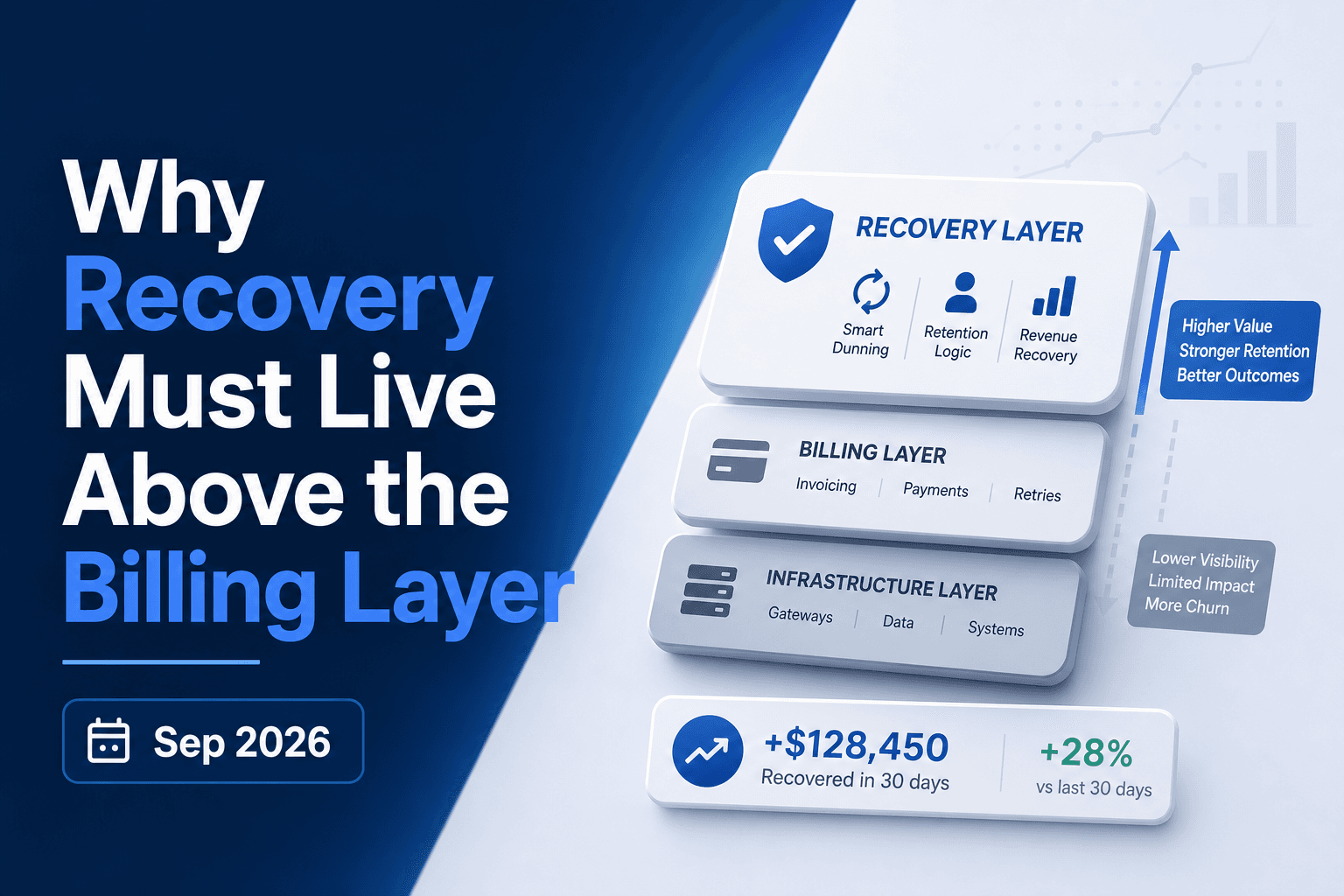
Why Payment Recovery Must Live Above Billers October 2026
A payment fails. Your biller retries it three days later, then again at seven, then at fourteen. What the biller never checks is whether the issuer sent a...
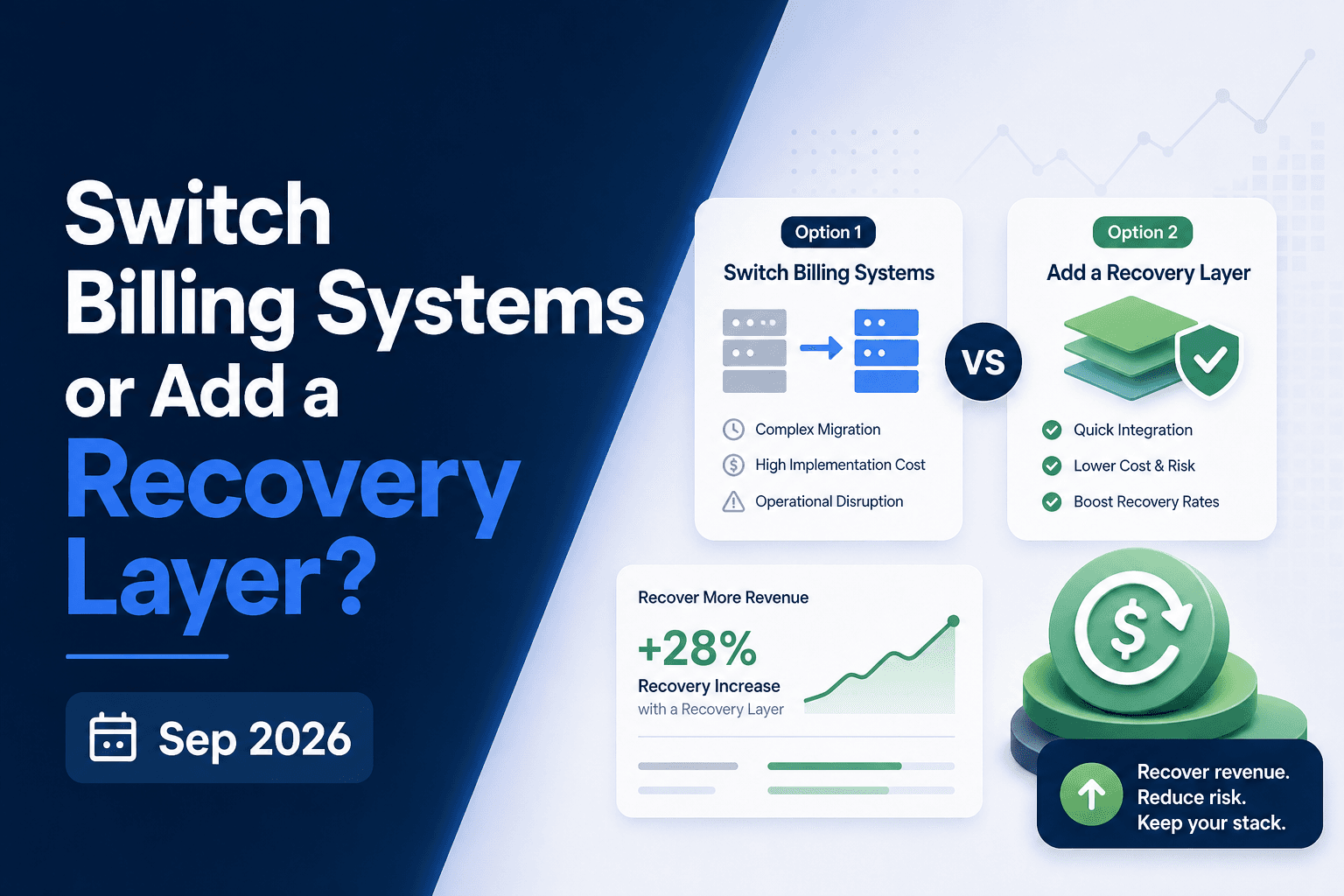
Billing Migration vs Recovery Layer: The Right Call October 2026
Switching billing systems feels like the right move when revenue collection starts breaking down. Sometimes it is. But soft declines, weak retry logic, and...
Stop losing revenue to failed payments
Join leading subscription businesses using Slicker to recover failed payments automatically.
Get Started