Failed Payments vs. MRR, ARR & Net Retention: The Real Impact (July 2026)
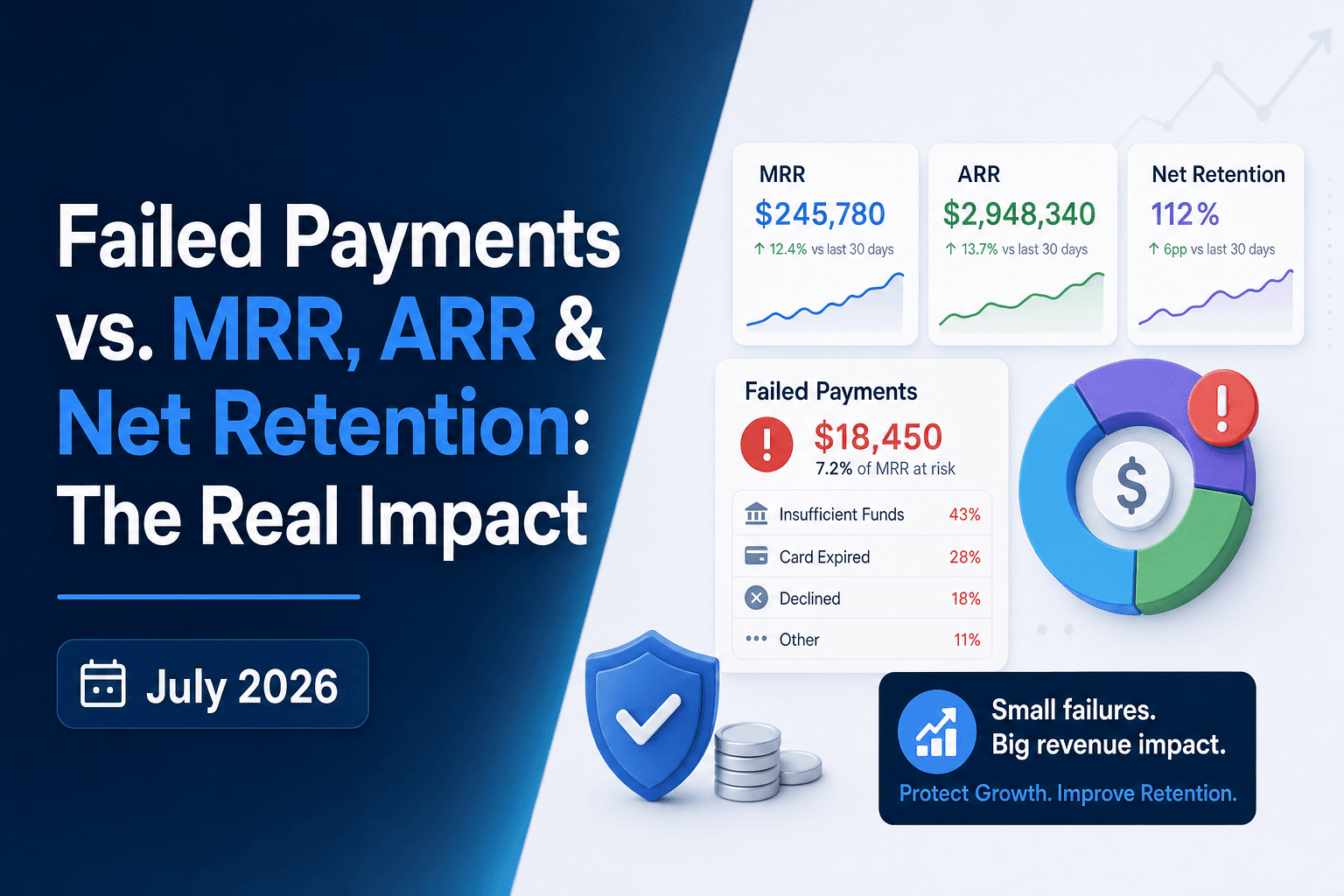
I'll be frank: failed payments MRR is one of the most consistently misread numbers in subscription finance. The subscriber hasn't cancelled, so the revenue stays in your MRR. The ARR projection inherits the same inflation. And when the account finally churns, your involuntary churn ARR registers as a sudden contraction instead of a slow collection failure. Your net retention rate (NRR) takes the hit, and it looks like a product or pricing issue when it was a billing problem the whole time. Here's where that distortion actually starts.
TLDR:
- Failed payments stay counted in your MRR for days or weeks before lapsing, creating a gap between reported revenue and collected cash.
- Industry data puts roughly 15% of recurring payments in decline; at $1M MRR with a 9% failure rate and 60% recovery rate, that's $432,000 in lost ARR annually.
- Involuntary churn (subscriber loss from payment failure, not cancellation intent) gets folded into NRR (net revenue retention), making your retention look structurally weaker than it is.
- Soft declines are temporary and recoverable with well-timed retries; hard declines require customer action. Treating them the same loses revenue either way.
- Slicker scores each declined charge with a dollar value and recovery probability before any retry runs, then measures lift via clinical-grade AABB (A/B/B/B) testing on your own data.
Why MRR and ARR Overstate Subscription Health During Billing Failures
Most SaaS finance teams treat MRR and ARR as reliable gauges of subscription health, but billing failures quietly erode both metrics in ways that standard reporting misses.
When a payment fails, the subscription often stays active in your billing system for days or weeks before it lapses. During that window, the revenue is still counted in MRR, even though it hasn't been collected. Your ARR projection inherits that same inflation. Net revenue retention (NRR) looks stable right up until the account finally churns out, at which point the drop registers as a sudden contraction, not a gradual collection problem.
The result is a lag between what your metrics report and what your bank account reflects.
Where the Distortion Compounds
The problem accelerates at scale. Consider a subscription business with 10,000 active accounts and a 2% monthly failed payment rate. That's 200 accounts at any given time sitting in a billing-failure state, still counted as paying subscribers. At an average contract value of $100/month, that's $20,000 in MRR that looks earned but isn't yet collected, and may never be if recovery fails.
NRR takes the harder hit. Because involuntary churn (subscribers lost to payment failures, not voluntary cancellation) gets folded into overall retention numbers, finance teams routinely misread product stickiness. A strong NRR figure can mask a deteriorating payment recovery rate entirely.
Cleaning up that distortion starts with separating billing failure events from voluntary cancellations in your retention reporting, which most billing systems don't do by default.
What Involuntary Churn Is and Why It Differs from Voluntary Churn
Involuntary churn happens when a subscriber wants to stay but loses access because a payment fails. The card gets declined, the charge never processes, and the subscription lapses without any cancellation intent from the customer. Voluntary churn is a decision; involuntary churn is a billing accident.
The distinction matters because the fix is completely different. Voluntary churn requires product, pricing, or engagement work. Involuntary churn requires payment recovery, and most of it is recoverable if caught quickly with the right retry logic.
Why Subscription Payments Fail
Subscription payment failures split into two categories that behave very differently in your billing system.
Hard declines are permanent. The card is stolen, the account is closed, or the transaction is flagged for fraud. Retrying won't help, and doing so can damage your merchant standing with issuers.
Soft declines are temporary. Insufficient funds, a velocity limit hit, a bank timeout. These are recoverable with the right retry timing and logic.
The distinction matters because most involuntary churn (subscriber loss caused by payment failure, not cancellation intent) comes from soft declines that were never retried intelligently.
Soft Declines vs. Hard Declines: The Framework That Determines Recovery Strategy
Not every failed payment is the same, and treating them as identical is where most recovery strategies break down. The two categories that matter are soft declines and hard declines, and they require fundamentally different responses.
Soft declines are temporary. The issuer is signaling that the payment cannot process right now, often due to insufficient funds, a velocity limit, or a temporary hold. The card itself is valid, and retrying at the right moment can recover the revenue without any customer involvement. For a structured approach, see the soft decline retry playbook.
Hard declines are permanent. A stolen card, a closed account, a fraud block. No retry will succeed. Customer action is the only path forward.
Soft Decline | Hard Decline | |
|---|---|---|
Definition | Temporary issuer refusal | Permanent issuer refusal |
Common causes | Insufficient funds, velocity limit, bank timeout | Stolen card, closed account, fraud block |
Card validity | Card is valid | Card is invalid or blocked |
Retry recommended? | Yes, timed to issuer windows and pay cycles | No; retrying damages merchant standing |
Customer action needed? | Rarely | Always |
Recovery path | Smart retries (no customer disruption) | Dunning email prompting card update |
MRR risk if mishandled | Revenue lost from premature cancellation notice | Revenue lost from repeated failed retries flagging merchant account |
Getting this wrong in either direction costs you. Retrying a hard decline repeatedly flags your merchant account for excessive declines and damages your relationship with the issuer. Treating a soft decline like a hard decline by immediately sending a cancellation notice loses a subscriber who had every intention of staying.
Your MRR and ARR take the hit either way, but the cause and the fix are completely different.
How Failed Payments Distort Your MRR Calculation
Monthly recurring revenue (MRR) is supposed to reflect what your subscribers are actually paying. When a payment fails and goes unrecovered, that revenue never lands, but your customer hasn't cancelled. The result is a gap between recognized and expected revenue that compounds quietly each month.
Industry data puts roughly 15% of recurring payments in decline at any given time, and 50% churn from failed payments across subscription businesses. Even a modest recovery shortfall on that volume means your reported MRR is understating the revenue your contracted base should be generating. The hidden cost of failed payments extends well beyond the headline number.
How Failed Payments Suppress Net Revenue Retention
Net revenue retention (NRR) measures how much revenue you keep and grow from your existing customer base. It accounts for expansions, contractions, and churn. According to Stripe, NRR above 100% signals that a business can grow without adding a single new customer. When failed payments go unrecovered, they function as silent contractions: customers who intended to stay, whose subscriptions lapse anyway.
The math is unforgiving. If your gross retention is 95% but failed payments account for 3 to 4% of that loss, your NRR is being dragged down by recoverable revenue, not genuine cancellations.
Why This Gets Misread in the Metrics
Most finance teams see the NRR drop without separating involuntary churn from voluntary cancellation. That misreading has real consequences.
- Recovery investment gets misdirected toward acquisition or pricing strategy when the actual problem is payment failure sitting unchallenged in the billing layer.
- Cohort analysis breaks down because customers lost to failed payments behave differently in the data than customers who chose to leave, skewing lifetime value calculations.
- Board-level NRR benchmarks get compared against peers without accounting for how much of the gap is recoverable, making the business look structurally weaker than it is. See what subscription businesses lose to failed payments to size the full exposure.
Recovering failed payments pulls NRR back toward its true baseline. That recovered revenue compounds across the year and shows up in ARR without a single new logo acquired.
The True Cost of a Failed Payment: The LTV Multiplier
Every failed payment carries a cost that extends well beyond the transaction itself. When a subscriber churns due to a declined card, you lose the remaining contract value, the upsell potential, and the referral revenue that customer might have generated. For high-LTV (lifetime value) subscribers, that compounding loss can dwarf the original monthly charge by a factor of 12x or more over a typical contract window.
Industry data suggests that recovering even a fraction of failed payments has an outsized effect on LTV-weighted revenue. A single recovered payment on a $200/month plan with a 36-month expected lifetime preserves $7,200 in future ARR (annual recurring revenue) that would otherwise be written off as involuntary churn.
How to Calculate Your MRR Exposure to Failed Payments
Your MRR exposure to failed payments follows a straightforward formula:
MRR at Risk = Total MRR × Failure Rate × (1 − Recovery Rate)
For a company with $1M MRR, a 9% failure rate, and a 60% recovery rate, that's $36,000 in lost MRR every month, or $432,000 annually in ARR that never gets counted. A ready-to-use failed payments revenue-loss model lets you run the same calculation on your own numbers.
Where to Pull the Numbers
Most finance teams already have access to everything they need:
- Your failure rate lives in your billing system or payment processor dashboard. Look at declined transaction volume divided by total attempted charges over a rolling 90-day window.
- Your recovery rate is recovered revenue divided by total failed revenue in the same period. If your billing tool doesn't surface this directly, you likely have a recovery rate close to zero.
- Apply the formula above to get your exposed MRR, then multiply by 12 for ARR impact.
Why This Number Is Probably Understated
The formula above only captures direct revenue loss. It excludes the downstream effect on net revenue retention (NRR): every subscriber lost to a failed payment reduces your expansion revenue base, raises your effective CAC (customer acquisition cost) to re-acquire them, and compresses NRR in ways that compound over time. The true ARR exposure is larger than the formula suggests.
The Recovery Stack: Retries, Dunning, and Card Updaters
Most subscription businesses layer three tools to fight failed payments: automated retries, dunning emails, and account updater services.
- Retries re-attempt declined transactions, ideally timed to issuer-specific windows when approval rates are highest.
- Dunning emails prompt customers to update payment details when the card itself is the problem, such as expiry or a reported theft.
- Card updaters like Visa Account Updater and Mastercard Automatic Billing Updater push refreshed card credentials before a charge even fails.
Each tool recovers a slice of revenue, but none of them feed corrected data back into your MRR or ARR automatically. A payment that fails on the 1st, gets retried on the 5th, and finally clears on the 12th still leaves eleven days of phantom churn distorting your net revenue retention calculation for that period. The recovered dollar shows up eventually; the metric damage lingers.
Retry Timing and Why It Matters More Than Retry Frequency
Retry timing shapes recovery outcomes as much as retry count does, and most billing systems get it wrong. A payment that fails on the 3rd of the month for insufficient funds has a meaningfully different recovery profile than one that fails mid-cycle on a stolen card. Retrying both on the same fixed schedule leaves recoverable revenue on the table.
Why Timing Windows Matter
Subscriber payment behavior follows predictable patterns tied to pay cycles. Retrying a card flagged for insufficient funds three days before a typical US payday will underperform the same retry placed one to two days after. Intelligent payday retries explain how to schedule these recovery attempts for maximum lift. The difference in recovery rate between a well-timed and a poorly-timed retry is measurable across subscriber cohorts, and that gap flows directly into MRR.
The variables that inform good timing include:
- The specific decline code returned, since soft declines like insufficient funds signal a temporary cash-flow gap (not a card problem), making timing relative to payday cycles especially consequential.
- Geographic pay frequency, since weekly-paid subscribers in the US recover differently than monthly-paid subscribers in Western Europe or bi-weekly earners in the UK.
- Days elapsed since the original failure, because retry attempts too close together compound the failure signal and can accelerate card cancellation by the issuer.
Fixed retry schedules ignore all of this. They apply the same cadence regardless of decline reason, geography, or subscriber pay pattern, which means they are optimized for no one in particular. A subscription payment retry strategy that accounts for these variables will consistently outperform a fixed schedule. The MRR that slips through that gap accumulates quietly, distorting net retention before it ever appears in a churn report.
How to Measure Whether Your Recovery Is Working
Recovery measurement starts with separating what you can control from what you're currently ignoring.
Most finance teams track gross MRR churn without isolating how much of it came from failed payments. That single gap means you're making retention decisions with incomplete data.
The metrics that matter
- Recovery rate by cohort: what percentage of failed payments were successfully retried within 30 days, segmented by failure reason (insufficient funds vs. expired card vs. stolen card). Knowing your involuntary churn rate SaaS benchmarks gives you a baseline to judge whether your cohort results are competitive.
- Net Revenue Retention impact: re-run your NRR calculation with and without recovered revenue to see how much involuntary churn is compressing the number.
- Time-to-recovery: how many days pass between a failed payment and a successful charge. Longer windows mean more subscriber-side cancellations before the payment resolves.
If your billing data can't answer these questions today, that's the gap costing you ARR. The 7 CFO dashboard metrics for involuntary churn lay out exactly what to instrument first.
How Slicker Quantifies and Recovers Failed Payment MRR
Slicker maps every failed payment directly to its MRR impact before any recovery work begins. Each declined charge gets a dollar value, a decline classification, and a recovery probability score, so your finance team sees exactly how much contracted revenue is at risk in real time.
From there, AI-powered smart retries work silently in the background, retrying soft declines at the optimal moment based on issuer behavior, card type, and subscriber history. No customer ever sees a disruption. When a payment genuinely requires customer action, hyper-personalized dunning emails go out under your own domain and brand, framed around the value the subscriber would lose, not the failed charge itself.
Every recovery decision runs through clinical-grade AABB testing, so the lift is measured on your own data with statistical significance before you commit.
Final Thoughts on What Failed Payments Are Really Doing to Your Subscription Metrics
Your MRR and ARR are telling you a cleaner story than the billing layer actually supports. The accounts sitting in a payment-failure state are still being counted, and when they finally churn out, the drop looks sudden, not structural. Fixing the reporting means separating involuntary churn from voluntary cancellation, and fixing the revenue means retrying the right declines at the right time. Get in touch with Slicker to see the full picture of what failed payments are costing your ARR.
FAQ
How do failed payments distort MRR and ARR in subscription businesses?
Failed payments inflate MRR because subscriptions stay active in your billing system during the grace period, counting as contracted revenue that has not been collected. Your ARR projection inherits the same inflation, and net revenue retention looks stable until the account finally churns, at which point the drop registers as sudden contraction, not a gradual collection problem that built up over time. Separating billing failure events from voluntary cancellations in your retention reporting is the first step toward accurate numbers.
What is the difference between involuntary churn and voluntary churn, and why does it matter for net revenue retention?
Involuntary churn happens when a subscriber wants to stay but loses access because a payment fails; voluntary churn is a deliberate cancellation decision. The distinction matters because involuntary churn caused by failed payments is largely recoverable with the right retry logic, whereas voluntary churn requires product, pricing, or engagement work. Finance teams that conflate the two routinely misread their NRR and redirect recovery investment toward acquisition strategy when the problem sits entirely in the billing layer.
How do I calculate my MRR exposure to failed payments?
Apply this formula: MRR at Risk equals total MRR multiplied by your failure rate, multiplied by one minus your recovery rate. For a company with $1M MRR, a 9% failure rate, and a 60% recovery rate, that is $36,000 in lost MRR every month, or $432,000 in ARR annually. Your failure rate comes from declined transaction volume divided by total attempted charges over a rolling 90-day window; your recovery rate is recovered revenue divided by total failed revenue in the same period.
Slicker smart retries vs. fixed retry schedules for recovering failed payment MRR: which actually performs better?
Smart retry systems that time attempts around issuer behavior, card type, and geographic pay cycles consistently outperform fixed schedules, which apply the same cadence regardless of decline reason or subscriber payday pattern. Industry-observed data shows smart retry systems recover 70 to 85% of soft declines compared to 40 to 60% for fixed schedules, because fixed logic is optimized for no subscriber cohort in particular. The MRR that slips through that gap accumulates quietly each month before it ever appears in a churn report.
Can I recover failed payments without any customer-facing disruption?
Yes. AI-powered smart retries work silently in the background, retrying soft declines such as insufficient funds at the optimal moment based on issuer behavior and subscriber pay patterns, with no customer ever seeing a disruption. Customer-facing dunning email outreach is reserved only for failures where the payment error genuinely requires subscriber action, such as a stolen or expired card, and those emails go out under your own domain and brand, not from a third party.
Related Articles

Authorization Rate in Subscription Billing: October 2026
There's a number sitting in your payments data that most finance and retention teams never report on separately: the share of renewal charges your issuing...
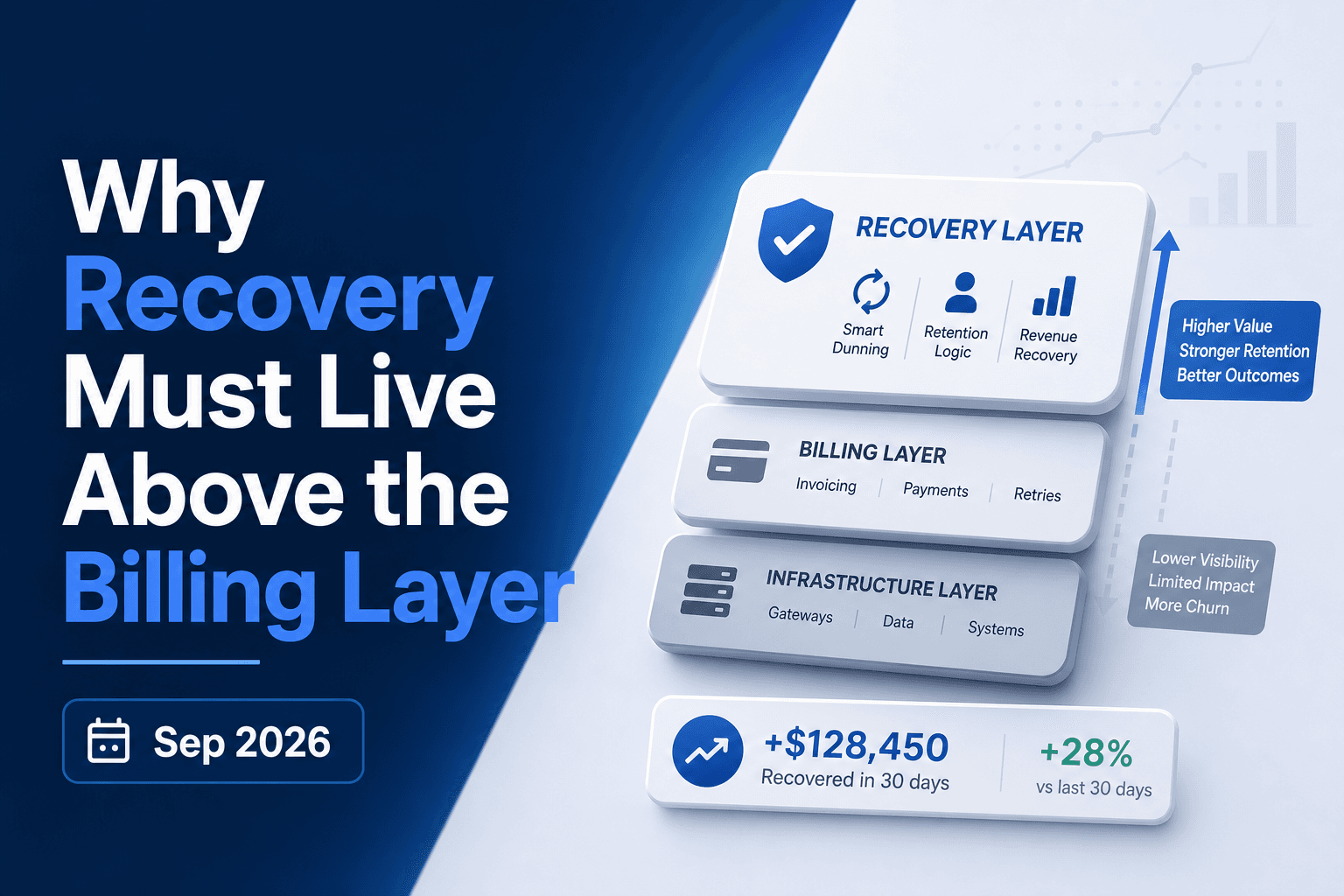
Why Payment Recovery Must Live Above Billers October 2026
A payment fails. Your biller retries it three days later, then again at seven, then at fourteen. What the biller never checks is whether the issuer sent a...
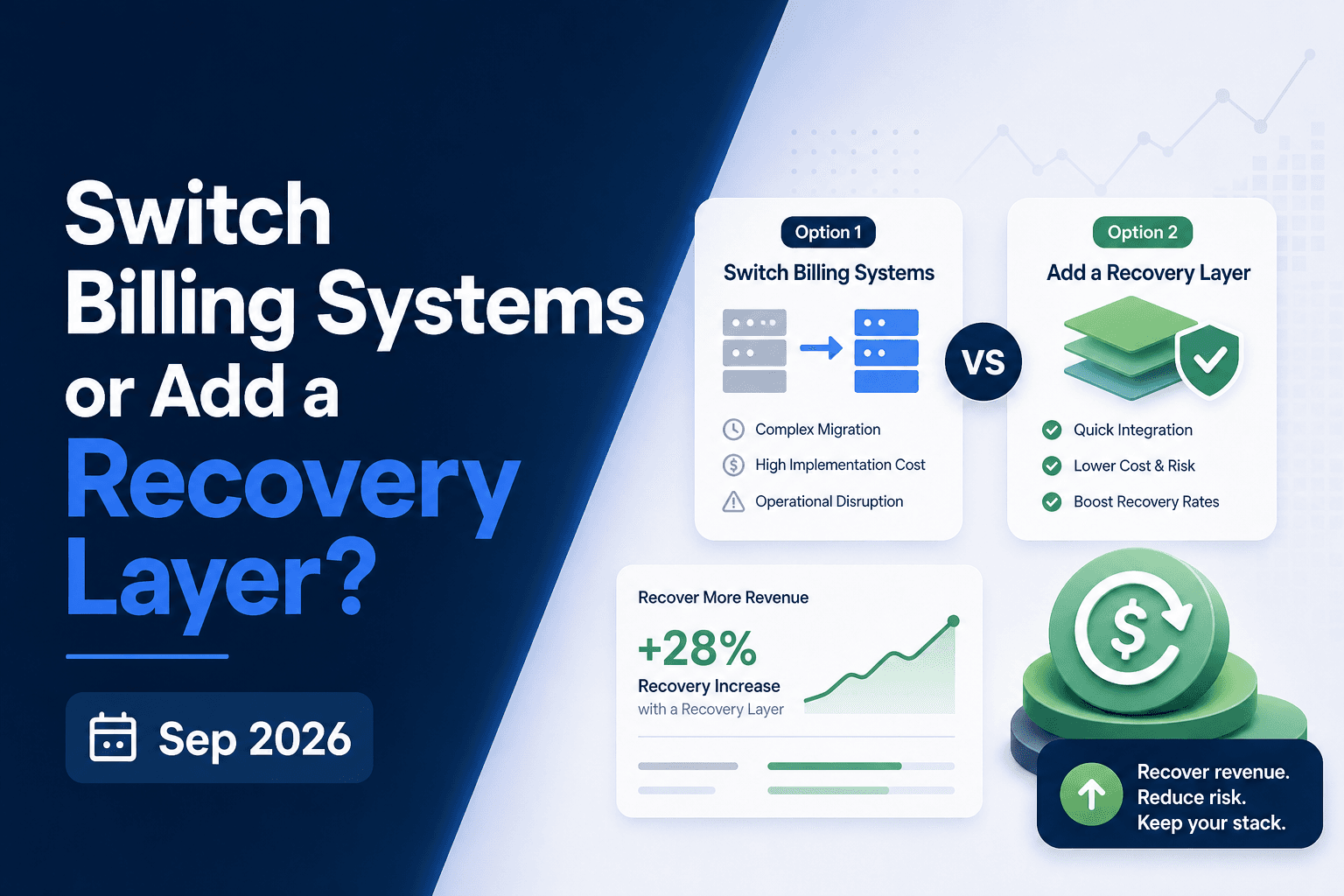
Billing Migration vs Recovery Layer: The Right Call October 2026
Switching billing systems feels like the right move when revenue collection starts breaking down. Sometimes it is. But soft declines, weak retry logic, and...
Stop losing revenue to failed payments
Join leading subscription businesses using Slicker to recover failed payments automatically.
Get Started