Best Revenue Recovery Tools for Stripe Subscriptions Oct 2026
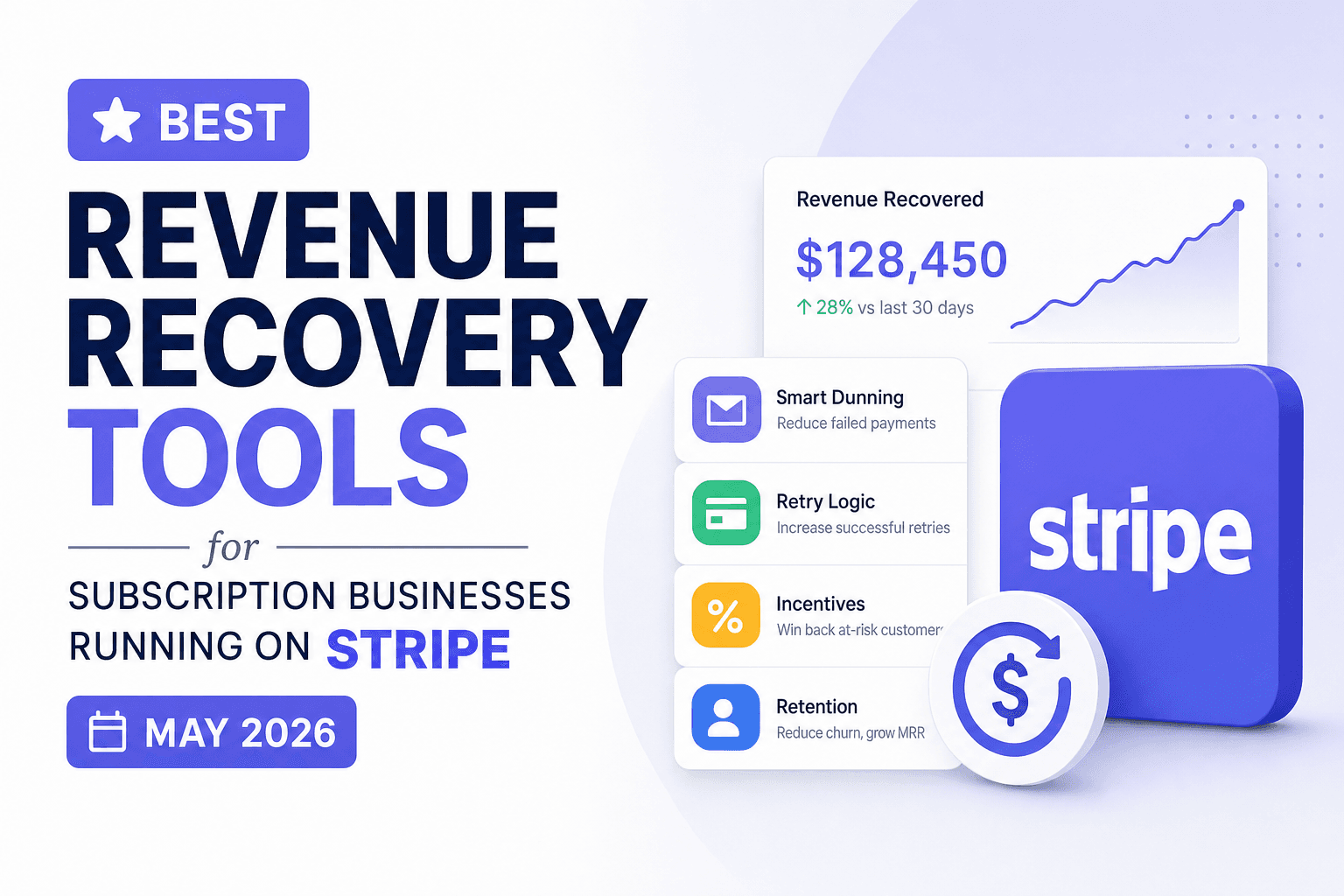
Your Stripe dashboard shows failed payments piling up each month, and you know some percentage could be recovered with better retry logic and smarter outreach. The tools built to recover failed payments on Stripe in 2026 differ sharply in AI sophistication, testing rigor, integration complexity, and whether pricing is tied to recovered revenue or charged regardless of results. We ranked six options based on what CFOs and Heads of Payments care about most: rigorous A/B testing, adaptive AI models that respond to decline codes and card network signals, fast integration without engineering lift, and pricing structures tied to recovered revenue instead of flat fees regardless of results.
TLDR:
- Stripe recovery tools use AI retry logic, dunning comms, and decline-code analysis to recover failed payments before customers churn.
- Industry-observed benchmarks show smart retry systems recovering 70 to 85% of soft declines; fixed retry schedules typically land between 40 to 60%.
- Evaluation criteria include clinical-grade A/B testing, retry intelligence, integration speed, billing complexity support, and performance-based pricing.
- Slicker pairs AI-driven retry scheduling with automated customer outreach and real-time Stripe webhook integration.
- Tools like Vindicia, Churnkey, FlyCode, Revaly, and Butter cover basic retry and dunning but vary in AI sophistication and setup complexity.
Quick Verdict: Best Stripe Payment Recovery Tool by Use Case
Tool | Best For | Primary Recovery Motion | Pricing Model | Avoid If |
|---|---|---|---|---|
Slicker | High-volume Stripe subscription businesses | AI-driven smart retries + dunning | Performance-based | You only need basic one-time payment recovery |
Vindicia | Large enterprise recurring revenue businesses | Network data-pooled retry logic | Performance-based | You need fast setup or flexible mid-market pricing |
Churnkey | Reducing voluntary cancellations | Cancellation flow interception + offers | Flat fee | Your primary churn driver is failed payments |
FlyCode | Lean Stripe or Shopify ecommerce brands | AI retries + dunning sequences | Performance-based | You use multi-gateway or international payment setups |
Revaly | Early-stage SaaS on Stripe | Automated retries + email dunning | Performance-based | You need verified recovery benchmarks or AI optimization |
Butter | Early-stage subscription businesses, basic coverage | Static retry scheduling + card updater | Not publicly disclosed | You process high volumes and need AI-adaptive retry logic |
What Are Stripe Payment Recovery Tools?
Stripe payment recovery tools are software solutions that automatically detect and recover failed recurring payments processed through Stripe. When a subscription charge fails from insufficient funds, an expired card, or a soft decline, these tools step in before a paying customer slips away unnoticed. Involuntary churn accounts for 20-40% of total subscription churn, making automated recovery a critical margin lever for recurring revenue businesses.

They operate through three core mechanisms:
- Smart retry logic that determines if and when to reattempt a charge based on the specific failure signal received. Soft declines like
insufficient_fundsare temporary; retrying near a customer's likely payday (the 1st or 15th) materially improves success rates. Expired or replaced cards are best resolved through automated card updater integrations before a retry fires at all. Hard declines likedo_not_honorsignal an issuer block that silent retries won't clear; dunning outreach is the right path. A fixed schedule treats all three identically, which is exactly why it underperforms. - Dunning communications that prompt customers to update their payment details before a subscription lapses. The decline type (soft vs. hard) determines which path, retry or outreach, is the right recovery motion.
- AI-powered decisioning that reads error codes and network signals to choose the right recovery path for each failure type.
Without them, subscription businesses fall back on Stripe's default retry behavior, which applies the same schedule regardless of why the payment actually failed. That gap is exactly where dedicated recovery tools do their work.
How We Ranked Stripe Payment Recovery Tools
We assessed each tool across five criteria:

- Proof of ROI: Does the vendor offer rigorous, statistically verified testing, or are they leaning on aggregate benchmarks and unverifiable claims?
- Retry intelligence: Does the tool go beyond fixed schedules and apply AI models that adapt to failure type, card network, geography, and issuer behavior?
- Integration speed: How quickly can a high-volume subscription business go live without engineering resources?
- Billing complexity support: Does the solution handle multi-gateway routing, international payments, direct debits, and complex billing stacks?
- Pricing alignment: Is the vendor paid on recovered revenue, or do they collect fees regardless of whether performance improves?
The weighting reflects what CFOs and Heads of Payments at subscription businesses operating at scale actually care about. Feature checklists are easy to game. Recovery rates tied to real dollars recovered are harder to fake.
How Stripe's Native Smart Retries Compare to Dedicated Recovery Tools
Stripe Billing includes Smart Retries at no additional cost: an AI model that times retry attempts and sends automated recovery emails on your behalf. It's designed as a generalist baseline across all Stripe merchants, and for businesses just starting out, it covers the fundamentals without any extra tooling. But the ceiling is low. Stripe's model optimizes for average outcomes across millions of merchants instead of adapting to your specific subscriber base, card mix, or decline code distribution. It offers no dunning email customization, no multi-gateway fallback, and no account-level retry personalization. Every failed charge gets roughly the same treatment, regardless of whether the decline was a temporary insufficiency, an expired card, or a hard block from the issuer. That's exactly why smart retries beat fixed retry schedules for subscription billing. That gap matters most once involuntary churn starts compounding, and since involuntary churn already accounts for 20-40% of total subscription churn, even a modest improvement in recovery rates moves real dollars. When monthly recovered revenue would exceed the cost of a dedicated tool, the case for upgrading is straightforward. Here's how the leading Stripe recovery tools stack up against each other.
Best Overall Stripe Payment Recovery Tool: Slicker
Slicker is built from the ground up for subscription businesses running on Stripe, and it shows in the recovery rates. Where industry benchmarks show fixed retry schedules recovering 40-60% of soft declines, Slicker's AI models push recovery to 70% and above by going well beyond simple retry schedules.
The core advantage is timing intelligence. Slicker's AI models analyze payment history, decline codes, card network signals, and account behavior to predict the optimal retry window for each individual charge. No two customers get the same retry sequence.
What Slicker Does Differently
Slicker pairs smart retries with automated customer communication, so recovery happens across both the payment and the cardholder simultaneously. When a card fails, outreach goes out at the right moment with the right message, reducing friction before it becomes churn.
Key capabilities include:
- Intelligent retry scheduling that adapts per customer based on AI-driven signals, not fixed intervals
- Automated dunning sequences with timing and copy optimized for recovery, beyond simple notification
- Real-time Stripe webhook integration so failed charges trigger recovery workflows instantly
- Transparent reporting that ties recovery attempts directly to revenue recovered, giving finance teams clear attribution
Slicker is purpose-built for this problem. The result is a tool that treats every failed payment as a recoverable revenue event, not an administrative task.
Best for: High-volume Stripe subscription businesses that need AI-driven retry intelligence and automated dunning to push recovery above 70% of soft declines. Avoid if: You only need basic one-time payment recovery and don't require adaptive AI models or real-time webhook-triggered workflows.
Pricing is performance-based, tied to recovered revenue instead of a flat monthly fee.
Vindicia
Vindicia has been in the subscription billing space for over two decades, making it one of the more recognized names in recurring revenue management. Its flagship retention product, Vindicia Retain, is built around a proprietary network of billing data that the company calls CashBox. The core idea is that by pooling anonymized transaction outcomes across its client base, Vindicia can make smarter retry decisions than any single merchant could on their own.
What Vindicia Offers
The tool covers the basics well: automated retries, account updater integrations, and customer-facing dunning communications. Where Vindicia stands apart is in its network data claims. The vendor asserts recovery rates above standard retry logic, though no independently verified benchmarks or A/B testing methodology backs those figures.
Who Vindicia Is Built For
Vindicia is squarely enterprise-focused. Pricing reflects that, and smaller or mid-market subscription businesses often find the onboarding process heavy and the contract structures rigid. Teams that need fast implementation or flexible pricing will find the fit uncomfortable.
For Stripe-native businesses in particular, Vindicia's architecture was built in an era before API-first billing infrastructure became the norm. That can create friction during setup and limit how granularly you can act on Stripe's own decline data.
Best for: Large enterprise recurring revenue businesses that want network data-pooled retry logic and can accommodate a heavy onboarding process. Avoid if: You need fast implementation, flexible mid-market pricing, or a Stripe-native setup without contract rigidity.
Pricing is enterprise-contract-based and typically requires a procurement process; not structured for self-serve or mid-market teams.
Churnkey
Churnkey focuses on cancellation flows and offboarding instead of payment recovery. Its core product helps subscription businesses intercept customers who are trying to cancel, surfacing targeted offers and pause options to reduce voluntary churn. It does layer in some dunning functionality, including email sequences for failed payments, but payment recovery is clearly secondary to its retention flow tooling. For teams whose biggest churn driver is voluntary cancellations, Churnkey fills a real gap. For teams primarily losing revenue to failed payments, dedicated payment recovery tools cover substantially more ground.
Best for: SaaS teams whose biggest revenue leak is voluntary cancellations, not payment failures. Avoid if: Failed payments are your primary churn driver and you need dedicated retry intelligence.
Pricing is subscription-based with a monthly floor; contact vendor for current tiers.
FlyCode
FlyCode is a YC-backed recovery tool for Shopify and Stripe merchants, offering AI-powered retries, coordinated dunning sequences, and a quick app install that gets you live in minutes. The vendor reports recovery rate improvements, though no independently verified benchmarks or A/B testing methodology backs those figures.
Support is limited to Stripe and Shopify, which means Chargebee, Recurly, Zuora, and any multi-gateway setup won't work. There is no AABB testing or rigorous validation methodology to prove incremental lift against your existing recovery system, and no evidence of SEPA or BACS support. For a lean, Stripe-native ecommerce brand with straightforward billing, FlyCode is a quick-start option. For any business with billing complexity, international payments, or a requirement to verify ROI before committing, the gaps are hard to ignore.
Best for: Lean, Stripe-native ecommerce brands with straightforward billing that want AI retries and dunning sequences up and running in minutes. Avoid if: You use multi-gateway or international payment setups, or need verified recovery benchmarks before committing.
Pricing is performance-based, which reduces upfront risk for Stripe-native ecommerce brands.
Revaly
Revaly is a newer entrant focused on subscription revenue recovery, built for SaaS businesses processing payments through Stripe. It sits in a similar category to tools like Gravy and Churn Buster, offering automated retry logic, dunning email sequences, and a customer-facing account updater to reduce involuntary churn.
The tool is relatively lightweight compared to enterprise-grade options, which can be an advantage for smaller teams that want quick setup without deep configuration. However, that simplicity comes with tradeoffs in retry intelligence. Revaly does not publish recovery rate benchmarks, making it difficult to benchmark performance against competitors before committing.
Who Revaly Works Best For
- Early-stage SaaS companies on Stripe that need basic dunning coverage without a heavy implementation lift.
- Teams without a dedicated payments or retention function who want a set-and-forget approach to failed payment recovery.
- Businesses processing lower monthly volumes where the cost of a more sophisticated retry engine may not yet be warranted.
Revaly is a reasonable starting point, but as transaction volume grows, the lack of AI-driven retry optimization and transparent performance data becomes a real limitation for revenue teams that need accountability from their recovery stack.
Best for: Early-stage SaaS companies on Stripe that need basic dunning coverage and a quick setup without a heavy implementation lift. Avoid if: You need verified recovery rate benchmarks or AI-driven retry optimization to support investment in your recovery stack.
Pricing details are not publicly disclosed; contact vendor directly to assess cost against expected recovery volume.
Butter
Butter is a payment recovery tool built for Stripe users, focusing on reducing involuntary churn through smart retry logic and card updater functionality. It sits at the lighter end of the market, making it a reasonable starting point for early-stage subscription businesses that want basic dunning coverage without a heavy implementation lift.
The tool offers automated retry scheduling, email dunning sequences, and Stripe's Account Updater integration to catch expired or replaced cards before they cause a failed charge. For teams without a dedicated payments engineer, this low-friction setup has appeal.
That said, Butter's retry logic is relatively static compared to AI-driven tools that adapt retry sequencing based on decline codes, card network signals, and account-level behavior. At higher transaction volumes, that gap in sophistication tends to show up in recovery rates.
Best for: Early-stage subscription businesses that want basic dunning coverage with minimal setup. Avoid if: You process high transaction volumes where static retry logic will underperform AI-adaptive alternatives.
Pricing is not publicly listed; designed for early-stage teams and expected to be accessible at lower MRR thresholds.
Feature Comparison Table of Stripe Payment Recovery Tools
Not every tool does the same job. Here's how each option stacks up across the key evaluation criteria.
Feature | Slicker | Vindicia | Churnkey | FlyCode | Revaly | Butter |
|---|---|---|---|---|---|---|
Clinical-grade A/B testing | Yes | No | No | No | No | No |
No-code billing integration | Yes | No | Yes | Yes | No | No |
Ensemble AI models | Yes | No | Yes | Yes | Yes | Yes |
Multi-gateway routing | Yes | Yes | No | No | Yes | No |
Direct debit support (ACH/SEPA/BACS) | Yes | Yes | No | No | Yes | No |
Dunning from your domain | Yes | No | Yes | Yes | Yes | Yes |
Payments on existing infrastructure | Yes | No | Yes | Yes | No | No |
Network-level error analysis | Yes | No | No | No | Yes | Yes |
Performance-based pricing | Yes | Yes | No | Yes | Yes | Yes |
Setup time under 10 minutes | Yes | No | Yes | Yes | No | No |
Why Slicker Is the Best Stripe Payment Recovery Tool
Slicker was built from the ground up for one job: recovering failed subscription payments on Stripe. Where most dunning tools send a few retry emails and call it done, Slicker runs a continuously learning ensemble of AI models that analyzes dozens of signals per transaction, including card network data, decline reason codes, time-of-day patterns, and customer payment history, to find the optimal retry moment for each individual charge.
What Sets Slicker Apart
- The AI retry engine adapts in real time, meaning recovery rates improve the longer it runs on your account, with gains extending well beyond the initial launch period.
- Slicker's smart dunning sequences go beyond generic email cadences. They adjust messaging, timing, and channel based on subscriber behavior and churn risk score.
- Transparent, recoverable-revenue dashboards give finance and retention teams a single view of exactly how much revenue has been saved, and where losses still exist.
- Setup connects directly to Stripe via API with no code required, so you can be live in under 10 minutes.
Slicker is purpose-built for high-volume subscription businesses where even a modest lift in recovery rates translates into meaningful recurring revenue. If your business runs on Stripe and involuntary churn is a margin problem, this is the tool designed to solve it.
Final Thoughts on Payment Recovery for Stripe Businesses
Stripe payment recovery tools that apply AI models to retry timing, dunning cadence, and decline analysis consistently outperform static workflows by a measurable margin. Your billing stack either treats declines as recoverable revenue or accepts them as churn, and that choice compounds every month.
FAQ
Which Stripe payment recovery tool works best for high-volume subscription businesses?
Slicker is purpose-built for high-volume operations, offering ensemble AI models that adapt retry timing based on dozens of transaction signals, multi-gateway routing, and clinical-grade testing to verify performance before you commit. Most alternatives cap out at basic retry schedules or lack support for complex billing stacks.
How do I choose between payment recovery tools if my business runs on multiple payment processors?
Look for tools that support multi-gateway routing and can handle payment complexity beyond Stripe alone. Slicker, Vindicia, and Revaly support multiple processors, while FlyCode, Churnkey, and Butter are limited to Stripe-only environments. If you process international payments through SEPA or BACS, that narrows your options further.
Can payment recovery tools prove ROI before I commit to a contract?
Only Slicker offers clinical-grade AABB testing that measures incremental recovery with statistical significance before you pay. Most vendors rely on aggregate benchmarks or unverifiable claims, making it impossible to validate whether their solution actually outperforms your current retry logic with your specific customer base.
What's the difference between AI-powered retries and standard dunning sequences?
AI-powered retries analyze decline codes as payment signals, card network signals, payment history, and account behavior to determine the optimal retry window for each individual charge. Standard dunning tools apply fixed retry schedules regardless of failure type; they don't route each failure through a decline-specific dunning cadence, which means they miss the timing nuances that drive higher recovery rates across different card issuers and geographies.
How does AI-powered payment retry logic actually work for subscription businesses?
An AI-powered retry engine treats each failed charge as a multi-variable prediction problem, not a scheduling task. When a payment fails, the model reads the decline code, the card network, the issuer country, the customer's payment history, and time-of-day patterns, then predicts the probability that a retry at a given future moment will succeed. For a soft decline like insufficient_funds, the model may identify that this customer consistently has funds clear by the 3rd of the month and schedule accordingly. For a decline routed through a specific issuer, it may recognize a 48-hour hold pattern from historical data across the merchant portfolio and wait it out.
Standard dunning tools apply a fixed rule (retry on day 3, day 7, day 14) regardless of why the payment failed or who the customer is. AI models replace that rule with a continuous, per-transaction decision. Slicker's ensemble of AI models updates its predictions in real time as new outcomes arrive, meaning recovery rates improve the longer the system runs on your account. The practical result: more charges recovered at the first retry attempt, fewer attempts wasted on charges that won't clear, and no issuer friction from aggressive retry velocity that triggers blocks.
How do I set up smart payment retries without any engineering work?
The fastest no-code path is a tool that connects directly to Stripe via OAuth or API key, with no webhook configuration and no custom code required. Slicker activates on your Stripe account in under 10 minutes: you authorize the integration, the system reads your failed charge history, and retry intelligence starts running on new failures immediately. FlyCode and Churnkey also offer quick installs for Stripe-native setups. The critical distinction is what activates without engineering: connecting to Stripe is table stakes, but tools that require you to configure retry rules, set up email templates manually, or write dunning sequences still demand substantial non-engineering time. A true no-code setup handles retry scheduling, dunning copy, and send timing automatically, so your team reviews dashboards, not configuration files.
What are the best alternatives to Churn Buster for AI-powered dunning and payment retries in 2026?
Churn Buster is a rules-based dunning tool focused on email sequences and card updater functionality. For teams that need AI-driven retry intelligence on top of dunning outreach, the main alternatives are: Slicker (ensemble AI models that adapt retry timing per transaction, with clinical-grade AABB testing to verify incremental lift on your specific account); FlyCode (AI retries plus dunning for Stripe and Shopify merchants with a fast setup); and Vindicia Retain (network data-pooled retry logic for enterprise recurring revenue businesses). Churnkey covers cancellation flow interception more than payment retry intelligence. If your primary gap is involuntary churn from failed payments, not voluntary cancellations, Slicker or FlyCode are the closer functional replacements, with Slicker offering the only independently verified performance methodology of the group.
What should a SaaS RevOps team track to measure involuntary churn recovery in 2026?
Five metrics form the core recovery scorecard: Recovery rate: the percentage of initially failed charges that end up succeeding, segmented by decline code type (soft vs. hard) so you can isolate where your retry logic actually works; Revenue recovered per month: absolute dollars saved, beyond percentages alone, reported against MRR to give finance a margin-denominated view; Mean attempts to recovery: how many retries fire before a charge clears, which surfaces whether your retry logic is efficient or burning issuer goodwill; Involuntary churn rate: subscribers lost due to failed payment sequences, tracked separately from voluntary cancellations; and Recovery tool incremental lift: the delta between your current recovery rate and the counterfactual without the tool, ideally verified through AABB testing over aggregate benchmarks. Without the incremental lift metric, you cannot distinguish between charges that would have recovered on Stripe's default logic and charges your dedicated tool actually saved.
When should subscription businesses consider switching from Stripe's default retry logic?
If involuntary churn represents more than 2% of your monthly revenue loss, or you're processing over $50k MRR with failed payment rates above industry averages, dedicated recovery tools will deliver measurable margin improvement. At that scale, even a modest recovery rate lift translates to material annual revenue gains.
Does Slicker require the merchant to have the customer's payment method stored on file to perform recovery?
Yes. Slicker operates on your existing Stripe payment infrastructure and retries charges against the payment method already stored on the customer's subscription. It does not independently store or vault card data. For cases where the stored method is expired or replaced, Slicker integrates with Stripe's Account Updater to refresh card details before a retry fires, reducing the share of failures that reach the customer communication layer at all. If no stored payment method exists on a subscription (for example, a lapsed free-trial customer who never provided a card), Slicker cannot initiate a charge and the dunning sequence handles outreach instead.
How does delta-based (incremental recovery) pricing work, and why is it fairer than charging a percentage of all successful recoveries?
Most recovery vendors charge a percentage of every dollar recovered, including payments that would have cleared anyway through Stripe's default retry logic or the customer updating their own card. Delta-based pricing, sometimes called incremental recovery pricing, charges only on the lift your vendor demonstrably created above your baseline. If your business already recovers 55% of failed payments without dedicated tooling, you should only pay on the incremental recovery above that floor, not on all 70% if the tool lifts you to 70%. Slicker's performance-based model is designed around this principle: the fee is tied to recovered revenue that wouldn't have existed without the intervention, not a tax on payments that were going to recover regardless. This matters most for businesses already running basic retry logic, where the vendor's actual contribution is narrower than their headline recovery rate implies.
How does Slicker integrate with Stripe technically: what API access is required and how are actions written back as the system of record?
Slicker connects to your Stripe account via OAuth, which means you authorize the integration without sharing raw API keys. The permission scope is read access to subscription and invoice objects, plus write access limited to the specific actions Slicker needs to perform recovery: retrying a charge, updating a subscription's billing anchor, or marking an invoice as uncollectible after a hard decline exhausts the retry window. Every action Slicker takes is executed through the Stripe API and reflected in your Stripe dashboard as a native event; there is no shadow state. Billing cycle resets, subscription status changes, and payment attempts all appear in your Stripe event log with Slicker identified as the originating application. Permissions can be reviewed and revoked at any time from your Stripe connected applications settings, and Slicker does not require access to your broader product or customer metadata outside of billing objects.
What GDPR and contractual safeguards should enterprises require from payment recovery vendors acting as subprocessors?
Any payment recovery vendor that processes cardholder or subscriber data on your behalf is a GDPR subprocessor under Article 28, and your data processing agreement (DPA) with that vendor must meet the regulation's minimum requirements. At minimum, enterprises should require: a signed DPA that explicitly defines the categories of personal data processed, the purpose, and the retention period; standard contractual clauses (SCCs) if data is transferred outside the EEA; a documented sub-subprocessor list with change notification obligations; liability clauses that assign responsibility for data breaches occurring within the vendor's infrastructure; and evidence of cyber insurance coverage adequate to the volume of cardholder data handled. For payment-specific risk, confirm whether the vendor is PCI-DSS compliant (or relies on Stripe's PCI scope), what data is retained post-recovery, and how deletion requests are handled. Slicker processes payment recovery actions through Stripe's infrastructure, which means cardholder data remains within Stripe's PCI-compliant environment; Slicker acts on billing objects, not raw card numbers. Verify vendor-specific documentation before finalizing any enterprise procurement.
How do you distinguish whether a recovered payment was genuinely incremental versus self-recovered or customer-initiated?
This is the attribution problem at the heart of recovery vendor evaluation, and most vendors don't solve it cleanly. A payment can succeed after a retry for three reasons: the vendor's retry timing was optimal, the customer independently updated their card or added funds, or Stripe's default logic would have recovered it anyway. Without a controlled experiment, you cannot separate these. The rigorous approach is AABB testing: splitting your failed charge population into a control group (no intervention) and a treatment group (vendor retries active) and measuring the difference in recovery rates with statistical significance. Any recovery in the control group is baseline; only the delta in the treatment group is attributable to the tool. In data exports, the practical step is tagging recovered invoices with the recovery source: vendor retry, customer self-service update, or default billing system retry. Slicker's reporting surfaces this attribution at the transaction level, so finance teams can build a defensible incremental recovery figure instead of crediting the vendor for the full recovery pool.
How can I monitor invoice recovery performance after changing a dunning window or retry configuration?
Changing a dunning window or retry schedule creates a natural experiment, but only if you have pre- and post-change cohort data segmented by the configuration in effect at the time of the failure. The core metric to track is recovery rate by cohort: invoices that failed and entered recovery under the old configuration versus invoices that failed after the change. Slicker's dashboard segments recovery performance by time period and retry ruleset, so you can isolate whether a window change improved or degraded recovery rates without contaminating the comparison with charges that entered the queue under different rules. Beyond the AABB test dashboard, Slicker provides invoice-level recovery logs with timestamps, retry attempt counts, decline codes per attempt, and final outcome, giving revenue operations teams the raw data to run their own cohort analysis or pipe into a BI tool. If you're testing a dunning window change, running a concurrent A/B split with half the failing invoices on the old window and half on the new gives you a clean comparison without waiting for a full billing cycle.
How can we measure the true impact of pausing or turning off a payment recovery service on our collections rate?
The cleanest method is a holdout test: before pausing, route a defined percentage of new failed charges to a no-intervention holdout group and measure the recovery rate difference over a statistically meaningful window, typically four to six weeks covering at least one full retry cycle. The gap between the treated group and the holdout is your vendor's incremental contribution; pausing the service should produce a collections rate that moves toward the holdout baseline. Without a pre-built holdout, pausing the service entirely gives you a before/after comparison, but any simultaneous changes, such as seasonality, card mix variations, or a Stripe policy change, will contaminate the read. A more conservative approach is to reduce the vendor's traffic share gradually (e.g., from 100% to 50%) and track whether the collections rate on the reduced-share cohort declines proportionally, which preserves some recovery while generating the measurement signal. Document your baseline recovery rate by decline code before any test, so you can separate changes in your underlying failure mix from changes in vendor performance.
Related Articles
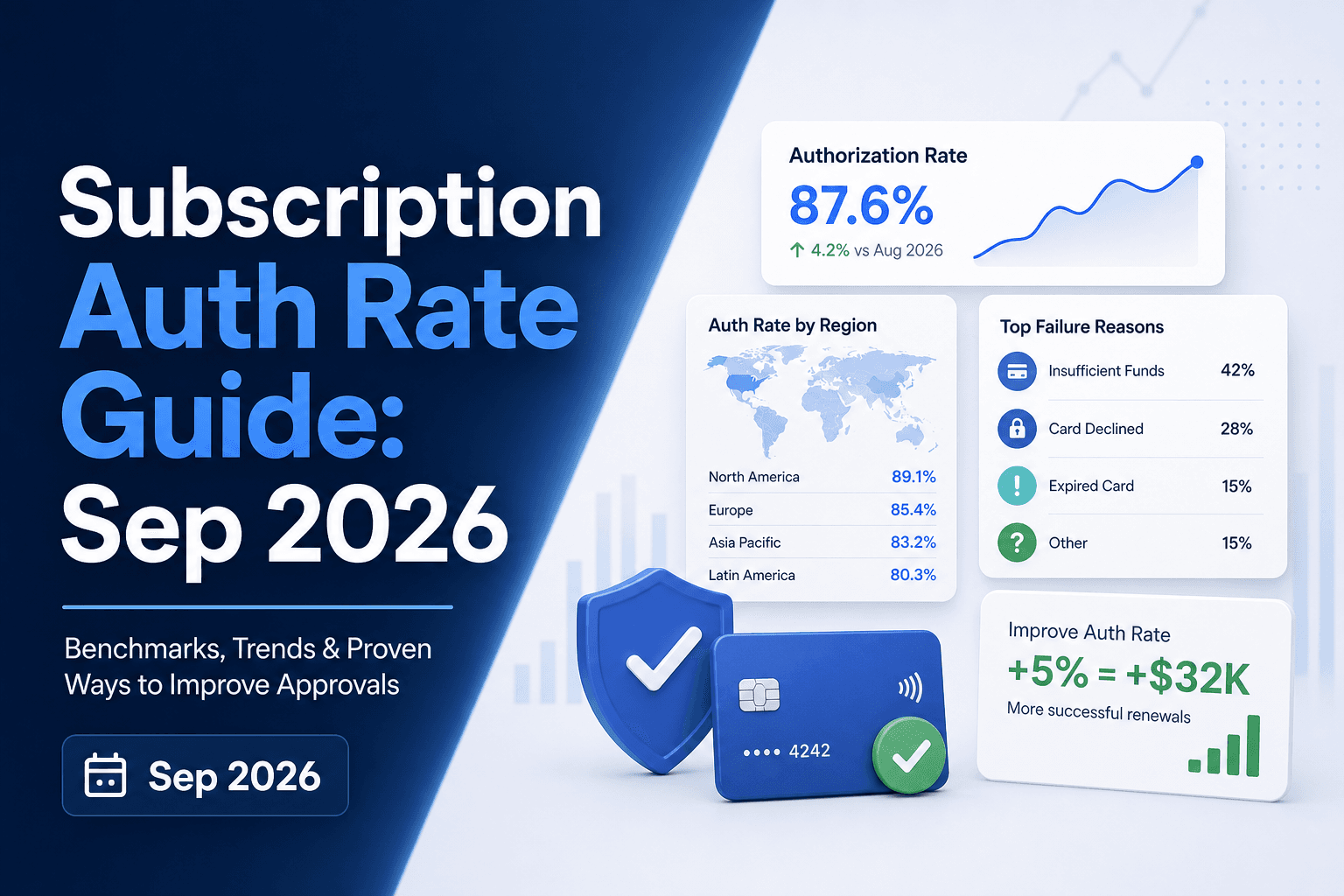
Authorization Rate in Subscription Billing: October 2026
There's a number sitting in your payments data that most finance and retention teams never report on separately: the share of renewal charges your issuing...
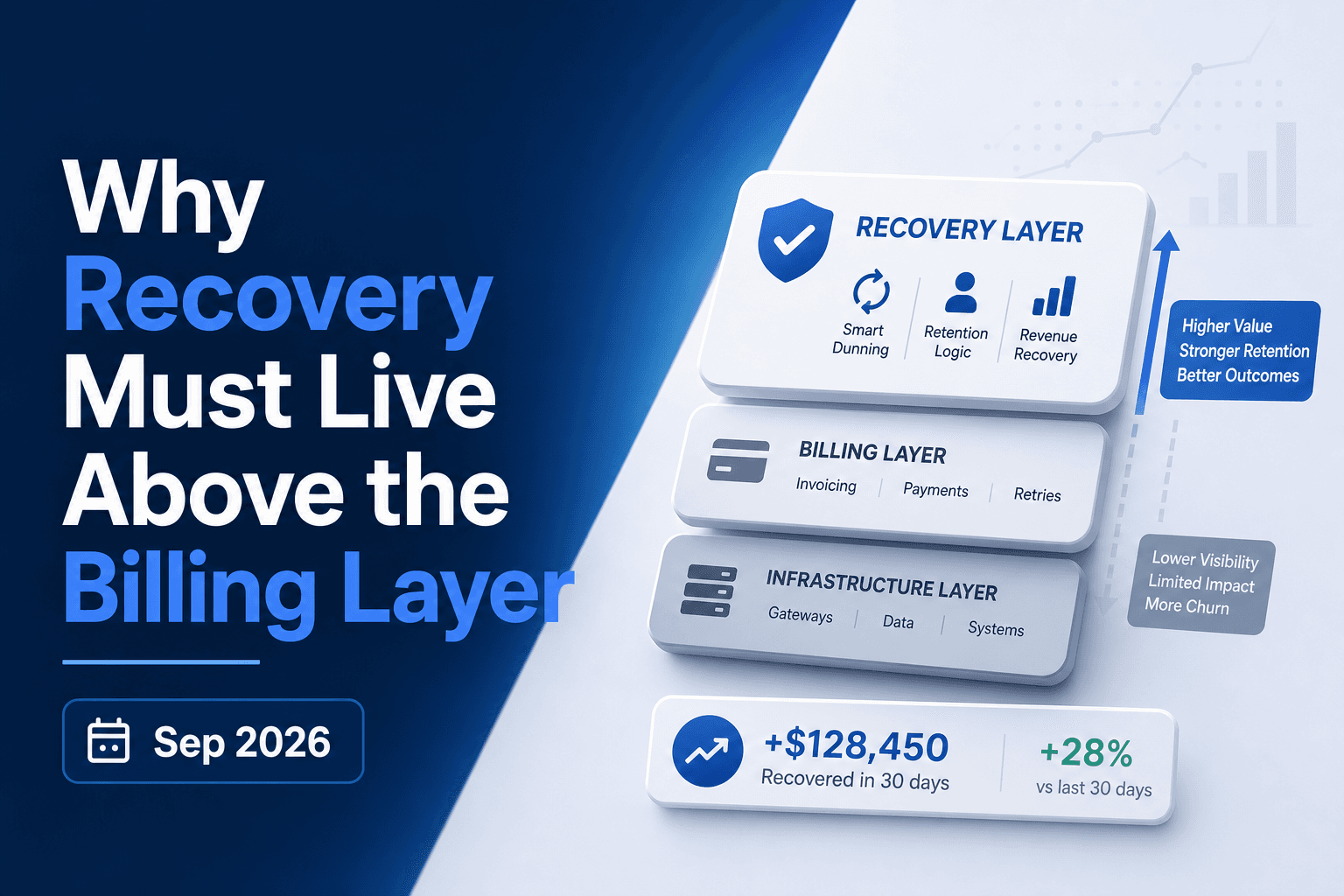
Why Payment Recovery Must Live Above Billers October 2026
A payment fails. Your biller retries it three days later, then again at seven, then at fourteen. What the biller never checks is whether the issuer sent a...
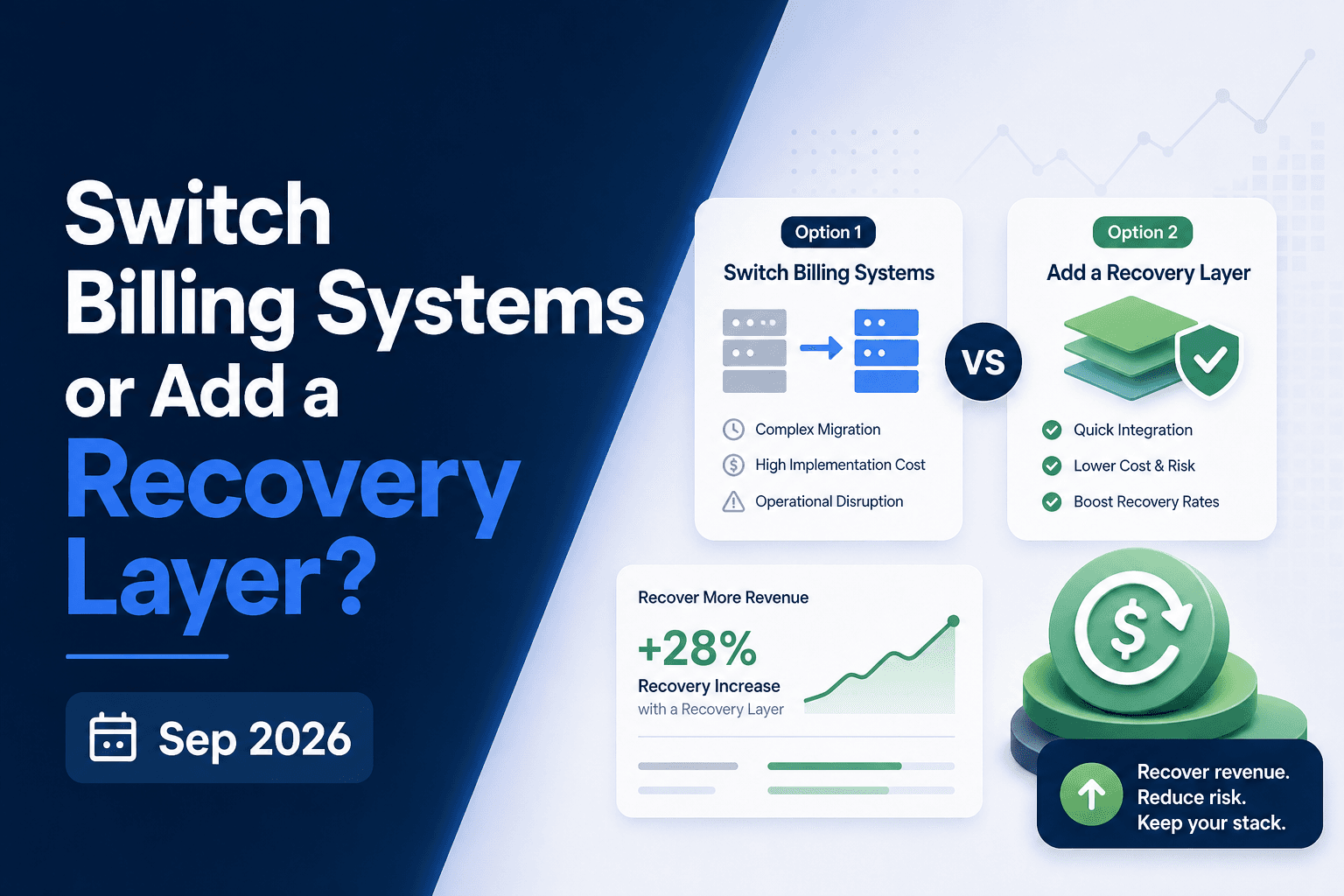
Billing Migration vs Recovery Layer: The Right Call October 2026
Switching billing systems feels like the right move when revenue collection starts breaking down. Sometimes it is. But soft declines, weak retry logic, and...
Stop losing revenue to failed payments
Join leading subscription businesses using Slicker to recover failed payments automatically.
Get Started