AI for Failed Payment Recovery in Subscription SaaS (October 2026)
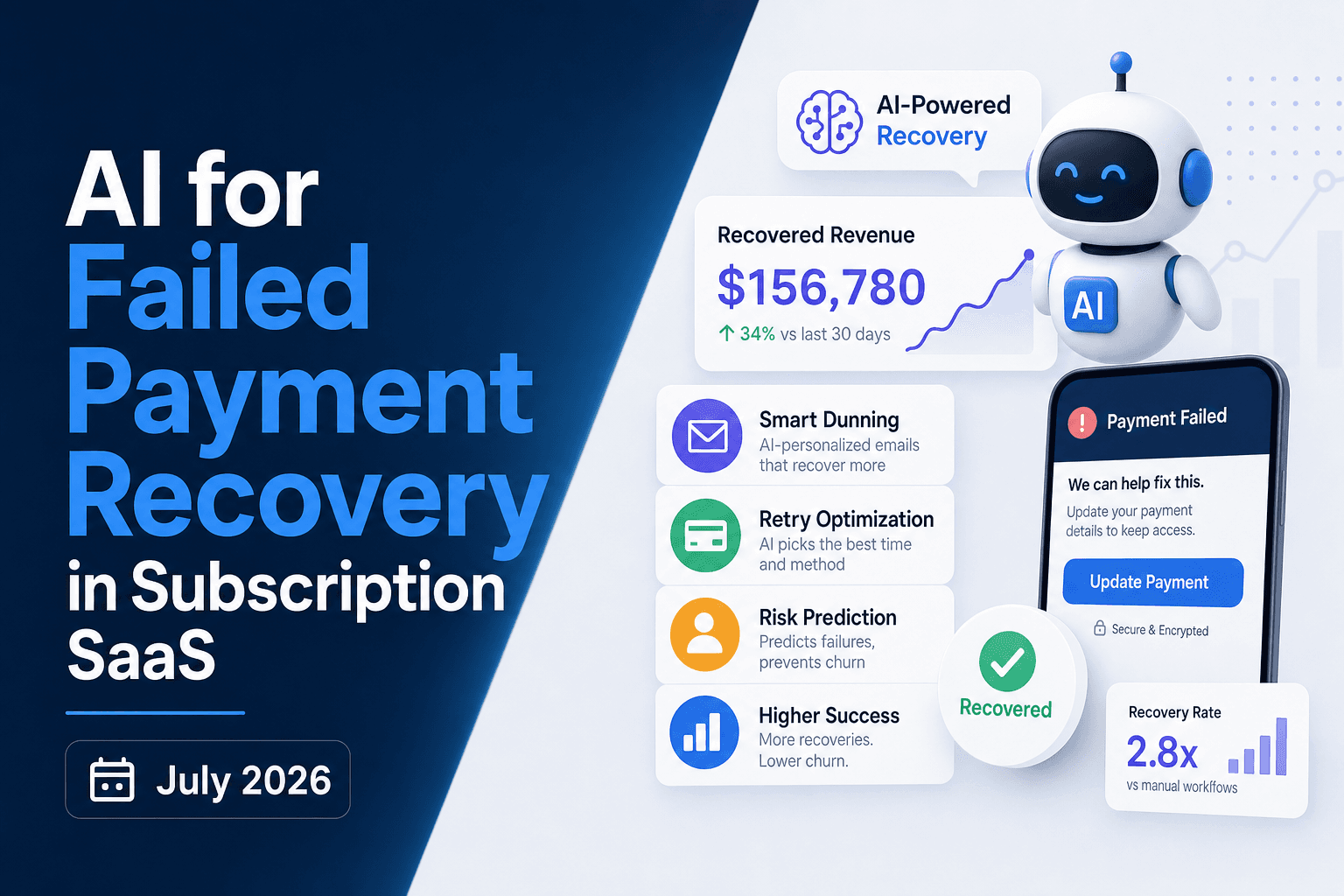
I'll be frank: most of the failed payment recovery advice out there focuses on dunning, when the bigger win is usually in the retry logic that runs before a single email gets sent. AI failed payments systems read decline codes, issuer patterns, and geographic pay cycles to pick the right recovery window per subscriber. The result is more payments clearing silently, fewer customers getting friction they didn't deserve, and less involuntary churn on your MRR. Here's how it all fits together.
TLDR:
- Industry data shows 10-15% of recurring payments fail first attempt, putting $1M-$1.5M at risk annually per $10M ARR (annual recurring revenue).
- AI recovery separates soft declines (retryable) from hard declines (require customer action), routing each to the right response.
- Retry timing by geography materially affects recovery: US windows cluster on the 1st, 15th, and Fridays; India on the 1st and 7th.
- MAC signals tell you whether to retry, stop, or escalate to dunning before you waste attempts or damage your merchant ID (MID) health.
- Slicker's Artificial Payments Intelligence runs retry timing, dunning, and recovery sequencing on autopilot with no engineering required, verified via AABB (AA/BB split) testing on your own data.
The True Cost of Failed Payments in Subscription SaaS
Industry data shows roughly 10 to 15% of recurring subscription payments fail on the first attempt. For a SaaS company with $10M in annual recurring revenue (ARR), that translates to $1M to $1.5M in revenue at risk every year, before a single customer has decided to cancel.
Most of that risk is invisible. Failed payments don't show up as lost sales; they surface quietly as involuntary churn, the kind that happens when a willing, paying customer gets dropped because their card declined. Unlike voluntary churn, there's no cancellation signal to act on. Research shows 50% of subscription churn stems from failed card payments, and 80% of those failures are unrelated to anything the subscriber did wrong. The subscriber wanted to stay.
The downstream cost compounds fast. Every failed payment that goes unrecovered accelerates involuntary churn, which erodes monthly recurring revenue (MRR) and drives up customer acquisition cost (CAC) as teams scramble to replace subscribers who never intended to leave.
Soft Declines vs. Hard Declines: Why the Distinction Drives Recovery Strategy
Not every declined payment signals the same problem, and conflating them is one of the most expensive mistakes a subscription business can make.
Soft declines are temporary. Insufficient funds, a bank-side timeout, or an issuer's fraud hold can all resolve on their own within hours or days. Hard declines are permanent: a stolen card, a closed account, or a card reported as fraudulent cannot be retried successfully no matter how many times you try.
Where AI Changes the Equation
This is where AI payment recovery separates from generic retry logic. An AI model can read the decline code, cross-reference it with issuer behavior patterns, account history, and card type, and route the payment accordingly: retry at the optimal window for soft declines, or trigger a targeted dunning sequence for hard declines that actually require customer action.
Treating every failed payment the same way, whether with a batch payment retry or a generic "update your payment info" email, wastes retry attempts on hard declines and misses recovery windows on soft ones. The revenue difference between a well-routed and a poorly-routed strategy is measurable across any high-volume subscriber base.
Where Static Retry Schedules Break Down
Subscription billing systems have relied on fixed retry schedules for decades: attempt on day one, retry on day three, try again on day seven. The logic is simple, but simplicity is the problem. A card declined for insufficient funds on a Monday behaves very differently from one flagged for suspected fraud on a Friday afternoon. Retrying both on the same schedule is, at best, a coin flip.
Industry data shows roughly 15% of recurring payments are declined at least once, and a meaningful share of those failures are soft declines that could be recovered with better timing. Fixed schedules ignore the variables that actually predict success: issuer behavior, day-of-week patterns, account type, geography, and the specific decline code returned. The gap between static vs adaptive retry logic is where revenue is won or lost.
The Cost of One-Size-Fits-All Logic
Every unnecessary retry has a price. Issuers track retry frequency, and merchants who bombard a declined card too aggressively risk being flagged, rate-limited, or penalized under network retry rules. Failed retries also erode authorization rates over time by signaling poor payment hygiene to card networks.
The revenue consequence is direct: soft-declined subscribers who could have been recovered silently instead receive a dunning email, introducing friction that increases voluntary cancellation risk on top of the original involuntary churn event. Static schedules do not distinguish between those two outcomes. AI-powered retry logic does.
How AI Determines Whether, When, and How to Retry
Three variables govern every retry decision: whether to attempt it at all, when to schedule it, and how to present the transaction to the issuer. Static billing tools apply the same answer to all three regardless of context. AI engines analyze dozens of signals simultaneously: decline code, card type, BIN, geography, account history, and issuer behavior patterns. They produce a distinct answer for each subscriber, because retrying generic declines without that context wastes attempts.
Timing alone creates material revenue differences. Retrying a soft decline on a paycheck-to-paycheck subscriber at 9 PM Tuesday versus Wednesday morning after funds clear produces measurably different outcomes. AI models learn those windows by issuer, region, and subscriber segment instead of applying a universal schedule.
What AI Weighs Before Each Retry
The decision layer typically ingests:
- The specific decline code and whether it signals a temporary liquidity gap or a card-level issue requiring customer action
- Issuer-level patterns, including how a given bank tends to behave around authorization windows and balance cycles
- Subscriber history, covering prior recovery outcomes, payment cadence, and account tenure
- Geographic timing signals tied to regional pay cycles (US biweekly paydays, UK monthly salary runs, India's varied pay frequency by employer type)
Hard declines (stolen cards, closed accounts) exit the retry queue immediately and route to dunning. Soft declines stay in the automated recovery loop until the window closes or the payment clears, keeping the subscriber experience silent and uninterrupted.
The business outcome is fewer wasted retry attempts burning authorization capacity, and more recoveries landing on the first or second try, not the fourth or fifth.
Retry Timing by Geography: Payday Cycles and Regional Windows
Retry windows vary more by geography than most billing teams expect. A retry fired on the wrong day in the wrong market will fail at a measurably higher rate, and those losses compound across a subscriber base.
Regional Windows to Know
- In the US, the strongest recovery windows fall on the 1st and 15th of each month, plus Fridays, when payday retry scheduling around direct deposit cycles typically clears failed payments.
- In Western Europe and the UK, mid-month SEPA settlement cycles and weekly payroll patterns make mid-week retries (Tuesday through Thursday) the most productive window.
- In India, salary credit dates cluster around the 1st and 7th of the month, making early-month retries materially more likely to succeed than retries fired mid-cycle.
- In Australia, monthly salary cycles mean end-of-month and early-month retries (around the 25th through the 3rd) produce the strongest recovery rates.
Getting this right is not a configuration toggle. AI models that have been trained on issuer-level decline patterns can read soft decline signals alongside geographic context to pick the retry window with the highest probability of approval for each individual subscriber. That per-subscriber precision is what separates intelligent retry logic from a fixed schedule, and the revenue difference across a high-volume base is real.
Merchant Advice Codes: Reading Network Signals Before Retrying
When a payment fails, the card network often tells you exactly why, and what to do next. Merchant Advice Codes (MACs) are standardized signals embedded in decline responses that carry issuer intent: retry is welcome, retry is futile, or customer action is required first.
Without MACs, retry logic is guesswork. AI payment recovery engines read these codes before scheduling any retry, separating recoverable soft declines from hard stops that would only trigger fraud flags or strain issuer relationships if retried blindly. Mastercard's updated MAC framework gives merchants clearer signals on when retries are appropriate, and when they'll incur penalties.
The Three MAC Categories That Matter
MACs sort declines into three actionable buckets:
MAC Category | What It Signals | AI Recovery Action | Revenue Impact |
|---|---|---|---|
Retry appropriate | Account in good standing; temporary liquidity or issuer-side issue | Schedule retry at optimal timing window based on geography, issuer, and payday cycle | Silent recovery: subscriber experiences no friction; MRR preserved |
Do not retry | Card blocked, account closed, or issuer has flagged the transaction | Exit retry queue immediately; route to failure-specific dunning sequence | Avoids wasted attempts, protects merchant ID (MID) health and authorization rates |
Customer action required | Stolen card, expired card, or 3D Secure (3DS) authentication failure | Trigger targeted dunning with messaging matched to the exact failure reason | No retry will clear; dunning is the only recovery path, and generic emails leave revenue on the table |
AI failed payments systems route each decline code into the correct lane automatically. A do-not-retry signal triggers dunning, avoiding a wasted retry attempt. A retry-appropriate signal feeds into the timing and amount logic that governs when and how the next attempt is made.
Reading MACs accurately before acting is what separates intelligent recovery from brute-force retry schedules, and it directly protects your merchant ID (MID) health in the process.
When Silent Recovery Is Not Enough: Failure-Specific Dunning
When automated retries have exhausted their options, the failure code determines what comes next. Hard declines on stolen or expired cards require the subscriber to act, and that means outreach. But generic "update your payment info" emails leave recovery rates on the table.
AI-driven dunning sequences personalize messaging to the exact failure reason. A subscriber whose card was reported stolen gets a fraud-alert message prompting them to contact their bank and add a new payment method, delivered via SMS and email within two hours of the decline. An expired card triggers an email the following morning at 9 AM with a direct link to update card details. A soft decline for insufficient funds, by contrast, routes back to the automated retry queue instead of triggering outreach at all. Timing, copy, and channel each adapt to the specific failure code.
Recovery happens quietly when possible. Dunning is the fallback, deployed only when the error genuinely requires customer action.
Multi-Payment Method Orchestration
When a payment fails, the card on file is rarely the only option. Many subscribers have multiple cards saved, digital wallets, or bank accounts that could complete the transaction silently, without any customer involvement.
AI payment recovery systems can detect which alternative method has the highest likelihood of success for a given subscriber, using multi-gateway routing to route the retry accordingly. A subscriber with a declined Visa might have an active Mastercard or a linked bank account that clears without issue.
This kind of multi-method orchestration keeps revenue recovery invisible to the customer, which protects the relationship while recovering the MRR you already earned.
How to Measure AI Payment Recovery Performance
Two metrics matter most: recovery rate uplift and incremental revenue recovered.
Recovery rate uplift measures how many more failed payments succeed compared to your previous approach. Incremental revenue recovered translates that into dollars, accounting for subscription value and retry volume.
Running a Clean Test
The only reliable way to attribute results to AI is a controlled split test. Run your AI recovery logic against a holdout group on identical traffic, measure recovered dollars on both sides, and check for statistical significance before drawing conclusions. Without that rigor, you are measuring noise.
Connect those results to MRR (monthly recurring revenue) impact and involuntary churn reduction to complete the picture for finance.
How Slicker Reduces Failed Payments for Subscription SaaS
Slicker's Artificial Payments Intelligence sits on top of your existing billing infrastructure with no engineering required. Setup takes roughly five minutes, and from there, an ensemble of AI models handles retry timing, dunning personalization, and recovery sequencing on autopilot.
Every retry decision is informed by card type, issuer behavior, BIN (Bank Identification Number)-level patterns, and subscriber history. Instead of firing retries on a fixed schedule, the system reads real signals to choose the highest-probability recovery window for each individual transaction.
Results are verified through clinical-grade AABB testing in payment recovery on your own data, with statistical significance confirmed before you commit. If Slicker doesn't outperform your control, you don't pay.
Final Thoughts on Reducing Involuntary Churn With AI Payments
A lot of involuntary churn is recoverable revenue that slipped through because the retry logic was too blunt. Smarter routing by decline type, geography, and timing changes that, and the results land directly on your MRR. See Slicker's impact on your data before you commit.
FAQ
What's the difference between AI payment recovery and static retry logic for subscription billing?
Static retry logic fires on a fixed calendar regardless of why the payment failed, which wastes attempts on hard declines and misses the optimal recovery window on soft ones. AI payment recovery reads the decline code, card type, issuer behavior, and geographic payday signals before acting, producing a distinct retry decision for each individual transaction. Slicker's ensemble of AI models analyzes card type, BIN, issuer behavior, geography, and subscriber history per transaction, with recovery rates on recoverable failed payments verified via AABB testing on your own data.
How do I measure whether AI payment recovery is actually working or just recovering payments that would have cleared anyway?
Run a controlled split test: divide failed payments into a treatment group (AI recovery logic) and a control group (your existing approach) on identical traffic, then measure recovered dollars on both sides and confirm statistical significance before drawing conclusions. Without that structure, you are attributing noise to the tool. Slicker uses clinical-grade AABB testing on your own transaction data, reports p-values and confidence intervals, and ties results directly to MRR impact so finance has a number they can defend.
When should I trigger dunning emails vs. letting AI retries handle a failed payment silently?
Let automated retries run first for soft declines (insufficient funds, temporary bank holds, network timeouts), where the card is valid and the failure is likely to resolve without any subscriber involvement. Dunning is the fallback, deployed only when the decline code confirms customer action is required, such as a stolen card, an expired card, or a 3D Secure (3DS) authentication failure that no retry will clear. Sending a dunning email on a soft decline introduces friction that raises voluntary cancellation risk on top of the original involuntary churn event.
Slicker vs. Stripe Smart Retries: which recovers more failed payments for a high-volume subscription business?
Slicker recovers measurably more than Stripe Smart Retries for high-volume merchants because it analyzes decline codes at the issuer and BIN level, applies hour-level retry timing instead of date-based scheduling, and can sequence retries across multiple payment methods on file instead of retrying the same instrument. Stripe Smart Retries applies a single retry schedule and does not switch between stored payment methods. Slicker runs alongside Stripe instead of replacing it, and the incremental lift is verified through AABB testing on your own data before you commit.
What is a Merchant Advice Code (MAC) and why does it matter for AI failed payments recovery?
A Merchant Advice Code is a standardized signal embedded in a card network decline response that tells a merchant whether to retry, wait a specific number of days, stop entirely, or request updated payment details from the cardholder. Ignoring MACs costs money: Mastercard charges a $0.10 penalty per retry attempt when a transaction is retried after receiving a Do Not Try Again (MAC code 03) response. AI payment recovery engines read MACs before scheduling any retry, routing do-not-retry declines straight to failure-specific dunning and keeping recoverable soft declines in the automated retry loop.
Related Articles
Why Payment Recovery Must Live Above Billers October 2026
A payment fails. Your biller retries it three days later, then again at seven, then at fourteen. What the biller never checks is whether the issuer sent a...
Billing Migration vs Recovery Layer: The Right Call October 2026
Switching billing systems feels like the right move when revenue collection starts breaking down. Sometimes it is. But soft declines, weak retry logic, and...
Stripe Billing Recovery Layer Setup Time: October 2026
Adding a recovery layer on top of Stripe Billing sounds like the kind of thing that goes on a quarterly roadmap and gets delayed twice. For most teams, it's...
Stop losing revenue to failed payments
Join leading subscription businesses using Slicker to recover failed payments automatically.
Get Started