AI-Powered Soft Decline Retry Schedules: October 2026

Introduction
Soft declines rank among the most frustrating challenges in subscription commerce: payments that fail not due to insufficient funds, but because of temporary issues like network timeouts, bank processing delays, or security checks. Unlike hard declines that signal definitive problems, soft declines offer a window of opportunity for recovery, but only if you retry at the right moment with the right approach.
Up to 70% of involuntary churn stems from failed transactions. These are customers who never intended to leave but are forced out when a card is declined. The stakes are enormous: in some industries, decline rates reach 30%, and each one represents a potential lost subscriber. Even more concerning, according to BridgerPay research, a staggering 62% of users who hit a payment error never return to the site.
This is where intelligent retry schedules powered by machine learning change the game entirely. AI-driven payment recovery flips the script, with machine-learning engines predicting the perfect moment, method, and gateway for each retry, lifting recovery rates 2-4× above native billing logic. Modern platforms like Stripe Smart Retries, Chargebee Smart Dunning, and Slicker's proprietary AI engine are leading this revolution, each bringing unique approaches to the challenge of optimizing retry timing.
TLDR:
- Soft declines are temporary failures (network timeouts, security holds) that recover with precise retry timing, unlike hard declines.
- Up to 70% of involuntary churn comes from failed payments; 62% of customers who hit a payment error never return.
- AI-powered smart retries consistently reach 70-85% recovery on soft declines; fixed calendar schedules land between 40-60%.
- ACH returns follow Nacha rules, not card network rules; applying card retry logic to ACH entries is a compliance violation.
- Slicker's AI engine processes each failed payment individually with multi-gateway routing, integrating into your existing billing stack in 5 minutes with no code changes.
Understanding Soft Declines vs Hard Declines
Before covering retry strategies, understanding what makes soft declines different from their hard counterparts is foundational. Hard declines are definitive rejections: expired cards, closed accounts, or insufficient funds that won't resolve with simple retries. Soft declines, however, are temporary failures that often resolve themselves within hours or days.
Common soft decline scenarios include:
- Network timeouts during peak processing periods
- Temporary security holds triggered by unusual spending patterns
- Bank processing delays during maintenance windows
- Velocity checks that flag rapid successive transactions
- International processing hiccups for cross-border payments
The global subscription market is projected to reach $1.2 trillion by 2030, making effective soft decline management a trillion-dollar opportunity. Merchant-Initiated Transactions (MITs) demand special attention to prevent involuntary churn, increase customer lifetime value, and maintain steady cash flow.
The Cost of Getting It Wrong
Traditional retry logic follows rigid, one-size-fits-all schedules that typically attempt retries at fixed intervals like 24 hours, 72 hours, and 7 days. Static retry logic ignores the subtle factors that influence payment success rates and often results in:
- Retry fatigue from too-frequent attempts
- Missed opportunities from waiting too long
- Increased processing costs from unnecessary attempts
- Customer frustration from poorly timed retry notifications
Paddle's 2023 analysis of 2,000+ SaaS companies found involuntary churn accounts for 13-15% of total churn across segments. This represents millions in lost revenue that could be recovered with smarter retry strategies.
The Machine Learning Revolution in Payment Retries
How AI Changes the Game
AI identifies the hidden patterns that human-designed rules miss. Modern models ingest geography, currency, pay cycles, and error codes to choose smarter retry times, sometimes within hours and sometimes after payday, improving approval odds dramatically.
The key insight driving this revolution is that every failed payment has a unique "fingerprint" of contributing factors:
- Temporal patterns: When during the month, week, or day the failure occurred
- Geographic factors: Regional banking practices and processing windows
- Customer behavior: Historical payment patterns and preferences
- Decline codes: Specific reasons provided by the issuing bank
- Payment method: Card type, issuer, and processing network
- Transaction context: Amount, currency, and merchant category
Smart dunning systems can lift recovery rates by up to 25% compared with static rules. This improvement comes from the ability to process vast amounts of transaction data and identify subtle patterns that inform optimal retry timing.
Platforms like Slicker "process each failing payment individually and convert past-due invoices into revenue" by applying proprietary AI models. Adaptive retries represent a measurable leap forward because the system "analyzes nuances in real time, delivering higher accuracy and success."
Stripe Smart Retries: The Pioneer's Approach
Adaptive Timing Based on Decline Codes
Stripe Smart Retries pioneered the concept of decline-code-specific retry logic. Instead of applying uniform retry schedules, the system analyzes the specific reason for each decline and adjusts timing accordingly:
Decline Code Category | Typical Retry Schedule | Reasoning |
|---|---|---|
Temporary holds | 2-6 hours | Security reviews often resolve quickly |
Processing errors | 30 minutes - 2 hours | Network issues are typically short-lived |
Velocity limits | 24-48 hours | Banks need time to reset transaction counters |
International blocks | 1-3 days | May require customer intervention |
Stripe's ML models continuously learn from millions of transactions, identifying patterns that improve retry success rates. The system considers:
- Historical success rates for similar decline scenarios
- Issuer-specific patterns based on bank processing behaviors
- Customer payment history to predict optimal retry windows
- Seasonal factors that affect payment processing
This approach has helped Stripe customers recover payments that would otherwise be lost, though specific recovery rate improvements vary by merchant and industry.
Chargebee Smart Dunning: The Subscription Specialist
Subscription-Optimized Retry Logic
Chargebee Smart Dunning takes a subscription-first approach, recognizing that recurring payments have different dynamics than one-time transactions. The system optimizes for:
- Customer lifecycle stage: New subscribers vs. long-term customers
- Subscription value: Higher-value subscriptions get more aggressive retry attempts
- Payment history: Customers with good payment history receive extended retry windows
- Billing cycle alignment: Timing retries around customer cash flow patterns
Chargebee reports that dunning systems with automatic card-updater services "recover up to 20% more invoices before a retry is even needed." This proactive approach handles expired cards and updated payment information before failures occur.
Smart Dunning integrates retry attempts with customer communication, sending targeted emails and in-app notifications that:
- Explain the payment issue without causing alarm
- Provide easy payment update mechanisms
- Offer alternative payment methods
- Include personalized retry schedules based on customer preferences
Slicker's Proprietary AI Engine: The Next Generation
Individual Payment Processing
Slicker's approach represents the cutting edge of AI-powered payment recovery. Instead of applying broad rules, Slicker's proprietary AI engine processes each failed payment individually and schedules an intelligent, data-backed retry instead of blindly following generic decline-code rules.
This individualized approach considers dozens of parameters for each failed transaction:
- Real-time bank processing patterns
- Customer-specific payment behaviors
- Geographic and temporal factors
- Historical success rates for similar scenarios
- Cross-gateway performance data
Multi-Gateway Intelligence
One of Slicker's key differentiators is its ability to route retries across multiple payment gateways. The AI engine determines both when to retry and which gateway offers the highest probability of success for each specific transaction. This multi-gateway approach can measurably improve recovery rates by:
- Avoiding gateway-specific issues that caused the initial decline
- Drawing on different bank relationships across payment processors
- Optimizing for regional processing strengths
- Reducing dependency on any single payment infrastructure
Performance Results
Customers consistently see measurably higher recovery rates and a 2-4× boost versus native billing logic, validated via AABB testing on their own data. This dramatic improvement comes from the combination of:
- Precise timing optimization based on individual transaction characteristics
- Multi-gateway routing that maximizes approval chances
- Continuous learning from every retry attempt across the system
- Real-time adaptation to changing payment processing conditions
Despite its sophisticated AI engine, Slicker offers 5-minute setup with no code changes, plugging into Stripe, Chargebee, Recurly, Zuora, and Recharge. This ease of implementation removes traditional barriers to adopting advanced payment recovery technology.
Best Practices for Adaptive Retry Schedules
1. Segment by Decline Code Categories
Not all soft declines are created equal. Effective adaptive retry schedules start with proper categorization:
Immediate Retry Candidates (0-30 minutes):
- Network timeouts
- Temporary processing errors
- Gateway communication failures
Short-Term Retry Candidates (2-6 hours):
- Security holds
- Fraud screening delays
- Velocity limit triggers
Medium-Term Retry Candidates (24-72 hours):
- International processing blocks
- Bank maintenance windows
- Unusual activity flags
Long-Term Retry Candidates (3-7 days):
- Complex security reviews
- Cross-border compliance checks
- Customer intervention required
2. Build In Customer Context
The most effective retry schedules consider individual customer characteristics:
- Payment history: Long-term customers with good payment records deserve more retry attempts
- Subscription value: Higher-value customers warrant more aggressive recovery efforts
- Geographic location: Regional banking practices affect optimal retry timing
- Communication preferences: Some customers prefer immediate notification, others want minimal contact
3. Optimize for Customer Experience
Payment retry strategies to combat involuntary churn must balance recovery effectiveness with customer satisfaction. Best practices include:
- Transparent communication about payment issues and retry attempts
- Easy payment update mechanisms that don't require customer service contact
- Flexible retry schedules that accommodate customer preferences
- Alternative payment options when primary methods consistently fail
4. Draw on Real-Time Data
Static retry schedules become obsolete quickly in the fast-changing payments world. Effective systems continuously adapt based on:
- Real-time success rate data for different retry scenarios
- Seasonal patterns that affect payment processing
- Gateway performance metrics that inform routing decisions
- Customer feedback about retry timing preferences
5. Implement Intelligent Escalation
Not every failed payment should follow the same retry path. Intelligent escalation considers:
- Retry attempt history to avoid infinite loops
- Customer engagement levels to determine communication frequency
- Alternative payment methods when primary options consistently fail
- Manual intervention triggers for high-value or complex cases
Measuring Success: Key Metrics for Adaptive Retry Schedules
Recovery Rate: The percentage of initially failed payments that are successfully recovered through retry attempts. Payment retry can help recover up to 50% of failed transactions when implemented effectively.
Time to Recovery: How quickly failed payments are successfully processed after the initial decline. Faster recovery reduces involuntary churn and improves cash flow.
Retry Precision: The ratio of successful recoveries to total retry attempts. A higher ratio indicates better targeting and timing of retry efforts.
Customer Retention: The percentage of customers who remain active after experiencing payment failures. This metric directly ties payment recovery to business outcomes.
Communication Effectiveness: Response rates to payment failure notifications and customer satisfaction with the retry process.
Support Ticket Volume: Reduction in customer service contacts related to payment issues, indicating smoother automated recovery processes.
Processing Cost per Recovery: The total cost of retry attempts divided by successful recoveries, helping optimize the economic performance of retry strategies.
Gateway Performance: Success rates across different payment processors, informing routing decisions for future transactions.
Decline Code Analysis: Tracking the distribution and recovery rates of different decline types to refine retry logic.
Implementation Roadmap: Getting Started with Adaptive Retries
Phase 1: Assessment and Planning (Weeks 1-2)
- Audit Current Retry Logic: Document existing retry schedules and identify improvement opportunities
- Analyze Decline Patterns: Review historical payment data to understand decline code distribution and current recovery rates
- Define Success Metrics: Set baseline measurements and target improvements
- Review Your Options: Compare solutions like Stripe Smart Retries, Chargebee Smart Dunning, and Slicker's AI engine
Phase 2: Solution Selection and Setup (Weeks 3-4)
- Choose Your Solution: Select the tool that best fits your technical requirements and business model
- Configure Initial Rules: Set up basic adaptive retry logic based on decline code categories
- Integrate Communication: Connect retry attempts with customer notification systems
- Test in Sandbox: Validate retry logic with test transactions before going live
Phase 3: Gradual Rollout (Weeks 5-8)
- Start with Low-Risk Segments: Begin with small transaction amounts or specific customer segments
- Monitor Performance: Track recovery rates, customer feedback, and execution metrics
- Refine Rules: Adjust retry timing and logic based on initial results
- Scale Gradually: Expand to larger customer segments as confidence grows
Phase 4: Optimization and Advanced Features (Weeks 9-12)
- Implement ML Enhancements: Activate machine learning features for more sophisticated retry scheduling
- Add Multi-Gateway Routing: If available, activate intelligent payment processor selection
- Customize Customer Segments: Create specialized retry logic for different customer types
- Integrate Advanced Analytics: Set up full-coverage reporting and alerting systems
Advanced Strategies: Beyond Basic Adaptive Retries
Predictive Retry Scheduling
The most advanced systems don't merely react to payment failures; they predict them. By analyzing patterns in customer payment behavior, these systems can:
- Preemptively update expired cards before they cause failures
- Adjust billing dates to align with customer cash flow patterns
- Identify at-risk payments before they fail and take preventive action
- Optimize payment timing based on individual customer preferences
Cross-System Intelligence
For businesses using multiple payment processors or billing systems, cross-system intelligence provides major advantages:
- Unified retry logic across all payment channels
- Shared learning from retry attempts across different systems
- Coordinated customer communication to avoid duplicate notifications
- Unified performance analytics that span multiple platforms
Advanced retry systems integrate with customer behavior data to optimize timing:
- App usage patterns to identify when customers are most likely to update payment information
- Email engagement to time retry notifications with high-engagement periods
- Support interaction history to adjust communication frequency and tone
- Purchase behavior to predict optimal retry windows based on buying patterns
Reducing Involuntary Churn in 2026: The Full Toolkit
Smart retries are the recovery layer, but they work best when layered on top of a prevention stack that keeps cards from failing in the first place. For SaaS businesses in 2026, reducing involuntary churn to its irreducible minimum requires four coordinated layers.
Layer 1: Account Updater Services
Account Updater (AU) is a network service that automatically refreshes expired or replaced card credentials before a billing cycle runs, so the retry engine never has to fight a battle caused by stale card data. Visa's Account Updater and Mastercard's Automatic Billing Updater (ABU) are available through most major processors; Chargebee reports that dunning systems paired with automatic card-updater services recover up to 20% more invoices before a retry is even attempted. Stripe surfaces this via its Smart Retries infrastructure; Recurly provides it through its Revenue Recovery suite.
AU works best for subscription businesses with long-tenured customers, the cohort most likely to have replaced a card without thinking to update their billing details. If your churn analysis shows a spike at 12 to 18 months of tenure, AU is frequently the highest-ROI intervention available.
Layer 2: Network Tokens
Network tokens replace the 16-digit PAN stored in your billing system with a payment-network-issued token that automatically updates when the underlying card is reissued. Unlike AU, which corrects credentials after they go stale, network tokenization means credentials never go stale to begin with. Visa and Mastercard publish measurably higher authorization rates on tokenized credentials versus raw PANs; Stripe's network token documentation cites improved approval rates across card-on-file recurring billing as a direct result of token-level credential freshness. For SaaS stacks running on Chargebee or Recurly, both platforms support network token passthrough via their gateway integrations, so confirm with your gateway that tokenization is active on your merchant account.
Layer 3: AI-Powered Smart Retries
Once the card credential is fresh and valid, the retry engine determines when and how to process. This is where the gap between static retry logic and AI-powered adaptive scheduling compounds. Static logic wastes retries on the wrong windows and misses payday-aligned peaks; AI models that ingest geography, issuer behavior, decline codes, and customer payment history consistently reach 70-85% recovery on soft declines versus 40-60% for fixed calendar schedules. Platforms like Slicker add multi-gateway routing on top of timing intelligence, selecting both when to retry and which processor gives the highest authorization probability for each specific transaction.
Layer 4: Dunning Communication Sequencing
For the subset of failures that require customer action, such as genuinely expired cards not yet refreshed by AU, closed accounts, or bank blocks requiring cardholder intervention, a well-sequenced dunning communication flow closes the loop. Best practice in 2026 combines in-app banners, targeted email, and SMS with a single-click card update mechanism. Timing matters: send the first notification within 24 hours of the initial decline, while the customer is most likely to recall the subscription; escalate cadence only if earlier messages go unengaged. Platforms like Chargebee's Smart Dunning and Slicker's customer-facing communication layer automate this sequencing, pausing outreach once a retry succeeds so customers are not alerted about a problem that has already been resolved.
Together, these four layers (AU, network tokens, AI smart retries, and dunning communication) set the 2026 standard for a subscription business that takes involuntary churn seriously. Companies that deploy all four consistently report involuntary churn rates below 1% of MRR, versus the 2 to 4% common in businesses relying on billing-provider defaults alone.
The Future of Payment Recovery
The payment recovery field continues to evolve with new technologies and approaches:
Real-Time Bank APIs: Direct integration with banking systems for instant payment status updates and retry optimization.
Blockchain-Based Verification: Immutable transaction records that improve fraud detection and reduce false declines.
Voice and Biometric Authentication: Alternative verification methods that reduce security-related declines.
Open Banking Integration: Access to customer financial data for more informed retry timing and payment method recommendations.
Several trends are shaping the future of adaptive retry schedules:
Increased Personalization: Retry schedules tailored to individual customer preferences and behaviors.
Regulatory Compliance: Enhanced focus on data privacy and customer consent in retry communications.
Cross-Border Optimization: Specialized retry logic for international transactions and multi-currency scenarios.
Sustainability Focus: Optimizing retry attempts to reduce unnecessary processing and environmental impact.
Failed ACH and Direct Debit Payments: A Different Set of Rules
Card payment retries operate under Visa and Mastercard network rules. ACH and direct debit failures operate under an entirely separate regulatory framework, namely Nacha's Operating Rules, and the retry logic that works for soft-declined cards will get you into compliance trouble if applied to returned ACH entries. The distinction matters more as SaaS companies expand into bank-debit billing for enterprise and SMB customers.
ACH Return Codes and What They Mean for Retries
Where card declines arrive as two-digit response codes, ACH returns arrive as Nacha standardized return codes with specific reinitiation rules attached. The most practically important codes for subscription billing are:
Return Code | Reason | Retry Permitted? | Key Constraint |
|---|---|---|---|
R01 | Insufficient Funds | Yes, up to 2 retries | Maximum 2 reinitiation attempts after the original return |
R09 | Uncollected Funds | Yes, up to 2 retries | Same reinitiation limit as R01 |
R02 | Account Closed | No | Hard stop; requires customer account update |
R03 | No Account / Unable to Locate | No | Hard stop; requires customer account update |
R04 | Invalid Account Number | No | Hard stop; do not reinitiate |
R07 | Authorization Revoked by Customer | No | Customer has explicitly revoked debit authorization, so retrying is a compliance violation |
R10 | Customer Advises Not Authorized | No | Dispute; stop all retries immediately |
R08 | Payment Stopped | No | Stop-payment order in place |
Under Nacha's Operating Rules, a returned ACH entry may only be reinitiated a maximum of two times following the original return, and only for returns caused by insufficient or uncollected funds (R01, R09). Any other return code category is a hard stop: retrying violates Nacha rules and exposes the originating company to liability and ODFI penalties. Routing each return through an appropriate dunning cadence based on failure reason guarantees the right action is taken for each return code.
Two additional compliance thresholds are non-negotiable for subscription billers:
- Unauthorized return rate: Nacha requires originators to maintain an unauthorized entry return rate (R05, R07, R10, R29) below 0.5%. Breaching this threshold triggers a compliance review and can result in suspension from the ACH network.
- Overall return rate: The overall ACH return rate threshold is 15%; the administrative return rate (R02, R03, R04) threshold is 3%. Ongoing violations put your ODFI relationship at risk.
Timing Windows: ACH vs. Card
Card soft declines can sometimes be retried within hours. ACH returns typically arrive 2 to 5 business days after submission, and unauthorized claims (R10) can arrive up to 60 days after the original transaction date. This asymmetry means ACH retry windows are measured in days and weeks, not hours, and your recovery communication must account for the longer feedback loop. For subscription businesses, this typically means triggering dunning communication immediately on return receipt instead of waiting for a retry attempt, since the window for customer-initiated resolution is your primary recovery path for anything beyond R01/R09.
Strategic Implication: Separate Your Retry Logic by Payment Rail
The biggest billing error SaaS teams make is applying card retry logic (adaptive timing, multiple rapid attempts) to ACH returned entries. A card retry engine optimized for soft declines will routinely exceed Nacha's two-reinitiation limit on R01 returns and may inadvertently reinitiate on return codes that prohibit it entirely. Retry velocity limits and issuer caps are critical to understand: the correct architecture maintains separate retry logic per payment rail, with ACH returns routed through a Nacha-compliant reinitiation workflow that hard-stops on unauthorized and administrative return codes before any retry is attempted.
Where the Industry Stands in September 2026
The numbers have sharpened considerably since AI-powered retries first entered the mainstream. The global subscription market surpassed $1.5 trillion in 2025, and subscription companies collectively lost an estimated $129 billion to involuntary churn that same year, according to data tracked by Recurly. With the industry median recovery rate hovering around 47.6%, the gap between businesses running static retry logic and those running AI-powered dynamic schedules has never been more measurable.
Several developments in 2026 are reshaping how teams think about retry strategy:
- Network retry compliance tightening. Visa and Mastercard have hardened their retry limits: 15 retries per 30 days per card for Visa; 10 per 24 hours for Mastercard on soft declines. Merchants still running unbounded retry loops now face fines and potential card-scheme penalties. Code-aware, adaptive scheduling covers both the performance and compliance dimensions of this constraint. Code-aware scheduling is a compliance requirement, not merely a performance optimization.
- Consumer comfort with AI-managed subscriptions rising. Recurly's 2026 State of Subscriptions report found that 43% of consumers are now comfortable with AI managing their subscriptions, chiefly for fraud prevention and billing, a signal that automated recovery is increasingly expected, not resented.
- AI retry systems pulling away from fixed-calendar schedules. The compounding advantage of payday-aligned, issuer-specific timing, which confirms the recovery gap described above, is now well-documented across large transaction cohorts.
- Multi-method orchestration becoming table stakes. Retrying across multiple payment methods on file, beyond the primary card, is expanding recovery opportunities within network compliance limits. Platforms that route across gateways and methods simultaneously are consistently outperforming single-gateway approaches.
The practical implication: the cost of inaction is rising. Every month a business runs a static retry schedule, it is likely leaving recoverable MRR on the table and inching closer to a network compliance violation. The benchmarks from August 2026 confirm that AI-powered platforms are consistently delivering 2 to 4× the recovery rates of native billing logic. That gap compounds month over month.
Conclusion: The Strategic Imperative of Adaptive Retries
Adaptive retry schedules are more than a technical improvement; they're a strategic imperative for any business relying on recurring payments. The difference between static, rule-based retries and AI-powered adaptive scheduling can mean the difference between losing customers to involuntary churn and maintaining healthy, growing subscription revenue.
The evidence is compelling: platforms like Slicker deliver 2-4× better recovery than native billing-provider logic, while smart dunning systems can lift recovery rates by up to 25% compared with static rules. For businesses processing thousands of recurring payments monthly, these improvements translate directly to sizable revenue recovery.
The key lessons from industry leaders like Stripe, Chargebee, and Slicker are clear:
- Individual transaction analysis beats one-size-fits-all approaches
- Machine learning continuously improves retry effectiveness
- Multi-gateway routing maximizes recovery opportunities
- Customer experience must remain central to retry strategies
- Real-time adaptation keeps pace with changing payment landscapes
As the subscription economy grows past its 2025 milestone of $1.5 trillion, businesses that implement sophisticated payment recovery strategies will have a sizable competitive advantage. The technology exists today to recover more payments with fewer retry attempts, reducing costs and maintaining a great customer experience.
For businesses ready to move beyond basic retry logic, the path forward is clear: audit your current payment recovery performance, assess the available AI-powered solutions, and implement intelligent retry schedules that turn payment failures into recovered revenue. With solutions like Slicker offering "only charges you for successfully recovered payments" pricing models (Slicker), the risk of trying advanced payment recovery has never been lower, while the potential rewards have never been higher.
The question isn't whether to implement adaptive retry schedules; it's how quickly you can get started and begin recovering the revenue that's currently walking out the door with every failed payment.
Frequently Asked Questions
What are soft declines and how do they differ from hard declines?
Soft declines are temporary payment failures caused by issues like network timeouts, bank processing delays, or security checks - not insufficient funds. Unlike hard declines that indicate definitive problems, soft declines offer recovery opportunities through strategic retries at optimal times.
How effective are adaptive retry schedules for recovering failed payments?
Adaptive retry schedules can recover up to 50% of failed transactions according to industry data. AI-powered systems like Slicker's proprietary engine process each failing payment individually, using machine learning models with tens of parameters to optimize retry timing and maximize recovery rates.
What makes Slicker's AI-powered payment recovery different from traditional retry methods?
Slicker's state-of-the-art machine learning model schedules retries at optimal times by analyzing individual payment failures instead of using generic schedules. Their AI engine draws on industry expertise and processes each failing payment uniquely, converting past due invoices into revenue more effectively than standard retry approaches.
How do Stripe Smart Retries and Chargebee Smart Dunning compare to other solutions?
Stripe Smart Retries and Chargebee Smart Dunning use machine learning to optimize retry timing based on historical data and decline reasons. These platforms analyze patterns to determine the best retry schedules, though newer solutions like Slicker offer more individualized AI-powered approaches with real-time optimization.
What impact do failed payments have on subscription businesses?
Failed payments cause measurable financial losses and customer churn for subscription businesses. When customers get locked out over failed payments, 62% never return according to industry research. This involuntary churn directly impacts customer lifetime value and steady cash flow, making effective retry strategies a core business priority.
How should businesses implement AI-powered payment recovery systems?
Businesses should implement AI-powered payment recovery by choosing platforms that offer individualized retry scheduling over generic approaches. Solutions like Slicker provide a 4-month pilot (first month free, three paid months, cancel anytime) to prove results on your own data, allowing businesses to see recovery improvements before committing to pricing models based on successfully recovered payments.
How do I avoid Visa and Mastercard retry fees when retrying failed subscription payments?
Both networks impose fees and penalties when merchants exceed retry limits on declined transactions. Visa permits a maximum of 15 retry attempts per card within a 30-day period; Mastercard limits retries on soft-declined recurring transactions to 10 attempts within a 24-hour window. Exceeding these thresholds triggers a per-transaction excessive retry fee and repeated violations can escalate to card-scheme review. The practical defense is AI-powered adaptive retry scheduling: instead of running unbounded retry loops, a code-aware system stops retrying on hard-stop codes immediately, spaces soft-decline retries to stay inside network windows, and allocates the permitted retry budget to the highest-probability timing windows. Merchants still on static retry logic, especially those running daily batch retries, are most at risk of inadvertently breaching Mastercard's 24-hour limit. Audit your retry counts per card per period as a first step; Stripe's radar and Chargebee's retry logs both surface this data.
What tools should I use to reduce payment failures on my Chargebee or Recurly billing stack?
For a Chargebee stack, the highest-impact interventions in order are: (1) activate Chargebee's automatic card updater integration with your gateway to refresh stale credentials before billing runs; (2) activate Chargebee Smart Dunning and configure decline-code-specific retry windows instead of the default fixed schedule; (3) confirm your gateway supports network tokenization passthrough so card credentials auto-update at the token level. For Recurly, the equivalent stack is: (1) Recurly's Account Updater service; (2) Recurly Intelligent Retries (their ML-powered retry layer); (3) network token support via your processor. Both platforms also support external recovery layers. Tools like Slicker connect directly to Chargebee, Recurly, Zuora, and Recharge via API to add an AI retry and multi-gateway routing layer on top of native billing logic, typically recovering an additional 10-20 percentage points of failed revenue beyond what the system's built-in dunning handles alone.
What tools should a SaaS CFO use to recover lost revenue from failed payments in 2026?
The 2026 SaaS CFO recovery stack has four layers. First, account updater services (Visa AU, Mastercard ABU) to keep card credentials current and prevent failures before they happen. Second, network tokenization through your billing system (Chargebee, Recurly, Stripe Billing) to eliminate stale-credential declines at the infrastructure level. Third, AI-powered smart retry scheduling, either through your billing system's native ML layer (Stripe Smart Retries, Recurly Intelligent Retries) or via a dedicated recovery layer like Slicker, which adds multi-gateway routing and payday-cycle timing intelligence on top of billing-system defaults. Fourth, a dunning communication flow that triggers immediately on return or decline, gives customers a frictionless card-update path, and pauses automatically when a retry succeeds. The CFO metric to track is recovered MRR as a percentage of failed payment volume by cohort. Businesses running all four layers consistently report recovering 70 to 85% of soft-declined revenue, versus 40 to 55% on billing-provider defaults alone. Slicker's performance-based pricing, where you pay only on successfully recovered payments, removes the financial risk of adding the AI retry layer.
How does Slicker differ from Stripe Smart Retries, Butter Payments, and payment orchestrators?
Stripe Smart Retries is built into Stripe Billing and optimizes retry timing within a single gateway using Stripe's own transaction data. It has no visibility into how the same card performs across other processors, and it follows Stripe's internal retry budget in place of an independently tuned AI model. Butter Payments focuses primarily on card-update and dunning-communication flows in place of AI-driven retry timing. Payment orchestrators route transactions across gateways for cost or redundancy reasons but typically do not carry a dedicated retry-intelligence layer. Slicker's differentiation is the combination of three things that none of these provides alone: (1) an AI retry engine trained on cross-merchant, cross-gateway transaction data, going beyond your own history, so the model has seen decline patterns your volume alone couldn't surface; (2) multi-gateway routing that selects both the right moment and the right processor for each retry attempt; and (3) performance-based pricing tied to successfully recovered payments, so the incentive is aligned with your outcome and not your transaction volume. Slicker also sits on top of your existing billing stack instead of replacing it, which means it can layer onto Stripe Billing, Chargebee, Recurly, Zuora, or Recharge without requiring a billing migration.
How do Slicker retries work alongside Stripe Billing, and what do I need to configure to avoid conflicts?
When Slicker is connected to a Stripe Billing account, the standard setup is to disable Stripe's native Smart Retries and set Stripe's dunning schedule to a single attempt (or the minimum permitted), then let Slicker's AI engine own the full retry cadence. Running both retry systems simultaneously against the same invoice creates duplicate retry attempts that can breach Visa and Mastercard network retry limits (15 per card per 30 days for Visa; 10 per 24 hours for Mastercard on soft declines) and inflates your retry-to-recovery ratio. Slicker writes its actions, such as retry attempts, billing cycle resets, and subscription status changes, back into Stripe as the system of record, so your Stripe dashboard and downstream data pipelines reflect what happened. The configuration checklist is: (1) disable Stripe Smart Retries in your Billing settings; (2) set your Stripe dunning period to pass-through mode; (3) confirm webhook events are flowing from Stripe to Slicker so the AI engine receives decline codes in real time. Slicker's onboarding team walks through this during the 5-minute setup, and no code changes are required on your side.
How does Slicker handle and protect PII from payment processor API calls?
Slicker's retry engine operates on tokenized payment identifiers: it receives decline codes, timestamps, and outcome signals from your payment processor instead of raw card numbers or cardholder PII. Raw PAN data does not transit Slicker's infrastructure. Where customer identifiers (email contacts, subscription IDs) are used to link retry outcomes to customer records, Slicker applies pseudonymization at the point of ingestion so that the AI model trains on behavioral signals instead of identifiable data. Slicker does not persist raw PII in its model training datasets, logs, or long-term cloud storage. For enterprise customers with specific data residency or DPA requirements, Slicker provides a Data Processing Agreement that specifies retention windows, subprocessor relationships, and deletion procedures. If your security review requires a detailed technical data-flow diagram or completed vendor security questionnaire, contact Slicker's sales team directly; this documentation is available under NDA.
What data signals does Slicker need to run its retry engine, and what is the Mastercard partnership?
At minimum, Slicker needs a read/write connection to your billing system (Stripe, Chargebee, Recurly, Zuora, or Recharge) via API. From this connection the engine receives decline codes, invoice ages, subscription plan data, customer tenure, and prior retry history: the core signals that drive timing decisions. No additional data pipelines or data warehouse access are required for the base integration. The Mastercard partnership provides Slicker's AI engine with issuer-level behavioral signals: aggregated, anonymized data about how specific card-issuing banks process retries across Mastercard's network, that individual merchants cannot source on their own. This network-level signal is what powers payday-cycle alignment and issuer-specific timing windows that go beyond what decline codes alone can tell you. Combined with Slicker's cross-merchant transaction history, the Mastercard data layer is a primary driver of the gap between Slicker's recovery rates and what a billing system's native retry logic can achieve using only your own transaction history.
What does migrating from one billing system to another (e.g., Chargebee to Stripe Billing) mean for a Slicker integration?
Slicker is designed to connect to your billing system at the API level instead of being embedded inside it, so a billing migration is a reconfiguration instead of a reinstallation. The practical steps are: (1) connect Slicker to the new billing system using the same OAuth or API-key flow used in the original setup; (2) confirm that your historical invoice and subscription data has migrated to the new system so Slicker's engine has continuity of customer payment history to work from; (3) disable Slicker's connection to the old system once the cutover is complete. Slicker's AI model retains the cross-merchant and network-level signals it has accumulated independently of which billing system you use, so there is no cold-start penalty on the retry engine after a migration. The main execution risk is a gap in historical data if the new system was not seeded with full invoice history from the old one; in that case, Slicker's model relies more heavily on network-level signals until the new system builds a sufficient local transaction history, typically within one to two billing cycles.
Why does Slicker measure recovery performance over a 21-day dunning cycle instead of per retry attempt?
A single retry attempt tells you almost nothing about the quality of a retry strategy. A payment can fail five times and succeed on the sixth, and the relevant question is whether the engine recovered the revenue within the dunning window at all, not how many attempts it took. Slicker measures recovery rate over a full 21-day dunning cycle because that window captures the complete range of soft-decline resolution timelines: network timeouts that resolve in hours, security holds that clear in 2 to 6 days, and payday-aligned windows that fall at the end of a monthly pay cycle. Judging on a per-attempt basis creates a perverse incentive to maximize attempt count instead of recovery probability, which drives up processing costs and network compliance risk without improving outcomes. The 21-day window also aligns with the period over which Slicker's AABB testing measures statistical significance: comparing the recovered MRR in the Slicker cohort against the control cohort over the same cycle, then reporting the p-value so you can verify the lift on your own data instead of taking Slicker's word for it.
Sources
- https://primer.io/blog/payment-retry-strategies
- https://recoverpayments.com/payment-retries/
- https://www.slickerhq.com/
- https://www.slickerhq.com/blog/comparative-analysis-of-ai-payment-error-resolution-slicker-vs-competitors
- https://www.slickerhq.com/blog/how-to-implement-ai-powered-payment-recovery-to-mi-00819b74
- https://www.slickerhq.com/blog/unlocking-efficient-ai-powered-payment-recovery-how-slicker-outperforms-flexpay-in-2025
- https://www.slickerhq.com/blog/what-is-involuntary-churn-and-why-it-matters
- https://www.slickerhq.com/pricing
Related Articles
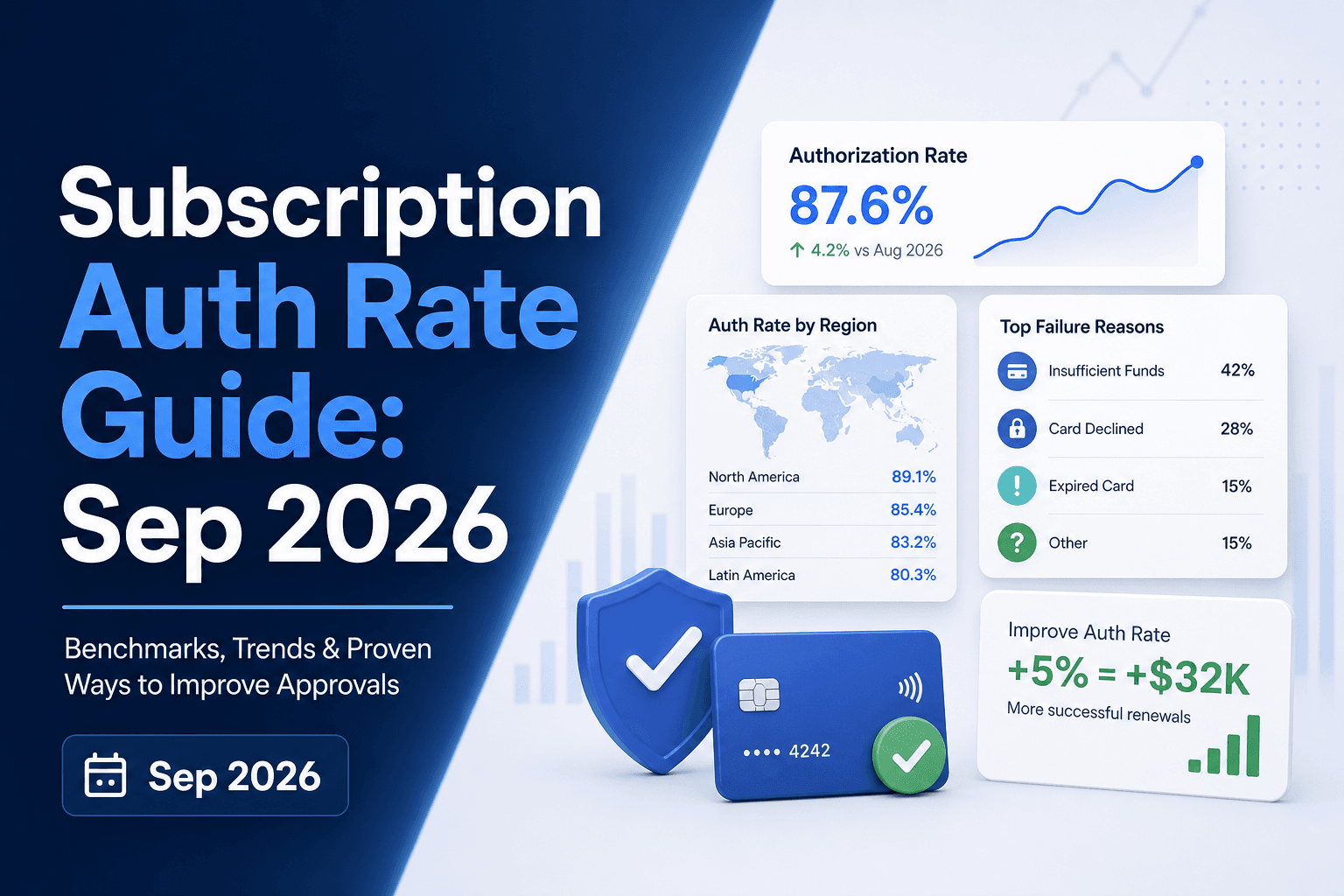
Authorization Rate in Subscription Billing: October 2026
There's a number sitting in your payments data that most finance and retention teams never report on separately: the share of renewal charges your issuing...
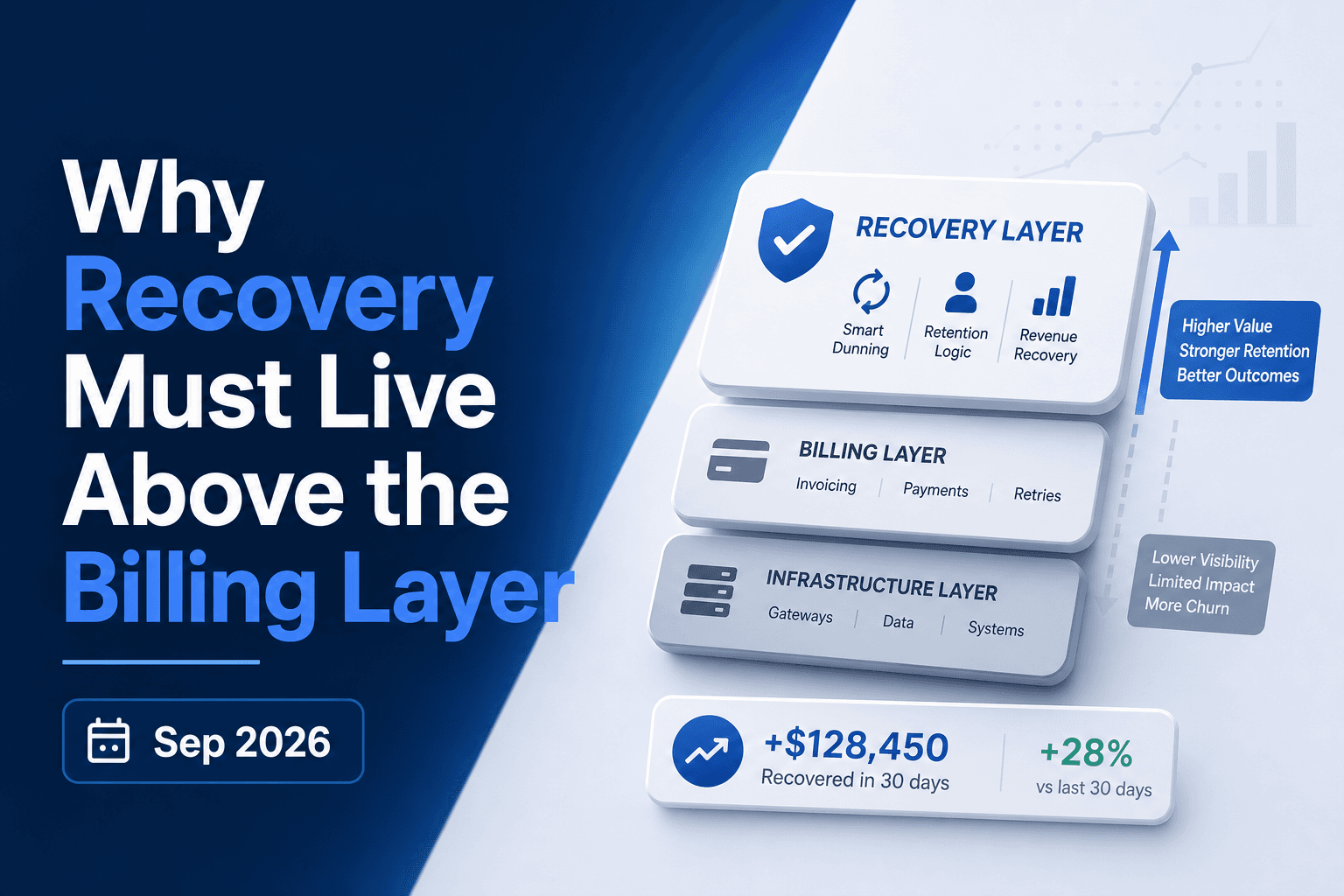
Why Payment Recovery Must Live Above Billers October 2026
A payment fails. Your biller retries it three days later, then again at seven, then at fourteen. What the biller never checks is whether the issuer sent a...
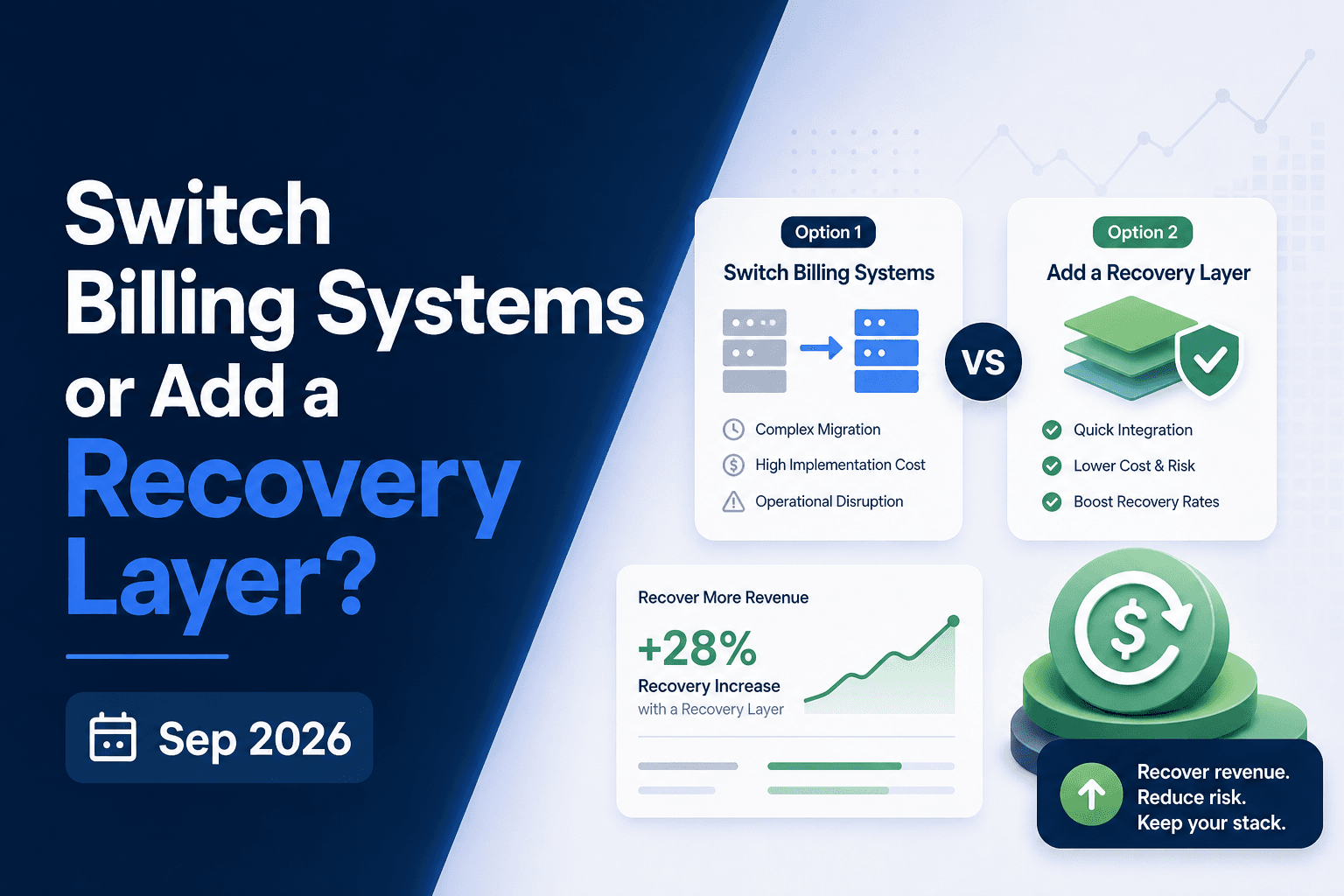
Billing Migration vs Recovery Layer: The Right Call October 2026
Switching billing systems feels like the right move when revenue collection starts breaking down. Sometimes it is. But soft declines, weak retry logic, and...
Stop losing revenue to failed payments
Join leading subscription businesses using Slicker to recover failed payments automatically.
Get Started