Billing Migration vs Recovery Layer: The Right Call October 2026
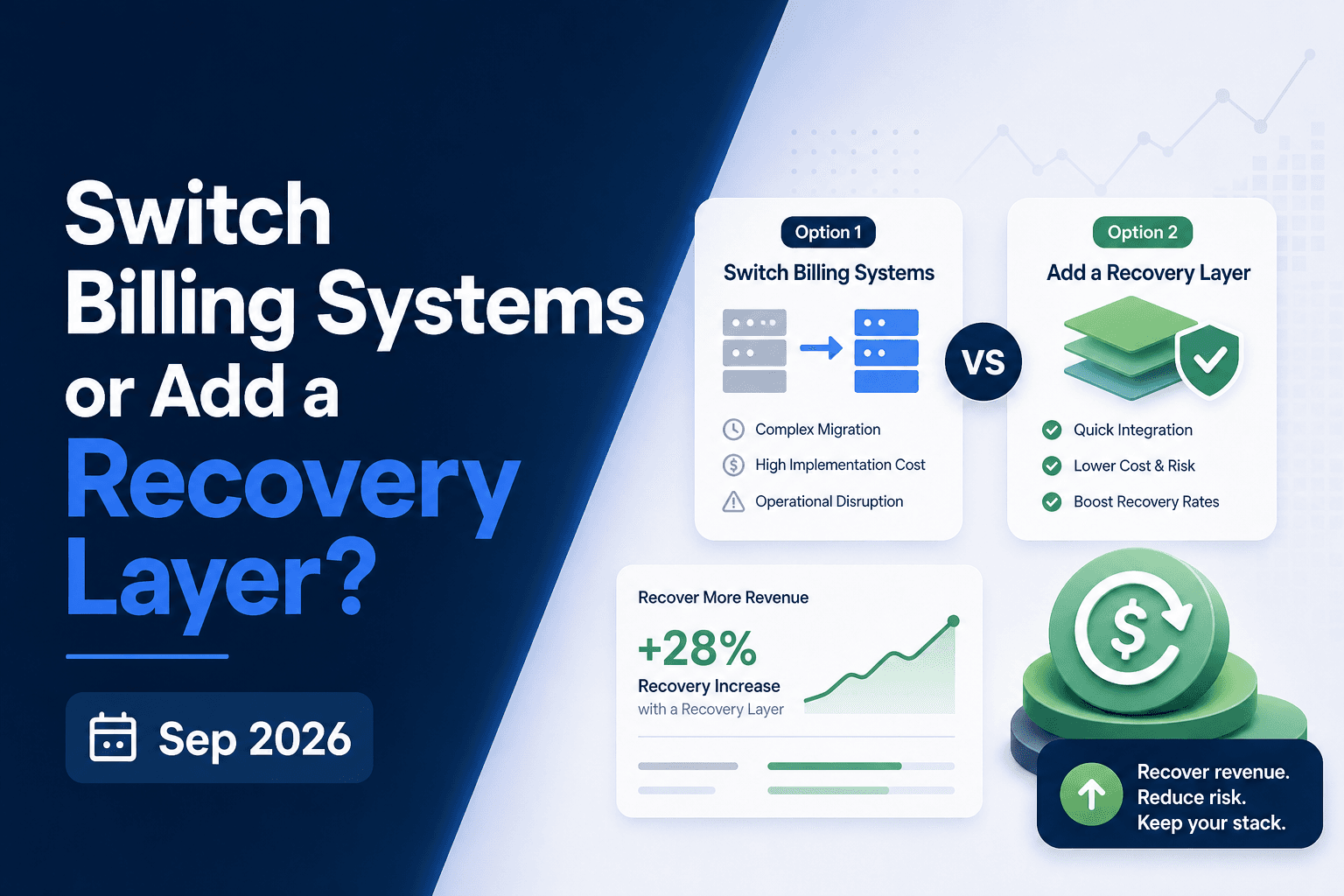
Switching billing systems feels like the right move when revenue collection starts breaking down. Sometimes it is. But soft declines, weak retry logic, and generic dunning are collection-layer failures, and they don't go away just because you moved to a new billing system. This post walks through how to tell the difference before you commit to either path.
TLDR:
- Switch billing systems when the pain is structural: broken pricing models, ASC 606 gaps, or unsupported markets.
- Plateaued recovery rates, generic dunning, and retry waste are collection-layer failures; a full migration will not fix them.
- Mid-market billing migrations run 4 to 9 months and cost $150,000 to $750,000; rushed cutovers produce 2 to 5% involuntary churn.
- Built-in retry logic across Stripe, Chargebee, Recurly, and Zuora lacks MAC and network-level signals, leaving recoverable soft declines unclaimed.
- Slicker layers on top of your existing billing system with zero engineering lift, measuring recovered dollars against your own baseline before any fee applies.
Why Businesses Consider Switching Billing Platforms
Subscription billing infrastructure tends to stay invisible until something breaks or stops fitting. The triggers that push teams toward considering a switch are usually predictable, and recognizing them matters because the right response is not always a full migration.
The most common reasons:
- Pricing model complexity: flat-rate billing systems struggle when you add usage-based tiers, hybrid seats-plus-consumption pricing, or mid-cycle upgrades that need proration logic
- Scaling pain: legacy systems built for a few hundred customers start creating reconciliation headaches, manual workarounds, and engineering debt at higher volume
- Missing integrations: no native connection to your CRM, ERP, or revenue recognition tools forces custom glue code that breaks during updates
- Inadequate revenue recognition: ASC 606 compliance gets painful when your billing system cannot separate performance obligations or handle multi-element arrangements
- Weak global support: limited currency handling, missing local payment methods, or poor cross-border tax logic create real revenue leakage in international markets
The question worth asking before starting a migration is whether the pain is structural or collection-layer. A system that handles your pricing model well but recovers failed payments poorly may not need replacing at all.
What a Billing Platform Switch Actually Involves
A billing platform migration touches almost every system in your revenue stack. The process runs in phases: audit your existing data and dependencies, select and test a replacement, build migration tooling, run both systems in parallel, cut over by customer cohort, then decommission the old system. Each phase requires sign-off from finance, engineering, and operations.
The cost is rarely what teams expect. According to Portmux, a mid-market SaaS billing migration typically runs 4 to 9 months end to end and costs $150,000 to $750,000 in services, tooling, and internal time. Multi-entity or multi-currency environments regularly push beyond 12 months and $1 million.
The cutover window is where revenue risk concentrates. Rushed cutovers routinely produce 2 to 5% involuntary churn from failed charges that customers notice before your team does. A wrong subscription end date becomes a missed renewal. A duplicated record becomes a double charge. Unlike most infrastructure migrations, there is no quiet failure mode here, and a disrupted billing cycle can erase months of subscription revenue recovery.
The Hidden Revenue Risk During a Migration
Most migration checklists focus on data fidelity and feature parity. Payment continuity rarely gets the same attention, and that gap is where revenue quietly disappears.
Every data error during cutover converts directly into a customer-facing money problem. An unvalidated payment token means a charge that never fires. A mismatched subscription end date means a renewal that never triggers. Customers review their bank statements before your team audits the migration logs.

What makes this costly is who gets lost. Payment failures and involuntary churn together account for as much as 40% of lost subscribers across SaaS businesses. These are not customers who chose to leave. A broken billing handoff made staying impossible, and recovering them afterward is expensive and often unsuccessful.
Even a few days without proper dunning or smart retries running means soft declines that would normally be recoverable simply churn. That revenue does not come back once the subscriber is gone.
When Switching Platforms Is the Right Call
Some billing problems are genuinely architectural. No amount of workarounds or layered tools will fix a system that cannot model your pricing, report revenue correctly, or support the markets you operate in.
The clearest cases for switching:
- Your pricing model has changed from flat subscriptions to usage-based, hybrid, or consumption tiers, and your current system cannot handle proration, overage, or mid-cycle changes without manual intervention.
- Revenue recognition under ASC 606 requires separating performance obligations your billing system cannot track, creating audit risk and manual reconciliation every quarter.
- Key markets or payment methods are unsupported, such as SEPA direct debit, UPI, or local tax logic, and you are losing revenue at the point of charge, not during collection.
- Your integration ecosystem has outgrown your billing system, requiring custom glue code to connect your CRM, ERP, or data warehouse, and that code breaks regularly.
The common thread is structural limitation: the system cannot do the job even if configured perfectly. That is different from a system that handles your pricing well but recovers failed payments poorly. Weak retry logic is a collection-layer problem, and it rarely warrants the cost and disruption of a full migration.
When Layering a Recovery Tool Is the Better Move
Soft declines account for 80 to 90% of failed card payments in subscription businesses, and most of that revenue is recoverable. The question is whether your current retry logic is actually going back for it.
The signals that point to a recovery problem, not a billing architecture problem:
- Your billing system handles pricing, proration, and revenue recognition correctly, but recovery rates have plateaued with no clear path to improvement.
- Rules-based dunning emails go out on a fixed schedule regardless of why the payment failed, sending the same "update your card" message to a customer with insufficient funds and one with a stolen card.
- You have no visibility into which decline codes are driving the most involuntary churn, or whether retries are hitting network limits.
If these describe your situation, the root cause is retry intelligence and dunning logic. A dedicated recovery layer targets that directly, without the migration timeline or switching cost described above. Your billing system stays in place; the recovery tool runs on top, classifying each failure and deciding when and how to act.
What Built-In Billing Platform Retries Actually Do
Rule-based retry logic is the default across every major billing system, and it works up to a point.
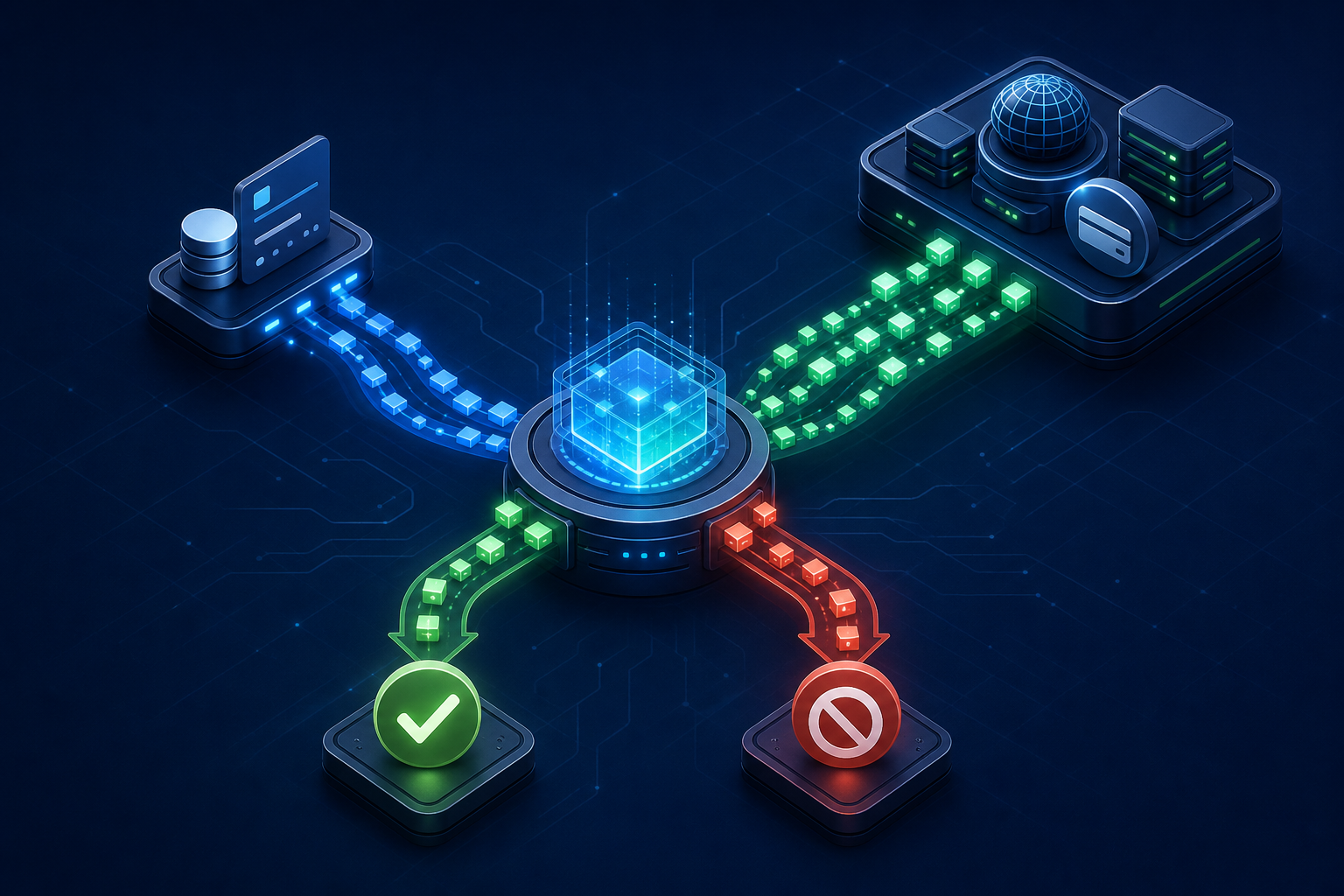
Stripe Smart Retries use AI to time retries based on Stripe's own transaction data. Chargebee Smart Dunning and Recurly's retry logic both follow configurable schedules that merchants adjust manually. Zuora offers Configurable Payment Retries, suited to teams that want to manage rules themselves. All four are included in the billing system and require no additional setup.
The shared limitation is what they cannot see. Built-in retry systems operate on a single platform's data, without access to network-level response codes or Merchant Advice Codes (MACs) from the card networks. MACs carry issuer instructions like "retry after two days" or "do not try again." Without those signals, a system retrying after a MAC 03 (do not retry) burns retry attempts and incurs a $0.10 Mastercard penalty per excessive retry attempt.
They also cannot adapt to card type, issuer behavior by geography, payday timing by country, or cross-issuer patterns learned from failures across multiple merchants. A stolen card and an insufficient funds decline on a debit card the day before payday get treated identically. That uniformity is where recoverable revenue slips through, and switching billing systems does not fix it.
How Recovery Tools Work Alongside Any Billing Platform
A dedicated recovery tool connects at two levels simultaneously: your billing system and your payment provider. That dual connection is what separates it from the retry logic built into the billing system itself.
The billing system tells the recovery tool which invoices are open and unpaid. The payment provider connection supplies what the billing system cannot see: gateway error codes, raw network response codes, and Merchant Advice Codes (MACs). Those network-level signals carry issuer instructions that change what the right recovery action looks like: whether to retry, when, on which card, and through which gateway.
Because all recoveries run through your existing billing system and payment rails, the billing system stays the authoritative record. Finance and reconciliation workflows are unchanged, and there are no duplicate charges since the recovery tool only acts on invoices the billing system shows as open.
This architecture means the tool is billing-system agnostic. It layers on top of Stripe Billing, Chargebee, Recurly, Zuora, or a custom in-house system, and the difference between built-in and add-on retry tools determines what recovery is possible. The billing system keeps handling pricing, proration, invoicing, and revenue recognition. The recovery layer handles the classification and timing decisions that determine whether a declined payment becomes recovered revenue or involuntary churn.
The Case for Running Both: Migrating and Adding a Recovery Layer
A billing platform migration and a payment recovery problem are not the same thing, and solving one does not solve the other. Some teams learn this mid-migration, when recovery rates drop and involuntary churn rises during the cutover window precisely because retry logic and dunning were never part of the migration plan.
The workstreams are genuinely separate. A billing system migration covers pricing architecture, data infrastructure, revenue recognition, and integration with your financial stack. A recovery tool covers what happens in the hours and days after a charge fails. One rebuilds the foundation; the other protects the revenue flowing through it.
Running a recovery layer during a migration is one of the more practical ways to reduce cutover risk. When both billing systems are running in parallel, the recovery tool can operate on whichever invoices the new system is already processing, without waiting for a full cutover. Involuntary churn that spikes during migration is mostly a subscription payment retry and dunning gap, and that gap can be closed independently of when the migration finishes.
For teams that have recently completed a switch and are now seeing a recovery plateau, the same logic applies. The new billing system handles pricing correctly, but its built-in retry logic carries the same structural limitations described earlier. Adding a recovery layer at that point is a faster and cheaper fix than reconsidering the billing system again.
Key Signals That Point to Platform vs. Recovery
Signal | What it indicates | Suggested action |
|---|---|---|
Retries firing on hard declines (stolen card, closed account) | Retry logic lacks decline classification | Recovery layer |
Same dunning email regardless of failure reason | Dunning is generic, not failure-aware | Recovery layer |
Recovery rates plateaued despite configuration changes | Built-in retry intelligence has a ceiling | Recovery layer |
No visibility into which decline codes drive most churn | Missing network-level signal access | Recovery layer |
Pricing model changes require engineering sprints | Billing architecture cannot model your pricing | Platform switch |
Revenue recognition is manual or requires quarterly reconciliation | System cannot track performance obligations | Platform switch |
Key markets or payment methods are unsupported | Structural gap in billing infrastructure | Platform switch |
Custom glue code breaks regularly between billing and CRM/ERP | Integration layer has outgrown the system | Platform switch |
The diagnostic question worth asking first: is the pain showing up on failed invoices, or on live ones?
What to Assess Before Either Decision
Before committing to either path, a structured audit of two to three weeks can prevent months of scope surprises.
Four areas to cover:
- Active subscription states and open invoice counts: know exactly how many subscriptions are mid-cycle, trialing, or past due. A migration moving 40,000 active subscriptions without this inventory will produce billing gaps. A recovery tool evaluation needs this to scope test traffic.
- Undocumented dependencies: billing systems connect to tax engines, CRMs, revenue recognition tools, and data warehouses, often through integrations nobody documented. These are the surprises that extend migrations beyond 12 months.
- Payment tokenization and card portability: tokens stored with your current processor may not transfer to a new one. Know this before switching, because unvalidated tokens are a direct source of post-cutover involuntary churn.
- Recovery rates by decline code category: break out failure volume by soft declines, hard declines, and ambiguous codes. This sets the baseline any tool should be measured against using AABB testing in payment recovery against your own numbers, not an industry average.
For a billing system switch, this audit feeds migration scope directly. For a recovery layer decision, it sets the baseline every credible tool should beat.
How Slicker Handles the Recovery Layer Decision
For subscription businesses where the diagnostic points to the collection layer, not billing architecture, Slicker connects directly on top of supported billing systems (Stripe Billing, Chargebee, Recurly, Zuora, Recharge, and Piano) with zero engineering lift.
Slicker's Artificial Payments Intelligence (API), its AI-powered decision engine, reads 40+ signals per failed transaction: network response codes, Merchant Advice Codes, BIN data, and network-level insights from an expanded card network data partnership (coming Q2). From those signals, it decides whether to retry, when, on which card and gateway, or whether the failure requires a targeted dunning email instead. The Economist and Freepik each saw roughly 20% recovery-rate improvement on their own validated data.
Slicker's AABB testing protocol, a crossover design borrowed from clinical drug trials, splits your own traffic and measures recovered dollars against your existing baseline. The Economist and Freepik each saw roughly 20% recovery-rate improvement on their own validated data. For teams assessing failed payment recovery software, this proof-before-payment model sets a clear standard. If we do not outperform, you do not pay, making Slicker straightforward to test alongside a migration, before one starts, or after a switch is complete.
Final Thoughts on Whether to Switch Billing Systems or Fix Your Recovery Layer
The two problems look similar from the outside but have very different price tags to fix. Structural billing gaps need a migration. Collection-layer failures need smarter retry logic. Running the audit first means you're solving the right thing, not merely the most visible thing.
If the data points to a recovery gap, Slicker can show you on your traffic before you commit to anything.
FAQs
Should I switch billing platforms or layer a recovery tool on top when my recovery rates have plateaued?
Layer a recovery tool first. A plateau in recovery rates is a collection-layer problem, not a billing architecture problem, and the two require different fixes. If your billing system handles pricing, proration, and revenue recognition correctly, adding a dedicated recovery layer targets the retry intelligence and dunning logic gaps directly, without a 4 to 9 month migration timeline or six-figure switching cost.
What does going live with a payment recovery platform actually require, and how long does it take?
On supported billing platforms (Stripe Billing, Chargebee, Recurly, Zuora, Recharge, and Piano), setup requires no engineering work: connect API keys for your billing system and payment provider, agree the test design, and verify your email sending domain. Go-live typically takes days, not weeks, and the first month runs as a free AABB test on your own traffic before any fee applies.
How do I know whether my billing platform's built-in retries are leaving recoverable revenue behind?
Break out your failed payment volume by decline code category: soft declines, hard declines, and ambiguous codes. If your system is firing retries after a Merchant Advice Code 03 (do not retry), treating an insufficient funds decline and a stolen card identically, or sending the same dunning email regardless of failure reason, those are signals that built-in retry logic has hit its ceiling. That baseline also sets the number any recovery tool should be required to beat on your own data before you pay.
What are the risks of giving a third-party payment recovery platform access to your Stripe account and customer data?
Card credentials never pass through Slicker: charges run through your existing PCI-compliant payment provider, and Slicker only acts on invoices your billing system shows as open and unpaid, which prevents duplicate charges. Data is encrypted at rest with AES-256 and in transit with TLS 1.3, stored in per-customer isolated environments, and can be deleted by customer ID via API for GDPR and CCPA compliance. Slicker is SOC 2 Type 2 certified.
Slicker vs. Stripe Smart Retries: which should I use if I'm already on Stripe Billing?
Stripe Smart Retries use Stripe's own transaction data on a fixed schedule, send Stripe-branded emails tied to each retry, and cannot switch to a different card on file during recovery. Slicker reads network response codes and Merchant Advice Codes that Stripe does not expose, times retries to the hour using issuer behavior and payday calendars by country, runs dunning independently from your domain, and can retry on an alternate card on file. Both can run in parallel during an AABB test on your own traffic so the recovered dollars decide, with no fee unless Slicker outperforms with statistical significance.
Related Articles
Stripe Billing Recovery Layer Setup Time: October 2026
Adding a recovery layer on top of Stripe Billing sounds like the kind of thing that goes on a quarterly roadmap and gets delayed twice. For most teams, it's...
Gateway Failover: Routing the Right Failures October 2026
A gateway outage and an issuer decline look identical in your failed payment count, but they call for completely different responses. Rerouting an issuer...
Stripe Dunning Configuration Guide (September 2026)
A surprising share of the subscribers leaving your list every month never chose to cancel. Their payment failed, your retry window ran out, and Stripe...
Stop losing revenue to failed payments
Join leading subscription businesses using Slicker to recover failed payments automatically.
Get Started