Why Payment Recovery Must Live Above Billers October 2026
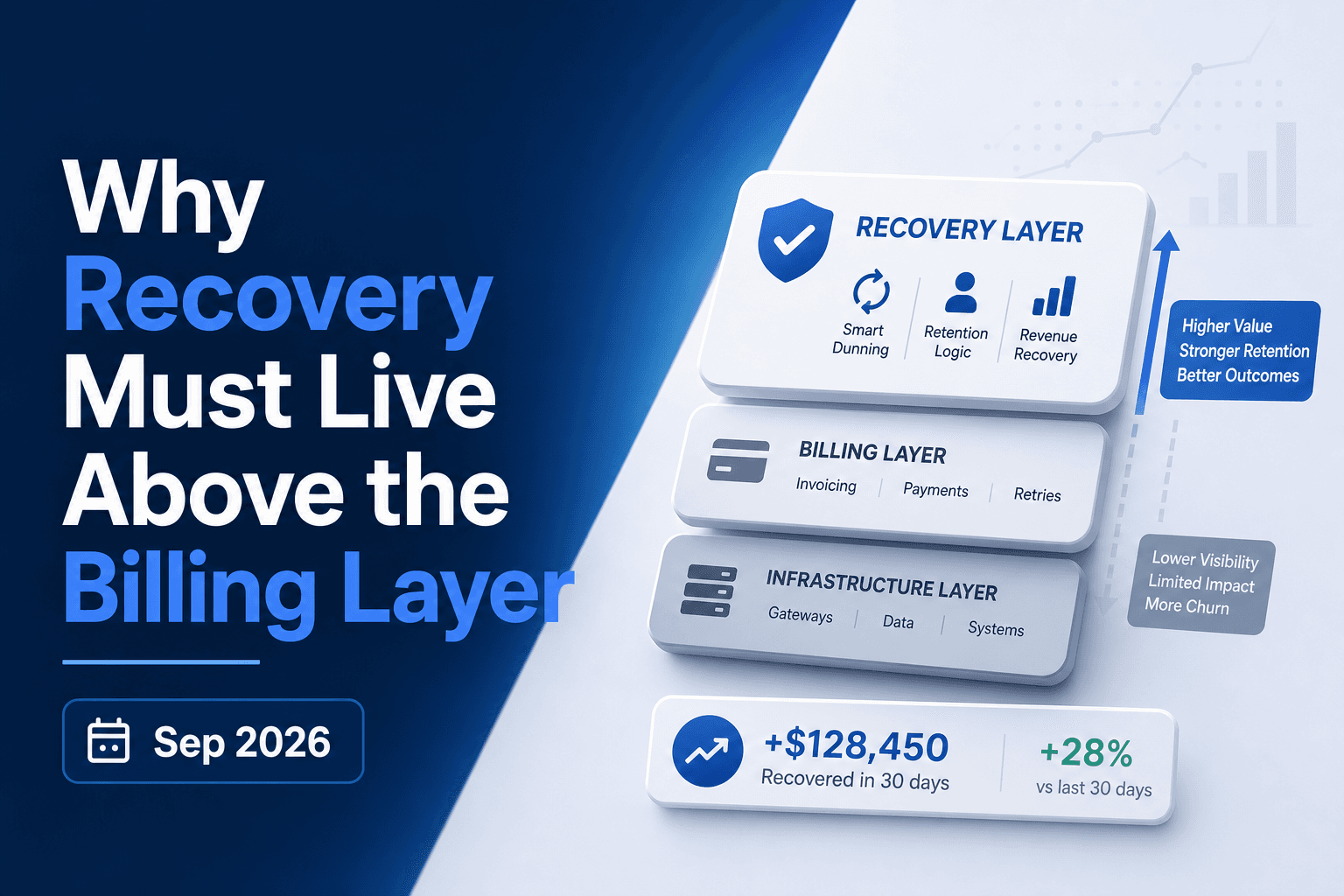
A payment fails. Your biller retries it three days later, then again at seven, then at fourteen. What the biller never checks is whether the issuer sent a Merchant Advice Code saying not to retry at all, or whether the cardholder's payroll deposits two days after the failure. That missing context is a solvable problem, but only if the recovery logic lives somewhere with access to it, not locked inside the biller that only sees its own slice of the decline.
TLDR:
- Billing platforms like Stripe, Chargebee, and Recurly were built for subscription lifecycle management, not payment recovery; their retry logic misses MAC signals, issuer intent, and cross-gateway patterns.
- Soft declines account for 80 to 90% of failed card-not-present payments, but recovering them requires network-level signal classification your billers never expose.
- Fixed retry schedules (day 3, day 7, day 14) treat every failure as identical; a single unrecovered $50/month subscriber over 24 months costs $1,200 in lost MRR (monthly recurring revenue).
- A consolidated recovery layer sits above all your billers simultaneously, normalizing decline taxonomies and timing retries at the hour level, not the day level.
- Slicker connects to both your billing system and payment provider, has recovered over 1,000,000 failed payments, and proves incremental lift via AABB testing before any fee is charged.
Why Recovery Logic Cannot Live Inside a Single Billing Platform
Billing platforms are built to manage subscriptions. Invoice generation, plan changes, proration, revenue recognition: that's where their architecture lives. Payment recovery is a different problem, and it shows.
When a payment fails, a billing platform sees its own gateway's response code. That code is often incomplete. The network-level decline reason, the Merchant Advice Code, the issuer's actual intent behind a "do not honor": most billing systems never see these signals. They fire a retry on a fixed schedule, using the data they have, which is rarely enough to make a good decision.
According to a 2023 PYMNTS study, subscription businesses lose 9% of revenue from failed payments, a subscription revenue leak that is recoverable in principle. The gap between recoverable and actually recovered comes down to whether the retry logic has enough information to act precisely.
Recovery intelligence needs to sit above the biller, where it can read across payment providers, interpret richer decline signals, and apply timing logic the biller was never designed to run.
Why Multi-Platform Stacks Are More Common Than They Appear
Multi-platform billing stacks are rarely a deliberate design choice. They accumulate.
A company acquires a competitor running on Recurly while the parent is on Stripe Billing. A new product line spins up on Chargebee because finance wanted cleaner revenue separation. A geographic expansion prompts a parallel Zuora deployment. A legacy in-house billing system gets partially migrated but never fully replaced. Each decision made sense at the time.
The result: many subscription businesses end up operating two or more billing systems simultaneously without ever planning to. For any company that has grown through acquisition, launched into new markets, or maintained a long-lived product catalog, some form of multi-biller reality is the norm. The recovery problem that follows is just as predictable: each biller runs its own retry logic, on its own data, with no coordination across the stack.
What Billing Platforms Actually Do Well (and Where They Stop)
Stripe Billing, Chargebee, Recurly, Zuora: these tools do exactly what they were designed to do. Subscription lifecycle management, invoice generation, proration, revenue recognition, plan upgrades and downgrades. They are reliable, mature, and purpose-built for that job.
Payment recovery is a narrower, more specialized problem. Each billing tool's retry logic operates on its own invoice records and the surface-level response codes its connected gateway returns. That scope is the limit.
What falls outside it:
- Network-level Merchant Advice Codes (MACs), which carry specific instructions from the issuer on whether and when to retry
- Cross-issuer behavioral patterns that indicate when funds are likely to be available
- Payday timing signals by country, card type, or employer pay cycle
- Signals from a second or third gateway if the merchant runs multiple processors
The issuer's actual intent, the network's retry guidance, the cardholder's funding cadence: none of that is in the billing tool's data model. Retries fire on a fixed schedule, using incomplete information, with no ability to learn across billing systems or payment providers. For a single-biller setup with light failure volume, that may be tolerable. Across a multi-biller stack, the gaps compound.
The Decline Data Problem Across Multiple Billers
Each billing system speaks its own dialect of decline codes. Chargebee surfaces one taxonomy, Stripe another, Zuora a third. A finance team managing all three is essentially reading three different languages with no dictionary connecting them.

The practical consequence: a spike in "do not honor" codes on one biller and a surge in insufficient funds failures on another may trace back to the same issuer tightening authorization criteria across card types. Siloed recovery logic treats them as separate events. A unified layer would recognize the pattern.
Soft declines account for 80 to 90% of all failed card-not-present payments in subscription businesses, and most of that revenue is recoverable with the right timing. But identifying soft vs hard declines, and which are ambiguous, requires reading network-level codes that billing systems often don't expose. Across multiple billers with inconsistent taxonomies, that classification problem multiplies, and you can't spot issuer-level trends before they widen into revenue gaps.
How Rule-Based Retry Schedules Break Down at Scale
Rule-based subscription payment retry schedules look reasonable on paper: retry on day 3, day 7, day 14. Simple, auditable, easy to configure. The problem is that the logic treats every failure as equivalent, and almost none of them are.

A US consumer debit card declined for insufficient funds has a very different recovery window than a UK corporate card returned with "issuer unavailable." The first is likely to authorize in the hours after a payroll deposit clears; the second may resolve within minutes once the issuer's processing queue recovers. A fixed schedule hits the optimal window on neither.
Visa caps retries at 15 per card and amount within 30 days. Mastercard caps soft decline retries at 10 within 24 hours. Exceeding those limits triggers fees that compound quickly at scale, and repeated attempts on hard declines can quietly suppress authorization rates on checkout payments too. Rule-based systems approach these limits carelessly because they have no mechanism to distinguish a soft decline worth retrying from a hard decline that should route immediately to dunning.
At a few thousand failed payments per month, a miscalibrated schedule is an annoyance. Across a multi-biller stack processing tens of thousands of failures, smart payment retries at scale with inconsistent taxonomies, the wasted attempts and missed windows add up to a material, recurring revenue gap.
What Consolidated Recovery Logic Actually Looks Like
A consolidated recovery layer sits between your billing systems and your payment providers, connected to both simultaneously. From the billing side, it reads open invoices across every biller in your stack. From the payment provider side, it reads network response codes, Merchant Advice Codes, and issuer signals that the billing system never sees. Those two data streams together are what make precise decisions possible.
That connection to the payment provider is the part most billing-native retry logic skips. Without it, classification is guesswork. With it, a "do not honor" response can be read alongside its MAC to determine whether it's retryable, how long to wait, or whether the card requires customer action before any attempt makes sense.
What that architecture unlocks in practice:
- Decline classification across the full taxonomy: soft, hard, and ambiguous codes resolved using network and issuer signals, beyond surface gateway responses alone
- Retry timing at the hour level, not the day level, based on card type, payday calendars by country, and the subscriber's own payment history
- Multi-gateway payment routing per attempt, choosing the card or processor most likely to authorize given the issuer and failure type
- Dunning that runs on its own cadence, fired only when customer action is genuinely required, independent of the retry schedule
That last point matters. When dunning is tied to retries, every retry triggers a customer email. Decoupled logic sends a message only when a human needs to act, reducing friction and preserving sender reputation.
Across a multi-biller stack, this layer also normalizes decline taxonomies into a single classification system, so a pattern developing across Stripe and Recurly reads as one signal instead of two unrelated events.
The Involuntary Churn Cost That Multi-Platform Gaps Compound
Involuntary churn is a revenue problem with a billing cause. A subscriber who never meant to cancel gets lost because a payment failed at the wrong moment and the retry logic couldn't recover it in time.
Industry data shows payment failures account for up to 40% of lost subscribers at high-volume subscription businesses. Those subscribers were already retained. They just weren't recovered.
Fragmented recovery logic makes this worse in a computable way. When Stripe handles retries for one product line and Chargebee handles them for another, each works from its own incomplete signal set with no coordination. Multiply that across two or three billers, each missing its own share of recoverable failures, and the gap widens quietly every billing cycle.
For a subscriber paying $50 a month over a 24-month lifetime, a single unrecovered failure represents $1,200 in expected revenue gone. At scale, that math shows up in MRR (monthly recurring revenue) trends before anyone identifies fragmented recovery logic as the source.
Cross-Platform Retry: Key Signals a Unified Recovery Layer Uses
Recovery decisions improve as the signal set widens. Biller-native retries work from a narrow slice: the surface gateway code and the invoice record. A layer sitting above all billers, connected to the payment provider directly, reads across a much broader input set.
The key signal categories:
- Network response codes and Merchant Advice Codes (MACs) from the issuer, going beyond the gateway's simplified translation
- BIN and issuer identity, which predict authorization behavior by card program
- Card type: consumer debit, corporate card, and prepaid each follow different funding patterns and network rules
- Subscriber payment history, including how prior failures on the same account resolved
- Regional payday calendars and bank holiday schedules by country
Timing signals are where the gap between biller-native and consolidated logic is most visible. US consumer debit cards declined for insufficient funds are most likely to authorize just after midnight, when payroll deposits post. UK and Western European subscribers follow monthly pay cycles near the last working day of the month, so a failure on the 28th has a narrower, more predictable recovery window than one on the 10th. Australian subscribers often follow weekly or fortnightly cycles, requiring a different cadence entirely.
A billing system operating in isolation sees one biller's invoices and one gateway's codes. A unified recovery layer sees the issuer's actual instruction, the cardholder's funding rhythm, and the card program's behavior, then times the retry to the hour.
How Dunning Fits Into a Consolidated Recovery Strategy
Automated retries handle most recoverable failures without the customer ever knowing a payment failed. Dunning is what runs when they can't.
The routing decision depends on the failure signal. A MAC 03 means Mastercard has instructed the merchant not to retry, which is where a precise understanding of smart payment retries becomes critical. MAC 21 (“Stop Recurring Payment”) is Mastercard’s signal that the recurring authorization must be stopped, typically because the cardholder has cancelled. A stolen card flag, a confirmed closed account, or an expired card with no updater data available: all of these require the subscriber to act before any charge can succeed. Retrying anyway burns attempts against network limits and, for hard declines, risks suppressing authorization rates on future checkout payments from the same card program.
When recovery logic sits above the billing layer, it reads those signals before firing any retry. The dunning email goes out because the failure classification says it must, not because a retry fired and triggered an automated follow-up on a fixed schedule. That distinction prevents a subscriber from being emailed on day three, day seven, and day fourteen simply because a retry fired on each of those days.
The email itself should reflect the specific failure. Scenario-aware dunning ties the message to the actual reason the payment failed, which determines what action the subscriber needs to take. For an expired card, the message prompts the subscriber to update their payment method before their next billing date. For an insufficient funds decline, it reminds them that their access renews automatically once funds clear, with no action needed. For a card flagged as stolen or a confirmed closed account, the message asks them to add a new card to keep their subscription active. Framing each message around the service the subscriber would lose, not the payment mechanics, keeps recovery focused on retention.
Measuring Recovery Performance Across Billing Systems
Gross recovery rate is the most common metric teams track, and also the most misleading one. A number calculated across your full failed-payment population hides which biller recovered which payment, which failure type responded to which retry strategy, and how much of that recovery would have happened with no intervention at all.
The metrics worth isolating:
- Recovery rate by failure reason, because soft declines, ambiguous codes, and Merchant Advice Code (MAC)-specific failures have fundamentally different recovery ceilings
- Recovery rate by billing system, so a drop on one biller doesn't get averaged away by a strong month on another
- Time-to-recovery, since recoveries landing three days sooner free up subscriber access and reduce dunning touchpoints
- Recovery delta above baseline, separating what a consolidated layer actually added from what biller-native retries would have caught regardless
That last metric is the one most teams skip. Without a controlled baseline, any improvement looks like a win, but you have no way to know whether the consolidated layer drove it. Regression to the mean, changes in the failure mix, and seasonal authorization rate movements can all move gross recovery numbers without any change in recovery logic.
The only defensible way to measure incremental lift is AABB testing in payment recovery: split failed payments across treatment and control groups, hold the populations comparable, and measure recovered dollars. Statistical significance matters. A two-percentage-point recovery rate improvement across three weeks of data may be noise; the same delta with a p-value below 0.05 across a representative sample is a result you can act on.
What to Review When Choosing a Consolidated Recovery Layer
Before committing to any consolidated recovery layer, run each candidate against these criteria:
Evaluation Criterion | What to Look For | Red Flag |
|---|---|---|
Billing & payment provider compatibility | Connects to both your billing system and payment provider simultaneously, reading network-level signals directly | Integrates only with the billing system; misses MAC and issuer-level data |
Decline classification depth | Reads Merchant Advice Codes and network-level response codes beyond the gateway's simplified translation | Classifies declines from surface gateway codes only; ambiguous failures misrouted |
Retry timing granularity | Hour-level timing based on card type, issuer behavior, and regional payday calendars | Fixed day-level schedule (day 3, day 7, day 14) that treats every failure as identical |
Dunning decoupled from retries | Dunning fires on failure classification (when customer action is genuinely required), not on retry cadence | An email triggers every time a retry fires, making it a fixed schedule with extra steps |
Incremental lift proof | Controlled AABB test on your own traffic with statistical significance before any financial commitment | Gross recovery rate quoted without a baseline; no controlled test offered |
Data security | Operates through your existing PCI-compliant rails; reads signals and issues retry instructions without handling card data | Card credentials pass through the recovery layer's infrastructure |
How Slicker Operates Above the Billing Layer
Slicker connects to both your billing system and your payment provider simultaneously. That dual connection gives Artificial Payments Intelligence access to signals a single biller never sees: Merchant Advice Codes, BIN-level issuer patterns, network response codes that gateway translations obscure. Every retry decision runs on that fuller picture.
Supported billing systems cover the most common multi-biller combinations: Stripe Billing, Chargebee, Recurly, Zuora, Recharge, and Piano. No engineering lift required. Recoveries run through your existing rails, and retry logic runs consistently across all of them from a single layer.
The results are verifiable. Slicker has recovered more than 1,000,000 failed payments, delivering roughly a 20% relative recovery-rate uplift versus standard retry logic, around 4 to 10 percentage points absolute. The AABB testing methodology splits your own failed-payment traffic, measures recovered dollars across treatment and control groups, and calculates statistical significance before any fee is charged. If Slicker doesn't outperform with statistical significance, you don't pay.
Final Thoughts on Cross-Platform Retry and Consolidated Recovery
The revenue leaking through a fragmented recovery stack is rarely visible in any single biller's reporting. It shows up later, in MRR trends that are hard to explain and involuntary churn numbers that seem just slightly worse than they should be. Getting a unified layer above your billing systems, one that reads issuer signals and coordinates retry timing across your full subscriber base, is the fix. Reach out to Slicker if you want to run a controlled test on your own data before making any commitments.
FAQs
What subscription payment recovery platforms work with Stripe, Adyen, and Braintree simultaneously?
Slicker connects to Stripe, Adyen, and Braintree (along with Checkout.com, PayPal, Worldpay, Cybersource, and Authorize.net) and reads network-level response codes and Merchant Advice Codes directly from each provider, going deeper than the surface translations your billing system exposes. That dual connection to both your billing system and your payment provider is what makes precise decline classification and hour-level retry timing possible across a multi-biller stack.
What should a SaaS revenue operations team track to measure involuntary churn recovery across multiple billing systems?
Gross recovery rate across your full failed-payment population is the least useful number to watch in isolation: it hides which biller recovered which payment, which failure type responded to which strategy, and how much would have recovered anyway. The metrics worth isolating are recovery rate by failure reason (soft declines, ambiguous codes, and MAC-specific failures have different recovery ceilings), recovery rate by billing system so a drop on Chargebee does not get averaged away by a strong month on Recurly, time-to-recovery, and recovery delta above baseline, which separates what a consolidated layer actually added from what biller-native retries would have caught regardless.
How does Slicker's retry timing differ from a static retry schedule on Stripe Billing or Chargebee?
Static schedules ignore card type and issuer signals. Slicker's Artificial Payments Intelligence times retries to the hour using card type, issuer behavior, regional payday calendars, and the subscriber's own payment history: timing is matched to card type and pay cycle: US debit near payroll post time, UK near month-end, AU on weekly or fortnightly cycles. The result is more recoveries from fewer attempts, which matters because Visa caps retries at 15 per card and amount within 30 days and Mastercard caps soft decline retries at 10 within 24 hours, and exceeding those limits triggers fees that compound quickly at scale.
What are best practices for retrying failed subscription payments without hurting your merchant reputation?
Classify every failure before retrying: soft declines (insufficient funds, issuer unavailable) are retryable with the right timing; hard declines (stolen card, closed account, MAC 03 or MAC 21) should route to dunning immediately, because retrying them burns attempts against network limits and can suppress authorization rates on future checkout payments from the same card program. Retry timing should follow card type and regional pay cycles instead of a fixed calendar, dunning should fire on failure classification instead of on retry cadence, and your retry volume should stay inside Visa and Mastercard limits so your standing with issuers stays intact across both recurring and checkout payments.
Can Slicker run a head-to-head test against Stripe Smart Retries to prove incremental lift before you commit?
Yes. Slicker's AABB testing methodology splits your own failed-payment traffic into treatment and control groups, measures recovered dollars across both, and calculates statistical significance before any fee is charged. For a Stripe Billing deployment, Stripe Smart Retries is paused for the treatment group while Slicker runs, so the comparison is direct and on your own data. If Slicker does not outperform with statistical significance, you do not pay.
Related Articles
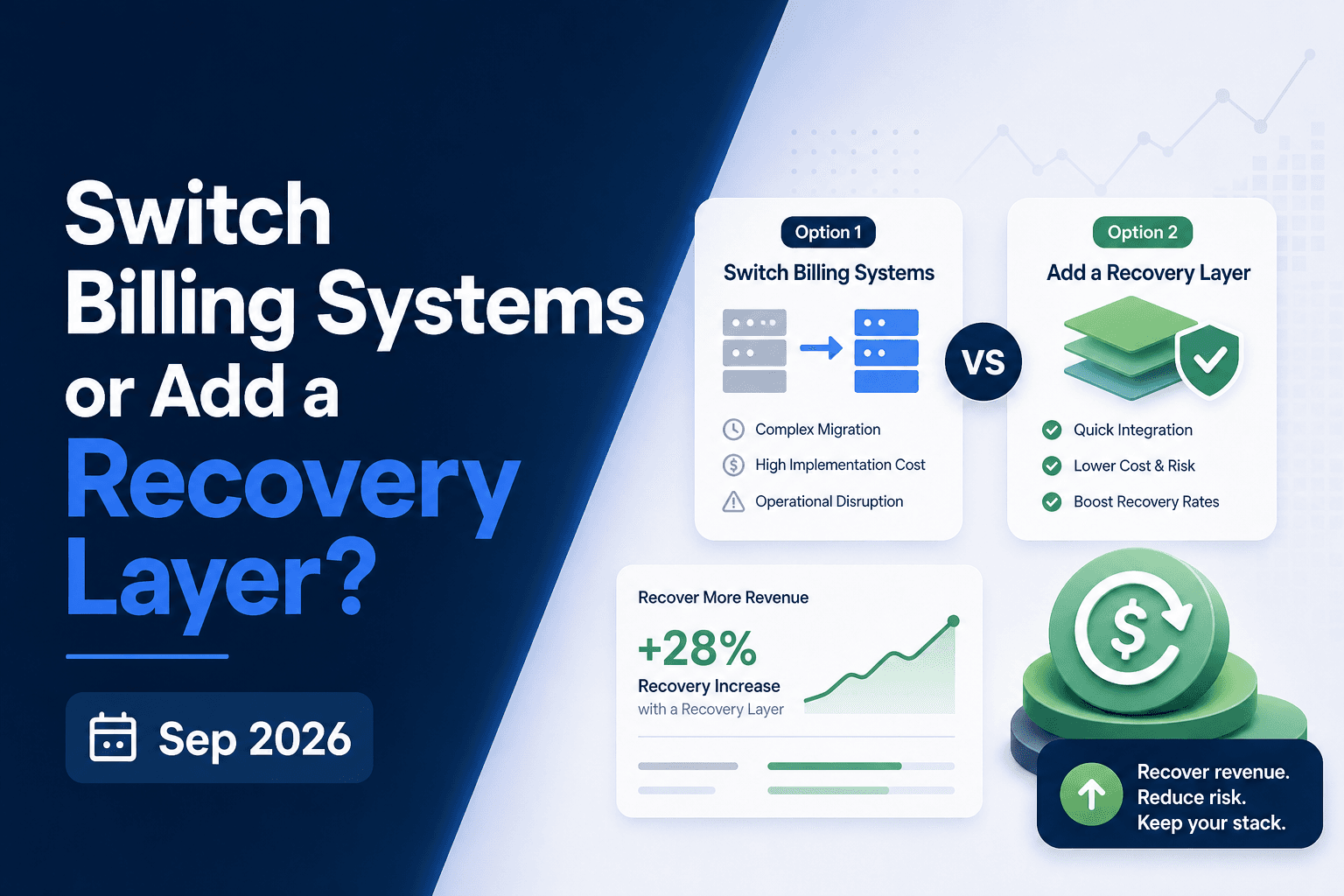
Billing Migration vs Recovery Layer: The Right Call October 2026
Switching billing systems feels like the right move when revenue collection starts breaking down. Sometimes it is. But soft declines, weak retry logic, and...
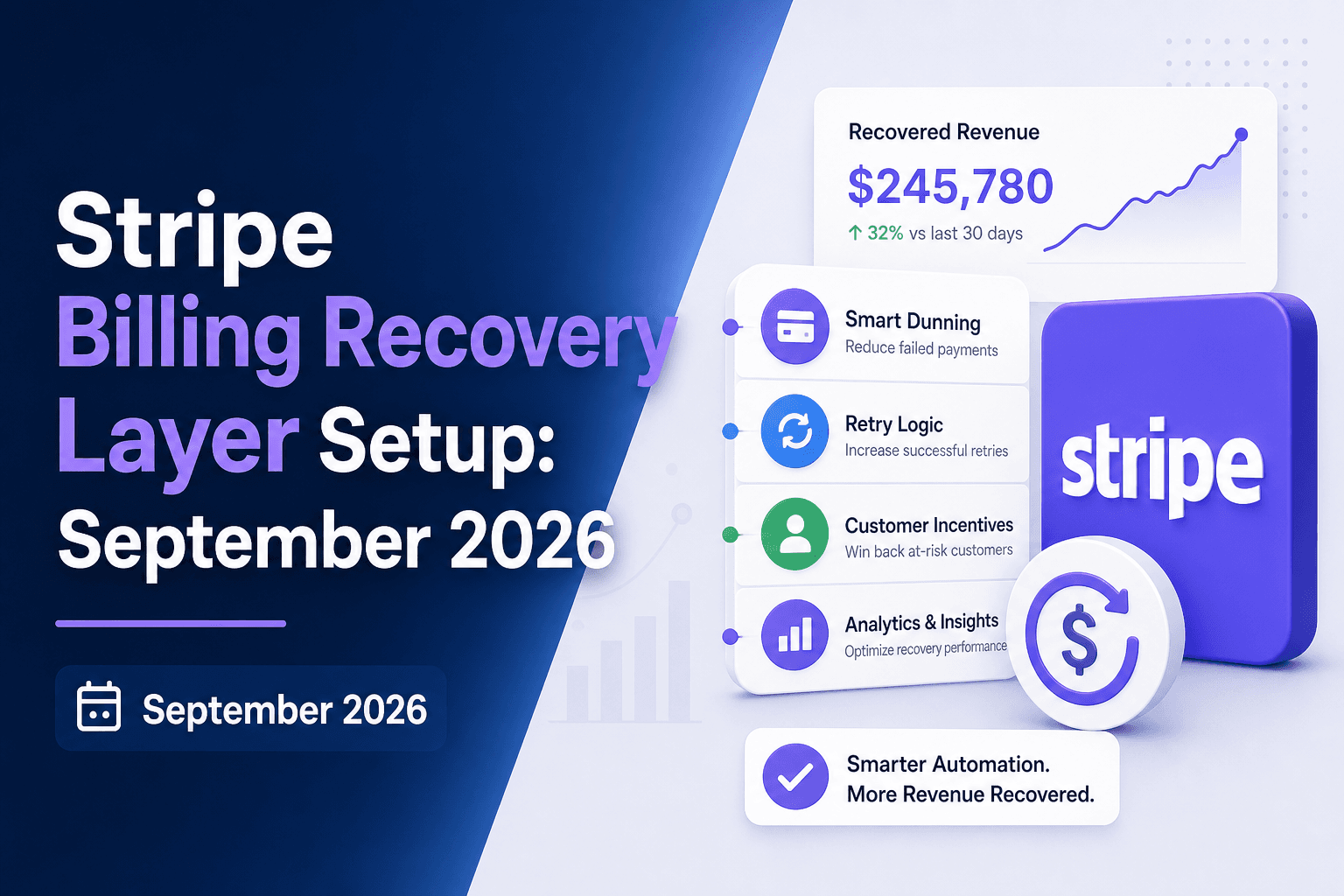
Stripe Billing Recovery Layer Setup Time: October 2026
Adding a recovery layer on top of Stripe Billing sounds like the kind of thing that goes on a quarterly roadmap and gets delayed twice. For most teams, it's...
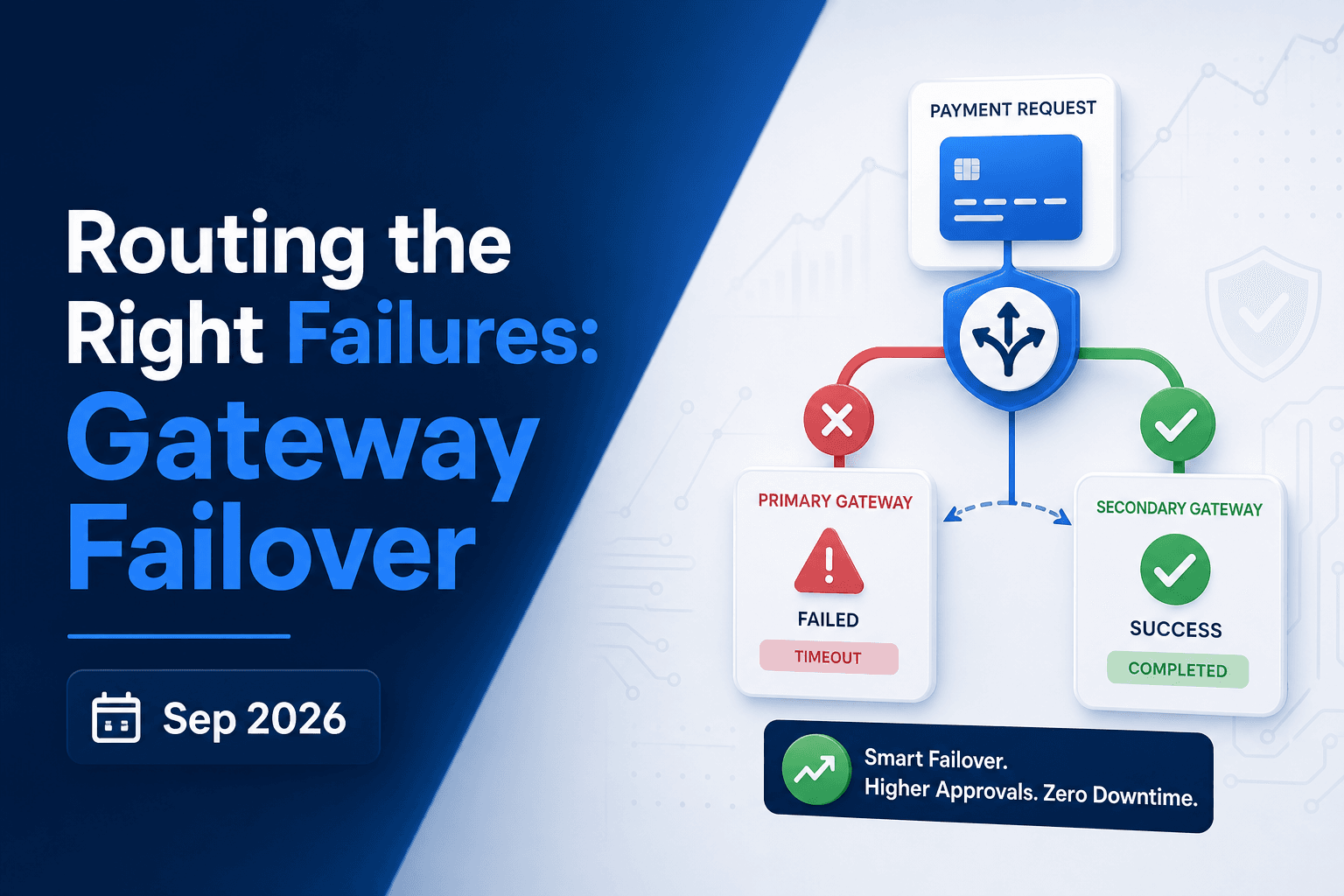
Gateway Failover: Routing the Right Failures October 2026
A gateway outage and an issuer decline look identical in your failed payment count, but they call for completely different responses. Rerouting an issuer...
Stop losing revenue to failed payments
Join leading subscription businesses using Slicker to recover failed payments automatically.
Get Started