Top AI Retry Tools for Involuntary Churn October 2026

Most subscription churn isn't voluntary. Somewhere between 20 and 40% of the customers you lose each month, according to industry data, never chose to leave. They hit a soft decline, your billing system retried on a fixed schedule, the card failed again, and the subscription lapsed. Exit surveys, cancellation flows, and discount save offers are built for customers who made a decision; they do nothing for customers whose card was silently declined. Smart retry software is built to fix that, using AI to personalize retry timing per transaction and recover revenue before it walks out the door. The real question is whether the tool can prove that recovery on your data, or whether you're buying someone else's benchmark. Here's what separates involuntary churn smart retry tools that measure from ones that guess.
TLDR:
- Involuntary churn accounts for 20-40% of subscription churn, and smart retry tools use AI to recover failed payments by analyzing decline codes, card type, and issuer behavior.
- Only one tool reviewed offers AABB testing before commitment, letting you verify recovery lift on your own data with statistical certainty.
- Most tools rely on rules-based retry schedules or aggregate benchmarks you cannot verify against your baseline.
- Slicker runs AABB testing on your traffic, reports the p-value, and takes five minutes to set up with zero engineering lift.
What Are Smart Retry Tools for Reducing Involuntary Churn?
Smart retry tools are software solutions that automatically reattempt failed subscription payments using AI to decide the optimal timing, amount, and routing for each retry. Instead of following a fixed schedule, these tools analyze variables like decline codes, card type, issuer behavior, and historical transaction data to maximize recovery.
Involuntary churn occurs when subscribers lose access not because they chose to cancel, but because a payment failed. Studies show it accounts for roughly 20-40% of all subscription churn, making it a substantial and largely preventable source of revenue loss. Industry research confirms involuntary churn represents a major revenue leak that most subscription businesses underestimate.
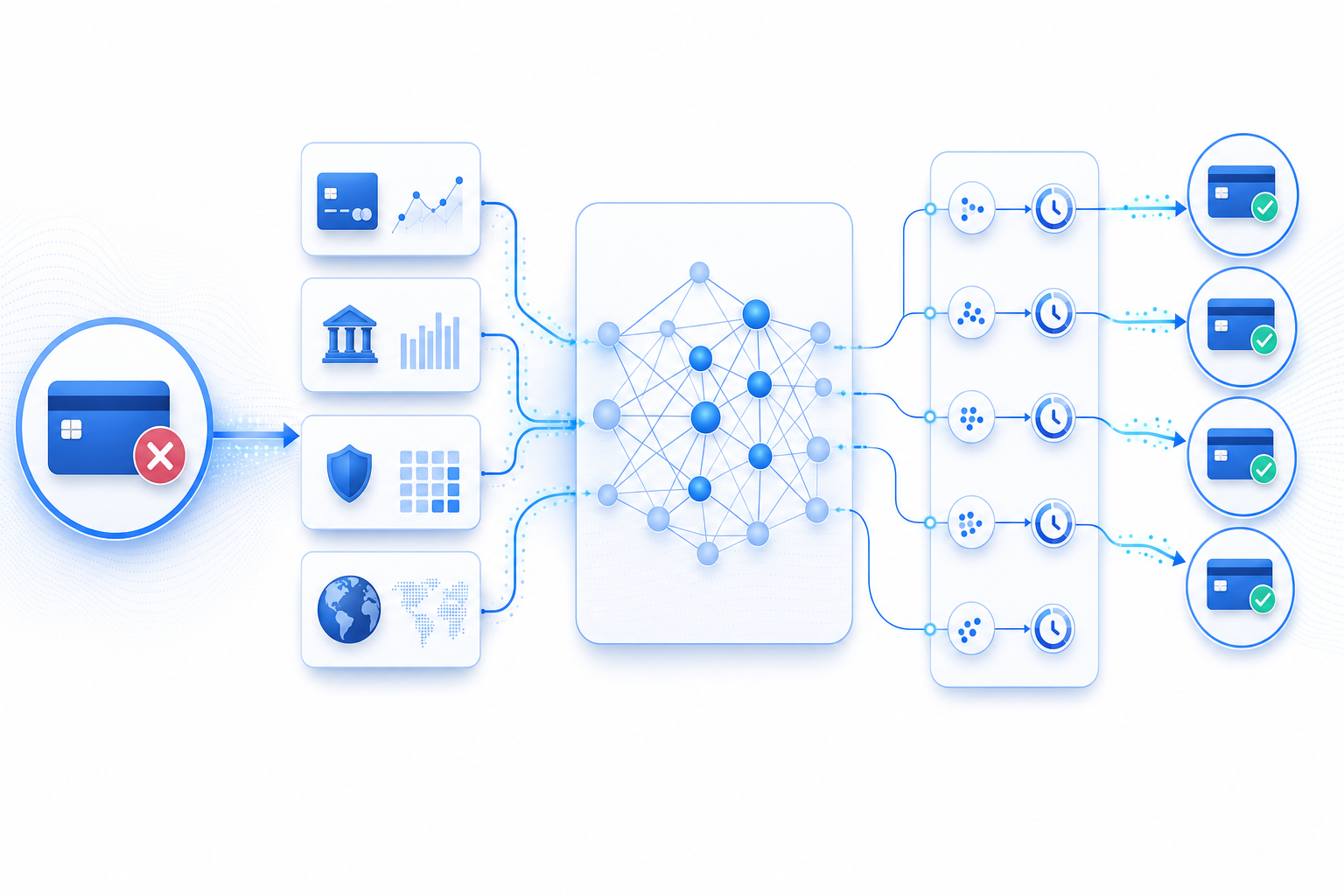
- Expired card credentials: the stored card number or expiry date no longer matches issuer records, requiring a card update or account updater pass before any retry.
- Soft declines: temporary issuer-side blocks (e.g., suspected fraud flag, temporary hold) where retrying at the right time with the right signal succeeds. See soft vs hard declines for recovery for a full breakdown.
- Hard declines: permanent failures (e.g., card reported stolen, account closed) where retrying burns goodwill and sends negative signals to issuers.
- False declines: legitimate transactions blocked by overzealous fraud filters, recoverable through retry timing or alternate routing without requiring cardholder action.
Smart retry software sits between your billing system and payment processor, intercepting soft declines and intelligently sequencing retry attempts to recover revenue before it walks out the door.
How We Ranked Smart Retry Tools
We scored each tool across five factors that reflect what actually moves the needle on involuntary churn recovery.
The Criteria
- Retry intelligence: does the tool use AI to decide timing, sequencing, and retry conditions per transaction, or does it apply a fixed schedule to everyone?
- Measurement rigor: can the tool prove its lift with statistically rigorous AABB testing on your own transaction data, or does it rely on aggregate benchmarks?
- Dunning depth: does the email layer personalize messaging to the specific decline reason, and does it send from your domain?
- Integration speed: how quickly can a payments team go live without engineering involvement?
- Pricing transparency: is the cost structure performance-based and clearly tied to recovered revenue?
Best Overall Smart Retry Tool: Slicker
Slicker is purpose-built for subscription businesses losing revenue to failed payments. Instead of applying a fixed retry schedule, Slicker runs an ensemble of AI models that analyzes each declined transaction individually, weighing variables like issuer behavior, card type, geography, and decline code before deciding whether to retry, when, and at what amount.
The core differentiator is clinical-grade AABB testing in payment recovery. Slicker splits your retry traffic 50/50, measures dollars recovered against a control group, and reports the p-value. You see proof on your own data before committing to a full rollout.
Setup requires no engineering lift and takes roughly five minutes.
Vindicia
Vindicia is a legacy dunning and subscriber management tool built primarily for large enterprise media and publishing companies. It offers payment retry logic and some customer communication features, but its retry scheduling is largely rules-based, meaning retries follow fixed intervals instead of adapting to real-time signals like card type, issuer behavior, or decline code.
For teams that need provable recovery lift measured against their own traffic, Vindicia falls short. There is no AABB testing framework, so you cannot confirm whether its retry logic is actually outperforming your baseline.
Pricing is enterprise-tier and typically requires a lengthy sales and implementation cycle.
Churnkey
Churnkey positions itself as a cancellation-flow and failed-payment recovery tool, targeting SaaS companies that want to reduce both voluntary and involuntary churn from a single interface. Its retry logic runs on scheduled cadences with some card-type segmentation, and its dunning emails can be customized by template.
The tradeoff is depth. Churnkey's retry engine lacks the AI-driven decision layer that predicts issuer behavior at the individual transaction level. Recovery logic is primarily rule-based, which means you're working with averages instead of per-subscriber optimization.
There's also no published AABB testing methodology, so measuring true recovery lift against a control group requires building your own measurement framework.
FlyCode
FlyCode is an AI-powered payment recovery tool built for Shopify and direct-to-consumer brands. It focuses on failed payment retries and dunning automation, with an emphasis on revenue recovery for e-commerce subscription businesses.
FlyCode uses AI to schedule retries using transaction and card data, aiming to reduce involuntary churn without requiring manual intervention from the merchant's team.
Where FlyCode Fits
- Designed primarily for Shopify merchants running subscription apps like Recharge or Skio, so its applicability outside that ecosystem is limited.
- Retry logic is AI-informed but not independently verified against a holdout group, so recovery attribution can be difficult to confirm with statistical certainty.
- No published AABB testing methodology, meaning you're relying on aggregate recovery numbers instead of a controlled measurement of lift against your own baseline.
For high-volume subscription businesses that need provable, statistically verified recovery uplift, FlyCode's Shopify-centric scope may be a constraint worth weighing carefully.
Revaly (formerly FlexPay)
Revaly (formerly FlexPay) is a payment recovery tool built for subscription businesses, with a focus on AI-driven retry logic and decline intelligence. The product has roots in FlexPay's early work on failed payment recovery and has since expanded its feature set under the Revaly brand.
Revaly's retry engine analyzes decline codes and issuer behavior to time retries intelligently, aiming to recover revenue without burning goodwill with cardholders. It also offers dunning email sequences for cases where silent recovery falls short.
That said, Revaly's AABB testing capabilities are less documented in the market, making it harder for finance teams to verify recovery uplifts on their own transaction data before committing to the product.
Butter Payments
Butter Payments is a failed payment recovery tool built for subscription businesses, with a focus on smart retry logic and dunning email sequences. It sits in the mid-tier of the smart retry software market, offering more than basic billing built-ins but less analytical depth than specialized recovery tools.
What Butter Does Well
- Card-type and decline-code retry scheduling, reducing the frequency of retries on hard declines where a retry is unlikely to succeed.
- Dunning email sequences that can be customized by failure reason, so a customer with an expired card gets different messaging than one with a temporary insufficient funds decline.
- A relatively fast setup process that requires minimal engineering involvement.
Where It Falls Short
The core limitation with Butter is measurement. There is no AABB testing framework, which means you cannot verify whether Butter's retry logic is actually outperforming your previous approach on your own subscriber base. Recovery rate claims are reported as aggregate averages across their customer base, not proven against a control group on your data. For a CFO assessing payment retry optimization tools, that gap in statistical verification is a real risk: you may be paying for recovery that would have happened anyway.
Butter also lacks the issuer-level and geography-level signal depth that drives meaningful recovery rate uplift on complex, high-volume subscription portfolios.
Prevention Before Retry: Account Updater and Network Tokenization
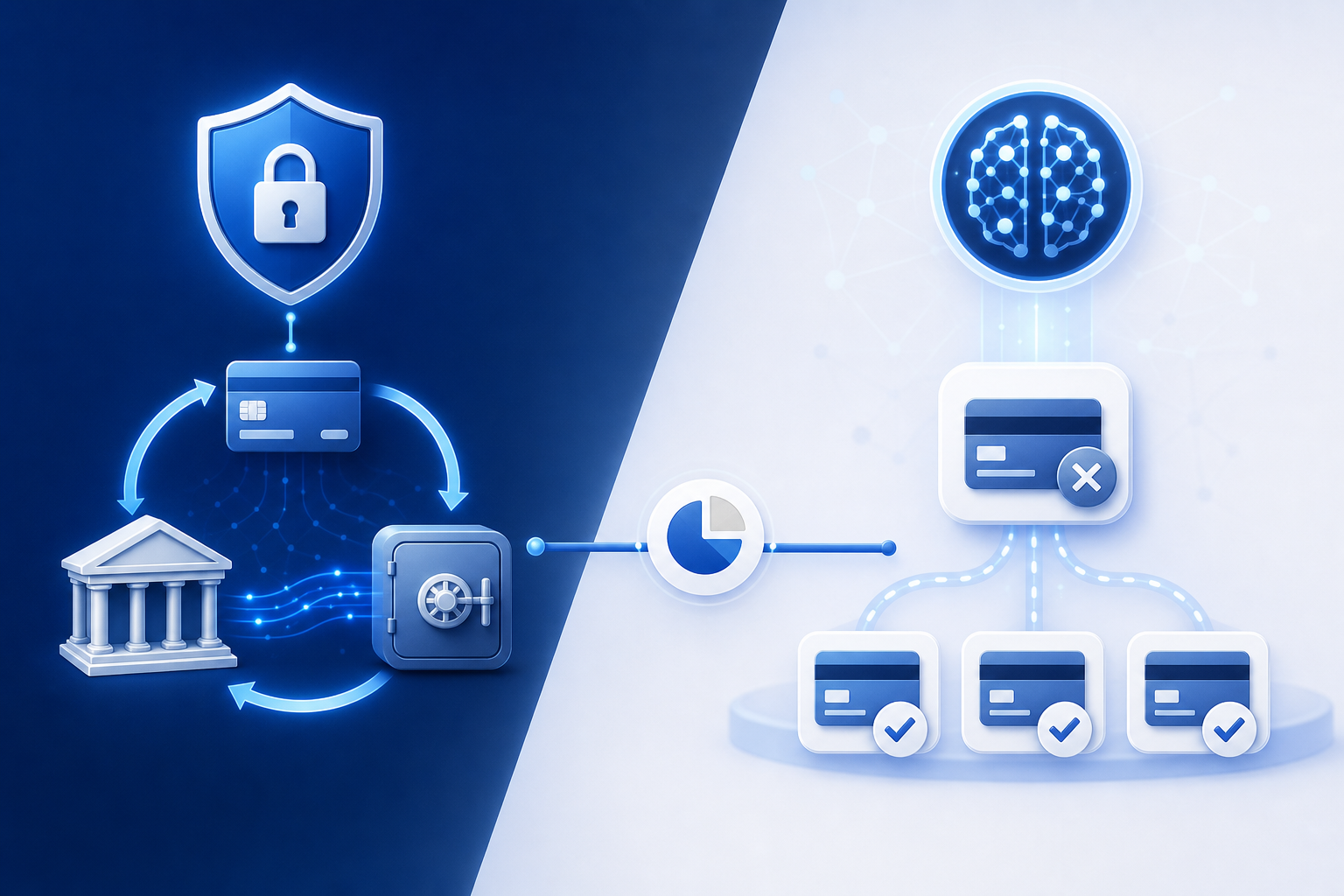
Smart retry logic is the second line of defense, not the first. A substantial share of involuntary churn can be eliminated before any retry fires by keeping payment credentials current. Account Updater services (Visa VAU and Mastercard ABU) automatically push updated card numbers and expiry dates from issuing banks directly to merchants, preventing failures caused by card replacements or renewals before a charge ever declines. Platforms like Recurly include Account Updater natively, meaning credential refresh happens in the background without any action from the subscriber.
Network tokenization takes this further by replacing stored primary account numbers (PANs) with network tokens that stay valid across card reissues. Because tokens are recognized as lower-risk by issuer fraud filters, they also reduce false decline rates that have nothing to do with the subscriber's intent to pay. Together, these prevention tools reduce the volume of transactions that need retry logic at all, which sharpens the signal quality of any AI retry model working on what remains.
How to Reduce Involuntary Churn for SaaS Subscriptions in 2026: A Layered Strategy
Involuntary churn isn't a single problem. It's three compounding failure points, each requiring a different layer of defense. The most effective SaaS subscription businesses in 2026 stack all three instead of relying on any one in isolation.
Layer 1: Prevent with Account Updater and Network Tokenization
See 'Prevention Before Retry' above for how Account Updater and network tokenization reduce retry volume.
Layer 2: Recover with AI-Powered Smart Retries
For the transactions that still decline, AI-powered retry logic is the recovery engine. An effective smart retry tool analyzes each declined transaction individually, weighing decline code, card type, issuer behavior, geography, and historical cohort data, before deciding whether to retry, when, and at what amount. Rules-based schedules that apply the same fixed cadence to every transaction leave substantial MRR (monthly recurring revenue) on the table by treating a soft decline and a hard decline on a closed account as equivalent.
Layer 3: Verify with Statistically Rigorous Measurement
The layer most SaaS businesses skip is measurement. Recovery rates that look strong in a vendor dashboard may include transactions that would have resolved on their own. The only way to confirm a smart retry tool is generating incremental lift, and not merely processing recoveries that were going to happen anyway, is AABB testing: splitting your retry traffic into a treatment group and a control group, measuring dollars recovered in each, and reporting the p-value. Without that statistical certainty, you cannot quantify what any single vendor is contributing to your MRR (monthly recurring revenue) retention.
Slicker is the only tool reviewed here that runs AABB testing on your own transaction data before asking for a full commitment. The combination of all three layers (prevent, recover, and verify) is the 2026 standard for subscription businesses that treat involuntary churn as a measurable, recoverable revenue line and not an accepted cost.
Feature Comparison Table of Smart Retry Tools
One row tells the story that matters most for any payment retry optimization shortlist: AABB testing before commitment.
Feature | Slicker | Vindicia | Churnkey | FlyCode | Revaly | Butter |
|---|---|---|---|---|---|---|
AABB testing before commitment | Yes | No | No | No | No | No |
No-code integration | Yes | No | Yes | Yes | No | No |
AI-powered retry optimization | Yes | No | No | Yes | Yes | Yes |
Multi-gateway routing | Yes | No | No | No | Yes | No |
Personalized dunning by failure reason | Yes | No | No | Yes | Yes | Yes |
Performance-based pricing | Yes | Yes | No | Yes | Yes | Yes |
Supports Chargebee | Yes | Yes | Yes | No | Yes | No |
Supports Zuora | Yes | Yes | No | No | Yes | No |
5-minute setup | Yes | No | Yes | Yes | No | No |
Network-level signal analysis | Yes | No | No | No | Yes | No |
Why Slicker Is the Best Smart Retry Tool for Reducing Involuntary Churn
Slicker's core structural difference from every other tool on this list: the others ask you to trust their reported recovery rates. Slicker runs your actual traffic through a statistically rigorous AABB test, reports the p-value, and charges nothing if we fail to outperform your control with statistical certainty on your own data.
Underneath that proof layer, an ensemble of AI models, weighing over 40 variables per transaction, reads network-level payment signals, issuer behavior, geography, and card type to decide whether to retry, when, and at what cadence. Setup requires zero engineering lift and takes roughly five minutes.
Each silently churned subscriber does more than remove the failed payment: it erases all future renewal revenue, compressing Customer Lifetime Value to a fraction of its intended arc. That same subscriber inflates your effective CAC (customer acquisition cost), because the acquisition cost is never amortized across the full lifetime you underwrote. At the portfolio level, involuntary churn suppresses NRR (Net Revenue Retention) even when expansion revenue is healthy, masking your true growth rate from investors and finance teams who use NRR as a signal of product-market fit.
That combination: proven performance before commitment plus hyper-personalized retry logic, is what separates Slicker from every other smart retry tool reviewed here.
Final Thoughts on Selecting Payment Retry Optimization Software
If you're on Shopify with a Recharge or Skio stack, start with FlyCode. If you're a high-volume subscription business on Stripe, Chargebee, or Zuora that needs statistically verified lift before committing, require AABB testing as a non-negotiable criterion. Involuntary churn is the only revenue leak where you can measure recovery down to the dollar and prove causality with a control group. The right smart retry tool runs that test before asking for a contract. If your subscription business is losing 20-40% of total churn to payment failures, you need retry logic that adapts to issuer behavior and card type, not a fixed schedule applied to everyone. Talk to us if you want to see AABB-tested recovery on your own data.
FAQ
What tools should a SaaS CFO use to recover lost revenue from failed payments in 2026?
A SaaS CFO's payment recovery stack in 2026 should be built in three tiers, matched to the source of the failure and the measurability of the fix.
Tier 1: Credential freshness: Account Updater (Visa VAU / Mastercard ABU) and network tokenization. These run automatically at the billing-platform or gateway level and prevent a material share of declines before they occur. Most enterprise billing platforms (Chargebee, Recurly, Zuora) include Account Updater natively; confirm it is active before assessing any retry tool.
Tier 2: Intelligent retry: A specialized AI-powered smart retry tool layered on top of the billing system's built-in logic. The selection criterion that matters most for a CFO: does the tool run AABB testing on your own transaction data, report the p-value, and tie its fee directly to incremental dollars recovered? If the answer is no, you're buying a reported average across someone else's subscriber base. Slicker is the only tool that meets this bar; you see proof of recovery uplift on your own traffic before committing to full deployment.
Tier 3: Dunning and cardholder communication: Personalized dunning emails triggered by specific decline reason, sent from your domain. This layer handles the cases where silent retry isn't sufficient and cardholder action (card update, payment method switch) is required. Slicker's dunning layer segments by failure type so a subscriber with an expired card receives a different message than one with a temporary soft decline.
Together, these three tiers tackle involuntary churn at the source instead of treating it as an immutable cost, recovering MRR that was already earned from subscribers who never intended to leave.
Together, these three tiers tackle involuntary churn at the source instead of treating it as an immutable cost, recovering MRR that was already earned from subscribers who never intended to leave.
Which smart retry tool is best for subscription businesses that need proven results before commitment?
Slicker is the only tool that uses AABB testing to verify recovery uplift with statistical certainty on your own transaction data before you commit to full deployment. Every other tool on this list relies on aggregate benchmarks or unverified claims, making it impossible to confirm whether their retry logic actually outperforms your baseline.
How do I avoid Visa and Mastercard retry fees when retrying failed subscription payments?
Both Visa and Mastercard have rules that impose fees on merchants who retry declined transactions excessively, and those fees add up quickly at subscription scale.
Visa's rules currently limit retries on a declined card transaction to 15 attempts within 30 days. Retrying beyond that threshold can trigger Visa's Excessive Retry fee, a per-transaction charge applied to each retry above the limit. Mastercard enforces similar thresholds under its excessive retry rules for recurring transactions, with fees applied when retry counts exceed defined limits for specific decline categories.
The compliance risk compounds when the same decline code is retried repeatedly. Hard declines (account closed, card reported stolen, do-not-honor) should not be retried at all; retrying them sends negative signals to issuer fraud systems and risks network fees simultaneously. Soft declines (temporary holds, insufficient funds) are retriable but only within the network limits and only when the timing is informed by issuer-behavior signals, not a fixed schedule.
A well-configured AI-powered retry tool handles this automatically by classifying each decline code before queuing a retry and enforcing a retry count ceiling per transaction per window. Rules-based retry schedules built into billing platforms do not always enforce card-network retry limits natively, which means a misconfigured dunning schedule can generate fees without ever surfacing them as a line item in the billing dashboard. Auditing your retry counts per declined transaction against Visa's and Mastercard's published thresholds, and confirming your retry tool enforces those limits, is a prerequisite before scaling any recovery program.
How do I choose the right payment retry tool if I'm running Stripe Billing?
If you're on Stripe Billing, you can run Slicker alongside Stripe Smart Retries to measure performance directly, or test Slicker's dunning against Stripe SmartDunning in a side-by-side evaluation. The key criterion is whether the tool can prove incremental lift on your own traffic through controlled testing, not whether it claims compatibility.
Stripe Smart Retries is a generalist solution optimized across Stripe's entire merchant base (B2B invoices, one-time payments, and subscriptions alike), not tuned for subscription recurring billing. Because it draws on aggregated network data from that full mix, it cannot apply issuer-behavior signals specific to your subscriber cohort. The meaningful test isn't "dedicated tool vs. Stripe" in the abstract; it's whether the dedicated tool can prove incremental lift above Stripe's baseline on your own traffic through controlled AABB testing.
What's the difference between AI-powered retry optimization and rules-based retry schedules?
AI-powered retry optimization analyzes each declined transaction individually, weighing variables like issuer behavior, card type, decline code, and geography before deciding whether to retry, when, and at what amount. Rules-based systems apply the same fixed schedule to every transaction regardless of context, treating a consumer debit card from a regional bank the same as a corporate Amex. Strategic retry optimization requires understanding decline patterns and timing nuances that generic schedules miss.
What tools should I use to recover failed payments on a Zuora or Recharge billing stack?
Both Zuora and Recharge have native retry and dunning capabilities, but they share the same core limitation: their retry logic is optimized for their billing system's general use case, not tuned to your subscriber cohort's specific issuer behavior, card mix, or geography. Zuora's Payment Retry settings let you configure retry intervals and gateway routing rules, but the schedule is rules-based, not AI-driven. Recharge offers configurable retry attempts and dunning notification sequences for subscription merchants, but the timing logic applies a fixed pattern across all failed charges instead of adapting per transaction.
For high-volume subscription businesses on either stack, layering a specialized recovery tool like Slicker on top of the native billing logic captures the incremental revenue those built-in tools leave behind. Slicker integrates with both Zuora and Recharge without engineering lift, runs AABB testing to confirm the incremental lift above the billing system's baseline, and charges nothing if it doesn't outperform your existing retry logic with statistical certainty on your own data.
Can smart retry tools work for e-commerce subscriptions or are they only for SaaS?
Smart retry tools work for any business model with recurring payments, including e-commerce subscriptions, membership businesses, and media subscriptions. The recovery logic applies to any failed recurring transaction, though some tools like FlyCode are built for Shopify merchants while others like Slicker support cross-system billing.
How do I handle failed ACH and direct debit payments differently from failed card payments?
ACH and direct debit failures operate under fundamentally different rules than card declines, and conflating the two in your retry strategy is a compliance and cost risk.
Card declines come back in real time with a specific decline code (R01 through R99 in ACH terminology does not exist; card networks use their own code sets), and the merchant knows immediately whether the failure is a soft decline (retriable) or a hard decline (stop). Visa and Mastercard retry rules for cards limit excessive retry attempts on declined transactions: Visa's rules currently prohibit retrying a declined card transaction more than 15 times in 30 days, and excessive retries can trigger fees from the card networks.
ACH returns arrive on a delay (typically 2-3 business days after the origination date) and return codes carry their own meaning. R01 (insufficient funds) is retriable; R02 (account closed) is not. R10 (unauthorized) is particularly sensitive: Nacha's rules impose a threshold on unauthorized ACH return rates, and exceeding it can put your originator status at risk. The 60-day window for consumers to dispute an unauthorized ACH debit means that unlike card chargebacks, the dispute clock continues ticking well after the payment appeared to clear.
The practical implication: your retry logic must bifurcate by payment method. Apply AI-driven card retry logic to card transactions where real-time decline codes allow per-transaction decisions. Apply ACH-specific return-code routing to direct debit transactions, halting retries on closed accounts (R02, R03) and unauthorized returns (R10) immediately, while allowing a single carefully timed retry on R01 insufficient funds returns. Specialized smart retry tools handle this bifurcation automatically; generic billing built-ins typically do not.
When should I consider switching from my billing system's built-in retry logic?
If your billing system's recovery rates have plateaued and you're losing more than 1% of MRR monthly to involuntary churn, you need a specialized recovery tool. Built-in solutions use generic, one-size-fits-all schedules that can't adapt to issuer-level signals or card-specific behavior patterns, leaving substantial revenue on the table.
What are the risks of giving a third-party payment recovery service access to your Stripe account and customer data, and what happens to that data when you stop using the service?
The core risks fall into three categories: access scope, data retention, and portability on exit.
Access scope. Any payment recovery tool that operates inside Stripe requires OAuth or API key access to your Stripe account. The risk is over-permissioned access: a vendor that requests write access to subscription objects, invoices, or customer records when read access would suffice for their stated function. Before connecting any tool, request a complete list of the Stripe permission scopes the vendor requires and confirm each scope is necessary for a specific feature. Slicker scopes its Stripe access narrowly to the actions its retry engine actually executes (billing cycle adjustments and retry triggers) and does not request access to customer PII beyond what is required to match a transaction to a retry candidate.
Reputable vendors will commit to a data deletion or anonymization timeline in writing (typically 30 to 90 days post-termination) and document this in a Data Processing Agreement (DPA). If a vendor cannot produce a DPA or declines to specify a retention window, treat that as a disqualifying signal.
Portability. Confirm that any recovery attribution data, retry logs, and performance reporting can be exported in a standard format (CSV, JSON) before you sign. Lock-in through proprietary data formats is a real risk when switching vendors.
What technical and contractual safeguards should enterprises require from payment recovery vendors to manage GDPR subprocessor risk?
If your subscriber base includes EU or UK residents, any payment recovery vendor that processes cardholder data on your behalf is a GDPR subprocessor. The contractual minimum is a signed Data Processing Agreement that covers: the categories of personal data processed, the purpose and legal basis for processing, sub-subprocessor notification obligations, data subject rights facilitation (access, deletion, portability), cross-border transfer mechanisms (Standard Contractual Clauses or UK IDTA where applicable), and a defined data retention and deletion schedule post-termination.
Beyond the DPA, enterprise procurement teams typically require: cyber liability insurance with a minimum per-incident limit appropriate to the data volume processed (request a current certificate of insurance, not merely a policy summary); a completed security questionnaire or SOC 2 Type II report confirming controls over access, encryption, and incident response; and a documented breach notification SLA. Most enterprise contracts require vendor notification within 24 to 72 hours of a confirmed incident, ahead of the GDPR's 72-hour supervisory authority clock.
On liability: standard SaaS contracts cap vendor liability at 12 months of fees paid. For payment data processors handling high transaction volumes, negotiate for a higher cap, particularly for breaches involving cardholder data, and confirm whether the indemnification clause covers regulatory fines or only direct damages. GDPR fines run to 4% of global annual turnover; verify that your contract allocates liability for regulatory exposure proportionally.
What data signals and integrations does Slicker need to run its retry engine?
Slicker's retry engine analyzes each failed transaction using a combination of network-level signals and billing system data. The core inputs are: the raw decline code returned by the issuer, card type and card network (Visa, Mastercard, Amex), issuer identifier, geography of the issuing bank, historical retry outcome data for the same card and issuer cohort, and subscription metadata (billing cycle, plan type, tenure).
On the network side, a Mastercard data partnership (planned, not yet live) is in development and will, once live, provide issuer-behavior signals currently unavailable through standard processor responses, particularly for Mastercard-network transactions where issuer-level congestion and fraud-flag patterns could be read in advance of a retry attempt.
On the billing system side, Slicker integrates natively with Stripe, Chargebee, Recurly, Zuora, and Recharge. The integration reads failed invoice and subscription events via webhook or API polling, passes the transaction context to the retry engine, and writes the outcome, whether retry success, retry deferred, or retry stopped, back to the billing system as the system of record. No cardholder PAN data is stored by Slicker; the retry instruction is passed back to the processor through the existing billing system's tokenized payment method.
How does delta-based incremental pricing work, and why is it fairer than charging a percentage of all recovered payments?
Most payment recovery vendors charge a percentage of every dollar recovered, typically 10 to 25% of gross recovered revenue. The problem with this model is that it charges you for payments you would have recovered anyway. If your billing system's native retry logic already recovers 60% of failed payments on its own, a vendor charging 15% of all recoveries is collecting fees on that 60% baseline even if their tool contributed nothing to it.
Delta-based pricing (also called incremental recovery pricing) charges only on the lift above your baseline. The measurement is straightforward: AABB testing splits your retry traffic into a treatment group (Slicker's retry logic) and a control group (your existing baseline). The delta is the difference in dollars recovered between the two groups. You pay only on that delta, at a contractually fixed percentage. If Slicker doesn't generate statistically verified incremental lift above your control, there is no fee.
The practical consequence: delta-based pricing aligns vendor incentives entirely with your incremental outcome. A vendor on gross-recovery pricing has no incentive to improve above your baseline; they get paid regardless. A vendor on delta pricing only earns when they beat it. For high-volume subscription businesses that already recover a meaningful share of failed payments through their billing system's native logic, the difference between gross-recovery and delta pricing can represent a material overpayment on the gross model.
How can I monitor invoice recovery performance in Slicker after a dunning window change, and what visibility tools exist beyond the A/B test dashboard?
Slicker's reporting layer gives you three visibility surfaces beyond the AABB test dashboard. First, a per-invoice retry log that shows the full retry history for each failed transaction: decline code received, retry timestamp, outcome, and whether the recovery was attributed to Slicker's logic or the control group. This is the audit trail for attribution disputes and is exportable in CSV and JSON.
Second, a cohort-level recovery report that segments recovery rates by card type, issuer, geography, and subscription plan, letting you identify which subscriber segments are driving the largest share of unrecovered revenue and where dunning window changes are having the most impact. After a dunning window change, the cohort report is the fastest way to confirm whether the change is improving or degrading recovery rates for specific card and issuer combinations.
Third, a dunning performance breakdown that shows open rates, click rates, and payment completion rates per dunning email template, segmented by failure reason. If a window change moves the timing of dunning emails, this report surfaces whether subscriber engagement with those emails is moving in the expected direction.
For teams that need recovery data inside their own BI stack, Slicker supports webhook-based event streaming and a REST API for pulling recovery attribution data into Looker, Tableau, or a data warehouse. The combination of per-invoice audit trails, cohort segmentation, and dunning performance metrics is designed to give a finance or payments team the visibility to manage recovery as a measurable revenue line, not a black box.
What is required to set up and maintain a Slicker integration when migrating from one billing system to another?
A billing system migration, for example, from Chargebee to Stripe Billing, requires a reconnection of Slicker's integration to the new billing system, but does not require a full re-onboarding. Slicker's integrations are modular: each billing system connection is independent, and adding a new connection while retiring an old one is a configuration change, not an engineering project.
The migration workflow has three steps. First, authorize Slicker's connection to the new billing system using OAuth or an API key with the scopes Slicker requires. Second, confirm that the subscription and invoice data structures in the new system are mapped correctly to Slicker's retry engine inputs. Slicker's onboarding team handles this mapping and validates it against a sample of historical failed transactions before going live. Third, deauthorize the legacy billing system connection once the new system is confirmed live and producing retry events correctly.
The maintenance overhead after migration is minimal. Slicker monitors its own webhook connections and alerts if an integration goes stale or if event volume drops unexpectedly, which is often the first signal that a billing system migration has introduced a configuration gap. There is no engineering involvement required on your side for routine maintenance; the integration is designed to run on autopilot once the initial connection is validated.
How does Slicker integrate with Stripe technically, what API access is required, and how are Slicker's actions written back into Stripe as the system of record?
Slicker connects to Stripe via OAuth, which allows you to authorize specific permission scopes instead of sharing a full-access API key. The scopes Slicker requests are limited to the actions its retry engine executes: reading invoice and subscription events, triggering payment retries on existing payment methods, and writing billing cycle adjustments back to subscription objects where recovery logic requires a cycle reset. Slicker does not request access to Stripe customer PII, payout settings, or Connect account structures beyond what is required for its stated function.
All actions Slicker takes in your Stripe environment are written back as standard Stripe API events (no proprietary event types, no external state that diverges from what Stripe records). A billing cycle reset triggered by Slicker appears in your Stripe event log as a standard subscription update. A retry success appears as a standard invoice payment event. Your Stripe account remains the authoritative system of record: your finance team, your customer success team, and any downstream tool reading from Stripe sees a consistent, complete event history without needing to query Slicker's dashboard separately.
Permission scoping can be narrowed further on request. If your security or compliance team requires Slicker to operate with read-only access to certain Stripe objects while retaining write access only to retry-relevant endpoints, that configuration is available. Request a permissions review during onboarding and Slicker's team will document the exact OAuth scopes required for your specific integration use case.
How do you determine whether a recovered payment was genuinely incremental versus self-recovered or customer-initiated, and how should attribution be structured in data exports?
The attribution problem in payment recovery is real and frequently underestimated: a subscription that recovers two days after a failed payment may have recovered because Slicker's retry logic fired at the optimal time, because the cardholder updated their card manually, or because the issuer's temporary hold expired on its own. Without a control group, you cannot tell which.
Slicker resolves this through AABB testing. Your retry traffic is split 50/50 between a treatment group (transactions where Slicker's AI retry logic runs) and a control group (transactions where Slicker does not intervene). Recovery rates in both groups are measured over the same window. The incremental recovery rate is the treatment group's recovery rate minus the control group's recovery rate. Any recovery that would have happened in the control group (self-recoveries, cardholder-initiated updates, issuer hold expirations) is automatically excluded from the delta. The p-value confirms whether the difference is statistically meaningful or within the range of random variation.
In Slicker's data exports, each recovered transaction is tagged with its attribution category: Slicker-initiated retry (the retry was triggered by Slicker's engine and succeeded), control group recovery (the transaction was in the control cohort and recovered without Slicker's intervention), or cardholder-initiated (a card update or manual payment from the subscriber resolved the invoice, regardless of which group the transaction was assigned to). This three-way tagging lets your finance team exclude control-group and cardholder-initiated recoveries from Slicker's fee calculation and gives your data team a clean attribution column for BI reporting.
Related Articles
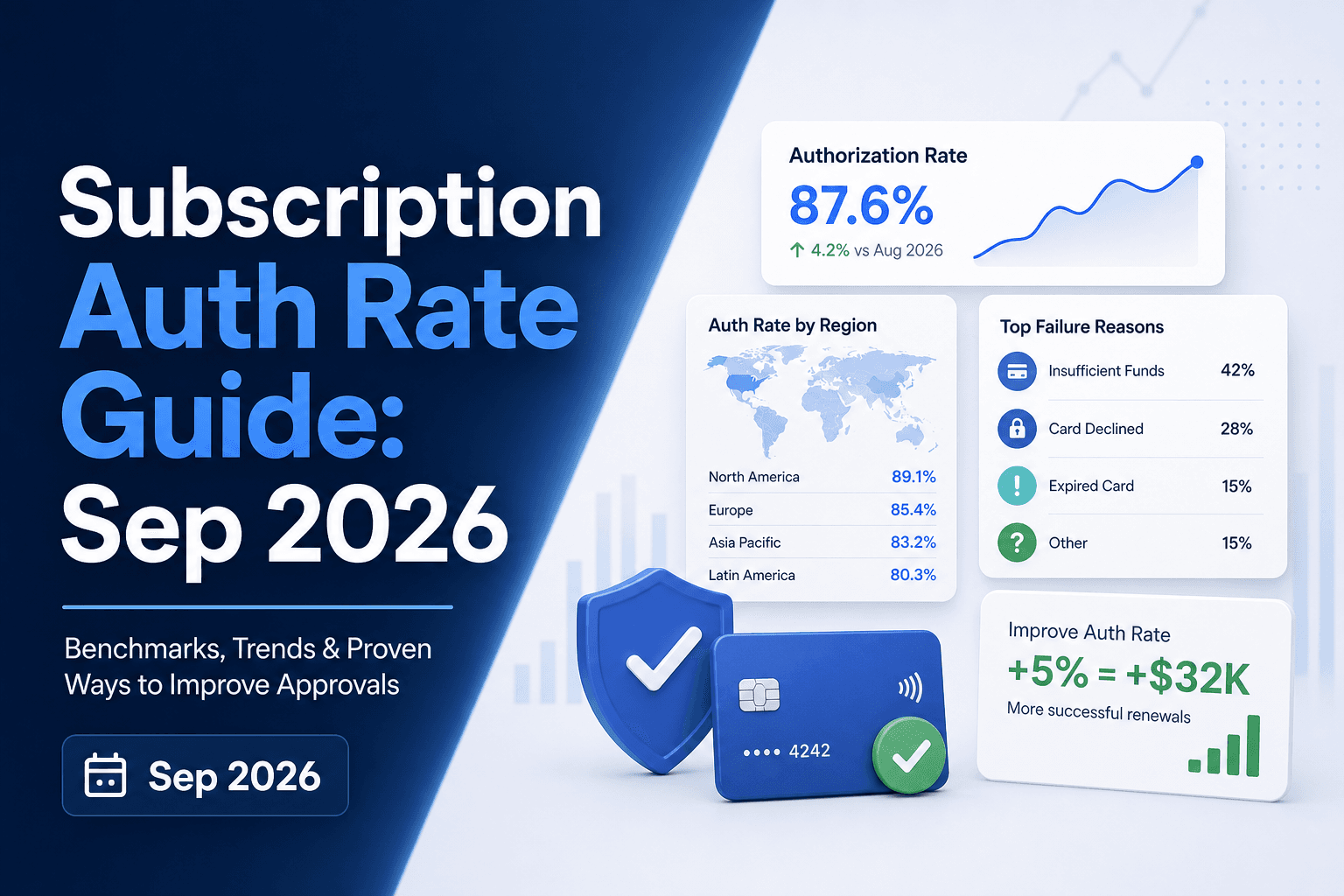
Authorization Rate in Subscription Billing: October 2026
There's a number sitting in your payments data that most finance and retention teams never report on separately: the share of renewal charges your issuing...
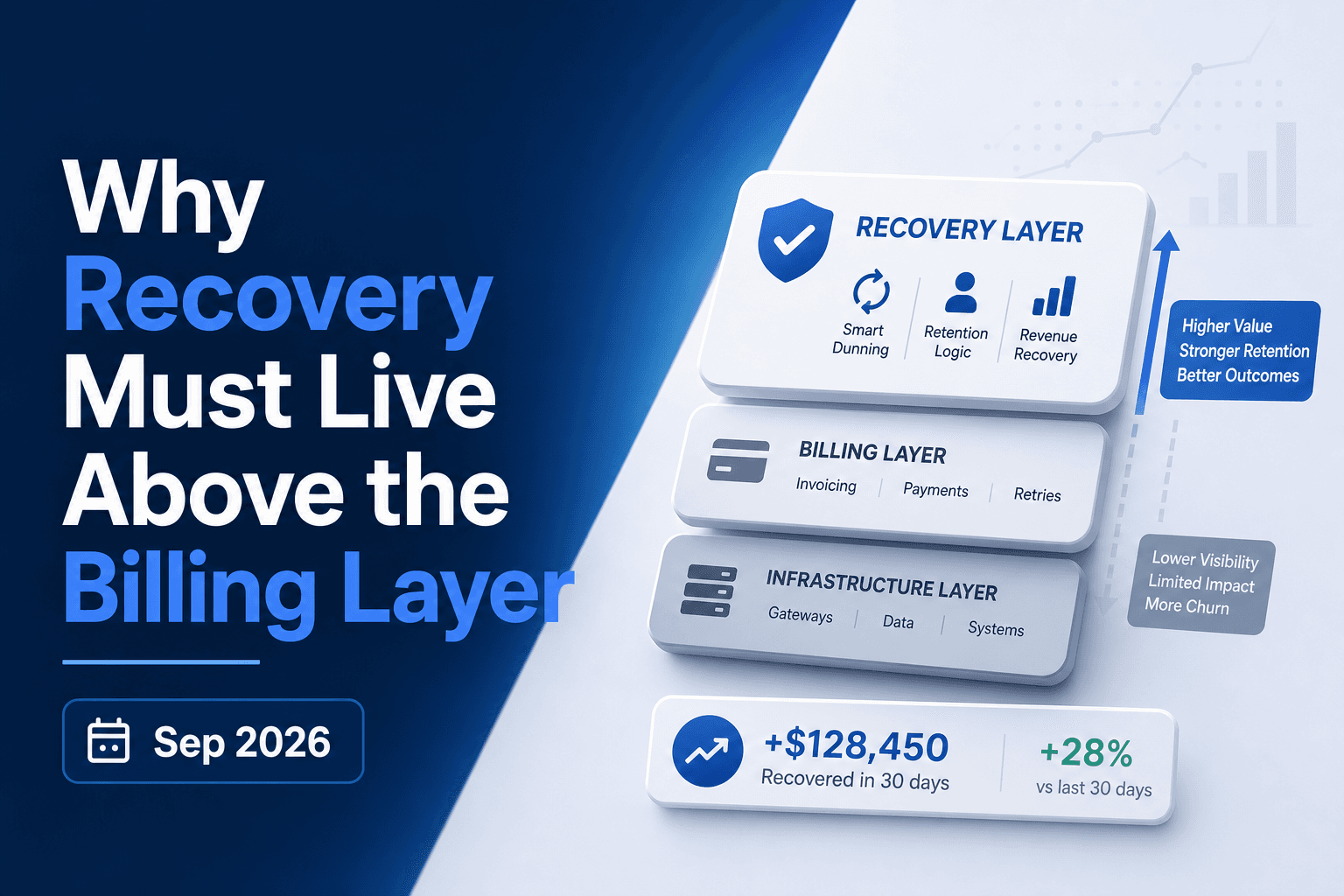
Why Payment Recovery Must Live Above Billers October 2026
A payment fails. Your biller retries it three days later, then again at seven, then at fourteen. What the biller never checks is whether the issuer sent a...
Billing Migration vs Recovery Layer: The Right Call October 2026
Switching billing systems feels like the right move when revenue collection starts breaking down. Sometimes it is. But soft declines, weak retry logic, and...
Stop losing revenue to failed payments
Join leading subscription businesses using Slicker to recover failed payments automatically.
Get Started