Best Failed Payment Recovery Strategies for Subscriptions (July 2026)
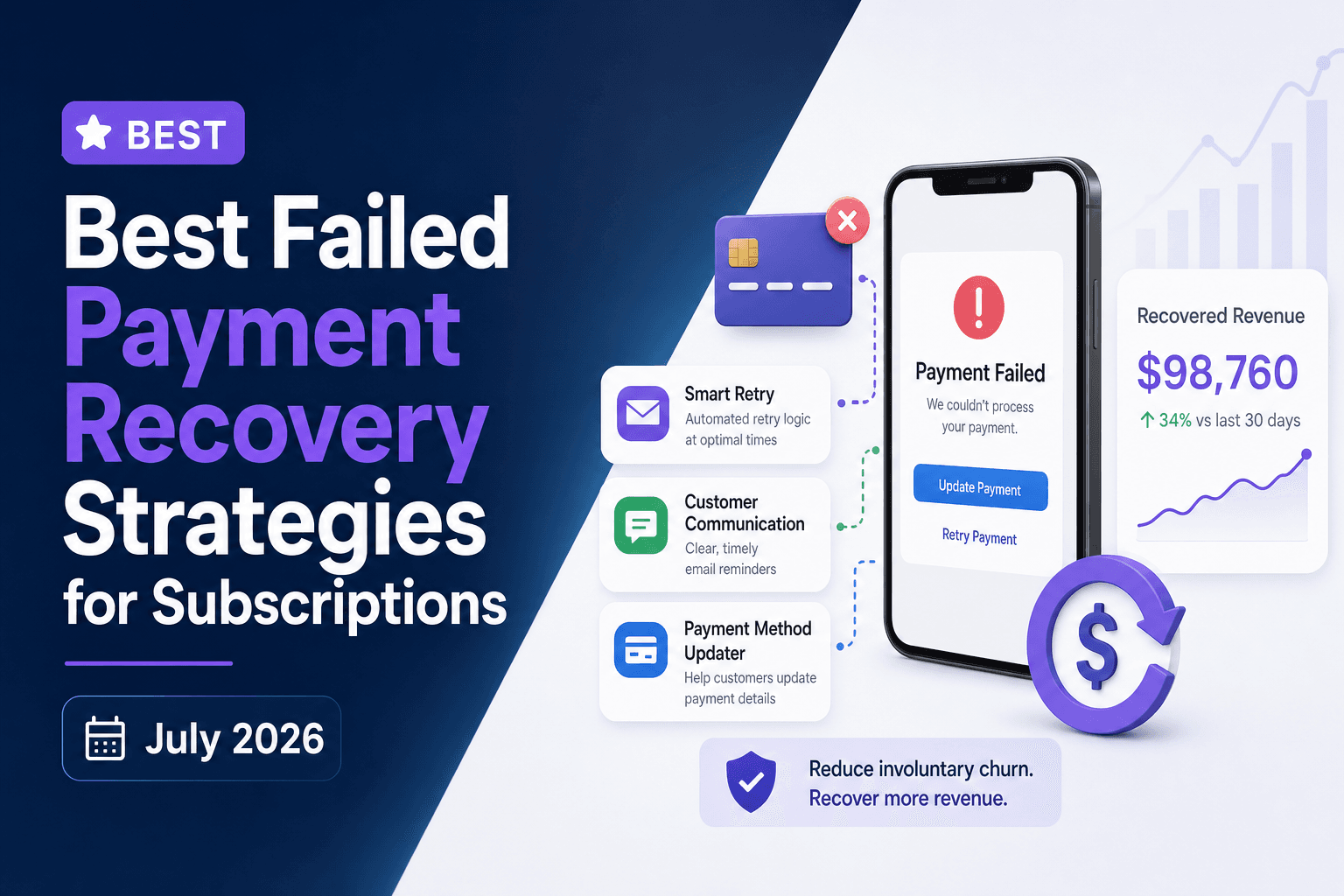
There's a gap between what your billing system does with a failed payment and what's actually possible. Stripe billing gives you stripe smart retries and a stripe subscription API with some retry controls, but static retry schedules treat a payment failed chase bank decline the same way they treat a card with insufficient funds, and those are very different problems. If your billing team is seeing repeated declines for the same subscriber, the root cause is almost always retry sequencing. Here's what better failed payment recovery looks like, from the basics of soft versus hard declines to dedicated recovery layers built for Stripe, Chargebee, or Recharge billing stacks that prove their own results on your data.
TLDR:
- Soft declines are retriable silently; hard declines require customer action before any retry works.
- The key evaluation criteria for recovery tools are retry intelligence, dunning quality, proof of performance, and setup lift.
- Most tools ask you to accept aggregate benchmarks on faith, with no way to verify recovery lift on your own data.
- Butter and FlyCode are scoped to the Recharge/Shopify ecosystem and lack cross-processor support.
- Slicker runs clinical-grade AABB testing on your live traffic before you commit, with a 4-month pilot (first month free, three paid months, cancel anytime).
What is Failed Payment Recovery?
Failed payment recovery is the process of recapturing revenue that was lost when a customer's payment attempt didn't go through. A payment can fail for dozens of reasons: insufficient funds, an expired card, a bank-side technical error, or a soft decline where the issuer simply flagged the transaction as suspicious.
The distinction that matters most for subscription businesses is between soft and hard declines. Soft declines are temporary and retriable. Hard declines, like a stolen or cancelled card, require customer action before any retry will succeed. Treating them the same way wastes retry attempts and risks irritating customers unnecessarily.
Recovery works across two tracks: silent automated retries that happen without the customer ever knowing, and customer-facing outreach when the error requires their involvement. Getting that sequencing right is where most of the recoverable revenue either gets captured or left behind.
How We Ranked Failed Payment Recovery Tools
We assessed each tool in this guide against a consistent set of criteria, so you can compare them on the factors that actually move the needle on recovered revenue.
Here is what we looked at:
- Recovery methodology: whether the tool uses AI-driven smart dunning and retries, static rule-based schedules, or some combination, and how much the approach adapts to individual card, issuer, and account signals.
- Dunning and customer communication: the quality and flexibility of outreach sequences, including whether emails are sent from your own domain or a third-party one, and whether messaging ties to the specific failure reason.
- Proof of performance: whether the vendor offers statistically validated testing (such as AABB testing in payment recovery with p-values) or asks you to accept aggregate case studies on faith.
- Integration and setup: time to go live, engineering lift required, and compatibility with billing infrastructure like Stripe.
- Pricing model: whether fees are performance-based, flat, or percentage-of-revenue, and how that aligns with your incentives.
No single tool wins on every dimension, but understanding where each one sits on these axes helps you match the right solution to your volume, stack, and risk tolerance.
Best Overall Failed Payment Recovery Tool: Slicker
Slicker is purpose-built for high-volume subscription businesses that need provable recovery results, not vendor promises. Where most failed payment recovery tools offer static retry schedules and generic dunning sequences, Slicker runs an ensemble of AI models that decide whether to retry, when to retry, and through which channel, based on decline code, card type, issuer, geography, and account history.
Recovery happens silently first. Automated retries run in the background without touching your customer. Only when a payment error genuinely requires customer action, such as a stolen or expired card, does Slicker trigger dunning outreach. See how dunning emails compare to AI retries for context. Those emails go out under your brand, your domain, and your voice, framed around the value the subscriber would lose, not the failed transaction itself.
What separates Slicker from alternatives is how it proves performance. Before you commit, Slicker runs clinical-grade AABB testing on your live traffic: 50/50 split, dollars recovered measured, p-value reported. If Slicker does not beat your current recovery baseline with statistical significance, you do not pay. Setup requires zero engineering lift and takes roughly five minutes.
The pilot is four months: the first month free, three paid months, cancel anytime.
Revaly
Revaly is a failed payment recovery tool built for subscription businesses, with a focus on intelligent retry logic and customer communication workflows. Based on Revaly's published feature set as of July 2026, it takes a more rules-based approach to retry scheduling in place of a fully AI-driven one.
Revaly offers dunning email sequences, customizable retry timing, and basic decline code handling. For teams that want more control over manual retry rules, it can be a workable fit. The tradeoff is that without AI-powered smart retries adapting to card type, issuer behavior, and subscriber history, recovery performance tends to ceiling sooner, since rules cannot adapt to issuer-specific signals the way AI models do.
Revaly also lacks the clinical-grade AABB testing methodology that lets you verify recovery rate uplift on your own data before committing. For a CFO vetting vendors, that gap is the deciding factor: you're comparing self-reported benchmarks against a system that proves its numbers against your actual subscriber base with statistical significance. For teams comparing a Revaly alternative for payment recovery, that difference is critical.
Butter
Butter is a failed payment recovery tool built for Shopify merchants, with a particular focus on subscription businesses running on Recharge. It intercepts failed payments before they result in cancellation, using retry logic and customer outreach to recover revenue that would otherwise be lost to involuntary churn.
Where Butter has carved out a niche is in its Recharge integration. For brands running subscription boxes or consumable replenishment on Shopify plus Recharge, Butter offers a relatively plug-and-play recovery layer. Its retry scheduling and dunning flows are designed around that specific stack, which makes initial setup straightforward for that audience.
The tradeoff is scope. Butter is purpose-built for one ecosystem. If your subscription business runs on Stripe, Chargebee, Recurly, or any billing infrastructure outside of Recharge, Butter is not a fit. The product does not offer cross-processor support, and there is no AABB testing methodology to prove whether its retry logic is actually outperforming your baseline.
That last point matters most for finance leaders vetting recovery tools. Without statistical validation on your own data, you are trusting the vendor's claimed performance instead of measuring it. Based on Butter's public documentation as of July 2026, Butter does not publish a methodology for isolating its recovery lift from organic recoveries, which makes ROI attribution genuinely difficult to verify. Businesses seeking a Butter Payments alternative with transparent performance proof will find the gap substantial.
For Recharge-native Shopify merchants who want a simple, low-lift solution and are comfortable with qualitative results, Butter covers the basics. For higher-volume subscription businesses that need processor-agnostic coverage and provable recovery attribution, the ceiling is low. Businesses on Stripe, Chargebee, Recurly, or Zuora, or those running any billing infrastructure outside of Recharge, will need a tool built for broader stack compatibility and statistical performance validation.
FlyCode
FlyCode is a failed payment recovery tool built for Shopify merchants, with a focus on subscription revenue lost to passive churn. It sits inside the Shopify ecosystem and works alongside tools like Recharge and Shopify Subscriptions to retry failed payments and send dunning emails.
The appeal is straightforward: if your store runs on Shopify, FlyCode requires minimal setup and plugs into your existing billing workflow. It covers the basics of retry logic and customer outreach, which is enough for merchants early in their subscription growth.
Where FlyCode shows its limits is at scale. The retry logic is relatively static, and there is no AABB testing framework to prove whether the recovery lift you see is actually attributable to FlyCode or just natural payment resolution. For a CFO vetting vendor ROI, that gap matters. You cannot separate signal from noise without a controlled measurement methodology, which means you are taking the recovery numbers on faith.
For high-volume subscription businesses where involuntary churn (customers lost to payment failures, not deliberate cancellations) represents meaningful monthly recurring revenue (MRR), a tool that cannot prove its own impact is a liability, not an asset. See our full breakdown of the best AI-powered payment recovery tools for 2026 for a detailed comparison.
Feature Comparison Table of Failed Payment Recovery Tools
Here is a feature comparison table of the leading failed payment recovery tools, covering the dimensions that matter most to subscription businesses weighing their options.
Recovery tools vary widely in what they actually do versus what they claim. The table below cuts through that by comparing the factors that directly affect recovered revenue: retry intelligence, testing methodology, dunning sophistication, and setup requirements.
Feature | Slicker | Revaly | Butter | FlyCode |
|---|---|---|---|---|
AI-powered smart retries | Yes, ensemble AI models | No, rules-based retry scheduling | Yes | No, limited retry logic |
AABB testing with statistical significance | Yes, before commitment | No | No | No |
Hyper-personalized dunning emails | Yes, failure-reason specific | Yes, customizable sequences | Limited | Yes, email and SMS sequences |
Silent automated recovery first | Yes | Partial | Yes | No, primarily customer-facing outreach |
Zero engineering lift | Yes, no-code setup | No, requires engineering effort | Partial, Recharge/Shopify only | Partial, Stripe and Shopify only |
Card account updater | Yes | No | No | No |
SOC 2 Type 2 compliant | Yes | No | No | No |
Performance proven on your own data | Yes | No | No | No |
The differentiator that separates Slicker from every other tool in this table is the AABB testing methodology. Every other tool asks you to trust aggregate benchmarks or their own reported averages. The independent SaaS recovery benchmark shows exactly how large that gap can be. Slicker splits your actual subscriber traffic, measures dollars recovered on your data, and reports statistical significance before you commit to paying. That is not a feature. That is a fundamentally different standard of proof.
Why Slicker is the Best Failed Payment Recovery Tool
Slicker is purpose-built for high-volume subscription businesses that lose real monthly recurring revenue (MRR) to failed payments every month. Where generic retry logic fires on a fixed schedule regardless of decline type, Slicker runs an ensemble of AI models that reads the specific decline code, card type, issuer behavior, and geography before deciding whether to retry, when, and at what amount. See the 2025 payment-recovery benchmark for MRR recovery to see how this plays out at scale.
The result is silent recovery: most failed payments are resolved before the customer ever knows there was a problem.
Here is what sets Slicker apart from every other tool in this space:
- Slicker uses clinical-grade AABB testing with statistical significance before you commit to anything. Your traffic is split 50/50, dollars recovered are measured, and the p-value is reported. If Slicker does not beat your control, you do not pay.
- Setup requires zero engineering lift. No-code, roughly five minutes, and it runs on your existing billing infrastructure.
- Dunning emails go out from your domain, branded to your voice, and tied to the specific reason the payment failed, not a generic "update your payment info" blast.
- Slicker is SOC 2 Type 2 compliant, and payment credentials flow through your existing PCI-compliant infrastructure, not Slicker's.
The pilot starts with the first month free, followed by three paid months with the option to cancel anytime. You see the recovery lift on your own data before you are locked into anything.
Final Thoughts on How Subscription Businesses Recover Failed Payments
Most failed payments are recoverable, but only if the tool handling them is making smart decisions at the right moment. The tools covered here range from basic retry schedules to AI-driven recovery with statistical validation, and where your business falls on that range affects real dollars every month. Start a conversation with Slicker if you want your next recovery decision backed by data, not a vendor case study.
FAQ
How do I choose the right failed payment recovery tool for my subscription business?
Start with your billing stack and volume. Butter and FlyCode are built for Shopify and Recharge merchants who want low-lift setup within that ecosystem. Revaly suits teams that want manual control over retry rules. Slicker fits high-volume subscription businesses on Stripe, Chargebee, Recurly, Zuora, or Recharge that need AI-driven retry logic and provable recovery attribution across the full billing stack.
Is Slicker better than Butter or FlyCode for subscription businesses running outside of Shopify?
Yes. Butter and FlyCode are purpose-built for the Shopify and Recharge ecosystem, so if your billing infrastructure runs on Stripe, Chargebee, Recurly, or Zuora, neither tool supports your stack. Slicker works across all of those platforms, applies an ensemble of AI models per individual transaction, and proves recovery lift on your own data through AABB testing before you commit.
What is AABB testing and why does it matter for vetting recovery vendors?
AABB testing is a clinical-grade methodology borrowed from crossover drug trials: your failed payment traffic is split 50/50, dollars recovered are measured in each group, and a p-value is reported to confirm statistical significance. It matters because every other tool in this category asks you to accept aggregate benchmarks or self-reported averages as proof of performance. Slicker runs this test on your actual subscriber data before you pay anything.
When should I rely on silent automated retries versus dunning emails for failed payment recovery?
Silent automated retries should run first, covering soft declines where the card is valid and the failure is temporary, such as insufficient funds or a processor timeout. Dunning emails are the fallback, triggered only when the specific failure reason requires customer action, such as an expired or stolen card. Mixing up that sequence means sending unnecessary outreach that erodes brand trust and increases unsubscribe risk.
How does Revaly compare to Slicker for finance teams that need to verify vendor ROI?
Revaly relies on configurable rules-based retry scheduling and does not offer a statistically validated testing methodology against your own subscriber data. For a CFO vetting vendor ROI, that means comparing self-reported benchmarks against Slicker's AABB test results, which report actual dollars recovered and p-values from a controlled split of your live traffic. Without that measurement framework, separating Revaly's lift from organic payment resolution is genuinely difficult.
Related Articles

Authorization Rate in Subscription Billing: October 2026
There's a number sitting in your payments data that most finance and retention teams never report on separately: the share of renewal charges your issuing...
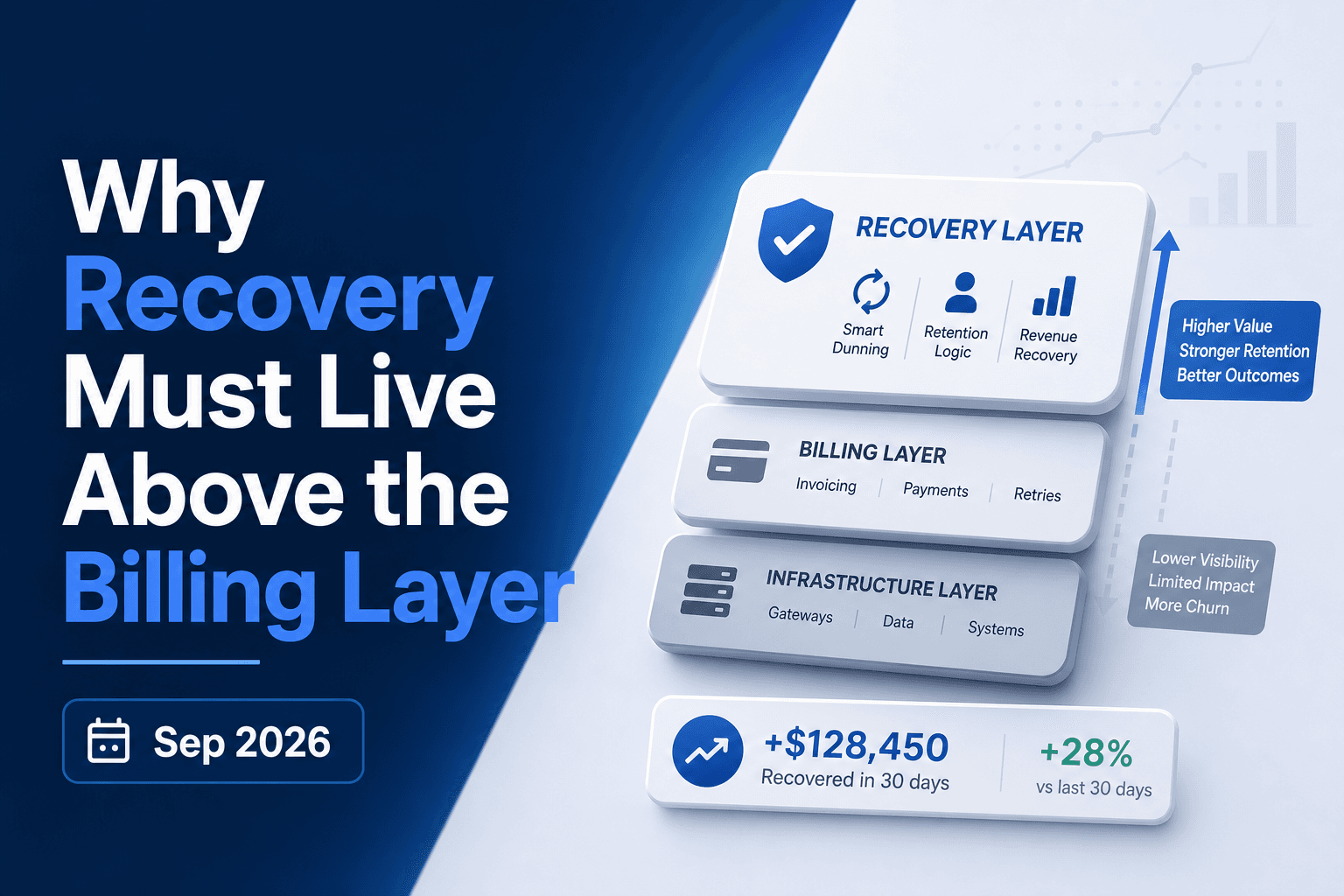
Why Payment Recovery Must Live Above Billers October 2026
A payment fails. Your biller retries it three days later, then again at seven, then at fourteen. What the biller never checks is whether the issuer sent a...
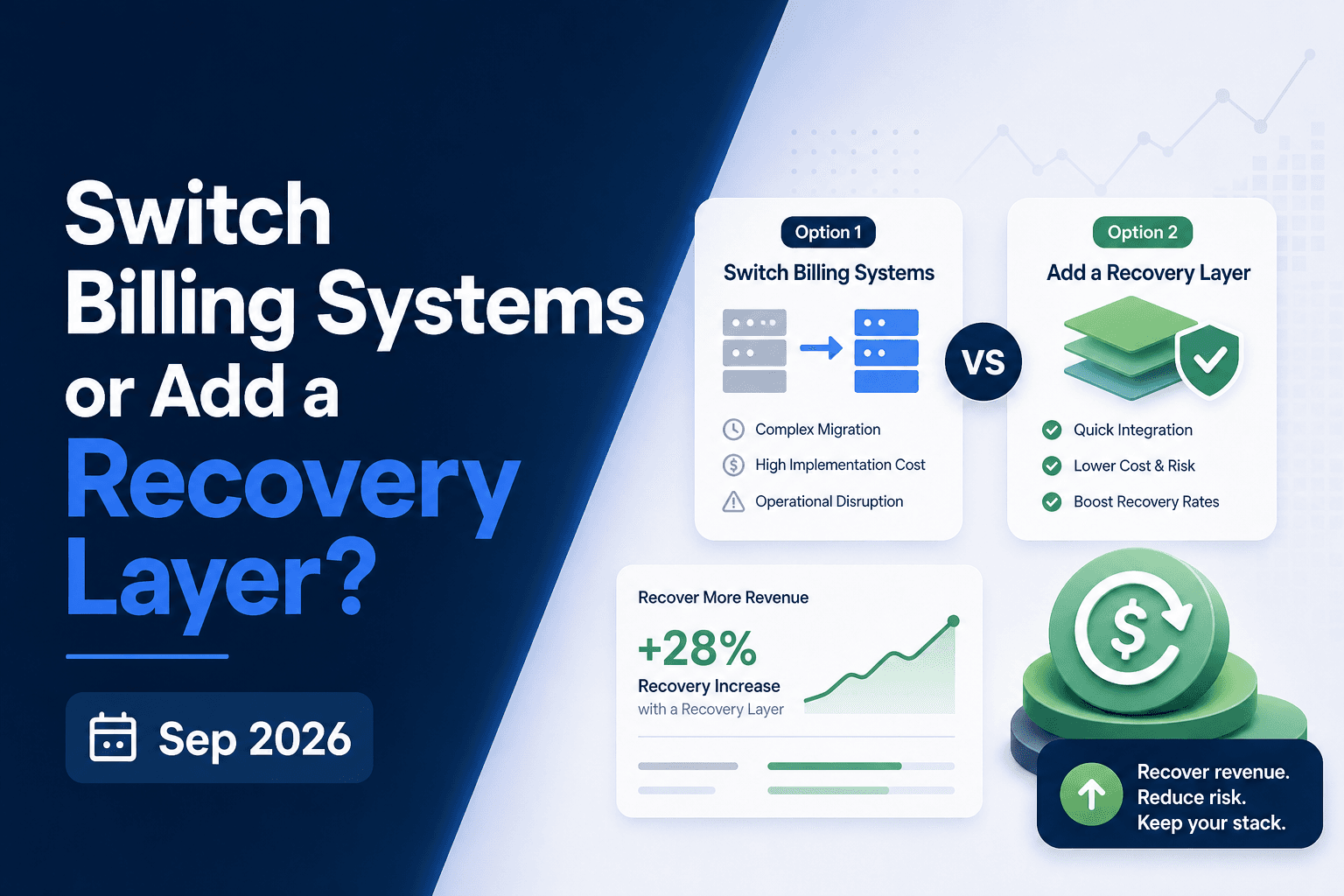
Billing Migration vs Recovery Layer: The Right Call October 2026
Switching billing systems feels like the right move when revenue collection starts breaking down. Sometimes it is. But soft declines, weak retry logic, and...
Stop losing revenue to failed payments
Join leading subscription businesses using Slicker to recover failed payments automatically.
Get Started