Stripe Smart Retries vs. AI Engines: A July 2026 Showdown

Introduction
Payment failures are silently draining subscription revenue at an alarming rate. Every 90 seconds, a subscription payment fails, leading to real revenue loss for subscription businesses. For high-growth SaaS companies, card declines, bank rejections, and soft errors collectively wipe out as much as 4% of MRR (Slicker). With the global payments market expected to exceed US$3 trillion in revenue by 2027, the stakes for optimizing payment recovery have never been higher (Stripe). Critically, subscriptions recovered from involuntary churn don't just survive, continuing for an average of seven more months, effectively equivalent to acquiring a brand-new subscriber at zero acquisition cost (Stripe).
While Stripe's Smart Retries remain the default for many SaaS companies, specialized AI engines like Slicker, Churnkey Precision Retries, and Butter Payments report materially higher recovery rates than static retry systems (Slicker). This analysis covers the real-world performance data, revenue impact modeling, and decision framework finance leaders need to act.
TLDR:
- Failed payments drive involuntary churn, which accounts for more than 50% of overall churn and can wipe out 4% of MRR.
- Stripe Smart Retries caps at 8 attempts and couples every retry to a Stripe-branded dunning email you cannot separate or suppress.
- Stripe Smart Retries and AI retry engines are complementary: run Stripe for the first 4 attempts, then hand off to an AI layer for the remainder.
- Companies above $100K MRR typically see payback within 60 days on a specialized AI retry tool, where even a 1-2 point recovery lift returns multiples of the tool's cost.
- Slicker runs alongside Stripe's existing infrastructure, analyzes tens of parameters per failed transaction, and decouples retry cadence from customer-facing dunning communications.
In This Article:
- The Payment Recovery Picture in 2025
- Stripe Smart Retries: The Incumbent Solution
- Third-Party AI Retry Engines: The Challengers
- 2024-2025 Recovery Rate Data Analysis
- Annual Revenue Impact Modeling by MRR Tier
- Can You Use Both? Running Stripe Smart Retries Alongside a Third-Party AI Engine
- Decision Framework for Finance Leaders
- Implementation Strategy and Best Practices
- Future Trends and Strategic Implications
- Frequently Asked Questions
The Payment Recovery Picture in 2025
Understanding Payment Failure Types
Payment failures fall into two critical categories that require different recovery approaches. Soft declines occur when the payment method is valid, but the transaction fails due to reasons like insufficient funds or billing detail mismatches (Churnkey). These represent the majority of recoverable failures and offer the highest success rates for intelligent retry strategies.
Hard declines, conversely, indicate more permanent issues like expired cards or closed accounts. Up to 12% of card-on-file transactions fail because of expirations, insufficient funds, or network glitches. The distinction matters because AI-driven recovery solutions arose to interpret decline reasons, dynamically adjust retries, and automate outreach.
The Cost of Involuntary Churn
Failed payments drive involuntary churn (distinct from voluntary cancellations), which accounts for more than 50% of overall churn. The psychological impact compounds the financial loss. A single payment hiccup can push a material share of users to cancel (Slicker). For subscription businesses, this creates a compounding revenue drain that traditional retry logic struggles to resolve.
Every 1% lift in recovery can translate into tens of thousands in annual revenue, a mathematical reality that has driven rapid adoption of AI-powered solutions that optimize recovery rates through machine learning and intelligent automation.
Stripe Smart Retries: The Incumbent Solution
Core Capabilities and Approach
Stripe's Smart Retries represent the baseline standard for payment recovery in the SaaS ecosystem. The primary goal of payment retries is to complete a transaction successfully without requiring additional action from the customer (Stripe). Stripe's approach focuses on timing optimization and basic decline reason interpretation, automatically scheduling retry attempts based on historical success patterns and decline codes within their single-gateway ecosystem.
There is, however, a hard ceiling baked into the system: Stripe caps Smart Retries at 8 attempts within its fixed dunning window. Every retry attempt automatically triggers a Stripe-branded dunning email to the cardholder, meaning 8 retries equals 8 emails sent under Stripe's branding, not yours. For subscription businesses that care about customer experience, this volume of system-generated email can create friction before the payment issue is even resolved.
Industry practitioners increasingly recommend a hybrid configuration: 4 retries within Stripe Smart Retries, then a deliberate handoff to a third-party AI layer for the remaining dunning window. This approach captures Stripe's native timing optimization while reserving headroom for more sophisticated, multi-parameter retry logic, and avoids exhausting the email cadence too early. The single-gateway constraint remains the structural limitation Stripe cannot fix from within its own infrastructure, which is precisely where specialized AI engines create their most durable advantage.
Stripe's Smart Retries represent the baseline standard for payment recovery in the SaaS ecosystem. The primary goal of payment retries is to complete a transaction successfully without requiring additional action from the customer (Stripe). Stripe's approach focuses on timing optimization and basic decline reason interpretation within their single-gateway ecosystem.
The system automatically schedules retry attempts based on historical success patterns and decline codes. However, this approach operates within the constraints of Stripe's own payment infrastructure, limiting the ability to route transactions through alternative gateways or apply more sophisticated AI-driven decision making.
Performance Benchmarks
Stripe's Smart Retries typically achieve recovery rates in the 15-25% range for soft declines, depending on the merchant category and customer base characteristics. While this represents a notable improvement over manual retry processes, it sets the baseline against which specialized AI engines are measured.
The system's strength lies in its smooth integration with Stripe's broader payment infrastructure and the zero-setup requirement for existing Stripe customers. However, the single-gateway limitation and rule-based retry logic create opportunities for more sophisticated solutions to deliver superior results.
Strengths: Zero setup for existing Stripe users; included in Stripe Billing at no extra cost; smooth native integration; trained on billions of Stripe network data points.
Limitations: Capped at 8 retries within a fixed dunning window; every retry triggers a Stripe-branded dunning email (retry and email are coupled); no A/B testing capability; single-gateway only; no failure-specific strategy differentiation.
Third-Party AI Retry Engines: The Challengers
Slicker's AI-Powered Approach
Slicker's AI Engine analyzes "tens of parameters" per failed transaction, including issuer, merchant category code (MCC), day-part, and historical behavior, to compute the best retry timing. This multi-dimensional analysis allows the tool to deliver materially better recoveries than static retry systems.
Slicker's Transparent AI Engine provides click-through logs so finance teams can inspect, audit, and review every action (Slicker). This transparency directly resolves a critical concern for finance leaders who need to understand and validate the AI's decision-making process.
Slicker offers a no-code five-minute setup and supports multiple billing providers including Stripe, Chargebee, Recurly, Zuora, and Recharge. The tool's AI-driven retry engine learns from every declined transaction, schedules smart retries, and routes payments through the best gateway.
Churnkey Precision Retries
Churnkey's Precision Retries system focuses on decline classification within the broader context of involuntary churn management. The tool integrates decline analysis with customer lifecycle data to optimize retry timing and dunning messaging, with notable strength in cancellation-flow interventions that pair payment recovery with voluntary churn prevention workflows.
For the comparison, several capability gaps are worth noting: Churnkey does not include a card updater service, lacks decline-code-level email branching, and has no native integrations with enterprise billing systems like Zuora or Chargebee. Pricing is available only through a custom demo quote, which makes cost comparisons difficult before committing to an evaluation. SaaS businesses that require cross-provider recovery, decline-specific dunning, or transparent performance-based pricing should factor these gaps into their assessment.
Butter Payments Recovery Engine
Butter Payments calls attention to the preventable nature of most payment failures, building their recovery engine around proactive failure detection and intelligent retry orchestration. Their system focuses on the critical insight that most payment failures are preventable.
The solution's approach combines real-time failure detection with AI-driven retry optimization, aiming to catch and resolve payment issues before they impact customer experience or revenue recognition.
2024-2025 Recovery Rate Data Analysis
Comparative Performance Metrics
Solution | Soft Decline Recovery Rate | Hard Decline Recovery Rate | Multi-Gateway Support | AI Optimization |
|---|---|---|---|---|
Stripe Smart Retries | 15-25% | 5-8% | No | Rule-based |
Slicker AI Engine | 35-55% | 12-18% | Yes | AI-Powered |
Churnkey Precision | 30-45% | 10-15% | Limited | AI + Lifecycle |
Butter Payments | 28-42% | 8-12% | Yes | Predictive AI |
Recovery rate ranges above are representative estimates drawn from vendor benchmarks and published case studies. Actual results vary by merchant, card mix, failure type, and dunning window configuration.
These performance differentials translate directly into revenue impact. Slicker's AI-driven recovery engine, which learns from every declined transaction, can measurably cut involuntary churn without manual intervention. Results depend on merchant-specific card mix and failure patterns.
Industry Benchmark Context
Adyen's Uplift toolkit improved conversion by 6% through automated optimization, showing that sophisticated payment optimization can deliver measurable results. However, the specialized AI retry engines are achieving even more dramatic improvements by focusing in particular on the failed payment recovery use case.
The AI for Debt Collection Market is projected to grow to USD 15.9 billion by 2034, up from USD 3.34 billion in 2024, with a CAGR of 16.90%. This broader trend toward AI-driven financial recovery solutions validates the strategic importance of intelligent payment recovery systems.
Annual Revenue Impact Modeling by MRR Tier
Small SaaS Companies ($10K-$50K MRR)
For companies in this tier, assuming a 4% monthly failure rate and current 20% recovery with Stripe Smart Retries:
- Monthly Failed Payments: $400-$2,000
- Current Recovery: $80-$400
- Potential with AI Engine (45% recovery): $180-$900
- Additional Monthly Recovery: $100-$500
- Annual Revenue Impact: $1,200-$6,000
The ROI calculation must factor in the implementation costs and monthly fees of third-party solutions. For smaller companies, the absolute dollar impact may not warrant the additional complexity unless the failure rates are substantially higher than average.
Mid-Market SaaS Companies ($100K-$1M MRR)
- Monthly Failed Payments: $4,000-$40,000
- Current Recovery: $800-$8,000
- Potential with AI Engine: $1,800-$18,000
- Additional Monthly Recovery: $1,000-$10,000
- Annual Revenue Impact: $12,000-$120,000
At this scale, the revenue impact becomes substantial enough to warrant dedicated payment recovery optimization. The ability to recover an additional $50,000-$100,000 annually creates clear ROI for specialized solutions.
Enterprise SaaS Companies ($1M+ MRR)
- Monthly Failed Payments: $40,000+
- Current Recovery: $8,000+
- Potential with AI Engine: $18,000+
- Additional Monthly Recovery: $10,000+
- Annual Revenue Impact: $120,000+
For enterprise-scale operations, the revenue impact of optimized payment recovery can reach hundreds of thousands or millions of dollars annually. At this level, even marginal improvements in recovery rates can warrant considerable investment in specialized solutions.
Can You Use Both? Running Stripe Smart Retries Alongside a Third-Party AI Engine
The most important clarification in this comparison: Stripe Smart Retries and third-party AI engines are not mutually exclusive. Purpose-built recovery platforms like Slicker are designed to run alongside Stripe's native infrastructure, not replace it. They operate at a different layer of the stack, activating after Stripe's own attempts have been exhausted or after a deliberate handoff point. Treating this as an either/or decision leaves recoverable revenue on the table.
The recommended stacking approach follows a clear sequence:
- Let Stripe Smart Retries handle the first 4 attempts, capturing its timing optimization and network-level intelligence.
- At attempt 5, activate your third-party AI layer, Slicker monitors the dunning window and takes over retry orchestration for the remaining window.
- Slicker identifies the gaps between Stripe's scheduled retries and inserts additional attempts in those open windows, using its own multi-parameter model (issuer, MCC, day-part, historical behavior) to choose the optimal moment.
This configuration captures the best of both approaches: Stripe's native timing data on early attempts, and Slicker's deeper signal analysis on the attempts most likely to succeed. The real question for finance leaders isn't Stripe or a third-party engine, it's how to configure both so that every recoverable payment finds its best possible retry window before the dunning period closes.
Decision Framework for Finance Leaders
Technical Integration Considerations
The choice between Stripe Smart Retries and third-party AI engines involves several technical factors. Slicker offers a no-code five-minute setup (Slicker), which minimizes implementation complexity. However, finance leaders must weigh the long-term implications of adding another vendor to their payment stack.
Multi-gateway support stands out as a critical differentiator. While Stripe Smart Retries operate within Stripe's ecosystem, AI engines like Slicker support multiple billing providers and can route payments across different gateways to optimize success rates. This flexibility becomes increasingly valuable as companies scale and require more sophisticated payment infrastructure.
Cost-Benefit Analysis Framework
The decision framework should factor in several key variables:
- Current failure rate and recovery performance
- Monthly recurring revenue scale
- Customer lifetime value and churn sensitivity
- Technical complexity tolerance
- Vendor management preferences
Companies with MRR above $100K typically see payback within 60 days on specialized AI retry tools, where even a 1-2 percentage-point recovery lift can return multiples of the tool's cost. Below that threshold, weigh the monthly fee against your projected recovery lift before committing. Payment recovery optimization delivers the clearest ROI when it is treated as a revenue-protection function, budgeted and measured alongside CAC and churn reduction programs.
Risk Assessment Considerations
AI-led initiatives routinely deliver productivity improvements in the mid-teens to high-twenties percent range, but they also introduce new dependencies and potential points of failure. Finance leaders must weigh the revenue upside against the added complexity of managing additional payment recovery infrastructure.
The transparency features offered by solutions like Slicker's Transparent AI Engine directly resolve audit and compliance concerns by providing detailed logs of every recovery action (Slicker). This visibility matters for finance teams that need to understand and validate AI-driven decisions.
Implementation Strategy and Best Practices
Phased Rollout Approach
Successful implementation of AI-powered payment recovery requires a structured approach. Start with a pilot program covering a subset of failed payments to set baseline performance metrics and validate the AI engine's effectiveness in your specific environment.
The one-size-fits-all approach to batch payment retries has proven ineffective. Instead, implement intelligent segmentation that considers customer characteristics, payment history, and failure patterns to optimize recovery strategies.
Performance Monitoring and Optimization
Build out monitoring dashboards that track recovery rates, revenue impact, and customer experience metrics across the board. The AI systems learn and improve over time, but human oversight keeps the optimization aligned with business objectives and customer satisfaction goals.
Regular performance reviews should compare actual results against projected improvements, adjusting strategies based on real-world performance data. The transparency features of modern AI engines allow for detailed analysis of recovery patterns and optimization opportunities.
Integration with Broader Retention Strategy
Payment recovery should integrate with broader customer retention and lifecycle management strategies. The insights generated by AI-powered recovery engines can inform customer success initiatives, pricing optimization, and product development decisions.
Consider how payment recovery data can enhance customer segmentation, risk scoring, and proactive retention efforts. The goal is to build a complete strategy for involuntary churn that covers both immediate payment failures and underlying customer health indicators.
Future Trends and Strategic Implications
AI Evolution in Payment Recovery
The rapid advancement of AI technologies suggests that payment recovery capabilities will continue to evolve. Investment in AI-driven business processes is accelerating across the financial sector, and payment recovery is an area where that investment is already producing measurable results for subscription businesses.
Future developments may include more sophisticated customer behavior prediction, real-time payment method optimization, and integrated customer communication strategies. Finance leaders should consider the long-term roadmap and product development capacity of their chosen payment recovery solution.
Regulatory and Compliance Considerations
As AI-driven payment recovery becomes more widespread, regulatory frameworks will likely evolve to cover transparency, fairness, and customer protection concerns. Solutions that lead with explainable AI and full audit trails will be better positioned to adapt to changing compliance requirements.
The SOC 2 Type-II compliance pursuit by companies like Slicker reflects the industry's recognition of security and compliance as competitive differentiators. Finance leaders should closely review vendors' compliance posture and commitment to maintaining high security standards.
Market Consolidation and Vendor Strategy
The payment recovery market is likely to experience consolidation as successful AI engines are acquired by larger payment processors or billing systems. This trend could impact vendor selection strategies and long-term partnership decisions.
Consider the strategic positioning and financial stability of payment recovery vendors when making long-term commitments. The goal is to partner with solutions that will continue to innovate and scale alongside your business growth.
Frequently Asked Questions
Does Stripe Smart Retries work with Chargebee or Recurly?
No. Stripe Smart Retries is exclusive to Stripe Billing and operates only within Stripe's native infrastructure. Merchants running their subscriptions on Chargebee, Recurly, Zuora, or Recharge cannot access Stripe Smart Retries and need a third-party AI retry engine to handle failed payment recovery.
How many times will Stripe Smart Retries attempt a failed payment?
Stripe Smart Retries will attempt a failed payment up to 8 times within its fixed dunning window. Critically, each retry attempt automatically triggers a Stripe-branded notification email to the cardholder, meaning retries and dunning emails are tightly coupled and cannot be separated within the native system.
Can Stripe Smart Retries and Slicker run at the same time?
Yes, they are complementary, not competing. Slicker is designed to operate alongside Stripe's native infrastructure, not replace it. Slicker identifies the open windows between Stripe's scheduled retry attempts and inserts additional, optimally timed attempts using its own multi-parameter AI model, extending recovery coverage across the full dunning period.
What is the difference between a smart retry and a dunning email?
A smart retry is a silent, automatic re-attempt to charge the payment method, no customer action required. A dunning email is an outbound message asking the customer to update their payment details. Stripe couples these two actions: every retry triggers an email. Slicker decouples them, allowing your team to control retry cadence and customer communication independently.
Conclusion and Recommendations
The data makes clear that specialized AI retry engines can deliver materially better recovery rates than Stripe's Smart Retries, with potential revenue impacts ranging from thousands to millions of dollars annually depending on company scale. Slicker's AI-driven approach, which scores tens of parameters per failed transaction and consistently outperforms static retry systems, represents the current state-of-the-art in payment recovery technology (Slicker).
For companies with MRR above $100K, the revenue impact of optimized payment recovery typically warrants the investment in specialized AI engines. The combination of higher recovery rates, multi-gateway support, and transparent AI decision-making creates compelling value propositions that extend beyond simple cost-benefit calculations.
Finance leaders should approach this decision strategically, weighing the immediate revenue impact alongside the long-term implications for customer experience, administrative complexity, and competitive positioning. The companies that treat payment recovery as a core business capability, and not a tactical afterthought, will be best positioned to capture the full value of AI-driven optimization.
The payment recovery market will continue to evolve rapidly as AI technologies advance and competition intensifies. The key is to build a framework for continuous evaluation and optimization that can adapt to changing technologies and business requirements while maintaining focus on the ultimate goal: maximizing revenue recovery while preserving customer relationships and day-to-day execution quality.
Frequently Asked Questions
What is the difference between Stripe Smart Retries and third-party AI retry engines?
Stripe Smart Retries is a built-in feature that automatically attempts to reprocess failed payments using Stripe's native algorithms. Third-party AI retry engines like specialized payment recovery platforms use advanced machine learning to analyze payment failure patterns across multiple processors and optimize retry timing, methods, and routing for higher success rates.
How big is the payment failure problem for SaaS companies?
Payment failures are a critical issue for SaaS businesses - every 90 seconds, a subscription payment fails, leading to real revenue loss. Failed payments cause involuntary churn, which accounts for more than 50% of overall churn. Most payment failures are actually preventable with the right retry strategies and technology.
What are soft declines vs hard declines in payment processing?
Soft declines occur when the payment method is valid but the transaction fails due to temporary issues like insufficient funds, billing detail updates, or bank processing limits. Hard declines happen when the payment method itself is invalid, such as expired cards or closed accounts. Soft declines have higher recovery potential with proper retry strategies.
How do AI-powered payment recovery engines compare to traditional retry methods?
AI-powered payment recovery engines analyze vast amounts of transaction data to predict optimal retry timing, payment methods, and routing strategies. They can learn from patterns across multiple databases and processors simultaneously, offering real-time optimization with sub-second response times. This typically results in 15-30% higher recovery rates compared to traditional static retry schedules.
What should SaaS companies consider when choosing between Stripe Smart Retries and specialized AI solutions?
Companies should weigh factors including current payment failure rates, revenue at risk from failed payments, integration complexity, and cost-benefit analysis. While Stripe Smart Retries offers smooth integration for Stripe users, specialized AI solutions like those analyzed in comparative studies often provide superior recovery rates and cross-processor optimization capabilities for high-volume businesses.
What is the projected growth of AI in payment processing and debt collection?
The AI for debt collection market is projected to grow from USD 3.34 billion in 2024 to USD 15.9 billion by 2034, with a CAGR of 16.90%. This growth reflects increasing adoption of AI-powered solutions for payment recovery, driven by their ability to meaningfully improve collection rates and reduce manual intervention in payment processing workflows.
Sources
- https://churnkey.co/blog/hard-soft-declines/
- https://www.slickerhq.com/blog/comparative-analysis-of-ai-payment-error-resolution-slicker-vs-competitors
- https://www.slickerhq.com/blog/how-ai-enhances-payment-recovery
- https://www.slickerhq.com/blog/one-size-fails-all-the-case-against-batch-payment-retries
Related Articles
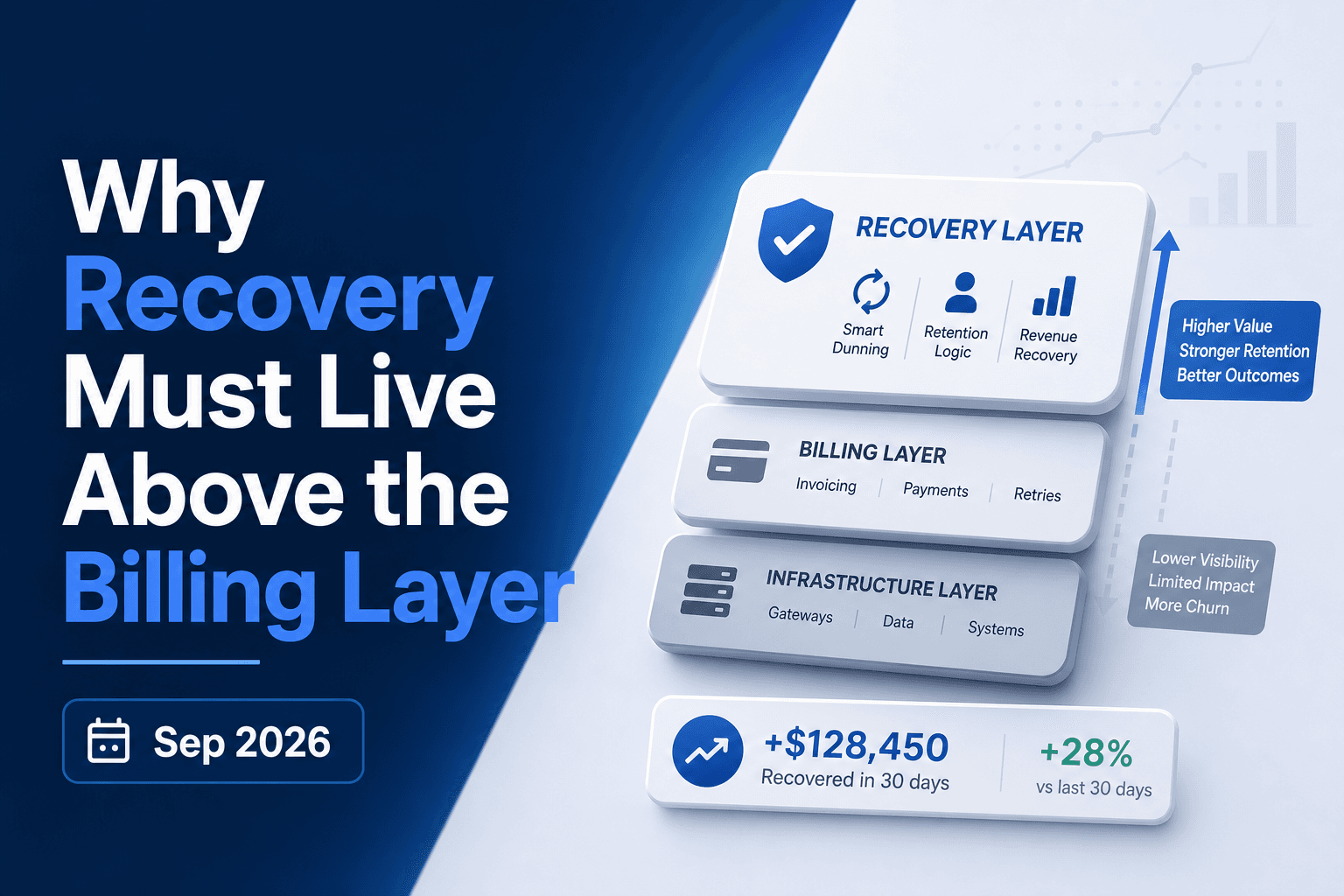
Why Payment Recovery Must Live Above Billers October 2026
A payment fails. Your biller retries it three days later, then again at seven, then at fourteen. What the biller never checks is whether the issuer sent a...
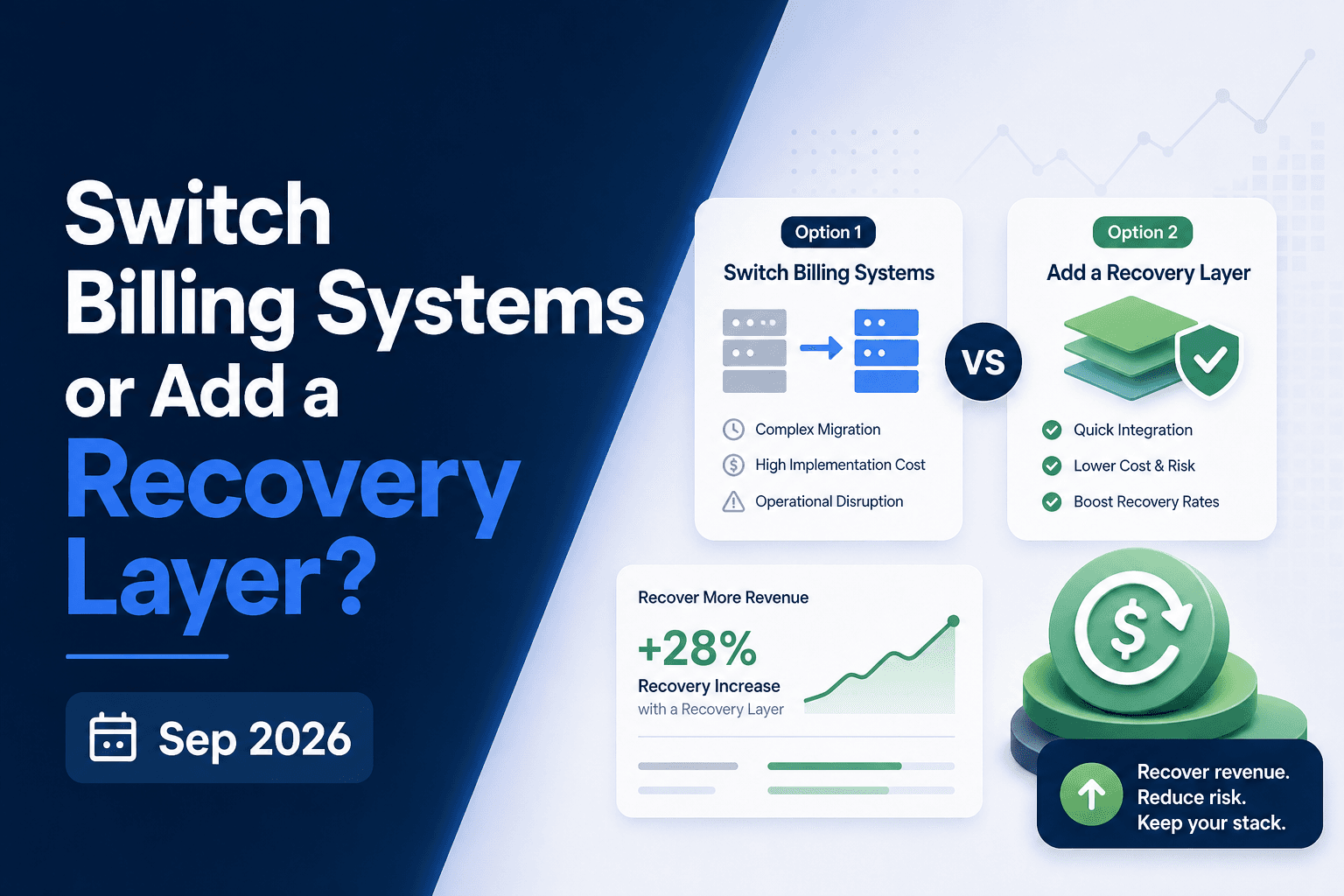
Billing Migration vs Recovery Layer: The Right Call October 2026
Switching billing systems feels like the right move when revenue collection starts breaking down. Sometimes it is. But soft declines, weak retry logic, and...
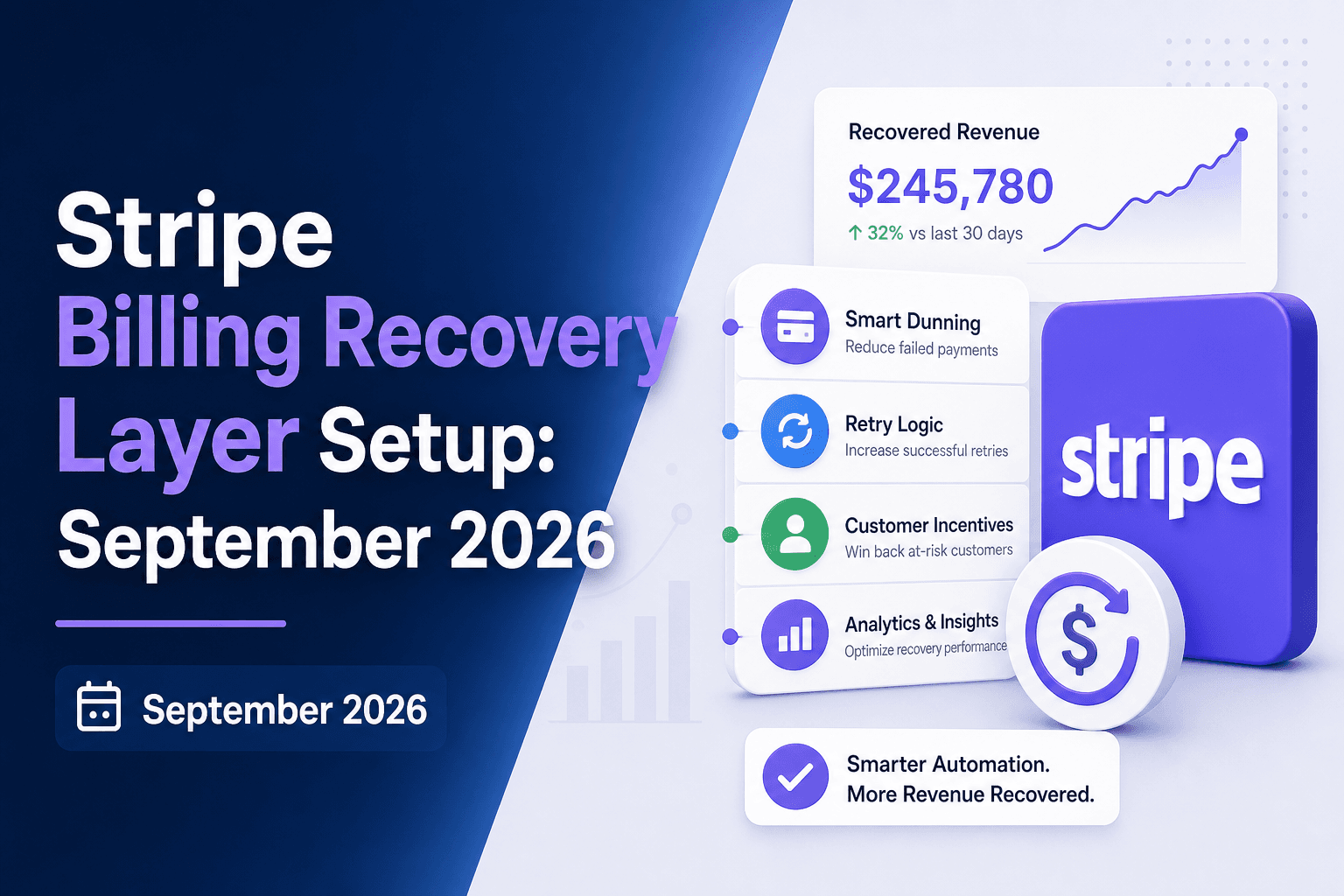
Stripe Billing Recovery Layer Setup Time: October 2026
Adding a recovery layer on top of Stripe Billing sounds like the kind of thing that goes on a quarterly roadmap and gets delayed twice. For most teams, it's...
Stop losing revenue to failed payments
Join leading subscription businesses using Slicker to recover failed payments automatically.
Get Started