Top Payment Recovery Tools for SaaS: Sep 2026
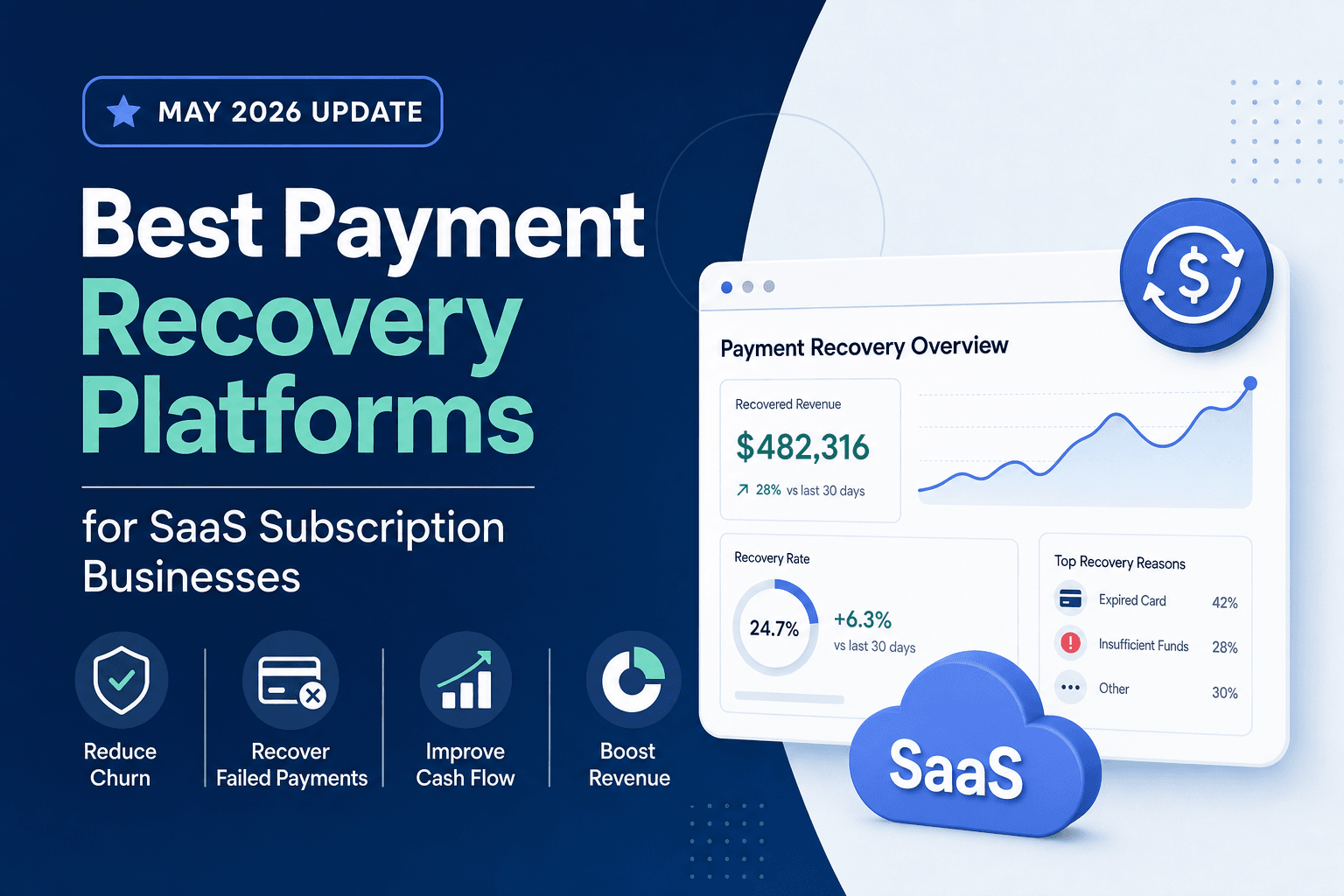
Around 9% of your MRR is getting lost to payment failures, and somewhere between 20-40% of the churn you're tracking as voluntary is actually involuntary. The right subscription payment recovery software closes that gap by reading decline codes, routing retries through the optimal time windows, and coordinating customer communications only when action is required. We scored six tools across recovery performance, AI sophistication, integration compatibility, reporting clarity, and pricing structure to show you which solutions actually recover revenue at scale and which ones just add another SaaS bill to your stack.
TLDR:
- 20-40% of subscription churn stems from payment failures, not product issues, losing you ~9% of revenue.
- Industry data shows AI-driven recovery tools consistently outperform basic retry schedules, recovering a meaningfully higher share of soft declines.
- Six platforms reviewed: Vindicia, Revaly, Butter, FlyCode, Churnkey, and Slicker.
- Most tools lack A/B testing to verify incremental lift, making performance claims hard to validate.
- Slicker uses AABB testing to prove recovery gains before you pay, with 5-minute no-code integration.
Most dedicated recovery tools use performance-based pricing: a percentage of recovered revenue instead of a flat monthly fee, so cost scales with results instead of requiring upfront budget commitment. Pricing structure is a scored criterion in the comparison below so you can assess cost-to-benefit at your specific failure volume.
What is a Payment Recovery Solution for SaaS Subscriptions
A payment recovery solution is software that detects failed subscription payments and works to recover them before they become lost revenue. When a card declines, a billing system might retry once or twice on a fixed schedule and call it done. A payment recovery tool goes further: it classifies each failure type, determines whether a retry is likely to succeed, times it optimally, and sends targeted communications only when customer action is required.
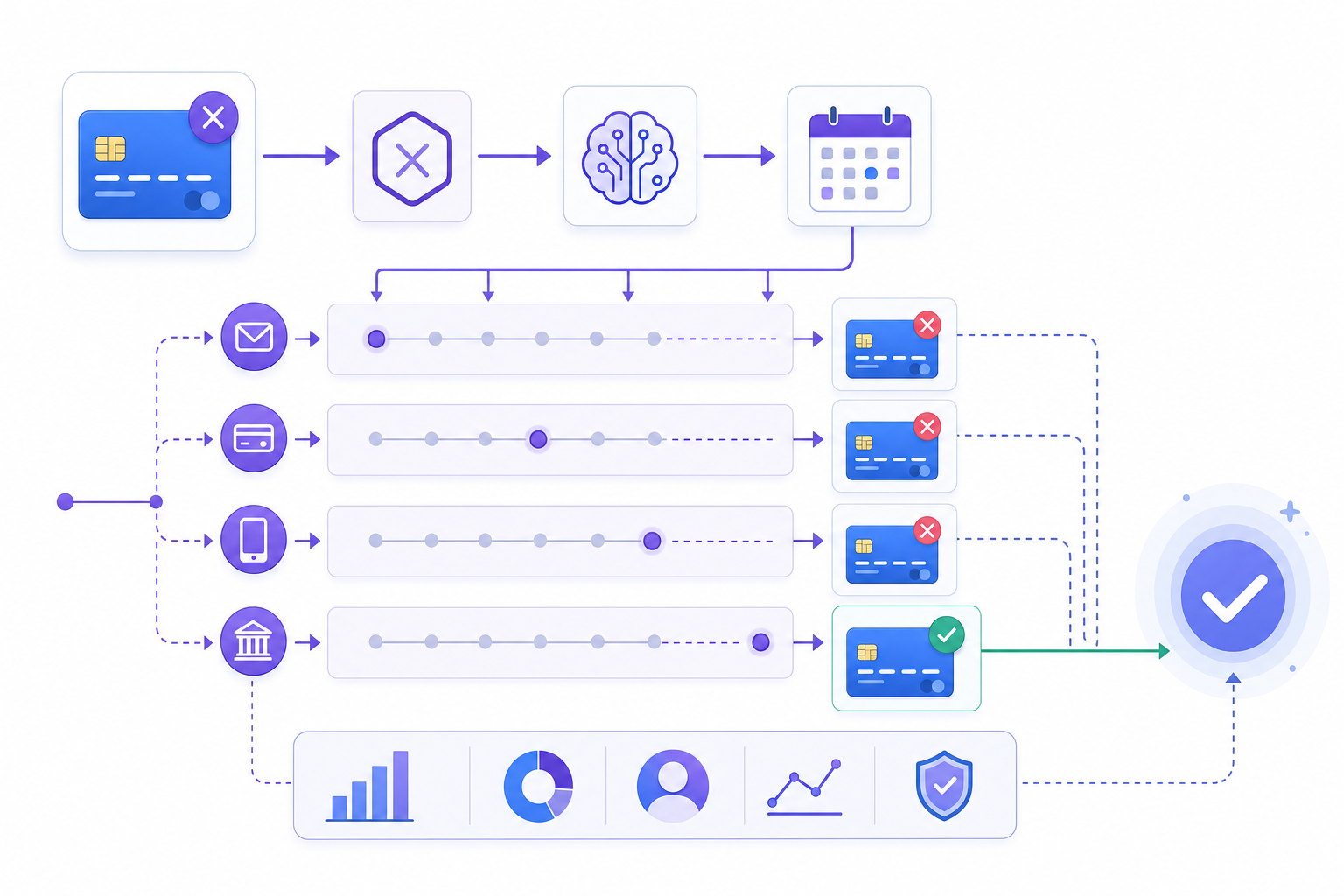
For subscription businesses, this gap is a real budget line. Around 9% of subscription revenue is lost to failed payments, and 20-40% of churn stems from payment failures, not product dissatisfaction. Your customers didn't cancel. Their card just declined. Built-in billing tools treat every decline the same. Specialized recovery software analyzes each failure individually.
Native Billing Retries vs. Dedicated Payment Recovery Software
Most SaaS teams start with whatever their billing system ships by default. Stripe Smart Retries, Paddle Retain, and Chargebee's built-in dunning are all functional starting points; they detect a failed charge and requeue it on a retry schedule. But that schedule is generalist by design, optimized across millions of merchants spanning e-commerce, marketplaces, and one-time transactions. It isn't tuned for the recurring-revenue dynamics that define subscription businesses.
That generalism is the core limitation. Native retry logic:
- Doesn't read decline codes at the issuer level, so it treats a temporary hold the same as an expired card
- Can't adapt retry timing per card type, geography, or account history
- Doesn't distinguish soft from hard failures with the fidelity needed to stop wasting retries on unrecoverable declines
- Applies the same cadence to your highest-LTV subscriber and your trial-to-paid conversion
For teams processing fewer than 50 failed payments per month or running below roughly $500K ARR, the incremental lift from a dedicated tool may not clear the cost bar, and native retries are a reasonable default at that scale. Above those thresholds, the plateau becomes expensive: each percentage point of unrecovered revenue compounds month over month, and a specialized solution typically pays for itself within the first billing cycle. The evaluation criteria below are built around that higher-volume reality.
How We Scored Payment Recovery Solutions
To surface the best payment recovery options available today, we applied a consistent framework across every tool reviewed.
We scored each solution across five areas:
- Recovery rate performance: average lift in recovered revenue, ideally backed by published benchmarks or customer data (best-in-class AI tools recover 60 to 80% of soft declines vs. 20 to 30% for static schedules; tools without published benchmarks or customer-verified data scored lower).
- Smart retry logic: whether the tool uses AI-driven retry timing and routing, or relies on static rule-based schedules (ensemble AI models process card type, issuer patterns, time of day, and account history simultaneously, a meaningfully different capability than single-variable rule-based systems). Understanding soft vs. hard declines is critical to applying the right logic.
- Integration depth: native compatibility with billing systems like Stripe, Chargebee, Recurly, and Braintree (tools that route payments outside your existing billing rails, creating reconciliation overhead and third-party path dependency, scored lower than tools that operate entirely within your current infrastructure).
- Reporting and analytics: visibility into decline reasons, recovery trends, and revenue impact at a granular level (granular decline-code-level reporting, beyond aggregate recovery percentages, was the threshold for a high score, since cohort-level visibility is what finance teams need to make confident decisions).
- Pricing transparency: whether costs scale reasonably with recovered revenue or penalize growth (tools charging 10 to 25% of recovered revenue were flagged for cost compounding risk at scale, since a fee that looks manageable on a small cohort can easily outpace a flat-rate alternative at high monthly failure volumes).
Best Overall Payment Recovery Solution: Slicker
Slicker is purpose-built for high-volume SaaS and subscription businesses that need more than basic retry logic to recover failed payments. Where most dunning tools apply the same rules to every card decline, Slicker uses AI to read individual decline codes, card network signals, and account-level behavior to decide exactly when and how to retry each transaction.
The result is recovery rates of up to 70% on soft declines, with AABB testing on customer data showing a roughly 20% relative improvement (4 to 10 percentage points) over standard retry logic, well ahead of the directional industry benchmark for static retry schedules.
What Sets Slicker Apart
Slicker's AI engine processes dozens of variables per failed transaction in real time, determining the optimal retry window down to the minute. This goes well beyond "retry on day 3 and day 7." The system accounts for card type, issuer patterns, time of day, and historical success signals specific to each account.
Key capabilities include:
- Intelligent retry scheduling that adapts per-transaction instead of applying a fixed cadence across your entire subscriber base
- Decline code interpretation that distinguishes between hard failures (card permanently invalid) and soft failures (temporary hold or insufficient funds), so you stop wasting retries on unrecoverable declines
- Automated customer outreach sequencing that escalates through email, SMS, and in-app prompts based on engagement signals, not a fixed timer
- Real-time revenue recovery dashboards that give finance and retention teams a clear view of dollars at risk, dollars recovered, and cohort-level churn exposure
Slicker also integrates with Stripe and major billing platforms without requiring custom engineering work, so recovery logic goes live in days.
- ✓ Strengths
- 60-80% recovery on soft declines vs. 20-30% industry average
- AABB testing proves lift on your own data before payment
- No-code integration live in 5 minutes, no engineering required
- ✗ Limitations
- Built for high-volume SaaS; may exceed needs at small scale
- AABB validation takes 1-3 months before full commitment
Vindicia
Vindicia has been in the subscription billing space for over two decades, giving it deep institutional knowledge of recurring revenue operations. Its ContinuityIQ product uses behavioral data and account history to predict which subscribers are at risk of involuntary churn before a payment actually fails.
Where Vindicia stands apart is its account updater integrations and its ability to work across complex billing architectures, making it a reasonable fit for enterprise media and publishing companies.
That said, Vindicia's pricing and implementation timelines tend to reflect its enterprise positioning, which can be a barrier for growth-stage SaaS companies moving quickly.
- ✓ Strengths
- 20+ years of subscription billing institutional knowledge
- Account updater integrations catch card issues proactively
- Handles complex enterprise billing architectures at scale
- ✗ Limitations
- Enterprise pricing is a barrier for growth-stage teams
- Implementation timelines are slower than modern alternatives
Revaly
Revaly rebranded from FlexPay in November 2025, expanding from post-decline recovery into pre-authorization optimization and real-time payment intelligence across the full transaction lifecycle. The product pairs AI models with exclusive card issuer partnerships to work on both ends of a payment attempt.
There are a few structural concerns worth flagging for high-volume subscription teams.
- Pre-authorization optimization, AI-based retry logic, intelligent acquirer routing, and issuer/network intelligence for BIN and region-specific patterns are all included.
- Revaly routes payments outside your existing billing stack, creating third-party path dependency that can complicate reconciliation.
- There is no rigorous A/B testing methodology to validate incremental lift against your prior setup, so performance claims are difficult to verify independently.
- The November 2025 rebrand signals product repositioning that carries real transition risk for teams mid-contract.
- ✓ Strengths
- AI covers both pre-authorization and post-decline recovery
- Exclusive card issuer partnerships add network-level intelligence
- Covers the full transaction lifecycle, from pre-authorization through post-decline recovery
- ✗ Limitations
- Routes payments outside your stack, complicating reconciliation
- No rigorous A/B testing to validate incremental lift independently
- November 2025 rebrand carries transition risk for mid-contract teams
Butter
Butter describes itself as a "payment failure prevention" tool, with a focus on account updater services and pre-dunning logic that catches card issues before a charge ever fails. It integrates with Stripe and Braintree with a lightweight setup that requires minimal configuration overhead.
For high-volume subscription businesses processing thousands of failed payments monthly, Butter lacks the predictive retry intelligence and revenue analytics needed to meaningfully move the needle on recovery rates. The tool's feature set does not scale to the complexity and volume requirements that CFOs and retention leaders face when managing material involuntary churn exposure.
- ✓ Strengths
- Focuses on preventing failures before a charge ever fails
- Lightweight setup with minimal configuration overhead
- Native integrations with Stripe and Braintree
- ✗ Limitations
- Lacks predictive retry intelligence for high-volume operations
- Revenue analytics insufficient for CFO-level churn decisions
FlyCode
FlyCode's AI-powered recovery tool built for subscription businesses. It uses machine learning to optimize retry logic and predict the best time to re-attempt failed charges, with the goal of recovering revenue that would otherwise be lost to card declines.
The tool integrates with Stripe and a handful of other processors, making it accessible for early-stage SaaS teams already in that ecosystem. For smaller companies, the setup is relatively low-friction.
That said, FlyCode's feature set is narrower compared to more mature recovery solutions. It covers retry logic and some basic dunning flows, but lacks the deeper analytics, payment intelligence, and revenue reporting that finance leaders at high-volume subscription businesses typically need to make confident, data-backed decisions on churn and recovery strategy.
- ✓ Strengths
- ML-optimized retry logic predicts best re-attempt timing
- Low-friction setup for early-stage Stripe-native teams
- ✗ Limitations
- Narrower feature set than more mature recovery solutions
- Lacks deep analytics and payment intelligence at scale
- Revenue reporting insufficient for high-volume finance decisions
Churnkey
Churnkey is a retention automation tool built around the cancellation moment. Its core product is a cancel flow builder, with payment recovery included as part of a broader suite and not its primary focus.
There are a few things worth knowing before assessing it as a payment recovery solution:
- Cancel flow builder with segment-based offers and pause options
- Payment recovery with a custom retry system
- SMS, email, and in-app dunning for hard declines
- Feedback AI to analyze cancellation reasons
The tradeoff is depth. Payment recovery is secondary to the cancel flow product, and Churnkey charges 10-25% of recovered revenue, which compounds quickly at scale. Retry logic lacks ensemble AI and deep payment network intelligence, and there is no AABB testing methodology to verify incremental lift against your existing setup.
Churnkey is built for customers who are trying to leave. Slicker is built for the 20-40% who never intended to, but got pushed out by a failed payment.
- ✓ Strengths
- Segment-based cancel flow builder with pause options
- Broad dunning channels: SMS, email, and in-app
- Feedback AI analyzes cancellation reasons for retention insight
- ✗ Limitations
- 10-25% of recovered revenue fee compounds quickly at scale
- Payment recovery is secondary to the cancel flow product
- No AABB testing to verify incremental lift independently
Feature Comparison Table
Not every feature gap is obvious from product pages alone. Here's how each solution stacks up across the criteria that matter most to finance and retention teams.
Feature | Slicker | Vindicia | Revaly | Butter | FlyCode | Churnkey |
|---|---|---|---|---|---|---|
AABB Testing | Yes | No | No | No | No | No |
No-Code Integration | Yes | No | No | No | Yes | Yes |
Works Within Existing Rails | Yes | Yes | No | No | Yes | Yes |
Ensemble AI Models | Yes | No | Yes | Yes | No | No |
Chargebee Integration | Yes | No | No | No | No | Yes |
Zuora Integration | Yes | Yes | No | No | No | No |
Multi-Gateway Routing | Yes | Yes | Yes | No | No | No |
Direct Debit Support | Yes | Yes | Yes | No | No | Yes |
Hyper-Personalized Dunning | Yes | No | No | Yes | No | No |
Statistical Proof Before Payment | Yes | No | No | No | No | No |
Performance-Based Pricing | Yes | Yes | Yes | Yes | No | Yes |
The sharpest gap here isn't retry logic or integrations. It's verification. Slicker is the only solution in this group that proves incremental lift with statistical significance before you commit to paying.
Why Slicker is the Best Payment Recovery Solution
Every tool in this list makes recovery claims. Slicker is the only one that proves them. Our AABB testing methodology, borrowed from clinical trial design, runs a statistically validated experiment using your own payment data before you commit to anything. If we don't outperform your current setup with statistical significance, you don't pay.

That proof sits on top of ensemble AI models trained on 1M+ failures, no-code integration that goes live in 5 minutes, and recovery logic that runs entirely within your existing billing infrastructure. No external routing. No reconciliation headaches. No trust-us benchmarks.
Common Mistakes SaaS Teams Make When Choosing Payment Recovery Software
Mistake | Why It Costs You |
|---|---|
Choosing a tool based on vendor-reported recovery benchmarks instead of testing against your own payment data | You may be paying for lift you already have. Vendor averages are drawn from across their entire customer base, so your baseline could already exceed those numbers, making the incremental gain zero. |
Selecting a cancel-flow tool as your primary payment recovery solution | Cancel flows target voluntary churn, not the 20-40% of involuntary lapsers who never intended to leave. Optimizing the cancellation moment does nothing for a subscriber whose card silently declined. |
Ignoring reconciliation complexity when a tool routes payments outside your existing billing rails | External routing creates third-party path dependency and complicates finance reporting. Every transaction that flows outside your stack is a reconciliation line your team has to manually account for. |
Deploying a recovery tool before segmenting hard vs. soft declines | Retrying hard failures wastes sends and can trigger card network flags; see hard decline retry penalties for the full cost breakdown. Without decline-code segmentation, you're burning retry attempts on transactions that have zero probability of recovering. |
Judging cost only on headline pricing without modeling the percentage-of-recovered-revenue fee at your actual monthly failure volume | 10-25% of recovered revenue compounds fast at scale. A fee that looks reasonable on a small cohort can easily exceed a flat-rate alternative once you're processing thousands of failed payments monthly. |
The throughline across all five mistakes is verification, or the absence of it. Paying for a recovery tool without an independent, statistically validated test of incremental lift means you're trusting a vendor's math instead of your own data. The most expensive mistake isn't choosing the wrong retry cadence or misjudging pricing tiers; it's committing budget to performance you can't independently confirm.
Final Thoughts on Recovering Failed Subscription Payments
When 20-40% of your churn is involuntary, fixing payment recovery becomes a finance problem as much as a billing one. The best subscription payment recovery software gives you statistically validated proof it can outperform your current setup before you commit a dollar. Your revenue team shouldn't have to trust vendor benchmarks when you can test real recovery lift against your own payment data, and your subscribers shouldn't churn because a basic retry schedule couldn't distinguish between a temporary hold and an expired card.
Key Metrics SaaS Revenue Operations Teams Should Track to Measure Involuntary Churn Recovery in 2026
Recovering failed payments is only half the job. Knowing whether your recovery program is actually working, and proving it to finance leadership, requires tracking the right numbers at the right granularity. Here are the metrics that matter most for SaaS RevOps teams in 2026.
- Involuntary churn rate: The percentage of total subscriber churn attributable to payment failures, not voluntary cancellations. Industry baseline sits at 20-40% of total churn. See involuntary churn benchmarks by vertical for SaaS- and DTC-specific ranges. If your involuntary churn rate exceeds that range, your retry logic or dunning cadence is underperforming.
- Soft decline recovery rate: The share of soft declines (temporary holds, insufficient funds, processor timeouts) that in the end resolve into successful charges. Best-in-class AI-driven tools recover 60 to 80% of soft declines; static retry schedules average 20 to 30%. This is the single most important signal of whether your recovery tool is adding incremental lift.
- Hard decline rate: The percentage of failures classified as permanent (expired card, account closed, card reported lost/stolen). Tracking this separately prevents your team from wasting retry budget on unrecoverable transactions, and helps identify card-aging patterns that proactive account updater services can intercept.
- Recovered MRR: Dollars of monthly recurring revenue successfully collected after an initial decline. Finance teams should model this as a distinct line from gross new MRR, since recovered MRR has zero CAC attached, making it the highest-margin revenue your company generates.
- Revenue at risk (RAR): The total MRR currently in a failed or at-risk payment state at any given moment. Tracking RAR as a rolling figure, measured continuously and not merely at month-end, gives retention teams a real-time view of churn exposure before it becomes realized churn.
- Retry attempt-to-recovery ratio: How many retry attempts it takes, on average, to recover one successful charge. A high ratio signals that your retry cadence is firing on hard declines or at suboptimal windows, burning network goodwill and risking issuer flags without incrementally improving recovery.
- Dunning email engagement rate: Open and click-through rates on payment failure outreach. Low engagement on card-update prompts often indicates message fatigue from over-broad sending, a sign that dunning sequences are triggering on hard declines that require no customer action.
- Incremental lift (vs. control): The statistically validated difference between your recovery tool's performance and your baseline setup, measured on the same cohort. This is the metric vendors routinely omit from their benchmarks. Slicker's AABB methodology runs this test on your own payment data, with a reported p-value, before you commit budget, so your RevOps team is working from verified lift, not vendor averages.
Track these eight metrics as a dashboard, not in isolation. The combination of soft decline recovery rate, recovered MRR, and incremental lift gives finance leadership the full picture: how much revenue was at risk, how much was recovered, and whether your recovery program is outperforming the counterfactual.
FAQ
What GDPR and contractual safeguards should enterprises require from a payment recovery vendor?
Payment recovery vendors process payment method data and subscriber PII on your behalf, which makes them a data sub-processor under GDPR. Before signing, enterprises should require four things.
Data Processing Agreement (DPA): A compliant DPA must identify the categories of personal data processed, list all sub-sub-processors, specify retention and deletion schedules, and bind the vendor to your instructions. Confirm the DPA is governed by the applicable SCCs (EU or UK) if data crosses borders.
Liability and indemnification clauses: The contract should cap the vendor's liability at a meaningful multiple of fees paid, not a nominal floor, and include explicit indemnification for breaches caused by the vendor's systems or personnel.
Cyber insurance: Require evidence of active cyber liability coverage (errors & omissions plus cyber) with a per-occurrence limit proportionate to the volume of payment data processed. Request a certificate of insurance, never a policy summary alone.
Audit rights and incident notification: You should have the contractual right to audit compliance (or require a third-party SOC 2 Type II report annually), and the vendor must commit to notifying you of any security incident within 72 hours, consistent with your own GDPR reporting obligations to supervisory authorities.
Slicker operates entirely within your existing billing infrastructure and does not store raw card numbers; recovery logic reads decline signals and triggers retry instructions through your billing system's own API, which limits the surface area of PII exposure compared to vendors that route payments externally.
How does delta-based (incremental recovery) pricing work, and why does it matter?
Most performance-based pricing models charge a percentage of every successful recovery, regardless of whether you would have collected that payment anyway. If your existing retry logic already recovers 40% of soft declines, you're paying the vendor's fee on those 40 percentage points of recoveries your own system would have produced. The vendor takes credit for work you already do.
Delta-based (or incremental recovery) pricing charges only on the additional revenue the vendor's system recovers above your verified baseline. The baseline is measured through a statistically validated control group. Slicker's AABB methodology splits your failed payment cohort 50/50, holds one half on your existing logic, and applies Slicker's AI to the other. For a deeper look at how this works, see AABB testing in payment recovery. You pay only on the incremental lift the test proves, with a reported p-value confirming statistical significance. If the test shows no lift above your baseline, there's nothing to bill.
This matters at scale. A 10-25% fee on all recovered revenue sounds manageable on a small cohort but becomes a large cost center once you're processing thousands of failed payments monthly, especially if a large share of those recoveries would have happened without the tool. Delta-based pricing aligns vendor incentives with actual incremental value delivered.
How can I monitor payment recovery performance after a dunning window change, and what reporting tools exist beyond the A/B test dashboard?
Changing a dunning window, meaning the number of days between a first decline and final lapse, directly affects which transactions are in-flight during any measurement period, which makes pre/post comparisons noisy if you rely only on aggregate recovery percentages. The right monitoring approach layers three views.
Cohort-level tracking: Segment failed payments by the date of first decline, not payment date. This lets you compare cohorts that entered before vs. after the window change without mixing in transactions mid-recovery that straddle both regimes.
Real-time recovery dashboards: Slicker's dashboards give finance and retention teams a live view of dollars at risk, dollars recovered, and recovery rate by decline-code category, broken down beyond a single aggregate percentage. Filter by billing system, plan tier, or geography to isolate whether a window change helped or hurt specific segments.
Automated performance reports: Slicker generates automated reports that surface what drove changes in recovery performance, such as decline-code distribution changes, retry timing changes, and cohort composition changes, without requiring manual analysis. These reports are designed for finance leaders who need to explain recovery variance to a board or audit committee without building the analysis themselves.
For teams that want deeper visibility, the underlying recovery data is available via API for direct export into your own BI tooling (Looker, Tableau, Mode), supporting custom dashboards alongside other RevOps metrics.
How does Slicker integrate with Stripe technically, and what API access is required?
Slicker connects to Stripe through OAuth, which means the integration uses scoped API keys instead of full account access. During setup, you grant Slicker read access to subscription and payment method objects, and write access limited to the specific actions needed for recovery: retrying charges, updating subscription status, and writing billing cycle changes back to Stripe as the system of record.
Permissions can be scoped narrowly. Slicker does not require access to your Stripe Connect accounts, payout settings, or dispute management, only the billing objects directly relevant to failed payment recovery. If your security posture requires restricted-key access instead of OAuth, Slicker's integration team can configure that during onboarding.
Writeback fidelity: Every action Slicker takes, including retry attempts, billing cycle resets, and subscription state changes, is written back into Stripe as a native Stripe event. Your Stripe dashboard and data warehouse remain the system of record. There is no shadow ledger, no external routing, and no reconciliation gap: what Slicker does shows up in Stripe exactly as if a billing admin had taken that action manually through the Stripe API.
The no-code integration path handles this setup in approximately 5 minutes through the Slicker dashboard. Engineering involvement is optional, not required.
How can we measure the true impact of pausing or turning off a payment recovery service?
The challenge with turning off any recovery tool is that the counterfactual, meaning what your collections rate would have been without it, is invisible once you've removed it. A simple before/after comparison conflates seasonal payment failure patterns, card-network changes, and billing system updates with the tool's actual contribution. Three approaches give you a cleaner read.
Holdout group testing (preferred): Instead of pausing the tool entirely, run a persistent holdout: route 10-15% of failed payments through your baseline logic and keep the rest on the recovery tool. The holdout gives you a live counterfactual at all times, so you can measure the tool's incremental contribution each month without a disruptive full pause. Slicker's AABB methodology supports this as an ongoing measurement posture, extending well beyond initial validation.
Segmented pause: If you must pause, do it on a defined cohort, such as a single plan tier, billing currency, or geography, instead of your entire failed payment volume. This limits revenue exposure and gives you a comparison segment that shares the same billing environment as your live recovery traffic.
Decline-code-level baseline: Before pausing, export a cohort-level breakdown of recovery rates by decline code. When you resume, compare the same breakdown. Aggregate recovery rates mask the signal; decline-code-level data shows whether changes in rate are driven by the tool's behavior or by changes in the mix of failure types you're receiving.
Does Slicker require the customer's payment method to be stored on file to perform recovery?
Yes. Slicker's retry-based recovery requires that a payment method token is stored in your billing system (Stripe, Chargebee, Recurly, etc.) and associated with the subscription. Slicker triggers retry attempts against the stored payment method through your billing system's API; it does not store raw card numbers, and it does not independently vault payment credentials.
In practice, Slicker recovers soft declines, including temporary holds, insufficient funds, processor timeouts, and issuer-side limits, where the card itself is still valid and the customer relationship is intact. It does not recover hard declines where the payment method is permanently invalid (expired card, account closed, card reported stolen) and no updated token exists. For those cases, proactive account updater services, which Slicker can coordinate with, intercept card changes before a hard decline fires.
If a customer's payment method is missing entirely (e.g., a failed free-to-paid upgrade where no card was ever collected), recovery requires a card-update dunning sequence that prompts the subscriber to re-enter payment details, which is a separate flow from retry-based recovery.
What causes week-on-week spikiness in payment recovery rates, and how do we track more consistent metrics?
Week-on-week volatility in recovery rates is normal and expected; it does not necessarily indicate a problem with your recovery tool or retry logic. The primary drivers are:
Cohort composition changes: The mix of soft vs. hard declines in any given week varies with billing cycle timing, card expiry cycles, and issuer-side authorization patterns. A week with a higher proportion of hard declines will produce a lower recovery rate even if your retry logic is performing identically.
Retry window carry-over: Transactions that entered the recovery window in a prior week resolve (succeed or lapse) in a later week. If you measure recovery rate by payment date instead of cohort entry date, early-resolving recoveries inflate one week's numbers and late-resolving ones inflate another.
Issuer authorization pattern changes: Card issuers periodically update their authorization rules, particularly around weekend vs. weekday approval rates and end-of-month liquidity signals. These changes are outside your control and introduce noise into weekly reads.
The fix is cohort-based measurement, not calendar-week measurement. Track recovery rate by the week a failed payment entered the retry window, and give each cohort a full 30-day resolution window before finalizing its rate. This smooths the carry-over effect and makes week-on-week comparisons meaningful. Slicker's reporting surfaces cohort-level recovery rates by default, alongside decline-code breakdowns, so finance teams can distinguish genuine performance changes from compositional noise without manual analysis.
How does AI-powered payment retry logic work for subscription businesses?
Standard retry schedules fire on a fixed cadence (retry on day 3, day 7, day 14) regardless of why the charge failed. AI-powered retry logic works differently. When a payment fails, the system reads the issuer-returned decline code, cross-references it against card type, BIN range, geographic issuer patterns, time of day, and the subscriber's own account history, then calculates the probability that a retry at each possible future window will succeed.
An ensemble of AI models, not a single algorithm, processes these variables simultaneously. Each model specializes in a different signal (issuer behavior, account-level patterns, network timing), and their outputs are weighted and combined to produce a retry recommendation that's specific to that transaction, not your subscriber base as a whole. This is what distinguishes ensemble AI from rule-based systems: a rule-based system applies the same cadence to a premium annual subscriber and a trial-to-paid conversion; an AI model treats them as the different payment risk profiles they actually are.
The practical result: AI-powered tools like Slicker recover 60 to 80% of soft declines, compared to 20 to 30% for static schedules. The difference compounds fast at scale, since each percentage point of unrecovered revenue is MRR you already earned, lost permanently if the retry window closes.
Which payment recovery tool works best for high-volume subscription businesses?
Early-stage ($500K to $2M ARR, <50 failed payments/month): Native billing retries (Stripe Smart Retries, Chargebee defaults) are often sufficient; dedicated tooling cost may not clear recovered revenue. FlyCode and Butter are the lightest-lift paid options here. Growth-stage ($2M to $15M ARR): AI-powered retry logic starts paying for itself clearly. Slicker and Churnkey enter the viable range; Slicker is preferred when payment recovery (not cancel-flow) is the primary use case. Scale ($15M+ ARR): Full-feature platforms with ensemble AI, multi-gateway routing, and direct debit support (Slicker, Vindicia, and Revaly) are appropriate. Score each on reconciliation architecture and proof-of-lift methodology.
What tools should a SaaS CFO use to recover lost revenue from failed payments in 2026?
The right stack depends on ARR and failure volume. A SaaS CFO assessing options in 2026 should map tooling to these three tiers:
Below $2M ARR / fewer than 50 failed payments per month: Native billing retries, such as Stripe Smart Retries Revenue Recovery, Chargebee's built-in dunning, Recurly's retry logic, or Maxio's collections engine, are often sufficient. The incremental lift from a dedicated tool is real but may not clear the cost bar at this volume.
$2M to $15M ARR: Dedicated AI-powered recovery tools start paying for themselves clearly. Slicker is the preferred choice when payment recovery (not cancel-flow retention) is the primary objective; it integrates in minutes, operates within your existing billing rails, and runs AABB testing to prove incremental lift on your own data before you pay. Churnkey is an option if you also want cancel-flow tooling in the same product, though its 10 to 25% of recovered revenue fee compounds quickly at higher volumes.
$15M+ ARR: Full-feature platforms with ensemble AI, multi-gateway routing, Zuora and Chargebee integrations, and direct debit support, such as Slicker and Vindicia, are the appropriate tier. At this scale, the CFO question moves from "should we use a dedicated tool" to "can we verify the incremental lift independently?" Only Slicker provides a statistically validated answer before billing begins.
How do I choose between AI-powered and rule-based payment recovery?
Rule-based systems apply the same retry schedule to every decline regardless of card type or failure reason, and industry data shows this approach leaves material revenue on the table compared to smarter timing. AI-powered solutions like Slicker analyze dozens of variables per transaction to time retries precisely, recovering up to 70% of soft declines, roughly a 20% relative improvement over standard retry logic based on Slicker's AABB testing. Choose AI if you're processing over $50k MRR and rule-based retries have plateaued.
How do I set up smart payment retries without any engineering work for my subscription business?
The fastest no-code path to smart retry logic depends on which billing system you're on:
Stripe: Turn on Smart Retries in your Stripe Billing dashboard under Revenue Recovery settings; no code required. This activates Stripe's ML-based retry schedule. For incremental lift beyond Stripe's defaults, Slicker installs on top of Stripe via a no-code connector and goes live in approximately 5 minutes.
Chargebee: Configure Smart Retry Logic under Settings → Dunning in the Chargebee admin. Slicker also offers a native Chargebee integration requiring no custom engineering work; retry rules are applied at the billing layer without touching your application code.
Recurly: Recurly's Intelligent Retry Logic is activated from the Account Settings panel. No development work is needed to turn it on.
Paddle: Paddle handles retries natively as the merchant of record; retry logic is managed by Paddle and does not require configuration from your team.
Zuora: Zuora's Payment Retry rules are configurable within the Collections Window settings in the Zuora admin, with no code required for basic retry setup.
For teams that want AI-powered retry logic with statistically proven lift beyond what any native billing tool provides, Slicker's no-code integration works across all major billing platforms, applies ensemble AI at the transaction level, and proves incremental performance against your existing setup before you pay, all without a single line of engineering work.
What's the difference between payment recovery and cancel flow tools?
Payment recovery solutions like Slicker focus on the 20-40% of churn caused by card declines, using intelligent retry logic and targeted dunning to recover revenue from subscribers who never intended to cancel. Cancel flow tools like Churnkey target voluntary churn with retention offers at the cancellation moment. Most subscription businesses need both, but payment recovery solves a larger revenue leak.
What are the best alternatives to Churn Buster for AI-powered dunning and payment retries in 2026?
Churn Buster is a dunning automation tool focused primarily on email-based payment recovery sequences. Teams looking for AI-powered alternatives that go beyond static email cadences have several options in 2026:
Slicker is the strongest Churn Buster alternative for high-volume subscription businesses. Where Churn Buster applies rules-based dunning sequences, Slicker uses an ensemble of AI models to analyze each failed transaction individually, reading decline codes, card type, issuer patterns, and account history, and retries at the statistically optimal window. Recovery rates of 60-80% on soft declines compare favorably to the 20-30% typical of email-sequence-based dunning. Slicker also runs AABB testing to prove incremental lift on your own data before you pay, which Churn Buster does not offer.
Churnkey offers a hybrid approach: AI-informed dunning combined with a cancel-flow builder. It's a reasonable fit if you want both payment recovery and voluntary churn reduction in one product, though its 10-25% of recovered revenue pricing compounds quickly at scale.
FlyCode uses ML-optimized retry timing and integrates with Stripe, making it an accessible entry-level option for early-stage teams already in the Stripe ecosystem.
The key differentiator across all Churn Buster alternatives is whether retry logic is rule-based or AI-driven, and whether the vendor can prove incremental lift against your specific baseline, verified on your own data instead of borrowed from industry averages.
Can payment recovery software work alongside my existing billing system?
Yes, most modern recovery tools run within your current billing infrastructure without requiring migration. Slicker, Vindicia, Butter, and FlyCode all integrate directly with Stripe, Chargebee, and major processors, processing retries through your existing rails. Revaly routes payments externally, which complicates reconciliation and creates third-party dependency.
How long does it take to validate whether a payment recovery tool actually improves recovery rates?
Most vendors ask you to trust benchmark claims without proof. Slicker runs a 1-3 month AABB test using your own payment data to prove measurable lift before you commit. This clinical trial methodology is the only way to verify incremental performance against your current setup instead of relying on vendor-reported averages.
Related Articles

Failed Payments as a Board-Level Revenue KPI (Sep 2026)
Failed payment recovery tends to live in finance ops reviews, not board decks. That's usually because it's reported as a process metric and not a revenue...
Building a Recovery Layer Above Chargebee Without Disrupting Billing September 2026
Failed payments in Chargebee don't all fail for the same reason, but Chargebee's native retry logic largely treats them that way. The result is burned retry...
CFO-Grade Failed Payment Recovery ROI Model Sept 2026
There's a revenue number sitting inside your billing data that most finance teams never model correctly. It's the incremental lift from better payment...
Stop losing revenue to failed payments
Join leading subscription businesses using Slicker to recover failed payments automatically.
Get Started