Dunning Management: How to Build a Recovery Process That Actually Works (May 2026)
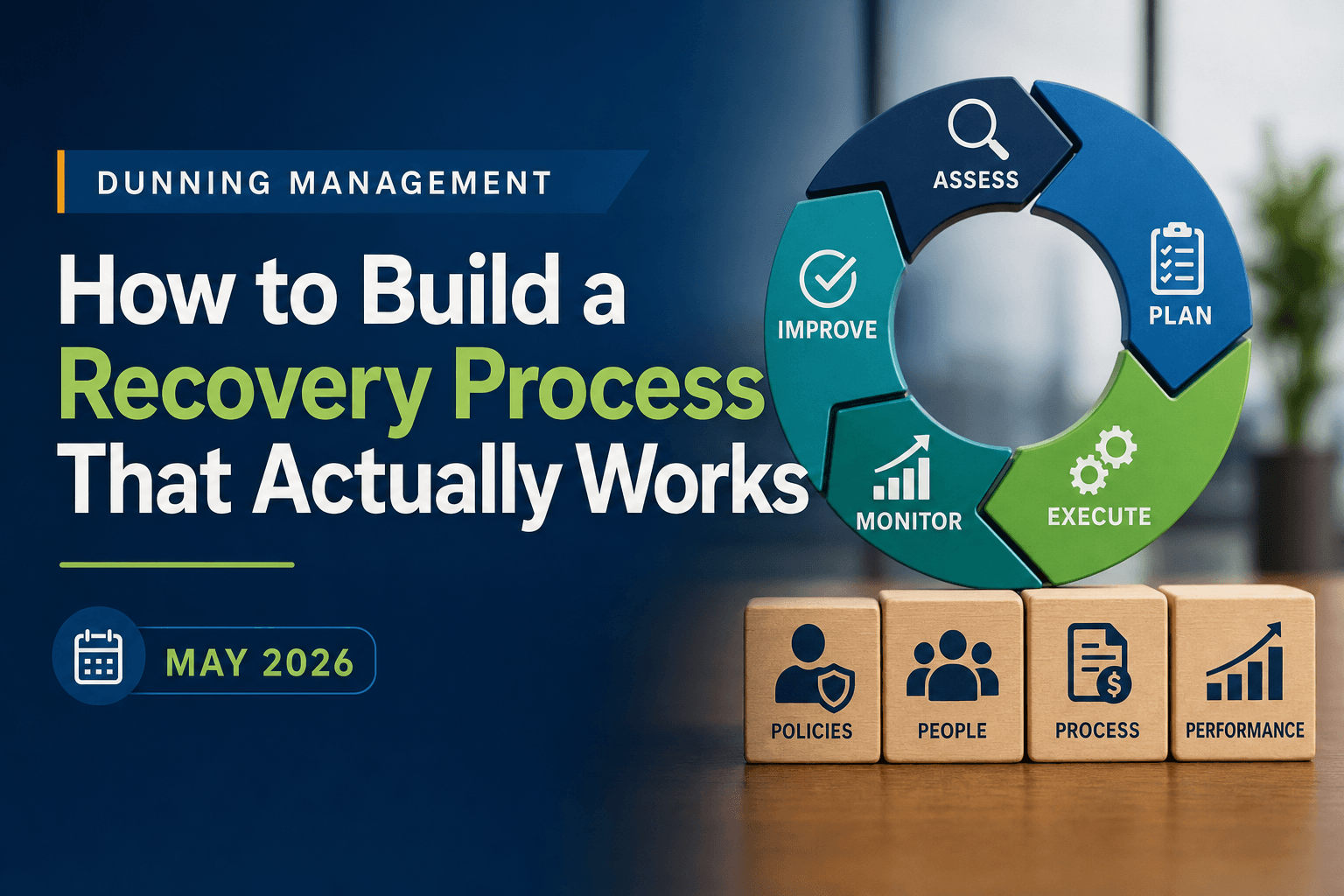
Your retry schedule is probably wrong. Most dunning management systems retry failed payments on a fixed cadence without checking why the card declined, which means you're hitting insufficient funds failures on the wrong day and burning goodwill on hard declines that need customer action, not another automated attempt. The difference between a dunning process that recovers 45% of failures and one that recovers 70% comes down to timing your retries around payroll cycles for funds issues, giving soft declines 24 to 72 hours to clear, and routing hard declines straight into a targeted email flow. Getting those three pathways right can add 15 to 25 percentage points to your recovery rate without touching your messaging or adding headcount.
TLDR:
- Failed payments cost the subscription economy $118.5 billion annually, with 20-40% of total churn driven by payment failures, not customer choice.
- Smart retry timing on different days (not same-day) and around payroll cycles recovers 50-70% of failed payments.
- Decline-code-specific retry logic separates 70%+ recovery rates from teams stuck below 50%.
- Account Updater services refresh expired card data before charges attempt, reducing involuntary churn by 20-30%.
- Slicker uses ML models to analyze decline codes and behavioral signals, recovering 20% more than standard retry logic.
What Is Dunning Management?
Dunning management is the systematic process of recovering failed or overdue payments through automated retries, targeted outreach, and structured recovery workflows. The term traces back centuries, originally referring to the persistent act of demanding payment from a debtor. In finance, a dunning letter is the formal notice sent to collect what's owed, and that same concept now lives inside the automated recovery sequences most subscription businesses run today.
For subscription companies, dunning occupies the reactive layer of your payment stack. Prevention happens upstream through card updater services and proactive expiry alerts. Dunning kicks in after a charge fails, converting missed payments into collected revenue before a customer quietly churns.
Why Dunning Management Matters for Subscription Businesses
Failed payments aren't a billing inconvenience. They're a $118.5 billion annual problem across the subscription economy, and most of that money disappears quietly, without a cancellation notice or a complaint.
Involuntary churn, caused by payment failures rather than a decision to leave, accounts for 20-40% of total churn at subscription businesses. That's a meaningful share of your attrition driven entirely by infrastructure, not product. Customers who intended to stay got pushed out anyway.
The recovery opportunity is real. Properly implemented dunning can recover 50-70% of failed payments, making it one of the highest-ROI levers available to a CFO or Head of Retention.
How the Dunning Process Works
The dunning process follows a tiered escalation sequence, moving from gentle automated reminders to formal collections as time passes.
Here is how a typical cycle unfolds:
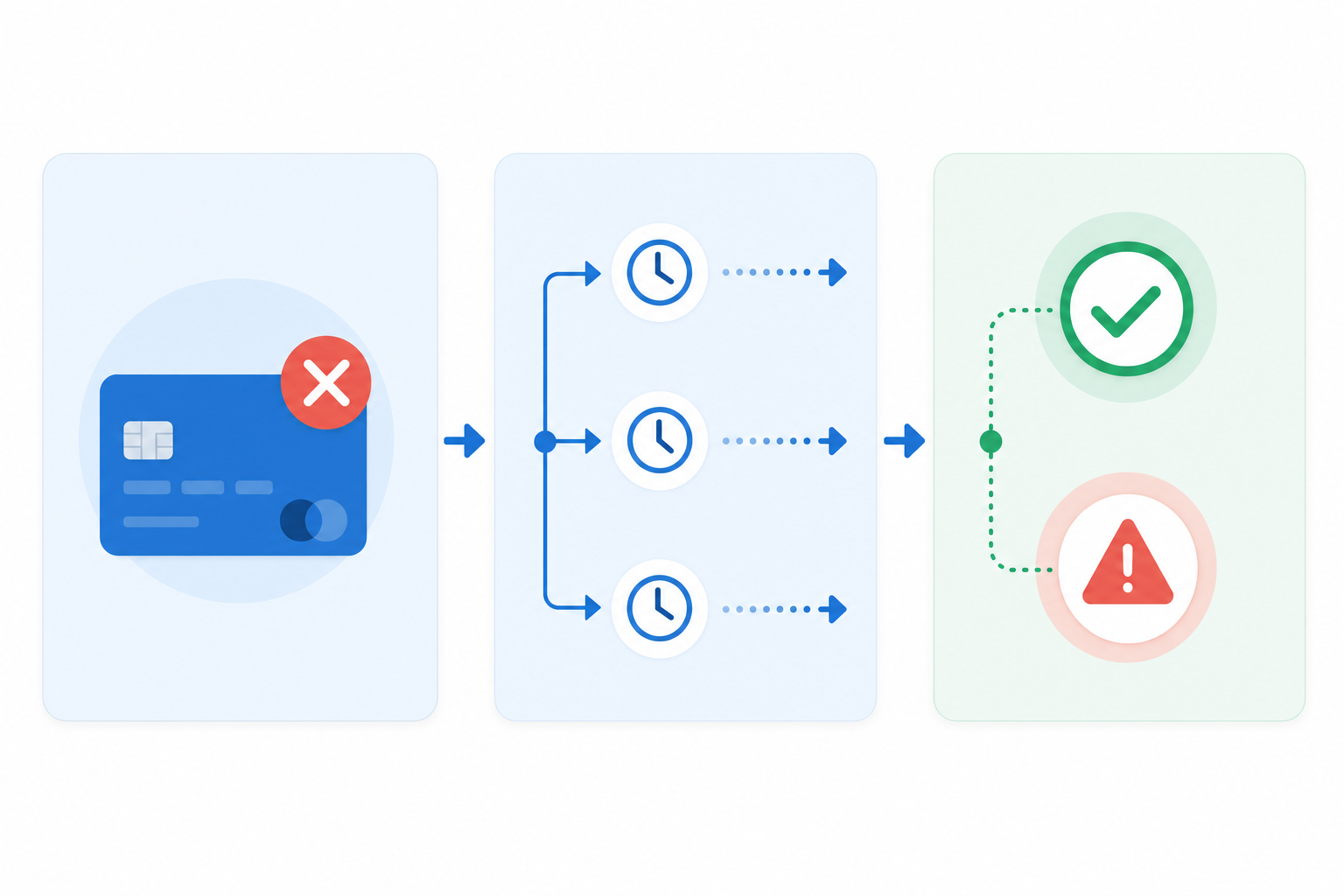
- A payment fails and the system logs the decline with a reason code, then schedules the first retry and queues an initial email notification to the customer.
- Follow-up attempts run at set intervals, with messaging that grows progressively more direct as days pass without resolution.
- If retries and outreach fail, the account enters a grace period before access is suspended or the account is formally referred to collections.
The Core Components of an Effective Dunning System
Effective dunning management rests on four interlocking components. First, smart retry logic that uses decline codes to time retries intelligently rather than blasting the same card on a fixed schedule. Second, a sequenced communication layer spanning email, SMS, and in-app messaging that escalates tone progressively across each dunning stage. Third, customer segmentation that routes high-LTV accounts into white-glove recovery paths and low-risk churners into automated flows. Fourth, real-time reporting that ties recovery outcomes directly to revenue, so you know exactly which touchpoints are recovering dollars and which are burning goodwill.
Smart Retry Strategies: When and How to Retry Failed Payments
Retry timing separates recovery teams that hit 70%+ recovery rates from those stuck below 50%. The core principle: retry on a different day of the week, never the same day a card declined.
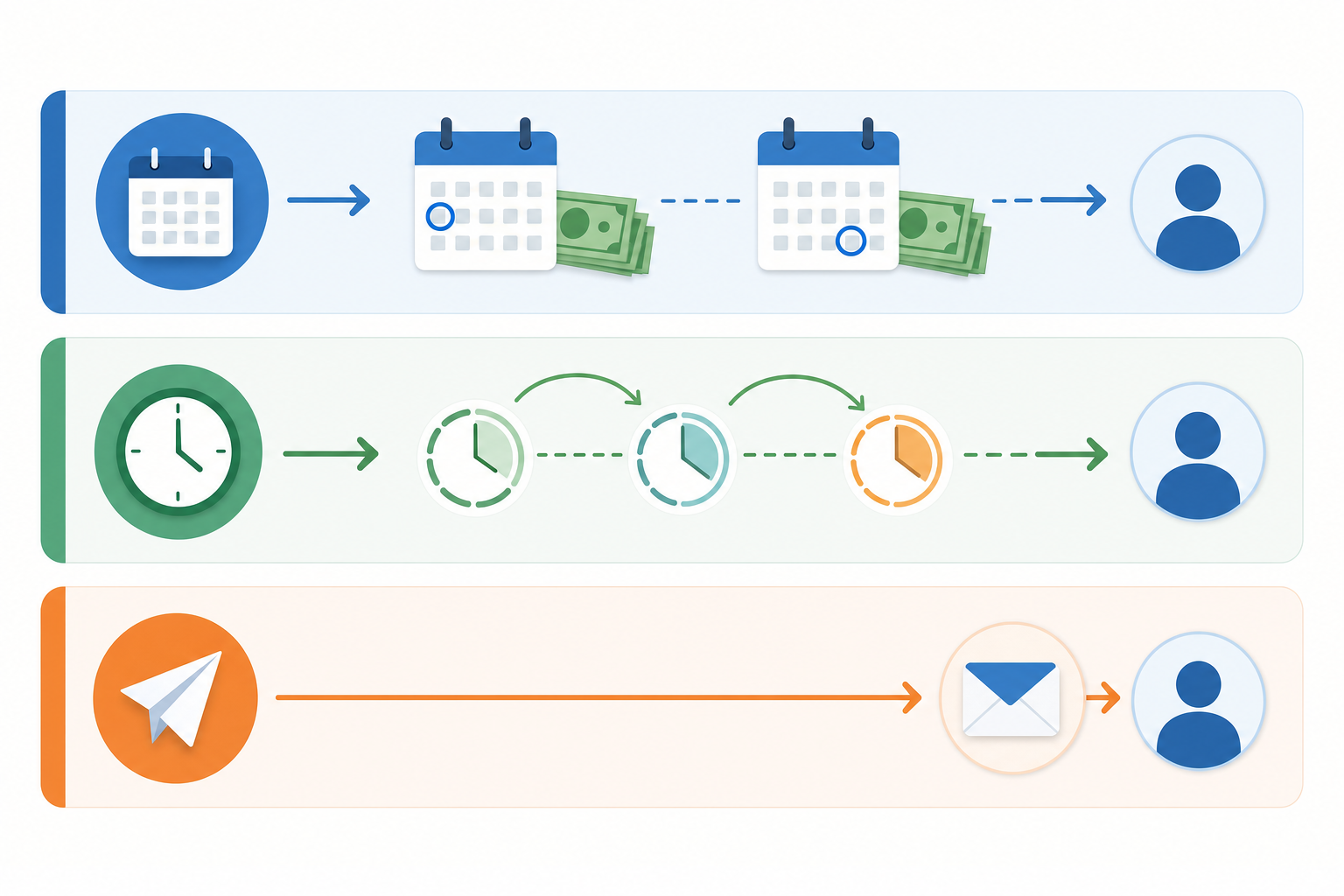
Most failed payments fall into three buckets:
- Insufficient funds declines respond best to retries timed around common payroll cycles, typically the 1st and 15th of the month.
- Soft declines (temporary holds, network timeouts) often self-resolve within 24 to 72 hours with a simple retry.
- Hard declines (stolen cards, closed accounts) should route immediately to a customer communication flow, skipping retries entirely.
Spacing retries three to five days apart, with no more than four attempts total, keeps you inside card network guidelines while maximizing recovery without burning goodwill.
Dunning Communication: Crafting Messages That Drive Action
The difference between a dunning email that gets ignored and one that recovers a payment is almost always context. "Your payment failed" tells a customer nothing actionable. Knowing their specific plan renewal is at risk, or that a shipment scheduled for Friday is on hold, gives them a concrete reason to act immediately.
A few principles that consistently drive better outcomes:
- Lead with what's at risk, not the technical failure. Frame messaging around access, upcoming benefits, or continuity rather than the decline itself.
- Keep early messages helpful in tone. Alarming language before day three damages customer relationships without improving recovery rates.
- Send the first notification within the hour of a failed charge. Waiting 24 hours gives customers time to disengage entirely.
- Mobile-optimize your payment update page. Most customers tap the link from a phone, and a clunky update flow kills completion rates at the worst possible moment.
- A/B test subject lines, CTA copy, and send timing continuously. Even a modest open rate lift compounds quickly across a large subscriber base.
Account Updater Services: Preventing Failures Before They Happen
Account Updater services work directly with card networks to refresh expired or reissued card credentials before a charge ever attempts. Visa Account Updater and Mastercard Automatic Billing Updater push updated card data to merchants automatically, eliminating a significant share of preventable declines. For high-volume subscription businesses, this single intervention can reduce involuntary churn by 20-30% before your dunning process even begins.
Measuring Dunning Performance: Metrics That Matter
Six metrics tell you whether your dunning program is performing or just running.
Metric | What It Measures |
|---|---|
Payment recovery rate | Recovered payments / total failed payments |
Recovery time | Days from first failure to collection |
Recovery rate by decline code | Which failure types respond to retries vs. outreach |
Email performance | Open rate, click rate, and conversion rate per sequence stage |
Involuntary churn reduction | Monthly drop in payment-driven cancellations |
Net revenue recovered | Gross recovery minus all dunning costs |
Recovery rate is the headline number. Net revenue recovered is what actually matters for margin. A program recovering 60% of failed payments through expensive manual outreach can underperform a leaner 45% automated flow on a pure margin basis. Decline-code-level recovery rates are where the real diagnostic work happens: if soft declines are resolving but insufficient funds failures are stalling, your retry timing needs adjustment, not your messaging.
Common Dunning Challenges and How to Overcome Them
Soft declines, outdated card details, and retry timing mismatches cause most recoverable revenue to slip through. The fix requires matching retry logic to specific failure types rather than running blanket schedules.
A few structural problems appear repeatedly:
- Retrying too aggressively damages customer relationships and triggers card network flags, while retrying too infrequently leaves recoverable revenue uncollected.
- Generic messaging ignores why a payment failed, reducing the chance a customer acts on it.
- No segmentation means high-value and at-risk accounts receive identical treatment, regardless of their lifetime value or churn probability.
Segment your dunning by failure code, customer tier, and tenure before anything else.
Building a Complete Dunning Management Strategy
No single tactic wins alone. Account Updater refreshes card credentials before a charge attempts. Smart retries resolve soft declines without customer involvement. Dunning emails engage customers only when human action is required. Escalation workflows handle what everything else misses.
The sequence that works:
- Account Updater runs preemptively before billing day.
- On failure, retry logic classifies the decline and schedules an attempt.
- If retries stall, targeted emails activate with a clear action step.
- Persistent failures escalate to higher-touch outreach or formal collections.
Each layer catches failures the previous one cannot. That's how a recovery program consistently outperforms any single-tactic approach, capturing revenue at every stage of the failure cycle.
How Slicker Turns Failed Payments Into Recovered Revenue
Slicker was built to close the gaps this article outlines. Ensemble AI models read network-level messages, gateway error codes, and behavioral signals to determine whether, when, and how often to retry each failure, recovering 20% more than standard retry logic. Hyper-personalized dunning emails activate only when customer action is required, sent from your domain in your voice. Multi-gateway routing maximizes authorization rates across your existing infrastructure.
"Slicker improved our margins by more than 1% when in my world even 0.1% is a game-changer." — CFO, AI Image B2C Company (1M subscribers, €150M/year)
What distinguishes Slicker is proof, not promises. Our AABB testing methodology, drawn from clinical trial design, validates recovery improvement with statistical significance before any commitment. If we don't outperform, you don't pay. Over 1 million recovered payment failures back that. Setup takes under 5 minutes with zero engineering lift, delivering recoveries through your existing billing stack, indistinguishable from regular payments.
Final Thoughts on Dunning That Drives Results
Your dunning management system either recovers revenue or it burns customer goodwill trying. The difference comes down to timing retries around decline codes, segmenting high-LTV accounts into white-glove flows, and tracking net recovery after all costs. Most subscription businesses already run automated sequences, but without decline-specific routing and real-time margin reporting, you're optimizing for volume instead of profit. The infrastructure exists. What separates performance is how intelligently you route each failure type through recovery.
FAQ
What's the best way to reduce involuntary churn without engineering work?
Smart dunning management paired with intelligent payment retries delivers the highest ROI, recovering 50-70% of failed payments with zero engineering lift. Modern platforms like Slicker integrate in under 5 minutes, running automated retry logic and targeted communications through your existing billing stack without requiring developer resources or infrastructure changes.
Dunning management vs payment retries: which one should I focus on?
You need both. Retries handle soft declines automatically (insufficient funds, temporary holds), while dunning communications activate when customer action is required (expired cards, authentication failures). A complete recovery strategy layers Account Updater services, smart retry logic, and sequenced dunning emails to catch failures at every stage before they become churn.
How do I measure if my dunning process is actually working?
Track payment recovery rate (recovered payments divided by total failures) as your headline metric, but optimize for net revenue recovered minus all dunning costs. Break recovery rates down by decline code to diagnose where your process succeeds and where it stalls. If soft declines resolve but insufficient funds failures don't, your retry timing needs adjustment before you touch messaging.
What are the 4 stages of dunning letter sequences?
The four stages escalate progressively: Stage 1 sends a friendly payment failure notification within hours of the decline, Stage 2 follows up 3-5 days later with urgency around what's at risk (access, benefits, shipments), Stage 3 adds direct "final notice" language before service interruption, and Stage 4 transitions to formal collections or account suspension. Each stage should match tone to timeline while making the required action crystal clear.
Can Account Updater services prevent most dunning situations?
Account Updater handles expired and reissued cards before charges attempt, preventing 20-30% of declines before your dunning process ever activates. But it doesn't cover insufficient funds, fraud blocks, or closed accounts, which still require smart retry logic and customer outreach. Run Account Updater as your first line of defense, then layer dunning management to catch what prevention misses.
Related Articles
Authorization Rate in Subscription Billing: October 2026
There's a number sitting in your payments data that most finance and retention teams never report on separately: the share of renewal charges your issuing...
Why Payment Recovery Must Live Above Billers October 2026
A payment fails. Your biller retries it three days later, then again at seven, then at fourteen. What the biller never checks is whether the issuer sent a...
Billing Migration vs Recovery Layer: The Right Call October 2026
Switching billing systems feels like the right move when revenue collection starts breaking down. Sometimes it is. But soft declines, weak retry logic, and...
Stop losing revenue to failed payments
Join leading subscription businesses using Slicker to recover failed payments automatically.
Get Started