Gross Margin for SaaS and Subscription Businesses Aug 2026
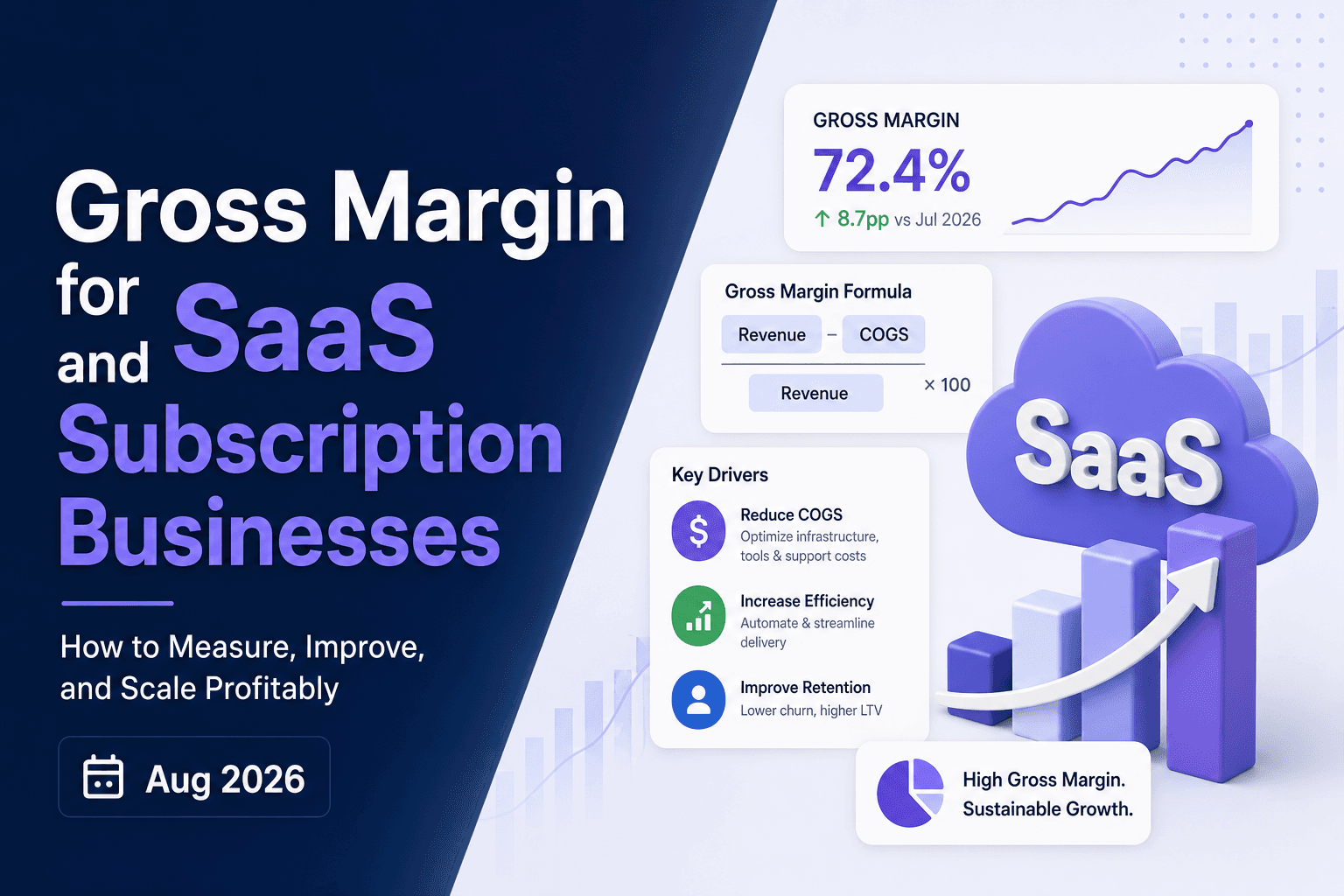
Running a subscription business and not sure if your gross margin is actually good? The benchmark ranges that matter depend heavily on whether you're SaaS, e-commerce, or streaming, and most comparisons people reach for are too broad to be useful. Getting clear on the formula, what counts as COGS in your model, and where your number should sit gives you a far more accurate read on the health of your unit economics.
TLDR:
- Gross margin (Revenue minus cost of goods sold (COGS), divided by revenue) sets the ceiling on every growth investment you can make.
- SaaS businesses typically run 70% to 85% gross margin; subscription e-commerce runs 30% to 50%; margins above 60% give you room to grow.
- Misclassifying operating expenses like sales or R&D as cost of goods sold (COGS) artificially suppresses your gross margin and distorts benchmarks.
- A 2% monthly involuntary churn rate on 50,000 subscribers means 1,000 lost subscribers per month, each carrying embedded customer acquisition cost (CAC) with no reduction in COGS.
- Slicker recovers failed-payment revenue through AI-powered smart retries and hyper-personalized dunning, with results proven via clinical-grade AABB testing on your own data before you commit.
What Gross Margin Means in Business
Gross margin tells you how much revenue remains after subtracting the direct costs of delivering your product or service. For subscription companies, those direct costs typically include hosting and infrastructure, customer success headcount tied to onboarding, payment processing fees, and third-party software embedded in the product.
The number matters because it sets a ceiling on everything else. You cannot spend more on sales, marketing, or R&D than your gross margin allows and still reach profitability. A subscription business with 60% gross margin has far more room to grow than one running at 40%, even if both show identical top-line revenue.
The Gross Margin Formula
Gross margin is calculated by subtracting the cost of goods sold (COGS) from revenue, then dividing by revenue:
Gross Margin % = (Revenue − COGS) / Revenue × 100
For a subscription company generating $1,000,000 in revenue with $300,000 in COGS, gross margin is 70%. That number tells you how much revenue remains to cover operating expenses, interest, and taxes before you reach net profit.
What Counts as COGS for Subscription Businesses?
COGS in a subscription context is narrower than most finance teams expect. It includes only the direct costs of delivering the service:
- Hosting and infrastructure costs tied directly to service delivery
- Customer support headcount allocated to onboarding and ongoing service
- Payment processing fees charged per transaction
- Third-party software or API costs embedded in the product
Sales, marketing, R&D, and general administrative expenses sit below the gross margin line. Misclassifying those as COGS will artificially suppress your gross margin and distort benchmarking comparisons.
Gross Margin vs. Gross Profit
Gross margin and gross profit measure the same underlying relationship between revenue and cost of goods sold (COGS), but they express it differently. Gross profit is the raw dollar figure left after subtracting COGS from revenue. Gross margin converts that number into a percentage of revenue, making it comparable across companies of different sizes.
For subscription businesses, the distinction matters because investors and operators almost always benchmark margin percentages, not absolute profit dollars.
The Quick Comparison
Metric | Output | Example ($1M revenue, $400K COGS) |
|---|---|---|
Gross Profit | Dollar amount | $600,000 |
Gross Margin | Percentage | 60% |
One tells you how many dollars your product generates above its direct costs. The other tells you how efficiently your business converts revenue into those dollars, which is what benchmarking, fundraising conversations, and board decks actually require.
What COGS Includes for Subscription Companies
For subscription businesses, cost of goods sold (COGS) looks different than in traditional product companies. Instead of raw materials or manufacturing costs, COGS covers the direct costs of delivering your service to customers.
Common COGS line items include:
- Hosting and infrastructure costs (cloud compute, storage, CDN fees) that scale with your customer base
- Payment processing fees, including per-transaction charges from your payment processor
- Third-party software or API costs embedded in your product delivery
- Customer support costs directly tied to service delivery, such as onboarding and technical support headcount
Expenses like sales, marketing, R&D, and general administration are operating expenses, not COGS. Keeping this separation clean is what makes gross margin a reliable signal of unit economics before overhead.
Gross Margin vs. Operating Margin vs. Net Margin
Gross margin stops at the cost of delivering your product. The two margins below it tell a fuller story about where revenue actually goes.
The Three-Layer View
These three margins sit at different points on the income statement:
- Gross margin measures revenue minus cost of goods sold (COGS), showing how much is left to cover all other expenses.
- Operating margin subtracts operating expenses like sales, marketing, and R&D from gross profit, revealing how much the business earns from its core activities before interest and taxes.
- Net margin takes everything out, including interest, taxes, and one-time items, producing the final bottom-line percentage.
For subscription companies, gross margin tends to be the most stable of the three because it isolates unit economics from the spending choices a company makes on growth. Operating and net margins fluctuate far more with investment cycles, making gross margin the cleaner signal for assessing whether the underlying business model is sound.
Why Gross Margin Matters More Than Revenue for Subscription Companies
Revenue is a vanity metric if the unit economics underneath it are broken. A subscription company growing at 40% annually can still be destroying value if its gross margin sits at 30%, because there is simply not enough left over after fulfilling each subscription to cover sales, marketing, product, or any path to profitability.
Gross margin tells you how much of each dollar of revenue survives the cost of delivering your product. For software-based subscription businesses, that surviving dollar funds everything else: customer acquisition, retention investment, and eventually, profit.
Investors and operators track this number for good reason. SaaS businesses typically carry gross margins between 70% and 85%, while usage-heavy or service-heavy subscription models often run closer to 40% to 60%. A company at the low end of that range needs dramatically more revenue to reach the same operating performance as one at the high end.
The implication for subscription companies is direct: protecting gross margin means protecting your ability to grow without proportionally growing your cost base.
Factors That Can Compress Gross Margin
For subscription companies, several structural cost pressures can quietly eat into gross margin over time.
- Infrastructure costs tend to scale with usage and not with revenue, so rapid subscriber growth can temporarily compress margins until engineering teams optimize resource consumption.
- Payment processing fees, including interchange and gateway costs, are typically treated as cost of revenue, reducing gross margin directly on every transaction.
- High support volume driven by onboarding friction or product complexity increases the cost of serving each customer, pulling margin down.
- Discounting and promotional pricing reduce recognized revenue without proportionally reducing delivery costs, which shrinks margin percentage even when subscriber counts grow.
Tracking failed-payment analytics KPIs separately gives finance teams visibility into which cost categories are driving compression versus which reflect healthy growth investment.
What Is a Good Gross Margin for Subscription Companies?
Gross margin benchmarks vary meaningfully by business model, so subscription companies need sector-specific reference points, not broad industry averages.
Benchmarks by Subscription Type
The right target depends on what you deliver:
- Software-as-a-Service (SaaS) companies typically see gross margins between 70% and 85%, reflecting low incremental delivery costs once the product is built.
- Subscription e-commerce businesses (physical goods, boxes, consumables) generally run 30% to 50%, weighed down by product, packaging, and fulfillment costs.
- Streaming and digital media sit in the 50% to 70% range, with content licensing and delivery infrastructure as the primary cost drivers.
What Signals a Healthy Margin
A gross margin above 60% gives a subscription business enough headroom to invest in sales, marketing, and retention without compressing operating income. Margins below 40% leave little room for growth spending and tend to attract investor scrutiny at scale. The right benchmark is less about a single number and more about whether your margin supports the unit economics your customer acquisition cost (CAC) and lifetime value require.
Your gross margin percentage is the starting point for that analysis, connecting directly to how much of each subscription dollar is available to cover the fixed costs that sit below the gross profit line.
How Failed Payments Erode Gross Margin at Scale
Every failed payment is a direct hit to gross margin. The revenue never arrives, but the cost to acquire and serve that subscriber already has. At scale, this gap compounds fast.
Consider a subscription business with 50,000 active subscribers and a 2% monthly involuntary churn rate. That's 1,000 lost subscribers per month from failed payments alone, each carrying embedded customer acquisition cost (CAC), onboarding cost, and forgone lifetime value. None of those costs disappear when the payment fails.
Recovering even a fraction of those failed payment losses moves the gross margin percentage meaningfully, without adding a single new customer.
How Slicker Protects Gross Margin for Subscription Businesses
Involuntary churn is one of the quietest destroyers of gross margin in subscription businesses. When a payment fails and a subscriber lapses, you lose the revenue you already earned without reducing your cost of goods sold (COGS). The margin on that lost subscriber simply disappears.
Slicker recovers that revenue through AI-powered smart retries and hyper-personalized dunning, working silently on your existing billing infrastructure with zero engineering lift. Subscribers never know it happened. Your gross margin recovers alongside the revenue.
The proof comes from your own data. Slicker runs clinical-grade AABB testing in payment recovery, splitting traffic 50/50 and measuring recovered dollars with statistical significance before you commit. If Slicker does not beat your control, you do not pay.
Final Thoughts on Gross Margin and What It Means for Subscription Growth
A strong gross margin percentage does not happen by accident. It comes from keeping COGS classification accurate, watching the cost categories that compress margin over time, and recovering every dollar of revenue your business already earned. The gap between a 60% and a 75% margin may sound small, but at scale it determines how much room you have to grow without burning cash.
Get in touch if you want to see how much of your margin is slipping through failed payments.
FAQ
What is a good gross margin percentage for SaaS and subscription businesses?
Gross margin benchmarks vary by business model: SaaS companies typically run 70% to 85%, streaming and digital media land in the 50% to 70% range, and subscription e-commerce sits closer to 30% to 50% due to fulfillment and product costs. A gross margin above 60% gives subscription businesses enough headroom to invest in sales, marketing, and retention without compressing operating income, while margins below 40% attract investor scrutiny at scale.
What is the difference between gross margin, operating margin, and net margin for subscription companies?
Gross margin measures revenue minus cost of goods sold (COGS), showing what remains before overhead. Operating margin subtracts sales, marketing, and R&D from gross profit, revealing what the core business earns before interest and taxes. Net margin takes out everything, including taxes and one-time items, producing the final bottom-line percentage. For subscription companies, gross margin is the most stable of the three because it isolates unit economics from growth-investment decisions.
What counts as COGS in the gross margin formula for a SaaS or subscription business?
COGS for subscription businesses covers only the direct costs of delivering the service: hosting and infrastructure, payment processing fees, third-party API costs embedded in the product, and customer support headcount tied to onboarding. Sales, marketing, R&D, and general administration are operating expenses that sit below the gross margin line. Misclassifying those as COGS artificially suppresses your gross margin and distorts any benchmarking comparison.
How do failed payments affect gross margin, and can I recover that revenue without adding headcount?
Every failed payment removes revenue you already earned while leaving your customer acquisition cost (CAC) and onboarding cost intact, directly compressing gross margin percentage at scale. Slicker recovers that revenue through AI-powered smart retries and hyper-personalized dunning that runs on your existing billing infrastructure, with zero engineering lift required. The recovery is silent: subscribers rarely know a payment failed, and the gross margin impact is proven against your own data through clinical-grade AABB testing before you pay anything.
Gross margin vs net margin: which metric should subscription CFOs focus on when assessing business model health?
Gross margin is the cleaner signal for assessing whether your underlying business model is sound, because it strips out variable growth spending that swings operating and net margin across investment cycles. Net margin tells you what survived after every cost, but a SaaS company burning on sales and marketing can show a near-zero net margin while carrying 80% gross margin, which signals a healthy unit economics foundation. Track gross margin as your primary business model health metric, and use operating and net margin to measure how efficiently you deploy the headroom it creates.
Related Articles
Retry Old Card or Wait for CAU? A Sep 2026 Guide
Card account updater retry logic sounds straightforward until you're staring at a mixed queue of expired cards, insufficient funds declines, and closed...

Defining Failed Payment Recovery for Subscription Businesses September 2026
Most subscription finance teams are solving the wrong problem. When a card declines and the account eventually closes, that loss lands in the churn column next...
Redefining Best Failed Payment Recovery Software Sep 2026
Vendor benchmarks for payment recovery software all tend to look the same: big recovery rate numbers, no control group, no way to know if your billing setup...
Stop losing revenue to failed payments
Join leading subscription businesses using Slicker to recover failed payments automatically.
Get Started