Defining Failed Payment Recovery for Subscription Businesses September 2026

Most subscription finance teams are solving the wrong problem. When a card declines and the account eventually closes, that loss lands in the churn column next to subscribers who actively decided to leave. But those are two separate problems with two separate fixes. This post works through what failed payment recovery means, how it differs from everything else in your retention stack, and why the definition itself shapes whether your revenue recovery efforts actually work.
TLDR:
- Failed payment recovery is a billing infrastructure problem, not a product problem; a declined charge and a churned subscriber are not the same event.
- Involuntary churn accounts for 20 to 40% of subscription losses, and PYMNTS data shows roughly 9% of subscription revenue sits in recoverable failures before any active cancellation.
- Soft declines make up 80 to 90% of failed card-not-present payments; most are recoverable with a well-timed retry, no customer contact needed.
- Misreading decline codes costs you in both directions: retrying hard declines triggers network penalty fees, while stopping early on soft declines forfeits recoverable revenue.
- Slicker layers an AI-powered recovery system on top of your existing billing infrastructure, with performance measured via AABB testing against your own baseline before any commercial commitment.
The Definition of Failed Payment Recovery
Failed payment recovery is the process of recapturing subscription revenue after a charge declines, before that failure becomes a permanent customer loss. A payment fails. The subscriber is still willing to pay. Recovery is everything that happens between that decline and either a successful charge or a canceled account.
The distinction matters for finance teams because a failed payment and a churned subscriber are not the same event. Churn is final: the subscriber leaves. A failed payment is a billing infrastructure problem, one that often resolves without the customer ever knowing it occurred. Treating the two interchangeably misattributes the cause and misdirects the fix.
In practical terms, recovery spans automated retries, targeted customer outreach, and proactive card credential updates. The goal across all three: close the gap between a declined charge and collected revenue without losing the subscriber.
Involuntary Churn vs. Voluntary Churn
Voluntary churn is a decision. A subscriber weighs the product, decides it isn't worth the price, and cancels. Involuntary churn is something else entirely: a subscriber who intended to stay, lost because a charge declined. Understanding what involuntary churn is and why helps teams separate billing failures from genuine product dissatisfaction.
The split is larger than most churn reports suggest. Industry data shows involuntary churn accounts for 20 to 40% of all subscription losses, meaning a large share of what looks like dissatisfaction on a dashboard is actually a billing infrastructure problem wearing a product problem's clothes.
That misclassification is expensive. A focused look at involuntary vs voluntary churn recovery shows why exit surveys and discount-led save flows are built for subscribers who chose to leave. Pointing them at subscribers whose cards simply declined wastes retention budget and leaves recoverable revenue untouched. The fix for involuntary churn lives in the billing layer, not the product.
Why Failed Payments Are More Common Than Most Finance Teams Realize
According to PYMNTS research, roughly 9% of subscription revenue is lost to failed payments before a single customer actively cancels. For a $10M ARR (annual recurring revenue) business, that's $900,000 sitting in recoverable failures.
Most finance teams don't see it clearly because standard churn dashboards aggregate it with voluntary cancellations. Unless reporting separates involuntary from voluntary exits, failed payments register as product churn and get treated accordingly.
The failures fall into three categories:
- Soft declines are temporary: insufficient funds, network timeouts, processor errors. The card is valid; the timing is wrong.
- Hard declines are permanent: stolen cards, closed accounts, active fraud flags. No retry will fix them.
- Stale credentials are expired or reissued cards where the stored number no longer matches what the bank holds.
Soft declines account for 80 to 90% of all failed card-not-present payments in subscription businesses. That share is recoverable with the right infrastructure. The revenue isn't gone; it's waiting on a better-timed retry or an updated card number.
The Three Layers of Failed Payment Recovery
Recovery follows a sequence, and each layer handles what the previous one cannot.
The first layer is prevention: card updater services silently refresh expired or reissued credentials before a charge is attempted, so the failure never occurs. The second layer is automated retry, where the system re-attempts the charge at the right moment with no customer-facing friction. The third layer is dunning, targeted outreach deployed only when the failure requires subscriber action, such as reporting a stolen card or adding a new payment method.
The order matters. Customer contact is a last resort. Sending dunning emails on failures that a well-timed retry would have cleared creates unnecessary friction, trains subscribers to ignore your messages, and adds spam risk with zero recovery benefit.

Soft Declines vs. Hard Declines: The Classification That Drives Strategy
Decline classification isn't a setup step. It's the entire strategy.
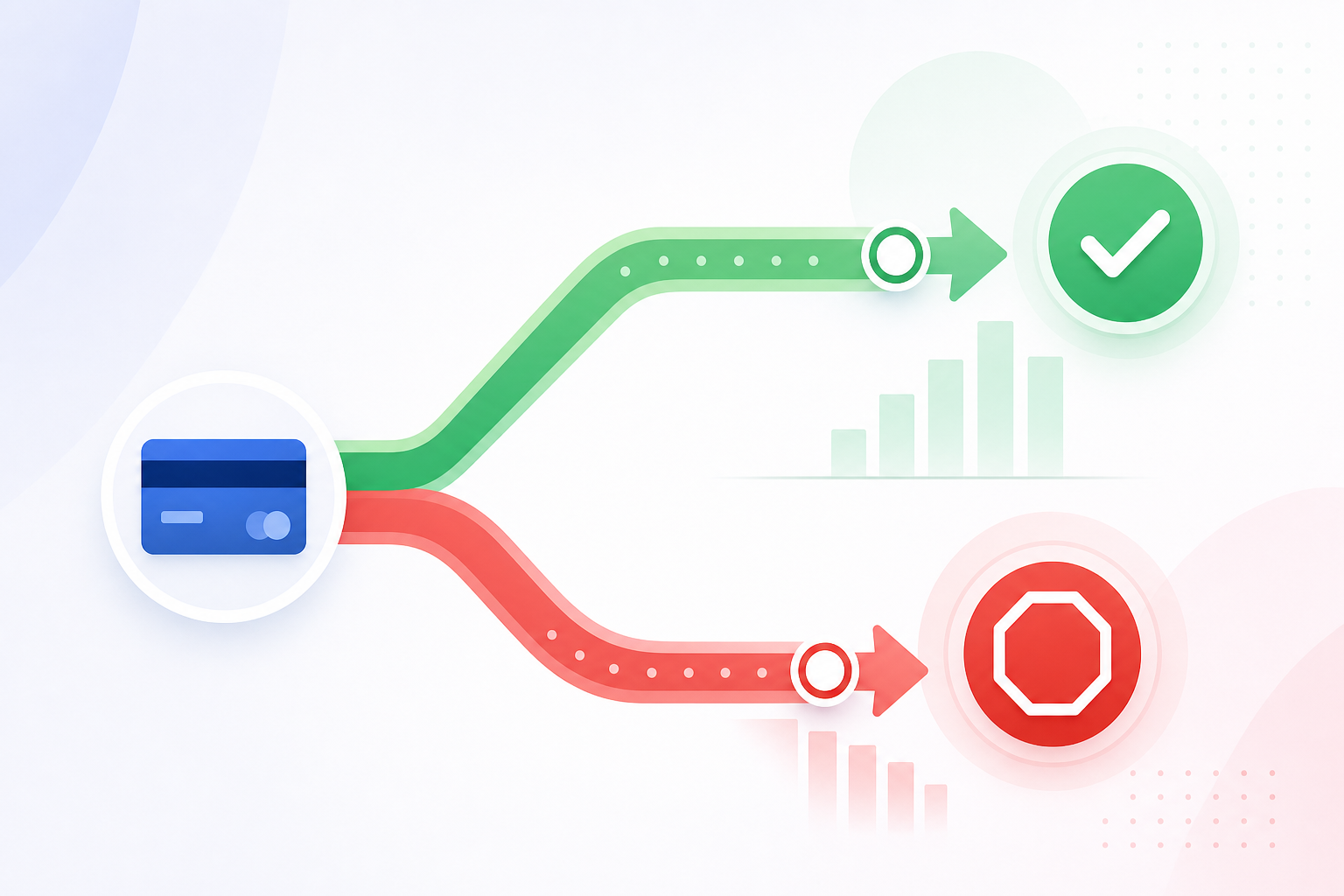
Soft declines are temporary. Insufficient funds, a network timeout, a processor hiccup: the card is valid, the subscriber is willing to pay, and a well-timed retry will likely succeed. Hard declines are permanent. A stolen card, a closed account, an active fraud flag: no retry will resolve them, and attempting one anyway wastes a permitted attempt while accumulating penalties.
Soft Decline | Hard Decline | |
|---|---|---|
Nature | Temporary | Permanent |
Common causes | Insufficient funds, network timeout, processor error | Stolen card, closed account, active fraud flag |
Card validity | Card is valid | Card is invalid or blocked |
Retry outcome | Likely to succeed with well-timed retry | No retry will resolve the failure |
Share of CNP failures | 80 to 90% of all failed card-not-present payments | Minority of failures |
Cost of misclassification | Forfeits recoverable revenue by stopping too early | Triggers excessive attempt fees; degrades authorization reputation |
The cost of misclassification runs in both directions. Retrying hard declines triggers Mastercard's excessive attempts fees and degrades the merchant's authorization reputation, lowering approval rates across all future transactions. Stopping too early on a soft decline forfeits revenue that was genuinely recoverable.
The harder problem is the ambiguous middle: codes like "do not honor" or "generic decline" that don't announce their category. The same gateway code can be a soft decline on one transaction and a hard decline on another, depending on which network code and Merchant Advice Code (MAC) accompanies it. A do not honor response paired with MAC 26 means retry in two days. The same response paired with MAC 03 means stop entirely. Understanding merchant advice codes and payment recovery is required for routing each decline correctly. Without reading all three signals together, a static system will guess wrong on a meaningful share of failures.
How Payment Retry Logic Works
Fixed retry schedules fire on a calendar: same intervals, same cadence, every failed payment treated identically regardless of what caused the decline. Intelligent retry systems make per-transaction decisions, reading the failure type, card type, issuing bank, geography, and timing signals before choosing whether to retry, when, and how many times. A complete subscription payment retry strategy accounts for all of these variables.
Merchant Advice Codes (MACs) add another input layer. Mastercard issues these codes to specify exactly what a merchant should do next: MAC 24 means retry after 24 hours; MAC 30 means retry after ten days; MAC 03 means stop entirely. Ignoring MAC 03 triggers a $0.10-per-attempt penalty for each retry attempt made after receiving a Do Not Try Again instruction.
Both Visa and Mastercard cap retries per card within a 30-day window, with penalty fees applied when merchants exceed those thresholds. Retrying a hard decline burns a permitted attempt and accumulates fees with zero recovery probability. Smart retry systems consistently recover 70 to 85% of recoverable failed payments; fixed retry schedules typically land between 40 to 60%.
The Role of Dunning in Payment Recovery
Dunning, in the subscription context, is the structured sequence of outreach sent when a payment failure requires the subscriber to act. Retries handle what the system can fix silently. Dunning handles what only the subscriber can fix.
The word "structured" carries weight here. Generic payment reminders treat every failure as identical. They aren't. An expired card needs a card-update request. A stolen card needs the subscriber to contact their bank. A payment flagged for suspected fraud needs a different message entirely, or no outreach at all. Sending the wrong message to the wrong failure type confuses subscribers and erodes brand trust.
Two factors separate effective dunning from generic reminders: sender identity and message framing. Recovery emails sent from a third-party domain look like billing spam. Sent from your own domain, in your own voice, they read as a service notification from a brand the subscriber already trusts. Anchoring the subject line to what the subscriber stands to lose (access, continuity, membership status) consistently outperforms transactional "payment failed" copy.
Grace periods define the clock dunning runs against. Extending the dunning window creates more recovery opportunity; shortening it reduces the cost of carrying non-paying subscribers. That tradeoff varies by business: a media publisher paying content licensing fees per active subscriber has different economics than a SaaS company with near-zero marginal cost per seat. The optimal window isn't the longest one. It's the one where incremental recovery probability exceeds the cost of keeping the subscription alive.
How Recovery Rate Is Measured
Recovery rate is recovered payments divided by failed payments, measured after the full dunning window closes. That last clause is where most measurement goes wrong.
Counting a subscriber as churned on the date of first decline inflates involuntary churn with failures that are still recoverable. The retry window hasn't closed. The subscriber hasn't left. Reporting churn at that point conflates a billing event with a customer decision.
The more useful pair of metrics is initial failure rate versus final failure rate. The gap between those two numbers is the measurable value the recovery process delivers, and a failure-reason retry and dunning sequence routes every decline to the right response. A wide gap means the system is recovering a meaningful share of what initially failed; a narrow gap means either the failures are majority hard declines, or the recovery infrastructure isn't working.
Recovery rates vary enough across subscriber mix, payment method, and billing infrastructure that industry benchmarks serve only as rough orientation. Your own historical baseline, measured on closed cohorts over 30 to 60 days, is the only number worth building strategy around.
The Account Updater Layer: Prevention Before Recovery
Card credentials don't stay current on their own. Cards expire on a fixed schedule, get reissued after fraud events, and change account numbers following loss or theft. Industry estimates put the share of stored payment credentials that change annually at up to 33%. For any subscription business running automated billing, that churn in card data translates directly into avoidable declines.
A card account updater (CAU) tackles this before a charge is ever attempted, and expired cards killing your MRR is a problem it directly solves. The service queries card network databases, Visa Account Updater and Mastercard Automatic Billing Updater, and refreshes stored credentials silently in the background. When the charge fires, it hits current card details instead of stale ones, so the subscriber never sees a failure and the retry system never needs to engage.
That prevention distinction matters for how you budget recovery resources. A failure caught by a CAU costs nothing in retry attempts, carries no risk of network penalties, and generates no customer friction.
How Slicker Approaches Failed Payment Recovery
Slicker sits on top of existing billing infrastructure as an AI-powered recovery layer, requiring no engineering work and going live in under five minutes. An ensemble of AI models analyzes over 40 variables per transaction, including card type, issuing bank, geography, local payday cadence, and time of day, to determine whether to retry, when, and through which payment method or gateway.
Hard declines stop immediately to protect merchant account standing and avoid network penalties. Soft declines enter the retry queue, with attempts timed to geography-specific payroll windows:
- US biweekly cycles
- Western European and UK monthly payroll schedules
- Australian weekly or fortnightly patterns
Dunning only activates when silent retry cannot resolve the failure. When it does, each email goes out from the subscriber's own brand domain, with messaging specific to the decline reason, not a generic payment update request.
Performance is proven before any commercial commitment through AABB testing in payment recovery, a clinical crossover design that measures incremental recovered revenue against the business's existing baseline with statistical significance. The pilot runs for four months: the first month is free, followed by three paid months, with the option to cancel anytime.
Final Thoughts on Failed Payment Recovery
Failed payment recovery isn't a single tactic. It's a layered process where prevention, retries, and targeted outreach each handle what the others can't. Getting the classification right (soft versus hard declines) is where strategy actually begins. Your own historical baseline on closed cohorts is the most reliable guide for where your recovery stands today. Connect with the Slicker team if you want to measure the gap on your real data.
FAQs
How does AI-powered payment retry logic work for subscription businesses?
AI-powered retry systems analyze each failed payment individually, reading the decline type, card type, issuing bank, geography, and payday timing signals to decide whether to retry, when, and through which payment method. This is structurally different from fixed retry schedules, which fire on a calendar regardless of failure reason. As noted in the retry logic section above, smart retry systems consistently outperform fixed schedules on recoverable failures because timing a retry to when a cardholder's account is most likely to have funds matters more than simply increasing the number of attempts.
What metrics should a SaaS revenue operations team track to measure involuntary churn recovery?
Track initial failure rate and final failure rate separately, measured after the full dunning window closes, not at the date of first decline. The gap between those two numbers is your recovery process's measurable output. Supplement this with recovered revenue in dollars (beyond raw transaction count), recovery rate by decline type (soft versus hard), and the share of churn classified as involuntary versus voluntary. Conflating the two in a single churn metric misattributes the cause and points retention spend at the wrong problem.
How does AABB testing work for proving ROI from a payment recovery vendor?
AABB testing splits your failed payments 50/50 into a control group (your existing retry logic) and a treatment group (the vendor's system), then measures recovered revenue in each cohort with statistical significance. The crossover design, borrowed from clinical drug trials, prevents cherry-picking by requiring both A buckets to perform similarly before results are accepted. If the treatment group does not outperform the control with a verified p-value, the test fails on its own terms. Most payment recovery vendors report recovery rates against internal benchmarks or industry averages; AABB testing measures incremental lift against your own baseline, on your own transaction data, making the result independently verifiable.
What subscription payment recovery platforms work with Stripe, Adyen, and Braintree?
Slicker integrates natively with Stripe, Adyen, and Braintree alongside billing systems including Stripe Billing, Chargebee, Recurly, Zuora, and Recharge, with setup completed in under five minutes using API keys and zero engineering work from your team. Direct integration with your payment service provider (PSP) is required alongside the billing system connection, because network-level decline codes and Merchant Advice Codes (MACs) that drive retry decisions are not exposed through billing systems alone.
How does delta-based pricing work for payment recovery, and why does it matter for businesses that already recover some failed payments?
Delta-based pricing charges only on the incremental recoveries above your existing baseline, not on the full volume of successful retries during a vendor's tenure. For a business already recovering 50% of soft declines through built-in billing platform retries, a vendor charging a percentage of all recoveries would collect fees on revenue you would have recaptured regardless. Delta-based pricing isolates what the vendor actually added, aligning the commercial model with the same logic as AABB testing: you pay for the lift, not the baseline.
Related Articles

Redefining Best Failed Payment Recovery Software Sep 2026
Vendor benchmarks for payment recovery software all tend to look the same: big recovery rate numbers, no control group, no way to know if your billing setup...

Decline Recovery Layers: Retries, Dunning & More (Sep 2026)
Most declined charges don't require a customer email. They need a well-timed retry, or a card number refresh before the attempt even fires. Dunning is the...

Expired Cards as a Churn Vector: The Plastic Aging Problem (Sep 2026)
A surprising share of lost subscribers didn't cancel. Their card aged out, the charge failed hard, and your billing system had no path forward. Separating...
Stop losing revenue to failed payments
Join leading subscription businesses using Slicker to recover failed payments automatically.
Get Started