The $129B Involuntary Churn Crisis and AI Recovery Oct 2026

Introduction
The subscription economy faces a staggering crisis: Recurly's 2026 State of Subscriptions report, drawn from 2,200 subscription businesses and 76 million unique subscribers, confirms failed payment losses across the industry at $129 billion, the confirmed 2026 benchmark for the scale of this problem. This astronomical figure is revenue walking out the door from customers who never intended to leave.
Involuntary churn occurs when a customer's subscription is terminated due to payment failures, not because of their conscious decision to cancel. Unlike voluntary churn, where customers actively decide to discontinue service, involuntary churn stems from technical payment issues: expired cards, insufficient funds, or gateway failures that force otherwise satisfied customers out of their subscriptions.
The scale of this problem is breathtaking. Up to 70% of involuntary churn stems from failed transactions—customers who never intended to leave but are forced out when a card is declined. For SaaS companies operating on razor-thin margins, this represents a massive opportunity for revenue recovery through intelligent AI-powered retry systems.
TLDR:
- Recurly forecasts $129B lost to failed payments in 2025; involuntary churn accounts for 20-40% of total subscriber loss.
- A $10M ARR company with a 5% monthly churn rate loses roughly $83,333 per month to recoverable payment failures.
- Prepaid cards represent 6.8% of subscriptions but drive 10.5% of first-payment failures, recovering at only 6.4% (Redux Payments, 2026).
- A Baremetrics 2026 benchmark of 119 US subscription businesses found 95% of dedicated recovery tool users saw it pay for itself within the first month, at a median recovery rate of 12.7%.
- Slicker applies an ensemble of AI models to every failing payment with no-code setup, charging only on successfully recovered payments.
The Anatomy of the $129 Billion Problem
Breaking Down the Numbers by Company Size
To understand the true impact of Recurly's forecast, consider how this $129 billion translates across revenue tiers. A $1M–$10M ARR company may have $50,000–$500,000 at risk annually; a $10M–$50M company faces $500,000–$2.5M. At $100M+ ARR, annual exposure can exceed $5M. The figures become even more alarming when you factor in that involuntary churn accounts for 20–40% of total customer churn. For a $10M ARR SaaS company with a 5% monthly churn rate, involuntary churn could be costing $83,333 monthly — nearly $1M annually in recoverable revenue.
Industry-Specific Impact Analysis
The subscription box industry reports involuntary churn rates reaching up to 30% of their total churn numbers. (Slicker) This means that for every 100 customers who churn, 30 never actually wanted to leave: they were simply victims of payment processing failures. SaaS and DTC involuntary churn rates diverge considerably depending on billing model and card mix, as seen in this industry-by-industry churn benchmarks breakdown.
Recent data shows that churn has two parts: involuntary and voluntary, with involuntary churn easily accounting for 40% of total churn depending on the nature of the business. (Churnkey) For B2C SaaS companies, anything over 46% annual churn is considered high, making involuntary churn reduction a critical lever for improving overall retention metrics. (Churnkey)
The Technical Reality Behind Payment Failures
Understanding Decline Types and Their Impact
Payment failures fall into two primary categories: soft declines and hard declines, each requiring different recovery strategies:
Soft Declines:
- Temporary issues like insufficient funds or network timeouts
- Often resolve within 24-72 hours
- Account for 60-70% of all payment failures
- Higher recovery success rates with intelligent timing
Hard Declines:
- Permanent issues like expired cards or closed accounts
- Require customer intervention or card updates
- Account for 30-40% of payment failures
- Lower recovery rates but still addressable through dunning
The staggering reality is that 62% of users who hit a payment error never return to the site. This single statistic shows why automated recovery systems are essential: manual intervention simply arrives too late for most customers.
The Cost of Inaction
In some industries, decline rates reach 30%, and each one is a potential lost subscriber. When we apply this to Recurly's $129 billion forecast, the math becomes sobering:
- $10M ARR Company: With a 30% decline rate and 5% monthly churn, potential monthly losses could reach $125,000
- $100M ARR Company: Similar conditions could result in $1.25M monthly losses
- Enterprise ($500M+ ARR): Could face $6.25M+ in monthly involuntary churn
These figures don't account for the compound effect of involuntary churn draining customer lifetime value, reduced word-of-mouth referrals, and the increased cost of acquiring replacement customers.
AI Recovery Engines: The Technology Behind Revenue Recapture
How Machine Learning Rebuilds Payment Recovery
AI-powered engines predict the optimal moment, method, and gateway for each retry, recovering materially more failed payments than native billing logic alone. This is about intelligent coordination that considers dozens of variables:

Timing Optimization:
- Historical success patterns by time of day
- Customer payment behavior analysis
- Bank processing schedules and optimal retry windows
- Seasonal and cyclical payment patterns
Gateway Intelligence:
- Real-time gateway performance monitoring
- Dynamic routing based on transaction characteristics
- Failure reason analysis and gateway-specific optimization
- Geographic and currency-based routing decisions
Customer Context:
- Payment history and preferred methods
- Subscription value and customer lifetime value
- Communication preferences and response patterns
- Risk scoring and fraud prevention integration
AI is reshaping payment tracking by improving speed, accuracy, and security, with invoice reconciliation now taking 1-2 minutes instead of 5-8 minutes due to AI optimization. (Tennis Finance)
The Competitive Landscape: AI Recovery Solutions
Slicker: The Intelligent Overlay Approach
Slicker is a new generation of payment recovery tools that process each failing payment individually and convert past-due invoices into revenue. Founded in 2023 by payments veterans and backed by Y Combinator, Slicker delivers materially better recovery than native billing-provider logic.
Key differentiators include:
- 5-minute setup with no code changes, plugging into Stripe, Chargebee, Recurly, Zuora, and Recharge
- Pay-for-success pricing where Slicker only charges you for successfully recovered payments
- Multi-gateway smart routing that optimizes payment paths in real-time
- SOC 2 Type 2 compliance achieved for enterprise security requirements
Recurly ML: Native Platform Integration
Recurly's AI-driven approach focuses on deep integration with their subscription management platform. In 2025, the software sector alone reclaimed over $155 million in revenue through Recurly's payment recovery tools, while digital media added nearly $100 million. (Recurly) Their payments decline management strategies reduce churn and boost monthly subscription revenues, with the 2026 State of Subscriptions report confirming ongoing material lifts for merchants across software, media, and education verticals. (Recurly)
Stripe Smart Retries: Gateway-Level Intelligence
Stripe's approach tackles the fact that 25% of lapsed subscriptions are due to payment failures, a phenomenon known as involuntary churn. (Stripe) Their system recognizes that subscriptions recovered by Stripe tools continue on average for seven more months, confirming the long-term value of successful recovery. (Stripe)
Quantifying Recovery Potential: The 8-20% Recapture Range
Modeling Recovery Scenarios
Based on industry data and AI recovery engine performance, businesses running AI-powered payment recovery systems can recapture a meaningful portion of failed payments. Full-stack recovery programs vary widely in their recapture performance depending on subscriber mix, billing infrastructure, and tooling depth. The Baremetrics 2026 benchmark of 119 US subscription businesses found a median recovery rate of 12.7%, giving a useful directional anchor. At that rate, a $10M ARR company recovers roughly $63,500 annually; a $100M company recovers around $635,000. The table below models the upside scenario at a 20% recovery rate.
Optimistic Scenario (20% Recovery Rate)
Company ARR | Annual Revenue at Risk | 20% Recovery Potential | Monthly Recovery |
|---|---|---|---|
$10M | $500,000 | $100,000 | $8,333 |
$50M | $2.5M | $500,000 | $41,667 |
$100M | $5M | $1,000,000 | $83,333 |
The Compound Effect of Recovery
Smart dunning systems can lift recovery rates measurably compared with static rules. When combined with automatic card-updater services, dunning systems recover additional invoices before a retry is even needed.
This creates a multiplicative effect:
- Prevention: Card updater services catch 15-20% of potential failures
- Intelligent Retry: AI engines recover 40-60% of remaining failures
- Smart Dunning: Recovers additional 15-25% through optimized communication
- Manual Intervention: Captures final 5-10% through human touchpoints
Implementation Strategies for Different Business Sizes
Small to Mid-Market SaaS ($1M-$10M ARR)
Immediate Priorities:
- Implement basic retry logic with 3-5 attempt cycles
- Set up automated card updater services
- Deploy simple dunning email sequences
- Monitor decline reasons and optimize timing
Expected Impact:
- 8-12% recovery rate achievable within 90 days
- Monthly revenue recovery: $3,000-$10,000
- ROI typically 300-500% in first year
Recommended Tools:
- Slicker for plug-and-play implementation
- Native billing platform retry logic as baseline
- Basic email automation for dunning
Enterprise SaaS ($50M+ ARR)
Advanced Implementation:
- Multi-gateway routing with real-time optimization
- AI models for customer-specific retry timing
- Integrated dunning with customer success workflows
- Advanced analytics and reporting dashboards
Expected Impact:
- 15-20% recovery rate with full implementation, above the 12.7% median for dedicated recovery tool users per the Baremetrics 2026 benchmark, achievable with multi-gateway routing and full dunning optimization
- Monthly revenue recovery: $200,000-$1M+
- ROI typically 800-1200% when fully optimized
Strategic Considerations:
- Custom integrations with existing billing infrastructure
- Compliance requirements (PCI DSS, SOC 2, GDPR)
- Multi-currency and international payment optimization
- Integration with customer success and support systems
The Broader AI Payments Ecosystem
Fraud Prevention and Recovery Synergies
AI is now central to the payments industry's fraud-fighting infrastructure, and it's paying off. According to Mastercard's 2026 analysis, 83% of industry leaders report that AI has materially reduced false positives and customer churn rates, while 42% of issuers and 26% of acquirers have saved more than $5 million in fraud attempts over the past two years thanks to AI. (Mastercard, 2026)
The intersection of fraud prevention and payment recovery creates powerful synergies, and teams that optimize AI-powered dunning and retry interaction together unlock the largest compound gains:
- Risk Scoring: AI models that identify legitimate customers for aggressive retry strategies
- Behavioral Analysis: Pattern recognition that distinguishes temporary issues from permanent failures
- Real-time Decision Making: Instant routing decisions based on fraud risk and recovery probability
Global card fraud losses dipped 1.2% to $33.41 billion in 2024 (the card industry's best result in years, aided by AI-powered fraud detection), but the Nilson Report projects losses will climb back to $41.06 billion by 2030 as criminals adopt the same AI tools. (Nilson Report, January 2026) Cumulative merchant losses from online payment fraud are still projected to exceed $343 billion between 2023 and 2027. (Merchant Savvy)
Advanced AI platforms like Disputed.ai use algorithms to make intelligent decisions about which chargebacks to fight, analyzing each case and hundreds of similar ones to determine optimal response strategies and likelihood of success. (Disputed.ai) This unified approach to payment optimization covers both recovery and dispute management.
Measuring Success: KPIs and Analytics

Essential Metrics for Recovery Programs
Primary Recovery Metrics:
- Recovery Rate: Percentage of failed payments successfully recovered
- Time to Recovery: Average time from failure to successful payment
- Recovery Value: Total dollar amount recovered monthly/quarterly
- Customer Retention Impact: Percentage of recovered customers who remain active
Process Performance Metrics:
- Retry Attempt Optimization: Success rate by attempt number and timing
- Gateway Performance: Success rates by payment processor
- Decline Reason Analysis: Recovery rates by failure type
- Cost per Recovery: Total program cost divided by successful recoveries
Customer Experience Metrics:
- Communication Effectiveness: Response rates to dunning messages
- Customer Satisfaction: Post-recovery survey scores
- Support Ticket Volume: Impact on customer service workload
- Voluntary Churn Impact: Changes in intentional cancellation rates
Advanced Analytics and Reporting
Businesses lose on average 7.2% of subscribers monthly due to passive churn (involuntary cancellations caused by changes to payment methods or expired cards, as distinct from deliberate cancellations). (Recurly) Advanced analytics platforms help identify patterns and optimize recovery strategies:
Predictive Analytics:
- Customer lifetime value modeling for recovery prioritization
- Failure probability scoring based on payment history
- Seasonal trend analysis for proactive card updating
- Cohort analysis for recovery strategy effectiveness
Real-time Dashboards:
- Live recovery performance monitoring
- Gateway health and performance tracking
- Customer communication status and response tracking
- Revenue impact visualization and forecasting
Future Trends and Innovations
New and Upcoming Technologies in Payment Recovery
Account-to-Account Payments:
- Direct bank transfers as backup payment methods
- Reduced card decline rates through alternative payment rails
- Lower processing costs and improved success rates
- Integration with open banking initiatives
Biometric Authentication:
- Reduced fraud-related declines through improved verification
- Smooth customer experience during payment updates
- Enhanced security for high-value subscription services
- Mobile-first authentication workflows
Blockchain and Cryptocurrency Integration:
- Alternative payment methods for international customers
- Reduced cross-border payment failures
- Smart contract automation for subscription management
- Decentralized payment recovery mechanisms
Data Privacy Requirements:
- GDPR compliance for European customer data
- CCPA requirements for California residents
- PCI DSS standards for payment data handling
- SOC 2 Type II for enterprise security requirements
Payment Regulation Evolution:
- Strong Customer Authentication (SCA) in Europe
- Open banking regulations and their impact on recovery
- Consumer protection laws affecting retry strategies
- Cross-border payment regulation harmonization
Where Things Stand in Mid-2026: The Numbers Have Only Gotten Starker
Recurly's $129 billion forecast has aged into reality. The company's 2026 State of Subscriptions report (drawn from 2,200 subscription businesses and 76 million unique subscribers) puts hard numbers on the problem. In 2025, the software sector alone reclaimed over $155 million in revenue through payment recovery tools; digital media added nearly $100 million. That's recoverable revenue hiding in failed transactions, not a bookkeeping abstraction.
The same data reveals a structural fragility in monthly billing: renewal rates have dropped to 82.9%, with only 23.3% of failed monthly-plan renewals recovered. Out of every 100 renewal attempts, nearly 18 fail, and three-quarters of those failures never convert to a successful charge. For subscription businesses leaning heavily on monthly plans, that's a compounding revenue leak that worsens with every billing cycle.
Two additional mid-2026 data points are worth benchmarking against:
- Prepaid card concentration risk. New failed-payment analysis from Redux Payments (August 2026), covering $500 million in processed failures, found that prepaid cards represent just 6.8% of subscriptions but drive 10.5% of first-payment failures — and only 6.4% of those failures ever recover. The card type a customer signs up with is now understood to be one of the strongest early predictors of involuntary churn.
- AI recovery is paying for itself faster. A Baremetrics benchmark report (May 2026) covering 119 US subscription businesses found that 95% of those using a dedicated recovery tool saw it pay for itself within the first month, at a median recovery rate of 12.7% — validating the 8–20% recapture range outlined earlier in this analysis.
The broader takeaway for 2026: involuntary churn is no longer a background nuisance that billing teams manage quietly. It is a board-level revenue metric: the best-performing subscription businesses are attacking it with ensemble AI models, proactive card-updater services, and hyper-personalized dunning sequences tuned to individual payment profiles. The companies that moved early on AI recovery are compounding the advantage; those still running static retry schedules are conceding recoverable MRR to the gap.
Early October 2026: Three Signals Worth Tracking Now
The mid-2026 picture has sharpened further in the weeks since. Three developments are worth adding to any board-level involuntary churn analysis as of early October 2026.
AI adoption crossed a structural threshold. By early 2026, 40% of subscription companies had deployed AI for revenue recovery and churn prediction — a figure that has continued climbing through Q3. The practical consequence: the performance gap between companies running ensemble AI recovery and those still on static retry schedules is now a compounding disadvantage. Every billing cycle that passes without intelligent retry logic is a cycle where the AI-equipped competitor is retaining subscribers you're losing permanently.
Network tokenization is emerging as a meaningful upstream layer. Where card-updater services were once the standard tool for reducing credentials-staleness failures, network tokenization (which automatically updates a stored payment token when the underlying card is reissued or expires) is increasingly cited as a structural improvement to authorization rates on subscription renewals. Early benchmarks point to a 2 to 4% lift in renewal acceptance rates for businesses that have rolled it out, operating before any retry or dunning logic fires. For high-volume B2C subscription businesses, that upstream reduction in first-failure rate directly lowers the recovery burden downstream.
The compounding gap is widening, not narrowing. The more important finding for October 2026, building on the Baremetrics benchmark referenced earlier in this analysis, is directional: the businesses that moved earliest on AI recovery are now entering their second and third year of compounding retention advantages. Recovered subscribers stay an average of seven more months (Stripe data). Those seven months generate additional LTV, word-of-mouth referrals, and upsell revenue that static-retry businesses are not capturing. The gap between early movers and laggards is no longer measured in recovery-rate percentage points alone, it's measured in customer lifetime value.
Failed Payment Recovery Tools for SaaS CFOs: 2026 Landscape
With $129 billion in at-risk subscription revenue, CFOs need more than a spreadsheet. They need a recovery stack. The tools below represent the primary options a SaaS finance leader should review in 2026, organized by where they sit in the payment infrastructure.
Overlay AI Recovery Engines
Slicker is purpose-built for subscription businesses that want immediate results with zero engineering lift. It connects to Stripe, Chargebee, Recurly, Zuora, and Recharge in roughly five minutes, then applies an ensemble of AI models to every failing payment, optimizing retry timing, gateway routing, and decline-code handling at the individual-transaction level. Pricing is pay-for-performance: you're charged only on successfully recovered payments. For CFOs who need to show board-level ROI fast, the math is straightforward: recovered MRR minus success fees.
Native Billing Platform Recovery
- Stripe Billing Smart Retries uses Stripe's AI model, trained on billions of transactions, to schedule retries when the issuer is most likely to approve. It's table stakes if you're already on Stripe, and recovers a meaningful share of soft declines without configuration. The ceiling, however, is the single-gateway constraint: Stripe can't route around itself.
- Recurly Revenue Recovery combines dunning email sequences, automatic card-updater, and AI-timed retries within the Recurly platform. Recurly's 2026 State of Subscriptions report, drawn from 2,200 subscription businesses, confirmed the software sector alone reclaimed over $155 million through Recurly's recovery tools in 2025, with digital media adding nearly $100 million. Effective if Recurly is your billing system of record; limited if you run multiple gateways.
- Chargebee Receivables offers rules-based dunning workflows with smart retry scheduling. Best suited to teams that want tight integration with Chargebee's subscription management and are comfortable configuring retry rules manually, as opposed to delegating to a model.
- Maxio (formerly SaaSOptics + Chargify) provides dunning and revenue recovery as part of its broader SaaS financial-operations suite, making it a natural fit for B2B subscription businesses that need combined billing, revenue recognition, and churn analytics in one platform.
How to Choose: A CFO Decision Framework
Situation | Best-fit tool tier | Why |
|---|---|---|
Single gateway, want fast wins | Native platform retries | Zero incremental cost; already in your billing stack |
Multiple gateways or billing providers | Overlay AI engine (Slicker) | Cross-gateway routing and unified recovery logic |
Need board-ready ROI proof | Pay-for-performance overlay | Success-only fee structure makes the P&L case self-evident |
B2B SaaS, complex rev rec | Maxio or Chargebee | Recovery integrated with revenue recognition workflows |
High-volume B2C subscriptions | Overlay AI + native retries | Volume justifies a second recovery layer; compound lift is meaningful |
The most important CFO insight: these tiers are not mutually exclusive. Native platform retries are a floor, not a ceiling. An overlay AI engine layered on top consistently adds a measurable uplift over the recovery rate of native logic alone, and the incremental MRR (monthly recurring revenue) recovered typically covers the tool cost within the first billing cycle.
Conclusion: Turning the $129B Crisis into Opportunity
Recurly's forecast of $129 billion in industry losses from failed payments represents both a crisis and an unprecedented opportunity. For SaaS companies across all segments, involuntary churn is more than a technical problem: it is a strategic imperative that directly impacts growth, profitability, and customer satisfaction.
The mathematics are compelling: even modest recovery rates of 8-12% can generate hundreds of thousands in additional annual revenue for mid-market companies, while enterprise organizations can recapture millions through end-to-end AI-powered recovery programs. Each year, millions of dollars in revenue are lost due to this issue—revenue that could have been saved with the right tools and strategies in place.
The recovery tool market offers multiple approaches, from overlay solutions like Slicker that provide immediate implementation with no code changes, to full-stack platform integrations that optimize every aspect of the payment lifecycle. The key is matching the solution complexity to business needs while maintaining focus on measurable ROI.
As we move deeper into 2026, the companies that proactively tackle involuntary churn will gain measurable competitive advantages. They'll retain more customers, generate higher lifetime values, and operate more efficiently than competitors who treat payment failures as inevitable losses.
The $129 billion problem is not going away. With intelligent AI recovery engines, sophisticated analytics, and strategic implementation, it becomes a $129 billion opportunity for those prepared to seize it. The question is not whether to implement payment recovery systems, but how quickly you can deploy them to start recapturing revenue that's walking out the door every single day.
For SaaS leaders weighing their options, the path forward is clear: assess your current involuntary churn rates, quantify the revenue at risk, and implement AI-powered recovery systems that can recapture a meaningful share of those losses. In a subscription economy where every customer matters, payment recovery is a business-critical capability that directly impacts your bottom line.
Frequently Asked Questions
How does delta-based (incremental) pricing work, and why is it fairer than charging a percentage of all successful recoveries?
Delta-based pricing — sometimes called incremental recovery pricing — means you're charged only on the additional revenue Slicker recovers beyond what your existing billing stack would have collected on its own. If your native Stripe or Recurly retry logic already rescues 40% of failed payments, you shouldn't pay a fee on that 40%. You were going to get that money regardless. Slicker's pricing is anchored to the delta: the recoveries that wouldn't have happened without Slicker's ensemble AI models.
Why it matters: a flat-percentage model inflates the apparent cost of a tool for businesses that already have decent baseline recovery. It also creates a perverse incentive — a vendor charging on all successful recoveries benefits from taking credit for payments that would have succeeded anyway. Delta pricing aligns the vendor's economics with provable incremental impact, which is the only number that belongs on a CFO's P&L. To isolate the delta precisely, Slicker uses AABB (clinical-grade) testing: traffic is split, the control group runs your existing logic, and recovery rates are compared with statistical significance. The fee applies to the measured uplift, not the gross recovery total.
What technical and contractual safeguards should enterprises require from a payment recovery vendor to manage GDPR sub-processor risk?
Enterprise procurement teams evaluating payment recovery vendors under GDPR (or equivalent frameworks) should require the following before signing:
- A signed Data Processing Agreement (DPA) that satisfies GDPR Article 28: documented processing purposes, restrictions on further processing, security obligation schedules, sub-processor disclosure and change notification, data subject rights support (access, erasure, portability), and a deletion or return commitment on termination. A vendor without a standard DPA is not enterprise-ready — treat an absent DPA as a disqualifying gap, not a paperwork delay.
- Sub-processor disclosure. Your DPA should list every sub-processor the vendor uses (cloud infrastructure, email delivery, analytics tooling) and require prior notice of any new sub-processor additions. Under GDPR, you are responsible for your sub-processors' sub-processors — the chain of accountability needs to be documented.
- Data residency and transfer mechanism. If your subscribers are EU residents, verify that the vendor's infrastructure and sub-processors are either EU-resident or covered by a valid transfer mechanism (EU Standard Contractual Clauses, adequacy decision, or equivalent). Post-Schrems II, a US-based vendor without SCCs in the DPA is a compliance gap.
- SOC 2 Type 2 report (or equivalent). An independently audited security report confirms that access controls, encryption at rest and in transit, incident response, and change management have been reviewed and verified by a third party, rather than self-asserted. Slicker holds SOC 2 Type 2 certification. Request the report summary and ask about the scope of systems covered.
- Cyber insurance coverage. Request the vendor's cyber liability policy limits and confirm coverage includes third-party data incidents. A $1M policy is insufficient for an enterprise handling tens of millions of payment events annually; typical enterprise vendor requirements run $5M–$10M in coverage.
- Breach notification commitment. The DPA should specify the vendor's obligation to notify you within 72 hours of confirmed awareness of a personal data breach, the GDPR standard. Vague language leaves you exposed; get a specific hour threshold in writing.
- Data deletion schedule on termination. Confirm the contractual window within which the vendor will delete or return your data after contract end, and the format of deletion confirmation. Thirty days is a common standard; some enterprises require 14 days for high-sensitivity data categories.
For procurement teams at companies where the legal review process is the bottleneck: Slicker's DPA is a standard document, not a custom negotiation, and SOC 2 Type 2 certification is already in place. Requesting both at the start of vendor evaluation — before technical scoping — typically compresses the enterprise onboarding timeline by several weeks.
How does Slicker's pricing model account for businesses with low gross margins — such as physical subscription box companies — so recovery costs never exceed the margin on a recovered subscription?
For businesses where a recovered $49 box subscription carries $8-12 in gross margin, a recovery fee structured as a flat percentage of recovered revenue can quickly become economically irrational: you'd be paying more to recover the payment than the recovered subscription is worth to the business. Slicker's pricing model is designed with low-margin businesses in mind: the success fee is calculated against the incremental recovery delta, and fee caps can be configured so that the cost of recovery never exceeds the contribution margin of the recovered subscription.
In practice, a physical subscription box company at 20% gross margin should be assessing recovery tools on net recovered margin, not gross recovered revenue. Slicker's team works through this math during onboarding, anchoring your average subscription value, gross margin per unit, and baseline recovery rate before setting a fee structure that keeps every recovery net-positive to the P&L. The pay-for-performance model means there's no retainer to absorb before the first dollar of net-positive recovery hits; costs scale precisely with results.
What does going live with a payment recovery platform actually require, and how long does it take?
The direct answer varies by platform, but for Slicker it is: approximately five minutes of setup, zero engineering work, and live recovery on the next failed payment. Here is what that actually means in practice:
What the setup involves. Slicker connects to your billing provider — Stripe, Chargebee, Recurly, Zuora, or Recharge — via a credentials handshake (typically an API key or OAuth token). No code changes to your application, no webhook configuration, no data pipeline. The integration reads your existing payment events and begins applying AI-optimized retry logic immediately. For most teams, the end-to-end process from signup to first recovery attempt takes under 30 minutes, including the time to log into your billing provider and generate the API key.
What configuration is needed before going live. Slicker's dashboard lets you configure communication preferences (whether and when to send dunning emails, the sender identity, the message templates) before activating the recovery layer. This is optional on day one — the retry engine operates independently of the communication layer — but most teams complete basic dunning configuration in the same session as the API key setup. There are no retry rules to write, no decline-code logic to configure: the ensemble AI models handle that automatically.
What typically slows down enterprise go-live. For smaller teams, the five-minute estimate is accurate. For enterprise customers, the timeline is usually gated by internal process, not technical complexity: security review of the API key scope, legal review of the DPA, and IT approval for a new vendor integration. These processes run in parallel with technical setup. The technical component still takes under 30 minutes; the enterprise review cycle typically runs 2–6 weeks depending on your organization's procurement velocity.
What you need on hand before starting. Admin access to your billing provider (to generate the API key), a Slicker account, and — if you're completing enterprise onboarding — a signed DPA. That's it. No sandbox environment, no staging migration, no parallel-run period before going live.
How do I set up smart payment retries without any engineering work for my subscription business?
The fastest path to no-code smart retries is an overlay recovery engine that connects directly to your existing billing provider via API — no changes to your codebase required. Slicker, for example, integrates with Stripe, Chargebee, Recurly, Zuora, and Recharge in approximately five minutes through a credentials handshake, then immediately begins applying AI-optimized retry logic to every new failed payment. You configure communication preferences in a dashboard; the AI handles timing, gateway selection, and decline-code interpretation automatically.
If you're already on Stripe, Stripe Billing's Smart Retries feature is on by default and requires no developer work. It uses Stripe's ML model to pick the optimal retry window based on issuer signals. Recurly's Revenue Recovery module is similarly activated within the platform's dunning settings. The trade-off with native tools is that optimization is bounded by a single gateway; an overlay engine can route across multiple processors, which is where the largest incremental recovery gains come from. Either way, the engineering lift to get from zero to an intelligent retry schedule is now measured in minutes, not sprint cycles.
How can I monitor invoice recovery performance in Slicker after a dunning window change, and what visibility tools exist beyond the A/B test dashboard?
After a dunning window change (say, extending the recovery window from 14 to 21 days), the AABB test dashboard shows the headline split between control and treatment. But several additional visibility layers exist for teams that need more granular monitoring:
- Invoice-level recovery log: Every invoice Slicker touches is logged with its decline reason, retry timestamps, gateway used, and final outcome (recovered, hard-failed, or still in-window). You can filter this log by cohort date, billing cycle, or payment method to isolate exactly which invoices were affected by the window change.
- Cohort-based recovery curves: Instead of looking at a weekly aggregate (which is noisy, see the spikiness question below), cohort curves plot the recovery rate over time for a defined group of invoices that entered the recovery window in the same period. This lets you see whether the extended window is actually recovering incremental payments in days 15-21, or whether most recovery was already happening in the first two weeks.
- Decline-reason breakdowns: The analytics product surfaces recovery rates segmented by failure reason (insufficient funds, card expired, do-not-honor, etc.), so you can see whether the dunning window change disproportionately helped or hurt specific decline types.
- Downstream integrations: Recovery events are exportable to Stripe Sigma, Metabase, or your own data warehouse, so you can join recovery data against subscription-level revenue metrics in your existing BI stack. See the integration question below for specifics.
How can we measure the true impact of pausing or turning off a payment recovery service on our collections rate?
The cleanest measurement design is a prospective holdout: before pausing, split a sample of failing invoices into a treatment group (service remains active) and a holdout group (service paused or removed). Compare recovery rates over a statistically meaningful window — typically 30 days, or one full billing cycle. This is the same AABB methodology Slicker uses to prove incremental value in the first place; it works equally well in reverse to quantify what disappears when recovery is off.
If a retrospective measurement is needed instead (you've already paused and want to understand the impact), compare recovery rates for the equivalent invoice cohort from the prior period, controlling for seasonality, plan mix, and billing cycle distribution. Two caveats worth flagging: (1) week-on-week recovery rates are inherently spiky due to billing cycle clustering; use 30-day rolling averages instead of week-over-week deltas to reduce noise; and (2) a pause affects more than immediate recovery: it affects the decay rate of aged failed invoices, which can suppress collections metrics for 2–3 billing cycles after the service is reinstated. The invoice-level log and cohort curves described above are the right tools for isolating this lagged effect.
What causes week-on-week spikiness in payment recovery rates, and how do you track more consistent metrics?
Week-on-week recovery rate volatility is structural, not a signal of a problem. Three main drivers:
- Billing cycle clustering: Most subscription businesses renew large cohorts on the 1st and 15th of the month. A recovery rate measured in a 7-day window will capture different proportions of a renewal cohort depending on where the week falls in the billing calendar, making the weekly number highly sensitive to timing rather than underlying performance.
- Issuer authorization patterns: Bank authorization rates vary meaningfully by day of week and time of month (end-of-month authorization rates are typically higher as consumers receive pay deposits). A retry fired on a Wednesday will have different approval odds than the same retry on a Friday, independent of anything Slicker controls.
- Invoice age mix: The recovery rate in any given week is a blend of fresh failures (high recovery probability) and aged invoices (lower probability). If a large renewal cohort fails in week 1 and the retries for those invoices resolve across weeks 2–4, each subsequent week looks progressively worse even though the underlying recovery is proceeding normally.
The fix: anchor your primary recovery KPI to cohort-based recovery rate: the percentage of invoices that entered the recovery window in a defined period and ultimately resolved successfully, measured at the end of the window. 30-day rolling averages of this metric eliminate most of the weekly noise. For board-level reporting, recovery-attributed MRR (the dollar value of MRR retained through recovery in a given month) is more stable and more immediately legible than a recovery-rate percentage.
How can we drill down to understand root causes when we see anomalies in our payment recovery data?
Anomaly investigation in payment recovery follows a standard decomposition hierarchy. When aggregate recovery rate drops or spikes unexpectedly, work through these layers in order:
- Decline-reason breakdown: Split the recovery rate by failure reason (soft vs. hard declines, then within soft: insufficient funds, do-not-honor, card-not-present errors, network timeouts). A shift in the mix — more hard declines, or a surge in do-not-honor codes — often explains the entire anomaly without requiring further investigation.
- Card-type segmentation: Recovery rates vary materially by card type. Prepaid cards recover at roughly 6–7% (per Redux Payments' 2026 analysis of $500 million in failures); debit cards recover at higher rates than credit for some issuer segments. A change in the card-type mix of your subscriber base — driven by a new acquisition channel, a promotional offer, or a geo expansion — can shift aggregate recovery rate without any change in tool performance.
- Gateway and issuer performance: Slicker's analytics surface authorization rates by gateway and by issuer BIN. A drop at a specific gateway often traces to a processor outage, configuration change, or routing shift. A drop at a specific BIN range may indicate an issuer-side policy change affecting retry approvals.
- Cohort vintage: Compare recovery curves for the current cohort against prior-period cohorts at the same age. If the current cohort is tracking below prior cohorts at day 7, that's a leading indicator worth investigating. If it catches up by day 21, the anomaly was timing, not structural.
- Plan and billing-cycle mix: Monthly plans fail and recover differently from annual plans. If a pricing change or promotional push shifted the mix of monthly vs. annual subscribers, that alone can move aggregate recovery rate by several percentage points.
How does Slicker handle data privacy and GDPR compliance as a third-party sub-processor — and how does it support enterprise customers who cannot share non-anonymized PII?
Slicker operates as a data processor (and, where required under GDPR, a sub-processor) on behalf of its customers. The core design principle is data minimization: Slicker requests only the payment-event data required to operate retry and recovery logic, and does not ingest raw customer PII (names, email contact details, postal locations) as part of its standard operating model.
For enterprise customers subject to GDPR, CCPA, or internal data governance policies that prohibit sharing non-anonymized PII with third-party vendors, Slicker supports a pseudonymized integration path. Payment events are passed with tokenized or hashed customer identifiers instead of cleartext PII. Slicker's ensemble AI models operate on payment-event signals (decline codes, card BIN, retry history, gateway response) instead of on identity attributes, so anonymization does not degrade recovery performance.
On the contractual side, Slicker provides a Data Processing Agreement (DPA) that reflects GDPR Article 28 sub-processor obligations: documented processing purposes, security obligations, sub-processor disclosure, data subject rights support, and deletion commitments. Enterprise procurement teams should request the DPA at the start of vendor evaluation — it's a standard part of Slicker's commercial process, not an exception. Slicker is SOC 2 Type 2 certified, giving enterprise security teams an independently audited baseline for access controls, encryption, and incident response.
What is involuntary churn and how much does it cost businesses?
Involuntary churn occurs when subscriptions are cancelled due to failed payments, not because of customer intent (unlike voluntary churn, where the customer actively chooses to cancel). According to Recurly's forecast, the industry could lose $129 billion in 2025 from failed payments alone. This type of churn can easily account for 40% of total churn and represents customers who never intended to cancel their subscriptions.
What are the risks of giving a third-party payment recovery platform access to your Stripe account, and what happens to your data if you stop using the platform?
The access a payment recovery platform requests is the first thing a security or finance team should audit. The risk surface is real but bounded — here is what to evaluate:
Scope of Stripe access. Slicker connects to Stripe via a restricted API key scoped to the permissions required for retry and recovery operations: reading payment intents, invoices, and subscription data; triggering retries; and reading decline metadata. It does not request write access to your subscription pricing, customer records, or payout settings. During onboarding, Slicker's setup guide explicitly shows which permissions are being granted so your team can verify scope before the key is issued.
Data retained during the relationship. Slicker stores payment-event records (decline codes, retry timestamps, gateway responses, recovery outcomes) tied to pseudonymized customer and invoice identifiers. Raw card numbers are never stored (Stripe tokenizes these before they reach Slicker). Depending on your DPA configuration, personally identifiable attributes (email contact details used for dunning communication) may be stored in Slicker's dunning layer but are governed by the DPA's data minimization and retention schedules.
What happens when you offboard. The DPA defines a data deletion timeline: upon contract termination, Slicker deletes or returns customer data within a documented window (typically 30 days). The restricted Stripe API key can be revoked from your Stripe dashboard immediately, severing all access. Slicker has no persistent access path once the key is revoked — there is no separate data sync, webhook subscription, or background process that continues after key revocation. Your team retains full control of the offboarding sequence without requiring Slicker's involvement to cut access.
Vendor risk posture. SOC 2 Type 2 certification means Slicker's access controls, encryption, and incident response procedures have been independently audited — a meaningful risk-reduction signal for enterprise security reviews. The DPA should also specify Slicker's obligation to notify you of a data breach within a defined window (72 hours is standard under GDPR).
How does Slicker's payment recovery product integrate with tools like Stripe Sigma and Metabase, and how does the recovery product differ from the analytics product?
Slicker ships two distinct products that can be used independently or together:
- Recovery product: The AI engine that actively retries failing payments, optimizing timing, gateway routing, and decline-code handling at the transaction level. This is the core pay-for-performance layer. It operates silently on your existing billing stack (Stripe, Chargebee, Recurly, Zuora, Recharge) with no code changes and no customer-facing disruption.
- Analytics product: A diagnostics and visibility layer that surfaces your payment failure data: decline-reason distributions, card-type recovery rates, gateway performance, cohort recovery curves, and trend analysis. It answers the "why" questions that aggregate billing dashboards don't: which failure reasons are disproportionate, which card types are dragging down your recovery rate, which gateways are underperforming on specific BINs.
On integrations: Slicker exports structured recovery and decline event data that connects to Stripe Sigma via the standard Stripe data export pipeline, making it queryable alongside your existing Stripe revenue and subscription data. For Metabase and other BI tools (Looker, Mode, Redash), recovery events are available via a webhook stream or direct data warehouse export, depending on your infrastructure. The practical outcome: you can join Slicker's recovery attribution against your subscription MRR waterfall, customer LTV segmentation, or acquisition channel data in whichever BI tool your team already uses — without duplicating a metrics workflow.
What can payment analytics tell you about the root causes of customer churn that native Stripe reporting can't?
Native Stripe reporting is built around transaction outcomes — did this payment succeed or fail, what was the decline code, what is the subscription status. That's necessary but not sufficient for diagnosing involuntary churn, because it answers the what without answering the why.
The gaps in native Stripe reporting that Slicker's analytics layer fills:
- Cohort-level recovery curves. Stripe shows you that a payment failed and whether a retry succeeded. It does not show you the recovery rate for a cohort of invoices over time — which invoices that entered the recovery window in a given month ultimately resolved, and how that compares to prior-period cohorts at the same age. Cohort curves are what let you distinguish a real deterioration in recovery performance from normal week-on-week volatility.
- Card-type and acquisition-channel attribution. Stripe's dashboard surfaces decline codes by transaction but does not link failure rates to the card type a customer enrolled with (credit vs. debit vs. prepaid) or to the acquisition channel that brought them in. Slicker's analytics does: the 2026 Redux Payments data showing prepaid cards recover at only 6.4% is the kind of signal that becomes actionable only when it's cut by card type and acquisition source. If a high-CAC paid social channel is loading your base with prepaid cards, that's a structural churn problem, and it shows up in payment analytics before it shows up in voluntary cancellation data.
- Failure-reason-to-churn pathway. A spike in insufficient funds codes is different from a spike in do-not-honor codes — the first may be a subscriber affordability signal, the second may be an issuer risk-scoring your merchant category. Stripe logs both as declines; Slicker's analytics surfaces the distribution shift and what it predicts about downstream churn probability for that subscriber segment.
- Gateway and BIN-level performance. If one gateway is underperforming on a specific issuer BIN, it shows up as a recoverable authorization-rate gap — not as a churn event. Native Stripe reporting doesn't surface this because Stripe has no visibility into what a different gateway would have done with the same transaction. A multi-gateway analytics view does.
- Recovery attribution vs. revenue waterfall. Stripe's MRR waterfall doesn't have a recovered involuntary churn line. Slicker's analytics creates one: recovery-attributed MRR, broken out from new MRR and expansion MRR, so the revenue impact of failed-payment recovery is legible at the board level, not buried in a net revenue retention number.
The practical upshot: use native Stripe reporting to monitor transaction health in real time. Use Slicker's analytics to understand why your involuntary churn rate is where it is and which lever — card-updater, retry timing, dunning, acquisition-channel mix — moves it the furthest.
How can payment failure analytics help diagnose whether a high decline rate is a real problem, and which failure reasons or card types are causing disproportionate declines?
A high aggregate decline rate isn't automatically a recovery problem — it may be a subscriber acquisition problem, a pricing problem, or a card-mix problem. Analytics are what let you make that distinction before deciding where to invest.
The diagnostic framework: start with your decline rate benchmarked against industry norms for your category (SaaS monthly plans run roughly 10–17% failure rates on renewal; physical subscription boxes can run higher). If your rate is above benchmark, decompose it by:
- Failure reason: A preponderance of "insufficient funds" codes suggests a subscriber affordability issue, not a card-credentials issue; retrying more aggressively won't fix it. A preponderance of "card expired" or "card not present" codes is a credentials-staleness problem, best resolved by card-updater services before retries fire. "Do not honor" codes running at high rates may indicate issuer risk-scoring your merchant category, which is a gateway or processor conversation.
- Card type: As noted in the mid-2026 data section above, prepaid cards represent 6.8% of subscriptions but drive a disproportionate share of first-payment failures, recovering at only 6.4%. If prepaid card share is high in your subscriber base (common in direct-to-consumer and lower-price-point subscriptions), that card-type mix is likely a structural floor on your recoverable decline rate, not a tooling gap.
- Acquisition cohort: Failure rates often track closely with acquisition channel. Subscribers acquired via buy-now-pay-later promotions, prepaid gift card offers, or certain paid social channels tend to have higher first-payment and renewal failure rates. Analytics that join decline data to acquisition source can identify which channels are loading your subscriber base with structurally hard-to-recover payment methods.
Once the root cause is isolated, the response is calibrated: card-updater for credentials staleness, AI retries tuned to the issuer for soft declines, dunning for cases requiring customer action, and acquisition-channel adjustment for structural card-type exposure.
What are the best alternatives to Churn Buster for AI-powered dunning and payment retries in 2026?
Churn Buster built its reputation on email-based dunning sequences for direct-to-consumer subscription businesses. The main alternatives in 2026, assessed on AI depth and billing-platform breadth, are:
- Slicker applies an ensemble of AI models at the transaction level, going beyond the email layer. Instead of sending a dunning message and waiting, Slicker retries the payment itself at the optimal moment, routes across gateways, and then escalates to customer communication only when the retry sequence is exhausted. Pay-for-performance pricing and a five-minute no-code integration make it the fastest Churn Buster alternative to deploy.
- Churnkey focuses on cancel-flow intervention and win-back, with dunning as a secondary capability. Best fit for teams that want to cover both voluntary and involuntary churn in a single tool.
- Stripe Billing Smart Retries — a free, embedded option for Stripe merchants. Less configurable than a dedicated dunning tool but sufficient as a baseline layer before adding a specialist overlay.
- Recurly Revenue Recovery — a strong option if Recurly is already your billing system of record, combining ML-timed retries with card-updater services and email dunning in one workflow.
The key differentiator to assess is whether a tool focuses on the communication layer (emails, SMS) or the transaction layer (retry logic, gateway routing). Churn Buster excels at the former; Slicker's AI operates at the latter. For most high-volume subscription businesses, the largest recovery gains come from getting the retry right before the dunning email ever sends.
How effective are AI-powered payment recovery systems?
AI recovery engines like Slicker can recapture 8-20% of revenue that would otherwise be lost to involuntary churn. These systems use machine learning to optimize retry timing, payment methods, and customer communication strategies. Stripe's smart retries show that recovered subscriptions continue on average for seven more months, confirming the long-term revenue impact of successful recovery.
What percentage of subscription churn is actually involuntary?
Stripe data shows that 25% of lapsed subscriptions are due to payment failures, with involuntary churn accounting for up to 40% of total churn depending on the business type. Businesses lose an average of 7.2% of subscribers monthly due to 'passive churn' caused by expired cards or payment method changes, making it a critical revenue recovery opportunity.
What should a SaaS revenue operations team track to measure involuntary churn recovery in 2026?
RevOps teams need a dedicated failed-payments KPI scorecard that sits alongside, and is kept separate from, voluntary cancellation metrics. The core KPIs to instrument in 2026:
- Failed payment rate — failed renewal attempts ÷ total renewal attempts, tracked monthly by plan type and billing cycle. Recurly's 2026 State of Subscriptions data puts the average monthly-plan renewal failure rate at roughly 17%, making this a useful benchmark.
- Involuntary churn recovery rate — of all failed payments, the percentage that convert to a successful charge within the recovery window (typically 14–30 days). The 2026 Baremetrics benchmark across 119 US subscription businesses reports a median recovery rate of 12.7%; anything below 8% signals underinvestment in recovery tooling.
- Recovery-attributed MRR — the dollar value of MRR retained through recovery actions, broken out from new MRR and expansion MRR in your revenue waterfall. This is the number to put in front of a CFO or board.
- Time-to-recovery (TTR) — median days from first decline to successful charge. A shorter TTR reduces customer disruption and the risk of the subscriber noticing a service interruption and cancelling voluntarily.
- Decline-reason distribution — breakdown of soft vs. hard declines, and within soft declines, the share attributable to insufficient funds vs. card-not-present errors vs. network timeouts. This distribution directly informs retry strategy: soft declines warrant intelligent retiming; hard declines require card-updater or outbound dunning.
- Post-recovery retention rate: the percentage of recovered subscribers still active 90 days after a successful retry. Stripe data shows recovered subscriptions continue on average for seven more months, so a low 90-day retention rate post-recovery may indicate a broader subscriber-health issue instead of a payments problem.
The reporting cadence that works best: weekly failed-payment-rate monitoring (to catch gateway or card-updater issues fast), monthly recovery-rate and TTR reviews, and quarterly recovery-attributed MRR roll-ups tied to the revenue waterfall.
What are the best practices for dunning emails that actually get customers to update their payment info?
Dunning emails are the customer-facing layer of payment recovery — and the layer most companies get wrong. The goal is not to notify the customer that something failed; it's to get a specific action (card update, payment method swap) from a customer who is distracted, not disengaged. A few practices that consistently improve conversion:
Send the first email within hours, not days. The window for frictionless card-update is narrowest at the moment of failure. Customers who receive a dunning email within 2-4 hours of a decline are far more likely to act before the failed payment registers as a service disruption. Waiting 24-48 hours to send the first email means you're now recovering a customer who has already noticed the interruption, a harder task.
Lead with the consequence, not the error code. "Your payment didn't go through" is less actionable than "Your [Product Name] subscription is on hold — here's how to keep it active in 60 seconds." Frame the email around what the customer loses if they don't act, not around the technical failure that caused it.
Use a single, frictionless CTA that deep-links to the payment update page. Every additional click between the email and the card-update form reduces conversion. The CTA should land the customer directly on a pre-authenticated payment method page — not your homepage, not a login screen. Chargebee, Stripe Billing, and Recurly all support hosted payment-update pages; Slicker's dunning layer passes the customer directly to the right page in the session.
Sequence matters: vary the message, beyond the timing alone. A three-email dunning sequence that sends the same message three times with different subject lines is less effective than one that escalates: (1) a transactional "action needed" notification, (2) a value-reminder email that reinforces what the customer is getting, (3) a final "your subscription ends [date]" with a clear urgency anchor. The second email in the sequence typically has the highest conversion rate; don't skip it.
Suppress dunning emails when retries are still in flight. Sending a "please update your card" email while your AI retry engine is actively attempting the payment creates a confusing and damaging customer experience: the customer updates the card, and then Slicker charges the old card on a retry a day later. Coordinate the retry and communication layers so dunning emails fire only when the retry window has closed or the failure has been classified as a hard decline requiring customer action.
Personalize to the failure reason where possible. An expired card failure warrants a different message than an insufficient funds soft decline. For expired cards, be direct: "Your Visa ending in 4242 expired — add a new card to continue." For soft declines, a softer message works better: "We had a temporary issue processing your payment — we'll try again, but you can also update your details here." Slicker's decline-reason data surfaces the distinction so your email platform can branch accordingly.
How does Slicker handle A/B testing and invoice segmentation when running manual payment runs outside of Zuora CPR — and can it support multi-way splits across multiple vendors?
Zuora's CPR (Charge Payment Run) handles scheduled billing cycles, but teams running manual payment runs — ad hoc retries, catch-up billing for past-due accounts, or one-time charge campaigns outside the standard cycle — need a different approach to segmentation and test design. Here is how Slicker handles it:
Invoice segmentation for manual runs. Slicker's recovery engine can operate on a defined invoice segment instead of on all failing invoices automatically. For a manual payment run, you pass Slicker a cohort of invoice IDs (filtered by age, plan type, failure reason, card type, or any combination) and Slicker applies recovery logic to that segment independently. This preserves your ability to run targeted campaigns (e.g., retry all invoices past 30 days that failed on insufficient funds codes) without commingling them with your standard automated recovery flow.
AABB testing outside the standard cycle. Slicker's AABB testing framework (the same clinical-grade split used to prove incremental recovery value) can be applied to manual runs. The cohort is split: treatment receives Slicker's AI-optimized retry; control receives either no retry or your existing logic. Recovery rates are then compared with statistical significance at the end of the window. This gives you a defensible measurement of incremental lift for the specific manual run, instead of an inference drawn from the automated flow alone. This is the design to use when you are assessing vendors head-to-head or want to test whether layering a second tool on top of Slicker adds incremental recovery beyond what Slicker delivers alone.
Multi-way splits across multiple vendors. Slicker supports multi-vendor segmentation: a manual run can be split across Slicker, a second recovery vendor, and a control group simultaneously. This is the design to use when you are evaluating vendors head-to-head or want to test whether layering a second tool on top of Slicker adds incremental recovery beyond what Slicker delivers alone. The constraint is statistical: multi-way splits require larger cohort sizes to achieve significance on each arm. For cohorts below roughly 500 invoices per arm, a two-way split (Slicker vs. control) will reach significance faster than a three-way split.
Zuora CPR interaction. When Zuora CPR is active, Slicker's integration listens for payment failure events from Zuora's billing engine and applies recovery logic automatically — no manual intervention needed. Manual runs initiated outside CPR (via Zuora's API or Slicker's dashboard directly) run as discrete cohorts and do not interfere with the automated CPR-triggered recovery flow. The two streams are tracked separately in Slicker's analytics so recovery attribution is clean.
For teams at high-volume Zuora-based businesses managing complex billing schedules, the short answer: Slicker's invoice-segmentation and AABB testing capabilities are not tied to CPR's billing cycle — they work equally well for scheduled runs, manual catch-up campaigns, and multi-vendor comparative tests.
How do I handle failed ACH and direct debit payments differently from failed card payments?
ACH and direct debit failures are structurally different from card declines — and treating them with the same retry logic damages both recovery rates and your merchant standing. The key differences:
Return codes replace decline codes. Card declines arrive with Visa/Mastercard decline codes (insufficient funds, do-not-honor, card expired) in milliseconds. ACH and direct debit failures arrive as return codes — R01 (insufficient funds), R02 (account closed), R03 (no account), R10 (unauthorized debit) — and they can take 2–5 business days to come back from the bank. You can't optimize retry timing the way you do with cards because you don't know the failure has occurred until days later.
Retry limits are regulatory as well as technical. NACHA rules (US ACH) restrict the number of times a merchant can retry a returned ACH transaction: you are generally limited to two retries on an R01 or R09 return (insufficient funds), with specific timing requirements. Violating these limits creates NACHA compliance risk and can result in fines or processor termination. Card retries have no equivalent hard regulatory limit, though Visa and Mastercard have their own retry rules (see the merchant reputation question below). Most card-focused retry engines are not built to track NACHA retry counts; if you're running ACH volume, verify that your retry logic is NACHA-aware.
R10 (unauthorized) returns are a compliance flag, not a recoverable failure. If a customer disputes an ACH debit as unauthorized, retry is not the right response — the right response is a dispute process. An R10 return that is retried risks a NACHA dispute and a damaged processor relationship. Card disputes (chargebacks) have a similar dynamic, but the triggering threshold is different: an R10 is a hard stop; a card chargeback doesn't automatically block retry on the underlying payment method.
Communication timelines are longer. Because ACH return windows are measured in days, the dunning communication sequence for ACH failures should be delayed relative to card sequences. Sending a "please update your bank details" email 4 hours after an ACH failure is premature — the bank may still process the debit. The standard approach is to wait for a confirmed return code before triggering customer outreach.
Recovery path is different. Failed card payments have two recovery options: retry the same card (if soft decline) or ask the customer to update (if hard decline). Failed ACH payments usually require customer action regardless — either re-authorizing the debit or providing a new account number. The practical implication: ACH recovery leans much more heavily on the dunning communication layer than on automated retry, and the CTA in dunning emails should point to a bank-account update form, not a card-update page. If card payments are available as an alternative, offering a payment-method switch in the dunning email is often the fastest path to recovery for ACH failures.
Slicker's analytics product surfaces ACH returns separately from card decline codes, so your RevOps team can track ACH return-code distribution and recovery rates independently from card recovery — a distinction that matters for compliance reporting and for setting realistic recovery expectations by payment method.
Chargebee smart dunning vs. a dedicated recovery platform: which recovers more failed payments?
Chargebee's Smart Dunning is a competent native-platform recovery layer: it sequences retry attempts, sends dunning emails, and integrates with Chargebee's subscription management workflows. For teams that want tight billing-platform integration and are comfortable configuring retry rules manually, as opposed to delegating to a model, it's a reasonable starting point. Based on Chargebee's public documentation as of mid-2026, Smart Dunning operates within a single gateway and relies on rule-based retry scheduling instead of a transaction-level ML model.
The gap that dedicated recovery platforms fill is the optimization layer that rule-based systems can't provide: when to retry (beyond a fixed count), which gateway to route through, and how to interpret specific decline codes at the issuer level. A rule that says "retry on day 3, 7, and 14" treats a soft insufficient-funds decline the same as a temporary network timeout, two failure types with very different optimal retry windows. An ensemble AI model treats each transaction individually, using signals from the issuer response, the customer's payment history, and the time of day to pick the retry moment most likely to succeed.
On recovery rate: the Baremetrics 2026 benchmark of 119 US subscription businesses found a median recovery rate of 12.7% for dedicated recovery tool users. Chargebee's own published recovery benchmarks (as of mid-2026) focus on dunning email conversion rather than end-to-end failed-payment recovery rates, which makes direct comparison difficult. What the data does support is that businesses running a dedicated overlay recovery engine on top of native platform retries — whether Chargebee, Stripe, or Recurly — consistently recover more than those relying on native logic alone. The incremental lift from the overlay is what justifies the additional tool cost.
The practical decision framework: if you are on Chargebee and running a single gateway with manageable churn, Smart Dunning is your floor — activate it and monitor recovery rates. If your failed-payment rate exceeds 10%, you have multiple gateways, or you're operating at $10M+ ARR, the incremental recovery from a dedicated AI layer (like Slicker, which integrates directly with Chargebee) typically covers its cost within the first billing cycle. The two layers are not mutually exclusive: Smart Dunning handles the billing-platform workflow; Slicker's ensemble AI handles the transaction-level optimization.
What are the best practices for retrying failed subscription payments without hurting your merchant reputation?
Every payment retry is a signal to the card network. Retry too aggressively — wrong timing, wrong frequency, ignoring decline codes — and Visa, Mastercard, and your acquiring bank will downgrade your merchant profile, raise your processing fees, or in severe cases restrict your ability to process recurring payments. Here are the practices that protect merchant standing while maximizing recovery:
Respect network retry rules. Visa's Transaction Retry Program and Mastercard's Excessive Retry Program both cap how many times you can retry a specific declined transaction within a defined window. For most decline codes, Visa limits retries to 15 attempts over 30 days; retrying beyond that threshold generates an excessive retry fee per transaction. Mastercard has similar rules. Subscription businesses running high-volume retry logic without tracking per-transaction attempt counts are routinely accumulating these fees without knowing it.
Stop immediately on hard decline codes. Certain decline codes are explicit instructions to stop: "Do Not Honor" (05), "Lost Card" (41), "Stolen Card" (43), "Invalid Account" (62). Retrying a transaction after receiving one of these codes does not improve recovery — it generates chargeback risk, wastes processing capacity, and flags your merchant ID to the network's fraud-monitoring systems. Any intelligent retry engine should classify these as terminal and route them to the dunning communication layer instead.
Use Account Updater before retrying. Network tokenization and card-updater services (Visa Account Updater, Mastercard Automatic Billing Updater) refresh stored card credentials when a card is reissued or expires, often before the first retry fires. Using Account Updater as a pre-retry step reduces the share of "card expired" and "card not present" failures that reach the retry queue — which directly lowers your retry volume and the associated network exposure. Early benchmarks for network tokenization point to a 2–4% lift in renewal authorization rates upstream of any retry logic.
Space retries to issuer rhythm, not your internal schedule. Retrying the same card at 9 AM, 9:05 AM, and 9:10 AM is not retry logic — it's spam to the issuer. Issuers interpret rapid successive retries as a system misconfiguration or fraud signal, and respond with progressively harder declines. Intelligent retry timing is calibrated to the issuer's authorization patterns: bank-deposit cycles (mid-month and end-of-month tend to have higher approval rates), time-of-day patterns, and the specific failure reason from the last attempt. Slicker's ensemble AI models encode these patterns at the issuer and BIN level.
Monitor your chargeback ratio as a leading indicator. A chargeback ratio above 1% (Visa's threshold) or 1.5% (Mastercard's threshold) triggers enhanced monitoring programs that restrict your processing options. Aggressive retries on disputed or unauthorized transactions are one of the fastest ways to breach these thresholds. If your chargeback ratio is trending upward while your retry volume is high, decompose the chargeback source: retries on already-disputed transactions are a compounding problem that hurts both recovery rates and merchant standing simultaneously.
Coordinate retries with customer communication. Retrying a payment without notifying the customer creates confusion when the charge appears unexpectedly on their statement — and confused customers file chargebacks. A coordinated approach: silent retries first (no customer notification) for soft declines within the first 48–72 hours; if retries exhaust, trigger a dunning email that explains the situation before any further retry attempt requires explicit customer re-authorization. This sequence maintains the best possible customer experience while keeping retry counts within network guidelines.
How do AI systems improve payment retry strategies?
AI-powered payment recovery systems analyze hundreds of data points including decline reasons, customer payment history, and optimal retry timing to maximize success rates. These systems can distinguish between soft declines (temporary issues) and hard declines (permanent failures), automatically adjusting retry strategies accordingly. The AI continuously learns from successful recoveries to improve future performance.
What makes Slicker's AI recovery engine different from traditional retry systems?
Slicker's AI recovery engine goes beyond basic retry logic by implementing intelligent decision-making that considers customer behavior patterns, payment method preferences, and optimal communication timing. Unlike traditional systems that use fixed retry schedules, Slicker's AI adapts to each customer's unique situation, resulting in higher recovery rates and better customer experience during the payment resolution process.
How quickly can AI detect and respond to payment failures?
Modern AI systems can detect payment failures in real time, with 94% of payment professionals reporting that AI detects fraud and payment issues instantly. AI-enhanced payment tracking has reduced invoice reconciliation time from 5-8 minutes to just 1-2 minutes, supporting immediate response to failed payments and maximizing recovery opportunities before customers notice the issue.
Sources
- https://churnkey.co/blog/unusually-high-churn/
- https://churnkey.co/reports/state-of-retention-2025
- https://disputed.ai/
- https://hgs.com/blog/understanding-and-preventing-chargebacks-with-artificial-intelligence/
- https://recurly.com/resources/report/state-of-subscriptions/
- https://recurly.com/research/churn-rate-benchmarks/
- https://stripe.com/blog/how-we-built-it-smart-retries
- https://www.merchantsavvy.co.uk/payment-fraud-statistics/
- https://tennisfinance.com/blog/how-ai-enhances-real-time-payment-tracking
- https://www.edgardunn.com/articles/the-impact-of-artificial-intelligence-and-machine-learning-on-the-payments-industry
- https://www.slickerhq.com/blog/how-to-implement-ai-powered-payment-recovery-to-mi-00819b74
- https://www.slickerhq.com/blog/what-is-involuntary-churn-and-why-it-matters
Related Articles
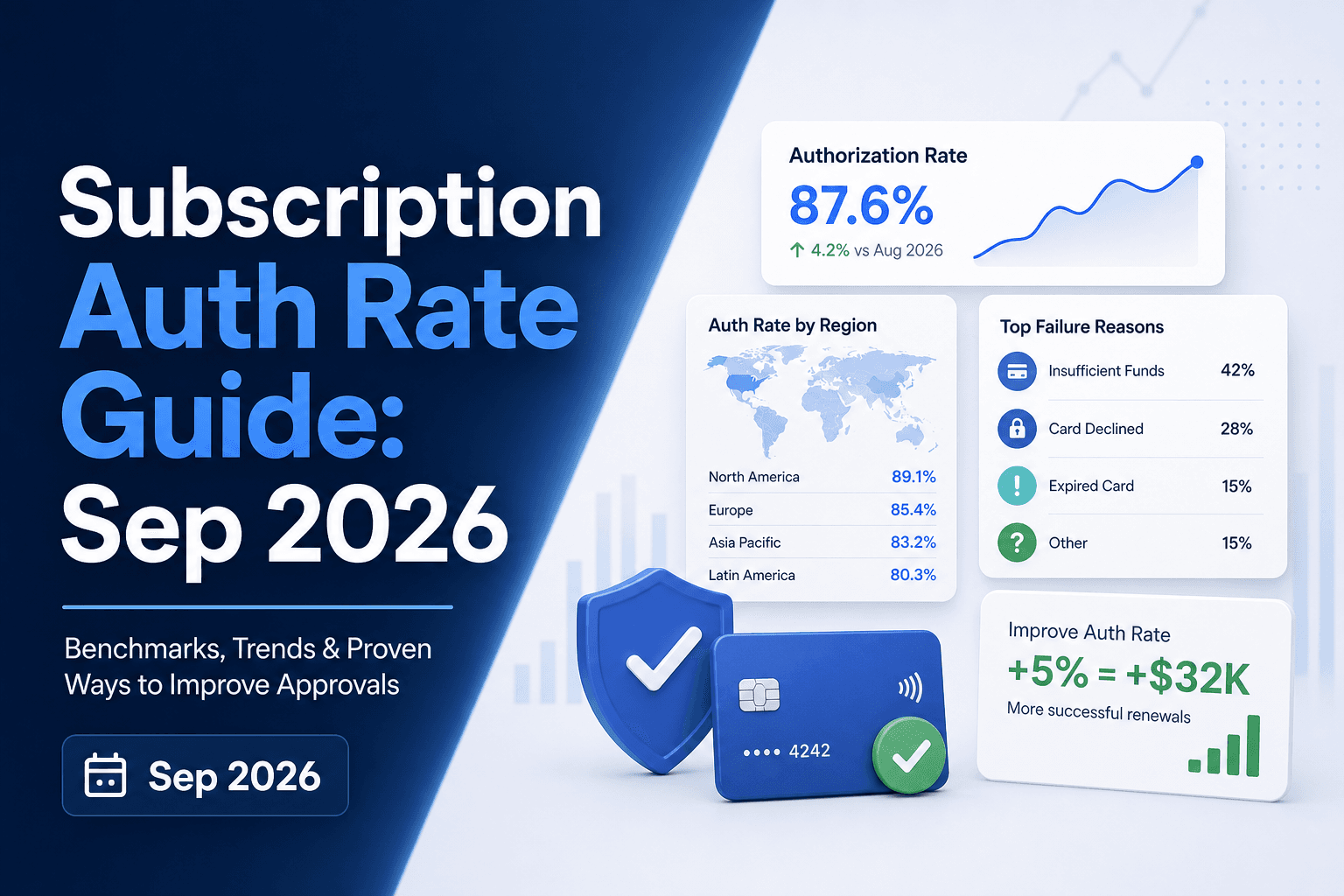
Authorization Rate in Subscription Billing: October 2026
There's a number sitting in your payments data that most finance and retention teams never report on separately: the share of renewal charges your issuing...
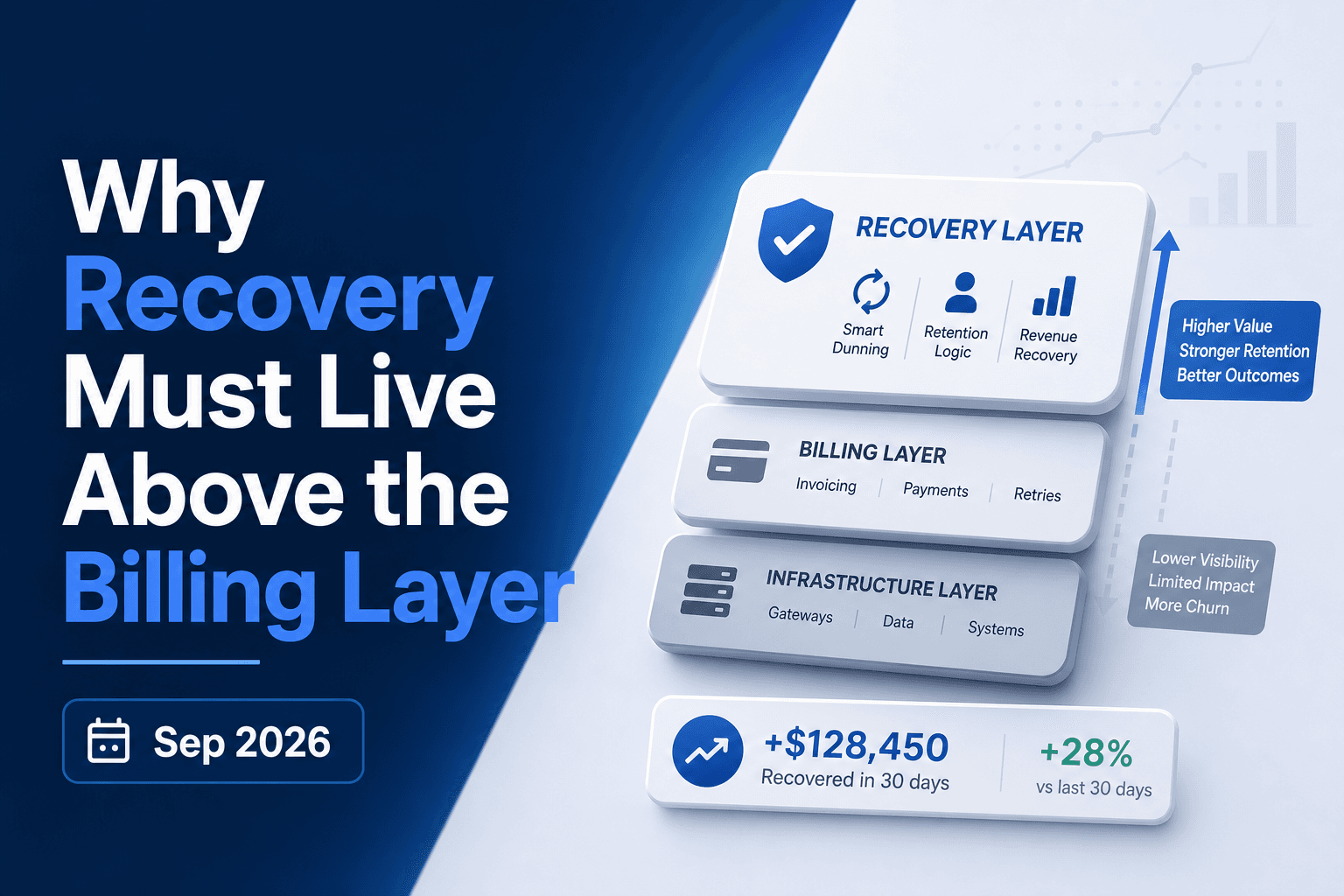
Why Payment Recovery Must Live Above Billers October 2026
A payment fails. Your biller retries it three days later, then again at seven, then at fourteen. What the biller never checks is whether the issuer sent a...
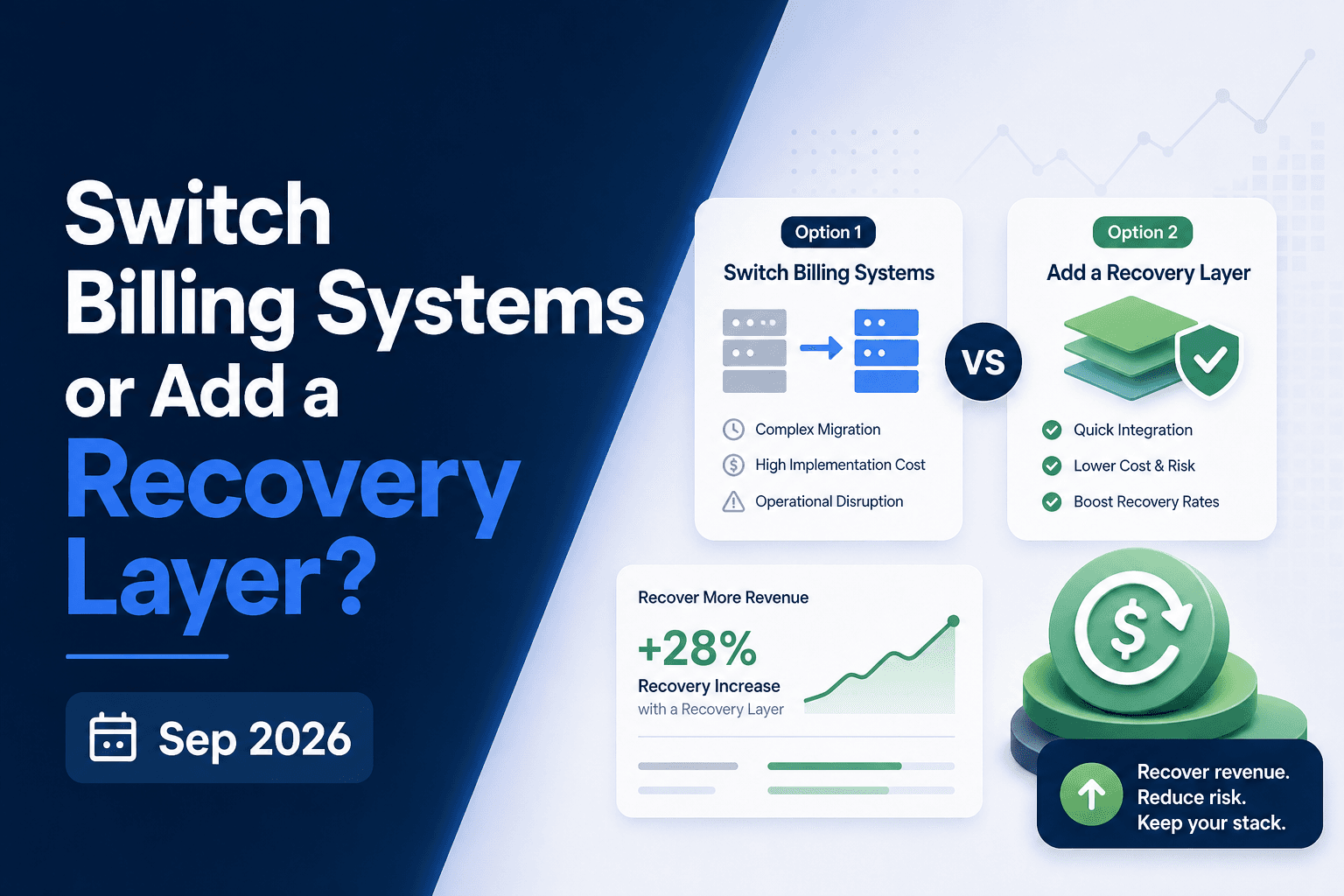
Billing Migration vs Recovery Layer: The Right Call October 2026
Switching billing systems feels like the right move when revenue collection starts breaking down. Sometimes it is. But soft declines, weak retry logic, and...
Stop losing revenue to failed payments
Join leading subscription businesses using Slicker to recover failed payments automatically.
Get Started