Stop the 9% Subscription Revenue Leak (Oct 2026)
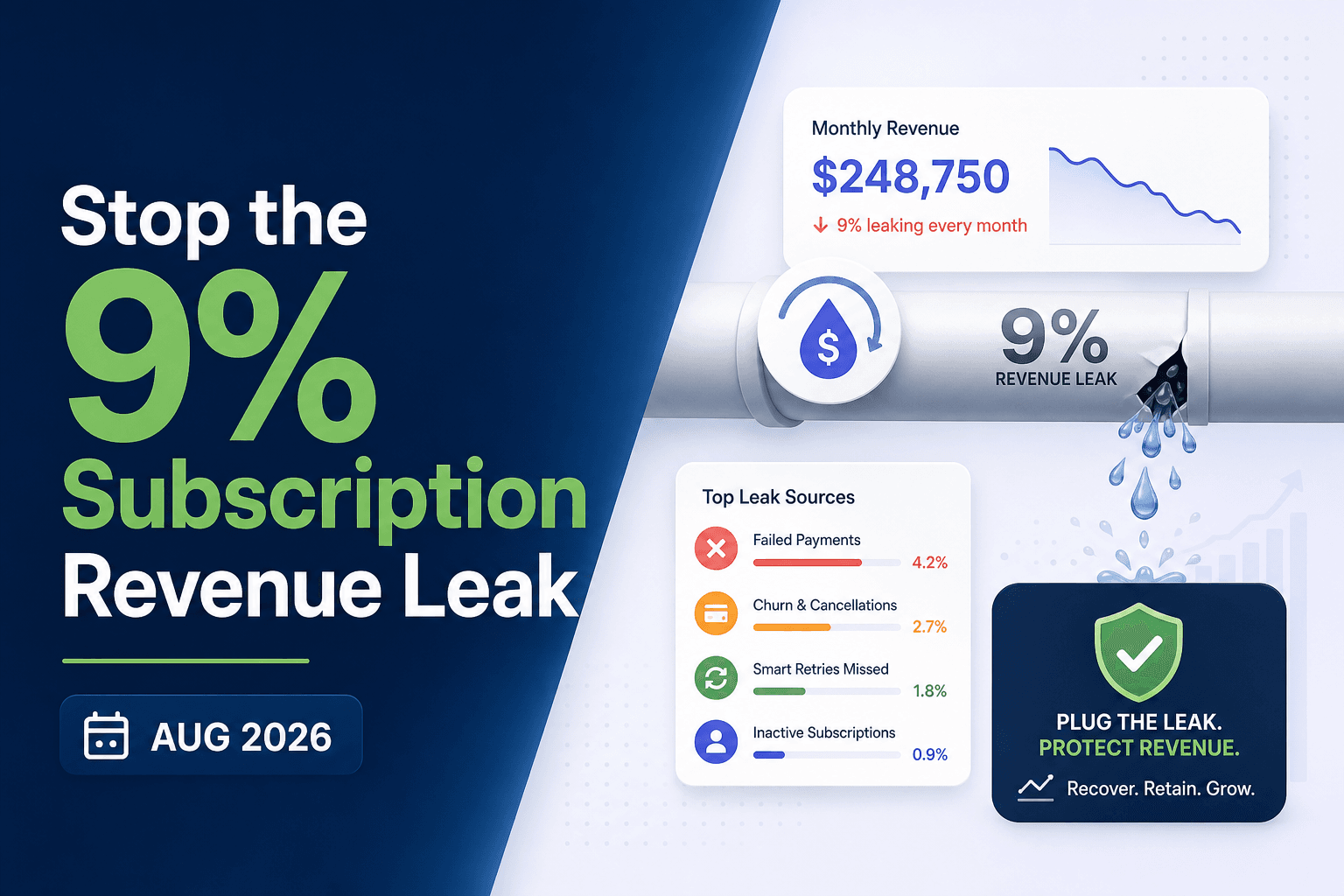
Most subscription businesses treat a failed payment the same way they treat a cancellation: log it, move on, maybe send a generic email. But a customer whose card declined is not the same as a customer who decided to leave, and conflating the two is quietly costing you around 9% of your recurring revenue every single month. The sources of that loss are more specific than you'd expect, and so are the ways to recover it.
TLDR:
- 9% of MRR (monthly recurring revenue) disappears before clearing; on $50M ARR (annual recurring revenue), that is $4.5M lost annually to billing failures.
- 20 to 40% of subscription churn is involuntary: the customer never cancelled, a payment failed and the account lapsed.
- Soft declines account for 70 to 90% of card-not-present failures and are recoverable with sound retry logic; hard declines are not.
- 73% of SaaS finance teams cannot quantify their leakage because financial statements log failed-payment lapses as ordinary churn.
- Slicker targets the failed-payment layer with an ensemble of AI models analyzing 40+ variables per transaction, with recovery verified through AABB testing on each customer's own data.
What Subscription Revenue Leakage Is (And Is Not)
Subscription revenue leakage is earned revenue that never arrives. The customer agreed to pay, the billing system issued the charge, and the money simply didn't come through. A payment failed, a billing configuration was wrong, or a process broke somewhere between invoice and settlement. That's leakage: a systems failure, not a customer decision.
This distinction matters because leakage is often conflated with two different problems. Voluntary churn is a customer choosing to cancel. Bad debt is an unpaid invoice where collection has been exhausted. Neither is leakage. Involuntary churn is its own distinct category. Leakage is the gap between what your billing system expects to collect and what actually clears, on accounts where the customer still wants the subscription.
You can't win back a customer who decided to leave. You can recover a payment that failed for a technical reason.
The Scale of the Problem: How Much Recurring Revenue Is at Risk
Nine percent of monthly recurring revenue (MRR) disappears before it ever clears. That figure, drawn from Baremetrics data across hundreds of subscription businesses, is the industry benchmark for failed-payment loss. In 2025, subscription businesses lost an estimated $129 billion to failed payments globally, according to Recurly's analysis of the $1.5 trillion subscription industry.
At the company level, the math is straightforward and uncomfortable:
ARR | 9% Annual Leakage |
|---|---|
$10M | $900,000 |
$50M | $4,500,000 |
$150M | $13,500,000 |
These aren't write-offs from customers who churned. They're billing failures on accounts that intended to renew. A subscriber lost to a failed payment's hidden cost in month three never contributes to months four through twenty-four, so the lifetime value gap widens far beyond what any single invoice shows.
Where Subscription Revenue Leaks Come From
Leakage doesn't come from a single source. Before targeting a fix, you need to know which category is driving your gap.
- Pricing and billing configuration errors account for roughly 38% of subscription revenue leakage. Discount logic applied incorrectly, wrong plan assigned at checkout, tax settings misconfigured. The billing system runs exactly as told, which is the problem.
- Pricing drift happens when negotiated contract terms, custom rates, or promotional pricing never make it into the billing system. The customer was quoted one number; the system charges another, or nothing at all.
- Unbilled usage and upgrades occur when consumption exceeds a tier or a feature is activated but the billing trigger never fires.
- Missed renewals and contract lapses let subscriptions expire quietly when auto-renewal isn't configured or a manual renewal step is skipped.
- Failed payments sit in their own category entirely, and at 9% of MRR (monthly recurring revenue), they dwarf most of the above.
The root failure behind each is different. Configuration errors are a setup problem. Pricing drift is a handoff problem between sales and finance. Unbilled usage is a product-billing integration problem. Failed payments are an infrastructure problem. Diagnosing the source correctly is the only way to avoid spending resources on the wrong lever.
Why Failed Payments Are the Dominant Payment-Side Leak
Involuntary churn benchmarks (2025) show 20 to 40% of all subscription churn is involuntary: the customer didn't cancel, a payment failed, the billing system gave up, and the account lapsed. No competitor earned that customer. The subscriber still wants the product.
That recovery potential is what separates failed payments from every other leakage category. Recover a failed payment and you retain a subscriber who never intended to leave, along with every renewal they would have generated.
Industry data shows the average transaction failure rate runs close to 8%, and failed payments rank as the top concern for 40% of subscription businesses. At that scale, this stops looking like a billing nuisance and starts looking like a recoverable revenue line.
Soft Declines vs. Hard Declines: The Recovery Divide
Not every failed payment is the same problem. Soft declines vs hard declines is a critical distinction: soft declines are temporary (insufficient funds, network timeouts, processor errors), the card is valid, the customer relationship is intact, and a well-timed retry will often clear. Soft declines account for 70 to 90% of card-not-present failures, which means the majority of your leakage is recoverable if the retry logic is sound.
Hard declines are permanent. Stolen cards, closed accounts, fraud flags: these won't resolve on retry. Under Visa and Mastercard payment retry rules, Visa caps retries at 15 attempts within 30 days and Mastercard charges fees per attempt when a merchant ignores a stop-code. Excessive retries on hard declines also damage your merchant reputation with issuers, lowering authorization rates on future first-attempt charges.
Merchant Advice Codes (MACs) are Mastercard's way of narrowing this gap. Visa does not publish a comparable MAC set. When a transaction declines, the network attaches a code instructing whether to retry, when, or to stop entirely. MAC 21 means the cardholder canceled the recurring authorization. MAC 26 means wait two days. MAC 03 means do not retry, and ignoring it triggers Mastercard's per-attempt penalty (per Mastercard developer documentation).
Classification before action is the operative principle. Retry a hard decline and face fees and reputational damage; treat a soft decline as permanent and leave recoverable revenue on the table.
Why Revenue Leakage Hides in Financial Statements
Financial statements record what happened, not why. When a subscriber lapses after a failed payment, your MRR dashboard logs a cancellation that looks identical to voluntary churn: no flag, no distinction, no recovery prompt.
Generic decline codes compound this. Roughly 39% of failed subscription payments return a vague "generic decline" label with no actionable failure reason (per Baremetrics industry data). Finance teams see a charge that didn't clear, but not whether it was retryable or permanent.
Billing undercollection is quieter still. When a payment fails but service access continues through a grace period, the revenue gap only surfaces if someone runs a reconciliation comparing invoices issued against payments settled. That reconciliation rarely happens: in one survey, 73% of SaaS finance teams reported they cannot quantify their revenue leakage.
The result is compounding invisibility. Leakage undetected in month one flows into month two. Involuntary churners never enter win-back campaigns because they were never flagged as involuntary. Forecasts miss because the denominator was wrong from the start.
How Subscriber Mix and Acquisition Quality Affect Leakage Rate
Leakage rate is a blended average that obscures wide variance across your subscriber base. Treating it as uniform leads to misallocated recovery effort.
A few factors drive most of the variance:
- Payment method mix: prepaid cards fail structurally, and consumer debit behaves differently than corporate credit. A portfolio heavy on prepaid skews your aggregate failure rate in ways that retry logic alone can't fix.
- Geographic distribution: payday cadences, local bank holidays, and regional payment rails all shift when a retry is most likely to clear.
- Acquisition channel quality: free-trial or low-intent flows attract higher proportions of unfunded or invalid cards that fail at first charge and don't recover.
High-value, long-tenure subscribers on corporate cards likely recover at rates well above your mean. First-payment failures from promotional trial channels may be structurally unrecoverable regardless of retry sophistication. Knowing which cohort is which determines where recovery investment pays off and where it doesn't.
How to Measure Your Subscription Revenue Leakage
Leakage is measurable. Most finance teams just haven't built the right reconciliation loop.
Start at the invoice level. For each billing cycle, compare expected revenue against what actually settled per subscriber. The gap between invoices issued and payments cleared is your raw leakage figure. Tracking at the subscriber level, not in aggregate, lets you separate structural failures from one-off events.
From there, a few measurement habits close the loop:
- Tag involuntary churn separately from voluntary cancellations in every churn report; measuring subscription churn rate correctly requires this split. If your billing system closes a subscription after a failed payment, that account needs its own flag. Without the split, win-back campaigns miss recoverable accounts and your churn rate overstates the customer satisfaction problem.
- Track initial failure rate and final failure rate as distinct metrics. Initial is what declined on first attempt; final is what remained unpaid after your full retry and grace period. The gap between the two is your recovered revenue, and it tells you exactly how much your retry logic is doing.
- Give recovery rate its own metric line, separate from churn. What share of failed payments actually cleared? Tracked monthly, this surfaces retry performance trends before they compound into a visible revenue problem.
Audit billing configurations quarterly at minimum, covering expired promotional pricing, plan changes that never updated the billing record, and usage-triggered upgrades that never fired a charge. Quarterly is structurally slow though: leakage compounds each cycle between audits. Continuous reconciliation against live billing and payment data is the standard worth working toward.
Strategies to Recover and Prevent Subscription Revenue Loss
Recovery effort should follow impact. These six levers, ranked by impact:
- Intelligent retry logic: classify failures before scheduling attempts. Soft declines get retried; hard declines don't. Timing aligned to subscriber pay cycles recovers materially more than calendar-based schedules firing on arbitrary days, as detailed in the Code 51 insufficient funds recovery playbook.
- Account updater services: Visa Account Updater and Mastercard Automatic Billing Updater (ABU) refresh expired or replaced card credentials automatically, before a charge attempt fails. This is the highest-ROI passive lever for card-heavy subscriber bases.
- Failure-reason dunning cadence: trigger outreach only when customer action is required. A stolen card needs a fraud-alert message; an expired card needs a card-update request. Generic "update your payment method" emails sent to every failed charge waste sends and erode trust.
- Pre-billing notifications: sent 3 to 7 days before renewal for subscribers with known expiry risk, these prevent failures before they happen instead of recovering after the fact.
- Multi-payment method orchestration: when the primary card fails, route to alternate instruments on file instead of exhausting retry attempts on a card that won't clear. A full subscription payment retry strategy covers how to sequence each of these levers.
- Billing configuration audits: pricing drift, unbilled upgrades, and misconfigured discount logic don't respond to retry logic. Close those gaps through quarterly reconciliation of contract terms against billing records.
Grace period length deserves its own consideration. Production data shows roughly 13% of failed invoices recover in days 14 to 21 of dunning, with negligible recovery after day 21. For digital subscriptions with no cost to maintain during a grace period, a 21-day window is defensible. For physical goods or device-based subscriptions where each dunning day carries fulfilment or hardware cost, a shorter window often wins on margin.
How Slicker Recovers the Failed-Payment Layer of Subscription Revenue Leakage
Slicker is built for this layer of the problem: failed payments on subscription businesses running Stripe Billing, Chargebee, Recurly, Zuora, or Recharge.
The core engine is an ensemble of AI models that analyzes over 40 variables per transaction: card type, issuing bank and BIN data, geographic region, local payday cadence, time of day, and transaction amount. It uses those signals to answer three questions before acting: whether to retry, when to retry, and which payment method to route to. Smart retry systems consistently recover 70 to 85% of soft declines; fixed retry schedules typically land between 40 to 60%. Slicker's recovery rate on recoverable soft declines is verified through AABB testing against each customer's own transaction data, with statistical significance required before any commitment is made.
A planned Mastercard network-data partnership (in development) would extend this further. When a previously declined card is successfully used elsewhere on the Mastercard network, Slicker would receive a real-time alert and trigger an immediate retry, replacing estimated payday-pattern timing with confirmed fund-availability intelligence.
Setup requires no engineering lift and takes under 5 minutes. Pricing runs 3 to 8% of recovered revenue, so cost only arises when revenue that would otherwise have been lost is actually recovered.
Final Thoughts on Subscription Revenue Leakage and How to Stop It
Revenue disappearing before it clears is a billing and infrastructure problem, not a customer satisfaction one, and that distinction changes what you do about it. The fix starts with measurement: invoice-level reconciliation, separate tags for involuntary churn, and initial versus final failure rates tracked as distinct metrics. From there, retry logic, account updater services, and configuration audits each close a different part of the gap. Connect with the Slicker team to see how much of your leakage falls into the recoverable category.
FAQs
What percentage of monthly recurring revenue do failed payments typically consume for SaaS subscription businesses?
Industry data consistently puts failed-payment loss at around 9% of MRR, making it the single largest payment-side leak for subscription businesses. At $50M ARR, that translates to roughly $4.5M in billing failures annually, on accounts where customers still intend to stay subscribed.
How do merchant advice codes affect whether and when to retry a failed subscription payment?
Merchant Advice Codes (MACs) tell you the card network's recommended action after a decline: MAC 26 means wait two days, MAC 03 means stop entirely, and Mastercard charges $0.10 per retry attempt when you ignore a stop-code. The complication is that MACs should be treated as one input, not an absolute instruction: a MAC prescribing a 10-day wait on a subscription with a 5-day dunning window left means following the code blindly costs you the recovery window entirely.
What's the best AI payment recovery tool for SaaS CFOs trying to recover lost recurring revenue in 2026?
The right answer depends on your billing stack and transaction volume, but the evaluation criteria should be: does the vendor prove lift on your own data before you commit, or do they ask you to trust a benchmark? Slicker runs AABB testing with statistical significance against your actual transaction data, recovering 70 to 85% of soft declines through AI models analyzing over 40 variables per transaction, and charges 3 to 8% of revenue recovered only after the test confirms outperformance.
Does recovery rate vary by acquisition channel, and how does customer quality affect involuntary churn?
Yes, materially. Subscribers acquired through free-trial or low-intent flows carry higher proportions of prepaid or unfunded cards that fail at first charge and rarely recover regardless of retry sophistication. Long-tenure subscribers on corporate cards typically recover well above your blended average. Treating your aggregate failure rate as uniform leads to spending recovery budget on structurally unrecoverable cohorts while under-investing where the returns are highest.
How do failed payment recovery tools like Slicker handle physical goods subscriptions differently from digital ones?
The core difference is margin exposure during the dunning window. A digital subscription costs nothing to maintain while a failed payment retries over 21 days; a physical goods or device rental subscription accumulates fulfilment or hardware costs for every day the grace period extends. Production data shows negligible recovery after day 21, so extending a dunning window beyond three weeks rarely pays off for digital subscriptions, and almost never does for physical goods where each additional dunning day carries a real cost. Slicker supports configurable grace periods and retry cutoff dates to align recovery windows with your actual margin structure.
Related Articles
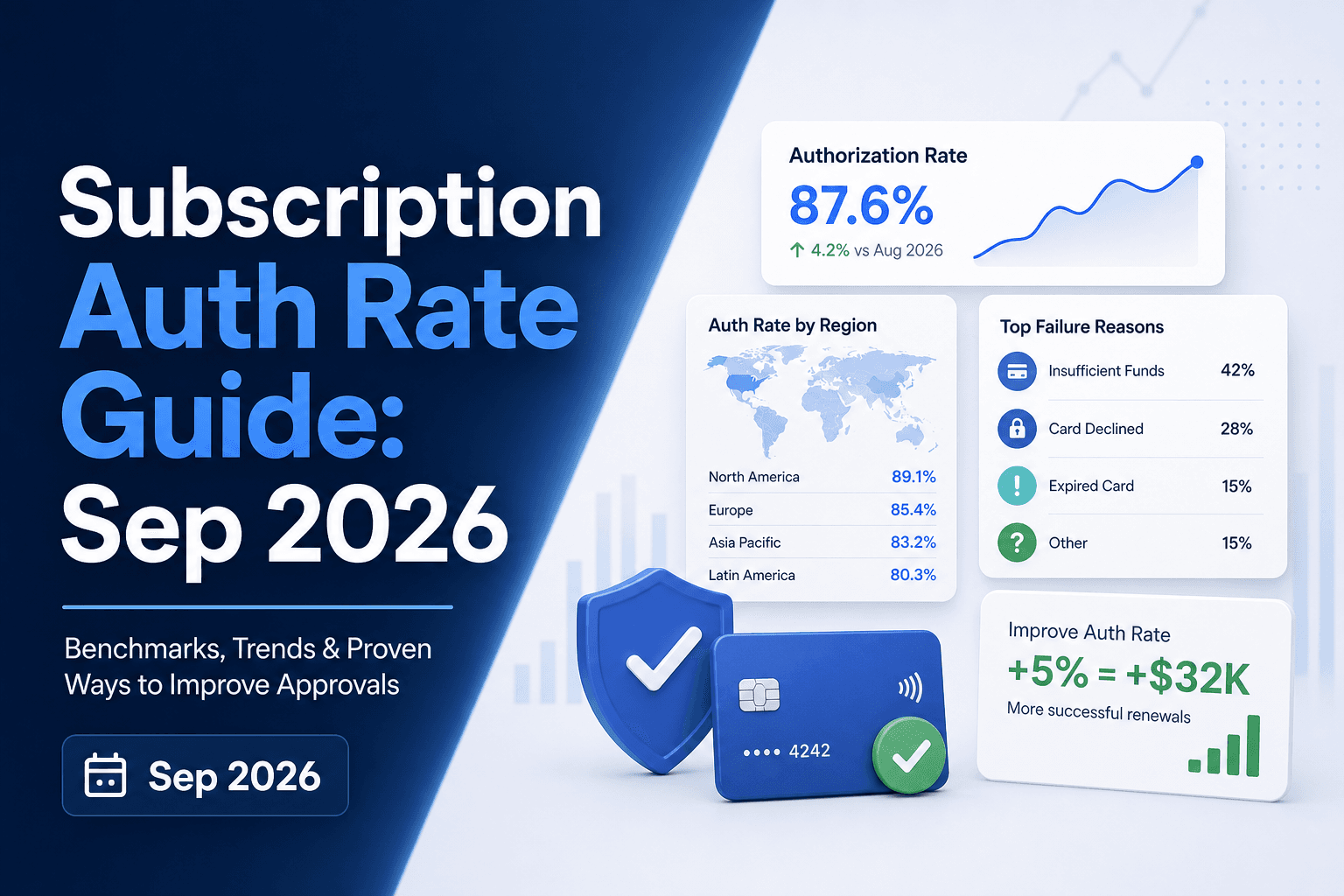
Authorization Rate in Subscription Billing: October 2026
There's a number sitting in your payments data that most finance and retention teams never report on separately: the share of renewal charges your issuing...
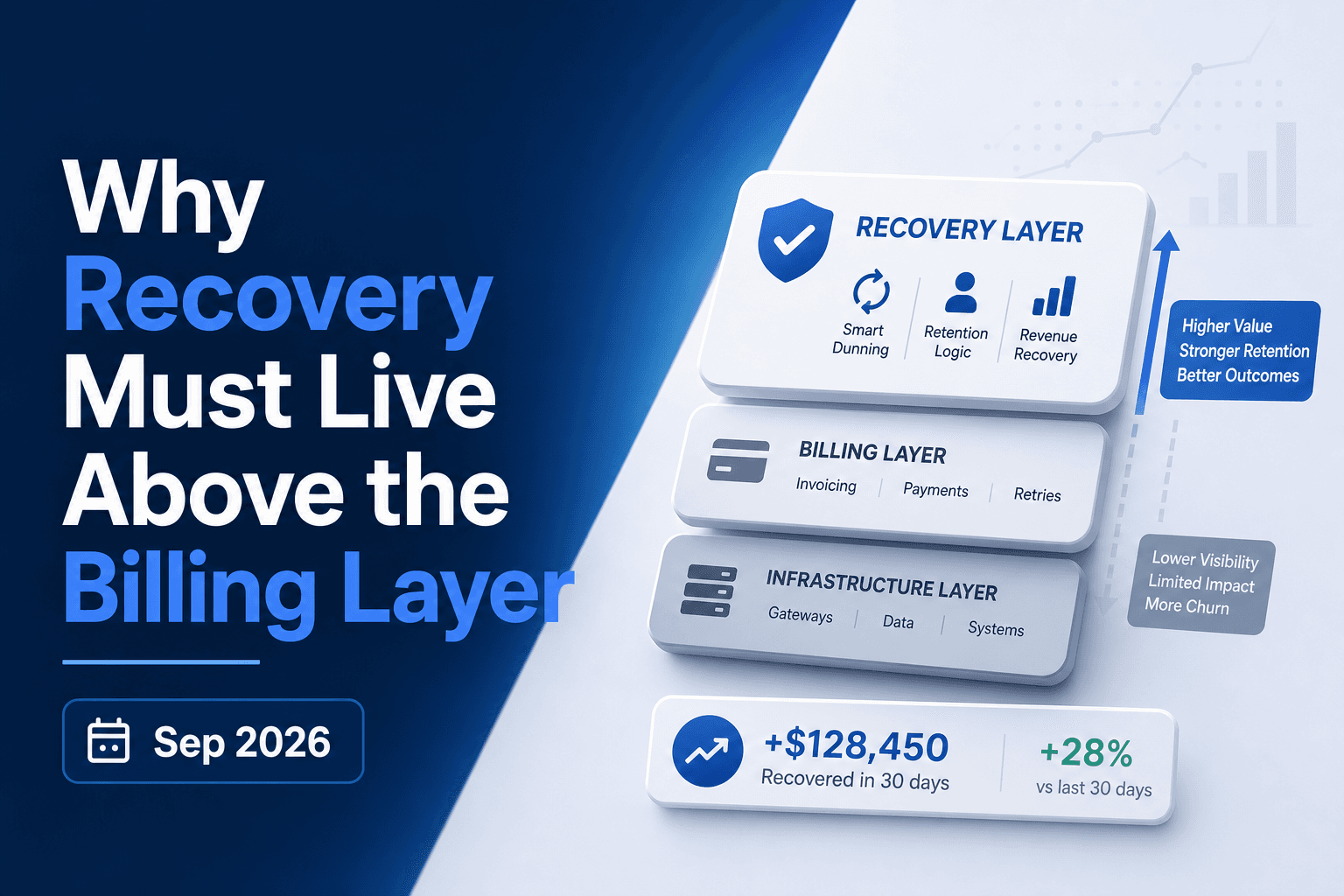
Why Payment Recovery Must Live Above Billers October 2026
A payment fails. Your biller retries it three days later, then again at seven, then at fourteen. What the biller never checks is whether the issuer sent a...
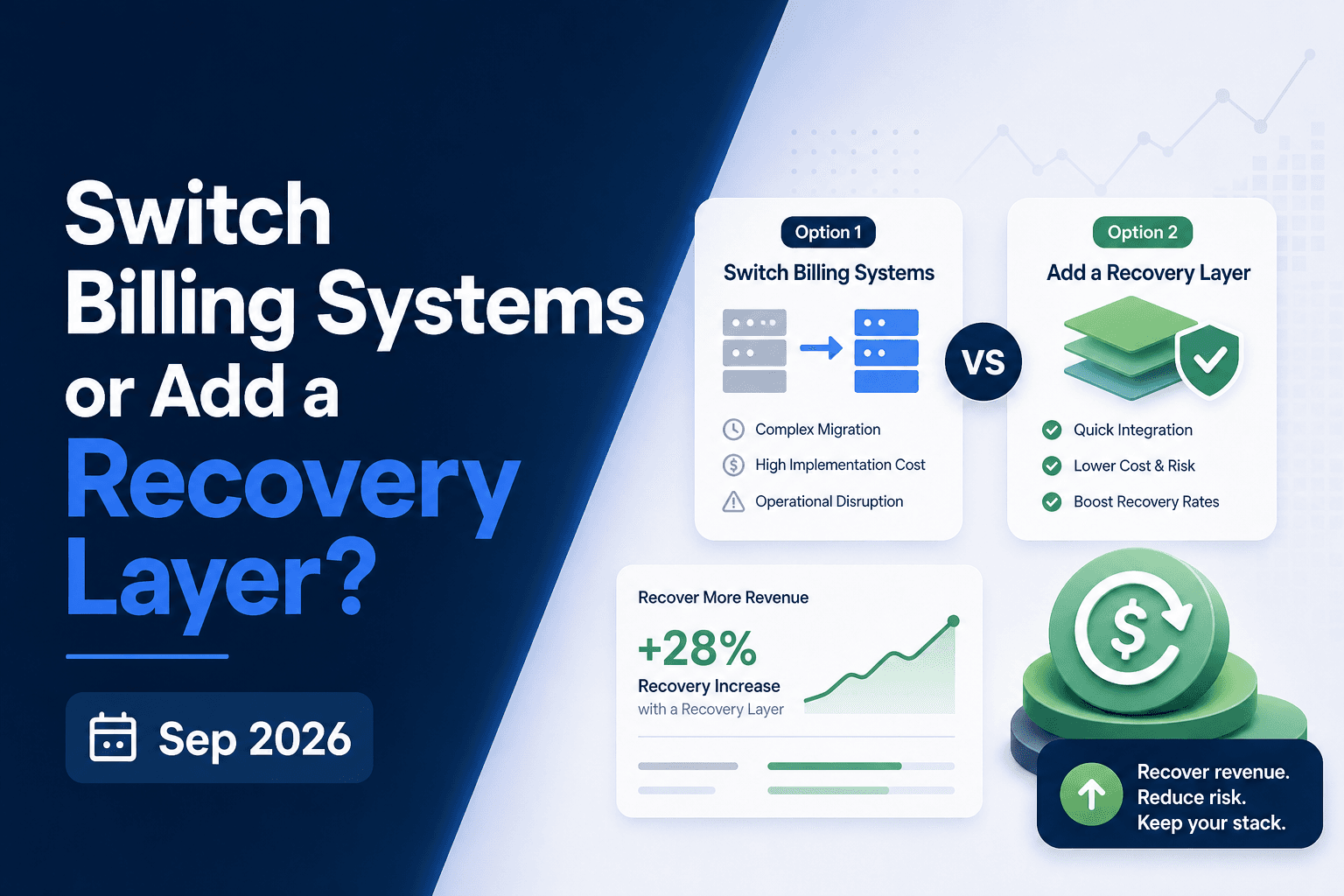
Billing Migration vs Recovery Layer: The Right Call October 2026
Switching billing systems feels like the right move when revenue collection starts breaking down. Sometimes it is. But soft declines, weak retry logic, and...
Stop losing revenue to failed payments
Join leading subscription businesses using Slicker to recover failed payments automatically.
Get Started