Annual Subscription Renewals That Fail: How to Recover High-Value Renewal Payments
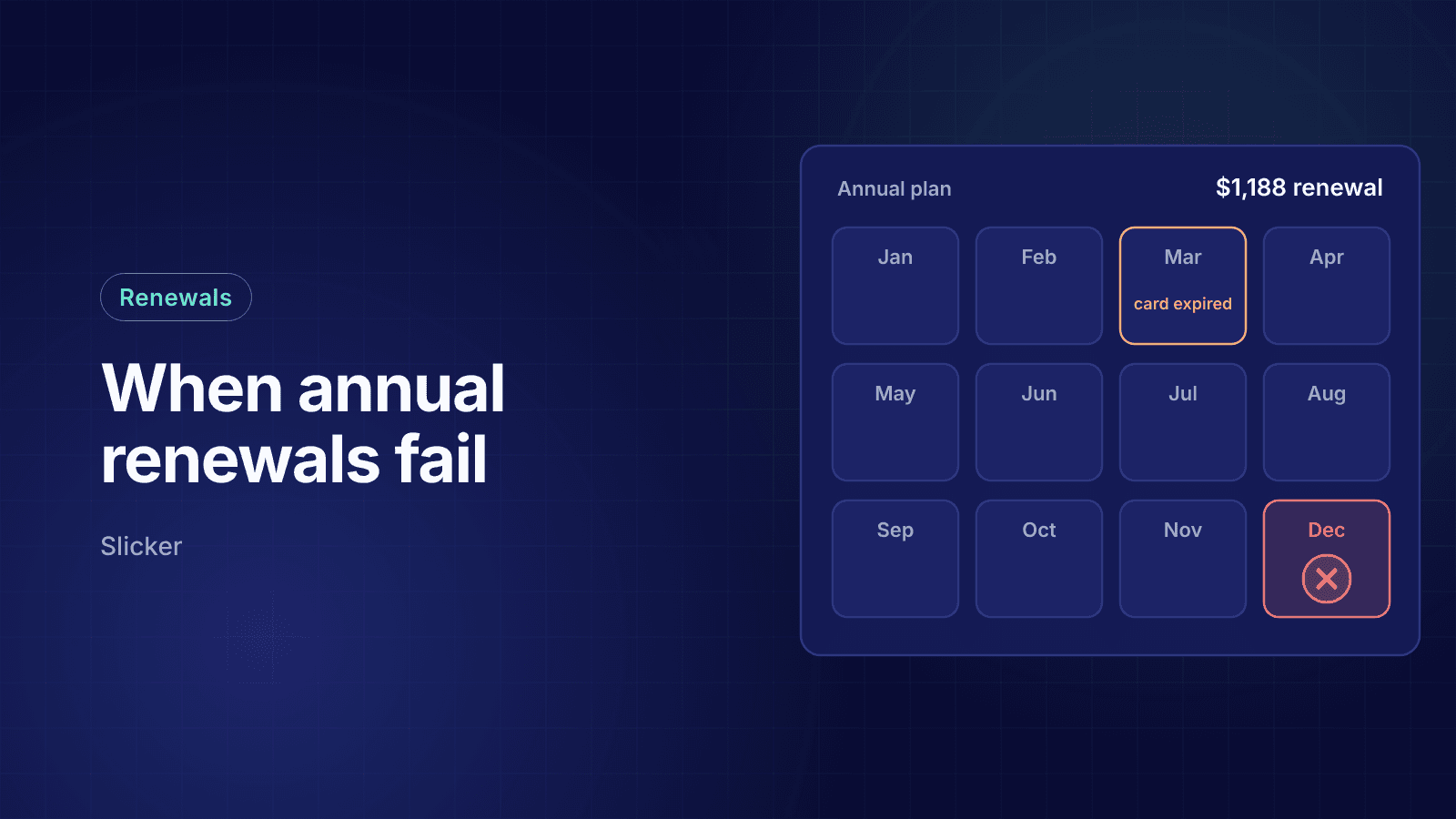
Twelve months ago a customer paid $1,188 for your annual plan without a second thought. This morning the renewal failed. The card on file expired in March, the replacement was never added, and the email that would have warned them went to an address nobody at the company reads anymore.
Annual renewals are the highest-value charges most subscription businesses process, and they are also the ones most likely to hit a problem. A monthly charge gets eleven chances a year to surface a stale card or a changed limit. An annual charge gets one, after a year in which almost anything about the card, the customer or their budget may have changed.
This guide explains why annual subscription renewals fail, what to do in the weeks before the charge, and how to retry and message a failed annual renewal so you recover the year of revenue instead of writing it off.
TLDR:
- Annual renewals fail for reasons a monthly charge catches early: expired or reissued cards, larger amounts that hit limits, and customers who forgot they renew.
- One lost annual renewal costs a full year of revenue at once, so it deserves a pre-renewal process, not just a retry schedule.
- Start 30-60 days out: refresh card data, warn about expiring cards, send the renewal reminder, and confirm any price change in advance.
- After a failure, time retries around paydays and card limit resets, reach the person who owns the budget, and offer a monthly or quarterly fallback.
- Slicker reads the decline code, card type and amount behind each failed renewal and combines smart retries with hyper-personalized emails from your domain.
Why Annual Renewals Fail More Often Than Monthly Charges
A monthly subscription is tested every 30 days. When a card expires or gets replaced, the next monthly charge fails, the customer updates it, and the problem is fixed within weeks. An annual plan skips all of that. The first time you learn the card is stale is the day you need it most.
Four things change over a year:
- The card itself. Cards expire, and many are reissued early after fraud, data breaches or product changes. In a 2017 Auriemma survey reported by American Banker, nearly half of US cardholders had at least one card reissued in the previous year.
- The amount relative to the limit. An annual charge is roughly ten to twelve times a monthly one. A card that comfortably covers $99 may not have $1,188 of available credit on renewal day.
- The issuer's view of the charge. A large charge from a merchant the card has not seen in a year looks less routine to a fraud model than a familiar monthly payment.
- The customer. The person who bought the plan may have left the company, changed roles or simply forgotten that it renews.
What a Failed Annual Renewal Really Costs
A failed monthly charge puts one month at risk. A failed annual renewal puts the next twelve at risk in a single transaction, and if it is not recovered, the customer is gone until a salesperson wins them back.
Annual customers are also usually your most committed ones. They chose to prepay, often at a discount, and many are on higher price tiers. Recurly's churn benchmarks show involuntary churn falling sharply as average revenue per customer rises, from 1.30% a month in the $10-25 tier to 0.18% above $250 (July 2026 data). Higher-value customers churn involuntarily less often, but each one that does is far more expensive, which is exactly the profile of an annual renewal.
That changes the recovery math. Spending more effort per failed payment, including a personal email or a call for the largest accounts, is worth it on a $12,000 renewal in a way it never is on a $12 one.
The Pre-Renewal Checklist: 60 Days to Renewal Day
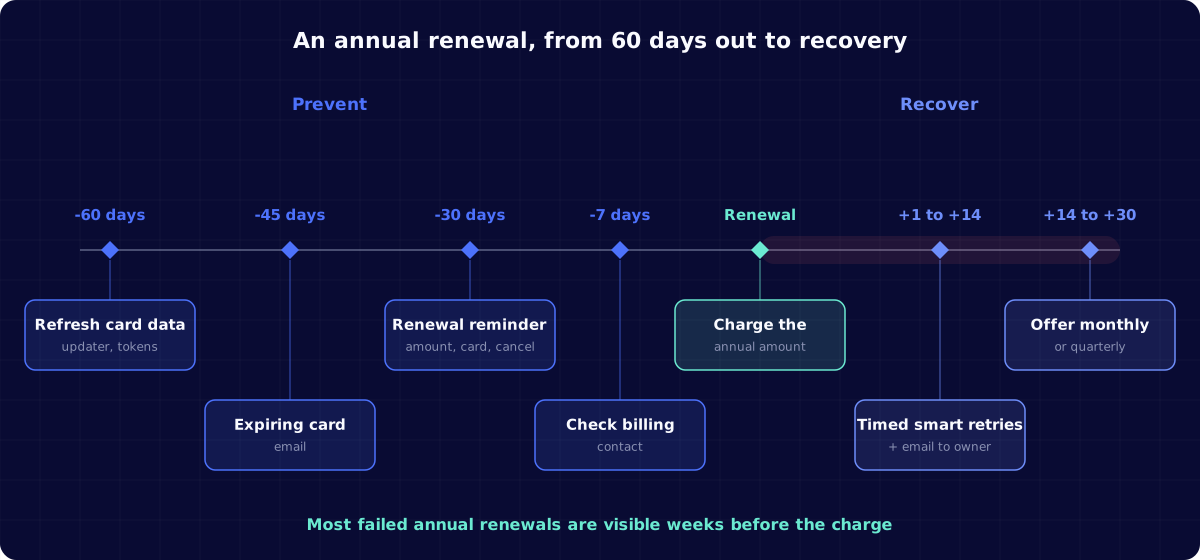
Most failed annual renewals can be prevented, because the causes are visible in advance. A simple schedule covers them:
| When | Action | What it prevents |
|---|---|---|
| 60 days before | Run a card account updater or confirm network tokens are current | Expired and reissued cards |
| 30-45 days before | Email customers whose card expires before the renewal date | Expired card declines |
| 30 days before | Send the renewal reminder with amount, date and how to cancel | Forgotten renewals, disputes |
| 7-30 days before | Confirm any price change in writing | Surprise charges, disputes |
| 7 days before | Check the billing contact is still valid for business accounts | Messages lost after staff turnover |
| Renewal day | Charge, and start recovery within hours if it fails | Lost days of the recovery window |
Card data refresh comes first because it fixes the most failures with no customer effort. Account updaters and network tokens update many expired and reissued cards automatically, though coverage varies by issuer and country. The comparison of card account updaters and predictive retries explains where each one helps. For the cards updaters miss, an expiring card email a month or more before renewal gives the customer time to act. Stripe's customer emails, for example, can send an expiring card notice one month before the card on file expires and a renewal reminder a configurable number of days before renewal.
The role of card expiration in churn is easy to underestimate on annual plans, because an expiry that happened in month three stays invisible until month twelve.
Renewal Reminders Prevent Failures and Are Sometimes Required
Renewal reminders also protect the charge. A customer who knows the renewal is coming is less likely to block it, dispute it or let it fail on a card they meant to replace.
In some places they are required. California's amended Automatic Renewal Law, which took effect on July 1, 2025, requires an annual reminder for subscriptions that renew automatically, describing the product, the charges and how to cancel, and requires notice of a price change 7 to 30 days before it takes effect, according to Fenwick's summary of the amendments. Rules differ by state and country, so check what applies to your customers with your own counsel.
A good reminder does more than meet the rule. It should state the exact amount and date, show which card will be charged (the last four digits and expiry), and link straight to the page where the customer can update it. That one line about the card is what turns the reminder into a failed-payment prevention tool.
Why Annual Renewals Are Declined: Reading the Decline Codes
When an annual renewal does fail, the decline code tells you what kind of problem you have, but the amount and the gap since the last charge change how to read it.
| Decline | What it usually means on an annual renewal | First move |
|---|---|---|
| Expired card | The card expired during the year and was never updated | Ask for a new card; updaters may already have it |
| Insufficient funds | The full annual amount exceeds the available balance or credit | Retry after paydays or limit resets; offer a smaller billing interval |
| Do not honor | Often an issuer risk check on a large, unfamiliar charge | One retry after the customer confirms; do not hammer it |
| Authentication required | The issuer wants the cardholder to authenticate, common in Europe | Send an authentication link; retries alone fail |
| Lost, stolen or closed account | The card will never work again | No retries; request a new payment method |
Insufficient funds deserves extra attention, because on annual plans it often means the customer can afford your product but not twelve months of it on one day. The guide to code 51 retry timing covers how timing changes recovery, and insufficient funds recovery shows how card type changes the right schedule. Authentication requests follow the rules covered in authentication required declines on renewals.
How to Retry a Failed Annual Renewal
Annual renewals justify a longer, more deliberate recovery window than monthly charges, because the stakes are higher and there is no next cycle coming in 30 days to try again.
- Retry when the money is likely to be there. Consumer cards recover best after common paydays. Corporate cards recover best after their monthly limit resets, usually at the start of a month or statement cycle.
- Space attempts instead of stacking them. A handful of well-timed attempts across two to four weeks beats daily retries, which add declines to the card's history and can run into network limits on repeated attempts.
- Stop retrying hard declines. A closed account or stolen card will not recover with time. Every attempt adds cost and risk without any chance of success.
- Use what you know about the card. The BIN tells you whether it is debit, credit, prepaid or commercial, which changes the timing. The guide to identifying a card from its number explains what the BIN reveals.
Offer a Smaller Billing Interval Instead of Losing the Customer
When an annual renewal fails for insufficient funds, the customer may still want the product but cannot pay a year upfront today. Retrying the full amount for a month and then cancelling loses a customer you could have kept.
Offer a way down instead:
- Switch to monthly or quarterly billing at the corresponding price, starting immediately.
- Split the annual amount into two or three charges where your billing platform supports it.
- Move business customers to invoicing with payment terms, so the charge goes through their accounts payable process rather than a card limit.
The offer belongs in the second or third recovery email, after a retry has failed for funds, not in the first message. Leading with a downgrade trains customers to wait for it.
Messaging a Failed Annual Renewal
A generic "your payment failed" email undersells what is at stake for both sides. The message for a failed annual renewal should make the situation concrete and easy to fix:
- Say what failed: the plan, the annual amount and the card, by its last four digits.
- Say what happens next: when access changes and when you will try again.
- Give one clear action: a link to update the card or approve the charge, with no login required where possible.
- Name the alternative when the decline points to funds: a monthly or quarterly option.
For business accounts, send it to the billing contact and the main user, because the person who uses your product every day rarely controls the card. For your largest renewals, add a personal email from the account owner. Hyper-personalized dunning emails adapt this content to the decline reason automatically, and a multi-channel pre-dunning workflow covers the steps before the charge.
Grace Periods and Access for Annual Customers
Cutting access the day an annual renewal fails is rarely the right call. These customers have just paid for a full year, often at a discount, and most failures are card problems rather than a decision to leave.
A longer grace period for annual plans, typically two to four weeks with clear in-product notices, gives retries and emails time to work. During that window, tell the customer exactly when access will change. If the renewal is still unpaid at the end, move the account to a limited or read-only state before deleting anything, so returning is easy when they fix the card.
Track recovery separately for annual and monthly plans. Blended recovery rates hide annual renewals inside a much larger volume of small monthly charges, and annual recovery is often where most of the dollars are.
How Slicker Recovers Failed Annual Renewals
Slicker sits on top of your existing billing platform and treats each failed renewal according to what actually caused it. Its smart retries combine the decline code with the card's type, issuer and country and the size of the charge, so a consumer debit card is retried around pay cycles, a corporate card around its spending limit reset, and a closed card not at all.
Slicker's hyper-personalized emails go out from your own domain only when the customer has to act, such as adding a new card or authenticating a payment, and they carry the specific amount, card and next step. For SaaS businesses with annual and enterprise plans, that is the difference between a renewal that quietly lapses and one that is recovered. Every change is measured with AABB testing against your current setup, so you see the recovered revenue before you pay.
Final Thoughts on Annual Subscription Renewals That Fail
Annual renewals concentrate a year of revenue into a single charge on a card you have not touched for twelve months. Most failures are predictable: an expired card, a limit that cannot cover the full amount, or a customer who forgot. A pre-renewal process catches most of them, and a recovery process built for high-value charges catches much of the rest.
If annual renewals are a large share of your revenue and you are still recovering them with the same schedule as a $10 monthly plan, talk to the Slicker team about recovering more of them.
FAQ
Why did my customer's annual subscription renewal fail when their monthly plan never did?
A year passed since the card was last charged, so expiries, reissues and limit changes all show up at once. The annual amount is also much larger, which can exceed the card's available balance or trigger the issuer's fraud checks. A monthly plan would have caught these problems one at a time, with much smaller charges.
How far in advance should I remind customers about an annual renewal?
Most businesses send the renewal reminder about 30 days before the charge, with the amount, the date, the card on file and how to cancel. Send expiring card notices earlier, 30-45 days or more before renewal, so customers have time to update the card. Check local rules too: California's Automatic Renewal Law requires an annual reminder and advance notice of price changes.
How many times should I retry a failed annual subscription payment?
Fewer, better-timed attempts work better than daily retries. A handful of attempts over two to four weeks, timed around paydays for consumer cards and limit resets for corporate cards, recovers more without damaging the card's history. Hard declines such as a closed account or stolen card should not be retried at all.
Should I offer monthly billing when an annual renewal fails?
Yes, when the decline points to insufficient funds. Offering monthly or quarterly billing after a retry has failed keeps customers who can afford the product but not a full year upfront. Make the offer after the first recovery attempt rather than in the first email, so it does not become the default.
Can Slicker recover failed annual renewals on Stripe Billing, Chargebee or Recurly?
Yes. Slicker connects to billing platforms including Stripe Billing, Chargebee, Recurly and Zuora and recovers failed renewals with smart retries and hyper-personalized emails from your own domain. Its impact is measured with AABB testing against your current setup.
Related Articles
What Card Is This? How to Identify and Validate a Card From Its Number
A customer emails support with a card number that "keeps getting rejected." Your checkout says the card is invalid, the customer insists it works everywhere...
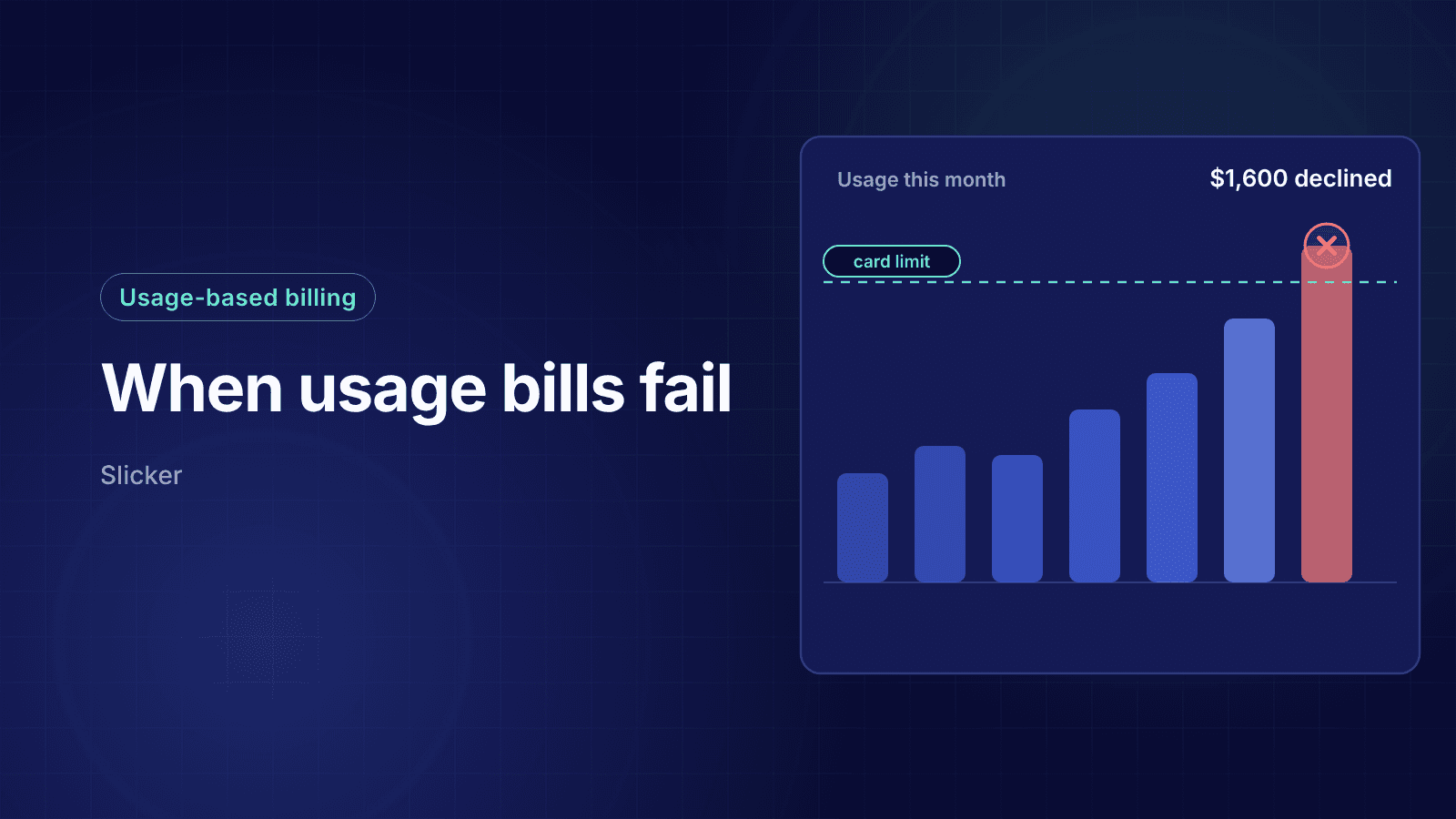
Failed Payments in Usage-Based and AI Billing: Why They Happen and How to Recover Them
Your best customer had a big month. Their team shipped an agent, usage tripled, and the invoice came out at four times the usual amount. The card that paid...
Why Are My Payments Failing Suddenly? A Diagnosis Checklist for Failed Payment Spikes
Your failed payment count doubled overnight. Finance is asking whether revenue is at risk, support is seeing "my card was declined" tickets, and the payments...
Stop losing revenue to failed payments
Join leading subscription businesses using Slicker to recover failed payments automatically.
Get Started