Why Are My Payments Failing Suddenly? A Diagnosis Checklist for Failed Payment Spikes
Your failed payment count doubled overnight. Finance is asking whether revenue is at risk, support is seeing "my card was declined" tickets, and the payments dashboard shows a red line without saying why. The instinct is to retry everything and hope. That is usually the wrong first move.
A sudden spike in failed payments almost always has one dominant cause, and finding it quickly decides how much revenue you lose. This checklist walks through the order to investigate, from outages you cannot control to a release you shipped yesterday, with the signals that point to each cause and what to do once you find it.
TLDR:
- First confirm the spike is real: count unique failed payments, not failed attempts, so a retry loop does not masquerade as a decline wave.
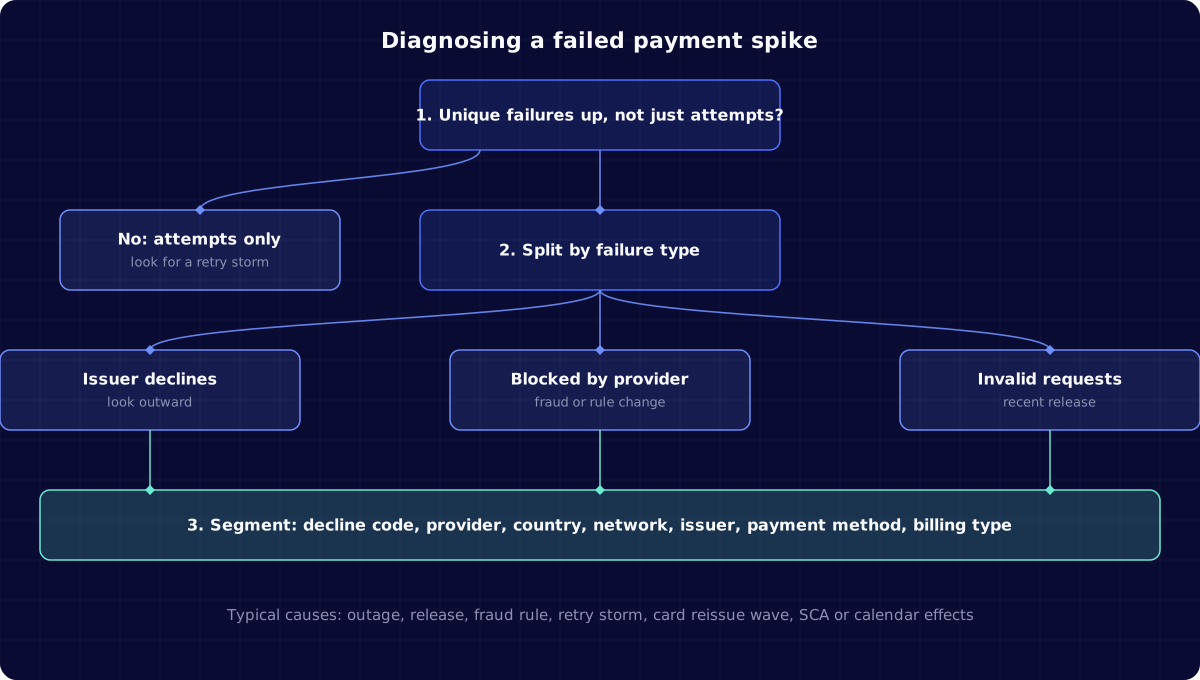
- Then split failures into issuer declines, payments your own provider blocked, and invalid requests; each points to a different owner.
- Segment by decline code, payment provider, country, card network, issuer and payment method; a real spike almost always concentrates in one slice.
- Common causes are provider or issuer outages, integration releases, fraud rule changes, retry storms, card reissue waves and SCA changes in Europe.
- Slicker Analytics compares each segment with its own baseline and flags outages and approval drops automatically, so you find the slice before the spike becomes churn.
Step 1: Confirm the Spike Is Real
Before investigating causes, check that the number you are looking at measures what you think it measures. Stripe's guidance on declines recommends analyzing unique declines and excluding failed retries when you look at authorization rates. A retry engine that suddenly retries every past-due invoice three times can triple your failed attempts while the number of customers with a problem stays flat.
Ask three questions:
- Did the number of unique failed invoices or customers rise, or only attempts?
- Did total payment volume change? A big billing day, such as the first of the month, raises failures in absolute terms.
- Did the rate of failure rise, measured as failed unique payments over all unique payments in the same window?
If only attempts rose, jump to the retry storm section. If the rate is flat but volume rose, you may not have a spike at all.
Step 2: Split Issuer Declines From Blocked Payments and Invalid Requests
Stripe groups payment failures into three types: issuer declines, payments Stripe blocked before sending them to the network, and invalid API calls. Most providers have an equivalent split, and it tells you immediately who owns the problem.
| Failure type | What it means | Who usually owns the fix |
|---|---|---|
| Issuer decline | The bank or network said no | Issuers, networks, your retry and messaging strategy |
| Blocked by provider | Your provider's fraud or optimization rules stopped it before authorization | You, in your fraud or rules settings |
| Invalid request | The request was malformed or missing data | Your engineering team |
A spike in blocked payments usually means a rule change, a new fraud model, or a change in traffic that rules now catch. A spike in invalid requests almost always means a release. Only a spike in issuer declines sends you looking outward.
Step 3: Segment Failures Until One Slice Stands Out
Real spikes concentrate. A provider outage shows up on one gateway. An issuer problem shows up on one bank's BIN ranges. A release bug shows up on one platform or one plan. Cut your failures along these dimensions, in roughly this order:
- Decline code. Did one code jump, such as
do_not_honor,authentication_requiredorprocessing_error? - Payment provider or gateway. Is the rise on one processor, merchant account or region?
- Country and currency. Is it one market?
- Card network and card type. Visa vs Mastercard, debit vs credit, consumer vs corporate.
- Issuer and BIN range. Is one bank responsible? Slicker's BIN lookup tool helps identify issuers from the first digits.
- Payment method. Cards vs PayPal vs wallets vs direct debit.
- Billing type. First payments vs renewals, monthly vs annual.
Cause 1: A Payment Provider or Issuer Outage
Outages produce the sharpest spikes: a near-vertical rise, often in processing_error, issuer_not_available or timeout responses, concentrated on one provider or one issuer. Check your providers' status pages and your own logs for elevated error rates and latency.
What to do: stop retrying into the outage, queue affected payments, and retry once the provider or issuer recovers. These failures are highly recoverable, because nothing is wrong with the customer's card. The gateway outage recovery guide explains how to clear the backlog afterwards without tripping network limits.
Cause 2: A Release or Integration Change
If failures started within hours of a deploy, suspect the deploy. Releases cause spikes in a few typical ways:
- Missing or wrong fields. A dropped billing address, CVC handling change or currency mismatch raises invalid requests or specific decline codes such as incorrect address or postal code.
- Lost merchant-initiated flags. If renewals stop being sent as off-session or merchant-initiated transactions, issuers in Europe start asking for authentication, and
authentication_requiredclimbs. The post on authentication required declines covers this failure mode. - Wrong payment method on retry. A change to which saved method gets charged can send renewals to old or expired cards.
What to do: compare failure rates before and after the deploy for the affected segment, roll back if the correlation is clear, and re-attempt affected payments once fixed.
Cause 3: A Fraud Rule or Risk Model Change
A new rule in your fraud tool, a provider's updated risk model, or a change in your traffic can block legitimate payments. The signal is a rise in blocked payments rather than issuer declines, often concentrated in one country, card type or amount band.
What to do: review rule changes in the window, check which rules fired on the blocked payments, and test the rule on historical data before re-enabling it. Remember that a blocked renewal is still a failed renewal for the customer, and it needs the same recovery as a decline.
Cause 4: A Retry Storm
Sometimes the spike is self-inflicted. A retry engine misconfiguration, a backlog replay, or a billing job that runs twice can push the same failing cards through again and again. The tell is a rise in attempts without a matching rise in unique failures, and repeated hard decline codes on the same cards.
This is more than a reporting problem. Card networks limit reattempts. Checkout.com's retry guidance documents Visa allowing up to 15 retries in a rolling 30-day window, rising to 20 under Visa's updated rules, and Mastercard allowing 10 in 24 hours and 35 in 30 days. PayPal's summary of excessive retry penalties lists per-transaction fees for going over. Mastercard's Merchant Advice Codes 03 and 21 mean do not try again.
What to do: pause the job, deduplicate, and stop retrying hard declines. The retry velocity caps guide explains how to stay inside network limits.
Cause 5: A Card Reissue or Expiry Wave
Issuers sometimes reissue large numbers of cards at once, after a data breach, a portfolio migration or a network change. Expiry dates also cluster: many cards issued in the same month expire in the same month. The signal is a rise in expired_card, invalid account or "new account information available" responses concentrated on one issuer.
What to do: make sure your card account updater and network tokens are enabled, then message affected customers with a clear request to update their card. The post on card expiration as a churn vector covers prevention.
Cause 6: Market, Regulation and Calendar Effects
Not every spike is a fault. Some are predictable.
- Regulatory changes. New authentication or mandate rules, such as SCA changes in Europe or recurring payment rules in India, can raise declines in one market overnight.
- Month-end and pay cycles. Insufficient funds declines rise when billing dates fall before paydays.
- Bank holidays. Some issuers process differently over holidays, and direct debits shift by days. The payday and bank holiday patterns post has examples.
- A new market launch. Cross-border declines and unsupported payment methods appear when you start billing a new country.
Quick Reference: Symptoms and Likely Causes
| Symptom | Likely cause | First check |
|---|---|---|
| Vertical rise in processing errors on one provider | Provider outage | Provider status and your error logs |
| Rise in one decline code right after a deploy | Release change | Diff of payment request fields |
authentication_required jumps on EU renewals | Lost MIT flag or SCA change | Renewal request flags |
| Blocked payments rise, issuer declines flat | Fraud rule or model change | Recent rule changes |
| Attempts rise, unique failures flat | Retry storm | Retry job logs and counts per card |
expired_card up on one issuer | Card reissue wave | Card updater coverage |
| Insufficient funds up at month-end | Calendar effect | Billing date vs pay cycle |
How to Contain Revenue Loss While You Investigate
You rarely have the full answer in the first hour, but you can stop the damage.
- Pause blind retries on the affected segment until you know the cause.
- Extend grace periods so customers do not lose access because of a problem on your side or a provider's.
- Hold dunning emails for failures that look like an outage. Telling customers their card failed when their bank was down creates support tickets and unnecessary card updates.
- Tell support and finance what you know and when you expect the next update.
Once the cause is fixed, re-attempt the affected payments in a controlled way, spread over time and inside network limits, and track how many recover.
Afterwards, write a short incident note: when the spike started, which segment it hit, the cause, how many payments failed, and how many recovered. Over a year these notes become your own playbook, and they show which causes repeat often enough to deserve a permanent alert.
Setting Up Alerts So the Next Spike Is Caught Early
The best time to diagnose a spike is minutes after it starts, not days later when finance closes the month. Good alerting compares each segment against its own recent baseline rather than one global threshold, because a 5% approval drop on one gateway in one country can matter more than a small rise everywhere.
At minimum, alert on approval rate by provider, country and payment method; on any single decline code rising sharply; on gateways that stop sending transactions; and on unusual retry volume. The post on real-time alerts when payments fail covers alert design in more depth.
How Slicker Helps Diagnose and Recover Failed Payment Spikes
Slicker Analytics harmonizes payment events from every connected provider into one data model, so a do_not_honor on Stripe, a 05 on Adyen and a 2000 on Braintree count as the same failure. Alerts compare each segment's 7-day trend with its own 60-day baseline and flag provider outages, approval drops by payment method, gateway, network or card country, decline-code anomalies, and gateways that stop sending transactions. You can ask the AI analyst plain-English questions such as "which issuers caused this week's spike?"
On the recovery side, Slicker's smart retries hold back during outages and retry when issuers recover, stay inside network limits, and skip hard declines, while dunning emails go out only when the customer has to act.
Final Thoughts on Diagnosing a Sudden Spike in Failed Payments
A failed payment spike feels chaotic, but the diagnosis is usually a short sequence: confirm it is real, split issuer declines from blocks and invalid requests, segment until one slice stands out, and match the pattern to a cause. Most spikes trace to an outage, a release, a rule change, a retry storm or a card reissue wave.
The teams that lose the least revenue catch spikes early and contain them before customers churn. If you want alerts that find the failing slice for you, and recovery that adapts once you know the cause, talk to the Slicker team.
FAQ
Why are my customers' payments suddenly failing?
The most common causes are a payment provider or issuer outage, a release that changed how payments are sent, a new fraud rule, a retry job resubmitting the same cards, a wave of card reissues, or a regulatory change in one market. Segmenting failures by decline code, provider, country and issuer usually points to one of them quickly.
How do I tell an outage from a real increase in declines?
Outages produce a sharp rise in processing errors, timeouts or issuer-unavailable responses concentrated on one provider or one issuer, often starting at a specific minute. Genuine decline increases spread across codes like insufficient funds or do not honor and rise more gradually.
Should I retry all failed payments after a spike?
No. Retry outage-related failures after the provider or issuer recovers, spread over time and within network retry limits. Do not retry hard declines, and pause retries entirely until you know the cause, so you do not create a retry storm.
What metrics should I monitor to catch failed payment spikes early?
Monitor approval rate by provider, country, payment method and card network, compared with each segment's own baseline. Also watch for any single decline code rising sharply, gateways that stop sending transactions, and retry volume per card.
Can Slicker alert me when payments start failing?
Yes. Slicker Analytics compares each segment's recent trend with its baseline and flags outages, approval drops, decline-code anomalies and gateways that go quiet. Proposed alerts are backtested on your history and stay off until a person on your team enables them.
Related Articles
Apple Pay and Google Pay Recurring Payment Failures: Causes, Tokens and Recovery
Wallet checkouts convert beautifully. A customer taps Apple Pay or Google Pay, confirms with a face scan, and your subscription starts in seconds. Then a few...
PayPal Subscription Payment Failed: Why It Happens and How to Recover It
A subscriber pays you through PayPal every month without thinking about it. Then their linked bank card expires, or they tidy up their PayPal settings and...
Authentication Required Declines on Subscription Renewals: SCA, MIT Exemptions and Recovery
A renewal that has charged cleanly for a year suddenly comes back declined with authentication_required. The card is valid, the customer has money, and nobody...
Stop losing revenue to failed payments
Join leading subscription businesses using Slicker to recover failed payments automatically.
Get Started