Expired Cards as a Churn Vector: The Plastic Aging Problem (Oct 2026)

A surprising share of lost subscribers didn't cancel. Their card aged out, the charge failed hard, and your billing system had no path forward. Separating expired-card failures from soft declines changes what you do next, and that distinction is where a lot of recoverable revenue gets left behind.
TLDR:
- Expired cards are hard declines, not soft declines; retrying the same credential wastes attempts and risks Mastercard penalties of $0.10 per attempt on MAC Code 03 (Do Not Try Again).
- Industry data shows 33-40% of cards are reissued annually, meaning half your stored credentials can go stale within 18 months without a refresh mechanism.
- A 30-45 day pre-expiry notification window, framed around service access loss, not payment mechanics, stops expired-card churn before a decline ever fires.
- Network tokenization covers 80-90% of major issuer portfolios and keeps vault credentials current automatically; card account updater (CAU, the network service that refreshes stored card credentials after reissue) covers the remaining gap reactively.
- Slicker classifies expired-card failures as hard declines immediately, stops retries on the stale instrument, and routes to alternate payment methods or failure-specific dunning; production data shows 13% of failed invoices recover between days 14 and 21.
Card Expiration as an Involuntary Churn Driver
Most payment failures get lumped together into a single churn bucket. Expired cards deserve a separate conversation.
Unlike insufficient funds or processor errors, card expiration follows a predictable biological clock. Cards expire every 2 to 5 years, and issuers also reissue cards after fraud events, portfolio conversions, and chip upgrades. For any subscription business with a card vault older than 18 months, these cycles are already compounding quietly against you.
Your subscriber base accumulates credential staleness at a steady, measurable rate. Treating expired-card churn as a one-off exception leaves a permanent revenue gap on the table.
How Much Churn Actually Comes from Expired Cards
Approximately 33 to 40% of cards are reissued in any given year, covering expirations, fraud replacements, lost or stolen cards, and bank portfolio migrations. For a business with 100,000 subscribers, that translates to tens of thousands of credentials going stale before the next billing cycle fires.
Layer that against the broader involuntary churn picture. Payment failures and involuntary churn account for as much as 40% of lost subscribers across SaaS and subscription businesses. These are not customers who decided to leave. They are customers your billing system quietly ejected because their card number changed.
The distinction matters for how you diagnose your churn report. Voluntary churn reflects a product or pricing decision. Involuntary churn from expired credentials reflects a data freshness problem, one that grows predictably as your subscriber base ages. A business that conflates the two will optimize for the wrong lever, investing in win-back campaigns when the actual culprit is a card that expired in March.
Why Expired Cards Are a Different Beast Than Soft Declines
Expired cards don't behave like a temporary funds shortfall. They fail hard.
When a card crosses its expiration date, the issuing bank rejects any charge attempt outright. No retry timing or payday window alignment changes that outcome. The credential itself is invalid, and the network will not authorize it regardless of how many times you try.
This is the classification problem that burns subscription businesses quietly. Soft vs hard declines differ fundamentally: soft declines (insufficient funds, network timeouts, processor hiccups) are temporary. The card is valid; the circumstances aren't. A well-timed retry a few days later frequently clears. Expired card declines are hard declines: the card number or expiration date no longer matches what the issuer holds on record, and retrying the same PAN is wasted effort.
The recovery pathway splits here. Soft declines route to retry optimization. Expired cards route to credential replacement: through an automated account updater service, a tokenization layer that self-refreshes, or a customer-facing dunning message requesting updated payment details. Billing systems that collapse all failures into a single retry queue will burn attempts on unrecoverable credentials and accumulate network fees with nothing to show for it.
Soft Decline | Expired-Card Hard Decline | |
|---|---|---|
Decline type | Temporary | Permanent (until credential is replaced) |
Common causes | Insufficient funds, network timeout, processor hiccup | Card passed expiration date; fraud/portfolio reissue |
Credential validity | Card is valid; circumstances aren't | PAN or expiration date no longer matches issuer record |
Retry viable? | Yes: a well-timed retry frequently clears | No: retrying the same PAN wastes attempts |
Mastercard penalty risk | Lower; timing optimization applies | $0.10 per attempt on MAC Code 03 (Do Not Try Again) |
Primary recovery path | Smart retry scheduling (payday alignment, issuer patterns) | Account updater, network tokenization, or dunning outreach |
Pre-emptive fix available? | No reliable pre-billing signal | Yes: 30 to 45 day pre-expiry notification window |

The Hidden Amplifier: Card-on-File Vaults Age in Silence
Vaults age whether you're watching or not. For a business with two and three-year subscriber cohorts, the card captured at signup may have already cycled through expiration before the next renewal attempt fires.
For a business with healthy two and three-year subscriber cohorts, the card captured at signup may have cycled through expiration before the next renewal attempt fires. Long-tenure subscribers (often your most valuable ones) carry the highest credential-age risk for exactly this reason. Their intent to stay is genuine, yet passive churn recovery depends on keeping their credentials current. The data in your vault is not.
Card Acquisition Quality and Involuntary Churn Rates
Not all card-on-file credentials carry equal risk. The card a subscriber submits at signup shapes how likely that credential is to fail months later. Prepaid and single-use virtual cards expire on shorter cycles, are replaced less predictably, and when a bank re-issues one, the update rarely flows back through account updater infrastructure the way a standard consumer credit card does.
Acquisition channel drives card type more than most billing teams realize. iOS in-app purchases often attach Apple Pay or stored wallet credentials with their own refresh cadence. Web checkouts during promotional offers skew toward prepaid or virtual card numbers from privacy-focused services, both of which carry higher structural churn risk.
Businesses that segment failure rates by acquisition channel gain a real diagnostic edge here. If your iOS cohort shows materially higher expired-card decline rates at month six than your direct web cohort, the problem is credential quality at capture, not retention. Targeting that cohort for earlier pre-expiry outreach or proactively requesting a backup payment method before the first hard decline gives you a structural recovery advantage that retry logic alone cannot provide.
Proactive Defense: Pre-Expiry Notifications Before the Decline
Expired-card churn is largely preventable, and the prevention window opens well before the billing system ever sees a decline.
Most cards display their expiration date in your stored credentials. That date is intelligence, not decoration. Billing systems with access to card metadata can flag credentials expiring within the next 30 to 60 days and trigger outreach before the charge attempt fails. A subscriber who updates their card before expiry never enters your decline queue: no failed charge, no hard decline, no retry burned on an unrecoverable credential.
Timing matters more than most teams give it credit for. Too early and the replacement card may not have arrived yet. Too close to expiry and the subscriber may have already churned silently. A 30 to 45 day pre-expiry window hits the practical midpoint: the new card is typically in hand, and the deadline creates enough urgency to act.
The message itself should not lead with the payment mechanic. Subscribers care about access, not PAN rotation. Framing around what they lose if payment fails (service continuity, a membership tier they've built, accumulated loyalty status) consistently outperforms generic "please update your card" phrasing. The call to action should route directly to a pre-filled update screen, not a generic account settings page. Friction at the update step is where recoverable subscribers drop off.
A well-timed, benefit-framed update request reads as a service reminder, not a collections notice, which preserves brand trust while closing a predictable churn vector before it opens. The broader question of invisible vs. engaged payment recovery determines when to avoid customer contact entirely.

Card Account Updater Services: The Silent Recovery Layer
Visa Account Updater (VAU) and Mastercard Automatic Billing Updater (ABU) tackle the credential-staleness problem at the network level. When a participating issuer reissues a card, they submit the new account number and expiration date to VAU, which merchants query through their acquirer to refresh stored credentials before the next charge fires. Mastercard ABU operates similarly, letting issuers and acquirers communicate account changes for credential-on-file and recurring payments. When it works, the subscriber never sees a failure.
The gaps are worth naming:
- Not all issuers participate, so a reissued card from a non-enrolled bank never surfaces in the updater feed.
- Prepaid and single-use virtual cards are largely excluded from both programs.
- Regional enrollment varies, with lower participation outside North America and Western Europe.
Enrollment is typically a processor-level configuration, not an engineering project, making non-enrollment difficult to defend. But updater coverage is table stakes, not a closed loop. The credentials it misses still need a recovery pathway: retry logic that recognizes when an updater event has occurred, or dunning outreach targeting the subscriber cohort the updater could not reach.
Network Tokenization as the Next Layer of Credential Currency
Network tokenization takes a different approach to the same problem. Instead of refreshing stored card numbers after they go stale, it replaces the raw PAN with a network-issued token that stays linked to the underlying account. When the physical card changes, whether through expiration, fraud replacement, or a bank portfolio migration, the token updates automatically at the network level. Your vault credential stays current without any query to an updater feed.
The coverage numbers reflect a meaningful jump. Network tokens cover 80 to 90% of major issuer portfolios. Card account updater depends on issuer participation and batch-processing cycles, so fraud-flag reissues and portfolio conversions that might never surface in an updater feed still flow through tokenization automatically.
The practical distinction: account updater is reactive, correcting a stored PAN after a card has already changed. For a direct comparison, see card account updater vs. predictive retries. Network tokenization is structural: the credential in your vault never references a physical card number that can expire in the first place.
The remaining 10 to 20% of issuer coverage is where account updater still earns its place, which is why running both is the higher-ROI configuration for any subscription business with material card-on-file volume.
Smart Retry Logic for Expired-Card Scenarios That Slip Through
When an expired card clears the updater and tokenization layers without being refreshed, it lands in your retry queue with nowhere to go. The charge will not clear. Retrying the same expired PAN wastes attempts, accumulates processing fees, and on Mastercard, risks a $0.10 penalty per attempt when the decline returns Mastercard MAC Code 03 (Do Not Try Again). This is a merchant advice code signaling the issuer will not authorize retries on that credential.
The retry decision here is binary. A well-classified system recognizes an expired-card hard decline, stops immediately on that instrument, and pivots to one of two paths: route the attempt to an alternate payment method on file, or escalate directly to dunning outreach requesting updated credentials. Continuing to retry the expired card is neither.
Conflating expired-card failures with soft declines causes compounding damage. Soft declines are temporary and respond to timing. Expired cards are permanent until the subscriber provides a replacement. A retry engine that applies the same scheduling logic to both categories burns the entire retry window on an unrecoverable credential while the subscriber ages toward cancellation.
The practical requirement is decline-code classification at the point of failure. The system reads the network response, identifies the hard-decline signature specific to expiration, and branches away from the retry path entirely. From there, multi-payment-method orchestration handles the pivot to an alternate instrument if one exists. If not, dunning takes over. The cost of skipping this logic compounds with every failed attempt.
Dunning for Expired Cards: Failure-Specific Outreach That Drives Action
Expired-card dunning fails when it treats a known, specific failure as if it were ambiguous. "Update your payment method" means nothing to a subscriber whose replacement card arrived months ago and who no longer remembers the issue. The message that converts names the problem precisely: your card ending in 4821 has expired, your access ends Friday, here is one tap to add the replacement.
Failure-specific messaging converts because it removes ambiguity and reduces spam complaints. Vague payment emails read like phishing to subscribers who cannot diagnose their own situation from the copy.
Sequence structure matters as much as the copy itself:
- Day 1: failure notification naming the expired card, with a one-click link routing to a pre-filled payment screen.
- Day 4 or 5: follow-up anchored to what the subscriber loses if the card goes unupdated, not to the payment mechanics.
- Day 10 to 14: final notice with a hard access deadline, framed around service continuity.
Grace period length determines how much runway that sequence has. A 7-day cancellation window allows two touchpoints at most. A 21-day window, supported by recovery data showing material capture through day 21, gives each message room to breathe without compressing every contact into the first 48 hours.
The update flow itself is where motivated subscribers drop off. A link routing to a generic account settings page adds unnecessary steps between intent and completion. A one-click, mobile-optimized screen with the card field pre-focused removes that friction entirely, and for expired-card dunning, that friction gap is often what separates a recovered subscription from a churned one.
Measuring Card Expiration Churn Separately from Other Involuntary Churn
A single "involuntary churn" number tells you nothing useful. Expired-card failures, insufficient funds, and generic processor errors have different causes, different recovery paths, and different costs. Collapsing them into one figure makes it impossible to know which lever to pull.
The metrics that matter, tracked separately:
- Initial failure rate by error code: how many declines carry an expiration-specific code versus a soft decline versus a hard decline for other reasons.
- CAU (card account updater) hit rate: of the expired-card failures, what percentage returned an updated credential from Visa Account Updater or Mastercard ABU before the next retry.
- Post-CAU recovery rate: of the credentials the updater refreshed, what percentage authorized successfully on the subsequent attempt.
- Residual churn after all levers: what remains after CAU, tokenization, alternate payment method routing, and dunning have all run their course.
A low CAU hit rate points to issuer participation gaps or a prepaid-heavy card mix. A high hit rate with a low post-CAU recovery rate suggests timing problems at the retry stage, not a credential problem. High residual churn after dunning points to sequence length or message framing.
Geography segments the picture further, and expired card dunning by region differs materially. CAU participation outside North America and Western Europe is lower, so residual expired-card churn sits structurally higher in those regions regardless of dunning quality, and that breakdown informs where pre-expiry notification investment pays back most.
How Slicker Tackles Expired-Card Churn Across the Recovery Stack
Slicker treats expired-card failures as hard declines from the moment the network response arrives. Retries on the stale instrument stop immediately. The system then routes to whichever recovery path applies: an alternate payment method on file if one exists, or a failure-specific dunning sequence requesting updated card details. An expired card generates a card-update request, not a generic prompt, because the subscriber needs to know exactly what action to take.
The recovery stack covers the full sequence: card account updater support, multi-payment-method orchestration across primary and alternate instruments, and adaptive dunning sequences calibrated to the subscriber's tenure and prior engagement with recovery outreach. The AI models weigh signals across issuer response code, subscriber tenure, prior retry history, payment method type, and decline pattern history per transaction to determine which path has the highest recovery probability before executing anything.
Grace period length is a material revenue decision. Production data from Slicker's largest deployments shows approximately 13% of all failed invoices are recovered between days 14 and 21, with recovery dropping sharply after day 21. A 14-day cancellation window abandons that cohort entirely.
Slicker's 4-month pilot, with the first month free, lets subscription businesses measure incremental lift on their own transaction data. The AABB testing framework provides statistical certainty before any commitment, so the performance case for expired-card recovery is built on your numbers, not on benchmarks.
Final Thoughts on Recovering Revenue Lost to Card Expiration
The subscribers you lose to expired credentials didn't decide to leave. They just had a card number change, and your billing system never caught up. Separating expired-card churn from other involuntary churn is the first step; building a recovery stack that handles credential staleness before the decline fires is what actually closes the gap. Get in touch with Slicker to see what that recovery lift looks like on your own data.
FAQs
What's the difference between expired card declines and soft declines for subscription recovery?
The core difference is credential validity: expired cards are hard declines that retrying cannot clear, while soft declines are temporary and respond to timing. The recovery path and billing system implications are covered in the classification breakdown above.
How does acquisition channel affect card expiration churn rates in subscription businesses?
The card type captured at signup shapes how likely that credential is to fail months later. iOS in-app purchases often attach Apple Pay or stored wallet credentials with their own refresh cadence, while web checkouts during promotions skew toward prepaid or virtual card numbers that carry higher structural churn risk and are largely excluded from Visa Account Updater and Mastercard Automatic Billing Updater coverage. If your iOS cohort shows materially higher expired-card decline rates at month six than your direct web cohort, the problem is credential quality at capture, not retention, and fixing it requires earlier pre-expiry outreach or a backup payment method request before the first hard decline fires.
How do I reduce expired card cancellations before the billing system ever sees a decline?
Flag credentials expiring within 30 to 45 days and trigger outreach before the charge attempt fails. A subscriber who updates their card before expiry never enters your decline queue, so there is no hard decline, no wasted retry, and no dunning sequence to run. The message should lead with what the subscriber loses if payment fails (service access, a membership tier, accumulated status), not the payment mechanic itself, and the call to action should route to a pre-filled update screen, not a generic account settings page, since friction at the update step is where motivated subscribers drop off.
Can Visa Account Updater and Mastercard Automatic Billing Updater fully close the card aging subscription churn gap?
No. Both programs cover a meaningful share of credential updates, but gaps remain: not all issuers participate, prepaid and single-use virtual cards are largely excluded, and enrollment outside North America and Western Europe is lower. Network tokenization closes most of the remaining gap by keeping vault credentials linked to the underlying account (not a physical card number that can expire), covering 80 to 90% of major issuer portfolios. Running both together is the higher-return configuration, with the residual expired-card churn from non-enrolled issuers handled through decline-specific dunning outreach.
Should I track card expiration churn separately from other involuntary churn metrics?
Yes, because expired-card failures, insufficient funds, and generic processor errors have different causes, different recovery paths, and different costs. The metrics worth separating out are: initial failure rate by error code, card account updater hit rate on expired-card declines, post-updater recovery rate on refreshed credentials, and residual churn after all recovery levers have run. A low updater hit rate points to issuer participation gaps or a prepaid-heavy card mix; high residual churn after dunning points to sequence length or message framing. Collapsing all involuntary churn into one number makes it impossible to diagnose which lever to pull.
Related Articles
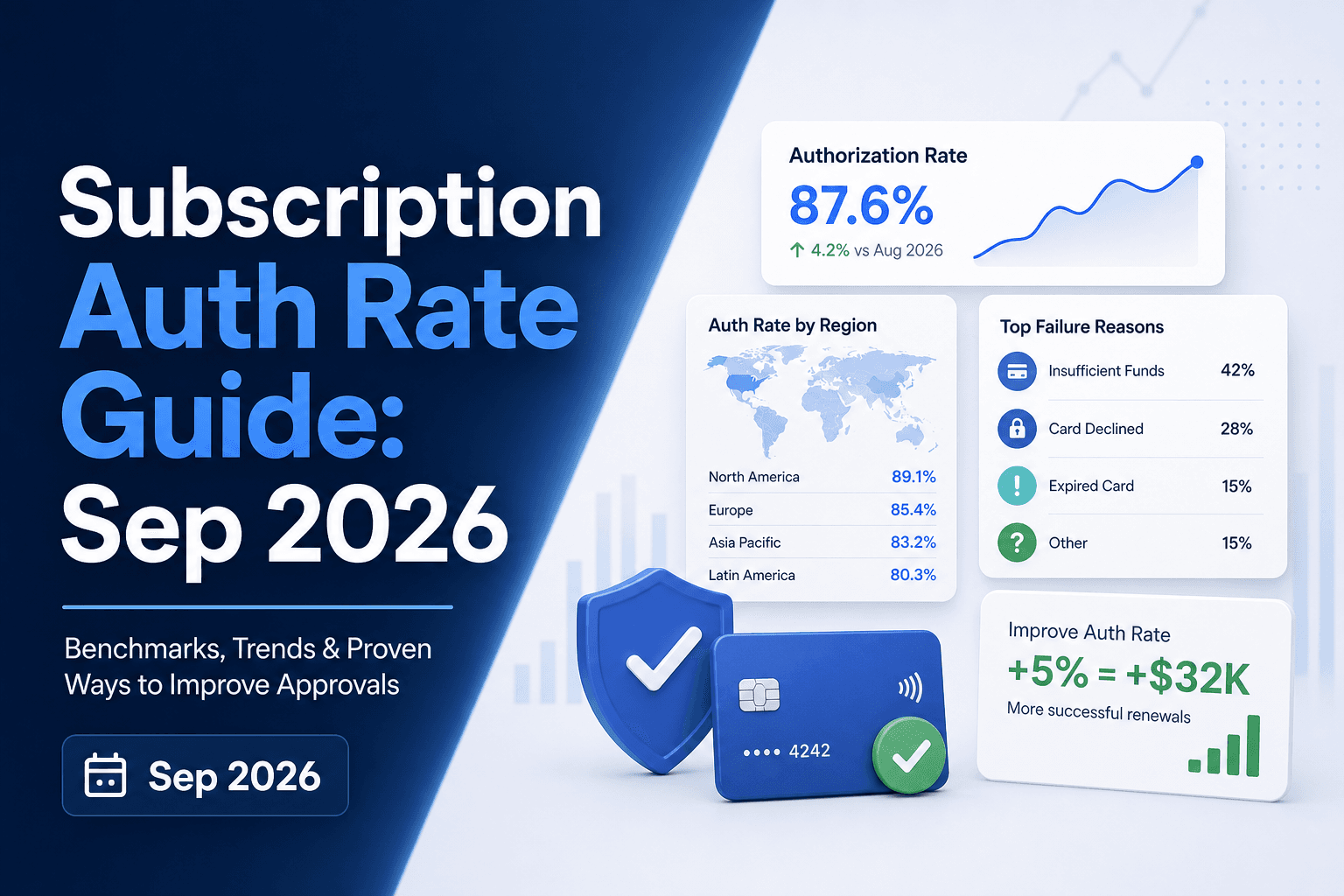
Authorization Rate in Subscription Billing: October 2026
There's a number sitting in your payments data that most finance and retention teams never report on separately: the share of renewal charges your issuing...
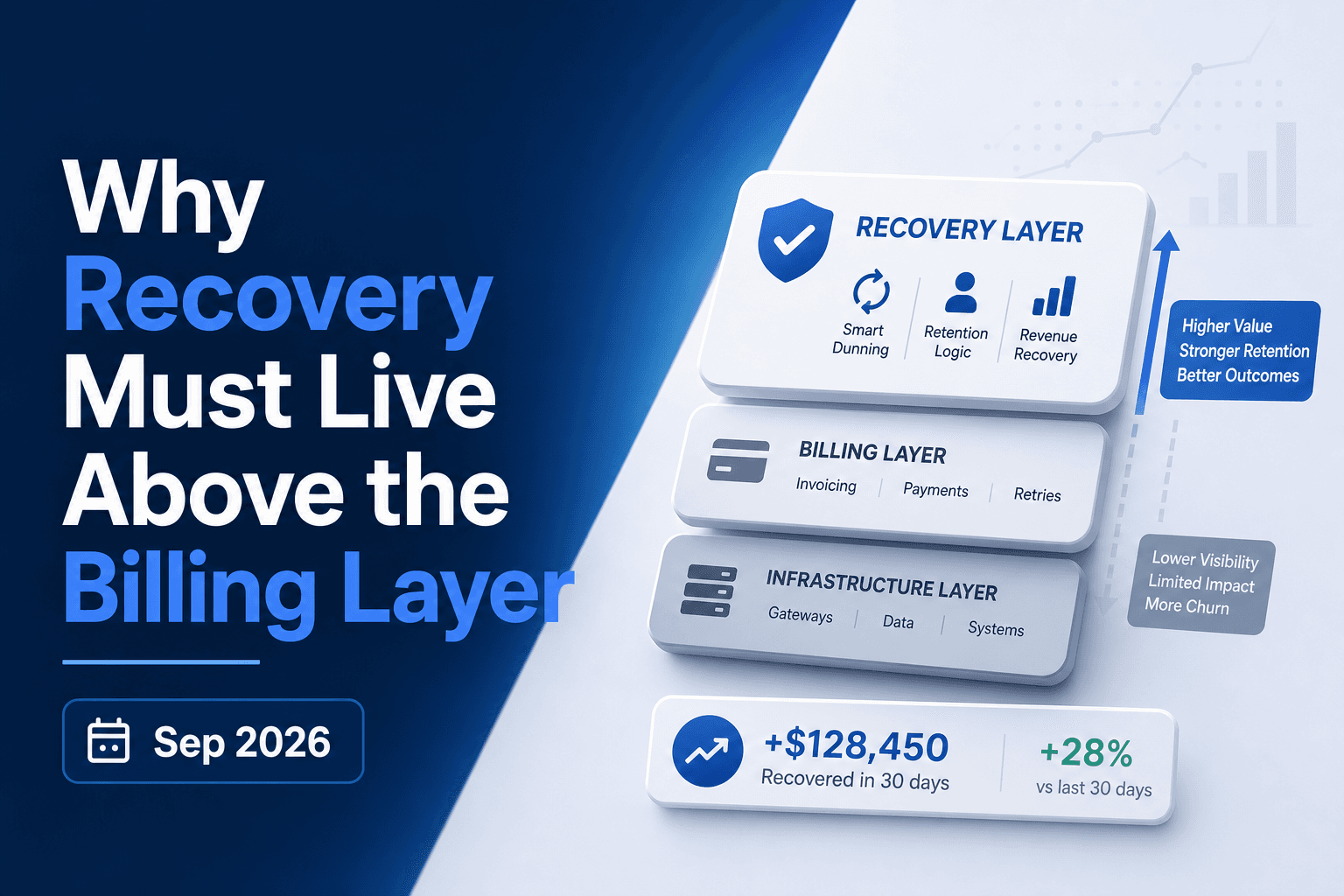
Why Payment Recovery Must Live Above Billers October 2026
A payment fails. Your biller retries it three days later, then again at seven, then at fourteen. What the biller never checks is whether the issuer sent a...
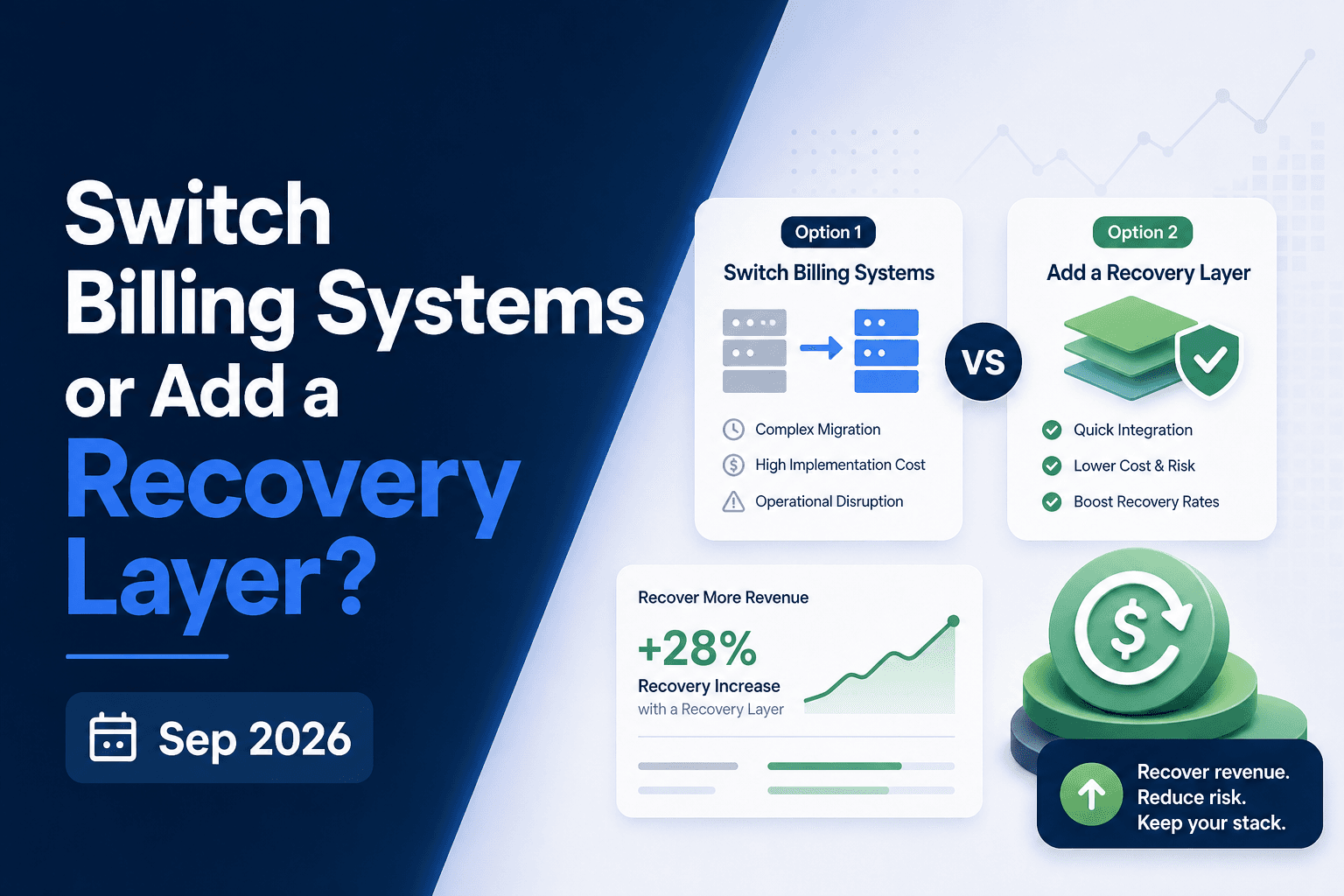
Billing Migration vs Recovery Layer: The Right Call October 2026
Switching billing systems feels like the right move when revenue collection starts breaking down. Sometimes it is. But soft declines, weak retry logic, and...
Stop losing revenue to failed payments
Join leading subscription businesses using Slicker to recover failed payments automatically.
Get Started