Best Payment Retry Tools for Global Businesses Oct 2026

Recovering failed payments domestically is one thing. Recovering them across borders is another. Issuer behaviors differ by region, local payment methods like SEPA direct debits add timing complexity, and bank holiday calendars vary by country. Retry logic that ignores those variables is not merely suboptimal; it is actively leaving revenue on the table. But geography-aware retry logic is only half the equation: finance and payments teams also need dashboards that let them isolate recovery performance by country and subscriber segment, because a blended global recovery rate hides exactly where revenue is actually leaking. Below, we break down which multi-region dunning platforms are built for both: geography-aware retry logic and the reporting infrastructure to measure it by country and segment.
TLDR:
- Recover measurably more failed payments across borders by matching retry timing to regional issuer behavior, local payment rails, and country-specific bank calendars instead of applying fixed schedules globally. Recovery uplift is proven on your own subscriber data via AABB testing, not on generic vendor benchmarks.
- AI-driven retry logic analyzes card type, geography, decline codes, and issuer patterns to decide whether to retry and when on a per-transaction basis, adapting to SEPA settlement windows and regional card network differences.
- Verify recovery uplift on your own subscriber data through clinical-grade AABB testing that splits traffic 50/50 and reports statistical significance with p-values before any financial commitment.
- Slicker personalizes retries by geography, issuer, and card type with zero engineering lift and five-minute setup, recovering revenue silently through your existing billing infrastructure.
- Most multi-region dunning tools lack issuer-level intelligence or statistical proof methodology, leaving cross-border recovery rates below what geography-aware AI models achieve.
What Are Subscription Payment Retry Tools for Global Businesses?
The core function of a retry tool
Subscription payment retry tools are software solutions that automatically attempt to recover failed recurring payments after a card decline or billing error. When a charge fails, these tools assess retryability, identify the optimal timing, and send targeted customer outreach only when the failure actually requires action.

Why global complexity changes the equation
For global businesses, the complexity scales fast. A domestic retry tool might handle a single currency and one or two payment methods without issue. Cross-border operations introduce regional card networks, local payment schemes like SEPA direct debits or India's RBI mandates, bank holiday calendars that vary by country, and issuer behaviors that differ substantially by geography. Global payments infrastructure continues evolving, with revenue growth patterns and processing behaviors varying considerably by region. Industry benchmarks put the average transaction failure rate at approximately 7.9% across subscription businesses, a figure that compounds quickly at scale, where payment failures can drive up to 40% of subscriber loss at high-volume operations, consistent with industry data. Smart retry systems recover 70-85% of recoverable failures, compared to just 40-60% for fixed-interval schedules, because they adapt to the specific context of each decline instead of applying a uniform cadence. Failure rates also vary meaningfully by region: card-not-present decline rates in some European markets run higher than North American averages due to Strong Customer Authentication (SCA) requirements under PSD2 (the EU's Payment Services Directive 2), which introduces an additional authentication layer that fixed retry logic is not built to handle. That regulatory reality makes geography-aware retry logic especially important for any business with a meaningful EU subscriber base. Retry logic that ignores these variables can miss recovery windows or trigger network penalty fees. Multi-region dunning software has to be built with all of that in mind from the start.
How We Ranked Subscription Payment Retry Tools for Global Businesses
The five criteria that matter for multi-region operators
Ranking subscription payment retry tools for global businesses requires a different lens than a standard dunning comparison. We scored each tool across five criteria that matter most to multi-region operators.
- Currency and payment method coverage: does the tool support local payment rails alongside major card networks?
- Retry logic sophistication. Are retries timed by issuer behavior and decline code, or just a fixed schedule?
- Compliance and data residency. Can the tool meet GDPR, PSD2, and regional data localization requirements?
- Reporting by geography. Can your team isolate recovery rates by country or region?
- Integration footprint. How much engineering lift is required to go live?
Best Overall Subscription Payment Retry Tool for Global Businesses: Slicker
How Slicker's AI Retry Logic Works
Slicker is built for high-volume subscription businesses that can't afford to guess at retry timing. Instead of applying a fixed schedule across your entire subscriber base, Slicker's ensemble of AI models analyzes card type, issuer behavior, geography, and decline code to decide whether to retry, when, and at what cadence, subscriber by subscriber. For global businesses, Slicker's issuer-level and geography-aware models mean retry logic adapts to regional bank behavior instead of applying rules tuned for a single market.
How Slicker Proves Recovery Uplift Before You Commit
What separates Slicker from the field is how it proves value before you commit. Using clinical-grade AABB testing, Slicker splits your live traffic 50/50, measures dollars recovered with statistical significance, and reports the p-value. If it doesn't beat your control, you don't pay.
Setup, Security, and Global Payment Method Support
Setup requires no engineering lift: roughly five minutes, no code, no changes to your existing billing infrastructure.
- Hyper-personalized smart retries based on issuer, geography, and decline type, not a one-size-fits-all schedule
- Silent recovery runs automatically in the background; customer-facing dunning is only triggered when the error requires action, such as a stolen or expired card
- Dunning emails send from your domain and reflect the specific failure reason, framing the message around the value the subscriber would lose
- AABB testing with statistical significance before any financial commitment, so recovery uplift is proven on your own data
- SOC 2 Type 2 certified; payment credentials flow through your existing PCI-compliant infrastructure
Vindicia
Multi-currency billing with a measurability gap
Vindicia has been serving subscription businesses since 2005 and handles multi-currency billing and regional tax compliance for media and telecommunications companies operating across multiple regions. Its Retain product handles failed payment recovery through a combination of retry logic and account updater integrations.
Where Vindicia Falls Short for Global Buyers
Where Vindicia falls short for most buyers is measurability. The system does not offer AABB testing with statistical significance, so you cannot verify whether its retry logic is actually outperforming your baseline on your own revenue data. For a CFO assessing involuntary churn recovery, that is a meaningful gap.
Best for: Large media and telecom businesses needing multi-currency billing with regional tax compliance.
Watch out for: No AABB testing means recovery uplift on your own data cannot be independently verified.
Revaly
Fixed-interval retry logic and limited geographic intelligence
Revaly positions itself as a recovery-focused dunning tool built for subscription businesses, offering retry logic and email sequences designed to reduce involuntary churn. It covers the basics well for companies operating primarily in one or two markets, but its retry scheduling relies on fixed interval logic instead of AI-driven timing decisions, which limits recovery performance as subscriber bases grow more geographically diverse.
For global subscription businesses, that gap matters. Retry windows that work in the US often conflict with banking hours, issuer behaviors, and card network rules in Europe, Latin America, or Southeast Asia. Revaly does not offer region-aware retry logic or multi-currency recovery intelligence, so international recovery rates tend to trail what dedicated global tools achieve.
Revaly also lacks the statistical testing infrastructure that lets finance teams verify whether their dunning configuration is actually recovering more revenue than a baseline. Without that, you are trusting the vendor's default settings over your own data.
Best for: Subscription businesses operating in one or two markets that need basic dunning and email sequences without complex multi-region requirements.
Watch out for: Fixed-interval retry logic with no region-aware intelligence means recovery rates trail purpose-built global tools as your subscriber base diversifies geographically.
FlyCode
Stripe-native recovery with limited cross-border depth
FlyCode positions itself as an AI-powered failed payment recovery tool, with a particular focus on Stripe-native businesses. It uses AI models to optimize retry timing and sequences, and offers some dunning email functionality alongside its core retry logic.
For businesses operating in a single region on Stripe, FlyCode covers the basics. Where it shows limitations is in multi-currency environments, regional issuer behaviors, and cross-border decline pattern variations, all areas where more specialized international failed payment recovery tools tend to outperform.
There is no published AABB testing methodology, which makes it harder for finance teams to verify recovery attribution with statistical confidence before committing.
Best for: Single-region Stripe-native businesses looking for AI-assisted retry optimization without substantial multi-currency complexity.
Watch out for: Limited depth on cross-border decline patterns and multi-currency issuer behavior, with no published AABB testing to verify recovery uplift on your own data.
Butter
Customizable dunning flows, limited regional adaptability
Butter focuses on failed payment recovery for subscription businesses, with particular strength in customer-facing dunning flows. Its email sequences are customizable and its retry logic is rule-based, making it accessible for teams that want control without deep technical overhead.
Where Butter falls short for global businesses is in its geographic adaptability. Its retry schedules are not tuned to regional issuer behavior, and its dunning communications lack the localization depth that multi-region operations require. For businesses operating across markets with distinct payment norms, that gap in regional intelligence translates directly into unrecovered revenue.
Best for: Teams that want customizable customer-facing dunning flows and rule-based retry control without deep technical overhead, primarily in a single market.
Watch out for: Retry schedules are not tuned to regional issuer behavior and dunning lacks localization depth, making it a weak fit for businesses operating across markets with distinct payment norms.
Churnkey
Cancellation-flow focus with basic retry capabilities
Churnkey positions itself as a cancellation-flow and failed payment recovery tool, leaning heavily on exit surveys and cancel-page interventions to reduce voluntary churn. Its retry logic is relatively basic compared to dedicated recovery tools, relying on rule-based schedules instead of an AI-driven ensemble that adapts by issuer, geography, or card type.
For global subscription businesses, that gap matters. Multi-region dunning requires logic that accounts for local card network behavior, currency-specific decline patterns, and issuer-level timing signals. Churnkey's retry capabilities don't appear built for that depth.
- Its core strength is the cancellation flow, not payment recovery, so businesses with high involuntary churn may find the tool misaligned with their actual revenue leak.
- There is no published evidence of AABB testing or statistically validated retry outcomes, making it harder to verify recovery rate uplift on your own data.
- International teams handling cross-border failed payments will likely need a separate, more specialized recovery layer alongside it.
Churnkey suits teams whose primary problem is voluntary cancellation. If involuntary churn from failed payments is the larger revenue leak, the tool's recovery functionality is a secondary feature, not a purpose-built solution.
Best for: Teams whose primary problem is voluntary cancellation and exit-flow optimization.
Watch out for: Retry logic is rule-based and not built for multi-region issuer behavior, making it a poor fit as a primary recovery tool for global subscription businesses.
What to Look for in a Failed Payment Recovery Dashboard: Country and Segment Views
A single blended recovery rate tells you almost nothing actionable. For global subscription businesses, that aggregate number masks which regions are underperforming, which customer segments are driving the most involuntary churn, and where retry logic is losing ground to regional issuer behavior. Country-level and segment-level dashboard views aren't a reporting nicety; they are a practical requirement for any team managing failed payment recovery across borders and subscriber cohorts that behave differently from one another.
Country-Level Dashboard Views
The metrics that matter most (recovery rate, retry attempt count, decline code distribution, and average recovery lag) should all be filterable by country. Without that granularity, a strong recovery rate in the US can conceal a persistently low rate in Germany, where SEPA settlement windows require different retry cadences, or in Brazil, where local card network rules create distinct decline patterns. Bank holiday calendars vary by country and directly affect when retries succeed; a tool that can't report recovery outcomes against those calendars is flying blind. Issuer behavior differences across markets compound the problem further. Per-country reporting turns a blended vanity metric into a diagnostic instrument that finance and payments teams can actually act on.
Segment-Level Dashboard Views
Subscriber segments that warrant separate recovery tracking include plan type (monthly vs. annual), billing cadence, LTV tier, and payment method. Annual subscribers represent higher-value recovery opportunities; trial converters have different payment method profiles than long-tenure customers; high-LTV (lifetime value) cohorts can support more aggressive retry configurations than low-margin plans. When a tool surfaces segment-level recovery data, your payments team can identify that annual subscribers on SEPA direct debit in France are recovering at 60% while monthly card subscribers in the same region recover at 82%, and adjust retry logic accordingly. Tools that only offer aggregate reporting obscure exactly those gaps, leaving retry configuration tuned to an average that fits no segment particularly well.
The feature comparison table below identifies which tools in this review offer country and segment filtering in their recovery dashboards versus those limited to aggregate views only.
Feature Comparison Table of Global Subscription Payment Retry Tools
Head-to-head feature breakdown
Side-by-side comparisons cut through vendor claims faster than any description. The table below covers the features that matter most for global subscription payment retry, based on the criteria ranked against.
Feature | Slicker | Vindicia | Revaly | FlyCode | Butter | Churnkey |
|---|---|---|---|---|---|---|
AABB Testing with Statistical Proof | Yes | No | No | No | No | No |
No-Code Integration (5 min setup) | Yes | No | No | No | No | No |
Multi-Gateway Routing Optimization | Yes | No | No | No | No | No |
Geographic Retry Optimization (Payday Patterns) | Yes | No | No | No | No | No |
Merchant Advice Code Intelligence | Yes | No | No | No | No | No |
SEPA/BACS Direct Debit Support | Yes | Yes | Yes | No | No | No |
Performance-Based Pricing (4-8%) | Yes | No | No (percentage of all recoveries) | No | No (percentage of all recoveries) | No |
Works on Existing Payment Stack (No PSP Change) | Yes | Yes | No | Yes | No | Yes |
Multi-Currency & Regional Payment Method Support | Yes | Yes | Yes | Limited | Yes | Limited |
Dunning Email Personalization by Failure Type | Yes | Yes | Yes | Yes | Yes | Yes |
Payment Recovery on Signup Failures | Yes | No | Yes | No | No | No |
AI-Powered Analytics & Insights | Yes | Limited | Yes | No | No | No |
Why Slicker Is the Best Subscription Payment Retry Tool for Global Businesses
Built for cross-border recovery from the ground up
Slicker was built for the problem global subscription businesses face: recovering failed payments across borders without sacrificing recovery rates or brand integrity.
At its core, Slicker runs an ensemble of AI models that analyze issuer behavior, card type, geography, and decline codes to decide whether to retry, when, and how aggressively. This is not a fixed schedule; it is hyper-personalized retry logic that adapts to each transaction's context across every region you operate in.

Revenue proof on your own data, before you pay
The proof comes before you commit. Slicker runs clinical-grade AABB testing on your actual traffic, splitting it 50/50 and measuring recovered dollars with statistical significance. If Slicker does not beat your control, you do not pay.
For businesses operating across payment methods with distinct timing characteristics, this matters directly to recovery rates: SEPA Direct Debit settlement windows differ fundamentally from card network processing, requiring retry logic that understands method-specific behavior patterns instead of applying uniform schedules. Setup requires zero engineering lift and takes roughly five minutes with no code required.
Final Thoughts on International Failed Payment Recovery Software
What to look for in a global-ready solution
The subscription payment retry tools that work well domestically often fall short when your business operates across borders. Regional card networks, local payment schemes, and issuer-level timing signals require retry logic built for multi-region complexity. Tools that prove recovery uplift on your own data before asking for commitment are the ones that respect how CFOs assess vendor claims. See what an AABB test uncovers about your current recovery rates.
FAQ
How do you distinguish whether a recovered payment was genuinely incremental versus self-recovered, and how should attribution be structured in data exports?
This is the right question to ask before signing any payment recovery vendor, because without a rigorous attribution methodology, you cannot know whether you're paying for recoveries you would have captured anyway.
The attribution problem. A payment that fails on Monday and succeeds when retried on Wednesday might have succeeded on Wednesday anyway: the customer may have topped up their account, resolved an issuer hold, or updated their card independently. Without a control group running in parallel, there is no way to distinguish vendor-recovered revenue from self-recovered revenue. Vendors that measure recovery rate as "all successful retries during our contract" are counting self-recoveries in their headline number.
How AABB testing solves it. Slicker's AABB methodology (described above) splits traffic 50/50; self-recoveries affect both groups equally and cancel out of the delta, isolating incremental revenue. What remains is the revenue attributable to Slicker's intervention, and only that.
Data export structure. For teams that need to verify this attribution in their own data warehouse or BI tooling, each recovered payment in Slicker's export should carry: the original charge ID, the recovery timestamp, the treatment arm (control or Slicker), the retry attempt count, the decline code on the original failure, and a boolean indicating whether the recovery occurred within or outside the expected self-recovery window for that decline type. That structure allows your data team to reproduce the attribution calculation independently and audit the incremental recovery claim against your own Stripe event data.
What is the best way to reduce involuntary churn for a SaaS subscription business in 2026?
The most effective 2026 approach layers three complementary mechanisms: smart retries, account updater, and network tokens, in that order of deployment complexity. Smart retries (AI-driven timing by issuer, geography, and decline code) handle the largest share of recoverable soft declines immediately and with zero customer friction. Account updater services automatically replace expired or reissued card credentials before a payment even attempts, removing a major driver of false hard declines. Network tokens, issued by Visa and Mastercard through your payment processor, replace raw card numbers with network-managed tokens that stay valid across card reissues and carry higher issuer approval rates on recurring transactions. Together, these three layers recover 20-50% more failed payments than fixed-interval schedules alone, measured through controlled AABB testing on real subscriber traffic. For global SaaS businesses, adding geography-aware retry logic that times retries to regional banking hours, issuer approval windows, and local payment rail settlement cycles closes an additional gap that domestic-only tools leave open.
How does Slicker integrate with Stripe technically: what API access is required, and how are actions written back to Stripe?
Slicker connects to Stripe through a restricted API key or OAuth connection scoped to the permissions required for payment recovery, with no broader access than that. The core permissions needed are: read access to charge events and payment intents (to detect failures), read access to subscription and customer objects (to identify the subscriber and plan context), and write access to trigger retries on specific payment intents. Slicker does not request write access to customer creation, product catalog, or financial reporting endpoints.
Permission scoping. Restricted API keys in Stripe allow you to define exactly which resources and methods the key can access. Slicker's integration is designed to operate within a narrowly scoped key; you do not need to grant full account access. During onboarding, Slicker provides the specific permission set required so you can configure the key in Stripe's dashboard under Developers > API keys > Create restricted key before connecting. This gives you explicit control over what Slicker can and cannot do in your Stripe account.
Writeback to Stripe as system of record. When Slicker takes an action (a smart retry attempt, a billing cycle reset to preserve the subscriber's renewal date, or a subscription state change), that action is executed through the Stripe API and recorded in Stripe's event log. Your Stripe dashboard, webhooks, and downstream reporting all reflect the action as a Stripe-native event. Slicker does not maintain a parallel subscriber state; Stripe remains the system of record, and Slicker's actions are visible in your Stripe event stream exactly as they would appear if a human had performed them through the dashboard.
Billing cycle resets. When Slicker recovers a payment on a date different from the original billing date, it can optionally reset the billing cycle anchor in Stripe so the subscriber's next charge falls on the correct schedule. This is a configurable behavior, not automatic; your team controls whether cycle resets are applied and under what conditions.
What is the average improvement in failed payment rates when using AI?
AI-driven retry tools recover 20 to 50% more failed payments compared to fixed retry schedules, measured through controlled AABB testing on real subscriber traffic. The exact uplift depends on your payment mix, geography distribution, and issuer composition, which is why statistical proof on your own data matters more than vendor benchmarks.
What tools should I use to recover failed payments on a Zuora or Recharge billing stack?
Both Zuora and Recharge have native retry settings: Zuora's Payment Retry rules let you configure payment run schedules and gateway routing, while Recharge offers built-in payment retry and customer notification workflows. Those native tools apply fixed-interval or rule-based schedules that don't adapt to issuer behavior, decline codes, or geography. For global subscription businesses, layering an AI-powered recovery tool like Slicker on top of either stack recovers what the native logic misses. Slicker integrates with your existing billing infrastructure without a PSP change or engineering lift, running its ensemble of AI models on each failed transaction to decide optimal retry timing by card type, issuer, and geography. The native Zuora or Recharge retry fires first; Slicker's smart retry layer handles the recoverable soft declines that fixed schedules either miss or hit at the wrong moment. For Recharge merchants on Shopify, this is especially relevant because cross-border card declines and SEPA mandates fall entirely outside what Recharge's native retry logic was built to optimize.
How can I monitor invoice recovery performance in Slicker after a dunning window change?
The AABB test dashboard is the primary instrument for measuring recovery rate changes after any configuration update, including dunning window changes, because it attributes recovered revenue to the correct treatment arm with statistical confidence. When you change a dunning window, that change is reflected in the next test cohort; the dashboard shows recovery rates, recovered dollars, and p-values for both the control and treatment groups, so you can see whether the new window is outperforming the previous configuration with statistical significance before deciding whether to make it permanent.
Beyond the AABB dashboard. Slicker's reporting infrastructure includes segment-level recovery views that let you filter by country, plan type, billing cadence, and payment method, which are the dimensions most relevant to monitoring whether a dunning window change is performing differently across subscriber cohorts. For example, if you tighten the retry window for SEPA direct debit subscribers in Germany, you can isolate that cohort's recovery rate in the segment view without it being averaged into your global recovery number.
Alerting and anomaly detection. Recovery rate drops after a configuration change, whether caused by the change itself or an external factor like an issuer behavior shift, surface in the trend data. Slicker's analytics layer flags statistically notable deviations from your baseline recovery trend, giving your payments team an early signal that a configuration change may be degrading performance before the full billing cycle completes.
The standing rule: never make multiple configuration changes simultaneously if you want clean attribution. Change one variable at a time (dunning window, retry cadence, or email trigger logic) and let the AABB test run for enough volume to reach statistical significance before reviewing the result.
Which payment retry tool works best for businesses new to recovery optimization?
Businesses new to payment recovery should focus on tools with no-code setup and performance-based pricing that requires zero engineering lift. Look for solutions that prove value through AABB testing on your actual traffic before any financial commitment, so you can verify recovery uplift with statistical significance instead of trusting vendor benchmarks or generic promises.
How do I handle failed ACH and direct debit payments differently from failed card payments?
Failed ACH and direct debit payments follow fundamentally different rules than card declines, and treating them the same way destroys recovery rates and creates compliance risk. Three critical differences govern the approach.
Return windows and timing. Card declines are typically synchronous: you know within seconds whether a charge succeeded. ACH and SEPA direct debit failures are asynchronous: the payment settles over one to three business days, and return codes arrive days later. Nacha's ACH rules allow consumers up to 60 days to dispute an unauthorized transaction (return code R10), while administrative returns like R01 (insufficient funds) and R02 (account closed) typically resolve within two business days. Retrying too quickly on an R01 violates Nacha's rules and increases your unauthorized return rate, which Nacha requires originators to keep below 0.5% (R05, R07, R10, R29, R51 codes) to avoid network penalties.
Retry limits and network rules. Visa and Mastercard both impose retry limits on declined card transactions, typically four retries within 15 days for a specific authorization reason code, with fees triggered by excessive retries. ACH operates under different rules: Nacha requires that re-presented ACH entries carry specific settlement date timing and limits re-presentment to twice after the original return, with no more than two re-presentments for returned items. SEPA direct debit has its own re-presentation rules under the SEPA Credit Transfer and Direct Debit rulebooks, with mandatory minimum delay periods between attempts.
The impact on retry tools. A retry tool that applies card-network timing logic to ACH or SEPA entries will either violate network rules or leave recoverable payments untouched. Purpose-built global recovery tools handle payment-method-specific retry logic separately, applying method-aware timing and re-presentation rules to each transaction type instead of a single unified schedule.
What data signals and integrations does Slicker need to run its retry engine?
Slicker's retry engine operates on a specific set of signals drawn from your existing billing infrastructure, with no PSP migration or engineering work required to feed it data. The core signals are: decline codes returned by the issuer, card BIN (the first six to eight digits that identify the card network, issuing bank, and card type), geography (country of the issuing bank and cardholder), and payment method type (card, SEPA direct debit, BACS (Bacs Payment Schemes, the UK direct debit rail), etc.). These are all available through your existing Stripe or billing system connection and require no additional instrumentation.
The Mastercard partnership (planned, Q2 2027, not yet available). Slicker's planned integration with Mastercard's network data is expected to give the retry engine access to issuer-level behavioral signals not available through standard decline codes alone. Mastercard's Transaction Excellence Program and related data partnerships are expected to surface issuer-specific approval window patterns: the times of day and week when a given issuing bank is most likely to approve a retry for a specific decline reason. This network-level signal will allow geography-aware retry logic to adapt to issuer behavior across markets instead of applying a single schedule tuned to one region's banking patterns.
Billing system data requirements. Slicker reads failed charge events, subscriber metadata (plan type, billing cadence, tenure), and payment method attributes from your billing system. It writes retry outcomes (attempted, recovered, or exhausted) back to your billing system as the system of record, so your internal reporting stays accurate and complete. No subscriber PII beyond what your billing system already holds is required; Slicker operates on the payment-event data, not on customer identity data beyond what's needed to route the retry to the correct subscriber record.
What's the difference between AI-powered retry logic and rule-based scheduling?
Rule-based scheduling applies fixed intervals regardless of transaction context: retry on day 3, day 7, and day 14 for every failed payment, no matter what caused it. AI models, by contrast, analyze issuer behavior, card type, geography, and decline codes to decide whether to retry, when, and at what cadence on a per-transaction basis. A soft decline from a UK Barclays card on a Thursday afternoon triggers a different retry window than a hard decline from a US Chase card, because the AI recognizes issuer-specific approval windows. For global businesses, fixed schedules tuned for one market systematically underperform when applied across regions with different banking hours, card network rules, and issuer behaviors.
How does delta-based (incremental recovery) pricing work, and why is it fairer than a percentage of all recoveries?
Delta-based pricing (also called incremental recovery pricing) charges you only on the additional revenue recovered above your existing baseline, not on the full volume of successful retries. The distinction matters most for businesses that already recover a meaningful share of failed payments through native billing system retries or basic dunning rules.
The problem with percentage-of-all-recoveries pricing. If your billing system already recovers 50% of failed payments through its built-in retry logic, and a vendor charges 30 to 50% of every successful recovery, you are paying the vendor's fee on revenue your existing infrastructure would have recovered anyway. The vendor is taking credit (and taking a cut) for work you were already doing. At high recovery volumes, that misattribution compounds into a material margin drag.
How delta-based pricing works. Slicker's AABB testing methodology measures your baseline recovery rate on the control group (traffic handled by your existing retry logic). Revenue recovered above that baseline (the incremental lift attributable to Slicker's AI models) is what the fee applies to. Slicker charges 4-8% of incrementally recovered revenue, not of total recovered revenue. If your baseline recovers $100K per month and Slicker recovers an additional $30K, the fee applies to the $30K, not the $130K. That structure aligns incentives: Slicker only earns when it demonstrably outperforms your baseline, and the AABB test provides the statistical proof of where the baseline sits.
Why this matters for CFO sign-off. Delta-based pricing converts the vendor relationship from a cost-of-revenue line into a provably positive ROI: every dollar paid to Slicker is a fraction of a dollar recovered above what you would have recovered without it. The p-value from the AABB test is the evidentiary basis for that claim: not the vendor's benchmark data, your own traffic.
How do I avoid Visa and Mastercard retry fees when retrying failed subscription payments?
Both Visa and Mastercard impose excessive retry fees on subscription businesses that retry declined transactions too frequently or outside the permitted windows for a given decline reason. Understanding Visa and Mastercard retry rules, and how AI-driven retry logic stays inside them, is critical for any high-volume subscription operation.
Visa's rules. Visa's Transaction Integrity Fee applies when a transaction is declined and then retried more than the permitted number of times within a 30-day window. For most decline reason codes, Visa limits retries to 15 attempts in 30 days. Some specific codes carry stricter limits: declines coded as "Do Not Honor" (response code 05) and "Insufficient Funds" (51) are subject to a cap of 15 retries in 30 days with a $0.10 excessive attempt fee per violation transaction after the limit is exceeded. Visa also requires that stored credential transactions, the category that covers recurring subscription charges, include the correct Stored Credential Transaction (SCT) indicators in the authorization request; missing or incorrect SCT flags can trigger integrity fees regardless of retry count.
Mastercard's rules. Mastercard's Excessive Retry Fee applies when an issuer declines a transaction and the merchant retries beyond the permitted threshold. For response code 05 (Do Not Honor) and code 51 (Insufficient Funds), Mastercard allows up to 10 retries in 30 days before the $0.25 per transaction excessive retry fee kicks in. Mastercard also requires a minimum 24-hour gap between retry attempts for most decline codes.
How AI retry logic keeps you compliant. Fixed-interval schedules (retry every 3 days regardless of decline code) routinely violate both networks' rules because they don't track retry counts by reason code or enforce minimum inter-attempt gaps by card type. AI-driven retry tools like Slicker ingest decline codes, card network rules, and issuer behavior patterns together, so retry decisions automatically respect the permitted attempt windows for each specific decline reason. The result: maximum recovery within the compliance envelope, with no excessive retry fees triggered on high-volume subscriber bases.
What are the risks of giving a third-party payment recovery service access to your Stripe account, and what happens to your data if you stop using the service?
The risks fall into three categories: access scope, data retention, and offboarding controls. Reviewing each before signing is non-negotiable for any enterprise buyer.
Access scope. Most payment recovery platforms request broad Stripe API access via OAuth or a restricted API key. The risk isn't that they need access (they do, to read failed charges, trigger retries, and write outcomes back to Stripe); it's whether that access is scoped to the minimum permissions required. A platform that requests write access to your full customer object, the ability to create new charges, or access to unrelated product data is asking for more than recovery work requires. Before connecting any platform to your Stripe account, audit the exact permission set the OAuth grant or API key covers. Legitimate recovery tools operate on a narrow, well-documented permission footprint.
Data retention after offboarding. Contractual data retention and deletion commitments belong in the Data Processing Agreement (DPA), not in marketing copy. At minimum, require: a defined retention period for any subscriber PII or payment metadata the vendor holds, a deletion or return-of-data obligation that triggers automatically on contract termination, and written confirmation of deletion within a specified window (30 to 90 days is standard). Without those terms, subscriber data (card metadata, email contacts, and payment history) may remain in a vendor's infrastructure indefinitely after you stop paying them.
Offboarding controls. Revoke API credentials immediately on contract termination and confirm the revocation in writing. If the vendor uses a Stripe OAuth connection instead of a static API key, revoke the OAuth application from within your Stripe dashboard under Settings > Connected applications. Verify that any webhooks or event listeners the vendor registered are removed. A clean offboarding checklist from the vendor (listing every integration touchpoint and how to disable each one) is a reasonable contractual requirement for enterprise buyers.
When should dunning emails be sent versus relying on automated retries?
Automated retries should run first as the primary recovery method, handling failures silently in the background without customer involvement. Dunning emails are the fallback, triggered only when the specific error requires customer action (expired card, stolen card, account closed). Sending generic "update your payment method" emails for retryable soft declines creates unnecessary friction and spam risk.
What technical and contractual safeguards should enterprises require from payment recovery vendors to manage GDPR subprocessor risk?
Under GDPR, a payment recovery service that processes EU subscriber data on your behalf is a data processor, and if it engages sub-processors (cloud infrastructure, analytics, AI model providers), those sub-processors carry the same obligations. Managing that chain requires both contractual and technical controls.
Contractual requirements. At minimum, require: a signed Data Processing Agreement (DPA) that names all sub-processors and obligates the vendor to notify you of any change (typically 30 days' notice); standard contractual clauses (SCCs) for any data transfers outside the EEA; a liability cap and indemnification clause that covers regulatory fines attributable to the vendor's breach; and a cyber insurance requirement (typically €5M to €10M for enterprise-tier vendors). The DPA should also specify data deletion timelines, incident notification windows (72 hours to align with GDPR Article 33), and the lawful basis under which each data category is processed.
Technical controls. Contractual commitments don't prevent breaches; they govern liability after the fact. Technical controls that reduce exposure include: data minimization at the API layer (transmitting only the fields required for retry logic, not full customer records); field-level encryption for any PII at rest on the vendor's infrastructure; and audit logging that gives you visibility into how your subscriber data was accessed and processed. Some enterprise buyers implement a PII-stripping proxy that intercepts API calls to the vendor and replaces identifiable fields with pseudonymous tokens. This reduces the data surface the vendor handles, though it requires engineering investment and careful token-mapping to preserve retry signal quality.
Sub-processor audit rights. Negotiate audit rights: the contractual right to request evidence of sub-processor compliance (SOC 2 reports, ISO 27001 certificates, penetration test summaries) on reasonable notice. For high-volume EU operations, this is standard practice and any vendor unwilling to grant it is a risk signal in itself.
What are the trade-offs between building a PII-stripping proxy versus relying on a vendor's contractual data protection commitments?
Both approaches reduce GDPR subprocessor risk, but they operate at different layers and carry different cost profiles.
PII-stripping proxy. A proxy that intercepts API calls and replaces identifiable subscriber fields (name, email, raw card metadata) with pseudonymous tokens before they reach the vendor substantially reduces the data surface exposed. The vendor's retry engine operates on tokenized signals, such as decline codes, card BIN, geography, and issuer identifiers, that carry predictive value without carrying identity. The trade-off is engineering cost (typically 2 to 6 weeks to build and maintain), token-mapping complexity (retries must write outcomes back against the correct subscriber record), and the risk of stripping signals the retry model actually needs. If your tokenization strips the card BIN or issuer identifier, you degrade the AI model's ability to apply geography-aware or issuer-specific retry timing.
Contractual DPA commitments. Relying on a vendor's DPA is lower-friction and preserves the full signal set the retry engine uses, but it moves risk onto a contractual promise instead of a technical control. If the vendor is breached, you are relying on their incident response, notification timelines, and liability coverage to limit your exposure. For most subscription businesses operating at mid-market scale, a well-drafted DPA with a creditworthy counterparty and meaningful liability caps is sufficient. For businesses handling sensitive subscriber categories (health, financial services) or operating under sector-specific regulations beyond GDPR (PCI DSS, FCA, HIPAA), technical controls are worth the investment.
The practical middle ground most enterprise buyers land on: rely on a DPA with SCCs, sub-processor audit rights, and cyber insurance requirements as the baseline; add technical controls (field minimization at the API layer, not a full proxy) for the highest-sensitivity data fields. That combination meaningfully reduces exposure without stripping the retry signal quality that drives recovery performance.
Can a payment retry tool recover failed transactions at initial signup, beyond recurring payments?
Yes, advanced recovery tools now handle payment failures at initial subscription signup alongside recurring payment failures. This extends coverage to the full payment lifecycle, capturing revenue loss at the acquisition stage where failed first payments traditionally result in lost customers before they ever become active subscribers.
Related Articles
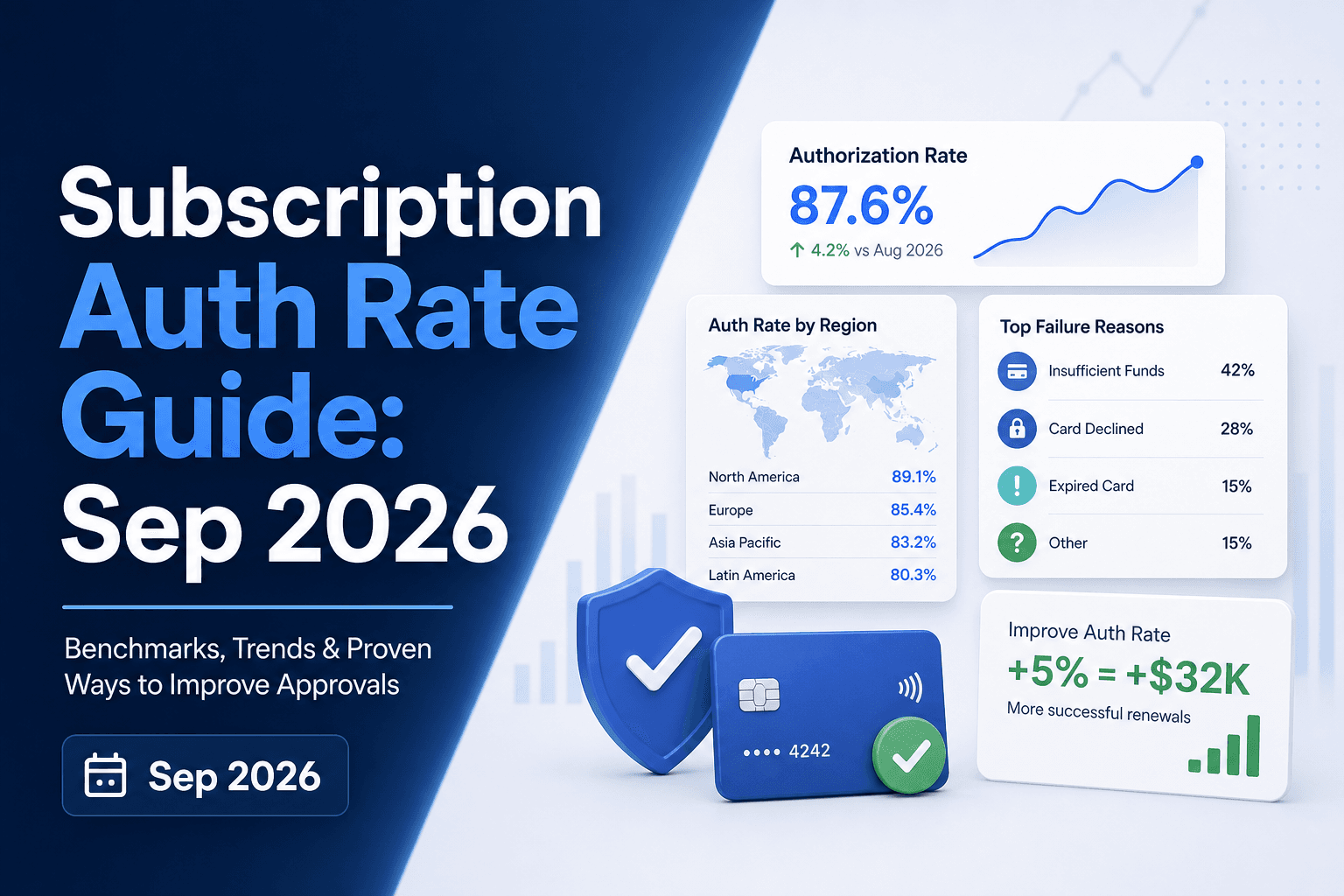
Authorization Rate in Subscription Billing: October 2026
There's a number sitting in your payments data that most finance and retention teams never report on separately: the share of renewal charges your issuing...
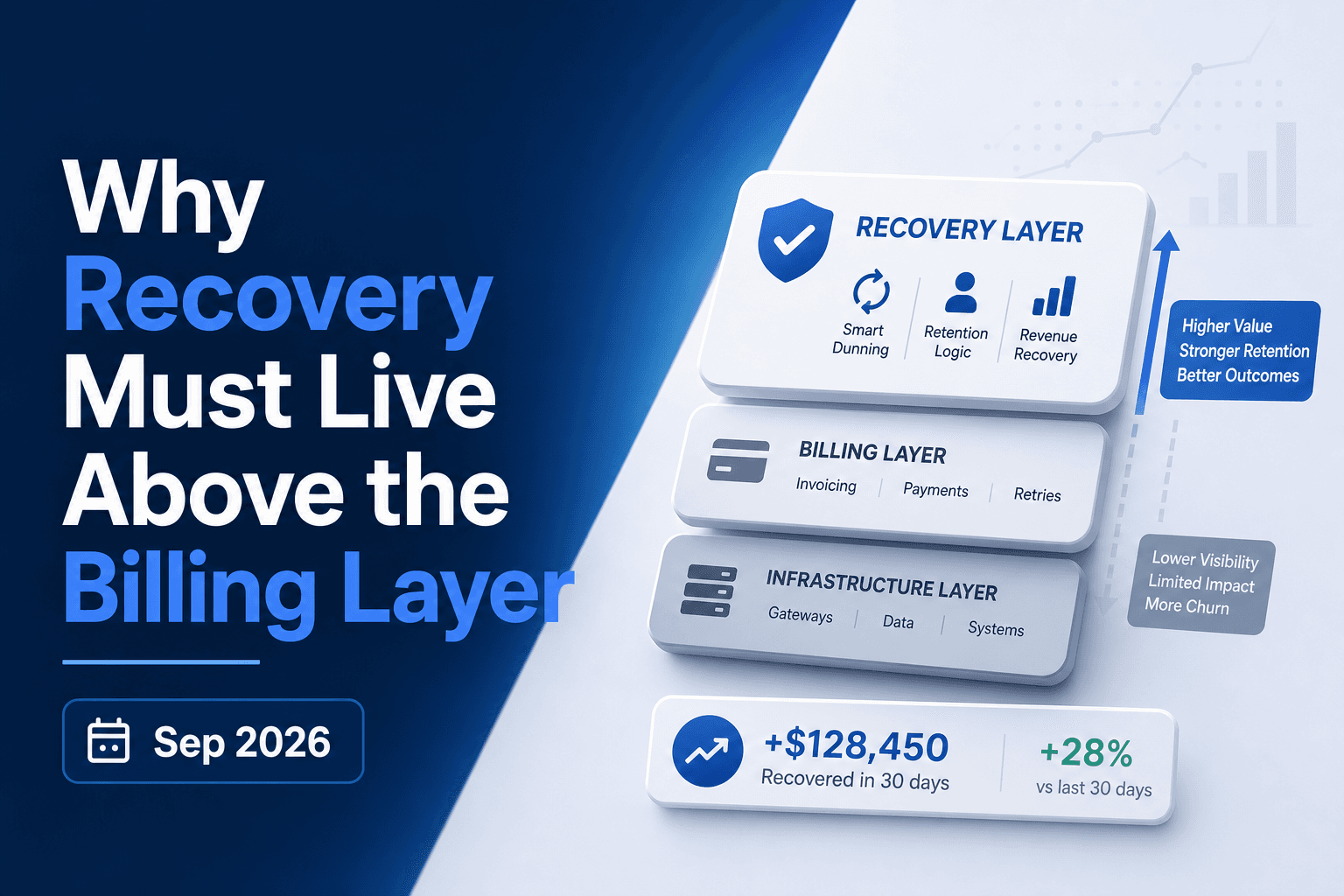
Why Payment Recovery Must Live Above Billers October 2026
A payment fails. Your biller retries it three days later, then again at seven, then at fourteen. What the biller never checks is whether the issuer sent a...
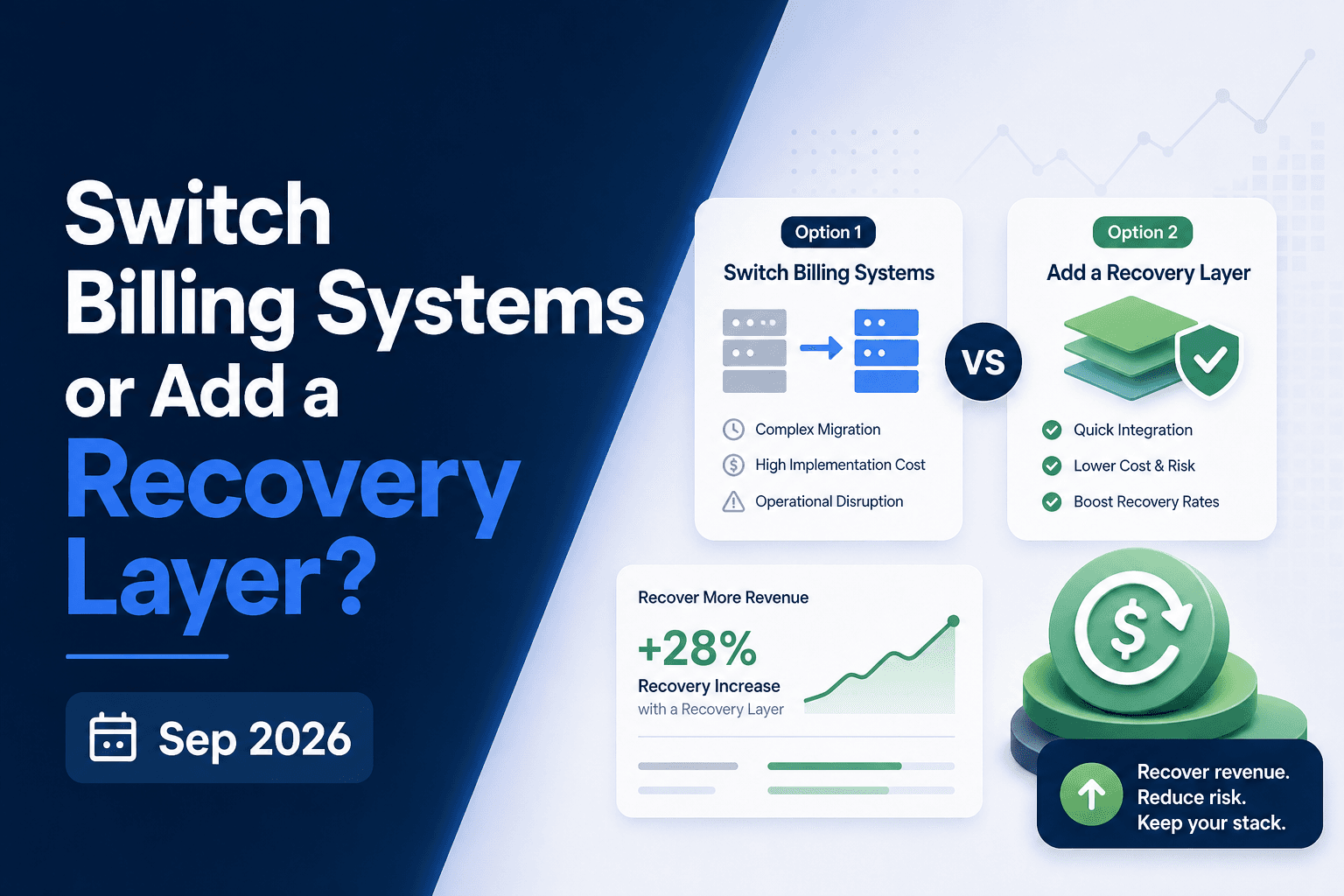
Billing Migration vs Recovery Layer: The Right Call October 2026
Switching billing systems feels like the right move when revenue collection starts breaking down. Sometimes it is. But soft declines, weak retry logic, and...
Stop losing revenue to failed payments
Join leading subscription businesses using Slicker to recover failed payments automatically.
Get Started