Expired Card Dunning: US vs Europe vs Australia (October 2026)
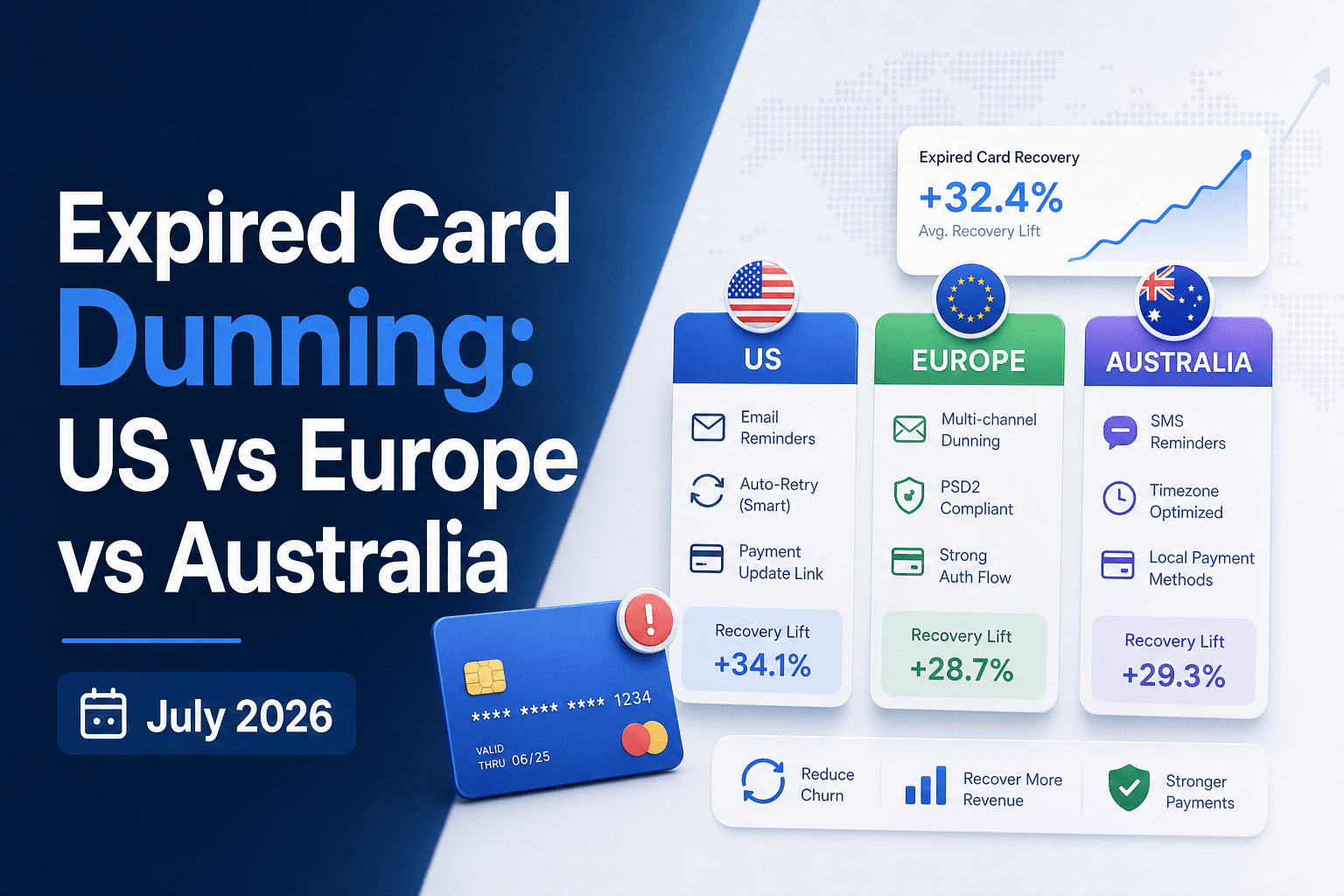
An expired card isn't a soft decline you can retry your way out of. The customer has to act, which makes your dunning sequence the only lever you have. What most teams miss is that the sequence working well in the US can quietly fail in Europe or Australia for reasons that have nothing to do with copy quality. This breaks down what to do differently by market.
TLDR:
- Card expiration drives 10-15% of involuntary churn (payment-driven subscriber loss unrelated to cancellation intent); no retry logic recovers it without customer action.
- In the US, Card Account Updater (CAU) programs silently resolve many expired cards before your email is needed; CAU coverage drops sharply in Europe, Latin America, and Southeast Asia.
- A 2-3 message post-failure sequence works best: day of failure, day 2-3, then a final notice at day 6-7, framed around service access loss.
- Copy and timing must vary by market: urgency-led subject lines for US subscribers, understated transactional framing for UK and European audiences, with EU emails bound by GDPR data minimization rules.
- Slicker runs expired card dunning as a separate workflow from retry logic, with each email sent from your domain and every copy or timing variant tested against a control before it ships.
Expired Cards as a Distinct Revenue Problem in Subscription Billing
Card expiration is one of the few failure types that automated retries cannot fix. When a card expires, the account itself is still active and the subscriber still wants your service, but no retry logic recovers a declined authorization on an expired credential. The customer must act. That makes expired card dunning categorically different from soft declines caused by insufficient funds or issuer-side friction, where silent recovery is the right first move.
The scale of the problem is real. Industry data puts card expiration as the source of roughly 10 to 15% of all involuntary churn (the payment-driven subscriber loss that has nothing to do with cancellation intent) in subscription businesses. For a company running $10M in monthly recurring revenue (MRR), that slice represents hundreds of thousands in recoverable revenue sitting behind a single, solvable action.
When CAU doesn't resolve it silently, the expired card email becomes your recovery lever. But sending one generic "update your card" message ignores two things that measurably affect whether that email converts: where your subscriber lives, and what their banking environment looks like.
Card Account Updaters: Silent Recovery Before the Email Is Needed
Card Account Updater (CAU) programs run quietly in the background, pushing refreshed card credentials to merchants before a payment even attempts to process. Visa Account Updater and Mastercard Automatic Billing Updater handle the bulk of this in the US, covering a large share of expired and reissued cards without any customer action required. When CAU works, the expired card email never needs to be sent.
The catch: CAU coverage drops sharply outside the US. Participation rates among issuers in Europe, Latin America, and Southeast Asia are far lower, which means your expired card dunning strategy carries more weight in those regions.
Proactive Card Update Emails: Catching Expiry Before the Charge Fails
Sending a card update email before the charge actually fails is one of the more straightforward wins in expired card dunning. Most card networks share expiry data with issuers months in advance, and many acquirers surface that information through account updater services, giving you a clean window to prompt subscribers before the decline ever hits.
In practice, US subscribers respond well to emails sent 30 days before expiry, with a reminder at 7 days. European subscribers, shaped by Strong Customer Authentication (SCA, mandated under PSD2) requirements, often need a more explicit prompt that ties the card update to a re-authentication step. Getting that timing right keeps recovery silent from the subscriber's perspective.
The Post-Failure Expired Card Email Sequence
Expired card emails occupy a narrow window. Once a card is confirmed expired (as opposed to soft-declined for insufficient funds), automated retries won't help; the customer must act. That makes the email sequence the only recovery lever available.
A two-to-three message sequence performs best:
- Send the first email on the day of failure, keeping the tone service-focused. Remind the subscriber what they stand to lose access to, not that their payment failed.
- Send a follow-up two to three days later if no action has been taken, with a direct link to the payment update page pre-populated where possible.
- Send a final notice at day six or seven, framing it as a last chance to retain access before the account suspends.
Each message should reference the specific failure reason so the call to action feels targeted, not generic.
Subject Lines and Copy That Drive Card Updates
Urgency and clarity drive opens and clicks in expired card dunning emails, but what resonates varies by market.
In the US, subject lines with direct financial stakes perform well. Lines like "Your subscription is about to pause" or "Action needed: update your card" consistently outperform vague reminders because American subscribers respond to concrete consequences.
In the UK and Europe, softer framing tends to work better. "We couldn't process your payment" leads with the problem without implying fault, which aligns with regional preferences for less aggressive communication.
A few principles hold across markets:
- Personalize to the failure reason where possible. An expired card email should say the card expired, beyond stating that payment failed. Subscribers are more likely to act when they understand exactly what went wrong.
- Keep the CTA singular. One button, one action. "Update your card" outperforms emails with multiple links competing for attention.
- Send from your own domain and brand. Recovery emails sent under a recognizable sender name see higher open rates because subscribers trust the source. Choosing the right dunning email tools for subscription businesses shapes how reliably you can execute on all of these principles.
The copy inside the email should frame the ask around what the subscriber stands to lose, not around the transaction itself. "Don't lose access to X" outperforms "Your payment of $X failed" across most subscriber segments.
Decoupling Retries from Expired Card Emails
Expired card emails sit in a category of their own. Unlike insufficient funds or a generic soft decline, an expired card is a hard stop: the card number is still valid, the customer still wants to pay, but no retry will succeed until they act. There is no amount of smart dunning logic that recovers an expired card without the customer updating their payment method first.
That separation matters because it changes what good recovery looks like. Your retry engine should be tuned for recoverable declines using a soft decline retry playbook. Your expired card dunning email campaign is a separate workflow entirely, with its own timing logic, copy requirements, and regional considerations.
Conflating the two is where most subscription businesses quietly lose revenue they could have kept.
What Makes the US Expired Card Recovery Email Different
In the US, expired card dunning operates inside a specific ecosystem of card network signals, issuer behaviors, and consumer expectations that don't translate cleanly to other markets.
The Account Updater Advantage
US issuers participate in Visa Account Updater and Mastercard Automatic Billing Updater at high rates. Understanding Visa and Mastercard payment retry rules helps clarify when network updaters apply versus when manual retry logic is needed. When a card expires, updated credentials often arrive before your customer even notices. Your expired card email in the US is frequently a backup confirmation, not the first line of recovery.
Timing and Behavioral Norms
American subscribers respond well to urgency framing tied to service continuity. Emails sent within 24 to 48 hours of an expired card decline, referencing the specific service at risk, tend to outperform generic "update your payment method" messages based on observed subscriber behavior.
Expired Card Emails in the UK and Europe: Strong Customer Authentication (SCA) and Direct Debit Complexity
Strong Customer Authentication (SCA) requirements under PSD2 add a layer of complexity that US senders never face. When a European cardholder's payment method expires, your card update email often needs to prompt re-authentication, and a card swap alone is rarely sufficient.
Direct Debit schemes like SEPA and UK Bacs operate on mandate logic. An expired card doesn't automatically invalidate a mandate, but a new card can require a fresh mandate, which means your dunning sequence may need to carry mandate renewal instructions alongside the payment update request.
Timing and Language Expectations Differ Too
- UK subscribers tend to respond faster to transactional, understated messaging, where emotional urgency reads as pressure and backfires on open rates.
- German and French subscribers often expect formal salutations and legal-precise language about what data is being processed, reflecting GDPR familiarity.
- Sending during Continental European lunch hours (roughly 12:00 to 14:00 CET) consistently underperforms versus morning sends before 10:00 CET.
The compliance burden here is real: every card update email in the EU must meet GDPR consent and data minimization standards, meaning your email can't reference payment details beyond what's strictly necessary to complete the update.
PSD2's Strong Customer Authentication (SCA) requirements add a layer of complexity US senders never face. When a European cardholder's payment method expires, your card update email often needs to prompt re-authentication, and a card swap alone is rarely sufficient. Under PSD2, adding a replacement card to a subscription account triggers a 3DS challenge in most cases, meaning your payment update flow must walk the subscriber through a full authentication step, beyond card entry alone. Subscribers who encounter an unexpected 3DS prompt with no guidance frequently abandon the flow entirely, converting an expiry-driven pause into a permanent churn event. Your dunning email should set that expectation before the subscriber clicks through: tell them they will need to approve the update in their banking app or enter a one-time code, and give them a direct link that routes into the re-authentication step, not a generic account page. Closing that drop-off window is where most of the revenue recovery opportunity sits in European expired card campaigns.
Direct Debit schemes like SEPA and UK Bacs run on mandate logic. A new card can require a fresh mandate, so your dunning sequence may need to carry mandate renewal instructions alongside the payment update request.
Timing and Tone Expectations
- UK subscribers respond better to understated, transactional messaging. Emotional urgency reads as pressure and backfires on open rates.
- German and French subscribers typically expect formal salutations and legally precise language around data processing, reflecting deep GDPR familiarity.
- Sending during Continental European lunch hours (roughly 12:00 to 14:00 CET) consistently underperforms versus morning sends before 10:00 CET.
Every card update email in the EU must also meet GDPR consent and data minimization standards, which limits how much payment detail you can reference in the message itself.
Expired Card Emails in Australia and Other Priority Markets
Australia runs on a fortnightly pay cycle, so expired card dunning hits differently there than in the US or UK. Timing your card update email to land just after a payday window (roughly the 1st or 15th of the month) can improve response rates compared to a mid-cycle send. The same logic behind intelligent payday retries applies directly to how you schedule these emails.
Key timing windows by market
Market | Pay cycle | Best send window | Notes |
|---|---|---|---|
Australia | Fortnightly (1st & 15th) | Within 48 hrs after the 1st or 15th | Accounts most likely funded; cardholders already reviewing finances |
UK | Monthly | 25th of month through 1st | Emails sent outside this window see lower open and action rates |
Canada | Biweekly (similar to US) | Two windows per month | Spread retry and email attempts across both windows to cover more of the subscriber base |
Continental Europe | Monthly | Before 10:00 CET | Lunch-hour sends (12:00 to 14:00 CET) consistently underperform morning sends |
Getting the timing right matters because an expired card email that arrives when a subscriber's attention is elsewhere gets ignored, and a second dunning attempt costs you days of MRR (monthly recurring revenue) per subscriber.
How to Measure Expired Card Email Performance
Three metrics tell you whether your expired card dunning is working or costing you.
- Recovery rate by email sequence position: track which email in your sequence (first notice, pre-expiry reminder, post-expiry follow-up) drives the actual card update, beyond which one gets opened. AI dunning tools can automate this tracking and surface the highest-performing touchpoint automatically. Most recoveries happen at the second or third touchpoint.
- Time-to-recovery: the gap between card expiry and successful charge matters. Longer gaps link directly to higher permanent churn, so tighter sequences protect more MRR (monthly recurring revenue).
- Geo-segmented conversion: US subscribers on Apple Pay or Google Pay update cards passively through network updater services, so your email-driven recovery rate will look artificially low there. Segment by country and payment method before drawing conclusions.
How Slicker Handles Expired Card Dunning
Slicker approaches expired card dunning the way it handles all failed payment recovery: silent retry logic runs first, and customer-facing emails are the fallback reserved for cases where human action is genuinely required. An expired card is one of those cases. No retry will recover it. The customer has to act.
When Slicker sends an expired card email, it goes from your domain, in your brand voice, with copy shaped by the specific decline context. The message isn't a generic "update your payment info" prompt. Timing, tone, and channel sequencing are all adjustable, and every variant is tested against a control with statistical significance before any change gets locked in. If a version doesn't beat your baseline on dollars recovered, it doesn't ship. This is the principle behind AABB testing in payment recovery.
That same AABB testing infrastructure applies across geographies. When the copy, timing, or payment update flow needs to differ for UK subscribers versus US subscribers, those variants run as separate tests on real traffic, measured on real revenue recovered. You're not trusting Slicker's judgment about what works in your market. You're seeing it proved on your own subscriber data.
Final Thoughts on Expired Card Recovery Across Markets
Expired card failures are recoverable, but only if your dunning sequence gets the timing, tone, and regional context right. A US-only playbook applied globally will quietly leak MRR in Europe and Australia where the banking behavior and compliance requirements are genuinely different. The framework here covers the core variables. Reach out to the Slicker team if you want to put a tested version of this to work on your own subscriber base.
FAQ
Should I use Slicker's dunning emails or rely on Visa Account Updater and Mastercard Automatic Billing Updater for expired card recovery?
The answer depends on your subscriber geography. In the US, card account updater programs cover a large share of expired cards silently, so your expired card email is often a backup confirmation. Outside the US, issuer participation in these programs drops sharply across Europe, Latin America, and Southeast Asia, making a well-sequenced dunning campaign your primary recovery lever. The right approach runs both: silent account updater first, targeted expired card email as the fallback when customer action is genuinely required.
What is the difference between expired card dunning and soft decline recovery in subscription billing?
An expired card is a hard stop where no retry will succeed until the subscriber updates their payment method, making dunning the only recovery path. Soft declines (insufficient funds, processor errors, issuer-side friction) are temporary failures where smart retries can recover revenue without any customer-facing outreach. Conflating the two leads to wasted retry attempts on expired credentials and missed dunning windows on cards that could have been recovered silently.
Can I use the same expired card email sequence for US and European subscribers?
No. US subscribers respond to direct urgency framing tied to service continuity, and account updater coverage means your email is often a backup. European subscribers face SCA requirements under PSD2, so your card update email may need to prompt re-authentication in place of a simple card swap, and direct debit mandates (SEPA, UK Bacs) may require renewal instructions alongside the payment update request. German and French subscribers expect formal language and GDPR-precise data references; UK subscribers respond better to understated, transactional tone. Running region-specific variants, tested against real revenue recovered, is the only way to know what works in your markets.
How do I measure whether my expired card email sequence is actually recovering revenue?
Track three metrics: recovery rate by sequence position (which email in the series drives the card update, beyond which one gets opened), time-to-recovery (longer gaps between expiry and successful charge tie directly to higher permanent churn), and geo-segmented conversion by country and payment method. Subscribers on Apple Pay or Google Pay in the US often update cards passively through network updater services, which makes email-driven recovery rates look artificially low if you report them in aggregate. Segment before drawing conclusions, and measure in dollars recovered, not open rates.
What is the best timing for expired card emails in Australia versus the UK?
Australia runs on fortnightly pay cycles, so targeting sends within 48 hours after the 1st or 15th of the month lifts response rates compared to a mid-cycle send. UK subscribers are on monthly salary cycles with recovery opportunities concentrated around the 25th through the 1st of the month; expired card emails sent outside that window see lower open and action rates. Getting the timing right matters because an expired card email that arrives when a subscriber's attention is elsewhere gets ignored, and each missed attempt extends the gap between failure and recovery.
Related Articles
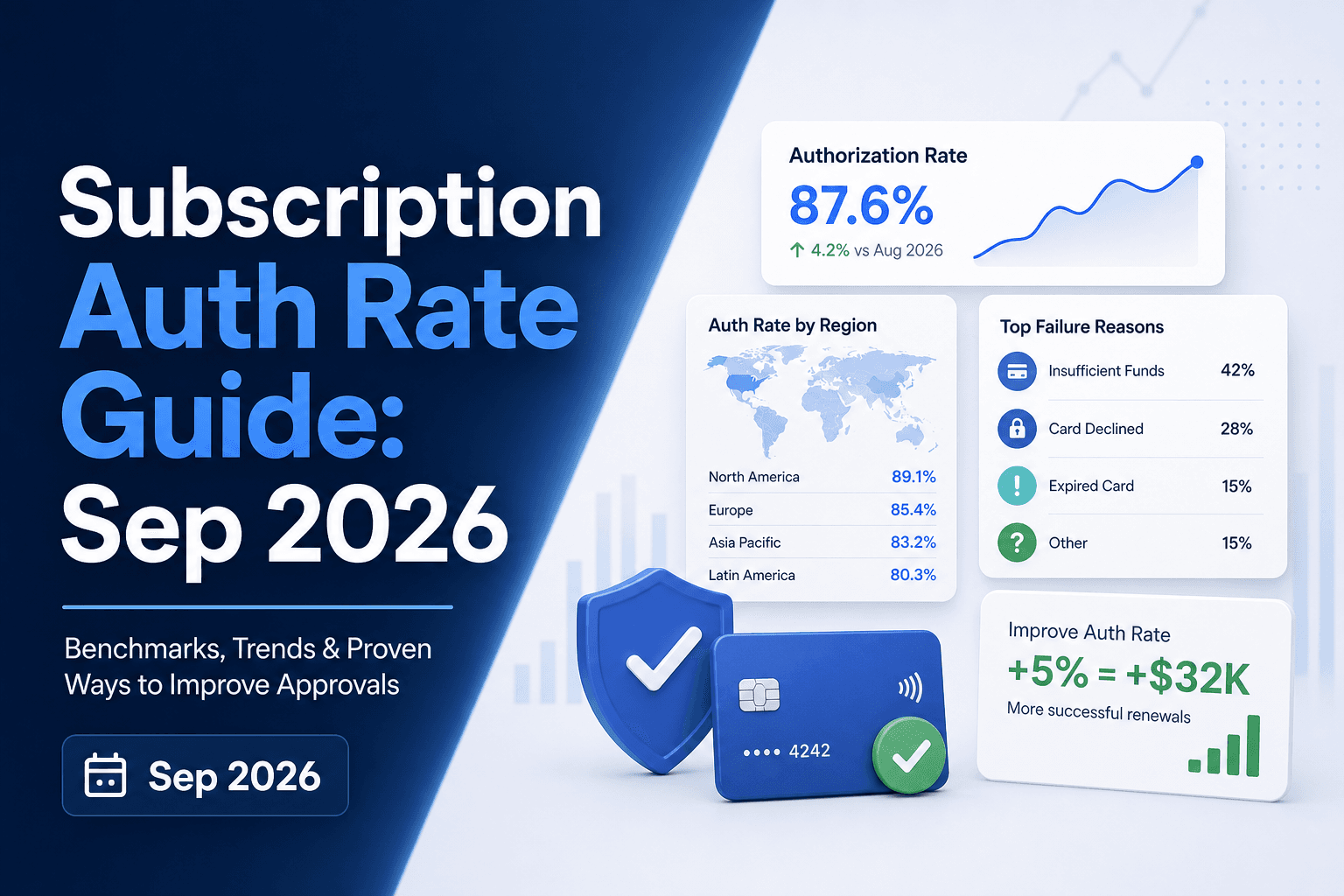
Authorization Rate in Subscription Billing: October 2026
There's a number sitting in your payments data that most finance and retention teams never report on separately: the share of renewal charges your issuing...
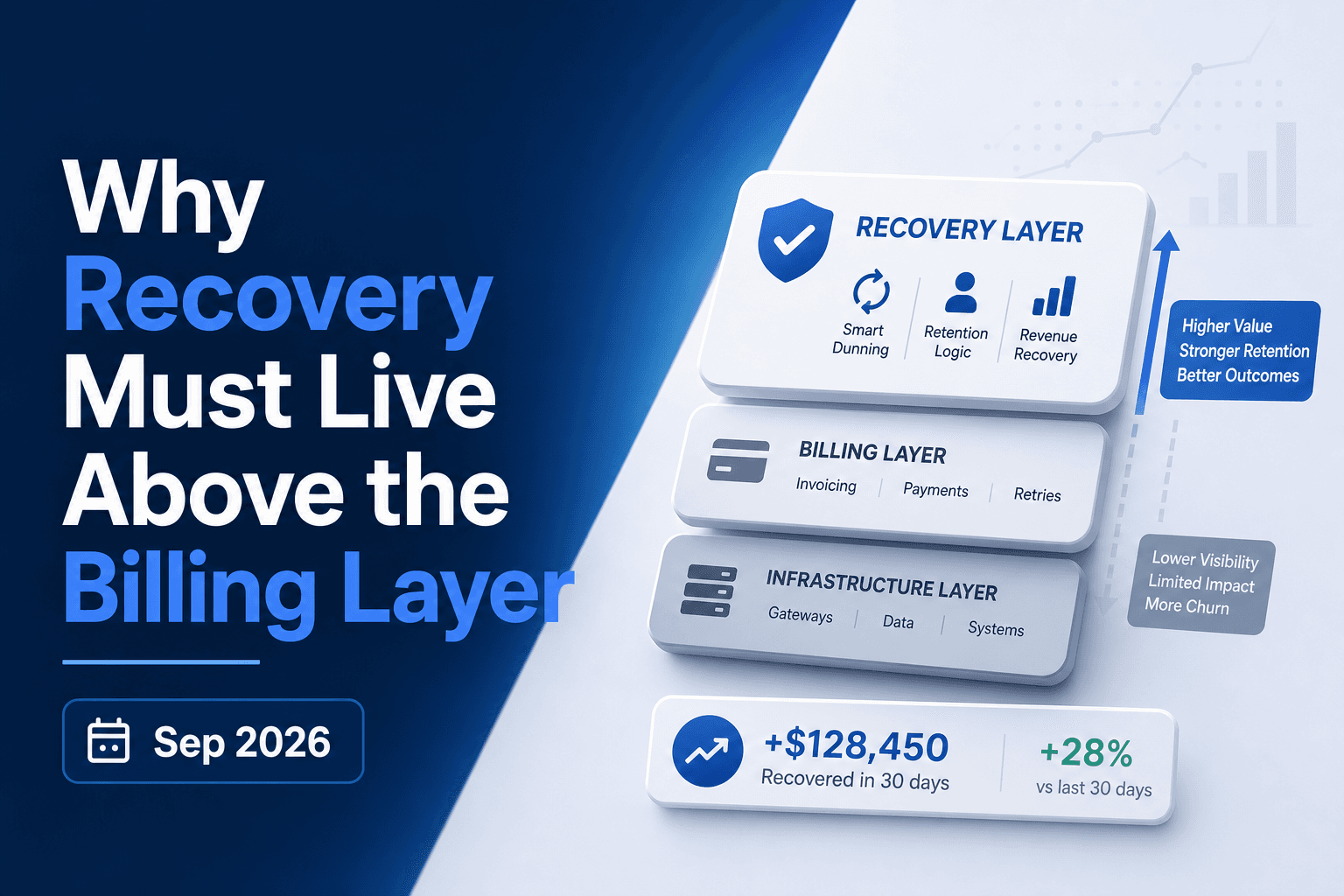
Why Payment Recovery Must Live Above Billers October 2026
A payment fails. Your biller retries it three days later, then again at seven, then at fourteen. What the biller never checks is whether the issuer sent a...
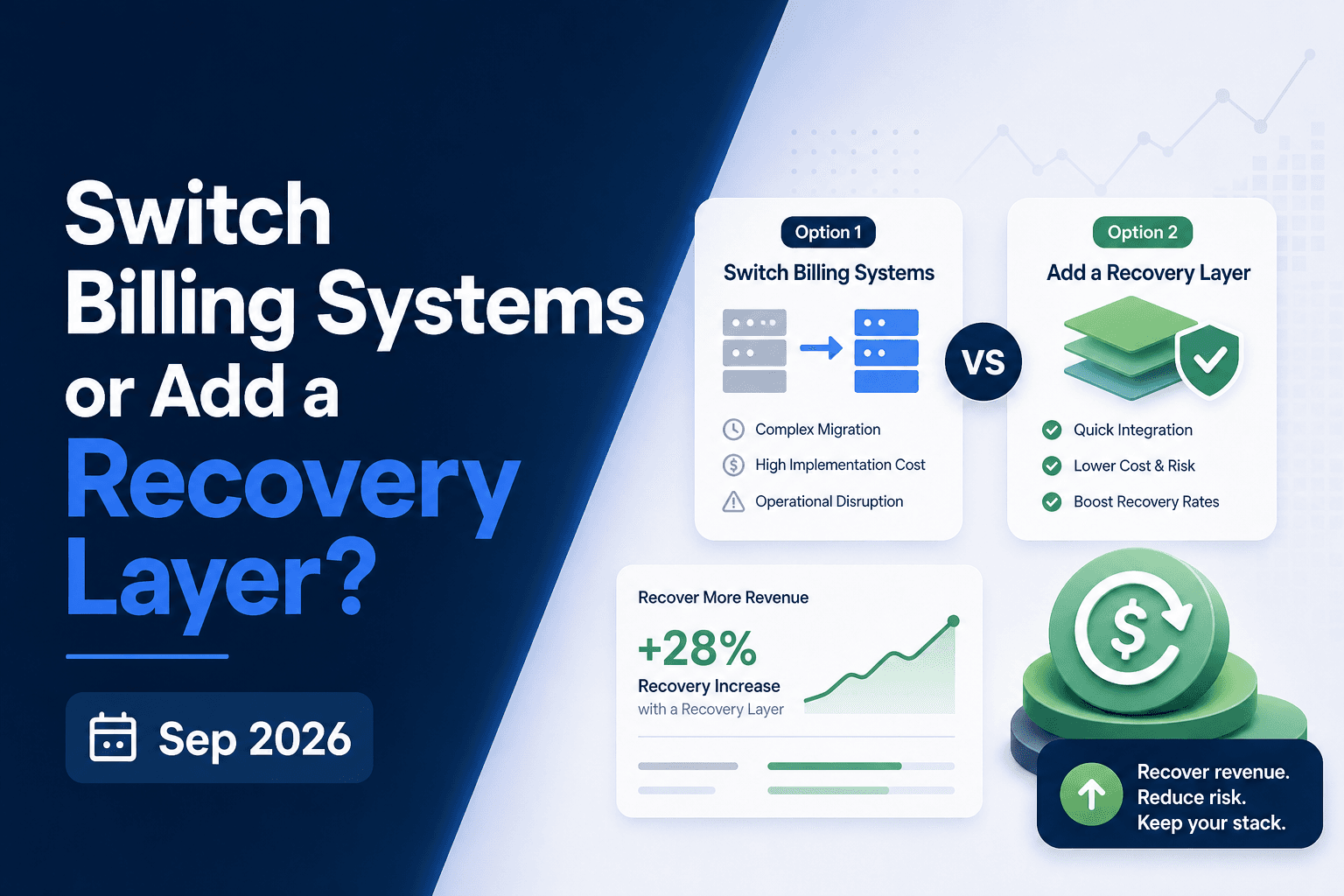
Billing Migration vs Recovery Layer: The Right Call October 2026
Switching billing systems feels like the right move when revenue collection starts breaking down. Sometimes it is. But soft declines, weak retry logic, and...
Stop losing revenue to failed payments
Join leading subscription businesses using Slicker to recover failed payments automatically.
Get Started