Soft vs Hard Declines: What They Mean for Recovery (Oct 2026)
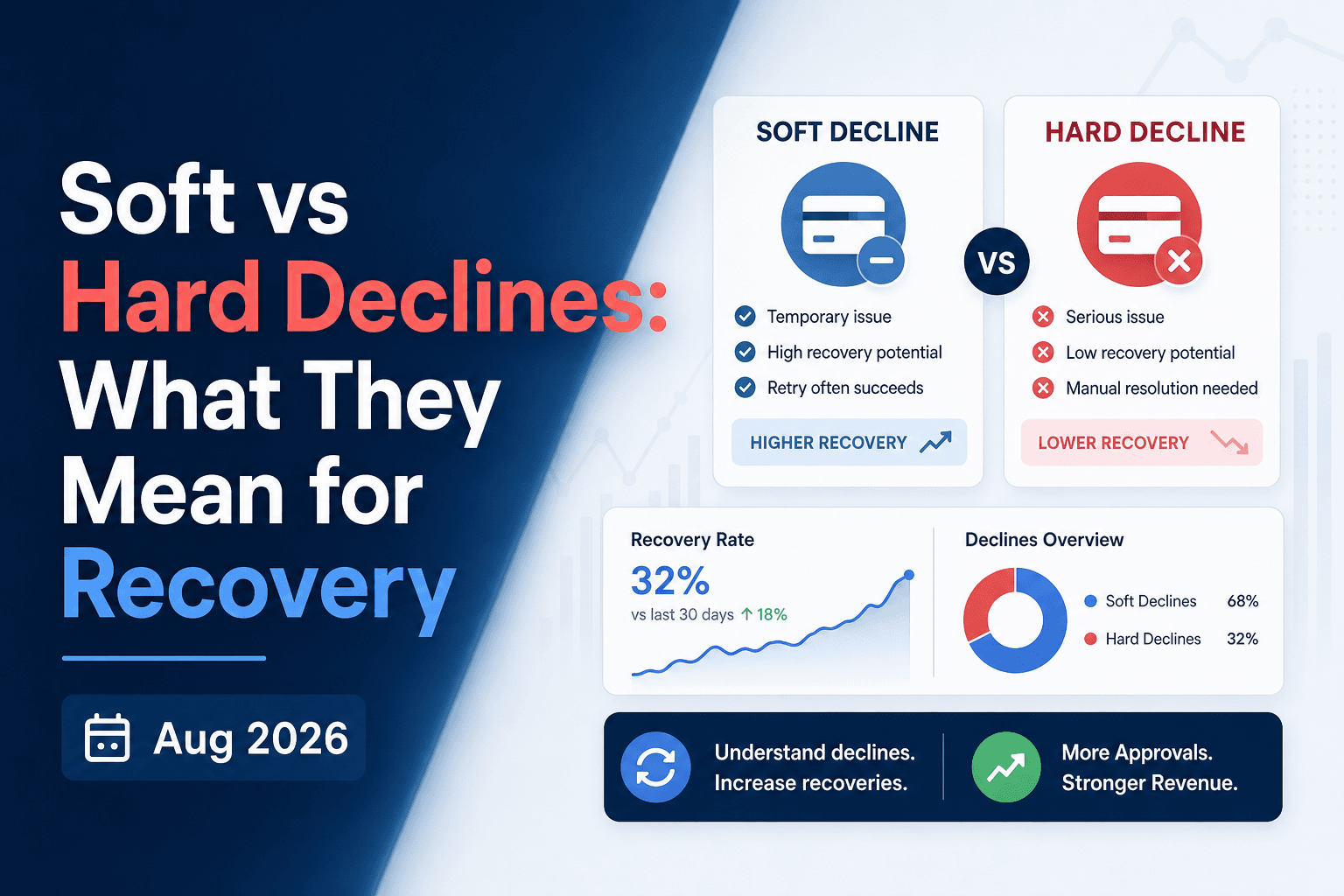
Your card network is telling you exactly what went wrong with each failed payment. The problem is that most billing systems aren't listening closely enough. Soft declines and hard declines carry completely different instructions, and collapsing them into one retry queue means you're either chasing payments that will never clear or abandoning revenue that was always recoverable.
TLDR:
- Soft declines are temporary; the card is valid and a well-timed retry recovers the revenue without any customer action.
- Hard declines are permanent: retrying codes like 41, 43, or 62 burns retry attempts, accumulates network fees, and depresses your authorization rates.
- Code 05 (Do Not Honor) paired with MAC 26 means retry after 2 days; paired with MAC 03, any retry triggers a $0.10 Mastercard penalty per attempt.
- Recurring payments see decline rates of 15 to 25 percent, roughly three times that of one-time purchases, so misclassifying soft declines as unrecoverable converts paying subscribers into involuntary churn.
- Slicker reads gateway code, network response code, and MAC together before any retry fires, recovering up to 70 percent of recoverable soft declines, verified via AABB testing on your own transaction data.
The Cost of Misreading a Payment Failure
Every month, subscription businesses lose roughly 9% of revenue to failed payments, per widely cited industry estimates. For a $10M ARR (annual recurring revenue) company, that resolves to $1M or more gone annually from customers who never chose to leave.
Between 20 and 40% of subscription churn is involuntary: customers pushed out by payment infrastructure, not dissatisfaction. They intended to stay. The card just failed at the wrong moment.
Whether that revenue is recoverable depends almost entirely on why the payment failed. Understanding your subscription payment retry strategy is where that analysis begins. Retry a stolen card and you waste attempts, accumulate network fees, and risk damaging your merchant standing. Abandon a temporarily underfunded debit card and you lose a subscriber who would have paid on day three. As one payments timing analysis finds, most declined payments are a timing problem, not a permanent block. Getting the classification right from the start is where recovery rates hold or fall apart, and where margin either stays intact or quietly erodes.
What a Soft Decline Means
A soft decline is a temporary authorization rejection. The card is valid, the account is active, and the customer has no idea anything went wrong. What failed was the circumstance: the account balance ran low before payday, a bank-side processing error fired at the wrong moment, a velocity limit triggered after a string of transactions, or the network timed out mid-authorization.
The underlying instrument is fine. The issuer isn't signaling fraud, cancellation, or compromise. It's signaling "not right now."
That distinction is what makes soft declines the primary target for automated recovery. Because the customer hasn't walked away and the card is still good, a well-timed retry can resolve the failure without anyone needing to pick up the phone or update their billing details. The revenue is still there. You just have to reach it at the right moment.
What a Hard Decline Means
Hard declines are permanent rejections. The card number is invalid, the account is closed, the card has been reported stolen, or the issuer has flagged the transaction for fraud. No timing adjustment will change that outcome. The problem is the instrument, not the moment.
A hard decline requires the cardholder to act before any payment can succeed: provide a new card, contact their bank, or resolve a fraud hold. Retrying the same card burns retry attempts, accumulates card network fees, and signals to issuers that your merchant account is poorly managed, which can lower authorization rates on future legitimate transactions across your entire subscriber base.
The categories worth knowing: stolen or lost card, closed account, invalid card number, and issuer-placed fraud blocks. Each is a dead end for automated recovery. The path forward is customer outreach, not another charge attempt.
Common Soft Decline Codes and What They Signal
Soft decline codes aren't interchangeable. Each signals a different recovery window, which changes how and when you retry.
Code | Description | Recovery Signal |
|---|---|---|
51 | Insufficient Funds | Retry aligned to payday; US consumer debit cards often clear at 12:01am when payroll deposits post |
61 | Exceeds Withdrawal Limit | Daily limit resets overnight; retry the following day |
65 | Exceeds Frequency Limit | Transaction count resets within 24 hours; one well-timed attempt usually suffices |
91 | Issuer Unavailable | Processor or network outage, not a card problem; retry within a few hours |
05 | Do Not Honor | Ambiguous on its own; outcome depends entirely on MAC pairing |
Code 05 is where fixed retry schedules break down most visibly. Alone, it tells you almost nothing about recoverability. Paired with MAC 26, it resolves to a defined 2-day soft decline with a clear retry window. Paired with MAC 03, any retry attempt becomes a compliance violation that triggers a $0.10 Mastercard penalty per attempt. Understanding merchant advice codes and payment recovery is required before acting on any decline signal. Subscription businesses face higher soft decline rates than one-time transaction merchants, so reading at this level of specificity is a revenue decision, not a technical one.
Common Hard Decline Codes and What They Signal
Hard decline codes carry a clear instruction: stop. The appropriate response to each one is customer outreach, not another charge attempt.
Code | Description | What It Means for Recovery |
|---|---|---|
04 | Pick Up Card / Fraud Flag | Issuer has flagged the card; automated retries will fail and may escalate issuer scrutiny |
14 | Invalid Card Number | The card number doesn't exist or has been entered incorrectly; no retry path |
41 | Lost Card | Cardholder has reported the card lost; issuer will block all attempts |
43 | Stolen Card | Cardholder has reported theft; retrying risks fraud-related penalties |
62 | Restricted Card / Closed Account | Account is closed or restricted at the issuer level; instrument is dead |
Two Mastercard MACs reinforce this with explicit consequences. MAC 03 (Do Not Try Again) is a hard stop: Mastercard charges $0.10 per attempt for any retry after receiving it. MAC 21 (Stop Recurring Payment) goes further, signaling that the cardholder has actively cancelled their recurring billing agreement through their bank. MAC 21 carries no documented per-retry monetary penalty, but treating it as a generic do-not-honor response is still a compliance error. Any retry after receiving MAC 21 violates Mastercard's rules and requires immediate cessation of all retry attempts on that account.
The path forward on any hard decline is a targeted customer communication that tells the subscriber exactly what happened and what action resolves it. A stolen card needs a fraud-alert message; a closed account needs a card-replacement request. Generic "update your payment method" emails sent to these segments miss the point and reduce conversion.
The Gray Zone: Ambiguous Decline Codes That Can Go Either Way
Not every decline arrives with a clear label. Code 05 (Do Not Honor) is the most common example: the issuer rejected the transaction but gave no reason. The same code can represent a temporary account restriction on one issuer and an active fraud flag on another.
Mastercard's Merchant Advice Codes (MACs) resolve this at the transaction level. Code 05 paired with MAC 26 means retry after 2 days. Paired with MAC 03, it means stop permanently, with a $0.10 penalty per attempt if you ignore it. Same gateway code, opposite instructions.
The problem compounds across multiple payment service providers. Checkout.com may surface the underlying network code directly; Stripe may collapse it into a generic generic_decline. Without a layer reading gateway codes, network codes, and MACs simultaneously, classification defaults to guesswork. Context before retrying generic declines is what separates recoverable revenue from wasted attempts, and guesswork in either direction costs you revenue.
Why Recurring Billing Makes the Distinction More Consequential
Recurring billing operates under structural disadvantages that one-time transactions don't face. Cards expire between billing cycles. Stored credentials lack CVV, which raises issuer risk scores. Subscription MCCs (Merchant Category Codes) attract heightened scrutiny at many banks. The result: recurring payments see average decline rates of 15 to 25 percent, roughly three times the rate of one-time purchases.
A subscriber whose renewal fails hasn't made any decision to leave. Misclassifying their soft decline as unrecoverable converts an active subscriber into involuntary churn, with no signal anything went wrong until the cancellation hits your MRR (monthly recurring revenue). That's recoverable revenue silently walking out.
Voluntary churn and involuntary churn require completely different responses. A soft decline retry playbook helps clarify when to retry, when to stop, and what to change. Lumping them together in churn metrics obscures recovery potential and misdirects retention resources toward customers who made a choice, away from customers who simply had a bad payment moment.
Soft Decline Recovery: How Retry Timing Actually Works
Effective soft decline recovery starts with reading what the decline code actually tells you about the account's state, then timing the retry accordingly. A network timeout (code 91) clears within hours. An insufficient funds decline on a consumer debit card follows a completely different clock.
Timing by Decline Type
Code 51 insufficient funds declines are where payday timing matters most. Consumer debit cards in the US typically clear at 12:01am when biweekly payroll posts, around the 1st and 15th of the month. Retry 2 to 3 days after those dates to catch the highest-probability window. Western European and UK cardholders on monthly payroll cycles warrant a different approach. Intelligent payday retries for these segments mean retrying within 48 hours of the last working day of the month, then hold until the equivalent window the following month.
A corporate card timeout behaves differently. Code 91 typically reflects a processor or network hiccup, not a balance problem. Retry within a few hours.
Mastercard MACs 24 Through 30
For recurring card-not-present transactions, Mastercard's Merchant Advice Codes (MACs) 24 through 30 prescribe specific retry windows:
- MAC 24: retry after 1 hour
- MAC 25: retry after 24 hours
- MAC 26: retry after 2 days
- MAC 27: retry after 4 days
- MAC 28: retry after 6 days
- MAC 29: retry after 8 days
- MAC 30: retry after 10 days
Following them reduces wasted attempts and keeps retry volume within network compliance limits.
Account Updater Services
Run Visa Account Updater and Mastercard Automatic Billing Updater alongside your retry logic. Many soft declines that appear to be insufficient funds or do-not-honor rejections are actually expired card failures. Resolving those before the retry cycle begins preserves retry attempts for genuinely timing-sensitive failures, improving recovery rates across the board.
Hard Decline Recovery: What Customer Outreach Actually Requires
When a hard decline fires, the first action is stopping retries entirely. The second is reading the failure reason before drafting a single word of outreach.
A stolen card and an expired card both produce hard declines, but they require completely different subscriber actions. A stolen card message should prompt the subscriber to contact their bank immediately and provide replacement payment details. An expired card message should direct them straight to a payment update page. Routing each failure correctly is the foundation of a failure reason dunning cadence that converts outreach into recovered revenue. Sending either message in response to the wrong failure type creates friction, confusion, and lower completion rates.
Before routing any hard decline into an outreach flow, run the card through Visa Account Updater or Mastercard Automatic Billing Updater. For lost or reissued cards with no fraud flag, the network may return a valid replacement credential automatically, resolving the issue before the subscriber ever sees a recovery email.
Where account updaters can't help (fraud blocks, closed accounts, genuinely cancelled cards), the outreach message needs to be direct and action-specific. Completion rates improve when the subscriber isn't left guessing whether the issue is on their bank's side, their card's side, or yours.
Card Network Retry Rules and the Cost of Getting Them Wrong
Visa and Mastercard payment retry rules are explicit, and violating them triggers direct monetary penalties that compound fast at volume.
Visa separates declines into two categories. Category 2 covers soft declines: retries are permitted, but fees apply once you exceed the threshold within a 30-day window. Category 1 covers hard declines: no retries are allowed, and penalty fees apply from the very first reattempt. Mastercard's Transaction Processing Excellence (TPE) program applies a $0.10 penalty per attempt when a merchant retries after receiving MAC 03 (Do Not Try Again). MAC 21 (Stop Recurring Payment) also requires an immediate halt to all retries, though Mastercard does not document a per-retry monetary penalty for it. The compliance obligation is to stop, not to absorb a fee on each attempt. As PayPal's excessive retry guidance notes, retry-related fees escalate for merchants who stay non-compliant across successive months.
The damage runs deeper than per-attempt fees. Excessive retries on hard declines signal to issuing banks that your merchant account has poor quality controls, which depresses your Transaction Authorization Rate (TAR) across all transactions, including first-attempt charges from new subscribers unrelated to the original failure.
Retry capacity is also finite. Every attempt burned on an unrecoverable card is one unavailable for a soft decline where timing is the only variable between a failed invoice and collected revenue.
Recovery Metrics That Actually Reflect Performance
Four metrics give a clearer picture of whether your retry strategy is working:
- Initial failure rate versus final failure rate: the gap between payments that fail on the first attempt and payments still unpaid after the full retry window closes. A wide gap means recoveries are happening; a narrow one means attempts are being wasted or the window is too short.
- Soft decline recovery rate: measured separately from hard declines. Mixing both into a single recovery figure produces a number that is nearly impossible to act on.
- Retry success rate by attempt number: most recoverable soft declines resolve on the first or second retry. If your third and fourth attempts carry the same weight as the first, either your timing logic needs adjustment or you are retrying cards that will not clear.
- Recovery distribution across the dunning window: production data shows roughly 13% of failed invoices recover in the third week of dunning. After day 21, recovery rates drop to negligible levels, which is why stopping retries earlier often outperforms extending the window, and informs how long a grace period is worth keeping open.
Recovery rates shift with subscriber mix, payment method, geography, and billing infrastructure. Your historical baseline, measured cleanly across decline type, is the only comparison that reflects your actual recovery ceiling.
How Slicker Classifies and Recovers Soft and Hard Declines
Slicker reads the full signal set before any retry decision fires: gateway code, network response code, and Merchant Advice Code (MAC). The Code 05 ambiguity covered earlier is a good example. Instead of treating it as a single input, Slicker layers in MAC guidance, card type, issuer behavior, and historical outcomes to determine whether a failure is recoverable and, if so, when to retry.
That classification depth is what separates smart retries from calendar-based schedules. Smart dunning systems consistently recover 70 to 85 percent of recoverable failures; fixed retry schedules typically land between 40 and 60 percent. Slicker has recovered up to 70 percent of recoverable soft declines in AABB-tested deployments on individual customers' own transaction data.
A planned Mastercard network partnership (planned for a future release) will add a further layer: when a previously declined card is successfully used elsewhere on the network, Slicker will receive a real-time fund-availability signal and trigger an immediate retry, replacing estimated payday-pattern timing with confirmed cardholder activity.
Those figures come from AABB testing run on your own subscriber base before any full commitment. The pilot is four months: the first month free, three paid, cancel anytime. Integration takes under five minutes with zero engineering lift.
Final Thoughts on Soft and Hard Decline Recovery
The gap between a 40% recovery rate and a 70%+ recovery rate almost always comes down to whether your retry logic reads the full signal set or defaults to a fixed schedule. Soft declines reward precise timing; hard declines reward stopping immediately and routing to the right outreach message. Your subscribers who hit a bad payment moment deserve both. Reach out to the Slicker team to run an AABB test on your own transaction data and see the actual recovery difference.
FAQs
What is the difference between soft declines and hard declines in recurring billing?
Soft declines are temporary rejections where the card is valid but the circumstance failed: low balance before payday, a bank-side processing error, or a velocity limit. Hard declines are permanent rejections where the instrument itself is the problem: stolen cards, closed accounts, invalid card numbers, or issuer fraud flags. The distinction determines everything about recovery strategy: soft declines are the primary target for automated retries timed to payday cycles and issuer windows, while hard declines require stopping retries immediately and sending failure-specific customer outreach instead.
What percentage of subscription revenue is typically lost to failed payments?
Industry data puts the figure at roughly 9% of subscription revenue, and between 20 and 40% of all subscription churn is involuntary, meaning customers pushed out by payment infrastructure, not dissatisfaction. For a $10M ARR business, that resolves to $1M or more in revenue annually from customers who intended to stay. The share that is recoverable depends on how accurately you classify each failure: most soft declines are a timing problem, not a permanent block.
Can Slicker retry a soft decline at the right time without involving the customer?
Yes. When a payment fails with a recoverable soft decline code, Slicker reads the full signal set (gateway code, network response code, and Merchant Advice Code) and schedules a retry at the highest-probability recovery window for that specific card and issuer, without the customer ever knowing a failure occurred. For US consumer debit cards with insufficient funds, that often means 12:01am when payroll clears. Through a planned Mastercard network partnership (planned for a future release), Slicker will also receive a real-time fund-availability signal when a previously declined card is used elsewhere on the network, replacing estimated payday-pattern timing with confirmed cardholder activity. Customer outreach is only triggered when the failure type requires cardholder action, such as a stolen or expired card.
How does Chargebee's built-in retry logic handle failed payments compared to an AI-powered retry solution?
Chargebee's native smart dunning uses a fixed retry schedule that applies the same logic regardless of decline code, card type, issuer, or geography. It doesn't read Merchant Advice Codes to distinguish a 2-day retry window from a hard stop, and it can't time retries to payday cycles by region or issuer. AI-powered retry systems analyze over 40 variables per transaction, including card type, issuer behavior, local payday cadence, and time of day, consistently recovering 70 to 85% of recoverable failures compared to 40 to 60% for fixed schedules. Slicker runs alongside Chargebee's infrastructure and can be tested in a direct A/B comparison against Chargebee's native retry logic before any full commitment.
What are the best failed payment recovery tools for subscription businesses in 2026?
The tools worth considering are Slicker, Butter, Churn Buster, Churnkey, and Revaly, with billing-platform built-ins like Chargebee smart dunning and Stripe Smart Retries as the baseline. The primary differentiator across the category is how each vendor proves performance: most rely on benchmarks or claims, while Slicker uses AABB testing (a crossover design borrowed from clinical trials) to measure incremental dollars recovered on your own subscriber data before you commit. Key capability gaps to check include whether the tool reads Merchant Advice Codes to avoid compliance penalties, whether dunning emails are failure-reason-specific and not generic, and whether the vendor supports enterprise billing platforms like Zuora alongside Stripe and Chargebee.
Related Articles

Stripe Dunning Configuration Guide (September 2026)
A surprising share of the subscribers leaving your list every month never chose to cancel. Their payment failed, your retry window ran out, and Stripe...
Stripe Recovery Add-On Evaluation Guide (September 2026)
Stripe's built-in recovery tools cover real ground. Smart Retries, Account Updater, dunning emails. For a lot of subscription businesses, that's a reasonable...

What Subscription Operators Miss About Built-In Retries (Oct 2026)
If your billing platform retries run on a fixed 14-to-21-day countdown from the failure date, they have no idea when your subscriber's paycheck actually...
Stop losing revenue to failed payments
Join leading subscription businesses using Slicker to recover failed payments automatically.
Get Started