Diagnose Involuntary Churn: 7 Billing Questions (Oct 2026)

Most churn dashboards hand you one number and let you figure out what's inside it. The problem is that a billing failure and a deliberate cancellation look identical in that number, so the fix you reach for is usually aimed at the wrong cause. Separating the two starts with a few direct questions about how your billing stack actually handles a failed payment.
TLDR:
- Involuntary churn accounts for 20 to 40% of subscription losses and is largely recoverable with the right billing stack audit.
- At $10M ARR (annual recurring revenue), 1 to 2% monthly involuntary churn sends $1 to 2M out the door annually from subscribers who never chose to leave.
- Smart retry systems recover 70 to 85% of recoverable failed payments; fixed retry schedules land between 40 to 60%, per industry benchmarks.
- Retrying after a do-not-retry MAC costs $0.10 per attempt and risks merchant ID (MID) suspension; your retry scheduler must read these codes before firing.
- Slicker runs a read-only diagnostic first, then measures recovery in incremental dollars against a randomized control group before billing begins.
What Involuntary Churn Actually Is (And Why It Hides in Your Data)
Involuntary churn happens when a subscriber loses access not because they chose to leave, but because a payment failed. The card expired. The account hit a temporary shortfall. An issuer's fraud filter fired at the wrong moment. The customer is still happy with your product, still intending to pay, often completely unaware anything went wrong.
Voluntary churn is the opposite: a deliberate cancellation driven by dissatisfaction, pricing friction, or a changed need. Understanding what involuntary churn is is the first step toward separating these two very different problems. These two types of loss share almost nothing in terms of cause or fix. Voluntary churn lives in your product and pricing. Involuntary churn lives in your billing stack.
Most churn reports blend both into a single number. When that happens, a payments problem gets misread as a retention problem, and teams spend time on product improvements for subscribers who were never actually dissatisfied. The distinction between involuntary churn vs voluntary churn is foundational to fixing the right problem. According to data from the 2026 dunning playbook published by Digital Applied, involuntary churn accounts for an estimated 20 to 40% of all subscription losses. That share is largely recoverable with the right infrastructure, making it a revenue operations problem, not a product-market fit signal.
Why Blended Churn Metrics Mask the Problem
A 5% monthly churn rate looks like a retention problem. It gets assigned to product, to customer success, to pricing. Surveys go out. Roadmap items shift. Meanwhile, 1 to 2 of those percentage points may be pure billing failure, recoverable with the right stack, and nobody is looking at them.
The core issue is attribution. When a subscriber's payment fails silently and the account cancels after a grace period, that cancellation enters the churn report looking identical to a deliberate cancellation. No flag, no distinction, no separate line item. The number absorbs it.
For a business running $10M ARR (annual recurring revenue), 1 to 2% monthly involuntary churn translates to $1 to 2M walking out annually from customers who never decided to leave. Framing that as a product problem produces the wrong fix. Retention initiatives cost time and money; a billing audit costs neither, and it targets the actual source.
Teams that never split voluntary from involuntary churn also lose the ability to benchmark correctly against involuntary churn rate SaaS benchmarks. Recovery rates, dunning effectiveness, retry performance: none of these metrics are visible or actionable inside a blended figure. You cannot optimize what you cannot see, and separating the two is the first step most subscription businesses skip.
The 7 Diagnostic Questions for Your Billing Stack
Run these seven questions against your billing setup. Any "no" or "I don't know" is a gap worth fixing.
Question 1: What Percentage of Your Churn Is Payment-Related?
Divide payment-failure-driven cancellations by total cancellations in the period. If your billing system does not tag cancellation reason codes, that absence is itself a finding.
Question 2: How Is Your System Classifying Decline Codes?
Understanding soft vs hard declines is foundational here: soft declines (insufficient funds, network timeouts) are retryable, while hard declines (stolen cards, closed accounts) are not. Retrying hard declines wastes attempts, risks card network penalties, and damages merchant standing with issuing banks.
Question 3: Is Your Retry Logic Timing-Aware or Calendar-Based?
Smart retry systems consistently recover 70 to 85% of recoverable failed payments; fixed retry schedules typically land between 40 to 60% (Source: Digital Applied dunning playbook). That gap comes almost entirely from timing precision: intelligent payday retries for US biweekly cycles, Western European monthly payroll windows, and Australian fortnightly cadences outperform calendar-based schedules materially.
Smart Retry System | Fixed Retry Schedule | |
|---|---|---|
Recovery rate | 70 to 85% of recoverable failures | 40 to 60% of recoverable failures |
Timing logic | Payday-aligned, issuer-aware, hour-level scheduling | Calendar-based intervals (e.g., every 3 days) |
Decline code handling | Classifies soft vs. hard declines; stops on hard declines immediately | Often applies the same schedule regardless of decline type |
Card network compliance | Reads MACs and respects network retry limits before firing | May retry after do-not-retry codes, risking penalties |
Geographic awareness | Accounts for US biweekly, Western European monthly, Australian fortnightly cycles | No geographic payroll calendar adjustment |
Configuration required | None on merchant side; engine self-tunes per transaction | Manual rule-setting; may require periodic updates |
Question 4: Are You Respecting Card Network Retry Limits?
Visa allows up to 20 retries per card per 30-day window on soft declines. Mastercard charges $0.10 per retry when MAC 03 instructs "Do Not Try Again," and violations can escalate to merchant ID (MID) suspension. Understanding Visa and Mastercard payment retry rules is critical here; ask whether your retry scheduler reads these codes before firing.
Question 5: Are Your Dunning Emails Failure-Reason-Specific?
A stolen card and an expired card require different customer actions, which is why a failure reason dunning cadence matters. A generic "update your payment method" message regardless of decline type leaves recoveries on the table. Emails should deploy only when customer action is genuinely required, sent from your own domain.
Question 6: Are You Tracking Initial vs. Final Failure Rates Separately?
A 15% initial failure rate with a 6% final rate means recovery infrastructure is working. The same 15% with a 13% final rate is a system problem. Most dashboards only surface the first number.
Question 7: Do You Have a Controlled Way to Measure Recovery Performance?
A raw recovery count is not a performance measurement. Ask whether results are validated against a randomized control group, whether cohorts are stratified by failure type and amount, and whether outcomes are expressed in recovered dollars at statistical significance, not percentages pulled from favorable periods.
The Five Most Common Failure Modes Found in a Billing Audit
These five failure modes appear repeatedly when subscription businesses run a billing stack audit.

- Unclassified decline codes: when your system cannot distinguish a network timeout from a fraud flag, it retries both the same way. Hard declines that should stop immediately keep consuming retry attempts and accumulate card network penalties.
- Retrying after do-not-retry MACs: firing another attempt after receiving Mastercard MAC 03 costs $0.10 per attempt and risks MID (merchant ID) suspension. The financial exposure scales directly with transaction volume.
- Dunning cadence locked to retry cadence: when emails fire every time a retry fires, subscribers receive a message for every failed attempt. Complaint rates rise, deliverability drops, and future recovery emails land in spam.
- No initial versus final failure rate separation: without both numbers, there is no way to know whether recovery infrastructure is functioning or failing silently.
- Identical handling for soft and hard declines: billing stack built-ins frequently apply the same retry schedule regardless of decline type. A stolen card retried eight times produces no revenue and measurable reputational damage with the issuing bank.
Each failure mode compounds the others. Poor code classification drives non-compliant retries. Those retries inflate dunning volume, and inflated volume poisons deliverability. The audit's value is tracing that chain back to its source before the revenue loss becomes structural.
How Acquisition Quality Affects Your Involuntary Churn Rate
Not all involuntary churn is created equal. Your billing audit will often surface that the problem clusters in specific cohorts, not spread evenly across your subscriber base.
Free-trial flows are the most common culprit. When users sign up with low-intent prepaid cards or unfunded virtual card numbers, the first post-trial charge fails at rates that have nothing to do with your retry logic. Mobile app store subscribers show different failure patterns than direct web subscribers, partly due to how payment methods are tokenized through Apple or Google's infrastructure.
A spike in involuntary churn among trial-converted subscribers is often a card-quality signal, not a billing-stack failure. A channel that drives high volume but poor payment success rates erodes MRR (monthly recurring revenue) before recovery infrastructure ever gets involved.
Knowing how to measure subscription churn rate and segment failure rates by acquisition channel, payment method type, and product plan separates these signals cleanly. When data shows a prepaid card concentration in one cohort versus a standard debit mix in another, the recovery strategy and acceptable recovery investment differ accordingly.
What a Proper Recovery Stack Looks Like After the Audit
A well-functioning recovery stack has three layers, each with a distinct job.

The first is an account updater service. Before any retry fires, the stack checks whether the card on file has been replaced, reissued, or expired. Card networks replace roughly 40% of cards annually through fraud response and routine reissuance. Catching that update before a retry attempt converts a certain failure into a likely success without touching the subscriber.
The second is a retry engine that classifies decline codes before scheduling anything. Soft declines get retried; hard declines stop immediately. Timing aligns to issuer behavior and payday windows, not a fixed calendar. The engine reads Merchant Advice Codes in payment recovery and respects network limits. Visa allows up to 20 retries per card per 30-day window on soft declines, while Mastercard allows 10 retries within 24 hours on soft declines. Where MACs prescribe a retry window that conflicts with the dunning deadline, the engine finds the highest-probability attempt within that constraint, overriding network guidance where necessary.
The third is a dunning layer that only activates when automated recovery has reached its limit and customer action is genuinely required. Stolen card, expired card, and cancelled mandate each produce a different message with a different call-to-action, sent from the merchant's own domain. Volume stays low because the engine handles most recoveries silently, keeping deliverability high so the emails that do go out actually land.
The architectural principle connecting all three: silent automated recovery is the primary path, and customer outreach is the fallback. A stack where dunning fires on every failed attempt has the layers inverted, and the deliverability cost compounds over time.
How to Measure Recovery Performance Without Getting Deceived by the Numbers
Recovery rate percentages are the easiest number to manipulate in a billing audit report. A vendor selects a favorable cohort, measures against a weak baseline, and surfaces a figure that looks compelling but tells you nothing about incremental revenue impact.
The distinction that matters is recovery rate versus recovered dollars. A 70% recovery rate on a deliberately narrow cohort of low-risk soft declines produces less revenue than a 50% rate applied correctly across the full failure mix. Percentages without cohort definition are unverifiable.
Properly structured performance measurement requires four things:
- A randomized control group receiving no treatment, so any lift is genuinely incremental.
- Stratified cohort assignment by failure type (insufficient funds, generic declines, and do-not-honor codes kept separate) and by transaction amount range.
- Sufficient volume to reach statistical significance before declaring a winner.
- Results expressed as incremental dollars recovered above the control baseline, not as a percentage in isolation.
Without stratification, a test that over-represents easy-to-recover failures in the treatment group will show inflated lift that disappears at full deployment.
Track time-to-recovery alongside recovery rate. A system that recovers the same percentage of failures but does so three days faster reduces the window of suspended access, which carries real cost for content businesses and material subscriber experience consequences for SaaS. Speed is a separate performance dimension.
Ask any vendor for the p-value on their reported results and the cohort composition underlying their recovery rate figure. If that answer is unavailable, the number is not a measurement.
How Slicker Approaches the Billing Stack Audit
Slicker's onboarding begins with a read-only integration that surfaces initial and final failure rates, decline code distributions, and recovery attribution gaps before any retry logic runs. No write access required, no engineering lift, and setup takes about 5 minutes with no code changes on your side. The diagnostic picture comes first.
From there, AABB testing in payment recovery splits failed payments into a randomized control group and a treatment group with stratified covariate randomization: failure types, amount ranges, and billing attributes are balanced across both cohorts to prevent result inflation. Performance is measured in incremental dollars recovered above the control baseline, held to statistical significance before billing begins.
The retry engine analyzes over 40 variables per transaction, including card type, issuing bank, BIN data, geographic payday calendar, time of day, and Merchant Advice Codes (MACs), to determine whether to retry, when, and on which payment method. That answers diagnostic Questions 2, 3, and 4 at the infrastructure level, with no configuration work on the merchant's side.
The four-month pilot structure (first month free, three paid months, cancel anytime) is built around the accountability requirement in Question 7. Merchants see verified recovery improvement on their own data before committing to an annual contract. If Slicker does not outperform the control with statistical significance, payment does not begin.
Final Thoughts on Separating Involuntary Churn From the Rest of Your Billing Data
A blended churn number is a convenient fiction that keeps real billing problems invisible. Working through the seven diagnostic questions and auditing your decline code handling, retry logic, and dunning cadence gives you the actual picture. For most subscription businesses, even closing one or two of the gaps covered here produces measurable MRR recovery from subscribers who never had any intention of leaving. If you want to start with a read-only look at your own failure rates, Slicker's onboarding is built for exactly that.
FAQs
What percentage of subscription revenue is typically lost to failed payments, and how do you separate that from voluntary churn?
Industry data puts 20 to 40% of all churn attributable to payment failures rather than deliberate cancellations, per the Digital Applied dunning playbook. The separation requires tagging cancellation reason codes in your billing system: if your platform does not distinguish payment-failure-driven cancellations from voluntary ones, your churn report is blending two problems that have entirely different fixes.
How do subscription businesses measure involuntary churn caused by failed payments, and what KPIs should we be tracking?
The core metrics are initial failure rate, final failure rate after the full retry window, and the delta between them expressed in recovered dollars. Tracking only the initial failure rate tells you how much is going wrong; tracking only recovery rate as a percentage tells you how well the system appears to be working on a potentially cherry-picked cohort. The pair together, measured against a randomized control group with stratified cohort assignment by failure type and transaction amount, gives you a number you can take to a CFO without qualification.
Chargebee Smart Dunning vs a dedicated recovery platform: which recovers more failed payments?
Smart retry systems with timing intelligence consistently recover 70 to 85% of recoverable failed payments; fixed retry schedules, including billing-platform built-ins like Chargebee Smart Dunning, typically land between 40 to 60%. The gap comes from timing precision: payday-aligned retries, issuer-specific authorization windows, and hour-level scheduling, not from simply increasing retry volume. The only way to verify which approach recovers more on your specific subscriber mix is a controlled test with a randomized split and results expressed in incremental dollars recovered above a baseline, not a percentage drawn from a favorable cohort.
Can Slicker integrate with a Zuora or in-house billing stack without disrupting existing payment rails or finance workflows?
Yes. Slicker triggers retries through Zuora's own API, so all recovered payments flow identically to regular payments through existing finance, accounting, and revenue recognition workflows with no downstream system changes required. Decline code classification, retry scheduling, and MAC compliance all run on Slicker's side; Zuora receives only the retry instruction and processes it like any standard charge.
For in-house billing systems, integration requires three API endpoints and two webhooks. Slicker sends a retry instruction to the merchant's system, which executes the charge using its own stored tokens, keeping payment credentials inside the merchant's infrastructure. The same decline code classification and payday-aligned scheduling logic applies regardless of the underlying billing system, and recovered payments flow through the merchant's existing finance and revenue recognition stack without modification. In both cases, a read-only integration can be set up first to surface failure rates and decline code distributions before any write access or active retry execution is granted.
What level of access does Slicker need from billing and payment platforms before active retries begin?
Slicker supports an initial read-only integration using read-only API keys that surfaces initial and final failure rates, decline code distributions, and recovery attribution gaps without requiring write access or any engineering work. Write access is added only when moving to active retry execution. Both the billing system and the payment service provider need to be connected for full analytics depth; connecting only one source returns a materially reduced diagnostic picture.
Related Articles

Authorization Rate in Subscription Billing: October 2026
There's a number sitting in your payments data that most finance and retention teams never report on separately: the share of renewal charges your issuing...
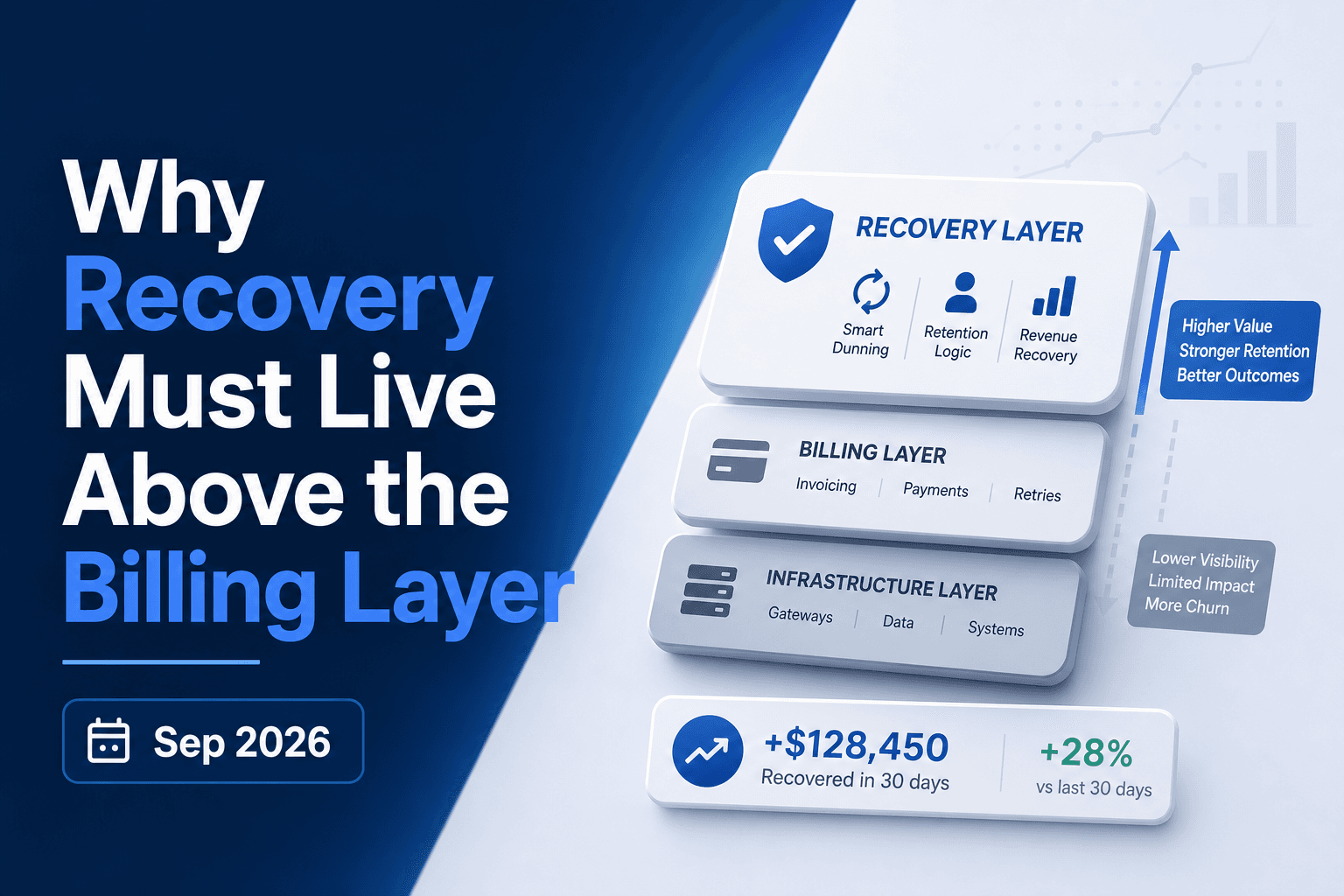
Why Payment Recovery Must Live Above Billers October 2026
A payment fails. Your biller retries it three days later, then again at seven, then at fourteen. What the biller never checks is whether the issuer sent a...
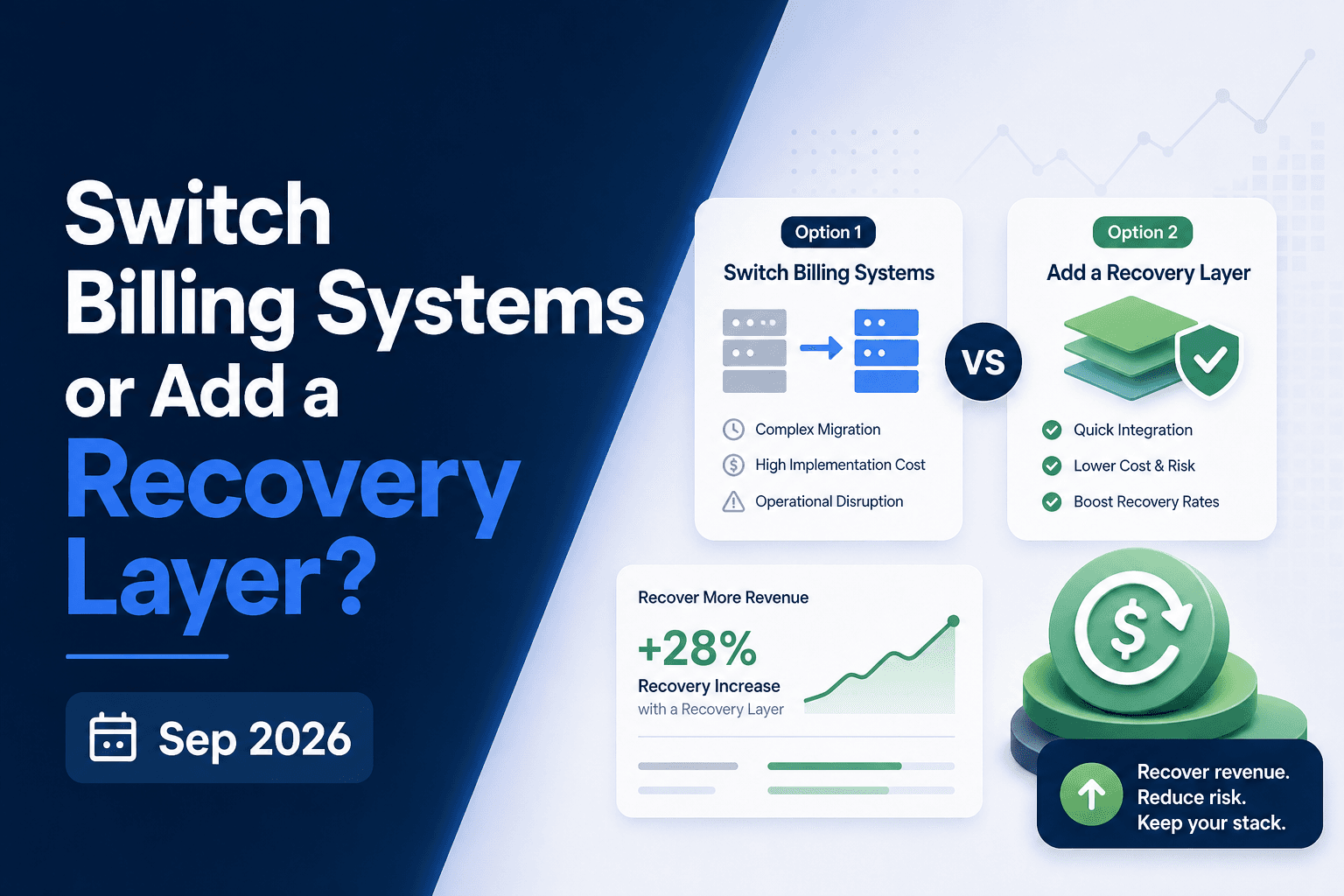
Billing Migration vs Recovery Layer: The Right Call October 2026
Switching billing systems feels like the right move when revenue collection starts breaking down. Sometimes it is. But soft declines, weak retry logic, and...
Stop losing revenue to failed payments
Join leading subscription businesses using Slicker to recover failed payments automatically.
Get Started