B2C Subscription Failed-Payment Benchmarks and AI Recovery (Oct 2026)

Introduction
Failed payments are the silent killer of subscription revenue. While businesses obsess over customer acquisition costs and conversion rates, they often overlook the fact that up to 70% of involuntary churn stems from failed transactions, customers who never intended to leave but are forced out when a card is declined (Slicker). In 2026, this problem continues to reach critical mass across B2C subscription verticals, with decline rates reaching 30% in some industries (Stripe).
The stakes couldn't be higher. A staggering 62% of users who hit a payment error never return to the site (Stripe), and 25% of lapsed subscriptions are due to payment failures, a phenomenon known as involuntary churn (Stripe). But here's the game-changer: AI-driven payment recovery systems can recapture up to 70% of failed payments, with tools like Slicker delivering 2-4× better recovery rates than native billing-provider logic (Slicker).
This analysis reviews 2025 failed-payment benchmarks across beauty-box, OTT, and fitness subscription verticals, revealing how AI-powered solutions are pushing renewal-invoice paid rates above 96% and changing revenue recovery for subscription businesses.
TLDR:
- Involuntary churn drives up to 40% of total subscription losses, and 62% of users who hit a payment error never return.
- Failed payment rates reach 18-25% in subscription boxes and 20-28% in e-commerce subscriptions, putting $5,000-$8,400 at risk per 1,000 subscribers monthly.
- Smart retry systems recover 70-85% of soft declines; fixed retry schedules typically land between 40-60%, per industry benchmarks.
- Subscription box businesses see up to 68% of total churn attributed to failed payments, well above generic vertical averages (SubJolt, 2026).
- Slicker uses AABB (A/A/B/B split) testing with statistical significance on your own transaction data to prove incremental recovery before you pay.
The Current State of Failed Payments in B2C Subscriptions
Industry-Wide Impact
Involuntary churn has become a growing problem for subscription businesses, with involuntary churn rates accounting for 20-40% of total customer churn. The problem is particularly acute in B2C subscription models where payment methods change frequently due to card expiration, bank switches, and spending limit adjustments.
Recent industry data reveals that churn has two distinct components: involuntary vs voluntary churn, with involuntary churn easily making up 40% of total churn depending on the nature of the business (Churnkey). This involuntary component includes both soft and hard credit card declines, each requiring different recovery strategies.
The Technology Gap
Despite the magnitude of this problem, many subscription businesses still rely on basic retry logic built into their billing tools. By early 2026, 40% of subscription companies had adopted AI for revenue recovery and churn prediction, with adoption accelerating as static retry logic proves less competitive (Recurly 2026 State of Subscriptions).
The difference in performance is stark. Subscriptions that were about to churn for involuntary reasons but are recovered by advanced tools continue on average for seven more months (Stripe), representing substantial lifetime value recovery.
2025 Failed-Payment Benchmarks by Vertical
Industry Vertical | Average Monthly Churn Rate | Involuntary Churn % | Failed Payment Rate | AI Recovery Potential | Revenue at Risk (per 1000 subscribers) |
|---|---|---|---|---|---|
Beauty & Subscription Boxes | 10-15% | 35-45% | 18-25% | 65-75% | $4,500-$7,500 |
OTT & Media Entertainment | 5-8% | 25-35% | 12-18% | 70-80% | $2,400-$4,320 |
Health & Fitness | 7-10% | 30-40% | 15-22% | 60-70% | $3,150-$5,500 |
E-commerce Subscriptions | 10-15% | 40-50% | 20-28% | 65-75% | $5,000-$8,400 |
SaaS (B2C) | 4-6% | 20-30% | 8-15% | 75-85% | $1,600-$2,700 |
Revenue calculations based on average subscription values: Beauty ($25), OTT ($12), Fitness ($45), E-commerce ($35), SaaS ($45)
Detailed Vertical Analysis
Beauty and Subscription Boxes
The beauty and subscription box vertical faces some of the highest churn rates in the industry, with average monthly churn rates ranging from 10-15% (Churnkey). This sector is particularly vulnerable to payment failures due to:
- High customer acquisition through social media leading to impulse subscriptions
- Frequent use of promotional pricing that transitions to higher regular rates
- Younger demographic with more volatile payment methods
- Seasonal spending pattern fluctuations
Involuntary churn represents 35-45% of total churn in this vertical, with failed payment rates reaching 18-25%. The revenue impact is substantial. For every 1,000 subscribers, businesses risk losing $4,500-$7,500 monthly to failed payments alone.
OTT and Media Entertainment
Over-the-top (OTT) and media entertainment subscriptions show more moderate churn rates at 5-8% monthly (Churnkey), but the sheer volume of subscribers means even small improvements in payment recovery translate to major revenue gains.
This vertical benefits from:
- More stable viewing habits creating stronger retention
- Lower price points reducing payment friction
- Existing payment infrastructure from major players
However, involuntary churn still accounts for 25-35% of total churn, with failed payment rates of 12-18%. AI recovery systems show particularly strong performance here, achieving 70-80% recovery rates.
Health and Fitness Subscriptions
The health and fitness vertical sits in the middle range with 7-10% monthly churn rates (Churnkey). This sector faces unique challenges:
- Seasonal subscription patterns (January spikes, summer lulls)
- Higher price points increasing payment sensitivity
- Competition from free alternatives and gym memberships
Involuntary churn represents 30-40% of total churn, with failed payment rates of 15-22%. The higher average subscription values mean revenue at risk ranges from $3,150-$5,500 per 1,000 subscribers monthly.
How AI Improves Payment Recovery
The AI Advantage
AI-powered payment recovery systems represent a fundamental shift from static retry logic to intelligent, adaptive strategies. Modern AI systems can predict customer churn weeks before it happens, allowing businesses to take proactive measures (MyAIFrontDesk).
Slicker's AI-powered engine reads each failed transaction individually, analyzing patterns in geography, currency, pay cycles, and error codes to choose optimal retry timing (Slicker). This approach can improve approval odds considerably, sometimes retrying within hours, sometimes waiting until after payday.
Key AI Capabilities
Intelligent Retry Timing
Traditional systems retry failed payments on fixed retry schedules, often at the worst possible moments. AI identifies the hidden patterns in payment behavior, ingesting data points like:
- Customer payment history and cycles
- Bank processing patterns
- Geographic and temporal factors
- Error code analysis and classification
Slicker's platform adapts its retry timing and frequency based on specific customer base and industry patterns (Slicker), leading to measurably higher success rates.
Multi-Gateway Smart Routing
AI systems can route payments across multiple gateways in real-time, selecting the optimal processor based on:
- Historical success rates by card type and issuer
- Geographic optimization
- Real-time gateway performance
- Cost optimization
This multi-gateway approach, combined with intelligent routing, can lift recovery rates by up to 25% compared with static rules.
Predictive Analytics
Advanced AI systems can flag at-risk customers long before they decide to leave by identifying early warning signs of customer dissatisfaction. Proactive intervention options then include:
- Pre-dunning messaging and alerts
- Personalized retention offers
- Alternative payment method collection
- Customer service outreach
Real-World Performance Gains
The performance difference between AI-powered and traditional systems is substantial. Businesses using failed payment recovery strategies can recapture up to 70% of failed payments, compared to typical recovery rates of 15-30% with basic retry logic.
Slicker's system delivers 2-4× better recovery than native billing-provider logic (Slicker), with some clients achieving renewal-invoice paid rates above 96%.
Case Study: 40% Churn Reduction in Action
The Challenge
A mid-sized beauty subscription box company was experiencing monthly churn rates of 14%, with involuntary churn representing 42% of total losses. Their existing billing platform's basic retry logic was only recovering 18% of failed payments, resulting in monthly revenue losses exceeding $12,000 for their 2,000-subscriber base.
The AI Solution
Implementing Slicker's AI-powered payment recovery platform, the company gained access to:
- Intelligent retry scheduling based on customer payment patterns
- Multi-gateway routing across three payment processors
- Real-time failure classification and response
- Predictive analytics for at-risk customer identification
The Results
Within three months of implementation, the company achieved:
- 40% reduction in overall churn rate (from 14% to 8.4%)
- 68% recovery rate on failed payments (up from 18%)
- $8,400 monthly revenue recovery
- 96.2% renewal-invoice paid rate
This case shows how AI can shift payment recovery from a reactive process to a proactive revenue optimization strategy (Slicker).
Implementation Strategies for 2025
Choosing the Right AI Solution
When choosing AI-powered payment recovery solutions, subscription businesses should focus on:
Integration Simplicity
Look for tools offering no-code integration with 5-minute setup times. The best solutions connect directly with existing billing tools like Stripe, Chargebee, Recurly, Zuora, and Recharge without requiring technical resources.
Transparent Analytics
AI systems should provide fully transparent analytics showing exactly how and why recovery decisions are made. This transparency is important for:
- Understanding ROI and performance metrics
- Compliance and audit requirements
- Optimizing customer communication strategies
- Making data-driven business decisions
Security and Compliance
Confirm that any AI solution maintains SOC-2-grade security standards and supports compliance requirements for your industry and geographic markets.
Best Practices for Implementation
Start with Data Collection
Before implementing AI recovery, collect baseline metrics:
- Current failed payment rates by payment method
- Existing recovery rates and timing
- Customer lifetime value by segment
- Churn attribution (voluntary vs. involuntary)
Implement Gradually
Roll out AI recovery in phases:
- Phase 1: Implement basic intelligent retries
- Phase 2: Add multi-gateway routing
- Phase 3: Turn on predictive analytics and pre-dunning
- Phase 4: Integrate advanced customer communication workflows
Monitor and Optimize
Continuously track performance metrics:
- Recovery rate improvements
- Customer satisfaction scores
- Revenue impact
- False positive rates in churn prediction
The Future of Payment Recovery
Rising Trends
Several trends are shaping the future of AI-powered payment recovery:
Advanced Personalization
AI systems are becoming increasingly sophisticated at personalizing recovery strategies. Chargebee's Retention AI delivers highly personalized offers that engage customers precisely when it matters most (Chargebee), representing the next evolution in customer-centric recovery.
Real-Time Fraud Detection
AI can detect fraud in real time, flagging suspicious activity before it results in losses (Mastercard). This capability is becoming a standard requirement as payment recovery systems need to balance aggressive retry strategies with fraud prevention.
Predictive Customer Lifetime Value
AI systems now apply predictive customer lifetime value calculations to optimize recovery investment. Recovery efforts then stay proportional to the potential value of each customer relationship.
Industry Outlook
The subscription economy continues to grow, with 96% of subscription professionals expecting subscription revenue to grow in 2025, up from 75% in 2023, a 20 percentage point rise (Chargebee). This growth makes effective payment recovery even more critical for sustainable business success.
What the Latest Data Shows (August 2026)
The numbers have only grown more stark through mid-2026. A Baremetrics recovery benchmark report (May 2026) covering 119 US subscription businesses found that those companies collectively recovered more than $1.24 million in failed payments in a single month, at a median attempted recovery rate of 12.7%. Ninety-five percent saw their recovery tool pay for itself within the first month.
At the industry level, Recurly's 2026 network data puts the scale in sharp relief: the software sector alone recovered $155 million through payment recovery tools, with digital media adding another $100 million. The subscription industry as a whole faced an estimated $129 billion in potential revenue loss from failed payments in 2025.
For subscription box businesses, the problem runs deeper than industry averages suggest. SubJolt's 2026 churn benchmarks put the share of total churn attributable to failed payments as high as 68% for subscription boxes, well above the 35-45% range cited for the vertical in earlier analyses. That gap between generic benchmarks and vertical-specific reality is why recovery tooling built around the specific failure patterns of each business type outperforms one-size-fits-all static logic.
Calculating Your Revenue Recovery Potential
Revenue Impact Formula
To calculate your potential revenue recovery from AI-powered payment systems:
Monthly Recovery Potential =
(Monthly Subscribers × Churn Rate × Involuntary Churn % × Average Subscription Value × AI Recovery Rate) -
(Monthly Subscribers × Churn Rate × Involuntary Churn % × Average Subscription Value × Current Recovery Rate)
Example Calculation
For a fitness subscription service with:
- 5,000 monthly subscribers
- 8% monthly churn rate
- 35% involuntary churn
- $45 average subscription value
- Current 20% recovery rate
- Potential 70% AI recovery rate
Current Monthly Recovery = 5,000 × 0.08 × 0.35 × $45 × 0.20 = $1,260
AI-Powered Monthly Recovery = 5,000 × 0.08 × 0.35 × $45 × 0.70 = $4,410
Additional Monthly Revenue = $4,410 - $1,260 = $3,150
Annual Revenue Impact = $3,150 × 12 = $37,800
ROI Considerations
When weighing AI payment recovery solutions, consider:
- Pay-for-success pricing models that align vendor incentives with your results
- Implementation costs and technical resource requirements
- Time to value and ramp-up periods
- Scalability as your subscriber base grows
Conclusion
The 2025 reality for B2C subscription e-commerce is defined by the critical importance of payment recovery. With failed payment rates reaching 30% in some verticals and involuntary churn representing up to 40% of total customer losses, businesses can no longer afford to rely on basic retry logic.
AI-powered payment recovery systems represent a new standard in how subscription businesses approach revenue retention. By applying AI to optimize retry timing, route payments intelligently, and predict customer behavior, these systems can achieve recovery rates of 70% or higher, measurably outperforming traditional approaches (Slicker).
The benchmarks presented in this analysis show clear opportunities across all B2C subscription verticals. Beauty and subscription box companies face the highest risk but also the greatest recovery potential. OTT and media services benefit from high AI recovery rates due to stable customer behavior patterns. Health and fitness subscriptions can use AI to manage seasonal fluctuations and optimize higher-value customer relationships.
For subscription businesses serious about growth in 2025, implementing AI-powered payment recovery is more than an optimization; it is a competitive necessity. The companies that act now to implement intelligent payment recovery systems will capture the revenue that their competitors are losing to preventable payment failures.
The question isn't whether AI will reshape payment recovery, because it already has. The question is whether your business will be among the leaders capturing this revenue opportunity or among the laggards watching potential customers disappear due to fixable payment issues. With platforms offering no-code integration and pay-for-success pricing models, the barriers to implementation have never been lower, and the potential returns have never been higher.
Frequently Asked Questions
What percentage of subscription churn is caused by failed payments?
Up to 70% of involuntary churn stems from failed transactions, with involuntary churn easily making up 40% of total churn depending on the business nature. According to Stripe, 25% of lapsed subscriptions are due directly to payment failures, making this a critical revenue recovery opportunity for subscription businesses.
How effective are AI-powered payment recovery systems compared to traditional methods?
AI-powered recovery systems achieve 70%+ recovery rates and can push renewal-invoice paid rates above 96%. Stripe's AI tools have shown that subscriptions recovered from involuntary churn continue on average for seven more months, while AI can reduce fraud losses by up to 40% and increase customer retention rates by 20%.
What is involuntary churn and why does it matter for subscription businesses?
Involuntary churn occurs when customers are forced to leave due to failed payments instead of choosing to cancel. This includes both soft declines (temporary issues) and hard declines (permanent issues requiring customer intervention). It's critical because these are customers who never intended to leave but are lost due to payment processing failures.
What are the key differences between soft and hard payment declines?
Soft declines are temporary issues that can be resolved through automated card retries, backup card requests, and dunning campaigns. Hard declines are permanent issues requiring customer intervention and cannot be automatically retried without penalties from card issuers. Each type requires different AI-powered recovery strategies for optimal results.
How can businesses implement AI-powered payment recovery to minimize churn?
Businesses can implement AI payment recovery through automated retry logic, predictive analytics to identify at-risk accounts, personalized dunning campaigns, and real-time decision-making systems. According to industry data, 43% of companies already use AI for payment optimization, with another 32% planning implementation within two years.
What are the average churn rates across different B2C subscription verticals in 2025?
Average monthly churn rates vary widely by industry: E-commerce subscription boxes (10-15%), Health & fitness (7-10%), Media & entertainment (5-8%), Gaming (5-9%), Retail (5-7%), SaaS (4-6%), Financial services (2-4%), and Telecom (1-2%). At a 10% monthly rate, businesses lose 70% of customers annually, making retention critical.
What are the best Churn Buster alternatives for subscription payment recovery?
The leading alternatives to Churn Buster include Slicker, Vindicia, Revaly, Butter, FlyCode, and Churnkey. Each takes a different approach: Slicker uses AABB testing that proves incremental lift with statistical significance before any commitment, so you see exactly how much additional revenue it recovers on your own data before paying. Most competitors, including Churn Buster, rely on static retry schedules and self-reported benchmarks with no controlled testing against your actual transaction mix.
Which AI payment recovery tools work best for B2C subscriptions?
The top AI-powered payment recovery tools for B2C subscriptions include Slicker, Vindicia, Revaly, Butter, FlyCode, and Churnkey. For B2C subscription e-commerce, key evaluation criteria are recovery rate on soft declines, retry timing that accounts for payday cycles, and transparent performance measurement. AI systems that analyze over 40 variables per transaction and route retries across multiple payment methods consistently reach 70-85% recovery on recoverable soft declines, compared to 40-60% for fixed retry schedules.
What are Merchant Advice Codes (MACs) and how do they affect payment recovery?
Merchant Advice Codes (MACs) are Mastercard-issued codes returned with declined transactions that tell merchants exactly how to respond. MAC 03 (Do Not Try Again) is a hard stop: ignoring it costs $0.10 per retry attempt in penalties. MAC 21 (Stop Recurring Payment) tells the merchant to stop all recurring charges on that card, not merely delay them. Smart retry systems read MACs before each attempt and stop on cards where further attempts would trigger penalties or prove futile. Visa does not publish a comparable MAC set, so retry logic for Visa cards relies on network response codes and gateway error classification.
What payment recovery metrics should a SaaS CFO track?
A SaaS CFO focused on payment recovery should track four core metrics: (1) involuntary churn rate, the share of total churn driven by failed payments, with a target below 20% of total churn; (2) soft-decline recovery rate, the percentage of retryable failures recovered, with AI-powered tools reaching 70-85% versus 40-60% for fixed logic; (3) MRR at risk, monthly recurring revenue exposed to payment failures; and (4) recovery ROI, additional MRR recovered divided by recovery tool cost. The most reliable benchmark is your own historical baseline, measured via AABB testing, since recovery rates vary considerably by subscriber mix and billing infrastructure.
What are best practices for subscription payment retry logic?
Sound subscription retry logic follows four principles. First, classify failures before retrying: hard declines (stolen card, closed account) should not be retried at all, while soft declines (insufficient funds, temporary network issues) are recoverable. Second, time retries around payday cycles: for US consumer debit cards, 12:01am when payroll deposits clear is a high-probability recovery window. Third, stay within card network limits: Visa allows up to 15 retry attempts per 30 days per card; Mastercard allows 10 retries within 24 hours on soft declines, and exceeding these thresholds triggers penalties of $1-$25 per excessive retry. Fourth, spread retries across multiple payment methods on file instead of exhausting retry limits on a single failing instrument.
At what stage of growth should a subscription business start thinking about failed payment recovery?
Failed payment recovery pays off from the first hundred subscribers, not merely at enterprise scale. A business doing $100K MRR with 5% monthly churn and a 30% involuntary churn component is already losing roughly $1,500 per month to fixable payment failures. At $1M MRR, that same math produces $15,000 in preventable monthly losses. Because Slicker deploys with zero engineering lift in under five minutes and prices on a pay-for-success model, there is no meaningful cost barrier to starting early. The earlier you set a baseline recovery rate, the more clearly you can measure improvement as your subscriber base scales.
How do I know if failed payments are silently costing my subscription business revenue?
Four signals point to a hidden involuntary churn problem: (1) your overall churn rate is higher than your voluntary cancellation activity suggests it should be; (2) you see clusters of lapsed subscribers who never contacted support and never replied to cancellation surveys; (3) your billing system shows a material share of invoices in a failed or past-due status at any given time; and (4) you are recovering fewer than 60% of soft declines. Because failed-payment churn rarely surfaces in product analytics or customer success data, most teams learn the scale of the problem only after connecting a recovery tool and seeing what walks in the door. A read-only analytics integration with a payment recovery tool is the fastest diagnostic: no engineering resources required, visible within hours of connecting your billing system API keys.
What kinds of subscription businesses benefit most from automated payment recovery?
Any subscription business processing card payments benefits from automated recovery, but the return is highest for businesses with: monthly billing cycles (more frequent billing means more frequent failure opportunities); a consumer-facing product (B2C demographics tend toward more volatile payment methods, including prepaid cards and frequently replaced debit cards); higher price points (the revenue per recovered invoice is larger, making recovery ROI stronger); and businesses operating across multiple geographies, where retry timing optimization across US biweekly payroll, European end-of-month payroll, and Australian weekly cycles produces material gains that flat retry schedules leave on the table. The verticals with the highest involuntary churn as a share of total churn, including subscription box, e-commerce subscription, and health and fitness, also tend to see the largest absolute recovery improvements.
Should subscription businesses fix involuntary churn before other revenue initiatives?
In most cases, yes. Unlike voluntary churn, involuntary churn is a recoverable revenue problem: the customer already agreed to pay, the card failed for a technical or temporary reason, and re-collecting that payment does not require a product improvement, a pricing change, or a marketing campaign. Recovery tools work on existing revenue that has already been earned. For a business at $2M ARR with 20% of churn attributable to payment failures, fixing involuntary churn can add $50,000 to $100,000 in recovered annual revenue without acquiring a single new customer. That ROI profile compares favorably to most acquisition or retention initiatives, in particular because the payback period is measured in weeks, not quarters.
How does a payment recovery tool prove it is working and delivering measurable results?
The gold standard is AABB testing with statistical significance measured on the customer's own transaction data, not on industry benchmarks or vendor-supplied case studies. Slicker's evaluation methodology works like a clinical drug trial: incoming failed payments are randomly split 50/50, with one cohort processed by the existing recovery system and the other by Slicker. Both groups are measured on dollars recovered, and the test runs until statistical significance is confirmed via p-value. If Slicker does not outperform with statistical significance, the customer does not pay. This methodology removes the most common problem in payment recovery vendor selection: vendors reporting impressive aggregate recovery numbers that reflect favorable transaction mixes, not incremental lift over what would have been recovered anyway.
How does payment recovery rate performance vary across different subscription plan tiers and price points?
Recovery rates vary by price point in two opposing directions. Higher-value subscriptions tend to see higher recovery rates because the cardholder has stronger motivation to resolve a payment failure on a service they rely on. At the same time, higher transaction amounts are more likely to trigger fraud or velocity checks at the issuing bank, which produce hard declines that cannot be recovered through retry. The practical implication: businesses with a mix of monthly and annual subscribers should segment recovery performance by plan type and avoid blending results, since annual plan failures often have different failure-code distributions than monthly plan failures. AI-powered recovery systems that analyze plan type as one of the variables in their retry models handle this segmentation automatically at the transaction level, not by applying a flat retry schedule across all plan tiers.
Does AI payment recovery work as well for e-commerce subscription boxes as for digital subscriptions?
Physical product subscriptions and e-commerce subscription boxes face the same soft decline failure patterns as digital subscriptions, with one added constraint: shipping cutoff dates create a hard deadline beyond which recovering a payment no longer maps to a deliverable product cycle. AI recovery systems built for digital subscriptions optimize purely around recovery probability, while systems deployed for physical product businesses also need to respect fulfillment calendars. Recovery rates for the recoverable portion of failures, roughly 65 to 75% for soft declines in the subscription box vertical based on observed industry data, are comparable to digital categories. The key difference is that e-commerce subscription businesses typically see a higher share of total churn attributable to payment failures, up to 68% according to SubJolt's 2026 data, making the absolute revenue impact of recovery higher per subscriber.
Why does recovery rate differ between brands within the same subscription business?
Recovery rate varies across brands because the underlying payment method mix, customer demographics, and acquisition source composition differ. Brands that acquire heavily through free trial promotions, social media paid ads, or buy-now-pay-later integrations tend to see higher rates of prepaid, low-balance, or low-intent cards in their subscriber base, all of which produce more hard declines and lower recovery rates. Brands with higher-intent organic acquisition, longer customer tenure, and a higher share of credit cards consistently recover a larger fraction of soft declines. Recovery rate benchmarks across a portfolio of brands are only meaningful when segmented by acquisition channel. An AI recovery system trained on the specific transaction history of each brand produces better timing predictions than a shared model calibrated on aggregate volume, because the issuer distribution and card mix differ materially across acquisition cohorts.
Sources
- https://churnkey.co/blog/the-average-churn-rate-for-subscription-services
- https://churnkey.co/reports/state-of-retention-2025
- https://www.mastercard.com/global/en/news-and-trends/Insights/2026/ai-is-helping-banks-save-millions-by-transforming-payment-fraud-prevention.html
- https://stripe.com/blog/how-we-built-it-smart-retries
- https://stripe.com/blog/using-ai-optimize-payments-performance-payments-intelligence-suite
- https://www.chargebee.com/blog/subscription-management-ai-retention-tools/
- https://www.myaifrontdesk.com/blogs/customer-churn-prediction-ai-that-identified-at-risk-accounts-47-days-before-cancellation
- https://www.slickerhq.com/blog
- https://www.slickerhq.com/blog/how-ai-enhances-payment-recovery
- https://www.slickerhq.com/blog/how-to-implement-ai-powered-payment-recovery-to-mi-00819b74
- https://www.slickerhq.com/blog/unlocking-efficient-ai-powered-payment-recovery-how-slicker-outperforms-flexpay-in-2025
- https://www.slickerhq.com/blog/what-is-involuntary-churn-and-why-it-matters
- https://www.slickerhq.com/blog/how-ai-enhances-payment-recovery
Related Articles
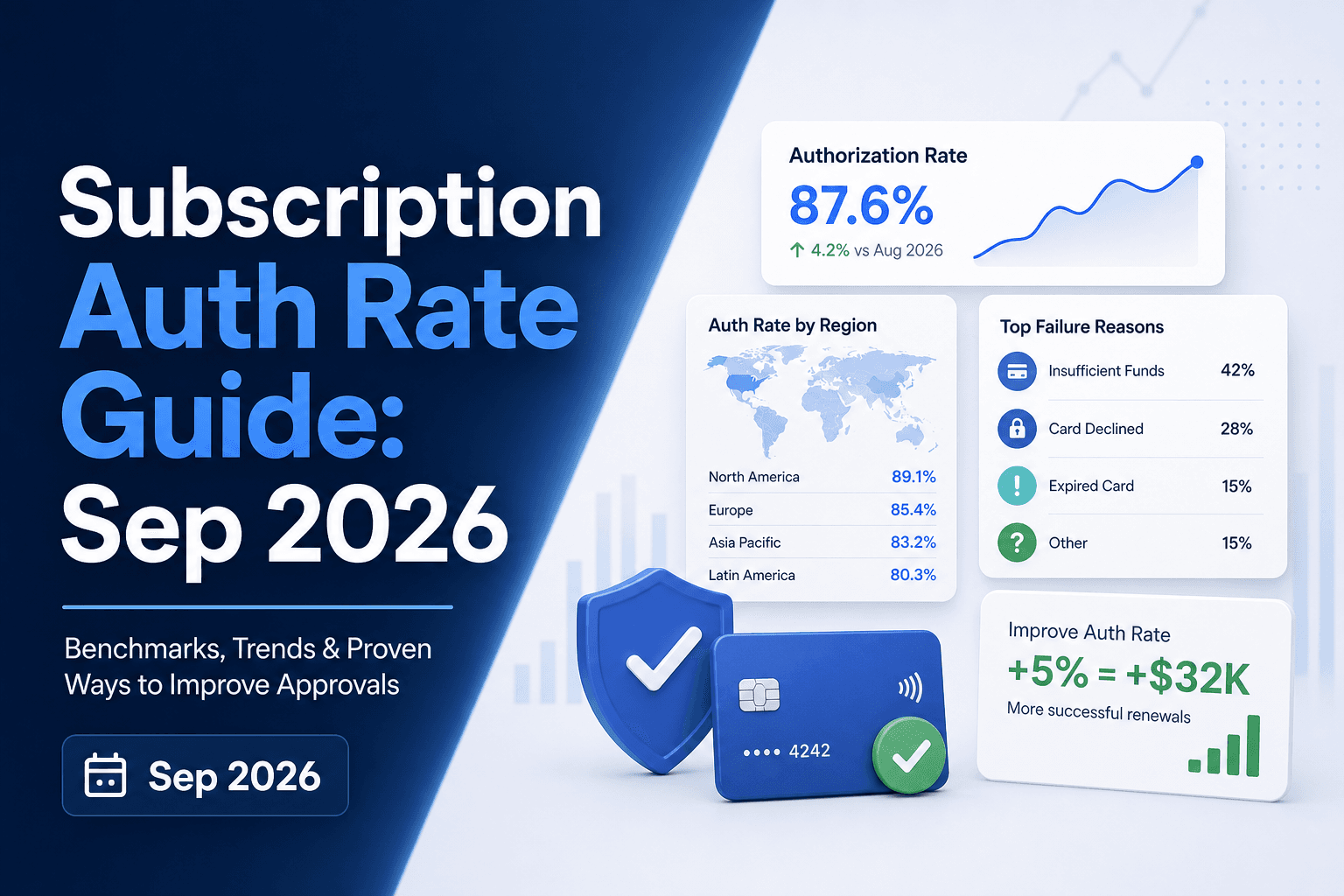
Authorization Rate in Subscription Billing: October 2026
There's a number sitting in your payments data that most finance and retention teams never report on separately: the share of renewal charges your issuing...
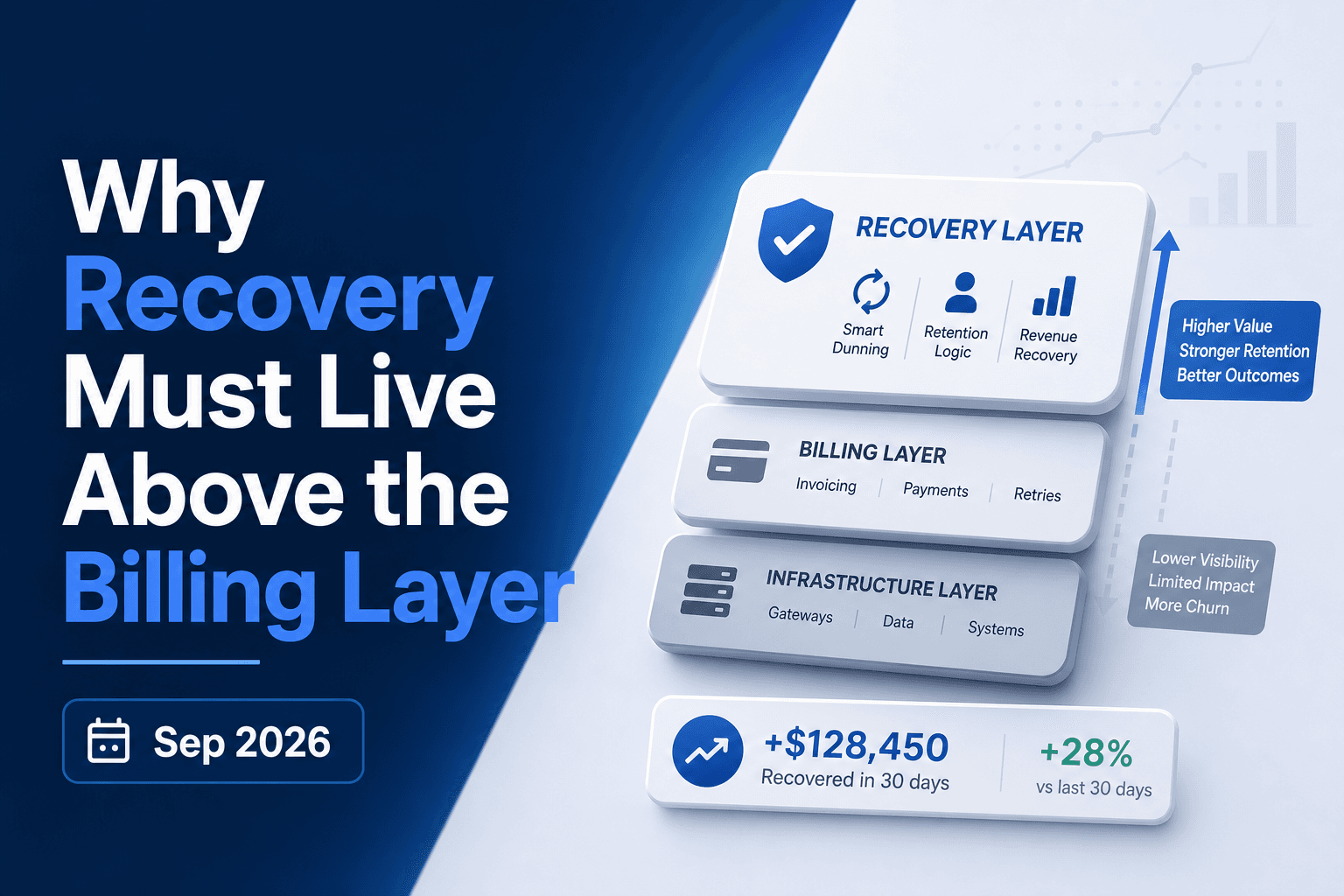
Why Payment Recovery Must Live Above Billers October 2026
A payment fails. Your biller retries it three days later, then again at seven, then at fourteen. What the biller never checks is whether the issuer sent a...
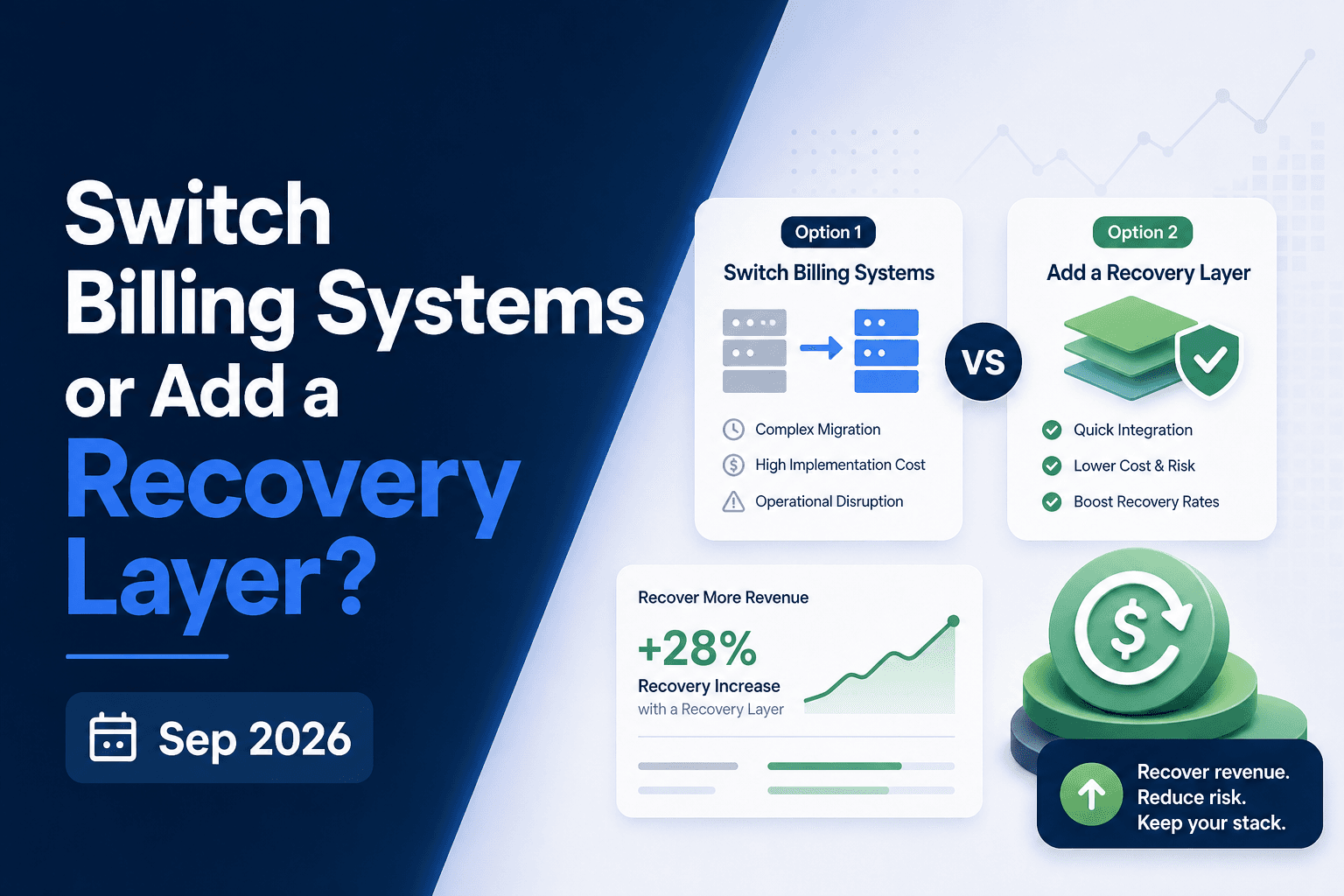
Billing Migration vs Recovery Layer: The Right Call October 2026
Switching billing systems feels like the right move when revenue collection starts breaking down. Sometimes it is. But soft declines, weak retry logic, and...
Stop losing revenue to failed payments
Join leading subscription businesses using Slicker to recover failed payments automatically.
Get Started