What Is Involuntary Churn and How to Fix It (October 2026)
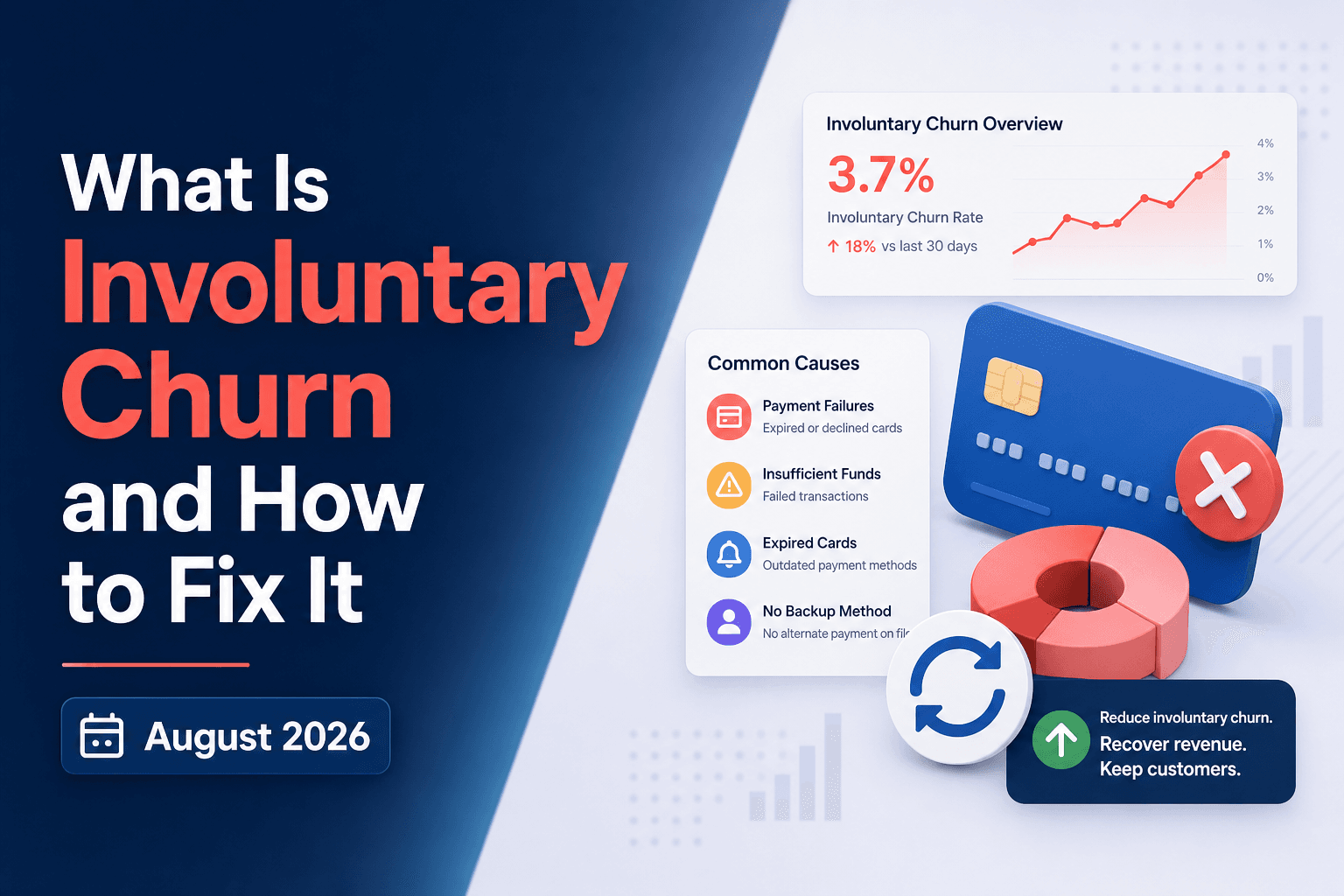
If your churn rate is creeping up, the instinct is to look at your product, your pricing, your onboarding. And sometimes that's exactly right. But a meaningful slice of that number might have nothing to do with how customers feel about you, and everything to do with what happened at the moment your billing system tried to collect.
TLDR:
- Involuntary churn ends subscriptions through payment failure, not customer intent; the correct fix is a payments strategy, not a retention strategy.
- Industry data puts 20-40% of all churn at payment failures, costing a $10M ARR business $1-2M from customers who never asked to leave.
- Distinguish soft declines (retriable with better timing) from hard declines (require customer action) before running any recovery logic.
- Track four metrics together: failed payment rate, recovery rate by failure reason, time-to-recovery, and MRR (monthly recurring revenue) at risk.
- Slicker's retry engine reads over 40 variables per transaction and runs AABB testing on your own data; you don't pay if it doesn't outperform your existing logic with statistical significance.
What Involuntary Churn Is
Involuntary churn happens when a subscription ends because a payment failed, not because the customer decided to leave. The customer still wants the product. They may not even know anything went wrong. Their access just quietly disappears.
You'll see it called passive churn, delinquent churn, or false churn depending on the context. The concept is the same: the relationship ended without the customer's intent.
Subscriptions are structurally exposed to this in a way one-time purchases aren't. The merchant initiates the charge automatically on a recurring schedule, the customer isn't present to intervene, and a single failed attempt can trigger cancellation before anyone notices. No cancellation flow. No "are you sure?" prompt. The payment processor declines, the billing system closes the account, and the subscriber is gone.
How Involuntary Churn Differs From Voluntary Cancellation
Voluntary churn is a signal. A customer decided your product wasn't worth the price, a competitor won them over, or their needs changed. That demands a product response: better onboarding, a pricing adjustment, a win-back campaign.
Involuntary churn carries none of that signal. The customer had no grievance. They weren't weighing alternatives. A card expired, a bank declined, a network timed out. The subscription ended anyway.
Conflating the two in your reporting is where the real damage happens. Your churn rate rises, your retention team launches a cancellation-flow redesign, and someone commissions an NPS study. None of that fixes a payment infrastructure problem. You're diagnosing a billing failure as a product failure and spending accordingly.
Dimension | Voluntary Churn | Involuntary Churn |
|---|---|---|
Cause | Customer decision (pricing, product, competitor) | Payment failure (expired card, decline, bank flag) |
Customer intent | Customer chose to leave | Customer still wants the product |
Signal value | Feedback on product or pricing | No product signal: billing infrastructure problem |
Correct response | Retention strategy (onboarding, pricing, win-back) | Payments strategy (smart retries, dunning, updater) |
Recoverability | Requires re-acquisition or win-back campaign | Often recoverable without customer action |
CAC (customer acquisition cost) to fix | High: need to re-win a lost customer | Zero: customer already said yes |
The correct response to voluntary churn is a retention strategy. The correct response to involuntary churn is a payments strategy. See the involuntary churn recovery playbook for implementation steps.
Why Involuntary Churn Deserves Its Own Priority
Industry data puts failed payments revenue loss at roughly 9% of subscription revenue lost annually, and 20-40% of all churn traces back to payment failures, not customer decisions. For a $10M ARR business, that's $1-2M walking out the door from customers who never asked to leave.
The compounding effect is what most churn analyses miss. A subscriber lost to a billing failure costs far more than one month's payment. Every future renewal, every upsell, every referral goes with them. The lifetime value destruction is total, not incremental.
Unlike almost every other revenue initiative on your roadmap, fixing involuntary churn requires zero new customer acquisition cost (CAC). These customers are already won. The revenue is already earned. Recovering it is cheaper, faster, and higher-margin than acquiring replacements, making the ROI profile hard to match anywhere else in the business.
What Causes Involuntary Churn
Not all involuntary churn comes from the same place, and the cause determines whether recovery is even possible.
The most common failure categories:
- Expired or reissued cards: the card is valid, but the credentials on file are outdated after a reissue or renewal
- Insufficient funds: a temporary soft decline tied to account balance at the moment of the attempt, often self-resolving with better timing
- Bank-side fraud flags: the issuer blocks a legitimate recurring charge as suspicious, requiring customer intervention to clear
- Generic or ambiguous declines: the largest single category, where the error code alone does not indicate recoverability and requires deeper analysis
- Spending limits or transaction caps: issuer or cardholder-set restrictions that block the charge without any underlying card problem
The most useful lens here is soft versus hard declines. Soft declines are temporary; the card is valid and a well-timed retry will frequently succeed. Hard declines are permanent until the customer takes action, such as replacing a stolen card or updating expired credentials. Retrying a hard decline wastes attempts and can trigger card network penalties. Recognizing the difference is the starting point for any recovery strategy worth running.
How to Calculate Your Involuntary Churn Rate
Two formulas give you the clearest picture.
Subscriber-level involuntary churn rate:
(Subscribers lost to payment failure / Total subscribers at period start) x 100
Revenue-level equivalent:
(MRR lost to failed payments / Total MRR at period start) x 100
Run both. Subscriber count tells you how many customers slipped out; the subscription churn rate MRR (monthly recurring revenue) version tells you the dollar exposure, which is what belongs in a CFO conversation.
Your billing system already has the data segmented. Stripe, Chargebee, and Recurly all tag invoices as past-due, unpaid, or delinquent separately from subscriber-initiated cancellations. Filter for subscriptions that moved to canceled status via a payment failure event, not a customer action, and you have your cohort.
Without that filter, you're measuring blended churn. A voluntary cancellation and a billing failure appear identical in the headline number, yet the first points to a product or pricing problem while the second points to a recoverable payments issue. Treating them as one metric means you'll diagnose the wrong root cause while the fixable portion compounds quietly each billing cycle.
How Acquisition Quality Shapes Involuntary Churn Rates
Two businesses running identical retry logic can end up with meaningfully different involuntary churn rates. The gap often has nothing to do with payment infrastructure and everything to do with how subscribers were acquired.
Heavy discounting, extended free trials, and low-intent acquisition channels tend to attract cardholders who submit prepaid cards, gift cards, or low-balance debit accounts at signup. Those credentials pass the initial charge or a zero-auth check, but fail reliably at first renewal. No retry strategy recovers a prepaid card with a zero balance. That's a structural failure, not a recoverable soft decline.
Card type composition matters at the portfolio level. A subscriber base skewed toward consumer debit carries a higher baseline failure rate than one dominated by credit cards, partly because debit accounts reflect real-time balances instead of credit availability. If your subscriber mix moves toward lower-income demographics or higher-discount acquisition cohorts, your involuntary churn rate moves with it regardless of what your retry logic does.
Segment your involuntary churn rate by SaaS benchmarks and acquisition channel and payment method before drawing conclusions about recovery performance. A recovery rate that looks low on a free-trial-to-paid cohort may simply reflect a high concentration of unrecoverable card types, not a failure of your retry system. Blending that cohort with organic, full-price subscribers into a single rate obscures both problems and inflates what looks like a solvable billing issue.
KPIs to Track for Involuntary Churn Recovery
Four metrics give you a clear picture of involuntary churn recovery. Track them together; any one in isolation misleads.
The Four Metrics That Matter
- Failed payment rate: failed billing attempts divided by total attempts, expressed as a percentage. Segment by payment method, plan type, and geography. A high failure rate on monthly consumer debit in one region points to a timing or card-type problem; the same rate on annual corporate cards points somewhere else.
- Recovery rate by failure reason: the percentage of failed invoices eventually collected, broken out by decline type. Soft declines should recover at a materially higher rate than hard declines. If they don't, your retry logic isn't distinguishing between them.
- Time-to-recovery: days between first decline and successful charge. Shorter windows mean less service disruption and fewer subscribers who notice an access gap and decide not to return.
- MRR (monthly recurring revenue) at risk: the dollar value sitting on open, unpaid invoices right now. This is the number that belongs in a CFO conversation.
Segment all four by customer tenure, payment method, and geography to find where recovery yields the greatest return. Long-tenured subscribers on credit cards typically recover faster and at higher rates than first-year subscribers on prepaid debit, a pattern reflected in involuntary churn benchmarks by industry (2025 data; verify against your current baseline). That segmentation tells you where to concentrate retry and dunning resources.
How to Reduce Involuntary Churn
Four levers reduce involuntary churn. Run them in this order.
Card Account Updater
Before a charge even attempts, card account updater vs. predictive retries services from Visa Account Updater and Mastercard Automatic Billing Updater silently refresh expired or reissued credentials on file. A subscriber who got a new card after a fraud reissue keeps their subscription without ever knowing there was a problem. No customer action required, and the payment never fails in the first place.
Smart Retry Logic
When a charge does fail, timing matters more than frequency. An insufficient funds decline on a consumer debit card often resolves once a payroll deposit clears. Retrying on a hard decline won't succeed regardless of timing and burns attempts that can trigger card network penalties. Smart retry systems that account for card type, issuer, geography, and payday patterns consistently reach materially higher recovery rates than fixed retry schedules.
Dunning Emails
Some failures require customer action. A stolen card won't recover through retries. When that's the case, a failure reason dunning cadence telling the subscriber exactly what action is needed outperforms a generic "update your payment method" message. Match the copy to the failure reason.
Multi-Payment-Method Orchestration
For subscribers with more than one card on file, exhausting all retry attempts on a single failing instrument before switching to an alternate is a recoverable error in your retry logic. Distributing attempts across available payment methods within card network retry limits expands total recovery opportunities without increasing penalty exposure.
How Slicker Recovers Involuntary Churn
Slicker's retry engine analyzes over 40 variables per transaction before acting on a failed payment. Card type, issuing bank, geographic region, local payday cadence, time of day, and transaction amount all feed into the decision. The result is retry timing aligned to when a specific card is most likely to authorize, down to the hour: not a fixed calendar schedule firing regardless of context.
The system classifies every failure as a soft or hard decline before attempting recovery. Soft declines get retried at the optimal window. Hard declines stop immediately, protecting merchant reputation and avoiding card network penalties that accrue when merchants retry against codes that explicitly instruct otherwise.
The performance difference is measurable: Slicker's retry logic materially outperforms standard fixed retry schedules, recovering more revenue with fewer total attempts per failure than control groups. More revenue recovered with less retry volume matters for merchants managing card network compliance thresholds.
For failures that require customer action, Slicker triggers dunning emails matched to the specific failure reason, sent from your domain. A stolen card gets a different message than an expired card or an insufficient funds decline.
Slicker proves this on your own data before you commit. The AABB testing in payment recovery splits your failed payments between your existing retry logic and Slicker's, measures dollars recovered in each cohort, and reports statistical significance. If Slicker doesn't outperform your control with statistical significance, you don't pay. Setup takes under five minutes with no engineering work required.
Final Thoughts on Involuntary Churn vs. Voluntary Cancellations
Once you separate involuntary churn from voluntary cancellations in your reporting, the path forward gets a lot clearer. These are customers who said yes, and a payment failure is the only reason they're gone. The recovery tools exist, the ROI math is straightforward, and the customers are still out there. Reach out to the Slicker team to see what a test on your own failed payments would look like.
FAQs
What is involuntary churn, and how is it different from voluntary cancellation?
Involuntary churn ends a subscription via payment failure, not customer choice; voluntary cancellation signals a product or pricing problem, while involuntary churn signals a billing infrastructure problem. See the full breakdown in the sections above.
What does Slicker do differently from the built-in retry logic in Stripe or Chargebee?
Slicker's AI models analyze over 40 variables per transaction, including card type, issuing bank, local payday cadence, and time of day, to determine whether to retry, when, and on which payment method. Billing platform retry logic applies fixed calendar-based schedules regardless of failure reason, which means it retries hard declines that will never succeed and misses the optimal timing window on soft declines that would. The performance difference is proven via AABB testing on your own transaction data before you pay anything.
How should a SaaS revenue operations team measure involuntary churn recovery in 2026?
Track failed payment rate, recovery rate by failure reason, time-to-recovery, and MRR at risk. See the KPIs section above for segmentation guidance on each metric and what to bring to a CFO conversation.
Why does involuntary churn rate differ between brands or subscriber cohorts within the same business?
Acquisition quality shapes the payment credential mix in your subscriber base more than most teams expect. Heavy discounting, extended free trials, and low-intent acquisition channels attract prepaid cards, gift cards, and low-balance debit accounts that pass signup but fail at first renewal with no recovery path. A subscriber cohort skewed toward consumer debit carries a structurally higher failure rate than one dominated by credit cards, regardless of retry logic. Segment your involuntary churn analysis by acquisition channel and payment method before drawing conclusions about recovery performance, or you risk conflating an unrecoverable card-quality problem with a fixable billing infrastructure problem.
What is the best way to reduce involuntary churn for a SaaS subscription business in 2026?
Run card account updater, smart retry logic, failure-reason dunning, and multi-payment-method orchestration in that order. The How to Reduce section above details each lever.
Related Articles
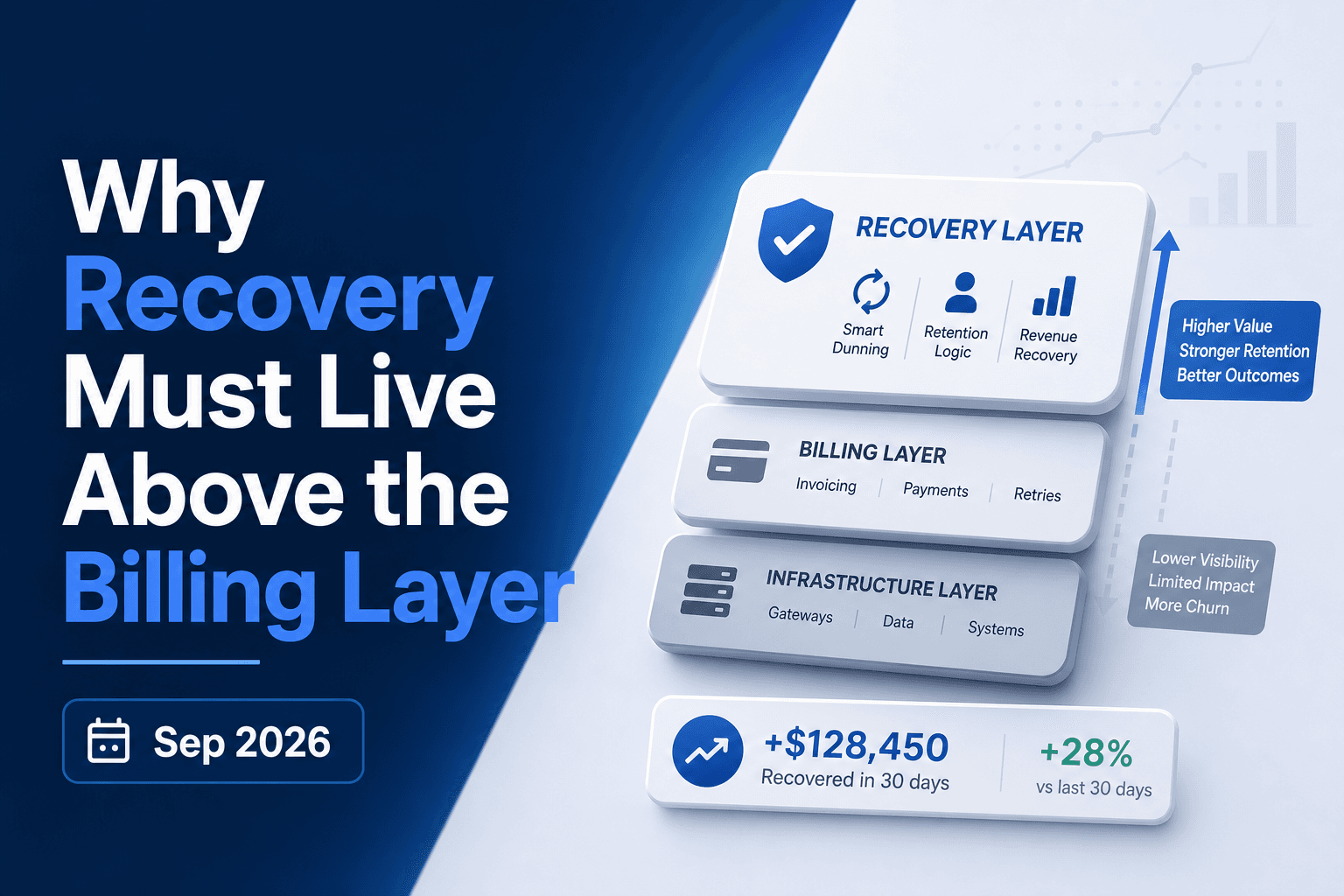
Why Payment Recovery Must Live Above Billers October 2026
A payment fails. Your biller retries it three days later, then again at seven, then at fourteen. What the biller never checks is whether the issuer sent a...
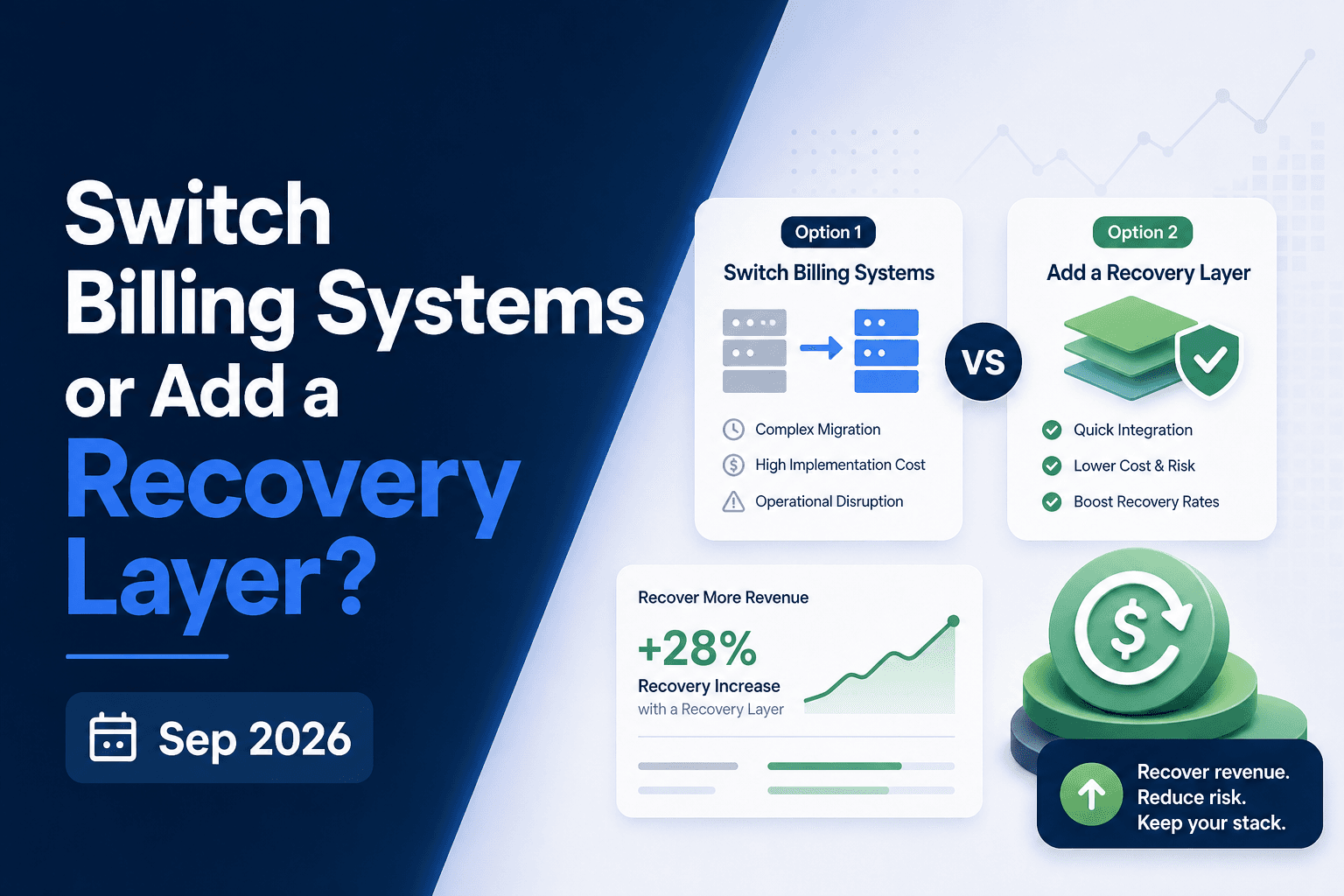
Billing Migration vs Recovery Layer: The Right Call October 2026
Switching billing systems feels like the right move when revenue collection starts breaking down. Sometimes it is. But soft declines, weak retry logic, and...
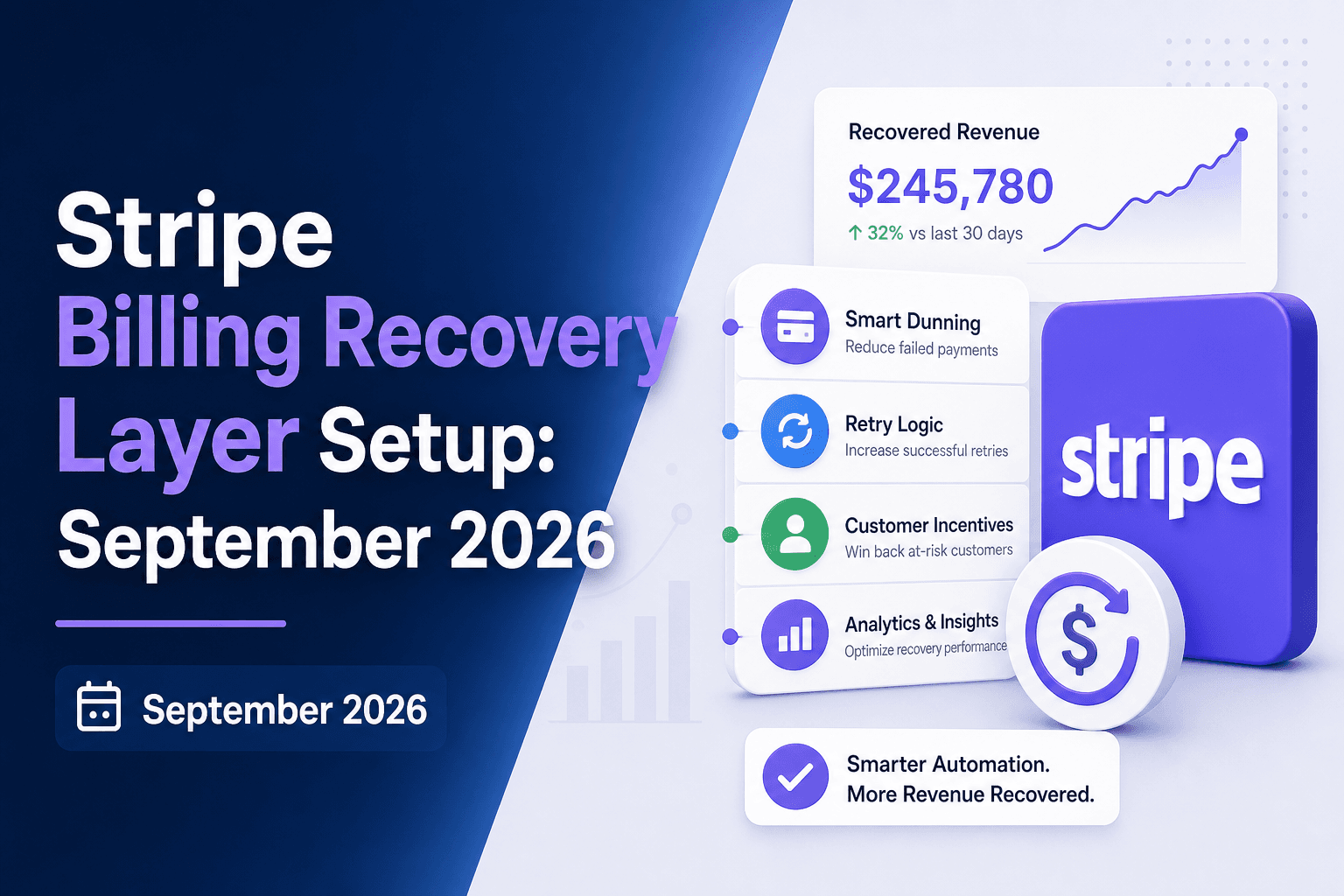
Stripe Billing Recovery Layer Setup Time: October 2026
Adding a recovery layer on top of Stripe Billing sounds like the kind of thing that goes on a quarterly roadmap and gets delayed twice. For most teams, it's...
Stop losing revenue to failed payments
Join leading subscription businesses using Slicker to recover failed payments automatically.
Get Started