Free Trial to Paid Conversion Failures: Why the First Charge Fails and How to Recover It
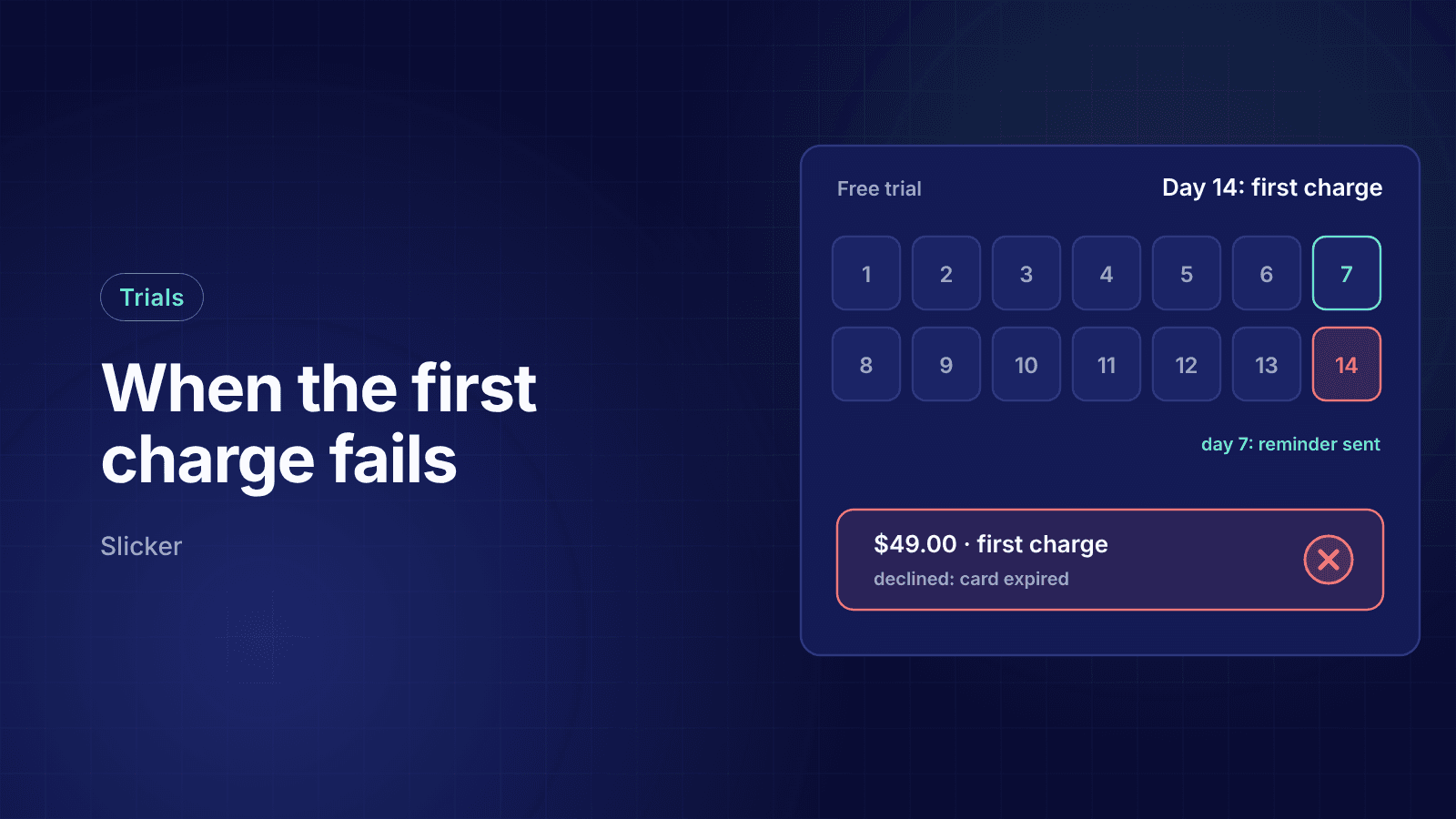
A customer signs up for your free trial, uses the product for two weeks, and then the first real charge fails. They never saw an error. They never decided to leave. They simply stop being a customer the moment they were supposed to start paying.
The trial-to-paid charge is the riskiest payment in a subscription's life. It is the first time the card is charged a real amount, often weeks after it was entered, and it lands on a customer who has not yet built the habit of paying you. Declines, disputes and abuse all concentrate here, and every one of them looks like a conversion problem in your funnel report rather than a payment problem.
This guide covers why first charges after a free trial fail more often than renewals, what card network rules require from trial merchants, and how to recover trial conversions without turning them into chargebacks.
TLDR:
- The first charge after a free trial fails more often than later renewals because the card has never been charged a real amount and may have expired, been replaced or been chosen to avoid paying.
- Visa's trial rules require consent at signup, a reminder before the first charge and a clear descriptor on it; merchants who skip them lose disputes on those charges by default.
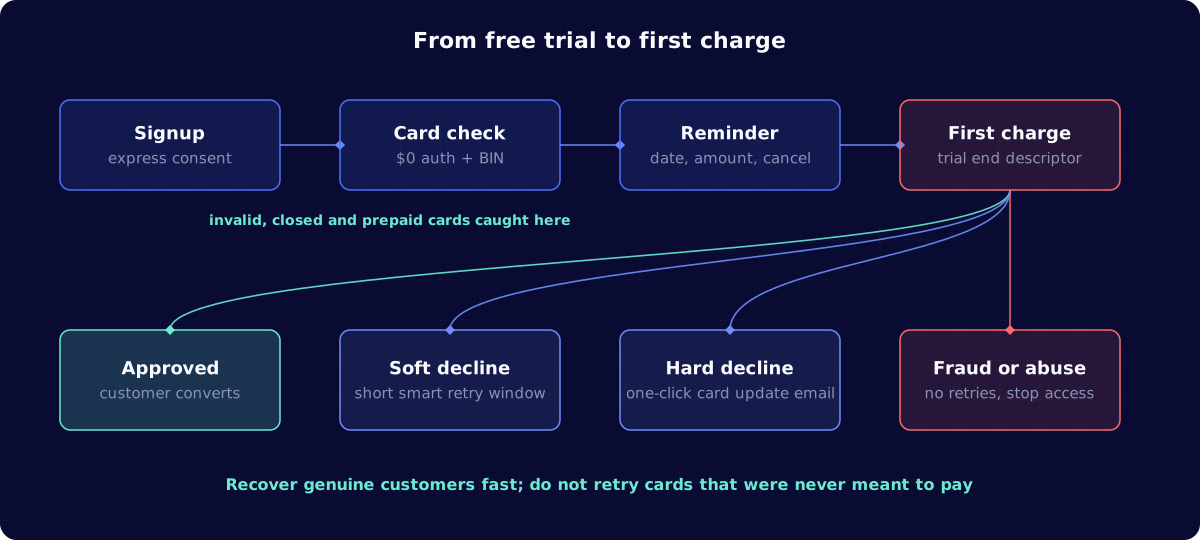
- Verifying the card at signup with a zero-amount authorization catches closed and invalid cards before the trial starts.
- Free trial abuse has grown sharply for AI products, so card checks at signup now protect compute costs as well as revenue.
- Slicker's smart retries and hyper-personalized emails treat the first charge as its own recovery case, with timing and messaging that fit a customer who has never paid before.
Why the First Charge After a Free Trial Is Different
A renewal is a repeat of something that already worked. The issuer has approved this merchant on this card before, the amount is familiar, and the customer has seen the charge on a statement. The first charge after a trial has none of that history.
Several things make it fragile:
- No prior approval. Issuer risk models weigh a merchant's history with a card. A first real charge, especially one for a larger annual plan, gets less benefit of the doubt.
- Time since card entry. A 14 or 30 day trial is long enough for a card to expire, be reported lost or be reissued after fraud. Nothing tested the card in the meantime.
- Different intent at signup. Some customers enter a card they do not expect to be charged: a nearly empty debit card, a prepaid card or a virtual card created only for the trial.
- No payment habit yet. A customer who has paid for six months notices a failure and fixes it. A trial user who has not paid yet often never opens the failure email.
These failures show up as lower trial conversion, which teams tend to treat as a product or pricing problem. Separating payment failures from genuine decisions to leave is the first step to fixing them.
The Most Common Reasons Trial Conversions Fail
The decline codes at trial end follow a recognizable pattern. Each one needs a different response.
| Failure | What it usually means | Best response |
|---|---|---|
| Insufficient funds | Low-balance debit or prepaid card | Retry around pay cycles, then ask for a new card |
| Expired card | Card expired during the trial | Account updater, then a card update request |
| Do not honor or generic decline | Issuer risk check on a first charge | Spaced retries, authentication where available |
| Authentication required | Issuer wants SCA or a mandate | Send the customer through authentication |
| Invalid card or account closed | Card never worked or was closed | No retries; request a new payment method |
| Fraud or stolen card | Card used without the owner's consent | No retries; stop access and review the account |
Two of these deserve extra attention. Authentication required declines are common in Europe and India, where the first charge on a card often needs the customer present, as covered in the guide to authentication required declines. And fraud declines at trial end usually point to an account that was never a real customer, which is a signup problem rather than a recovery problem.
What Card Network Trial Rules Require
Card networks treat trial conversions as a known source of disputes, so they set rules for them. Visa's rules for free trials and introductory offers took effect on April 18, 2020. As summarized in Stripe's FAQ on the Visa trial requirements, merchants offering a trial that converts into a subscription need to:
- Get express consent at signup, with clear terms covering the price, billing frequency and how to cancel.
- Send a reminder before the first charge, telling the customer when the trial ends, what they will be charged and how to cancel.
- Use a clear descriptor on the first charge so it reads as the end of a trial on the customer's statement.
- Offer cancellation online or by SMS, without forcing a phone call.
Stripe's FAQ is blunt about the consequence: a merchant that has not made the required changes will lose a dispute on that charge by default. Many teams send the reminder about 7 days ahead, which gives the customer time to cancel or update their card. Local law often adds to this. California's automatic renewal law, for example, treats free trials that convert to paid plans as automatic renewals with their own disclosure and cancellation requirements.
Most billing platforms help. Stripe's trial documentation covers sending trial ending reminders, and the same reminder can be sent from your own email system if you prefer to control the copy.
Verify the Card Before the Trial Starts
The cheapest fix for a failed first charge happens weeks before it, at signup. A zero-amount authorization, also called a card verification or account status check, asks the issuer whether the card is valid and open without moving money.
It catches a large share of the cards that would fail at trial end:
- Closed, invalid and fake cards are declined immediately, before the customer gets free access.
- Typos are caught even earlier with a Luhn check in the browser, as explained in the guide to card number validation.
- Card type and issuer country come from the BIN, so you know at signup whether the card is prepaid, whether the first charge will need authentication, and which recurring rules apply.
The Slicker card validator and BIN lookup show what that data looks like. Some teams go further and place a small temporary authorization at signup, released right away, to confirm the card can carry a real amount. That gives a stronger signal but is more visible to the customer, so test it against your conversion rate before rolling it out.
Free Trial Abuse and Why It Matters More for AI Products
Not every failed trial conversion is a genuine customer with a card problem. Some trials were never meant to convert. People sign up with throwaway or virtual cards, use the trial, and move on to the next account.
For most software this costs little. For AI products it costs real money, because every trial consumes compute. In a March 2026 post on free trial abuse, Stripe reported detecting 6.2 times more abusive free trials between November 2025 and February 2026, and said self-serve AI startups see around 10 times more attempted abuse than other businesses. Across four AI businesses, Stripe said it blocked more than 550,000 high-risk trials and saved about $4.4 million in compute.
That changes how to read trial conversion data:
- Count abusive signups separately. A trial that fails because the card was disposable is not a lost customer, and including it makes your recovery rate look worse than it is.
- Use card data at signup. BIN data identifies prepaid and virtual card ranges, and repeated cards across accounts are a strong signal of abuse.
- Do not retry fraud. Retrying a card that was never going to pay adds declines to your history with the issuer and gets nothing back.
The same compute economics show up after conversion, which is why failed payments in usage-based billing need their own access and retry policy.
How to Retry a Failed Trial Conversion
Once the first charge fails on a genuine customer, smart retries still work, but the timing needs to be tighter than for a renewal. The customer is at their least committed, and every day without access gives them a reason to stop caring.
A practical approach:
- Classify the decline first. Hard declines such as invalid card, closed account or fraud get no retries. Soft declines such as insufficient funds or do not honor are worth retrying.
- Retry insufficient funds around pay cycles. For consumer debit cards, a retry after a likely payday is far more effective than several attempts in the first 48 hours, as the soft decline retry playbook explains.
- Keep the window short. Most recoverable first charges recover within the first week or two. Long retry tails on a trial user rarely pay off and raise dispute risk.
- Respect network limits. Visa limits retries on the same card and transaction, and Mastercard sends Merchant Advice Codes that mean "do not try again." Both apply to first charges just as they do to renewals.
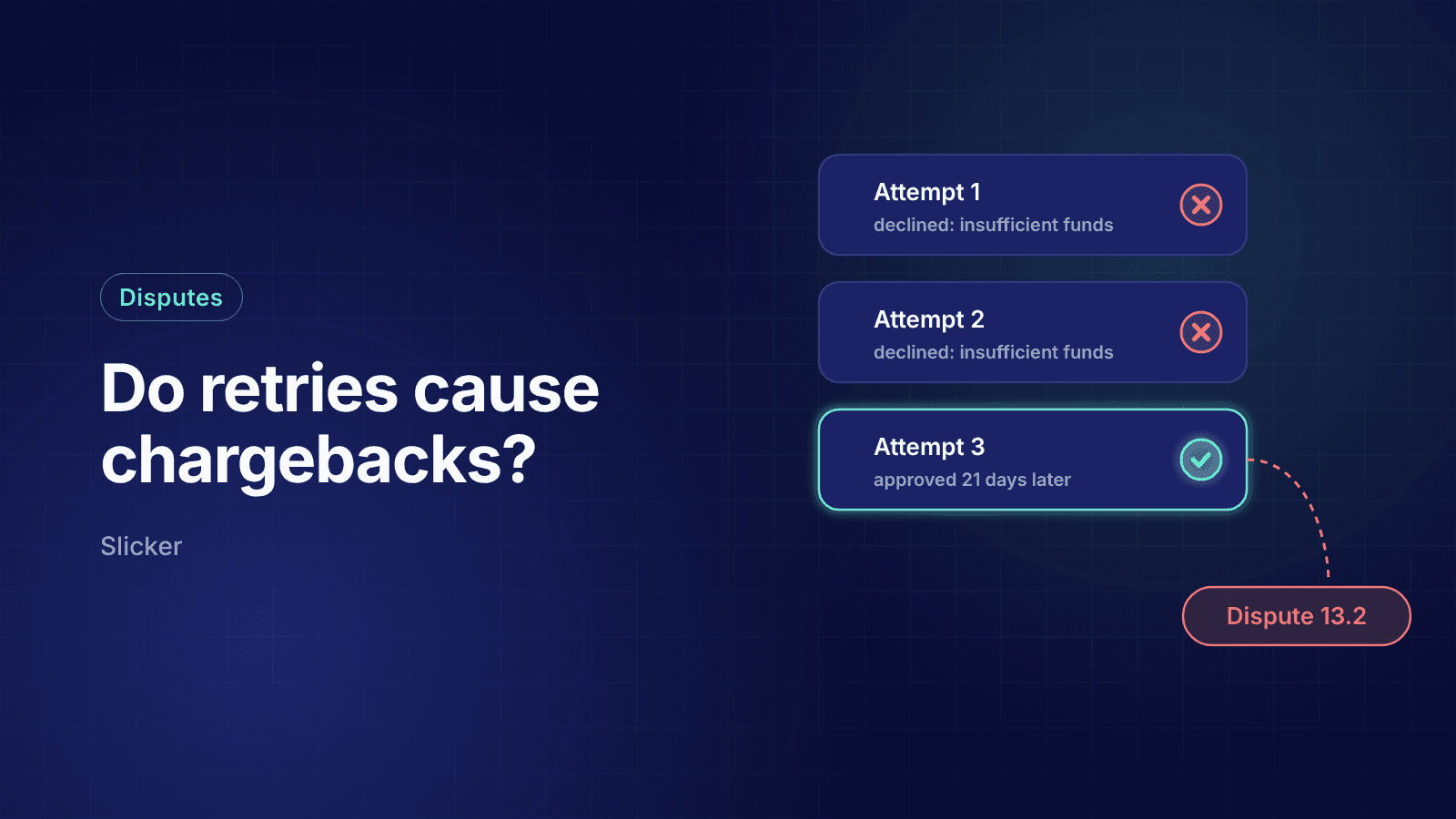
Retries on a trial conversion are also where disputes start. A charge that succeeds three weeks after the trial ended, on a customer who assumed the account was closed, is a classic "cancelled recurring" dispute. The guide to whether payment retries cause chargebacks covers how to keep retries away from that risk.
What to Say When the First Charge Fails
The first failure email reaches someone who has never paid you. Treat it as part of onboarding, not as collections.
What works for trial conversions:
- Lead with what they keep. Remind them what they built or used during the trial, such as their projects, settings or data, and that it is still there.
- Name the problem plainly. "Your card was declined when your trial ended" is clearer than "there was a problem with your payment."
- Make the fix one click. Link straight to a payment update page. Do not make them log in, find billing and search for the card form.
- Match the message to the decline. An expired card needs a new card. An authentication failure needs a confirmation step. Insufficient funds needs a gentler note, often after a retry has already been tried.
- Send from your domain. A message from a known sender name and domain is more likely to be opened and trusted, which matters even more for someone who barely knows your brand.
The guide to payment failure email copy has examples you can adapt, and pre-dunning workflows show how the trial reminder and the first failure email can work as one sequence instead of two disconnected messages.
Decide What Happens to Access
When the first charge fails, you need a rule for what the customer can still do. There are three common options:
- Keep access for a short grace period, usually a few days. This gives retries and emails time to work and keeps the customer engaged. It is the best default for products where the customer has invested real work during the trial.
- Move to a limited plan. Read-only access or a free tier keeps the account alive without giving away the paid product. It suits freemium products with a natural free level.
- Pause immediately. Stop access until payment succeeds. This is often right for AI and usage-heavy products, where every extra day of access has a direct compute cost.
Whatever you choose, tell the customer in the failure email. Losing access without warning is one of the most common reasons trial users give up instead of updating their card.
How Slicker Recovers Failed Trial Conversions
Slicker treats the first charge after a trial as a distinct recovery case rather than the first renewal. For every failed payment, Slicker's smart retries combine the decline code with the card's type, issuer and country and the customer's history to decide whether to retry, when and how many times. A first charge on a consumer debit card is retried around likely pay dates; a hard decline goes straight to a request for a new payment method instead of wasting attempts.
Slicker's hyper-personalized dunning emails are written for the customer's situation, so a trial user gets a message that reminds them what they are keeping and gives them a one-click payment update page, all sent from your own domain. Because Slicker only reaches out when customer action is the only path to recovery, trial users are not flooded with emails while a retry is still likely to work.
Every change is measured with AABB testing against your current setup, so you can see exactly how many trial conversions Slicker recovers, in dollars.
Final Thoughts on Recovering Free Trial to Paid Failures
A failed first charge is the most expensive kind of failed payment. You have already paid to acquire the customer and to serve the trial, and the failure lands before they have formed any habit of paying you. Treating it as a lost conversion hides how much of it is recoverable.
The fixes are not complicated: verify cards at signup, follow the network trial rules, separate abuse from genuine customers, retry soft declines on a short and well-timed schedule, and send a clear, helpful message when the charge fails. Talk to the Slicker team about recovering more of your trial conversions.
FAQ
Why do payments fail when a free trial ends?
The first charge after a trial is the first time the card is charged a real amount, often weeks after it was entered. The card may have expired or been replaced, the issuer has no history of approving this merchant on it, and some customers enter low-balance, prepaid or disposable cards. Those factors make the first charge fail more often than later renewals.
Should I require a card for a free trial?
Requiring a card usually lowers trial signups but raises the share of trials that convert, because it filters out people who never intend to pay. If you do require one, verify it at signup with a zero-amount authorization so that invalid and closed cards are caught before the trial starts rather than at the first charge.
What are Visa's rules for free trials?
Visa's rules, effective April 2020, require merchants to get express consent at signup, send a reminder before the first charge with the amount, date and a way to cancel, use a clear descriptor on the first charge, and offer cancellation online. Merchants that skip these steps lose disputes on trial conversions by default.
How many times should I retry a failed trial conversion?
Fewer and faster than a renewal. Do not retry hard declines such as invalid card, closed account or fraud at all. For soft declines, a few well-timed retries within the first one to two weeks, combined with an email asking the customer to update their card, recover most of what can be recovered.
Does a failed trial conversion count as churn?
It counts as involuntary churn if the customer wanted to keep the product and the payment failed for a reason they did not choose, such as an expired card. It is not churn at all if the trial was abusive or the card was never meant to pay. Separating the two gives you an accurate recovery rate and a cleaner view of trial conversion.
Related Articles
Do Payment Retries Cause Chargebacks? How to Retry Without Raising Dispute Risk
Your recovery rate went up last quarter, and so did your dispute rate. Finance wants to know whether the new retry schedule is to blame, risk wants to know how...
Annual Subscription Renewals That Fail: How to Recover High-Value Renewal Payments
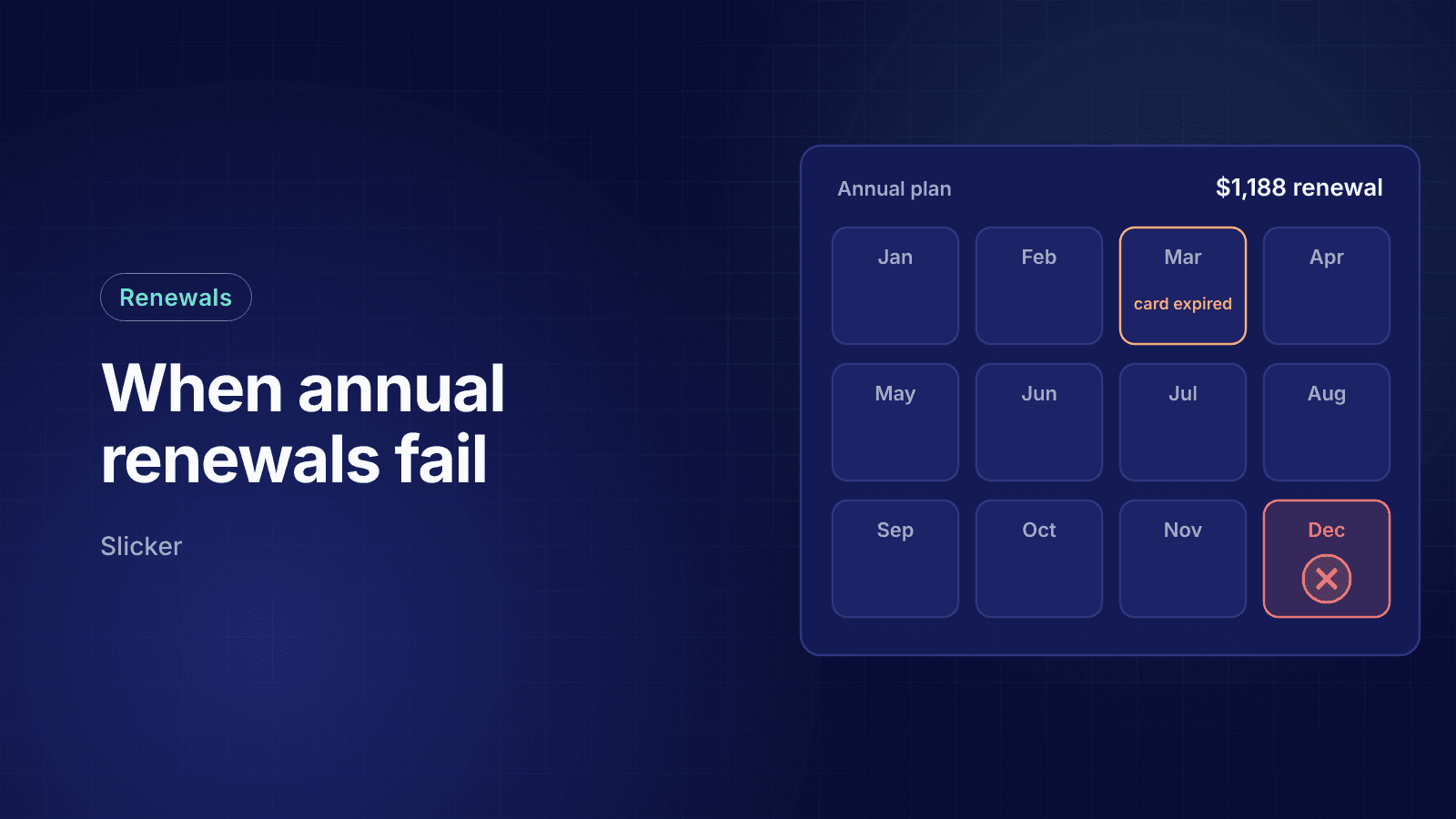
Twelve months ago a customer paid $1,188 for your annual plan without a second thought. This morning the renewal failed. The card on file expired in March, the...
What Card Is This? How to Identify and Validate a Card From Its Number
A customer emails support with a card number that "keeps getting rejected." Your checkout says the card is invalid, the customer insists it works everywhere...
Stop losing revenue to failed payments
Join leading subscription businesses using Slicker to recover failed payments automatically.
Get Started