Do Payment Retries Cause Chargebacks? How to Retry Without Raising Dispute Risk
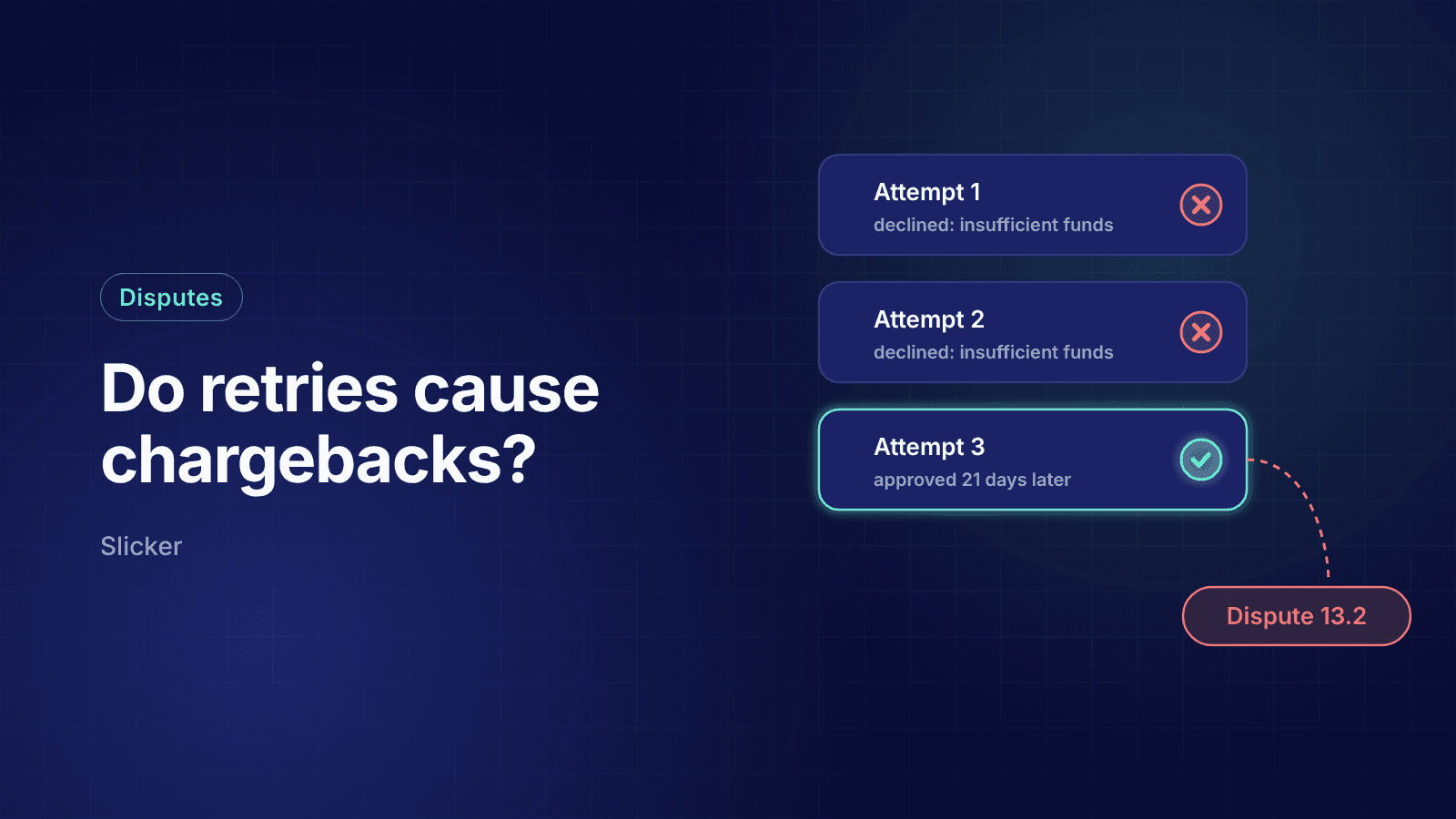
Your recovery rate went up last quarter, and so did your dispute rate. Finance wants to know whether the new retry schedule is to blame, risk wants to know how close you are to a card network monitoring threshold, and nobody can say which recovered payments turned into chargebacks a month later.
It is a fair question. Every retry is another attempt to take money from a customer whose payment already failed once. Done carelessly, retries can charge people who meant to leave, surprise people who forgot, and break network rules on repeated attempts. Done well, they recover revenue without moving your dispute rate at all.
This guide explains when payment retries lead to chargebacks, how retries and disputes interact with Visa and Mastercard rules, and how to design recovery that does not trade revenue now for disputes later.
TLDR:
- A declined retry cannot create a chargeback; only a retry that succeeds can, usually when the customer did not expect or no longer wanted the charge.
- The riskiest recoveries are charges after a cancellation request, long after the original failure, or after access was already cut off.
- Repeated declines carry their own costs: Visa limits retries to 15 attempts in 30 days, and Mastercard's Merchant Advice Codes say when to stop.
- Visa's VAMP counts both fraud reports and disputes against settled sales, with the merchant threshold at 1.5% in most regions since April 2026.
- Slicker's smart retries respect decline codes and network limits, and hyper-personalized emails make sure customers know about a charge before it lands.
Can a Payment Retry Cause a Chargeback?
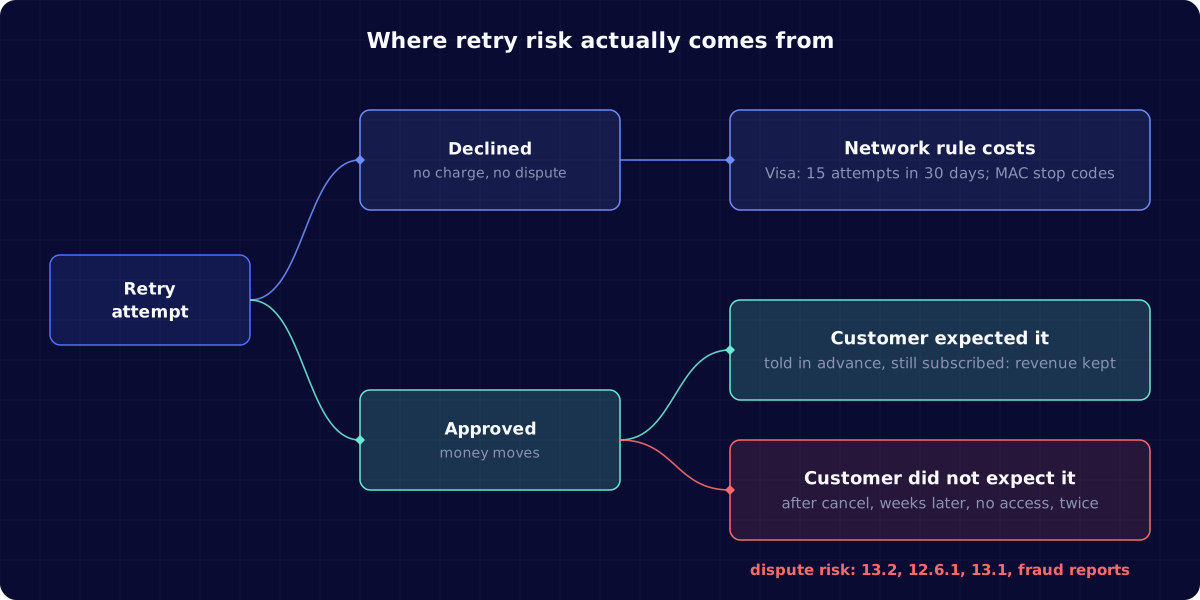
A chargeback needs a completed charge. A retry that is declined never reaches the cardholder's statement, so it cannot be disputed. The risk sits entirely in the retries that succeed.
That matters because it changes the question. "Do retries cause chargebacks?" really means "do the payments I recover by retrying get disputed more often than payments that succeed the first time?" They can, for a specific set of reasons, and almost all of them come down to the customer not expecting the charge.
The other costs of retrying, such as network fees for excessive attempts and damage to your authorization rates, come from declined retries. Those are real, but they are not disputes, and they need different fixes.
When Recovered Payments Turn Into Disputes
Recovered payments become disputes in a handful of predictable situations:
- The customer tried to cancel. They emailed support, closed the tab on the cancel flow, or removed the card on purpose. A successful retry days later looks like a charge after cancellation.
- The charge came long after the failure. A retry that succeeds three weeks after the original renewal date can look unfamiliar, especially if the customer forgot the failure ever happened.
- Access had already been cut off. Charging for a period in which the customer could not use your product invites a "services not provided" dispute.
- The card was replaced or updated. Some cardholders replace a card expecting it to stop old subscriptions. When an account updater or network token carries the charge through to the new card, the charge can be reported as unrecognized.
- Retry logic charged twice. Bugs that retry two open invoices for the same period, or retry an invoice that was already paid another way, produce duplicate processing disputes.
None of these are caused by retrying as such. They are caused by retrying without checking what the customer wanted, what they were told and what they received.
The Dispute Reason Codes Retries Tend to Trigger
The reason codes behind retry-related disputes are narrow and recognizable, which makes them easy to monitor.
| Situation | Visa reason code | Mastercard reason code | Prevention |
|---|---|---|---|
| Charged after the customer cancelled | 13.2 Cancelled Recurring Transaction | 4841 Cancelled Recurring or Digital Goods | Stop retries the moment a cancellation request arrives |
| Charged twice for the same period | 12.6.1 Duplicate Processing | 4834 Point of Interaction Error | Retry one invoice per period; check payment status before each attempt |
| Charged for a period without access | 13.1 Merchandise or Services Not Received | 4855 Goods or Services Not Provided | Restore access when a retry succeeds; do not bill locked periods |
| Cardholder does not recognize the charge | 10.4 Other Fraud, Card-Absent | 4837 No Cardholder Authorization | Clear billing descriptors, advance notice, receipts |
Visa's guidance on condition 13.2 is explicit that recurring transactions are especially prone to disputes and recommends responding promptly to cancellation requests and checking for them daily. That is the single most effective retry-related dispute prevention step: a cancellation request has to stop the retry engine immediately.
Network Retry Limits: The Cost of Retries That Fail
Declined retries do not become chargebacks, but card networks still police them. Stripe's support article on excessive retries summarizes Visa's rule: no more than 15 attempts to charge the same payment within 30 days, with a fee for excessive retries since April 2021. Stripe blocks further Visa retries after the 15th attempt for users on integrated pricing when it judges the charge unlikely to be approved.
Mastercard approaches the same problem through Merchant Advice Codes, which come back with a decline and tell you whether to retry later, update the card, or never retry. Ignoring a "do not try again" advice code is how merchants end up paying fees without recovering anything. The guides to Merchant Advice Codes in payment recovery and Mastercard MAC codes cover each code, and retry velocity caps explains how to stay inside network limits.
The practical rule: retry fewer times, at better moments, and never against a decline that says stop. That lowers fees and raises recovery at the same time.
How Visa VAMP Counts Recovered Payments and Disputes
Visa's Acquirer Monitoring Program, VAMP, replaced Visa's separate fraud and dispute monitoring programs in 2025 and puts both into one ratio. According to Solidgate's summary of the VAMP rules, the merchant ratio counts card-not-present fraud reports (TC40) plus card-not-present disputes (TC15) against settled card-not-present sales. The "excessive" merchant threshold was 2.2% from June 2025 and fell to 1.5% in the US, EU and most regions on April 1, 2026, with a minimum of 1,500 combined fraud reports and disputes per month before the threshold applies.
Two consequences follow for recovery:
- Recovered payments count in the denominator. A successful retry is a settled sale like any other, so good recovery slightly improves the ratio on its own.
- Disputed recoveries count twice in effect. A recovered payment that ends in a dispute or a fraud report adds to the numerator and costs you the revenue, the dispute fee and the operational time.
The second point is why recovery strategy and dispute strategy belong together. A retry schedule that recovers 2% more revenue but triggers fraud reports from confused customers can push a merchant near a monitoring threshold for the sake of a small gain.
Retry Patterns That Raise Dispute Risk
Some retry patterns are reliably worse than others:
- Retrying for weeks with no customer contact. The longer the gap between the failure and a successful charge, the less the customer remembers, and the more the charge looks unfamiliar.
- Retrying after access was revoked. If you suspend access on day 7 and a retry succeeds on day 21, the customer has paid for two weeks they could not use.
- Retrying through a cancellation. Support teams that take cancellation requests by email, without connecting them to billing, leave retries running on customers who have already left.
- Retrying hard declines. Lost, stolen and closed card responses are not going to recover, and repeated attempts against them look like the patterns fraud teams watch for. The cost of retrying hard declines is almost always higher than the expected recovery.
- Retrying large, unusual amounts repeatedly. Big charges declined by an issuer's risk model need customer confirmation, not more attempts. The same is true of the variable charges covered in failed payments in usage-based billing.
How to Retry Failed Payments Without Raising Chargebacks
Low-dispute recovery rests on a few rules that are easy to state and easy to break in practice:
- Wire cancellations straight into billing. Any cancellation request, from any channel, stops retries immediately and closes open invoices.
- Tell the customer before you succeed. A failed payment email that says "we will try your card again on Friday" turns a surprise charge into an expected one.
- Keep the recovery window proportional. Short windows for low-value monthly plans; longer, well-communicated windows for annual renewals, as covered in the guide to annual renewals that fail.
- Match billing to access. If a retry succeeds, restore access at once. If access was suspended, consider billing from the date of recovery rather than the original renewal date.
- Respect decline codes and network advice. Stop on hard declines and "do not retry" advice codes, and stay well under Visa's 15 attempts in 30 days.
- Send a receipt every time a retry succeeds, with a clear descriptor and a link to manage the subscription.
Messaging Is Dispute Prevention
Most retry-related disputes come down to a customer who did not know a charge was coming. That makes customer communication the cheapest chargeback prevention tool you have.
A good failed payment email does three things for dispute risk. It confirms the customer still has an active subscription, which gives anyone who wanted to leave a clear way to cancel instead of disputing. It names the date of the next attempt, so the charge is expected. And it comes from your own domain with a recognizable sender, so it is read rather than ignored or flagged as spam, which the guide to dunning email sender domains explains.
Avoid the opposite pattern: an email sent with every retry. Repeated identical messages train customers to ignore them, and the one they ignore may be the one that would have prevented a dispute.
How to Measure Retry-Related Chargebacks
You cannot manage what you do not separate. Tag every successful payment with whether it was a first attempt or a recovery, and with the number of days since the original failure. Then track:
- Dispute rate on recovered payments vs first-attempt payments. If recovered payments are disputed at a much higher rate, something in the recovery flow is surprising customers.
- Disputes by days since failure. A spike in disputes on recoveries after day 14 is a sign the window is too long or the messaging too thin.
- Reason code mix. 13.2 and 4841 point to cancellation handling; 12.6.1 and 4834 point to duplicate retries; fraud codes point to unrecognized charges.
- Fees from excessive retries, reported separately from dispute fees, so you can see the cost of declined attempts.
How Slicker Keeps Recovery Dispute-Safe
Slicker's smart retries read each decline code, network response and Merchant Advice Code before deciding whether to retry at all, so hard declines and "do not retry" responses are never hammered, and attempts stay inside network limits. Retries are timed for the moments a payment is most likely to succeed, which means fewer attempts per recovered dollar.
Slicker's hyper-personalized dunning emails are sent from your own domain only when customer action is the only path to recovery, so customers hear about a failed payment in plain language instead of receiving a stream of identical notices. Every change is measured with AABB testing against your current setup, so you can see recovered revenue and confirm that it is not coming at the cost of disputes.
Final Thoughts on Payment Retries and Chargebacks
Retries do not cause chargebacks by themselves. Surprise does. Recovered payments get disputed when they arrive after a cancellation, long after the failure, without access, or twice, and each of those is a process problem you can fix.
The safest recovery strategy is also the most effective one: fewer, better-timed retries that respect decline codes, clear messages before every successful charge, and a hard stop the moment a customer says they want to leave. If you want to recover more without watching your dispute rate climb, talk to the Slicker team.
FAQ
Do failed payment retries increase chargebacks?
Only retries that succeed can be disputed. They raise chargeback risk when the customer did not expect the charge, for example after a cancellation request, long after the original failure or during a period without access. With clear messaging and a hard stop on cancellations, recovered payments do not need to be disputed more often than first-attempt payments.
How many times can I retry a declined card under Visa rules?
Visa's rules broadly prohibit more than 15 attempts to charge the same payment within 30 days, and Visa has charged fees for excessive retries since April 2021. Good recovery uses far fewer attempts than that, timed around likely approval windows, and stops immediately on hard declines.
Does a recovered payment count toward my Visa VAMP ratio?
A recovered payment is a settled sale, so it counts in the VAMP denominator like any other transaction. If it is later disputed or reported as fraud, that dispute or report counts in the numerator. That is why retry-related disputes are worth tracking separately.
What chargeback reason code is used when a customer is charged after cancelling a subscription?
On Visa it is usually condition 13.2, Cancelled Recurring Transaction; on Mastercard it is reason code 4841, Cancelled Recurring or Digital Goods. The best prevention is to stop all retries the moment a cancellation request arrives through any channel and to confirm the cancellation in writing.
Can Slicker reduce chargebacks from payment recovery?
Slicker reduces the patterns that cause retry-related disputes. Its smart retries respect decline codes, Merchant Advice Codes and network retry limits, and its emails tell customers about a failed payment and the next attempt in plain language. Results, including recovered revenue, are measured with AABB testing against your current setup.
Related Articles
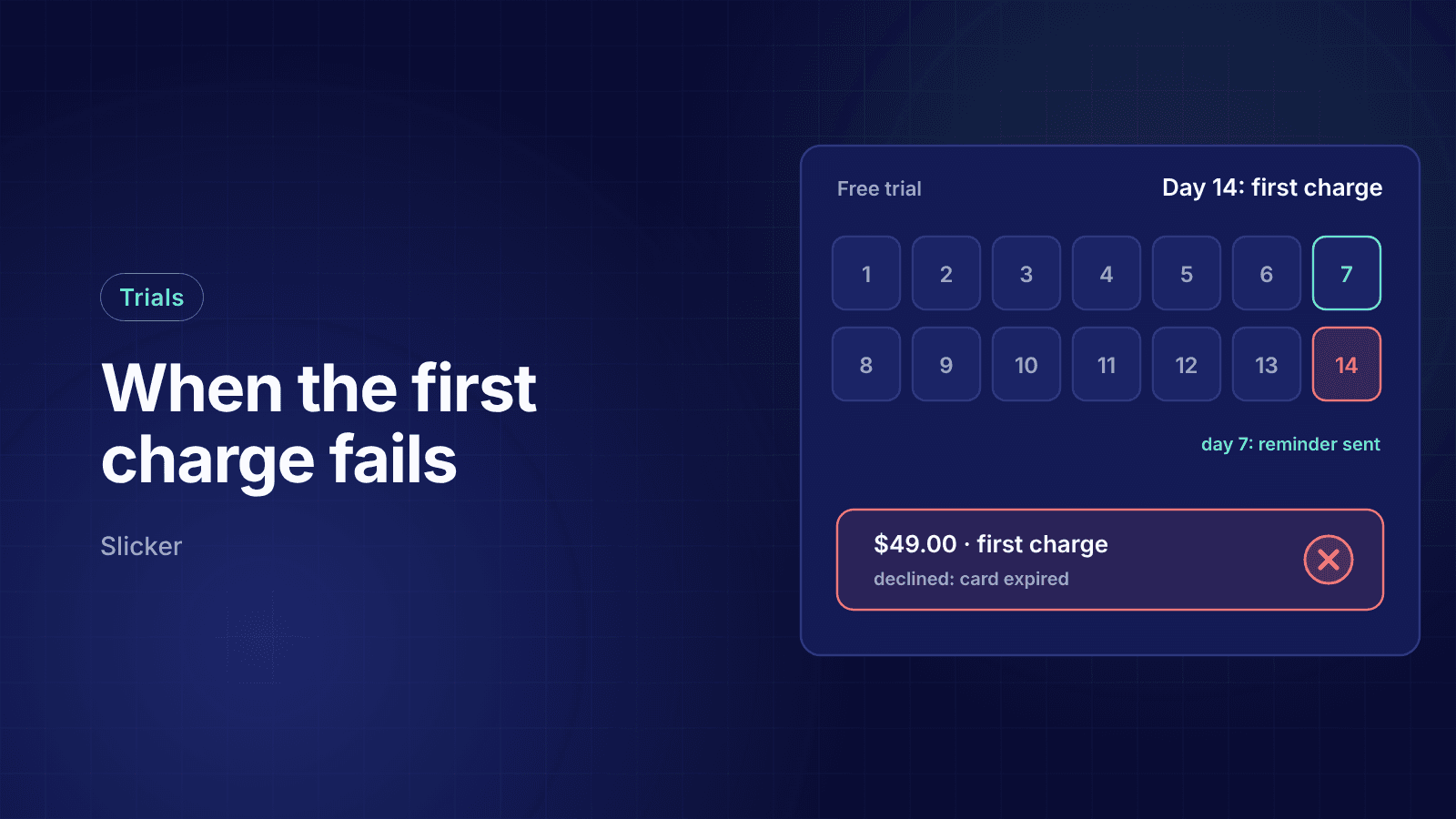
Free Trial to Paid Conversion Failures: Why the First Charge Fails and How to Recover It
A customer signs up for your free trial, uses the product for two weeks, and then the first real charge fails. They never saw an error. They never decided to...
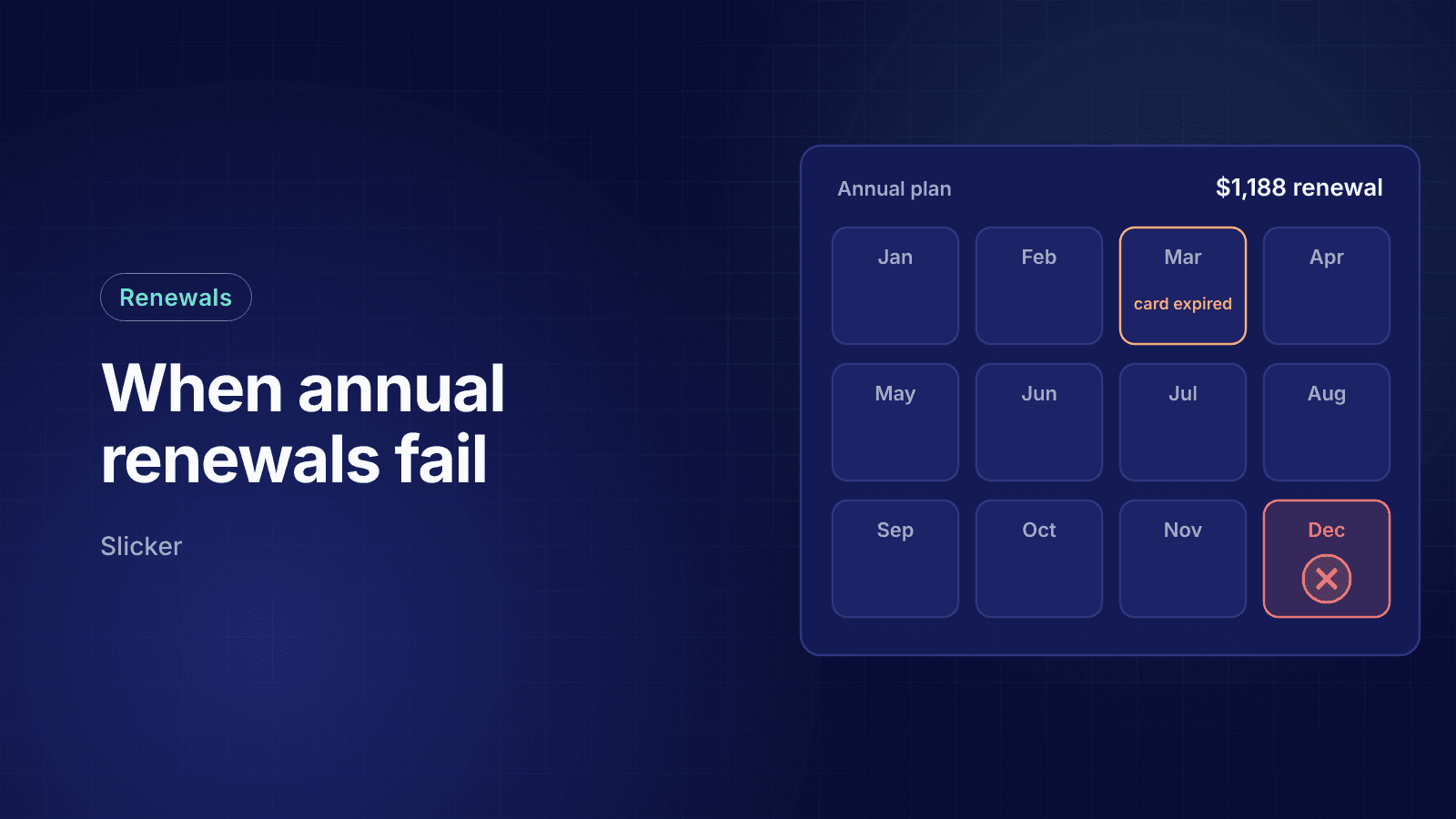
Annual Subscription Renewals That Fail: How to Recover High-Value Renewal Payments
Twelve months ago a customer paid $1,188 for your annual plan without a second thought. This morning the renewal failed. The card on file expired in March, the...
What Card Is This? How to Identify and Validate a Card From Its Number
A customer emails support with a card number that "keeps getting rejected." Your checkout says the card is invalid, the customer insists it works everywhere...
Stop losing revenue to failed payments
Join leading subscription businesses using Slicker to recover failed payments automatically.
Get Started