Recover Error Code 05 Soft Declines via Smart Retries Oct 2026

smart retries outperform generic schedules by assessing each declined payment individually and determining the optimal retry strategy based on historical success patterns.
TLDR
• Error code 05 represents temporary soft declines that Visa allows up to 20 re-attempts within a 30-day window, making them prime candidates for intelligent retry strategies
• Generic retry systems lose 9% of subscription revenue (PYMNTS) by applying identical logic to all failures
• Slicker's multi-gateway routing delivers 7 to 13 pp approval lifts versus single-processor setups, proven via AABB testing
• Smart retry engines analyze dozens of variables including transaction histories, time zones, and issuer behaviors to predict optimal retry timing and gateway routing
First retry success rates jump from 10 to 15% with generic scheduling to 25 to 35% with intelligent timing
• Implementation requires respecting network retry limits, distinguishing soft from hard declines, and activating multi-gateway routing for maximum recovery
• Modern AI systems reduce retry attempts by 40-60% while achieving 3-4x better overall recovery rates compared to fixed schedules
Error-code 05 soft declines drain revenue, but smart payment retries turn them into approvals. By combining AI timing, routing and issuer-specific rules, companies can recover more payments automatically, cutting involuntary churn at scale.
Why does error code 05 matter, and how do smart payment retries beat brute-force schedules?
Soft declines are the silent killers of SaaS cash flow. While hard declines signal definitive payment failures, soft declines represent temporary issues, insufficient funds, expired cards, or processing hiccups, that can often be resolved with the right retry strategy.
Error code 05, commonly known as "Do Not Honor," falls squarely into the soft decline category. Unlike hard declines that indicate permanent failures like stolen cards or closed accounts, Code 05 represents temporary refusals that merchants can retry, as detailed in this breakdown of Code 05 causes. In fact, Visa allows up to 15 re-attempts for these temporary issues within a 30-day window.
The challenge lies in how error codes mask the real issues. As one payment recovery expert notes, "Error codes are inconsistent across banks and payment gateways, often mask multiple underlying issues, and ignore key context like customer history." Consider this reality: Amex uses identical codes for about 85% of their declines.
This inconsistency creates chaos for retry strategies. Gateway A might return "insufficient_funds," Gateway B prefers "NSF," while Bank C just sends "51", and they might all mean slightly different things. With modern payments failing for dozens of possible reasons, understanding network error codes as retry signals matters more than relying on error codes alone: it's like using a horoscope to make financial decisions.
The smart alternative? Build payment behavior profiles that track how specific banks and gateways actually behave. If Bank X historically approves 80% of retries after a specific error, that pattern matters more than the error code itself. This is where AI-powered smart retries fundamentally change the game.
Where does generic retry logic fall short?
Generic retry systems operate on a dangerous assumption: all failed payments deserve identical treatment. Batch systems typically apply identical retry logic to every declined transaction, missing critical nuances that determine success or failure. A detailed breakdown of when to retry and when to stop appears later in this post.
The numbers tell a sobering story. According to PYMNTS industry data, subscription businesses lose 9% of their revenue due to failed payments. Yet most companies still rely on fixed retry schedules that treat a Fortune 500 company's expired card the same as a startup's insufficient funds error.
This one-size-fits-all approach creates multiple problems:
Excessive retry fees: Blindly retrying payments that will never succeed wastes money on processing fees. Each failed attempt costs money, and those fees compound quickly when you're retrying thousands of transactions.
Network blacklisting risks: Visa caps retries at 20 attempts (raised from 15 in May 2025), while Mastercard's Excessive Authorization Rules set their own thresholds. Exceed these limits and you risk compliance violations, fines, or being flagged as a problematic merchant.
Customer friction: Generic retries often happen at inconvenient times, triggering multiple decline notifications that frustrate customers and damage trust.
Lost recovery opportunities: Fixed schedules miss optimal retry windows. Involuntary churn reduces revenue unnecessarily when payments that could succeed with proper timing fail repeatedly.
The hidden cost compounds over time. When generic retry logic fails to recover soft declines, those customers often disappear permanently. The relationship ends not because of dissatisfaction with the product, but because of payment infrastructure limitations.
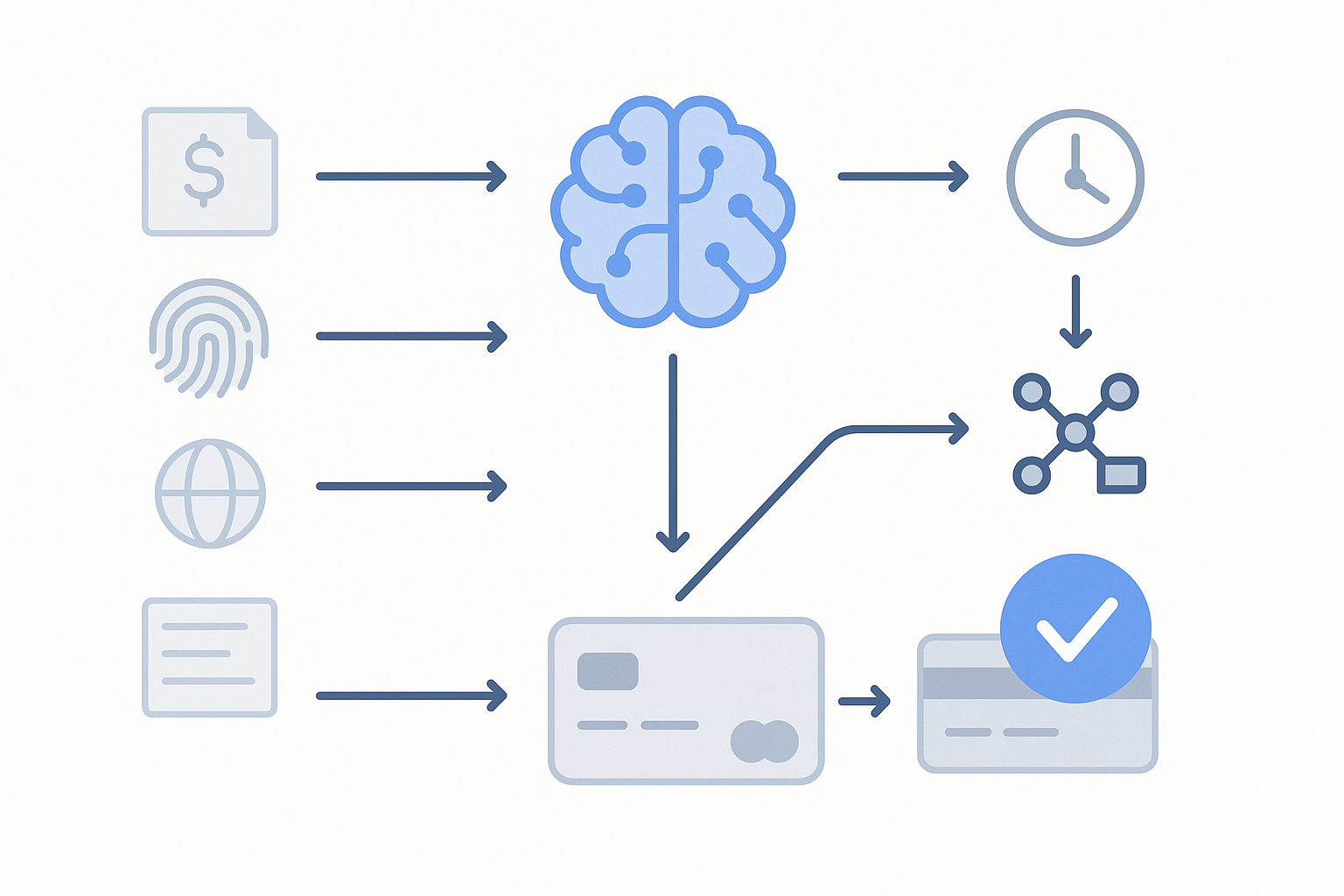
How does an AI retry engine optimize timing, routing and messaging?
AI picks optimal retry times for failed payment attempts by analyzing patterns humans would never detect. Instead of following rigid schedules, machine learning models score each transaction individually, considering dozens of variables simultaneously.
The core components work in concert:
Data inputs: AI engines ingest transaction histories, device fingerprints, time zones, spending patterns, and issuer behaviors. AI-powered multi-gateway routing scores each failed transaction individually, building detailed profiles that predict success probability.
Model outputs: The system generates three critical decisions for each failed payment:
- Optimal retry timing (when the account likely has funds)
- Best gateway routing (which processor has highest approval rates for this scenario)
- Message optimization (how to frame the retry request to the issuer)
Real-time decision loops: Data-driven decision-making draws on AI models to create adaptive retry schedules. The model continuously learns from each attempt, updating its predictions based on success and failure patterns.
Routing intelligence: Modern AI engines don't just retry through the same gateway. They maintain relationships with multiple processors and route each retry through the path most likely to succeed, automatically identifying false declines in real time.
This orchestration happens invisibly. A payment fails at 3 PM on Friday. The AI knows this customer's employer deposits payroll on the 15th and 30th, their timezone is PST, and historically similar profiles succeed when retried at 6 AM on Monday through a specific gateway. The retry executes automatically at the optimal moment.
The sophistication extends beyond timing. AI models understand that "insufficient funds" from one bank might mean retry in 24 hours, while the same code from another bank suggests waiting until the next pay cycle. These detailed decisions multiply recovery rates.
What do the numbers say? Benchmarks from Stripe, Recurly, Pagos & Slicker
The data from payment processors reveals the dramatic impact of intelligent retry systems compared to generic approaches:
Metric | Generic Retry | Smart Retry | Improvement |
|---|---|---|---|
First retry success rate | 10-15% | 2-3.5x | |
Overall recovery rate | 20-30% | Up to 89% | 3-4x |
Retry attempts needed | 3-5 optimized attempts | 40-60% reduction | |
Revenue impact | Baseline | 7-13 pp approval lift | Millions in ARR |
Platform-specific results reveal consistent patterns:
Stripe Smart Retries: The recommended default setting is 8 tries within 2 weeks, but their AI optimizes each attempt individually rather than following fixed intervals.
Recurly Intelligent Retries: Uses billions of transaction data points to predict optimal retry windows, particularly effective for soft declines.
Pagos optimization: First retry attempts after initial declines succeed 25-35% of the time when properly timed, compared to 10-15% for generic scheduling.
Slicker's multi-gateway routing: AI-powered routing algorithms deliver 7-13 percentage point approval lifts versus single-processor setups. One merchant improved their success rate from 86% to 93%, reshaping their unit economics overnight.
The compounding effect is remarkable. Across large transaction volumes, smart retry systems have shown material recovery gains over fixed schedules, and that gain translates directly to retained revenue and reduced customer acquisition costs.

What's changed in 2026: tighter rules, smarter tools
The stakes for getting retry logic right have risen sharply this year. Three developments are reshaping how subscription businesses approach soft-decline recovery right now.
Mastercard's 2026 Excessive Authorization Rules are live. The network tightened oversight on automated retry behavior this year, applying stricter penalties to merchants whose billing systems repeatedly attempt the same declined card, merchant, and amount. Subscription, SaaS, and digital-goods companies are the primary targets. Finance leaders who haven't audited their retry stacks against Mastercard's Merchant Advice Codes (MACs), particularly MAC 03 (Do Not Retry) and MAC 21 (Stop Recurring Payment), face escalating per-attempt fees and program-level fines up to $100,000 per month.
Involuntary churn benchmarks have worsened. Baremetrics' 2026 subscription data confirms that involuntary churn now accounts for up to 50% of total subscription churn, up from the 20-40% range cited in earlier research. That means for every two customers who cancel, roughly one is lost not because they chose to leave, but because a payment failed and recovery logic didn't catch it in time.
AI payment analytics has become its own product category. In 2026, the recovery conversation has expanded beyond "retry or don't retry" into continuous performance measurement. AI investment continues to grow rapidly across industries, and payment intelligence is a clear beneficiary of that momentum. Dedicated analytics dashboards now sit alongside retry engines, giving finance teams a unified view of failure patterns, revenue at risk, and recovery rates without manually stitching together gateway reports. The ability to see why payments fail (and not merely that they failed) is increasingly table stakes for high-volume subscription businesses.
Together, these changes make the argument for intelligent retry infrastructure stronger than ever: the compliance floor is higher, the revenue at risk is larger, and the tooling to handle both has matured considerably.
How do you implement smart payment retries without breaking compliance?
Implementing intelligent retry logic requires careful orchestration of technology, compliance, and customer experience:
1. Respect network retry limits Visa allows up to 20 re-attempts within 30 days for soft declines (raised from 15 in May 2025). Mastercard's 2026 Excessive Authorization Rules cap retries at 10 attempts per 24 hours and 35 per 30-day window. Exceed either threshold and escalating fees apply. Your retry engine must track attempts across all gateways to avoid violations that trigger fines or merchant account issues.
2. Distinguish soft from hard declines Card networks limit retries by decline type. Hard decline codes like stolen_card or account_closed should never trigger retries. Your system needs real-time decline code interpretation to route appropriately. The soft decline retry playbook covers exactly when to act and when to stop.
3. Activate multi-gateway routing Adaptive retries using alternative payment methods enhance success rates. Set up relationships with multiple processors and implement routing logic that selects the optimal gateway for each retry attempt.
4. Configure retry timing windows Avoid retrying during typical insufficient funds periods (late in the month before payday). Instead, draw on data on payroll cycles, time zones, and historical success patterns.
5. Implement retry decay logic First retries should happen quickly (within 24-48 hours) for technical failures. Subsequent attempts should space out progressively, with final attempts concentrated around likely funding events.
6. Monitor retry performance metrics Track success rates by decline code, gateway, timing, and customer segment. AI continuously processes streaming data to identify patterns and optimize future attempts.
7. Maintain transparency with customers Send a single, clear notification about payment issues instead of bombarding customers with failure alerts. Provide self-service options for updating payment methods.
8. Document your retry strategy Maintain clear documentation of retry rules, timing logic, and compliance measures for audits and regulatory reviews.
Stop guessing, let AI fix soft declines before revenue leaks out
Error code 05 and other soft declines no longer need to drain your revenue. The technology exists today to convert these temporary failures into successful payments through intelligent retry orchestration.
The gap between error code ambiguity and actual recovery potential is where AI-powered systems do their best work, turning incomplete signals into confident, timed retry decisions that retain revenue.
Smart payment retries go beyond technology: they're about recognizing that each failed payment has unique characteristics that determine the optimal recovery path. Generic retry schedules treat symptoms. Building payment behaviour profiles for each bank and gateway combination targets root causes.
For subscription businesses watching involuntary churn erode their growth, the choice is clear. Fixed retry schedules belong in the past alongside batch processing and manual dunning. Modern AI retry engines deliver measurable improvements in recovery rates, reduced processing costs, and customer retention.
Slicker's intelligent payment recovery platform embodies this evolution. By scoring each failed transaction individually, scheduling optimal retries, and routing through the best gateway, Slicker helps subscription companies convert payment failures into recovered revenue. The platform's AI engine continuously adapts to changing payment patterns, keeping your recovery rates on an upward path instead of stagnating with fixed rules.
The future of payment recovery isn't about trying harder, it's about trying smarter. Let AI handle the complexity of soft decline recovery while you focus on growing your business.
Frequently Asked Questions
What is error code 05 in payment processing?
Error code 05, also known as "Do Not Honor," is a soft decline indicating a temporary refusal of a payment transaction. It often results from issues like insufficient funds or expired cards, which can be resolved with strategic retry attempts.
How do smart payment retries differ from generic retry logic?
Smart payment retries use AI to analyze transaction patterns and optimize retry timing, routing, and messaging. Unlike generic retries that apply the same logic to all transactions, smart retries work by reviewing each transaction's history and issuer behavior individually to improve success rates.
Why are soft declines significant for subscription businesses?
Soft declines, such as error code 05, can lead to involuntary churn if not managed properly. Subscription businesses risk losing up to 9% of their revenue due to failed payments, making effective retry strategies necessary for revenue recovery.
How does AI improve payment retry success rates?
AI enhances payment retry success by evaluating each transaction individually, considering factors like transaction history, time zones, and issuer behaviors. This allows for optimized retry timing and routing, markedly increasing recovery rates compared to generic methods.
What compliance measures are necessary for implementing smart retries?
To implement smart retries, businesses must respect network retry limits, distinguish between soft and hard declines, activate multi-gateway routing, and configure retry timing windows. Monitoring performance metrics and maintaining transparency with customers are also critical for compliance.
What are the best alternatives to Churn Buster for AI-powered dunning and payment retries in 2026?
The leading alternatives to Churn Buster for AI-powered failed payment recovery in 2026 include Slicker, ProfitWell Retain, Recurly Intelligent Retries, and Stripe Smart Retries, each with different strengths. Churn Buster focuses primarily on dunning email sequences, while dedicated retry platforms go further: Slicker applies an ensemble of AI models to decide whether to retry, when, and through which gateway, delivering 7-13 percentage point approval lifts versus single-processor setups. ProfitWell Retain (now part of Paddle) combines dunning emails with some retry logic but does not publish statistically verified recovery uplift data by cohort. Recurly uses billions of historical transactions to predict retry windows but is limited to merchants on the Recurly billing platform. For subscription businesses that need multi-gateway routing, issuer-specific timing, and provable revenue uplift measured against a control group, a purpose-built platform like Slicker is the strongest Churn Buster alternative for AI-powered retries in 2026.
What is the best way to reduce involuntary churn for a SaaS subscription business in 2026?
Reducing involuntary churn in 2026 requires a layered approach that goes beyond basic retry schedules. The four most impactful levers are: (1) AI-powered smart retries: timing each attempt around payroll cycles, time zones, and issuer-specific behavior instead of fixed intervals; (2) Account Updater services: automatically refreshing expired or replaced card credentials before a payment is even attempted, available through Visa, Mastercard, and processors like Stripe and Adyen; (3) network tokenization: replacing raw card numbers with network tokens that update automatically when cards are reissued, reducing declines caused by stale credentials by up to 30% on some issuer networks; and (4) Compliance with 2026 retry rules: Mastercard's Excessive Authorization Rules cap retries and penalize merchants who ignore MAC 03 (Do Not Retry) and MAC 21 (Stop Recurring Payment) codes, so a compliant retry stack prevents fines while protecting approval rates. As covered above, the majority of that loss is recoverable with the right infrastructure in place.
Stripe Smart Retries vs. a dedicated payment recovery system: which recovers more revenue?
Stripe Smart Retries is a strong default for merchants already on Stripe Billing: it uses machine learning to optimize retry timing and recommends up to 8 attempts over two weeks, recovering meaningfully more revenue than fixed schedules. However, it has structural limitations that a dedicated platform resolves. Stripe Smart Retries only retries through Stripe; it cannot route a failed payment to an alternative processor that may have a higher approval rate for that specific issuer or card type. It also does not combine retry logic with account updater services, network tokenization, or issuer-specific behavioral models trained on multi-gateway data. A dedicated payment recovery platform like Slicker scores each failed transaction across multiple gateways, applies ensemble AI models tuned by geography, issuer, and card type, and delivers 7-13 percentage point approval lifts versus single-processor setups, a gap that translates to millions in recovered ARR for high-volume subscription businesses. For merchants processing under ~$5M ARR on Stripe alone, Smart Retries is a reasonable starting point. Above that threshold, or wherever multi-gateway routing is possible, a dedicated platform recovers materially more revenue.
What are the best failed payment recovery tools for subscription businesses in 2026?
The top failed payment recovery tools for subscription businesses in 2026 fall into three tiers. Purpose-built AI recovery platforms (Slicker, Churn Buster, ProfitWell Retain/Paddle) combine smart retries, dunning email sequences, and in some cases multi-gateway routing; Slicker stands apart with ensemble AI models and a clinical-grade AABB testing methodology that measures recovery uplift against the merchant's own control group. Billing-platform-native tools (Stripe Smart Retries, Recurly Intelligent Retries, Chargebee Smart Dunning, Zuora Configurable Payment Retry) are tightly integrated with their respective platforms but generally limited to single-gateway retries and pre-set dunning templates. Payment orchestration layers (Adyen, Primer.io, Pagos) add retry optimization and multi-gateway routing at the infrastructure level, often complementing a dedicated dunning tool instead of replacing it. When assessing tools, the key metrics to benchmark are: first-retry success rate (smart platforms target 25-35% vs. 10-15% for generic schedules), overall recovery rate (up to 89% with AI-optimized retries), and compliance with Mastercard's 2026 Excessive Authorization Rules. The best tool is the one that proves its recovery uplift on your own transaction data, not aggregate benchmarks.
How can payment failure analytics help diagnose whether a high decline rate is a real problem?
A high overall decline rate is not automatically a problem: the diagnosis depends on why payments are failing and which segments are affected. Payment failure analytics disaggregate your decline data by failure reason, card type, issuer, gateway, and customer cohort so you can separate signal from noise. For example, a spike in error code 05 across a single issuer on a specific card type may indicate a temporary issuer-side risk flag and not a fundamental billing problem, and retrying through a different gateway often resolves it. Conversely, a rising share of hard declines (stolen cards, closed accounts) in a particular cohort signals a different problem entirely: fraud or poor payment-method hygiene, not retry logic. The most actionable analytics dashboards show failure reason distribution, issuer-level approval rates, and recovery rates by decline code side-by-side, so you can identify whether a disproportionate share of losses is concentrated in a handful of issuers, card types, or failure categories that a targeted fix (gateway routing change, Account Updater enrollment, MAC compliance adjustment) can resolve directly.
What level of access does Slicker require, and can a read-only integration be set up before granting write access for active retries?
Yes. Slicker is designed to support a phased access model. In the first phase, a read-only integration connects to your billing platform (Stripe, Zuora, Recurly, Chargebee, and others) and ingests historical transaction data without touching any live payments. This gives your team full visibility into failure patterns, recovery opportunity sizing, and which decline codes are driving the most revenue leakage. All of this is available before Slicker executes a single retry. Write access, which lets Slicker's AI schedule and execute retries on your behalf, is granted separately once you are satisfied with the diagnostic findings and have reviewed the proposed retry rules. This staged approach means no substantial engineering resources are needed for the initial analysis, and your finance or payments team can validate the business case before any automated actions are activated.
How does a retry system handle different payment methods (cards, direct debits, and digital wallets) differently?
Retry logic is not uniform across payment methods: the rules, timing constraints, and failure semantics differ by instrument. For cards, retry behavior is governed by card network rules (Visa's 15-attempt / 30-day limit, Mastercard's Excessive Authorization Rules), decline codes, and Merchant Advice Codes (MACs). MACs such as MAC 03 (Do Not Retry) and MAC 21 (Stop Recurring Payment) are mandatory stop signals: a compliant retry engine must honor them immediately instead of retrying. For direct debits (ACH, BACS, SEPA), the retry window and permissible attempt count are set by the scheme, not the card network; BACS has strict rules on re-presentation timing, and ACH returns carry R-codes with their own retry implications. For digital wallets (Apple Pay, Google Pay), the underlying funding instrument (typically a card) still governs retry eligibility, but wallet tokenization can sometimes recover a payment that would fail on the raw card number because the token routes to the issuer's updated credentials. A mature retry platform maintains scheme-specific rule sets for each payment method and routes each failed transaction through the appropriate logic, not a single generic schedule across all instrument types.
How does Slicker's AI decide when to retry, and what happens when it produces a bad result?
Slicker's AI scores each failed payment individually against an ensemble of models that consider decline code, issuer behavior, gateway history, customer transaction profile, time zone, and payroll-cycle signals to generate a retry probability score. When that score exceeds the threshold for a given decline type (and the attempt would not violate network retry limits or a MAC stop signal) the system schedules the retry at the predicted optimal moment. When the AI produces a suboptimal result (a retry that fails when the model predicted success, or an unnecessary retry that incurs a processing fee), the outcome is fed back into the model as a labeled training example, improving future predictions. On the accountability side, Slicker uses clinical-grade AABB testing: splitting your transaction volume 50/50 between Slicker's logic and your existing baseline, so you can see exactly which decisions added or destroyed value, measured in dollars recovered, with a reported p-value. If Slicker does not beat your control with statistical significance, you do not pay for the uplift. That testing architecture converts a concern about AI accountability into a measurable, auditable line item.
How does Slicker integrate with Zuora for payment retry orchestration?
Slicker integrates with Zuora through Zuora's payment orchestration and retry APIs, connecting at the billing-engine level so that failed payment events in Zuora trigger Slicker's AI decision engine instead of Zuora's native Configurable Payment Retry logic. The integration is designed to require no notable engineering resources: setup typically involves configuring a webhook or API credential handoff that routes retry decisions through Slicker, with the read-only diagnostic phase available immediately after credentials are provided. Slicker's rule engine can also ingest Zuora's payment run schedules and subscription metadata to align retry timing with billing cycles, an important nuance for subscription businesses where retry windows need to respect both network rules and the subscriber's next renewal date.
Can payment method switching recover failed payments automatically, without the customer doing anything?
Yes, and this is one of the most underutilized recovery levers available today. Automatic payment method switching works at two levels. At the credential level, Account Updater services (available through Visa, Mastercard, and processors including Stripe and Adyen) automatically refresh expired or replaced card numbers before a payment is attempted, eliminating declines caused by stale credentials without any customer action. At the instrument level, if a customer has multiple payment methods on file (a backup card, a bank account, a digital wallet) a retry platform can attempt the charge against an alternative method when the primary instrument declines, again without requiring customer involvement. Stripe does offer some native Account Updater functionality for cards stored in Stripe Billing, but cross-gateway credential refresh and multi-instrument switching require a third-party tool or a custom orchestration layer. For subscription businesses with high card-expiry churn or customers in markets where card reissuance is frequent, combining Account Updater with smart retries is the most effective automated recovery stack, often recovering a meaningful share of failures before a dunning email is ever needed.
Sources
- https://www.slickerhq.com/blog/dunning-emails-vs-intelligent-retry-logic-2025-subscription-revenue-recovery
- https://primer.io/blog/soft-declines
- https://www.slickerhq.com/blog/machine-learning-multi-gateway-routing-slicker-approval-lift-vs-single-processor
- https://pagos.ai/use-cases/retry-strategy
- https://www.slickerhq.com/blog/how-ai-enhances-payment-recovery
- https://www.slickerhq.com/blog/one-size-fails-all-the-case-against-batch-payment-retries
- https://beastinsights.com/blog/failed-payment-recovery/
- https://stripe.com/resources/more/payment-retries-101-how-businesses-can-make-the-most-of-this-important-detail
- https://stripe.com/docs/billing/revenue-recovery/smart-retries
- https://docs.y.uno/docs/retries
- https://stripe.com/blog/ai-enhancements-to-adaptive-acceptance
- https://docs.zuora.com/en/zuora-payments/payment-orchestration/cascade-payment-methods
Related Articles
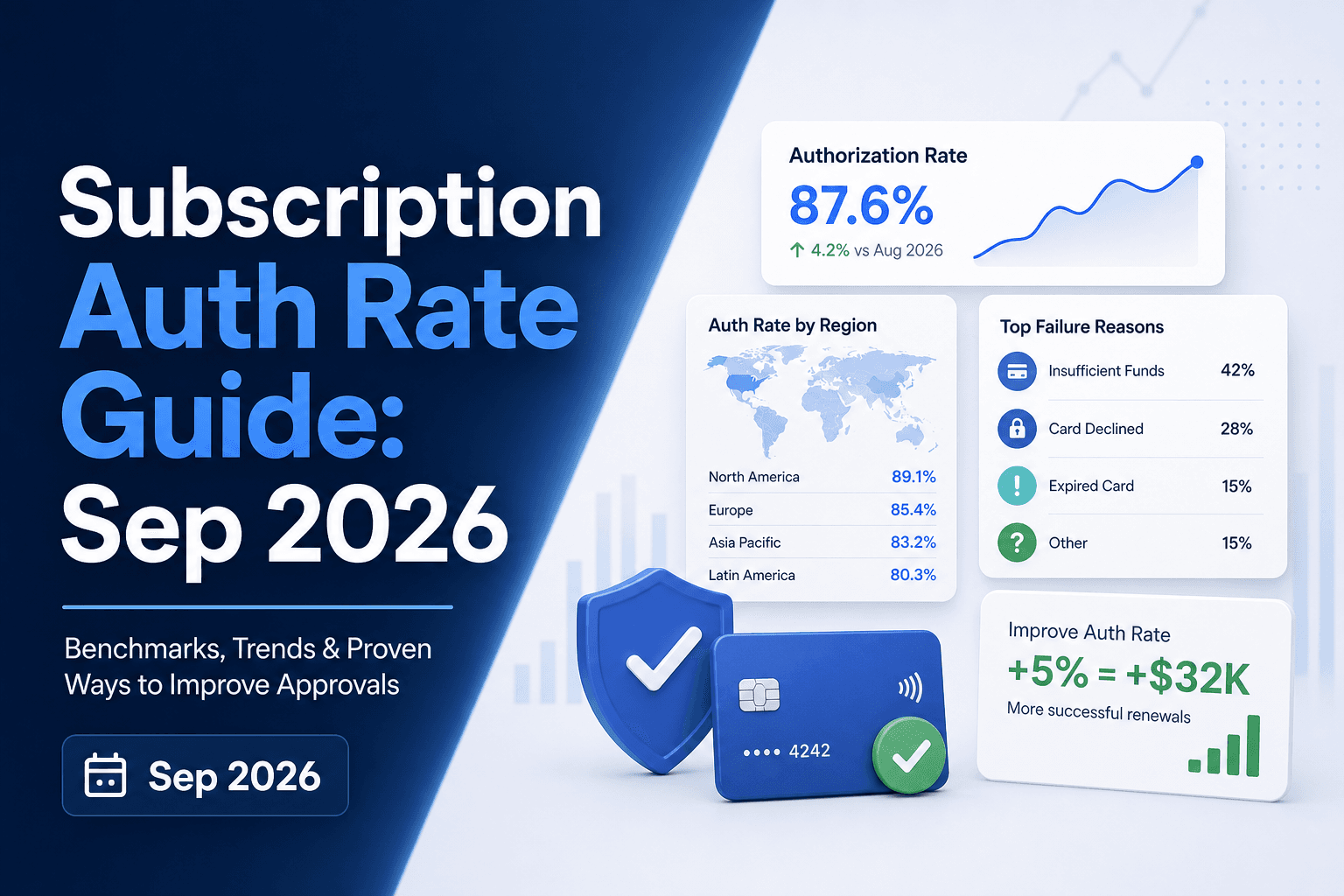
Authorization Rate in Subscription Billing: October 2026
There's a number sitting in your payments data that most finance and retention teams never report on separately: the share of renewal charges your issuing...
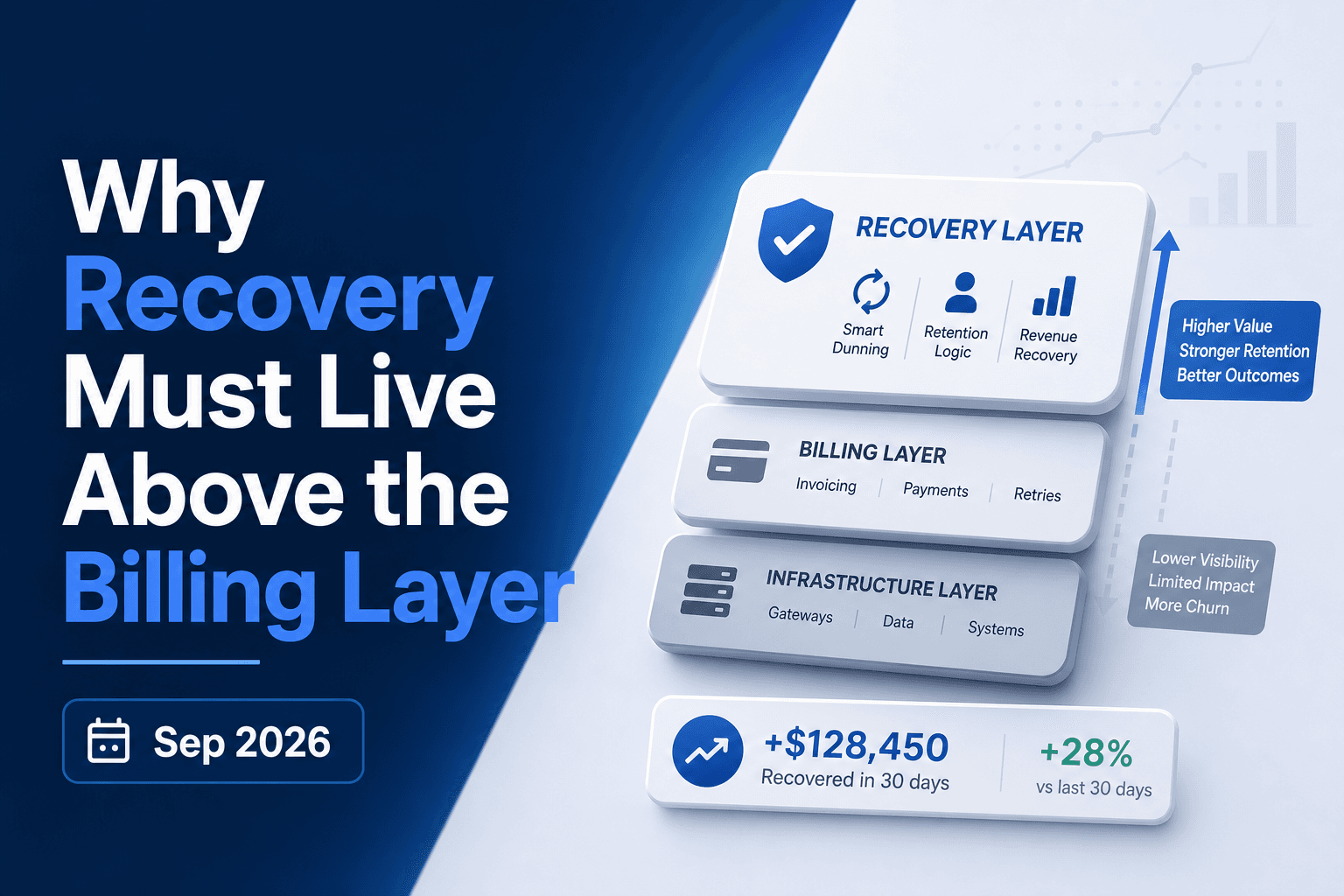
Why Payment Recovery Must Live Above Billers October 2026
A payment fails. Your biller retries it three days later, then again at seven, then at fourteen. What the biller never checks is whether the issuer sent a...
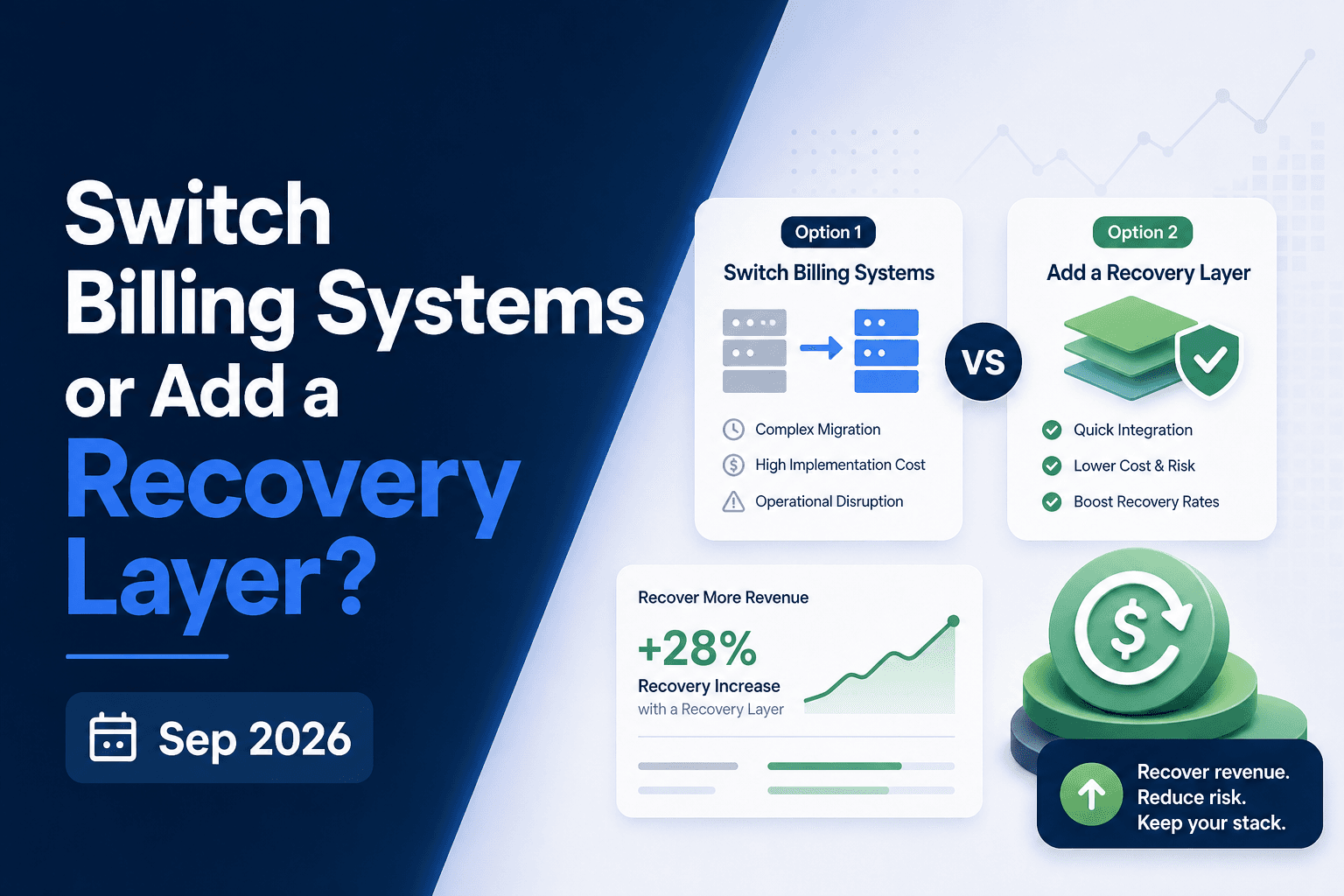
Billing Migration vs Recovery Layer: The Right Call October 2026
Switching billing systems feels like the right move when revenue collection starts breaking down. Sometimes it is. But soft declines, weak retry logic, and...
Stop losing revenue to failed payments
Join leading subscription businesses using Slicker to recover failed payments automatically.
Get Started