Hard Decline Retry Penalties Explained (October 2026)
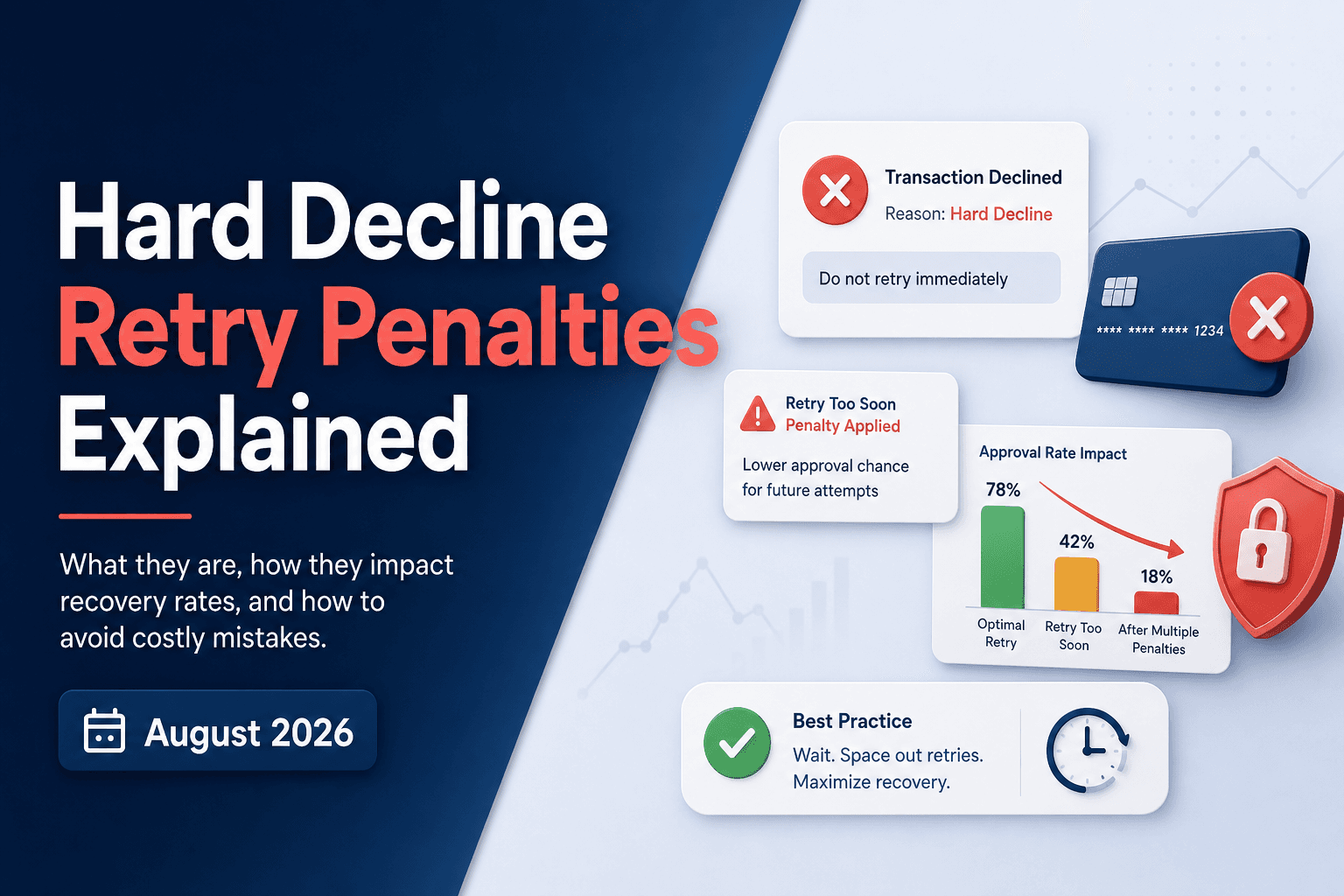
If a card comes back as stolen or the account is closed, no retry will recover that payment. What it will do is trigger a per-attempt fee every single time your billing system tries anyway. With Mastercard's penalty now at $0.50 per attempt and program-level fines on top of that, the math gets uncomfortable fast. Here's what those fees actually look like and how to stop generating them.
TLDR:
- Retrying a Visa Category 1 hard decline costs $0.10 per domestic attempt from retry one, with no grace threshold (per Visa's Excessive Reattempts Rule).
- Mastercard charges $0.10 per retry when the merchant advice code is Do not retry (MAC 03) or Stop Recurring Payment (MAC 21).
- Program-level fines stack on top of per-transaction fees: Visa can levy $5,000 to $75,000 monthly, Mastercard up to $50,000 to $100,000.
- Repeated hard decline retries lower your MID's (Merchant ID) Transaction Authorization Rate (TAR), causing issuers to reject even recoverable payments.
- Slicker reads decline codes and MAC values before scheduling any retry, averaging 4.4 attempts per recovery versus a control group's 6.1.
Hard Declines vs. Soft Declines in Recurring Billing
Every failed recurring payment falls into one of two categories, and which one determines whether retrying is smart or costly.
Soft declines are temporary. Insufficient funds, a brief issuer block, a network timeout: the card is valid, the customer relationship is intact, and a well-timed retry will often succeed. These are recoverable failures.
Hard declines are permanent. A closed account, a stolen card, a fraud flag: the issuer has rejected the transaction outright, and no amount of retrying will change that outcome without cardholder action first.
The business consequence of mixing these up is direct. When a billing system retries a hard decline on the same schedule it uses for insufficient funds, it triggers the exact hard decline retry penalty fees that Visa and Mastercard payment retry rules were designed to punish. Misclassification is not a technical error. It is an expensive one.
How Visa Categorizes Decline Codes for Retry Eligibility
Visa response code retry rules sort every decline response into one of four categories, each with its own retry rules. Which bucket your failed payment lands in determines whether your next attempt is permitted, conditional, or penalized from the first retry.
Category | Description | Retry Permitted? |
|---|---|---|
1 | Do not retry (hard declines: stolen card, fraud, closed account) | Never; fees apply immediately |
2 | Retryable with attempt limits (soft declines: insufficient funds, issuer unavailable) | Yes, within Visa's threshold |
3 | Retry after fixing the underlying data (expired card, invalid account number) | Yes, once corrected |
4 | Generic issuer responses (similar conditions to Categories 2 and 3) | Conditional |
Category 1 is where the hard decline retry penalty becomes a real cost. Unlike Categories 2 and 4, where fees only accrue after you exceed Visa's retry limits, Category 1 codes carry fees immediately. There is no grace threshold. The moment a Category 1 response is returned and you retry, the fee is triggered.
For subscription businesses running fixed billing schedules, a retry engine that treats a Category 1 stolen card the same way it treats a Category 2 insufficient funds decline will generate fees on every single attempt after the first decline, with no recovery to show for it.
Mastercard's Merchant Advice Codes (MACs) and the Retry Rulebook
Where Visa uses broad categories, Mastercard communicates at the transaction level. Each decline response can carry a Merchant Advice Code (MAC) that tells you exactly what to do next.
The critical distinction is between codes that are hard stops and codes that prescribe timing. Ignoring either type costs money.
Merchant Advice Codes MAC 03 (Do Not Try Again) and MAC 21 (Stop Recurring Payment) are absolute stops. MAC 03 signals the payment will not succeed without cardholder intervention. MAC 21 means the cardholder has cancelled the recurring billing relationship entirely. Retrying after either code triggers Mastercard's $0.10 per-attempt penalty fee with no possibility of recovery on that instrument.
For recoverable insufficient-funds declines, Mastercard's time-specific codes remove any guesswork about when to retry:
MAC Code | Retry Window |
|---|---|
24 | Retry after 1 hour |
25 | Retry after 24 hours |
26 | Retry after 2 days |
27 | Retry after 4 days |
28 | Retry after 6 days |
29 | Retry after 8 days |
30 | Retry after 10 days |
Visa publishes no comparable set of transaction-level timing codes. A retry engine handling both networks cannot apply a single ruleset and stay compliant on both. Mastercard's MAC framework requires the system to read the advice code, classify it as a hard stop or a timing instruction, and act accordingly before scheduling anything.
The Per-Transaction Penalty Fees: What Each Retry Actually Costs
The numbers are specific, and they compound fast.
Under Visa's Excessive Reattempts Rule (active since April 2022), Category 1 declines carry a $0.10 per-attempt fee by transaction type. No grace threshold; the fee starts at retry one.
Mastercard's Transaction Processing Excellence (TPE) program follows the same logic for MAC 03 and MAC 21 violations. The per-retry fee is $0.10 per non-compliant attempt.
The detail that hits hardest: penalties apply even on successful retries. A retry on a hard-declined card that somehow clears still costs you the fee. For a subscription business firing weekly retries across thousands of failed invoices, those per-transaction amounts stop looking small fast.
How Program-Level Monitoring Turns Per-Transaction Fees Into Monthly Fines
Per-transaction fees are only the first layer. Both networks run monitoring programs that aggregate your retry behavior across an entire month and levy separate fines when volume thresholds are crossed.
Visa's Merchant Monitoring Program flags merchants who exceed a 15% decline rate or 1,000 monthly decline transactions. Once flagged, monthly fines range from $5,000 to $75,000, assessed on top of per-transaction penalties already accumulating on the same activity.
Mastercard's Excessive Attempts program operates independently from the MAC-specific TPE fees. Merchants who breach retry volume thresholds face escalating per-excessive-transaction fees: $1.00 in the first month, rising to $2.00 in subsequent months. At high transaction volumes, aggregate monthly exposure from this program alone can reach $50,000 to $100,000.
The compounding math is what makes this punishing at scale. Per-transaction fees accrue on every non-compliant retry, and program-level fines apply separately on top, calculated against the same underlying retry volume. A billing system retrying hard-declined cards is simultaneously building the monthly aggregate that triggers the larger fine tier.
How Hard Decline Retries Damage Your Merchant ID (MID) Reputation
Fees are recoverable. Reputation damage is slower to undo.
Every failed authorization attempt is logged against your Merchant ID (MID). When hard declines make up a disproportionate share of those attempts, your Transaction Authorization Rate (TAR) falls. Issuing banks read a low TAR as a signal of poor payment hygiene and begin declining even legitimate, recoverable transactions at higher rates in response.
The feedback loop compounds. Issuers track retry velocity on individual cards, and bursts of attempts on a hard-declined instrument flag the merchant as a risk, independent of the per-attempt fee structure. Over time, a damaged MID reputation can escalate to held reserves, higher processing costs, or account termination by the acquirer.
Why Fixed-Schedule Billing Systems Accumulate Penalties Silently
Fixed-schedule retry logic has no awareness of why a payment failed. It sees a declined invoice and schedules the next attempt on a calendar cadence, regardless of whether the decline was a recoverable insufficient funds error or a permanent fraud flag. A stolen card and a missed paycheck get identical treatment.
Most billing systems do not read decline codes or Merchant Advice Code (MAC) values before queuing the next retry. A failure reason dunning cadence routes each decline correctly before the schedule fires, the attempt hits the network, and the fee accrues. None of that surfaces as a warning in your billing logs.
What does surface, eventually, is a line on your processing statement. Visa's excessive reattempts penalties appear as "VS RAF Excessive Reattempts," and Mastercard's Total Payment Experience (TPE) charges carry their own line. Both are easy to miss among interchange fees until the monthly total becomes material enough to prompt a question.
Penalty exposure scales directly with transaction volume. A business processing 50,000 failed invoices monthly accumulates far more non-compliant retry attempts than one processing 5,000, but the underlying logic producing those attempts is identical. The fees grow as long as the retry schedule stays unchanged, which for most fixed-cadence billing systems means indefinitely.
Building a Compliant Retry Strategy That Stops at Hard Declines
Three core requirements define a compliant retry strategy.
Read the decline code and any MAC (Merchant Advice Code) value before scheduling anything. A retry system that queues the next attempt without inspecting the response code is flying blind. The issuer response tells you whether a retry can succeed, when it should happen, and in some cases whether it must never happen at all.
Enforce a hard stop on Category 1 codes (Visa) and MAC 03 or MAC 21 (Mastercard) with zero reattempts. These codes are permanent rejection signals. Continued attempts produce fees without any recovery probability.
Preserve your retry budget for genuinely recoverable failures. Visa and Mastercard retry limits explained. That budget is finite, and spending attempts on hard-declined cards depletes the window available for insufficient funds declines that can actually resolve.
When a hard decline appears, the only productive path is immediate escalation to dunning outreach. A subscription payment retry strategy makes clear that no retry substitutes for a cardholder updating a stolen card or calling their bank.
How Slicker Eliminates Hard Decline Retry Penalties for Subscription Businesses
Slicker's retry engine reads gateway error codes, network error codes, and MAC (Merchant Advice Code) values before scheduling anything. When a hard decline appears (whether a stolen card, closed account, or fraud flag), the system stops. No next attempt is queued, no fee accrues, and the invoice moves immediately to failure-reason-specific dunning outreach. A subscriber with a stolen card gets a message telling them exactly what action is required. No $0.10 per-retry Mastercard penalty. No wasted retry.
For soft declines, Slicker applies MAC timing codes selectively, not literally. When MAC 30 prescribes a 10-day wait but a subscriber's dunning window closes in 5 days, Slicker finds the highest-probability attempt within that window instead of following the code blindly and forfeiting the recovery entirely.
The harder classification problem is ambiguous codes. A generic_decline carries different recovery profiles depending on card type, issuer, and network-level signals. Slicker's ensemble of AI models analyzes over 40 variables per transaction to distinguish a retryable soft decline from a hard decline wearing a vague error code. That precision keeps compliant retries from becoming fee generators.
The outcome shows in attempt counts. In documented tests, control groups averaged 6.1 attempts per failure recovery. Slicker averaged 4.4, which means fewer attempts, higher recovery rates, and materially lower processing fee exposure across the same transaction volume.
Final Thoughts on Avoiding Hard Decline Retry Fees in Recurring Payments
The penalty math compounds fast, and most of it shows up quietly on your processing statement long before anyone asks a question. Your retry logic needs to treat a stolen card differently than a missed paycheck, full stop. Once that distinction is built into your retry engine, the Visa retry fee exposure drops, your MID reputation stabilizes, and you stop burning retry attempts on transactions that will never recover. If you want to review how your current setup stacks up, the Slicker team is easy to reach.
FAQ
What is the difference between soft declines and hard declines in recurring billing, and why does it matter for retry decisions?
Soft declines are temporary failures where the card is valid and a well-timed retry can succeed; hard declines are permanent rejections where the issuer has blocked the transaction outright. Retrying a hard decline generates Visa and Mastercard penalty fees from the first attempt with no recovery to show for it, so the classification has to happen before anything is scheduled.
How do Visa's decline categories and Mastercard's Merchant Advice Codes determine when you can and cannot retry a failed subscription payment?
Visa sorts declines into four categories: Category 1 codes (stolen card, fraud, closed account) carry a fee from retry one with no grace threshold, while Categories 2 and 3 cover retryable soft declines and correctable data errors. Mastercard operates at the transaction level through Merchant Advice Codes (MACs): MAC 03 and MAC 21 are hard stops that trigger a $0.10 per-attempt penalty if ignored, while codes MAC 24 through MAC 30 prescribe specific retry windows ranging from one hour to ten days. Because the two networks use entirely different rule structures, a single retry ruleset cannot stay compliant on both simultaneously.
What are best practices for retrying failed subscription payments without damaging your Merchant ID (MID) reputation?
Stop retrying immediately on Visa Category 1 codes and Mastercard MACs 03 and 21, and preserve your retry budget for genuinely recoverable soft declines. Visa allows 15 attempts per 30-day window per card, and Mastercard allows up to 10 retries over 30 days on soft declines; spending those attempts on hard-declined cards depletes the window available for failures that can actually resolve, while simultaneously lowering your Transaction Authorization Rate and signaling poor payment hygiene to issuing banks.
Stripe Smart Retries vs. a dedicated payment recovery platform: which recovers more revenue?
Stripe Smart Retries applies the same retry logic to every failure regardless of the underlying decline code, network-level signals, or MAC values. A dedicated platform reads the full signal set before scheduling anything, stops on hard declines that Stripe's fixed schedule would retry, and applies hour-level timing precision based on card type, issuer behavior, and payday patterns. The result is fewer attempts per recovered failure and lower processing fee exposure across the same transaction volume (see attempt-count data above).
How does an AI-powered smart retry system decide when to retry, when to stop, and how to classify ambiguous decline codes compared to a configurable rule-based system?
A rule-based system applies fixed logic to a decline code regardless of context; an AI-powered system weighs the code alongside card type, issuer behavior, network-level signals, transaction history, and MAC values to determine whether a vague response like generic_decline is a retryable soft decline or a hard decline in disguise. The practical difference is that rule-based systems accumulate fees silently on hard declines they misclassify, while an AI system built to read the full signal set stops before the fee accrues and routes the subscriber to failure-reason-specific dunning outreach instead.
Related Articles
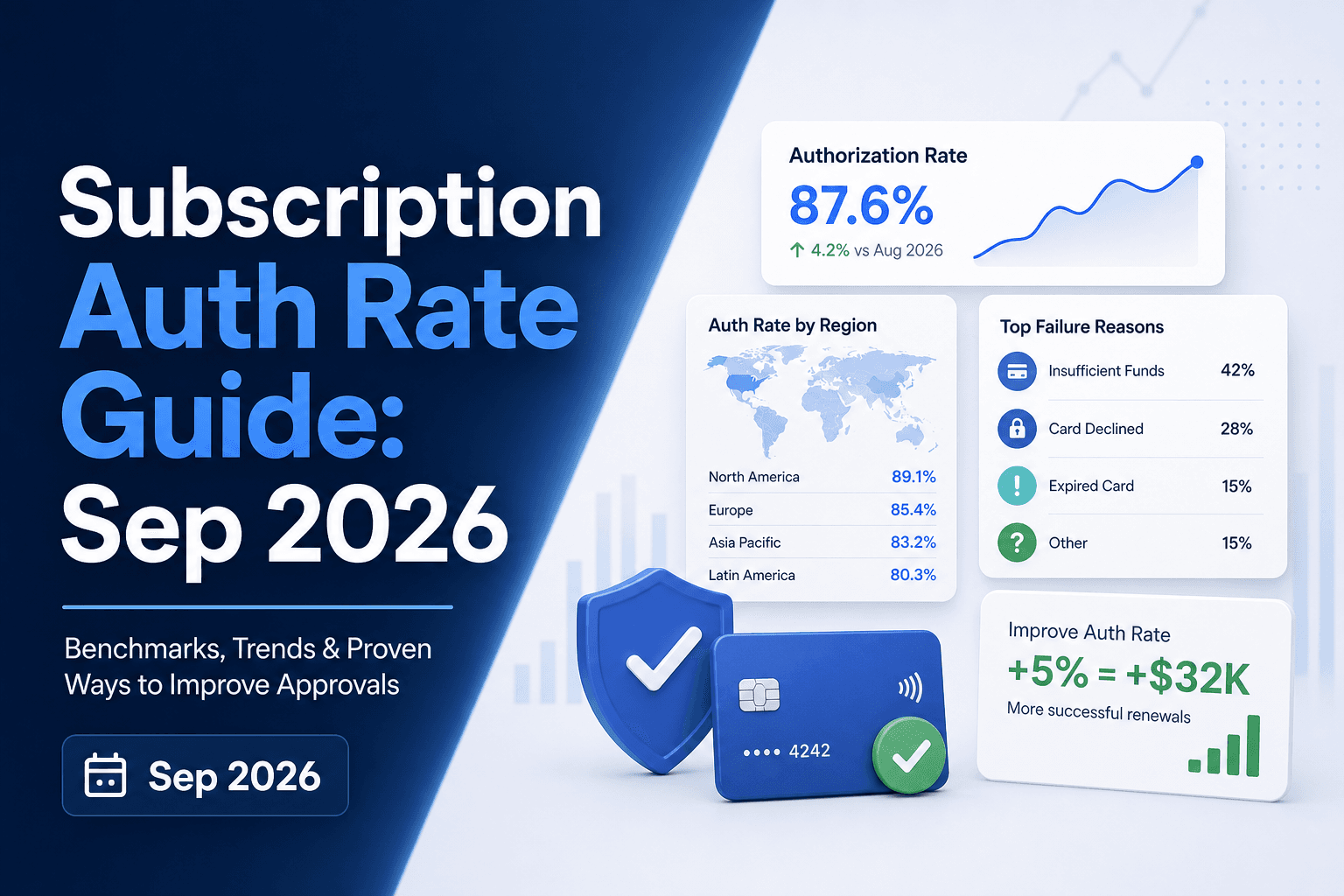
Authorization Rate in Subscription Billing: October 2026
There's a number sitting in your payments data that most finance and retention teams never report on separately: the share of renewal charges your issuing...
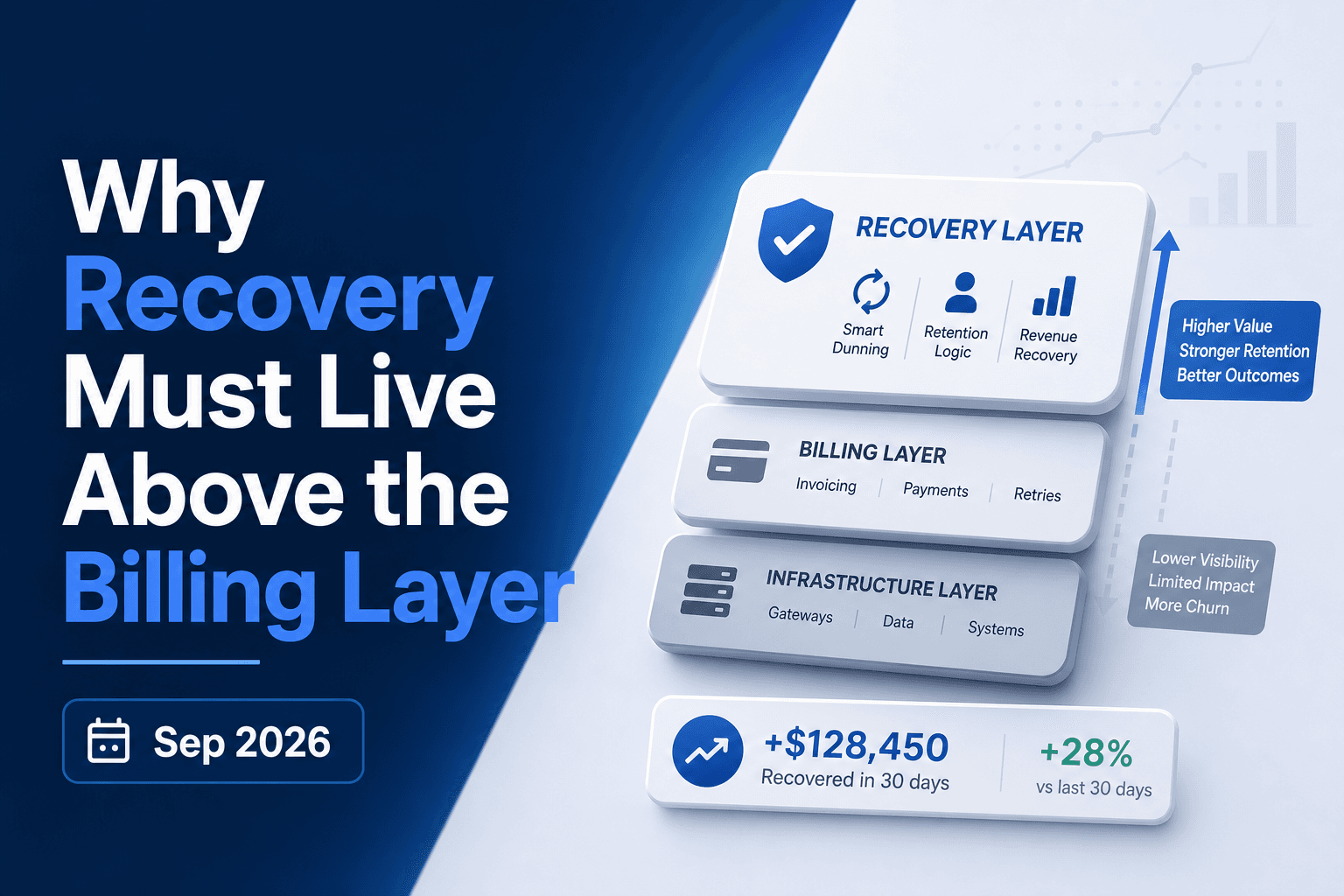
Why Payment Recovery Must Live Above Billers October 2026
A payment fails. Your biller retries it three days later, then again at seven, then at fourteen. What the biller never checks is whether the issuer sent a...
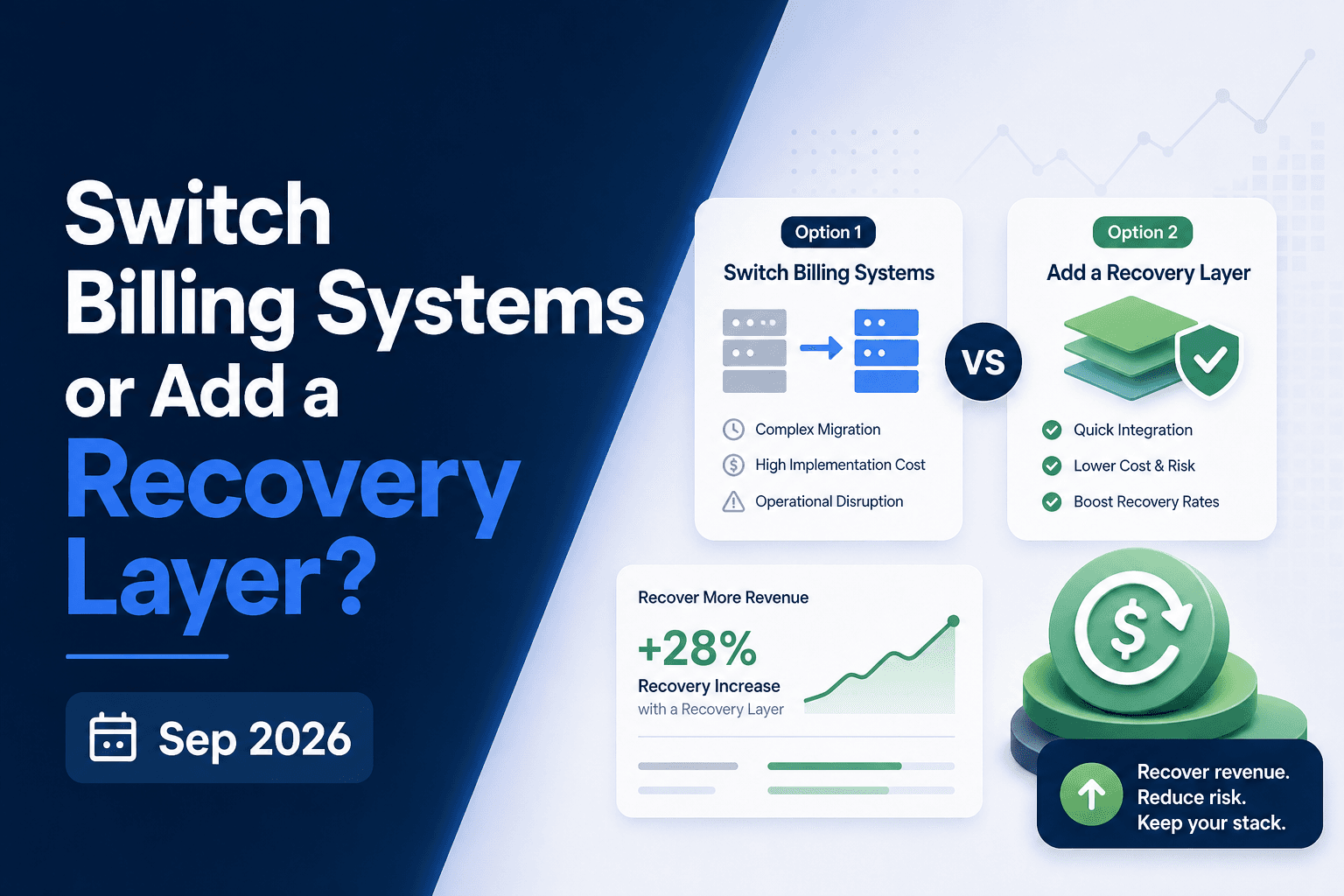
Billing Migration vs Recovery Layer: The Right Call October 2026
Switching billing systems feels like the right move when revenue collection starts breaking down. Sometimes it is. But soft declines, weak retry logic, and...
Stop losing revenue to failed payments
Join leading subscription businesses using Slicker to recover failed payments automatically.
Get Started