Handling Decline Code 59 Suspected Fraud Declines October 2026
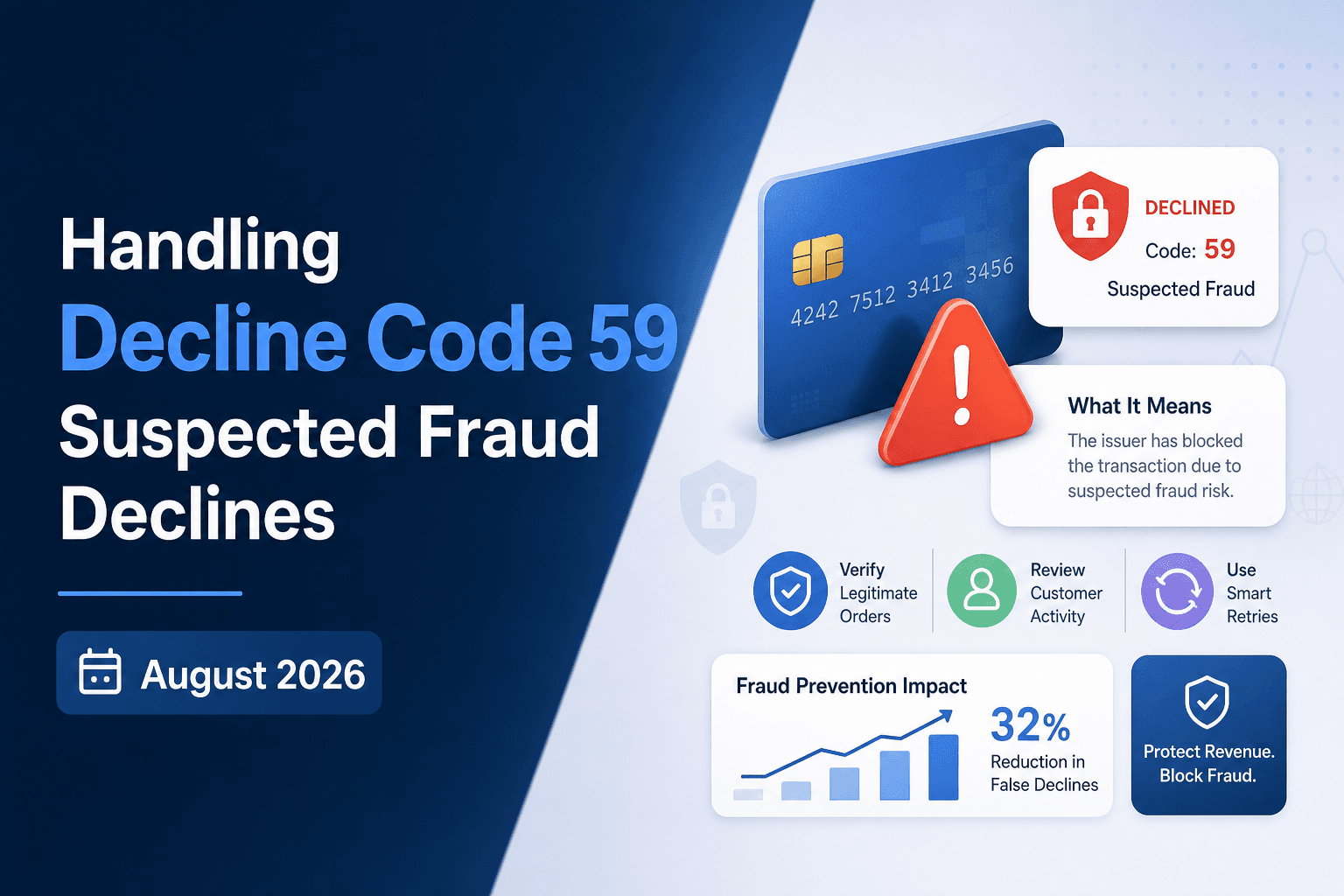
Decline code 59 carries the words "suspected fraud," which sounds like a hard stop. In reality, false declines cost merchants an estimated $443 billion a year globally, and a big chunk of that comes from merchants who treat every fraud flag as confirmed and never look closer. The decision to retry, reach out, or let it go depends on context the decline code itself won't give you.
TLDR:
- Decline code 59 means suspected fraud at the issuer level, not confirmed fraud; false declines cost merchants an estimated $443 billion per year.
- Visa classifies code 59 as Category 2 (temporary), permitting up to 15 retry attempts within a rolling 30-day window.
- Visa's network frequently remaps code 59 to the generic code 05, making accurate retry decisions impossible without network-level signals and MAC data.
- Retry decisions depend on subscriber history and MAC response: MAC 03 means stop entirely, as retrying triggers an immediate $0.50 Mastercard penalty per violation.
- Slicker reads beyond the gateway response, analyzing over 40 variables per transaction to separate recoverable code 59 declines from genuine fraud signals.
What Decline Code 59 Means
Decline code 59 is an issuer-generated response that flags a transaction as suspected fraud before any funds move, as defined in Visa's request and response codes. The refusal originates at the cardholder's bank, not at your payment processor or gateway. By the time the code reaches your system, the issuing bank has already made its call.
What triggers that call varies. Issuers weigh cardholder account history, transaction velocity, merchant category, device signals, and internal fraud-screening models. None of those inputs are visible to you as the merchant, and the code itself doesn't explain which signal crossed the threshold. Suspected fraud is the verdict, not the evidence.
That distinction carries real stakes. A legitimate subscriber's payment gets declined, their access lapses, and your revenue takes a hit from a flag you had no part in creating.
Why Code 59 Is Not Always Real Fraud
The label says "suspected fraud." That word "suspected" is doing a lot of work.
Issuer fraud models operate on transaction-level signals: velocity, device, IP location, purchase amount, merchant category. They have no visibility into your subscriber relationship. A loyal customer paying from a new laptop while traveling abroad looks identical to a stolen-card attempt from the issuer's perspective. The outcome is the same decline code, regardless of intent.
The scale of this mismatch is striking. False declines cost merchants an estimated $443 billion globally per year, roughly 13 times more than actual fraud losses. Merchants who treat every code 59 as confirmed fraud quietly compound that damage themselves.
Common Triggers for a Code 59 Decline
Several conditions push an issuer's fraud model past its threshold, and most have nothing to do with actual fraud.
- Unusual transaction amounts relative to the cardholder's spending history
- Rapid transaction velocity on the account, sometimes triggered by other merchants entirely
- Geographic or device anomalies, such as a familiar card used from an unfamiliar country or IP location
- Merchant Category Code (MCC) friction, where certain MCCs carry higher inherent risk scores in a given issuer's model
- Card-not-present environments, which carry lower issuer confidence by default
Subscription businesses face compounding exposure here. Recurring charges are merchant-initiated, card-not-present, and often cross-border, checking multiple risk boxes at once. When a cardholder's account is already flagged elsewhere, your routine renewal attempt can absorb the collateral damage.
The harder problem is that none of this is visible to you. Code 59 arrives without a footnote explaining which signal triggered it, leaving you to reason from context using transaction timing, geography, and customer history to form a hypothesis the issuer will never confirm.
Visa's Category 2 Classification for Code 59
Here is where the "suspected fraud" label misleads most merchants into the wrong decision.
Visa classifies decline codes into four categories based on recoverability. Code 59 sits in Category 2 ("Issuer Cannot Approve at This Time"), alongside codes like 51 (insufficient funds) and 91 (issuer unavailable). Category 2 permits up to 15 reattempts within a rolling 30-day window. Visa treats the condition as temporary, not permanent.
Category 1 is a different story. Codes like 41 (lost card) and 43 (stolen card) fall there, and reattempts are prohibited entirely.
Visa Category | Description | Code 59 | Retry Permitted |
|---|---|---|---|
Category 1 | Issuer will never approve | No | No |
Category 2 | Issuer cannot approve at this time | Yes | Up to 15 in 30 days |
Category 3 | Issuer cannot approve, data issue | No | Conditional |
Category 4 | Generic/other | No | Varies |
A code 59 on a recurring subscription charge from a known subscriber is not treated by Visa's own framework as a hard stop. The issuer flagged it; Visa says try again, carefully. That gap between the code's label and its actual classification is where recovery lives.
The Code 05 Remapping Problem
There is a layer underneath code 59 that makes it harder to act on in practice.
Visa's network frequently remaps code 59 to code 05 ("Do Not Honor") before the decline reaches your gateway. By the time it surfaces in your billing system, the suspected fraud flag has been replaced by one of the most generic responses in the decline taxonomy. Code 05 also covers insufficient funds, general issuer risk triggers, and a range of conditions unrelated to fraud. The remapping collapses meaningfully different situations into a single undifferentiated label.
For merchants running standard gateway integrations, this creates a compounding problem. You see code 05 with no reliable way to determine whether the underlying reason was a fraud flag, a temporary hold, or something else. Fixed retry logic treats them identically, so strategy becomes a coin flip.
Accurate retry decisions on code 05 require reading beyond the gateway response. Network-level signals, Merchant Advice Codes (MACs), and historical transaction context are what separate a recoverable code 05 from one that will fail again regardless of timing.
When to Retry and When to Walk Away
The right call depends on three inputs: what you know about the cardholder, what the network is telling you, and whether you're dealing with a recurring charge or a first-time attempt.
Retry when context points to a false positive
A long-tenured subscriber with a clean payment history receiving code 59 on a routine renewal is a strong candidate for a thoughtful retry. Weigh subscription age, prior authorization success rate, consistent billing geography, and whether the transaction amount matches their history. Under Visa's Category 2 rules, you have up to 15 attempts in 30 days. Use them with purpose, not on a fixed calendar.
Pause and reach out when the fraud signal carries weight
First-time payment attempts are a different calculation. With no relationship history to contextualize the decline, the issuer's fraud flag deserves more deference. The safer path is dunning outreach, not automated reattempts that risk compounding issuer suspicion and burning retry attempts on a card that won't authorize.
Stop entirely when the network says so
If Mastercard returns Merchant Advice Code (MAC) 03 ("Do Not Try Again"), that is an explicit network instruction. Retrying after MAC 03 triggers a $0.10 penalty per attempt under Mastercard's Excessive Attempts program. MAC 21 ("Stop Recurring Payment") goes further: it signals the cardholder has canceled the mandate, making further attempts both non-compliant and futile.
Retry Limits, Network Fees, and Compliance Risk
Both Visa and Mastercard impose hard retry limits, and the penalty economics have shifted enough that ignoring them is an increasingly expensive mistake.
Visa caps reattempts at 15 per card within a rolling 30-day window for Category 2 codes. Exceed that, and fees apply per attempt beyond the threshold. Mastercard charges $0.10 per retry when the merchant advice code is "Do Not Try Again" (MAC 03), and that penalty activates from the first unauthorized attempt. Retrying after MAC 03 or ignoring a MAC 21 doesn't start a clock; the fee begins immediately.
The exposure compounds fast for high-volume billing systems running fixed-schedule retries. A system that can't tell a recoverable code 05 from a MAC 03 fires attempts indiscriminately, accumulating penalties across thousands of transactions with no additional recovery to show for it.
What to Do Immediately After a Code 59 on a Subscription
When code 59 hits a recurring charge, the instinct to retry immediately is usually wrong. Pause first.
Check whether Mastercard Merchant Advice Code data came back with the decline. MAC 03 means stop entirely. MAC 02 means wait. If no MAC is present, the retry decision falls back to subscriber context covered in the previous section.
If a retry isn't the right immediate move, reach out to the subscriber with messaging tied to the specific failure. Generic "update your payment method" language won't help here because the card itself isn't the problem: the issuing bank flagged the transaction. Tell the subscriber to contact their bank directly to clear the block, framed around what they stand to lose in service access. Industry data suggests 27% of customers cancel or switch providers after a decline is handled poorly, so the quality of that communication carries real revenue consequences.
If the subscriber can't resolve the flag quickly, offer an alternative payment method. A different card on file may clear without triggering the same issuer model, avoiding wasted retry attempts on an instrument already flagged.
Log the event with enough detail to spot patterns later: transaction amount, timing, geography, subscriber tenure, and MAC response if present. A single code 59 is noise. Several across similar subscriber profiles or billing windows is a signal worth investigating.
When Code 59 Becomes a Pattern Worth Investigating
A single code 59 is a transaction event. A cluster of them is a merchant-level problem.
Patterns worth escalating include a sudden spike in code 59 frequency without a corresponding change in volume, declines clustering around a specific product, billing descriptor, or merchant category code (MCC), and cross-cardholder patterns suggesting the issuer has applied a risk flag at your merchant ID (MID) level instead of individual accounts. That last scenario is the most serious: the issuer's fraud model has developed a negative prior on your merchant as a whole, not a single cardholder.
When the pattern points there, remediation starts on your end. Audit your billing descriptor for clarity, confirm payment requests are submitting complete data including billing location details and device fingerprint, and verify that 3DS (3D Secure) is configured correctly for markets where it applies.
Your acquiring bank is also an underused resource. Acquirers can request issuer-level feedback on authorization performance and surface whether specific issuers are flagging your MID systematically. That intelligence rarely arrives unsolicited.
The long-run risk is authorization rate degradation across all transaction types. Issuers adjust their approval posture based on your overall risk profile, so unresolved code 59 accumulation quietly erodes your baseline authorization rate, compounding revenue loss well beyond the individual failed payments that surfaced the problem.
How Slicker Handles Code 59 Declines for Subscription Businesses
Code 59 creates a specific problem for subscription businesses: a long-tenure subscriber who triggers a geographic anomaly flag looks identical to a stolen card at the gateway level. Blunt retry logic and hard stops fail equally here, one by burning compliance budget on a card the issuer will decline again, the other by abandoning revenue that was genuinely recoverable.
Slicker's retry engine reads beyond the gateway response. Network-level signals, BIN data, issuer behavior patterns, MACs, and subscriber tenure feed into a classification that asks whether a code 59 on a recurring charge is a probable false positive or a genuine fraud signal requiring cardholder action. A subscriber three years into their billing cycle with consistent payment geography who triggered a device anomaly is a different recovery calculation than a first-payment attempt on a new card with no prior transaction history. Analyzing over 40 variables per transaction is what makes that distinction possible at scale.
When automated retry is the right path, Slicker executes it through your existing billing infrastructure on supported platforms including Stripe Billing, Chargebee, Recurly, Zuora, and Recharge, going live in under 5 minutes with zero engineering involvement. When it is not, Slicker routes the subscriber into failure-reason-specific dunning that tells them to contact their issuing bank directly to clear the fraud flag, not a generic card-update prompt. Those communications go out from your domain, in your brand's voice.
Recovery lift is verified through AABB testing against your own transaction data, so the incremental improvement is measurable before any long-term commitment. The pilot runs for four months: the first month is free, followed by three paid months, with the option to cancel anytime. If Slicker does not outperform with statistical significance, you do not pay.
Final Thoughts on Code 59 Declines and Subscription Payment Recovery
Most code 59 declines are not the fraud signal they appear to be, and the cost of treating them that way compounds fast across a high-volume subscriber base. Your response window is real: Visa allows up to 15 reattempts in 30 days for Category 2 declines, and the right retry timing, combined with direct subscriber outreach, recovers a material share of that revenue. The details matter here: MAC data, subscriber tenure, billing geography, and issuer behavior patterns are what separate a recoverable decline from a wasted attempt. Connect with the Slicker team if you want to put that logic to work on your own transaction data.
FAQs
What does Visa's Category 2 classification mean for retrying a decline code 59 suspected fraud decline?
Visa places decline code 59 in Category 2 ("Issuer Cannot Approve at This Time"), which permits up to 15 retry attempts within a rolling 30-day window. Under Visa's own rules, a suspected fraud decline on a recurring charge is not a permanent hard stop; the issuer flagged the transaction as temporarily unapprovable, not irreversibly blocked. The practical implication is that a legitimate subscriber's renewal hit with code 59 may well recover with a well-timed retry over a cardholder intervention.
How does an AI-powered retry system decide whether a code 59 or code 05 decline is recoverable versus a genuine fraud signal requiring a hard stop?
A rule-based system cannot answer that question reliably because code 59 is frequently remapped to the generic code 05 before it reaches your gateway, collapsing suspected fraud, insufficient funds, and a range of other conditions into a single undifferentiated response. An AI-powered retry engine reads beyond the gateway code by weighing network-level signals, Merchant Advice Codes, BIN data, issuer behavior patterns, and subscriber tenure to separate probable false positives from genuine fraud flags. A subscriber three years into their billing cycle with consistent payment geography who triggers a device anomaly is a materially different recovery calculation than a first-payment attempt on an unfamiliar card, and that distinction determines whether to retry, escalate to failure-specific dunning, or stop entirely.
How do I recover failed subscription payments from suspected fraud declines without engineering work?
When a code 59 hits a recurring charge, the recovery path depends on whether automated retry or cardholder outreach is the right move, and executing either without engineering involvement requires a no-code integration with your existing billing infrastructure. Slicker connects to Stripe Billing, Chargebee, Recurly, Zuora, and Recharge in under 5 minutes using API keys, then handles retry classification and dunning routing automatically. If the decline warrants cardholder action, failure-specific dunning goes out from your domain telling the subscriber to contact their issuing bank directly to clear the fraud flag, not a generic card-update prompt.
What are the Mastercard penalty economics for retrying a payment fraud decline after receiving a stop code?
Retrying after Mastercard Merchant Advice Code 03 ("Do Not Try Again") triggers a $0.10 penalty per attempt under the Mastercard Excessive Attempts program, and the fee applies from the first unauthorized retry with no grace threshold. MAC 21 ("Stop Recurring Payment") is a separate instruction that signals the cardholder has canceled the mandate entirely, making further attempts both non-compliant and unrecoverable. For high-volume billing systems running fixed-schedule retries that cannot read these codes before firing, the penalty exposure compounds across thousands of transactions with no additional recovery to offset it.
How do I know whether my payment fraud retry tool is actually recovering incremental revenue versus payments that would have resolved anyway?
The only reliable answer requires a controlled test that isolates the retry tool's contribution from self-recoveries and cardholder-initiated resolutions. Slicker uses AABB testing, a methodology borrowed from clinical crossover trial design, that splits failed payments 50/50 between a control group (your existing retry logic) and a treatment group (Slicker), then measures dollars recovered with p-values and confidence intervals. If Slicker does not outperform with statistical significance on your own transaction data, you do not pay; the first month of the 4-month pilot runs at no charge so the proof precedes any long-term commitment.
Related Articles

Stripe Dunning Configuration Guide (September 2026)
A surprising share of the subscribers leaving your list every month never chose to cancel. Their payment failed, your retry window ran out, and Stripe...
Stripe Recovery Add-On Evaluation Guide (September 2026)
Stripe's built-in recovery tools cover real ground. Smart Retries, Account Updater, dunning emails. For a lot of subscription businesses, that's a reasonable...

What Subscription Operators Miss About Built-In Retries (Oct 2026)
If your billing platform retries run on a fixed 14-to-21-day countdown from the failure date, they have no idea when your subscriber's paycheck actually...
Stop losing revenue to failed payments
Join leading subscription businesses using Slicker to recover failed payments automatically.
Get Started