Stripe Recovery Add-On Evaluation Guide (September 2026)

Stripe's built-in recovery tools cover real ground. Smart Retries, Account Updater, dunning emails. For a lot of subscription businesses, that's a reasonable starting point. But retry timing locked to day-level schedules, retry cadences permanently coupled to customer emails, and zero automated retries on India card payments are deliberate design boundaries, not bugs. Whether those boundaries matter for your business depends on your volume, your geography, and how much of your current decline mix is actually recoverable. That's what this guide works through.
TLDR:
- Industry data shows 15% of recurring transactions are declined; Stripe attributes 25% of lapsed subscriptions to payment failures alone.
- Stripe's native recovery couples retries and dunning emails permanently, operates on day-level scheduling, and performs no automated retries for India card payments.
- Ask any vendor whether they report recovered invoices or recovered transactions; the difference can materially overstate their headline recovery rate.
- Delta-based pricing charges only on incremental recoveries above your existing baseline, so you pay on the lift, not volume Stripe already recovered.
- Slicker decouples retry cadence from dunning cadence, runs hour-level AI-powered retry scheduling across 40+ variables, and only charges if it outperforms your control with statistical significance.
What Involuntary Churn Actually Costs Subscription Businesses
Industry data shows roughly 15% of recurring transactions are declined. At any meaningful subscription scale, that's a structural revenue drain occurring every billing cycle.
Stripe's own engineering research attributes 25% of all lapsed subscriptions purely to payment failures, and recovered subscribers continue for an average of seven more months after recovery. These are customers who never chose to leave. A card declined, a retry failed, and the subscription closed. That's involuntary churn: payment-driven subscriber loss that looks like cancellation in your dashboard but has nothing to do with product dissatisfaction.
Paysafe research projected failed transactions would cost subscription companies $129 billion in 2025. Most of that loss is recoverable with the right billing infrastructure. The question is whether your current stack is built to recover it.
What Stripe Billing's Built-In Recovery Features Actually Cover
Stripe Billing ships with four native recovery mechanisms worth understanding before you layer anything on top.
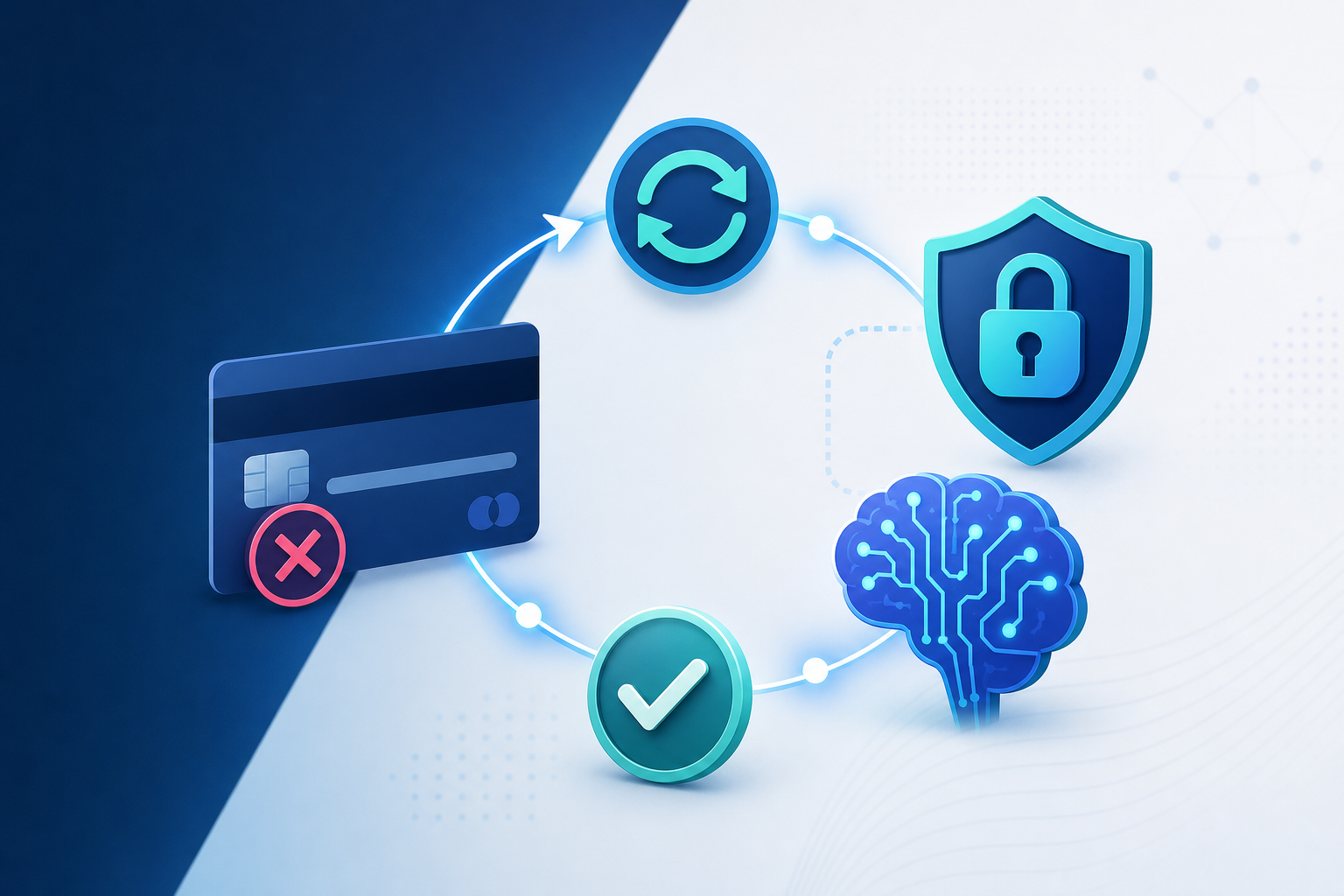
Smart Retries uses AI to pick retry timing based on signals from Stripe's transaction network, instead of firing on a fixed calendar. Adaptive Acceptance works at the network messaging layer, optimizing how transactions are presented to issuers to improve first-attempt authorization rates. Account Updater automatically refreshes expired or reissued card details before a charge attempt, reducing declines caused by stale credentials. Automated dunning emails notify customers when payment fails, prompting them to update their payment method.
Each targets a real slice of the involuntary churn problem: retry timing, authorization optimization, credential churn, and customer outreach. For businesses at earlier revenue stages, this combination is a reasonable starting point. Stripe Billing pricing changes periodically, so verify current rates directly on Stripe's pricing page.
Where Stripe's Native Recovery Hits a Ceiling
Stripe's native tools cover real ground. The ceiling appears when you look at the structural constraints underneath them.
Smart Retries and dunning emails are permanently coupled inside Stripe Billing. Every retry attempt triggers a customer-facing email notification. At higher retry volumes, that coupling becomes a spam risk and undermines the brand experience you've built. There's no way to decouple the two cadences natively.
Retry timing in Stripe also operates at a day-level schedule, not hour-level issuer-specific precision. Retrying a consumer debit card at the wrong hour, even on the right day, can miss the authorization window entirely.
Stripe also does not natively switch between multiple cards on file during a retry cycle, leaving secondary stored cards untouched as a recovery pathway. For India card payments, Stripe performs no automated retries at all, making any recovery there entirely dependent on a third-party layer.
There's also a configuration dependency that catches teams off guard: Stripe's default grace period may close a subscription before an extended retry window finishes executing. Merchants must manually extend that cancellation setting to match their recovery window, or Stripe will terminate the subscription mid-attempt.
None of this is a product flaw. These are deliberate design boundaries. The built-in vs add-on retry tools distinction exists precisely because high-volume subscription businesses need controls and flexibility that a general-purpose billing product won't build in.
How the Add-On Layer Works: Categories of Tools Available
The recovery add-on market covers at least three distinct categories that solve different parts of the same problem. Knowing which you're buying matters before any evaluation begins.
There are a few common approaches worth understanding:
- Specialized retry engines add AI-powered retry logic on top of, or alongside, Stripe Smart Retries. The value is timing precision: hour-level issuer analysis, payday-aware scheduling, and decline-code classification that separates retryable soft declines from hard stops.
- Dunning-only tools focus entirely on customer communication: sequence design, failure-reason personalization, and email delivery from your own domain. They don't touch retry timing, and their value is in reducing friction when customer action is the only path to recovery.
- Multi-gateway routing layers route retry attempts across multiple processors and payment methods, selecting among available cards on file and routing each attempt through whichever processor is most likely to approve based on card type, geography, and issuer history.
Several tools sit across more than one category. A retry engine that also handles dunning emails changes your evaluation criteria: you're assessing retry intelligence and communication quality at the same time, and a weakness in one dimension can offset strength in the other.
The Retry Intelligence Dimension: What to Look for Beyond Stripe
Retry intelligence separates tools that recover revenue from tools that create liability. The first question to ask any vendor is whether their system classifies declines before retrying.
Soft declines vs hard declines tell the story plainly: soft declines (insufficient funds, network timeouts, processor errors) are temporary, while hard declines (stolen cards, closed accounts, fraud blocks) are permanent. Retrying a hard decline wastes an attempt, accumulates fees, and damages your merchant ID's authorization reputation with issuers.
Merchant Advice Code (MAC) guidance adds another layer. Mastercard's 2026 excessive authorization rules apply stricter penalties to merchants who retry after issuer-declined responses, with particular scrutiny on subscription and SaaS businesses. MAC 03 (Do Not Try Again) is a hard stop: Mastercard charges $0.10 per retry attempt made after receiving this code. MAC 21 (Stop Recurring Payment) is a separate hard stop that means the cardholder has cancelled the recurring; retrying it is prohibited, though the $0.10 per-attempt fee is specific to MAC 03 violations. Time-based codes like MAC 24 through MAC 30 prescribe windows from one hour to ten days. Visa caps soft decline retries at 15 per 30 days and charges per-transaction fees for excess attempts. The full scope of Visa and Mastercard payment retry rules covering subscription businesses goes further than most teams realize.
Beyond compliance, timing precision matters. Ask vendors whether their system decides per individual failed payment or applies logic to cohorts. Per-transaction decision-making outperforms segment-level rules, and intelligent payday retries tied to payday cycles outperform date-based calendars. The answer tells you whether you're buying adaptive intelligence or a configurable rule set.
The Dunning Layer: Personalization, Branding, and Sequence Logic
When a payment fails, the default dunning email says some version of "update your payment method." That instruction is correct for an expired card. It's wrong for a stolen card, where the customer needs to contact their bank, not enter a new number on your payment page. Sending the same message regardless of failure reason increases friction and lowers recovery rates.
A well-designed failure reason dunning cadence branches at the decline code. Two structural questions separate capable tools from generic ones:
- Does the dunning cadence operate independently from the retry cadence? When the two are permanently coupled, every retry fires a customer-facing notification whether or not customer action is needed, creating a spam risk that degrades the subscriber relationship.
- Do emails send from your own domain, or a third-party one? Emails from an unfamiliar sender domain increase unsubscribe rates before the subscriber reads a word.
Grace period logic matters here too. Industry recovery distribution data shows meaningful invoice recovery in days 14 to 21, with negligible gains beyond day 21. Extending or shortening that window is a testable decision, not a default to accept. The underlying framing should center on service continuity: a subscriber who sees "your access to X is at risk" converts at a higher rate than one who sees "your payment failed."
Multi-Gateway Routing as a Recovery Strategy
Multi-gateway routing answers a different failure mode than retry timing. When a charge fails because of a gateway-specific problem (processor downtime, a regional outage, or a weak issuer relationship with that processor), retrying on the same gateway later won't fix it. Routing the attempt to a secondary processor can recover it immediately, before the customer sees a decline at all.
The mechanics require relationships with multiple processors already in place. Reviewing multi-gateway payment routing tools helps clarify what is needed: Stripe alone doesn't create a routing decision; you need Adyen, Braintree, Checkout.com, or Worldpay alongside it for any failover logic to activate. At lower volumes, that infrastructure overhead rarely pays off. At higher volumes with multi-processor setups already running, routing tools reduce the portion of declines that sit waiting through a retry window when a live alternative processor could have approved the charge in the same billing cycle.
Routing and retry scheduling answer different questions: routing asks which processor to send the charge to; retry timing asks when. The most effective recovery stacks coordinate both, so a payment that fails on Stripe and routes to Adyen still gets retried on the optimal schedule if that rerouted attempt also fails. For merchants on Stripe exclusively, adding routing complexity produces limited return. The value scales with the number of active processor relationships and the transaction volume running across them.
How to Run a Rigorous A/B Test When Assessing a Stripe Add-On
Most vendors will show you a recovery rate. Few will show you how they calculated it.

The measurement problem is structural. A single invoice with multiple failed attempts can surface as multiple recovered transactions in aggregate reporting, overstating volume without technically lying. Before accepting any vendor's headline number, ask whether they're reporting recovered invoices or recovered transactions. The difference can be material.
A valid AABB testing in payment recovery splits traffic into matched cohorts and measures dollars recovered across both. Stratification prevents bias: if high-value invoices cluster in the treatment arm by chance, apparent lift is an artifact of cohort composition, not recovery performance. Useful variables to stratify include error type (insufficient funds vs. generic decline), transaction amount ranges, and card type. A crossover design, where arms switch mid-test, reduces noise by letting both groups experience both conditions and isolating the vendor's contribution from subscriber-mix differences.
Statistical significance matters here in a concrete way. A p-value below 0.05 means there's less than a 5% probability the observed lift is random. Without it, a vendor decision is built on noise.
For enterprises that can't run an immediate 50/50 split, a partial traffic allocation (10% to the treatment arm) reduces risk during evaluation. The tradeoff is speed: a smaller cohort takes longer to reach statistical significance, extending the evaluation window by weeks or months. That's a real cost to weigh against the reduced disruption of a phased approach.
Security and Data Governance Questions to Ask Every Vendor
Payment recovery tools process subscriber data, placing them in subprocessor territory under GDPR. The due diligence questions follow directly from that classification.
Under GDPR Article 28, processors remain fully liable for their subprocessors' compliance. A written data processing agreement (DPA) is required before data sharing begins. If a vendor can't produce one on request, that's a procurement blocker.
Four questions apply to every vendor in this category:
- Does payment credential data touch the vendor's infrastructure, or does it flow through your existing PCI-compliant billing rails? Understanding hard decline retry penalties is equally important when scoping vendor risk. A well-architected recovery tool should never handle raw card numbers; it should provide timing and routing instructions while your billing system executes the charge.
- What is the data retention and deletion policy, and does a customer deletion API exist for GDPR and CCPA compliance workflows?
- Is SOC 2 Type 2 achieved or still in progress? The answer changes what the vendor can contractually back.
- What API permissions does the integration require? Broad scopes may not survive an internal security review at enterprise accounts. Confirm required scopes during discovery, before procurement escalates.
These are the questions that extend go-live timelines when asked late.
Pricing Models Compared: Performance-Based, Flat Fee, and Delta Pricing
Three pricing structures define this market, and the differences matter more than the headline rate.
Pricing Model | How You're Charged | Incentive Alignment | Risk on Existing Baseline |
|---|---|---|---|
Flat monthly / annual fee | Fixed rate regardless of recovery volume | Low: vendor collects the same fee whether recovery improves or stagnates | None: you pay regardless of results |
Percentage of all recoveries | % of every dollar recovered (including what Stripe already recovered) | Moderate: vendor benefits from your performance, including volume they did not drive themselves | High: you pay fees on volume your existing stack would have recovered anyway |
Delta-based pricing | % only on incremental recoveries above your existing baseline | High: vendor revenue is directly tied to the lift they produce | None: if the vendor doesn't beat your baseline, you pay nothing |
Flat monthly or annual fees are the simplest to budget. The problem is incentive misalignment: the vendor collects the same fee whether recovery improves or stagnates, with no financial consequence for underperformance.
Percentage-of-all-recoveries models are more aligned but contain a hidden cost. If your existing Stripe Smart Retries already recovers a meaningful share of failed payments, a vendor charging on total recovered revenue collects fees on volume they didn't produce.
Delta-based pricing corrects for this. The vendor charges only on incremental recoveries above your current baseline. The choice of smart dunning vs rules-based recovery shapes how reliably that baseline improves over time. If Stripe recovers 40% of your soft declines and the add-on pushes that to 55%, you pay on the 15-point lift, not the full 55%. For businesses with an existing recovery baseline, that distinction is substantial.
When comparing vendors, ask exactly which figure the percentage applies to: gross recoveries or net incremental lift. That single clarification can shift your cost-of-ownership calculation by a meaningful margin.
How Slicker Positions Above Stripe's Native Recovery Layer
Slicker is built to answer the evaluation criteria this article has covered: retry intelligence, dunning quality, pricing alignment, and provable performance.
On the retry side, Slicker decouples retry cadence from dunning email cadence entirely. Unlike Stripe's permanent coupling (covered above), Slicker runs cadences independently, sending dunning emails only when the specific failure reason requires cardholder intervention. Those emails go out from the merchant's own domain, with messaging mapped to the decline reason, not a generic "update your payment method" prompt.
The contrast between static vs adaptive retry scheduling is evident here: Slicker's retry timing runs at hour-level precision, not day-level scheduling, with AI models weighing over 40 variables per transaction: issuer behavior, card type, subscriber history, and payday cycle data segmented by geography (US biweekly windows, Western Europe and UK monthly windows, Australia weekly or fortnightly windows). Recovery flows entirely through the merchant's existing billing infrastructure; payment credentials never touch Slicker's systems, keeping the integration outside PCI scope.
On pricing, Slicker offers both a percentage-of-recovered-revenue model (4 to 10% depending on volume) and a delta-based option that charges only on recoveries above the merchant's existing baseline. The pilot runs for four months: the first month is free, followed by three paid months, with the option to cancel anytime. The AABB test runs on the merchant's own traffic during that period. If Slicker does not outperform with statistical significance, the customer does not pay. Freepik and The Economist each saw approximately 20% recovery-rate improvement under this methodology, measured against their own control groups, not an industry benchmark.
The proof is always the customer's own data, not a headline rate.
Final Thoughts on Building a Recovery Layer Above Stripe Billing
Most of the revenue lost to involuntary churn is recoverable with the right retry logic, dunning setup, and pricing model in place. The key is holding any add-on to the same standard you'd apply to any other revenue decision: test it on your data, measure the lift, and verify the math before you commit. Talk to Slicker if you want to see those numbers on your own billing traffic.
FAQs
What tools should a SaaS CFO use to recover failed payments from a Zuora or Chargebee billing stack in 2026?
Your billing platform's built-in retry logic is a starting point, not a ceiling. Zuora's Configurable Payment Retries requires substantial rule management from your team, and Chargebee's smart dunning applies generic schedules instead of per-transaction AI decisions. A dedicated stripe billing add-on or cross-platform recovery layer like Slicker sits above the billing stack, applies hour-level issuer-specific retry timing, and proves incremental lift through a four-month AABB pilot on your own traffic, with payment required only if results reach statistical significance.
How does delta-based pricing work for stripe payment recovery tools, and why does it matter if you already recover some failed payments yourself?
Delta pricing means you pay only on the lift above your existing recovery baseline, not on total recovered revenue. That distinction matters materially at scale: a percentage-of-all-recoveries model collects fees on volume your billing platform would have recovered anyway, while delta pricing aligns the vendor's revenue directly to the incremental value they produce.
How do I avoid Visa and Mastercard retry fees when retrying failed subscription payments?
Stop retrying before network rules require you to. Visa caps attempts at 15 per 30 days per card and transaction amount, with per-attempt fees on excess retries. Mastercard charges $0.10 per attempt when a merchant retries after receiving MAC 03 (Do Not Try Again). A recovery tool that classifies declines before acting, reads Merchant Advice Codes, and stops on hard declines keeps you inside compliance guardrails while protecting your merchant account's authorization reputation with issuers.
How do Slicker retries work alongside Stripe Smart Retries, and what configuration settings need to be aligned first?
Slicker runs independently from Stripe Smart Retries and decouples retry cadence from dunning email cadence, which Stripe Billing permanently couples together. Before go-live, you must extend Stripe's default subscription cancellation grace period to match Slicker's multi-week retry window; if Stripe closes the subscription before Slicker completes its retry schedule, recovery attempts are lost. For full orchestration deployments where Slicker manages grace period extensions and edge-case handling, Stripe's native Smart Retries must be disabled entirely to avoid execution conflicts.
What security and data governance questions should enterprises ask every stripe add-ons recovery vendor before signing?
Four questions cover the material risks. First, does payment credential data touch the vendor's infrastructure, or does it flow through your existing PCI-compliant billing rails? Second, does a written data processing agreement exist, given that GDPR Article 28 makes you fully liable for your subprocessors? Third, what is the customer data deletion policy, and does a deletion API exist for GDPR and CCPA workflows? Fourth, what specific API permissions does the integration require? Broad permission scopes often fail internal security reviews at enterprise accounts, and catching this late extends go-live timelines by weeks.
Related Articles

What Subscription Operators Miss About Built-In Retries (Oct 2026)
If your billing platform retries run on a fixed 14-to-21-day countdown from the failure date, they have no idea when your subscriber's paycheck actually...

Failed Payments as a Board-Level Revenue KPI (Oct 2026)
Failed payment recovery tends to live in finance ops reviews, not board decks. That's usually because it's reported as a process metric and not a revenue...
Building a Recovery Layer Above Chargebee Without Disrupting Billing September 2026
Failed payments in Chargebee don't all fail for the same reason, but Chargebee's native retry logic largely treats them that way. The result is burned retry...
Stop losing revenue to failed payments
Join leading subscription businesses using Slicker to recover failed payments automatically.
Get Started