Failed-Payment Benchmarks Oct 2026: Where AI Beats Industry Averages

Introduction
The subscription economy is booming, with the global market having surpassed $1.5 trillion in 2025 and continuing to expand. (Recurly) But beneath this growth lies a massive revenue leak: failed payments. Industry analysis tracking the $1.5 trillion subscription market estimated that subscription companies lost an estimated $129 billion to involuntary churn across 2025 alone. (Recurly)
Involuntary churn occurs when subscription payments fail due to expired cards, insufficient funds, or gateway errors. These are customers who never intended to leave but are forced out by payment hiccups. (Recurly) Industry data shows that up to 70% of involuntary churn stems from failed transactions, with some sectors seeing decline rates as high as 30%. The median recovery rate across the industry hovers around 47.6%, but AI-powered platforms are consistently delivering 2-4x better results.
This detailed analysis merges macro-level projections with vertical-specific benchmarks to reveal what "average" really means in payment recovery, and why businesses are increasingly turning to machine learning solutions to reclaim lost revenue.
TLDR:
- Subscription companies lost an estimated $129 billion to involuntary churn in 2025; the industry median recovery rate sits at 47.6% (Recurly).
- Involuntary churn accounts for up to 40% of total churn and is a technical problem with a technical fix, not a product or satisfaction issue.
- AI-powered smart retry systems consistently reach 70-85% recovery on soft declines; fixed retry schedules typically land between 40-60%.
- Separate hard declines from soft declines before scheduling any retry; retrying hard declines risks card network penalties and damages your MID reputation.
- Slicker routes failed payments across multiple gateways using AI-powered retry logic, with a no-code setup and pay-for-performance pricing.
The $129 Billion Problem: Understanding Failed Payment Impact
Industry-Wide Revenue Loss
The scale of failed payment losses is staggering. With the subscription industry's explosive growth, even small percentage losses translate to billions in aggregate revenue impact. (Recurly) Forbes estimates that failed payments typically cost subscription businesses 10-20% of their potential revenue, making payment recovery one of the highest-impact optimization opportunities available.
The Anatomy of Payment Failures
Involuntary churn can account for up to 40% of a business's total churn, making it a critical metric for subscription companies to monitor and optimize. (Churnkey) Payment failures fall into two main categories:
- Soft declines: Temporary issues like insufficient funds or network timeouts that may succeed on retry
- Hard declines: Permanent failures such as expired cards or closed accounts requiring customer intervention
Research shows that 62% of users who encounter a payment error never return to the site, pointing to the urgency of immediate recovery efforts. (Churnkey) Beyond that, up to 12% of card-on-file transactions fail due to expirations, insufficient funds, or network glitches, while a single payment hiccup can drive 35% of users to cancel.
2025 Payment Recovery Benchmarks by Industry
Cross-Industry Churn Rate Analysis
Understanding your industry's baseline is important for setting realistic recovery targets. Here are the average monthly churn rates across key subscription verticals: (Churnkey)
Industry | Monthly Churn Rate | Annual Customer Loss | Recovery Opportunity |
|---|---|---|---|
SaaS | 4-6% | ~50% | High |
E-commerce Subscription Boxes | 10-15% | ~70% | Very High |
Media & Entertainment | 5-8% | ~55% | High |
Telecom | 1-2% | ~20% | Moderate |
Health & Fitness | 7-10% | ~65% | Very High |
Financial Services | 2-4% | ~40% | Moderate |
Education & E-learning | 8-12% | ~70% | Very High |
Gaming | 5-9% | ~60% | High |
The Involuntary vs. Voluntary Churn Split
Involuntary churn represents a unique opportunity because these customers didn't choose to leave. (Churnkey) Unlike voluntary churn, which requires fixing product-market fit or customer satisfaction issues, recovering failed subscription payments is purely a technical problem with technical solutions.
Recurly's 2021 benchmark data found that businesses were losing an average of 7.2% of subscribers monthly to "passive churn" caused by payment method changes or expired cards. Current vertical-level data shows involuntary churn rates vary widely by industry, ranging from around 1% for SaaS to over 3% for consumer subscriptions, but the underlying cause (stored-credential failures) remains constant.
The AI Advantage: How Machine Learning Improves Recovery Rates
Beyond Static Rules: Intelligent Payment Processing
Traditional payment recovery relies on static retry schedules. It attempts the same payment method at predetermined intervals regardless of failure reason or customer context. AI-powered systems take a fundamentally different approach, analyzing each failed transaction individually to determine the optimal recovery strategy. (Slicker)
Machine learning algorithms can process vast amounts of historical payment data to identify patterns that humans might miss. (Tennis Finance) These systems achieve over 90% accuracy in payment predictions by analyzing customer behavior, transaction history, and external factors that influence payment success.
The Slicker Approach: 2-4x Better Recovery
Slicker's AI-powered retry engine shows what machine learning can do in payment recovery. Slicker's proprietary algorithms assess each failed transaction across multiple dimensions:
- Timing optimization: Determining the ideal moment for retry attempts based on customer behavior patterns
- Gateway intelligence: Routing payments through the most likely-to-succeed processor for each specific failure type
- Adaptive scheduling: Adjusting retry frequency and duration based on failure reason and customer value
This intelligent approach delivers 2-4x better recovery rates compared to native billing provider logic, with recovery rates measurably above the 47.6% industry median.
Real-World AI Impact
The practical benefits of AI-driven payment recovery extend beyond simple percentage improvements. Machine learning systems can:
- Reduce manual intervention: Automating recovery processes that previously required customer service involvement
- Improve customer experience: Minimizing payment interruptions through proactive failure detection
- Optimize resource allocation: Focusing human attention on high-value recovery opportunities
Artificial intelligence in payments has matured considerably, with machine learning now capable of detecting patterns, making predictions, and optimizing decisions in real time. (Aeropay) This real-time adaptability allows AI systems to adjust to new patterns with minimal human intervention, continuously improving recovery performance.
Industry Recovery Rate Benchmarks: Where You Stand
The 47.6% Median Reality
Industry data consistently shows that traditional payment recovery methods achieve median success rates around 47.6%. This benchmark represents the performance of basic retry logic and manual dunning processes used by most subscription businesses.
Smart Dunning vs. Basic Retry
Smart dunning systems can lift recovery rates by up to 25% compared with static rules, while automatic card-updater services recover up to 20% more invoices before a retry is even needed. (Recurly) These improvements come from:
- Contextual messaging: Tailoring communication based on failure reason and customer segment
- Multi-channel outreach: Combining email, SMS, and in-app notifications for maximum reach
- Behavioral triggers: Timing outreach based on customer engagement patterns
The AI Performance Gap
While traditional methods plateau around 50-60% recovery rates, AI-powered systems consistently achieve 70-85% success rates. (Slicker) This performance gap represents the difference between rule-based systems and adaptive AI models that improve with every transaction.
Vertical-Specific Recovery Strategies
SaaS and B2B Subscriptions
B2B SaaS companies typically see lower churn rates (4-6% monthly) but higher customer lifetime values, making recovery efforts particularly valuable. (Churnkey) Key strategies include:
- Account-based recovery: Engaging multiple stakeholders within customer organizations
- Usage-based messaging: Calling out feature adoption and ROI in recovery communications
- Extended retry windows: Allowing longer recovery periods for high-value enterprise accounts
E-commerce and Consumer Subscriptions
Consumer subscription boxes face the highest churn rates (10-15% monthly), requiring aggressive recovery tactics. (Churnkey) Effective approaches include:
- Immediate retry attempts: Making the most of temporary decline reasons
- Incentive-based recovery: Offering discounts or perks to encourage payment method updates
- Social proof messaging: Stressing community and FOMO in recovery communications
Media and Entertainment
Streaming services like Netflix maintain some of the industry's lowest churn rates (2.1% monthly for Netflix vs. 6.5-7% for Apple TV+), a strong indicator of content stickiness and optimized payment processes. (Churnkey) Recovery strategies focus on:
- Content-driven messaging: Featuring upcoming releases and exclusive content
- Smooth payment updates: Minimizing friction in payment method changes
- Graduated access: Providing limited access during payment resolution periods
The Technology Behind Superior Recovery Rates
Machine Learning in Payment Processing
Modern AI systems analyze multiple data points to optimize payment recovery:
- Historical transaction patterns: Learning from past successes and failures
- Customer behavior data: Understanding engagement and usage patterns
- External factors: Factoring in time-of-day, seasonality, and economic indicators
- Gateway performance: Tracking success rates across different payment processors
Multi-Gateway Smart Routing
AI-powered tools like Slicker route payments across multiple gateways, selecting the processor most likely to approve each specific transaction. (Slicker) This approach recognizes that different gateways have varying success rates for different failure types, customer segments, and geographic regions.
Predictive Analytics and Risk Assessment
Advanced systems predict payment failures before they occur, allowing for proactive intervention. By analyzing customer behavior patterns, these systems can:
- Identify at-risk payments: Flagging transactions likely to fail
- Trigger preemptive outreach: Encouraging payment method updates before expiration
- Optimize billing timing: Scheduling charges when success probability is highest
Implementation Strategies for Maximum Recovery
The 5-Minute Setup Advantage
Modern AI payment recovery tools put a premium on ease of implementation. Slicker offers a 5-minute setup with no code changes, plugging directly into popular billing systems like Stripe, Chargebee, Recurly, Zuora, and Recharge. (Slicker) This rapid deployment means businesses can start recovering revenue within hours instead of months.
Pay-for-Success Pricing Models
Slicker only charges for successfully recovered payments, so Slicker's success ties directly to client revenue recovery. (Slicker) This model reduces implementation risk and guarantees positive ROI.
Integration and Analytics
Full-featured recovery tools provide detailed analytics and reporting to track performance improvements. Key metrics include:
- Recovery rate improvements: Comparing AI performance to baseline methods
- Revenue impact: Quantifying additional MRR recovered through intelligent retry
- Customer retention: Measuring the impact on overall churn rates
- Gateway performance: Analyzing success rates across different payment processors
Future Trends in Payment Recovery
The Evolution of AI in Payments
Advanced AI models now serve as foundational "brains" for more complex AI systems, powering more sophisticated payment recovery strategies.
Up-and-Coming Technologies
Recent developments in AI agents show promise for payment recovery applications. NYU Tandon's EnIGMA AI agent has shown the ability to solve complex challenges autonomously, suggesting that future payment recovery systems may become even more sophisticated in their problem-solving capabilities. (AI Agent Store)
Industry Consolidation and Standards
As AI payment recovery becomes table stakes, we expect to see:
- System consolidation: Billing providers integrating AI recovery capabilities natively
- Standardized metrics: Industry-wide adoption of recovery rate benchmarks
- Regulatory considerations: Increased focus on customer communication and consent in automated recovery
Measuring Success: KPIs and Benchmarks
Key Recovery Metrics
To effectively measure payment recovery performance, track these key indicators:
- Overall recovery rate: Percentage of failed payments successfully recovered
- Time to recovery: Average duration from failure to successful payment
- Customer retention impact: Reduction in involuntary churn rates
- Revenue recovery: Total MRR/ARR recovered through retry efforts
- Cost per recovery: Total program cost divided by successful recoveries
Setting Realistic Targets
Based on industry benchmarks and AI recovery tool performance:
- Baseline expectation: 50-60% recovery rate with traditional methods
- AI-enhanced target: 70-85% recovery rate with machine learning platforms
- Best-in-class performance: 85%+ recovery rate with optimized AI systems and processes
ROI Calculation Framework
To back up investment in AI payment recovery, calculate potential impact:
- Identify baseline: Current recovery rate and monthly failed payment volume
- Project improvement: Expected recovery rate increase with an AI system
- Calculate revenue impact: Additional recovered revenue minus system costs
- Factor in retention: Long-term value of customers retained through better recovery
If smart retries add measurable recovery points on soft declines, translate that improvement into annualized MRR to secure budget approval.
Conclusion: The Competitive Advantage of AI Recovery
The $129 billion involuntary churn problem represents both a massive challenge and a recoverable revenue opportunity for subscription businesses. (Recurly) While traditional recovery methods plateau around 47.6% success rates, AI-powered systems consistently deliver 2-4x better performance without manual intervention.
The data is clear: businesses that implement intelligent payment recovery systems gain a real competitive edge. (Slicker) With tools like Slicker offering 5-minute setup, pay-for-success pricing, and proven results, the barrier to entry has never been lower.
As the subscription economy continues its explosive growth, payment recovery will increasingly separate winners from losers. (Recurly) Companies that adopt AI-driven recovery today will capture more revenue, retain more customers, and build more sustainable businesses tomorrow.
The question isn't whether to implement AI payment recovery. It's how quickly you can get started. With billions in revenue at stake and proven solutions available, every day of delay represents lost opportunity in an increasingly competitive market.
Frequently Asked Questions
What is the current industry benchmark for failed payment recovery in 2025?
According to 2025 data, the industry median for failed payment recovery stands at 47.6%. However, subscription companies are projected to lose an estimated $129 billion due to involuntary churn, pointing to the massive revenue leak from failed payments across the global subscription economy.
How much better do AI-powered payment recovery systems perform compared to traditional methods?
AI-powered payment recovery systems achieve 2-4x better results than the industry median of 47.6%. These systems use machine learning to detect patterns, make real-time predictions, and optimize recovery decisions with over 90% accuracy, materially reducing involuntary churn for subscription businesses.
What percentage of total churn is caused by involuntary payment failures?
Involuntary churn can account for up to 40% of a business's total churn rate. This occurs when subscriptions are cancelled due to payment failures like expired cards, gateway errors, or other technical issues - representing a large share of the 7.2% average monthly subscriber loss businesses experience.
How does AI enhance payment recovery compared to manual processes?
AI enhances payment recovery by implementing machine learning algorithms that analyze payment patterns, predict optimal retry timing, and personalize recovery strategies. Unlike manual processes, AI systems can process vast amounts of data in real-time, adapt instantly to new patterns, and continuously improve their success rates without human intervention.
Which industries have the highest failed payment rates and benefit most from AI recovery?
E-commerce subscription boxes (10-15% monthly churn), education platforms (8-12%), and health & fitness subscriptions (7-10%) typically see the highest failed payment rates. These industries see the greatest gains from AI-powered recovery systems that can reduce involuntary churn and boost monthly revenues by an average of 12.7%.
What specific strategies can subscription businesses implement to minimize payment failures?
Businesses should implement AI-powered payment recovery systems that use predictive analytics to optimize retry timing and payment methods. Key strategies include automated dunning management, intelligent payment routing, and personalized customer communication sequences that cover the root causes of the 2,000+ reasons payments can fail.
What are the best Churn Buster alternatives for subscription payment recovery?
Subscription businesses weighing alternatives to Churn Buster typically want a tool that proves incremental lift with statistical certainty, not aggregate recovery rate claims tied to a vendor's own benchmarks. Slicker sets itself apart by running AABB testing (a crossover methodology borrowed from clinical drug trials) that splits traffic 50/50 between your existing system and Slicker's AI retry engine, measures dollars recovered on your own data, and calculates a p-value before you commit. Based on Churn Buster's public documentation as of 2026, the service does not publish AABB-validated, statistically meaningful lift figures on individual customer data, so customers cannot independently verify incremental performance above their own baseline. For CFOs requiring proof before commitment, AABB testing with statistical significance on your own transaction data is the key criterion separating provable recovery tools from those relying on published benchmarks.
What are Merchant Advice Codes (MACs) and why do they matter for payment recovery?
Merchant Advice Codes (MACs) are Mastercard-issued response codes that give merchants specific guidance on how to handle a declined transaction. Unlike a generic decline code, a MAC tells you exactly what to do next. Code 03 means "do not retry," and Mastercard charges $0.10 per retry when a merchant ignores this code, making MAC compliance a direct cost issue beyond a purely procedural one. Code 21 instructs the merchant to cancel the recurring payment plan, while Code 30 signals to retry after 10 days. AI-powered retry systems read MACs before scheduling any retry attempt, stopping on hard-stop codes to avoid penalty fees and routing soft-stop codes through intelligent retry logic. Note: MACs are Mastercard-specific; Visa does not publish a comparable set of merchant advice codes.
Which payment analytics tools should SaaS CFOs use to track involuntary churn?
SaaS CFOs focused on involuntary churn should look for tools that report recovery performance in MRR terms, not raw transaction counts, since MRR drives company valuation. Key capabilities to weigh: MRR impact tracking (how much recurring revenue was protected through recovery), recovery rate broken down by decline type (soft vs. hard), and AABB-tested incremental lift so you know exactly how much additional MRR your recovery tool contributed above your billing system's baseline. Slicker's analytics suite reports recovery performance as MRR protected, integrates with billing systems like Stripe, Chargebee, and Recurly with no engineering work, and generates CFO-ready reports that separate Slicker-recovered amounts from your own baseline recovery, so you can present clean, auditable numbers to your board.
What are the payment retry best practices for subscription businesses in 2026?
The most effective retry approach separates hard declines from soft declines before scheduling any retry attempt. Hard declines (stolen card, closed account, fraud flag) should not be retried, because doing so risks card network penalties and MID reputation damage. Soft declines (insufficient funds, network timeout, generic processor error) are retryable, but timing matters more than frequency. AI retry systems that align retry windows with cardholder payday cycles consistently reach 70 to 85% recovery on soft declines, compared to 40 to 60% for fixed calendar schedules. Multi-method orchestration, which retries across multiple payment methods on file, expands recovery opportunities within Visa and Mastercard network compliance limits (15 retries per 30 days per card for Visa; 10 per 24 hours for Mastercard on soft declines). Silent automated recovery should be the first line of response; customer-facing dunning emails are the fallback, reserved for failures that require cardholder action such as an expired or stolen card.
What RevOps metrics should subscription companies track for failed payment recovery?
RevOps teams tracking failed payment recovery should monitor five core metrics: (1) involuntary churn rate, the share of total churn driven by payment failures instead of deliberate cancellations; (2) recovery rate, the percentage of failed payments successfully recovered within the dunning window, with a healthy AI-powered baseline between 70 and 85% on soft declines; (3) MRR at risk, the monthly recurring revenue (MRR) currently in a failed-payment state; (4) MRR protected, the MRR successfully recovered before subscription cancellation; and (5) time-to-recovery, the average days elapsed from initial failure to successful payment, which affects service continuity costs. Tracking involuntary churn separately from voluntary cancellations is the single most important step: involuntary churn is a technical problem with a technical fix, and conflating it with voluntary churn obscures a recoverable revenue opportunity.
Does automated retry recovery increase chargeback rates?
Well-designed retry systems do not increase chargebacks when they read decline codes before scheduling any attempt. The risk comes from retrying hard declines, particularly those flagged as suspected fraud. AI retry systems that read Merchant Advice Codes (MACs) and decline classifications stop on hard-stop codes entirely, which removes the chargeback risk. Slicker's data from the Kilo pilot showed zero increase in chargeback rates alongside roughly $7,000 in incremental recovered revenue, because retries were scoped to soft-decline invoices where the cardholder's intent was not in question.
At what stage of growth should a subscription business focus on failed payment recovery?
Failed payments occur as soon as you have recurring billing, so the revenue leak starts on day one. At modest scale, say $20,000 MRR with a 5% monthly failure rate and a 50% recovery rate, you lose roughly $500 per month to unrecovered payments. At $200,000 MRR, the same math produces $5,000 in permanent monthly losses. The practical threshold where a dedicated recovery tool pays for itself varies by price point and failure rate, but most subscription businesses see positive ROI somewhere between $50,000 and $100,000 MRR. The measurement habits, however, are worth building from the start: tracking involuntary churn separately from voluntary cancellations gives you a clean baseline before adding any recovery tooling.
What does a subscriber actually experience when a failed payment is retried silently?
For most soft declines (insufficient funds, temporary network errors, generic processor rejections), the subscriber sees nothing. The retry runs in the background, the payment clears, and the subscription continues without interruption. No email, no banner, no action required from the customer. This silent recovery model is one of the main experience advantages of AI retry systems: the customer never learns anything went wrong. Customer-facing communications (email, SMS, in-app notice) are reserved for failures that genuinely require cardholder action, such as an expired card or a stolen-card replacement.
How do you build an internal business case for payment recovery investment?
Start with MRR at risk: multiply your monthly failed payment volume by your average subscription value, then by (1 minus your current recovery rate). That is your permanent monthly revenue loss from involuntary churn. Annualize it to get a number your CFO will recognize. Next, model the improvement: if smart retries add 15 to 20 percentage points of recovery on soft declines, apply that uplift to your soft-decline volume and convert to annual MRR. Layer in customer lifetime value (LTV) -- a subscriber recovered today who stays 18 more months is worth far more than the single payment amount. For statistical credibility, reference AABB testing: tools like Slicker split traffic 50/50 between your existing retry logic and the AI engine, then calculate a p-value so the incremental lift is auditable, not a vendor estimate.
Why do payment failure rates spike at the second billing cycle?
First-cycle payments go through manually entered card details at checkout, where the cardholder is actively engaged and the card is almost certainly valid. Second-cycle payments run automatically against stored credentials, often 30 days later, when cards may have been replaced (fraud re-issue, new expiry), account balances may have shifted, or the bank's stored-credential verification may have lapsed. Second-cycle failures commonly run 2 to 3 times higher than first-cycle failures, which is why involuntary churn concentrates in months 2 and 3 of a subscription. Understanding this pattern matters for retry window design: second-cycle soft declines from insufficient funds often self-resolve within 3 to 7 days as the cardholder's balance refreshes after their payday.
How do payment decline codes differ across processors, and how do you normalize them?
Each processor returns its own decline-code vocabulary. Stripe returns codes like "insufficient_funds" or "card_declined"; Chargebee, Zuora, and CyberSource each use different nomenclature for equivalent failure states. Without normalization, retry logic built for one processor's codes will misfire on another. Cross-processor normalization maps each gateway's codes to a standardized taxonomy (soft decline, hard decline, do-not-retry) before any routing decision is made. AI retry systems handle this classification internally, reading the incoming failure reason regardless of source and applying the correct retry strategy. For merchants running multiple gateways, this normalization layer is what makes multi-gateway retry orchestration possible: without it, you are running several disconnected retry strategies that cannot be measured against a common baseline.
How does automated payment recovery handle PayPal failures differently from card failures?
Card failures follow a standardized decline-code model governed by Visa and Mastercard network rules, with a defined set of retryable (soft) and non-retryable (hard) failure states. PayPal failures work differently because PayPal acts as both issuer and processor, outside the card network retry framework. PayPal declined payments typically require direct customer action -- topping up a PayPal balance or linking a new funding source -- not automated silent retries. AI retry systems account for this by routing PayPal failures directly to customer-facing dunning communications from day one. The result: card soft declines go through the silent retry engine first; PayPal failures go straight to targeted, reason-specific customer outreach.
How do you keep retrying failed payments after the grace period ends without giving customers free access?
The answer is to decouple service access from the retry window. Suspend or downgrade access on the last day of your grace period, but continue silent retries in the background for an extended window, typically 14 to 21 days beyond the grace period cutoff. If a retry succeeds, restore access automatically with no customer action needed. If the retry window closes without success, proceed to cancellation. This approach means the customer loses service at the normal access cutoff, but your retry logic continues working on their behalf. Slicker manages this separation natively, extending retries past the billing system's default cancellation date with zero engineering changes on your side.
What is the difference between a subscription billing tool like Chargebee or Stripe and a dedicated payment recovery tool?
Billing tools like Chargebee, Stripe, and Zuora manage the subscription lifecycle: invoicing, plan changes, proration, and basic retry schedules. Their built-in retry logic follows fixed rules (retry on day 3, day 7, day 14, then cancel). A dedicated payment recovery tool sits on top of those billing tools and replaces the static retry schedule with an AI-driven system that reads decline codes, respects card network limits, and times each attempt around cardholder behavior patterns such as payday cycles. The two serve different functions: your billing tool handles subscription management while a recovery tool like Slicker handles the optimization layer that lifts recovery rates from the 40-60% range toward 70-85%.
How long does an AI payment recovery tool take to start producing results?
AI-powered recovery tools begin recovering payments from day one, since they apply classification and retry logic to each new failure immediately. The AI refines its timing predictions based on your customer behavior over time, with measurable improvement visible within 30 to 60 days of live data. For a validated performance benchmark, tools like Slicker run clinical-grade AABB tests where results typically reach statistical significance after 4 to 8 weeks, depending on your monthly failed payment volume. Businesses with higher failure volumes reach statistical significance faster.
How does payment recovery work differently for physical product subscriptions versus digital subscriptions?
Physical subscription businesses (subscription boxes, device rentals, magazines) face a hard constraint that digital ones do not: a monthly fulfillment cutoff. If payment is not recovered before the shipping date, the order either ships at a loss or is skipped, creating a service gap. Digital subscriptions can extend retry windows to 21 days or more without service disruption, since access can be suspended while retries continue silently in the background. For physical businesses, payday-aligned retries in the first 5 to 7 days carry the most weight, and retry windows must be designed around the dispatch date, not simply the billing cycle.
How does Chargebee's built-in retry logic compare to an AI-powered payment recovery tool?
Chargebee's native retry logic follows a configurable but rule-based schedule: you set the number of retries and the intervals, and it applies that schedule to every failed payment regardless of failure reason. It does not read Mastercard Merchant Advice Codes (MACs), does not adjust timing based on payday cycles, and does not route across multiple gateways. An AI-powered tool analyzes each failure individually, classifies it as soft or hard, reads network-level signals, and selects the retry timing most likely to succeed for that specific cardholder. In side-by-side AABB tests, AI retry systems consistently outperform Chargebee's native retry by a material margin on soft declines.
How does a real-time card network signal improve payment retry timing compared to scheduled estimates?
Standard AI retry systems predict the optimal retry window by analyzing historical payment patterns. For example, they recover payments 3 to 5 days after an insufficient funds decline because payday typically falls in that range. Real-time card network signals, such as those from the Mastercard network, go further: they fire an alert to the merchant the moment the cardholder's account has sufficient funds to cover the transaction, bypassing the scheduled retry window entirely. The retry fires within minutes of funds becoming available. For businesses with high volumes of insufficient funds declines, real-time signals can lift recovery rates on that failure type without waiting for the next scheduled attempt.
Can payment recovery be scoped to specific customer segments, such as self-serve only?
Yes. Well-designed recovery tools let merchants exclude customer segments from automated retry logic. Common exclusions include enterprise customers (handled by dedicated account managers), customers in high-risk geographic markets where retry rules differ, and trial-to-paid conversions that warrant a different communication approach. Scoping the recovery tool this way keeps enterprise relationships in manual management while self-serve subscribers go through the silent recovery engine, preventing automated systems from contacting a paying enterprise account about a routine payment failure.
How do you explain the business case for payment recovery to investors or co-founders?
Start with the math at your current scale: multiply your monthly failed payment volume by your average subscription price, then by (1 minus your recovery rate). That number is your permanent monthly revenue leak. Annualize it to get the figure your investors recognize. Next, show the improvement potential: if AI recovery adds measurable percentage points on soft declines, apply that to your soft-decline volume and convert to annual MRR (monthly recurring revenue). Add customer lifetime value (LTV) to show that a recovered subscriber worth 18 months of revenue is worth far more than the single saved payment. Pay-for-success pricing, such as Slicker's model, removes the risk argument: the investment only costs money when it works.
How does payment recovery handle customers who have multiple payment methods on file?
Multi-method orchestration is one of the key advantages AI recovery tools have over basic retry logic. When a primary card fails, the system checks for secondary payment methods (additional cards, digital wallets, bank accounts) on file and attempts the charge on those as well, within Visa and Mastercard network rules. Soft declines on the primary card are retried first before falling back to secondary methods, while hard declines trigger an immediate switch to alternatives. This expands the total recovery opportunity: a customer whose card expires may have a perfectly valid backup card that the billing tool never tries automatically.
Sources
- https://aiagentstore.ai/ai-agent-news/2025-july
- https://churnkey.co/blog/the-average-churn-rate-for-subscription-services
- https://churnkey.co/blog/unusually-high-churn/
- https://churnkey.co/reports/state-of-retention-2025
- https://medium.com/ai-simplified-in-plain-english/the-frontier-of-intelligence-ais-state-of-the-art-in-june-2025-f072dc909f6a
- https://recurly.com/press/failed-payments-could-cost-subscription-companies-more-than-129-billion-in-2025-us/
- https://recurly.com/press/revenue-recovery-customers-2021/
- https://tennisfinance.com/blog/how-machine-learning-predicts-payment-dates
- https://www.aeropay.com/blog/artificial-intelligence-ai-improves-payments
- https://www.slickerhq.com/blog
- https://www.slickerhq.com/blog/how-ai-enhances-payment-recovery
- https://www.slickerhq.com/blog/how-to-implement-ai-powered-payment-recovery-to-mi-00819b74
Related Articles
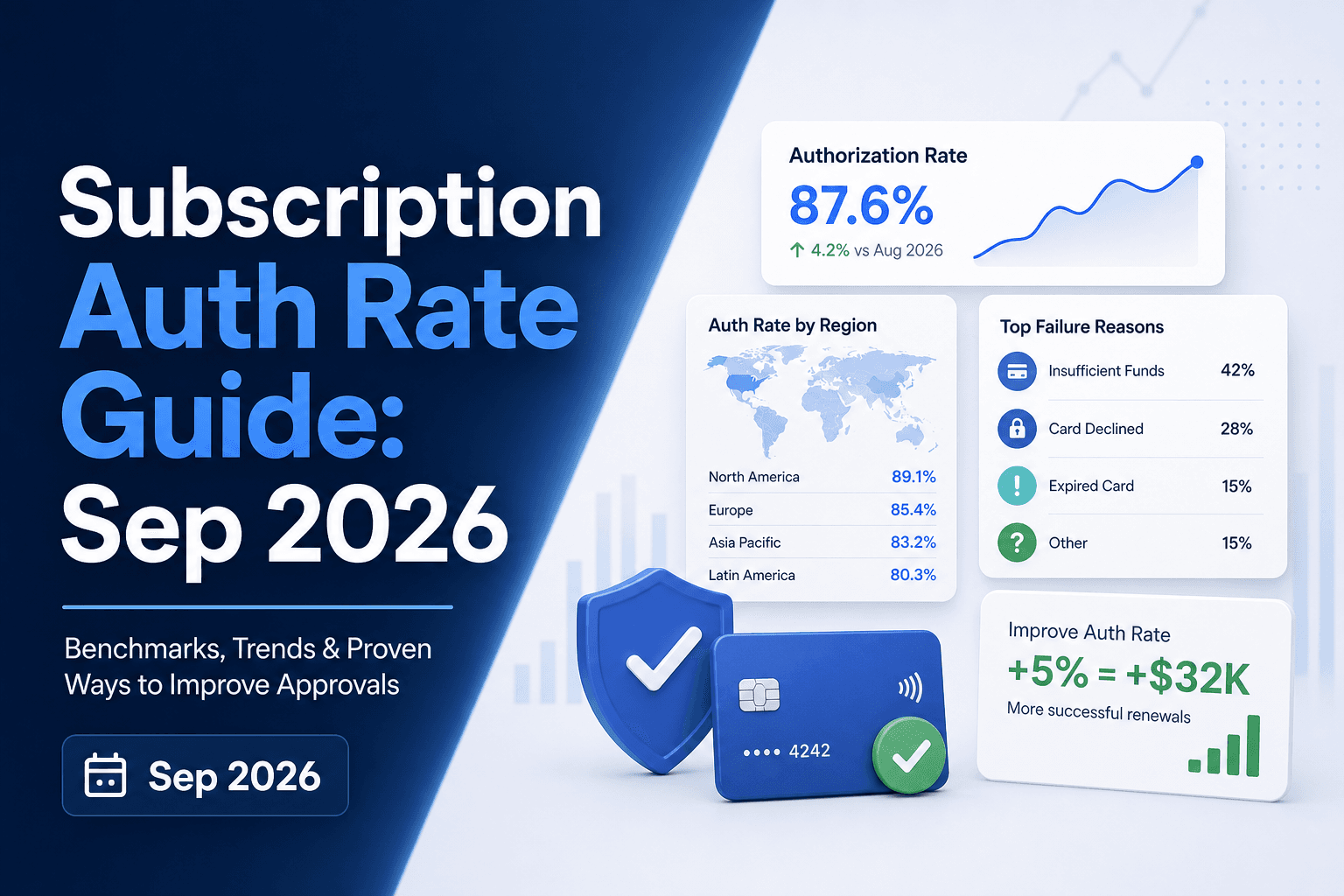
Authorization Rate in Subscription Billing: October 2026
There's a number sitting in your payments data that most finance and retention teams never report on separately: the share of renewal charges your issuing...
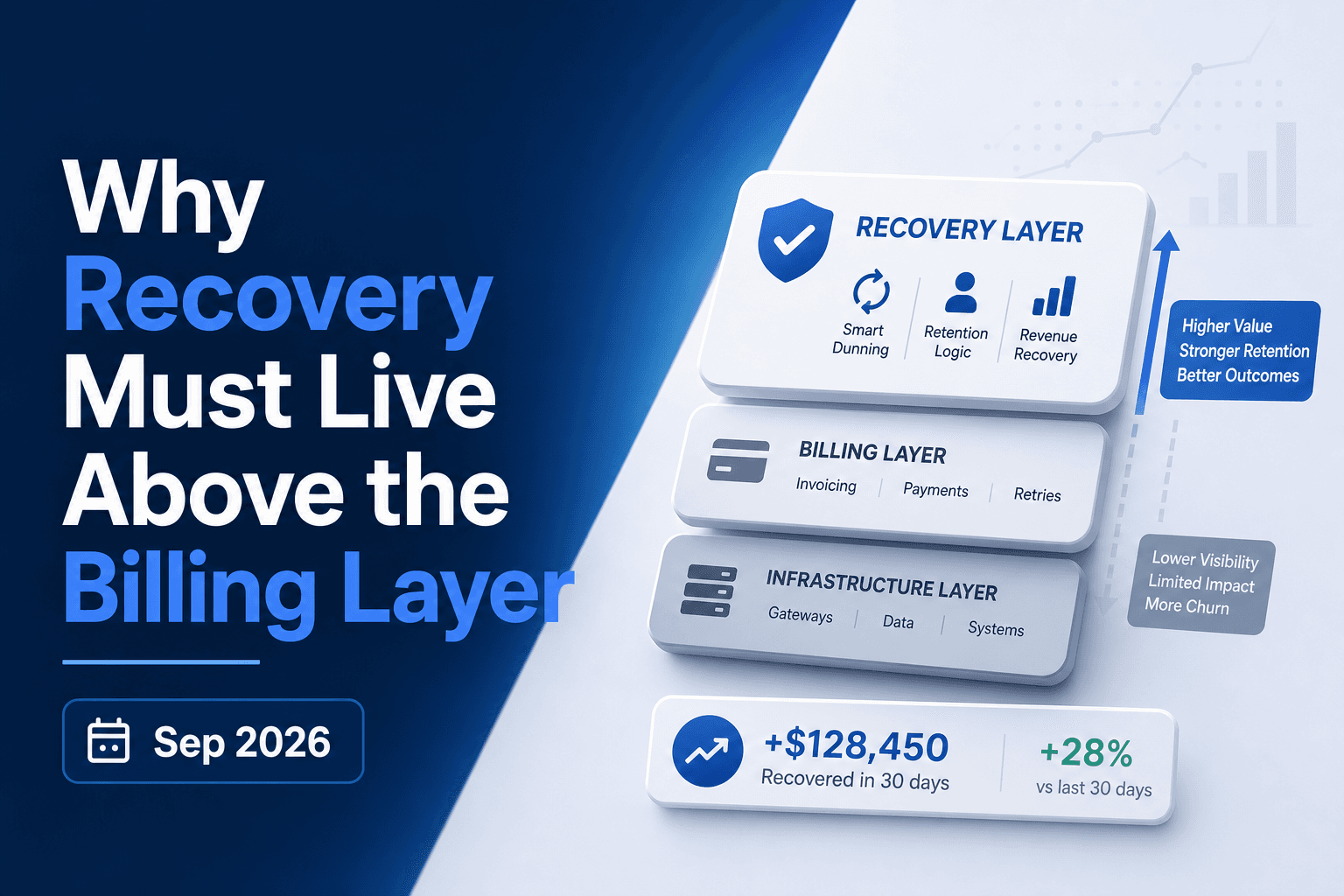
Why Payment Recovery Must Live Above Billers October 2026
A payment fails. Your biller retries it three days later, then again at seven, then at fourteen. What the biller never checks is whether the issuer sent a...
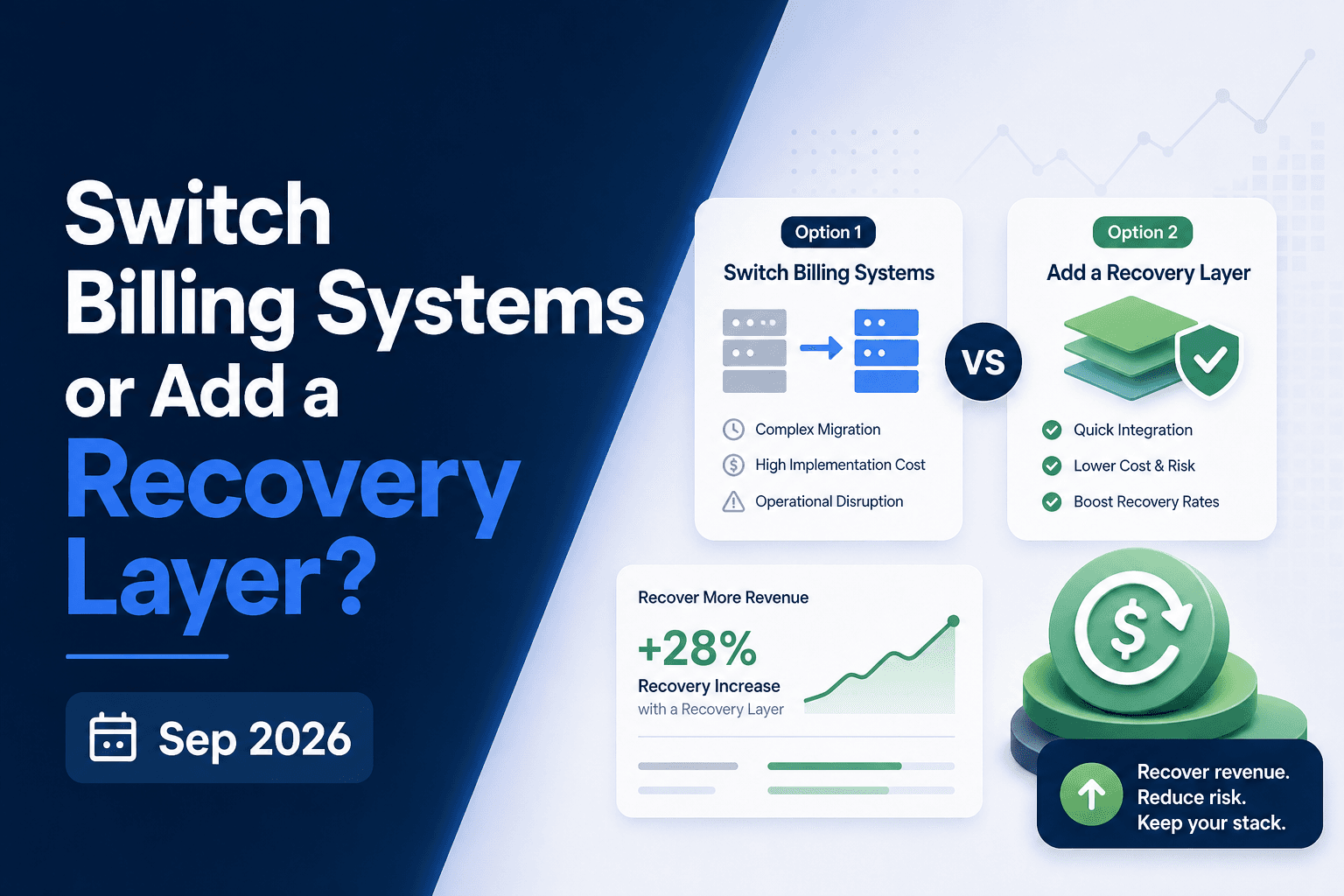
Billing Migration vs Recovery Layer: The Right Call October 2026
Switching billing systems feels like the right move when revenue collection starts breaking down. Sometimes it is. But soft declines, weak retry logic, and...
Stop losing revenue to failed payments
Join leading subscription businesses using Slicker to recover failed payments automatically.
Get Started