Recovering Failed Subscription Payments: August 2026
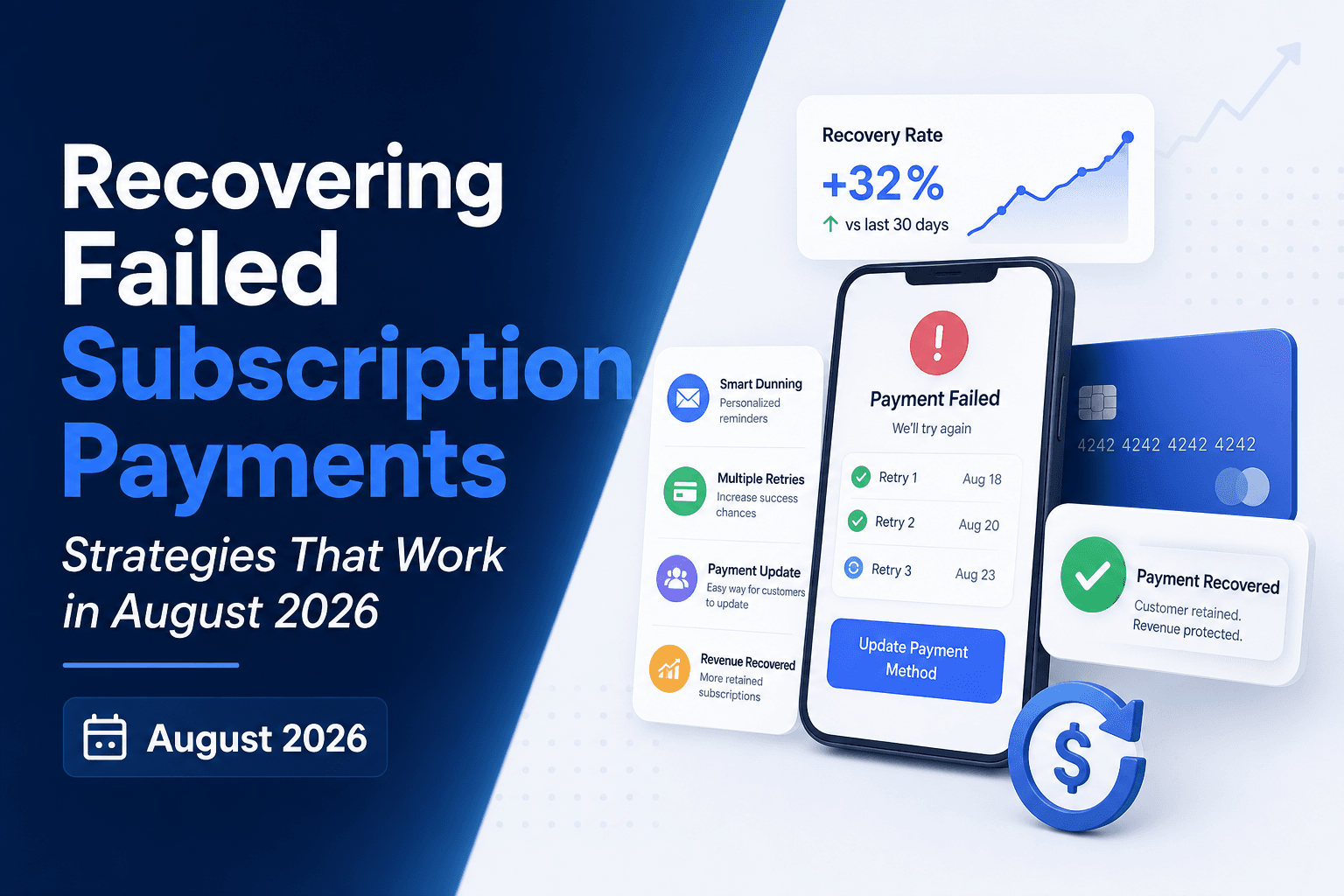
Most subscription businesses know involuntary churn is a problem. Fewer realize it typically accounts for 20 to 40% of total churn, almost all of it from customers who never wanted to leave. The good news is that unlike voluntary cancellations, this kind is fixable. The trick is knowing which failures to retry, when to retry them, and when to reach out to the customer instead.
TLDR:
- Involuntary churn accounts for 20 to 40% of total subscription churn; it's recoverable MRR from customers who already said yes.
- Roughly 15% of recurring payments decline each billing cycle, and the majority are soft declines recoverable with smart retry timing.
- Smart retry systems recover 70 to 85% of soft declines as an industry benchmark; fixed schedules land between 40 to 60%.
- Aligning retries to payday windows (US: 1st, 15th, Fridays; UK: 25th to 28th) produces material revenue differences at scale.
- Slicker runs clinical-grade AABB testing on your own data, splitting traffic 50/50 and reporting the p-value; you pay only if results reach statistical significance.
The Revenue Scale of Involuntary Churn
Industry data puts roughly 15% of recurring payments in decline each billing cycle. For a business doing $10 million in monthly recurring revenue (MRR), that's $1.5 million walking out the door before a single customer actively cancels.
The scale compounds quickly. Involuntary churn (payment failures that cancel subscribers without any intent to leave) typically accounts for 20 to 40% of total churn at mature subscription companies. Voluntary churn gets the roadmap meetings; involuntary churn quietly drains the revenue you already earned.
That asymmetry is where payment recovery solutions earn their keep.
Involuntary Churn vs. Voluntary Churn: Why the Distinction Matters
Involuntary churn happens when a subscriber wants to stay but loses access because a payment fails. Voluntary churn is a deliberate cancellation. Conflating the two is a costly analytical error: involuntary vs voluntary churn shows that one is recoverable revenue from customers who already said yes, while voluntary churn signals a product or value problem that no retry logic can fix.
Industry data puts involuntary churn at roughly 20 to 40% of total subscription churn. That share makes it the single largest recoverable revenue leak most subscription businesses are sitting on, and unlike voluntary departures, the fix is an execution problem, not a strategy problem.
Why Subscription Payments Fail: Soft Declines vs. Hard Declines
Most failed payments in subscription billing fall into one of two categories, and the difference shapes everything about how you should respond.
Soft declines are temporary. The card is valid, the customer intends to pay, but something situational blocked the transaction: insufficient funds, a bank-side fraud flag, or a processor timeout. These are recoverable with a well-timed retry.
Hard declines are permanent. A stolen card, a closed account, a card number that no longer exists. Retrying does nothing except waste attempts and risk triggering issuer fraud flags.
Here is how the two categories break down:
Decline Type | Common Causes | Retry Worth It? |
|---|---|---|
Soft decline | Insufficient funds, velocity limits, bank timeout, fraud hold | Yes, with smart timing |
Hard decline | Stolen card, closed account, invalid number, do-not-honor | No, requires customer action |
The recovery opportunity lives almost entirely in soft declines. Industry data puts roughly 15% of recurring payments in decline at any given billing cycle, and the majority of those are soft. Getting the retry timing, sequencing, and channel right is where real revenue is won or lost.
Smart Payment Retries: The Primary Recovery Layer
Smart retries are the first line of defense against involuntary churn (subscriber loss caused by payment failures, not by the customer's choice to cancel). When a soft decline comes in, the right retry at the right moment quietly recovers the charge before the subscriber ever knows there was a problem.
The timing and logic behind each retry matters far more than the volume of attempts. AI models can read issuer signals, account-level patterns, and card network response codes to choose the optimal retry window, cutting unnecessary declines and recovering more revenue from your existing subscriber base.
- Soft declines are temporary failures where the issuer may approve a future attempt. Hard declines signal a card that cannot be charged again without direct customer action.
- Retry timing tied to payday windows, balance replenishment cycles, and issuer behavior consistently outperforms fixed schedules.
- Smart retries recover 70 to 85% of soft declines, drawing on observed industry benchmarks; fixed retry schedules typically land between 40 and 60%.
The gap between those two ranges represents real monthly recurring revenue (MRR) that subscription businesses are already leaving behind. Getting smart retries right is the highest-impact move in any payment recovery strategy.
Retry Timing and Payday Alignment
Retry timing matters more than most billing teams realize. Payday-aligned payment retries recover measurably more revenue than retrying on a fixed schedule that ignores pay cycles entirely.
Here are concrete retry windows by geography:
- US: target the 1st and 15th of the month, plus Fridays, when direct deposits typically post
- UK and Western Europe: align to the 25th to 28th monthly pay cycle common across salaried workers
- Australia: the 15th and end-of-month windows reflect the most common fortnightly pay structure
Timing retries to these windows instead of arbitrary intervals produces material revenue differences at scale.
Card Network Retry Rules and Compliance
Visa and Mastercard payment retry rules that subscription businesses must follow carry real consequences for non-compliance: excessive retry fees, merchant ID (MID) suspension, or outright card network fines.
The core rules to know:
- Visa limits declined transactions to 15 retry attempts within 30 days for a given card and merchant. Attempts beyond that threshold trigger per-transaction fees.
- Mastercard requires that transactions returning MAC Code 03 (“Do Not Try Again”) be honored. This is a hard network stop, not a soft decline qualifier. Retrying against Code 03 triggers a $0.10 per-attempt penalty from Mastercard; the code signals that no future retry will succeed without cardholder action.
- Both networks distinguish between merchant-initiated transactions (MITs) and customer-initiated transactions (CITs), and MIT compliance is where most subscription businesses accumulate violations quietly.
Non-compliance here is a revenue problem as much as a legal one. Fines and merchant ID (MID) suspensions can disrupt billing across your entire subscriber base, well beyond the accounts in question. Checkout.com's payment retry guide for merchants outlines the fee structure in detail.
Card Account Updater Services: Prevention Before Recovery
Card Account Updater (CAU) services (namely Visa Account Updater and Mastercard Automatic Billing Updater) push refreshed card credentials to merchants automatically when a subscriber's card is reissued or expires. A charge that would have hit a stale card number goes through on the updated one, with no customer action required.
The coverage boundary matters. CAU handles expiry-driven and replacement-card failures well, but insufficient funds, fraud blocks, and closed accounts fall entirely outside its scope. That makes it a prevention layer upstream of your retry queue, not a substitute for the retry logic and dunning management that handles the rest of the failure mix. CAU shrinks the volume entering that queue; dunning management works the failures that remain.
Dunning Email Management: When Customer Action Is Required
When automated retries cannot recover a payment, the failure reason determines whether customer outreach makes sense. A stolen or expired card requires the subscriber to act; a soft decline retry playbook shows that a temporary bank-side shortage often resolves without any contact at all. Sending a generic "update your payment method" email for every decline wastes goodwill and trains subscribers to ignore your messages.
Effective dunning sequences are triggered by the specific decline type and sent from your own domain, in your brand's voice. The message should frame the situation around what the subscriber stands to lose, not around the payment itself.
Timing and Sequence Design
- Send the first message within hours of a card-action-required decline, not days. Subscriber engagement drops sharply the longer the gap between the failed charge and the outreach.
- Space follow-up messages by failure severity. A hard decline on a stolen card warrants faster escalation than a soft decline that may self-resolve.
- Limit the sequence to three or four touchpoints before pausing. Excessive contact accelerates cancellation instead of preventing it.
Recovery rates for well-designed dunning sequences vary by subscriber mix and billing infrastructure, so your own historical baseline is the most reliable reference point for setting realistic recovery targets.
Measuring Payment Recovery Performance: The Metrics That Matter
Three metrics separate subscription businesses that recover failed payments well from those that don't, as covered in a subscription payment retry strategy: recovery rate, time-to-recovery, and revenue recovered per attempt.
Recovery rate is the percentage of failed payments eventually collected. Time-to-recovery tracks how long that takes, since MRR (monthly recurring revenue) delayed is cash flow impaired. Revenue recovered per attempt tells you whether your retry logic is efficient or just persistent.
Watch involuntary churn separately from voluntary cancellations. Conflating them obscures where the real revenue leak lives and makes it impossible to size the fix accurately.
How to Assess Payment Recovery Solutions
When comparing vendors, skip the demo scripts and go straight to the proof. Ask each vendor how they measure incremental recovery, namely whether they run AABB testing in payment recovery that isolates their contribution from baseline retry performance. A vendor who cannot show you a statistically proven lift on your own data is asking you to take their word for it.
Three questions that separate real solutions from noise:
- Do you run AABB testing with a holdout group, and will you share the p-value before I commit?
- What happens to my recovery rate if I cancel, does performance revert to baseline immediately?
- Can you show recovery results segmented by decline code, card type, and issuer?
Any vendor who deflects on these is not worth your time.
How Slicker Recovers Failed Payments for Subscription Businesses
Slicker sits behind your existing billing infrastructure and recovers failed payments before customers ever know there was a problem. There's no engineering lift required, no new payment rails to adopt, and setup takes roughly five minutes.
The recovery logic runs on an ensemble of AI models that reads issuer response codes, timing signals, and account-level patterns to decide whether to retry, when, and how. Silent automated recovery is always the first move. Customer-facing dunning only triggers when the failure directly requires subscriber action, like a stolen or expired card.
When communication is needed, messages go out under your domain and brand, not Slicker's, and the copy is anchored to the value the subscriber would lose, not the payment that failed.
Every customer runs through clinical-grade AABB testing: traffic splits 50/50, recovered dollars are measured against a control group, and Slicker reports the p-value. If the result doesn't reach statistical significance, you don't pay. Your own data is the proof, not Slicker's claims about it.
Final Thoughts on Payment Failure Recovery for Subscription Businesses
Most of the revenue lost to failed payments is recoverable. Smart retries catch the soft declines before your subscribers notice anything went wrong, and targeted dunning handles the cases that actually need customer action. The gap between a business that recovers well and one that doesn't is almost always a matter of timing, sequencing, and treating payment failures as their own category. Talk to the Slicker team to see what recovery looks like measured against your own data.
FAQs
What's the difference between smart retries and dunning emails for recovering failed subscription payments?
Smart retries are the primary recovery layer: AI models silently retry soft declines at the optimal moment, and most subscribers never know a payment failed. Dunning emails are the fallback, triggered only when the specific failure reason requires customer action, such as a stolen or expired card requiring the subscriber to update their payment details. Sending customer-facing outreach for every decline wastes goodwill and trains subscribers to ignore your messages, which is why the sequencing matters.
Should I pay Portfolio Recovery Associates or work with a payment recovery solution like Slicker for subscription billing failures?
Portfolio Recovery Associates is a debt collection agency that purchases charged-off consumer debt, which operates in an entirely different context from subscription payment recovery. Slicker stops involuntary churn at the billing layer, recovering soft declines through AI-powered retry timing and hyper-personalized dunning before a subscription ever cancels, so the debt never reaches a collections stage in the first place. If you are a subscription business, your revenue leak is happening at the retry and dunning layer, not the collections layer.
How do I assess whether a payment recovery vendor like Slicker is actually improving my recovery rate or just taking credit for payments that would have resolved anyway?
Ask every vendor whether they run controlled AABB testing with a holdout group and whether they will share the p-value before you commit. Slicker splits traffic 50/50, measures dollars recovered against a control group running your existing retry logic, and reports the statistical result on your own data. Any vendor who cannot show you a statistically proven lift on your transaction data is asking you to accept unverifiable claims, which is exactly the pattern that makes most payment recovery solutions reviews difficult to trust.
What payment recovery metrics should subscription businesses track beyond overall recovery rate?
Recovery rate, measured as the percentage of failed payments eventually collected, is the starting point, but time-to-recovery and revenue recovered per retry attempt tell you whether your retry logic is precise or just persistent. Track involuntary churn separately from voluntary cancellations: conflating the two makes it impossible to size the fix accurately or build a credible internal business case for a payment recovery solution.
Can I build a payment recovery strategy without involving my engineering team?
Yes. Solutions like Slicker connect to your existing billing platform, whether Stripe Billing, Chargebee, Recurly, Zuora, or Recharge, using API keys, with no code changes and no new payment rails required. Setup takes roughly five minutes, and the retry logic runs as an invisible layer behind your existing infrastructure, so recoveries flow through your billing system indistinguishably from regular payments.
Related Articles

Recurly Revenue Recovery Tactics That Win (Sep 2026)
Forty percent of lost subscribers across subscription businesses never decided to leave. Their card expired, their bank blocked a charge, or a billing...

Zuora Retry Logic: CPR Limits and Layering (September 2026)
There's a version of Zuora retry logic that works well, and a version that looks fine in the settings but quietly misfires on soft declines, closes invoices...

Build vs Buy: Payment Retry Logic Deep Dive (September 2026)
Your engineering team can build retry logic. The harder question is whether they should. The gap between a basic retry schedule and something that actually...
Stop losing revenue to failed payments
Join leading subscription businesses using Slicker to recover failed payments automatically.
Get Started