PayPal Subscription Payment Failed: Why It Happens and How to Recover It
A subscriber pays you through PayPal every month without thinking about it. Then their linked bank card expires, or they tidy up their PayPal settings and cancel a billing agreement they forgot was yours, and the next renewal fails. From your side it looks like one more failed payment. From PayPal's side it might be a funding problem, an account problem, or a customer who withdrew permission entirely.
PayPal failures need their own playbook. The reasons are different from card declines, PayPal runs its own retry logic on some integrations, and a few of the most common failures can only be fixed by the customer inside their PayPal account. This guide explains what is actually failing and how to recover each case without wasting retries.
TLDR:
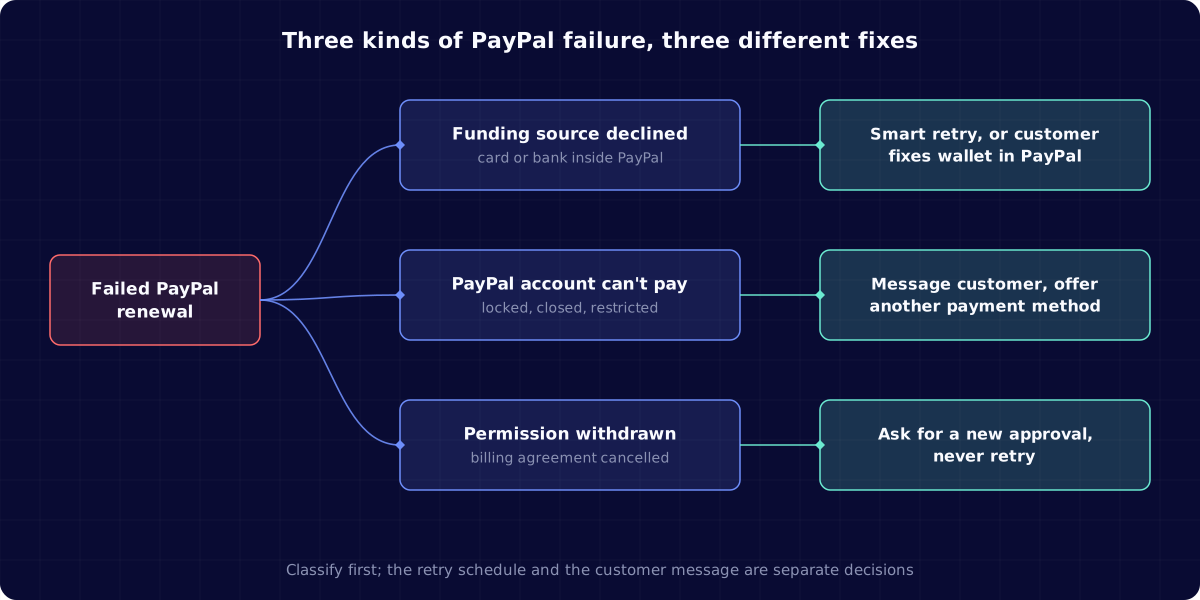
- PayPal subscription payments fail for three broad reasons: the funding source behind the PayPal account was declined, the PayPal account itself cannot pay, or the billing agreement was cancelled.
- When PayPal is a saved payment method in your own billing stack, your billing platform decides when to retry, and most platforms apply card-style schedules that do not fit PayPal failures.
- A cancelled billing agreement (PayPal error 10201) cannot be retried; the customer has to set up a new agreement.
- Most Braintree PayPal processor responses, such as 2074 and 2075, are hard declines that need the customer to act inside PayPal or switch payment method.
- Slicker treats PayPal as its own payment method, retrying only what can recover and sending PayPal-specific emails from your domain.
How PayPal Works as a Subscription Payment Method
When a customer picks PayPal at checkout, they approve a billing agreement that lets you charge their PayPal account later. Your payment provider (Braintree, Stripe, Adyen, Checkout.com or PayPal directly) stores that agreement, and your billing platform, whether Stripe Billing, Chargebee, Recurly, Zuora or an in-house system, creates each renewal charge against it.
That split matters for recovery. PayPal decides whether to approve each charge, but your billing platform decides what happens after a failure: whether to retry, when, how often, and which email goes out. Most billing platforms were designed around cards, so they apply the same retry schedule and the same "update your card" email to PayPal subscribers, even though PayPal fails for different reasons and is fixed in a different place.
This guide is about PayPal as a payment method inside your own billing. PayPal also sells its own subscription billing product, which runs its own retry schedule; if you use that, the decline reasons below still apply, but the retry settings live in PayPal.
Why PayPal Subscription Payments Fail
Every PayPal failure falls into one of three buckets.
The funding source was declined. A PayPal account pays from a balance, a linked bank account or a linked card. If the card behind the account expires or the bank declines, the PayPal payment fails even though the PayPal account is fine.
The PayPal account cannot pay. The account may be locked, closed, limited for risk reasons, missing required information, or restricted from paying in your currency or country.
The customer withdrew permission. Customers can cancel a billing agreement or a subscription from their PayPal settings at any time, sometimes without realizing it was attached to an active subscription. Once that happens, there is nothing left to charge.
The first bucket often recovers with time or a nudge. The second needs the customer to fix something inside PayPal. The third needs a fresh approval.
PayPal Decline Codes Worth Knowing
If you process PayPal through Braintree, the processor response tells you which bucket you are in. The codes below come from Braintree's authorization response reference.
| Code | Meaning | Type | What recovers it |
|---|---|---|---|
| 2074 | Funding instrument in the PayPal account was declined or can't be used | Hard | Customer updates funding in PayPal or uses another method |
| 2075 | Payer account is locked or closed | Hard | Customer contacts PayPal or switches method |
| 2076 | Payer cannot pay for this transaction with PayPal | Hard | Another payment method |
| 2077 | Transaction refused due to PayPal risk model | Hard | Customer or merchant resolves with PayPal |
| 2082 | PayPal domestic transaction required | Hard | Another payment method |
| 2046 | Declined | Soft | Customer contacts PayPal; a later retry may succeed |
| 2001 | Insufficient funds | Soft | A later retry, often after payday |
On the older NVP and SOAP APIs, two codes come up constantly. PayPal error 10201 means the customer cancelled the billing agreement, and PayPal's advice is to tell the customer and let them set up a new one. PayPal error 10417 most often means the buyer's card failed bank authorization, and PayPal suggests offering other payment methods.
The pattern is clear: far more PayPal failures are hard declines than card failures are, so the recovery mix shifts from retries toward customer action.
How Billing Platforms Retry Failed PayPal Payments
Because your billing platform owns the retry schedule, PayPal failures usually get whatever rules you set up for cards. That causes three common problems.
- Permanent failures get retried. A cancelled billing agreement or a closed PayPal account is retried several times over one or two weeks, with no chance of success.
- Recoverable failures get the wrong timing. A PayPal account funded by a debit card or bank account clears when money lands, not on a fixed every-three-days rhythm.
- Every failure gets a card email. "Please update your card" confuses a customer whose PayPal agreement was switched off, or whose problem is the bank account linked inside PayPal.
The fix is to classify PayPal failures by cause before deciding anything, as in the diagram below, and to treat the retry schedule and the customer message as two separate decisions.
When to Retry a Failed PayPal Payment
Retry only the failures that can change on their own. In practice that means insufficient funds, generic declines from the funding bank, and processing errors.
Timing matters more than count. A PayPal account backed by a debit card behaves much like that debit card: it clears after deposits land, so retries aligned with pay cycles work better than retries every 24 hours. Respect PayPal's merchant agreement guidelines and your processor's limits, and stop when the response tells you the account itself cannot pay.
The complete payment retry strategy guide explains pay-cycle timing in more depth, and country-specific retry rules covers markets where PayPal behaves differently.
When Not to Retry a PayPal Payment
Do not retry a cancelled billing agreement, a locked or closed account, a risk refusal, or a country or currency restriction. None of these change with time, and every attempt adds cost without adding recovery.
Billing platforms that apply card-style retry schedules to PayPal often get this wrong. A generic rule like "retry four times over two weeks" treats a 10201 the same as an insufficient funds decline. The hard decline retry costs post quantifies what those wasted attempts cost.
Recovering Cancelled PayPal Billing Agreements
A cancelled billing agreement is the PayPal failure most worth getting right, because it is common and it is permanent. The customer did not necessarily mean to leave you. Many people clear out "automatic payments" in PayPal without matching each entry to an active subscription.
Your message should do three things:
- Say what happened, neutrally. "Your PayPal automatic payment for [Brand] was turned off, so we couldn't renew your plan."
- Make it easy to restart. A single button that opens a new PayPal approval for the same plan, or a page where they can pick PayPal or a card.
- Avoid blame or alarm. They may have done it on purpose. A calm, clear message respects that and still wins back the ones who did not.
Because the customer can always choose to leave, measure these recoveries separately from soft-decline recoveries. They behave like a small win-back campaign.
Recovering PayPal Funding Source Failures
When the funding source is declined (2074 on Braintree, often 10417 on NVP), the fix lives inside the customer's PayPal wallet. They need to update the expired card, add a bank account, or top up a balance.
Tell them exactly that. A generic "update your payment method" email sends them to your site, where they may not see PayPal's wallet at all. A better message names PayPal, explains that the card or bank linked to their PayPal account was declined, and offers two paths: update the wallet in PayPal and you will try again, or switch to a card on your own payment page right now.
This is where hyper-personalized dunning emails earn their keep. The failure reason decides the words, the link and the timing.
PayPal Failure Patterns by Market
PayPal's role varies by country, and so do its failure patterns. In Germany and several other European markets PayPal is a primary payment method rather than a backup, so cancelled agreements and funding failures make up a larger share of involuntary churn. In markets where PayPal sits mostly on top of cards, funding source declines track card behavior: expiry waves, end-of-month balance pressure, and issuer outages.
Country and currency restrictions also catch businesses expanding abroad. If you add a new market, check whether your PayPal account and processor configuration support domestic and cross-border payments there before renewals start failing with codes like 2082.
Preventing PayPal Subscription Failures Before They Happen
Some PayPal failures can be headed off before the renewal date.
- Name your business clearly in the agreement. Customers who recognize the merchant name in their PayPal automatic payments list are less likely to cancel it by accident.
- Send a short pre-renewal notice for annual plans. A reminder a week before a large charge gives customers time to top up a balance or fix a linked card.
- Offer a backup payment method. Let PayPal subscribers add a card as a fallback, and ask permission to use it if PayPal fails.
- Check new markets before launch. Confirm your PayPal and processor setup supports the currencies and countries you are adding.
None of these replace recovery, but each one shrinks the pile of failures that need it.
Metrics to Track for PayPal Subscription Failures
PayPal failures hide inside aggregate recovery numbers. Break them out.
| Metric | What it tells you |
|---|---|
| PayPal share of failed renewals vs share of revenue | Whether PayPal is over-represented in involuntary churn |
| Failures by bucket (funding, account, permission) | Where to spend effort: retries, messaging or re-consent |
| Retry success rate on PayPal soft declines | Whether your retry timing fits PayPal funding patterns |
| Billing agreement re-approval rate | How well your re-consent message works |
| Retries spent on permanent PayPal failures | Wasted attempts your retry rules should skip |
If PayPal's share of failures is much larger than its share of revenue, start with the permission bucket. It is usually the biggest and the most fixable with a better message.
How Slicker Recovers Failed PayPal Subscription Payments
Slicker treats PayPal as its own payment method, whether you accept it directly or through Braintree, Stripe or Adyen, and whatever billing platform creates the renewals. It reads each PayPal response, separates funding, account and permission failures, and applies smart retries only to the failures that can recover on their own, with timing that accounts for PayPal balance patterns and funding source availability.
For failures that need the customer, Slicker sends PayPal-specific dunning emails from your own domain: a re-approval link for a cancelled agreement, wallet instructions for a declined funding source, and an alternative payment option where PayPal cannot be used. Everything works within PayPal's merchant agreement guidelines, and AABB testing shows the incremental lift on your PayPal traffic. More detail is on the PayPal solution page.
Final Thoughts on PayPal Subscription Payment Failures
PayPal failures are less about timing and more about diagnosis. Once you know whether the funding source, the account or the permission failed, the right action is usually obvious: retry, ask the customer to fix their wallet, or ask for a new approval.
Get the classification right, stop retrying what cannot recover, and write messages that name PayPal and the exact fix. If you want to see how your PayPal failures break down and what a tailored recovery flow would add, talk to the Slicker team.
FAQ
Why did my customer's PayPal subscription payment fail?
The most common reasons are a declined card or bank account linked to the customer's PayPal account, a PayPal account that is locked, limited or restricted, or a billing agreement the customer cancelled in their PayPal settings. The processor response code tells you which one it is.
Should failed PayPal payments be retried on the same schedule as cards?
No. Your billing platform controls PayPal retries, and card schedules fit PayPal poorly. Retry only soft failures such as insufficient funds, timed around when the linked bank or card is likely to have funds, and never retry a cancelled agreement or a closed account.
What does PayPal error 10201 mean?
PayPal error 10201 means the customer cancelled the billing agreement. You cannot retry it. Tell the customer their automatic payment was turned off and give them a simple way to approve a new agreement or pay with another method.
Can I retry a PayPal payment that failed with code 2074?
Retrying alone rarely helps. Braintree classifies 2074 as a hard decline: the card or bank linked to the PayPal account was declined. Ask the customer to update the funding source in PayPal or switch to another payment method, then charge again.
What is the best way to reduce involuntary churn from PayPal subscribers?
Separate PayPal failures by cause, retry only soft declines with pay-cycle-aware timing, send PayPal-specific messages for wallet and permission problems, and stop retrying permanent failures. Then measure the result against a control group so you know which changes worked.
Related Articles
Authentication Required Declines on Subscription Renewals: SCA, MIT Exemptions and Recovery
A renewal that has charged cleanly for a year suddenly comes back declined with authentication_required. The card is valid, the customer has money, and nobody...
Stripe Smart Retries Alternatives for Subscription Businesses (October 2026)
You turned on Stripe Smart Retries because it was free, it was one toggle, and Stripe said it beats a fixed schedule. Months later your past-due list still...
Authorization Rate in Subscription Billing: October 2026
There's a number sitting in your payments data that most finance and retention teams never report on separately: the share of renewal charges your issuing...
Stop losing revenue to failed payments
Join leading subscription businesses using Slicker to recover failed payments automatically.
Get Started