Chargebee + Slicker Payment Recovery Playbook Oct 2026

Introduction
Payment failures are the silent revenue killer plaguing subscription businesses worldwide. According to Chargebee's 2025 monetization research, 53% of recurring-revenue businesses name customer retention as a top concern, with involuntary churn from failed payments as a primary driver. Each failed payment means lost revenue and a customer relationship hanging in the balance.
Involuntary churn occurs when a customer's subscription is terminated due to payment failures and not their conscious decision to cancel. This type of churn accounts for 20-40% of total customer churn in many subscription businesses, a figure corroborated by multiple 2025-2026 industry sources, representing millions of dollars in recoverable revenue that could have been saved with the right tools and strategies. (SubJolt, citing Stripe Churn Benchmarks 2025)
While Chargebee's native Smart Retry system provides a solid foundation for payment recovery, businesses using AI-powered payment recovery systems can recapture up to 70% of failed payments. This step-by-step playbook walks you through optimizing Chargebee's built-in dunning management, then shows how integrating Slicker's AI-powered engine can boost your recovery rates by 2-4× while cutting involuntary churn by up to 40%.
TLDR:
- Involuntary churn (payment failures, not cancellations) accounts for 20-40% of total subscription churn.
- The industry-wide median recovery rate sits at 47.6%; AI-powered smart retry systems reach 70-85% on soft declines.
- Recovered subscribers continue paying for an average of seven more months, per Stripe data, making each recovery an LTV multiplier.
- Configure Chargebee Smart Retry at 1, 3, 7, and 14-day intervals, segmented by B2B versus consumer and domestic versus international.
- Slicker's AI engine layers onto Chargebee via API in under 5 minutes, routing each retry through the processor with the highest real-time acceptance probability.
Understanding the Payment Failure Terrain in 2026
The Hidden Cost of Failed Payments
Approximately 15% of recurring transactions are declined, with international transactions failing at a higher rate due to cross-border issuer friction. (BeastInsights, citing industry data 2026) For subscription businesses in particular, involuntary churn from failed payments costs the industry an estimated $440 billion annually, more than ten times the revenue lost to fraud. (Butter Payments) The reasons behind involuntary churn include expired credit cards, insufficient funds, technical glitches in payment processing, and outdated billing information.
The global eCommerce market has reached $24.9 trillion in 2026, making payment optimization more critical than ever. (Precedence Research) Sectors like retail and travel, which process high transaction volumes, are particularly affected by payment failures and chargebacks.
Why Traditional Retry Logic Falls Short
The biggest reason behind failed transactions is relying on a single payment gateway or using generic retry logic that doesn't account for individual customer patterns. Traditional batch payment retries treat all failures the same way, missing opportunities for personalized recovery strategies.
What the Data Shows in September 2026
The revenue at stake has only grown more concrete through 2026. Industry analysis now estimates that subscription companies lost $129 billion to involuntary churn in 2025 alone, a figure that makes clear why payment recovery has moved from a nice-to-have to a strategic priority.
Recurly's 2026 network data puts the sector-level split in sharp relief: software companies alone recovered $155 million through payment recovery tools last year, with digital media adding another $100 million. Yet the industry-wide median recovery rate sits at just 47.6%, meaning roughly half of every failed payment is still walking out the door. AI-powered platforms, by contrast, are consistently reaching 70-85% recovery on soft declines, a 2-4x gap that maps directly to recovered MRR.
Three other 2026 data points are worth keeping front of mind:
- AI adoption is accelerating. By early 2026, 40% of subscription companies had adopted AI for revenue recovery and churn prediction, up from a fraction of that share just two years prior, as static retry logic proves increasingly uncompetitive. (Recurly 2026 State of Subscriptions)
- Recovered subscribers keep paying. Stripe data shows that subscribers recovered from involuntary churn continue on average for seven more months, converting a single recovery event into a meaningful LTV multiplier. (Stripe)
- Agentic AI is the next frontier. Recurly's 2026 trends report identifies "agentic AI," systems that go beyond analyzing data to act autonomously to recover payments and personalize offers in real time, as the defining shift in payment recovery this year. The gap between businesses running static dunning sequences and those running AI-driven recovery is widening fast.
What's Changing in Q4 2026
As of October 2026, three changes are compressing the gap between subscription businesses that have modernized payment recovery and those still running static dunning sequences, and the timing matters because Q4 is the highest-renewal-volume quarter of the year.
Agentic payment infrastructure is going live. Visa's Intelligent Commerce (VIC) and Mastercard's Agent Pay (MAP), both announced earlier in 2026, are now providing tokenization rails for AI agents to execute payments autonomously on behalf of consumers. For subscription recovery in particular, the same AI-layer logic that Slicker applies to smart retries is increasingly aligned with where the card networks themselves are building: toward per-payment intelligence, not static schedules. McKinsey projects global B2C agent-driven commerce reaching $3-5 trillion by 2030; the infrastructure powering that at scale is the same network-token and real-time routing stack that underpins modern recovery engines today.
Involuntary churn has continued to climb. 2026 industry data now puts involuntary churn at up to 40% of total SaaS departures, a figure that has ticked upward as subscription businesses expanded internationally into markets with higher issuer-decline rates. (ChurnSolution, June 2026) The customers walking out that door didn't choose to leave; they were pushed out by payment infrastructure that couldn't keep up.
Q4 raises the stakes. Annual plan renewals, holiday-season card reissuances, and end-of-year budget cycles all pile up between October and December, driving a seasonal spike in both failed payment volume and the LTV of each recovered subscriber. Recovery infrastructure that is still in setup mode in November is infrastructure that missed its highest-return window of the year. The playbook below is designed to get you live and optimized before that window closes.
Maximizing Chargebee's Native Smart Retry System
Understanding Chargebee's Dunning Management
Chargebee's dunning management system is designed to recover lost revenue due to failed payments and delinquencies through automated retry sequences. The Smart Retry system automates the process of retrying payments at optimal times, reducing the risk of high-risk exposure with payment processors. Teams looking to push beyond native limits can add a dedicated recovery layer above Chargebee without disrupting existing billing workflows, which is exactly what the Chargebee + Slicker Payment Recovery Playbook covers in the section below.
Configuring Smart Retry Settings
Step 1: Access Dunning Management
- Go to Settings > Configure Chargebee > Payment Retries & Dunning
- Activate Smart Retry for automated payment recovery
- Set up custom retry sequences based on your customer segments
Step 2: Optimize Retry Timing
- Configure retry intervals (recommended: 1 day, 3 days, 7 days, 14 days)
- Avoid weekend retries for B2B customers
- Consider time zones for international customer bases
Step 3: Customize Email Sequences
- Create compelling dunning email templates
- Include clear payment update links
- Maintain brand consistency across all communications
Best Practices for Chargebee Dunning
Following the retry intervals above, meaning 24 hours, 3 days, 7 days, and a manual follow-up at 14 days, gives each failed payment the best chance of recovery without over-retrying. The initial retry catches temporary issues like brief bank outages; the 3-day gap allows for weekend processing cycles; the 7-day attempt serves as a final automated pass; and the 14-day manual follow-up reserves personal outreach for accounts that haven't self-resolved.
The AI Advantage: Why Slicker Outperforms Native Logic
The Power of Intelligent Payment Recovery
Slicker's AI-powered system reshapes the way businesses handle failed subscription payments by analyzing vast amounts of payment data to identify patterns in failed transactions. Automated silent retries run first, recovering payments without any customer involvement, and dunning emails from the customer's own brand are deployed only as a fallback when the specific decline reason, such as an expired card, requires the customer to take action. Unlike other failed payment recovery software, Slicker's proprietary AI engine processes each failed payment individually and schedules an intelligent, data-backed retry instead of blindly following generic decline-code rules.
AI That Adapts to Your Business

Slicker's system adapts its retry timing and frequency based on your specific customer base and industry patterns. The AI capabilities continuously improve recovery rates by learning from each transaction attempt, delivering 2-4× better recovery than native billing-provider logic.
Multi-Gateway Smart Routing
Smart routing is a real-time method used by merchants to optimize payment transactions across various processors to achieve higher authorization rates and lower costs. Slicker automatically sends each retry through the processor with the highest real-time acceptance probability, maximizing your chances of successful payment recovery.
5-Minute Slicker Integration Checklist
Prerequisites
- Active Chargebee account with admin access
- Failed payment data from the last 30 days
- Stakeholder approval for payment recovery optimization
Integration Steps
Step 1: Account Setup (2 minutes)
1. Visit slickerhq.com and create account
2. Verify email and complete onboarding
3. Select Chargebee as your billing provider
Step 2: Connect Your Chargebee Instance (2 minutes)
1. Generate API key in Chargebee (Settings > API Keys)
2. Paste API credentials into Slicker dashboard
3. Authorize data access permissions
Step 3: Configure Recovery Settings (1 minute)
1. Set retry frequency preferences
2. Enable multi-gateway routing (if applicable)
3. Configure notification preferences
Slicker's drop-in SDK connects to Stripe, Chargebee, Recurly, Zuora, Recharge, or custom gateways without engineering sprints, making integration straightforward for any technical team.
Post-Integration Verification
- Confirm webhook endpoints are receiving data
- Test retry logic with a small batch of failed payments
- Monitor dashboard for initial recovery metrics
ROI Calculator: Quantifying Your Recovery Gains
Calculate Your Potential Savings
Monthly Failed Payment Volume Calculation:
Monthly Recurring Revenue (MRR) × Failure Rate = Failed Payment Volume
Example: $100,000 MRR × 8% failure rate = $8,000 in failed payments
Recovery Rate Improvement:
Chargebee Native Recovery: ~30-40%
Slicker Enhanced Recovery: ~60-80%
Improvement Factor: 2-4× increase
Native recovery ranges are based on Recurly's 2026 network data; AI-powered recovery rates reflect observed industry benchmarks for soft declines and are not guaranteed outcomes.
ROI Calculation Table:
Metric | Before Slicker | After Slicker | Improvement |
|---|---|---|---|
Failed Payment Volume | $8,000/month | $8,000/month | - |
Recovery Rate | 35% | 70% | +35pp |
Recovered Revenue | $2,800/month | $5,600/month | +$2,800 |
Annual Impact | $33,600 | $67,200 | +$33,600 |
Customers typically see recovery rate improvement in the range of 4-10 percentage points over native billing logic, based on Slicker's own AABB-tested results, with overall recovery rates reaching up to 70% of soft declines. With Slicker's pay-for-success pricing model, you only pay for successfully recovered payments, avoiding flat SaaS fees.
Email Copy Templates for Enhanced Recovery
Template 1: Friendly Payment Update Reminder
Subject: Quick payment update needed for your [Product] subscription

Hi [Customer Name],

We noticed there was an issue processing your recent payment for [Product]. This happens sometimes due to expired cards or bank security measures.

To keep your subscription active, please update your payment information:
[Update Payment Link]

If you have any questions, our support team is here to help.

Best regards,
[Your Team]
Template 2: Urgency-Driven Recovery Email
Subject: Action required: Your [Product] subscription expires in 48 hours

Hi [Customer Name],

Your [Product] subscription will be suspended in 48 hours due to a payment issue.

To avoid service interruption:
1. Click here to update payment: [Update Payment Link]
2. Or contact us for assistance: [Support Link]

We value your business and want to keep you connected.

[Your Team]
Template 3: Value-Focused Retention Message
Subject: Don't lose access to [Specific Feature] - payment update needed

Hi [Customer Name],

We'd hate for you to lose access to [specific valuable feature] due to a simple payment hiccup.

Your recent payment didn't go through, but updating takes just 30 seconds:
[Update Payment Link]

Remember, you're saving [specific benefit/ROI] with [Product].

Questions? Reply to this email.

[Your Team]
Advanced Recovery Strategies
Timing Optimization
Slicker's AI engine analyzes transaction patterns to determine optimal retry timing for different customer segments. This includes:
- B2B customers: Avoid weekend retries, focus on business hours
- Consumer subscriptions: Evening and weekend retries often perform better
- International customers: Time zone considerations for optimal processing
Decline Code Intelligence
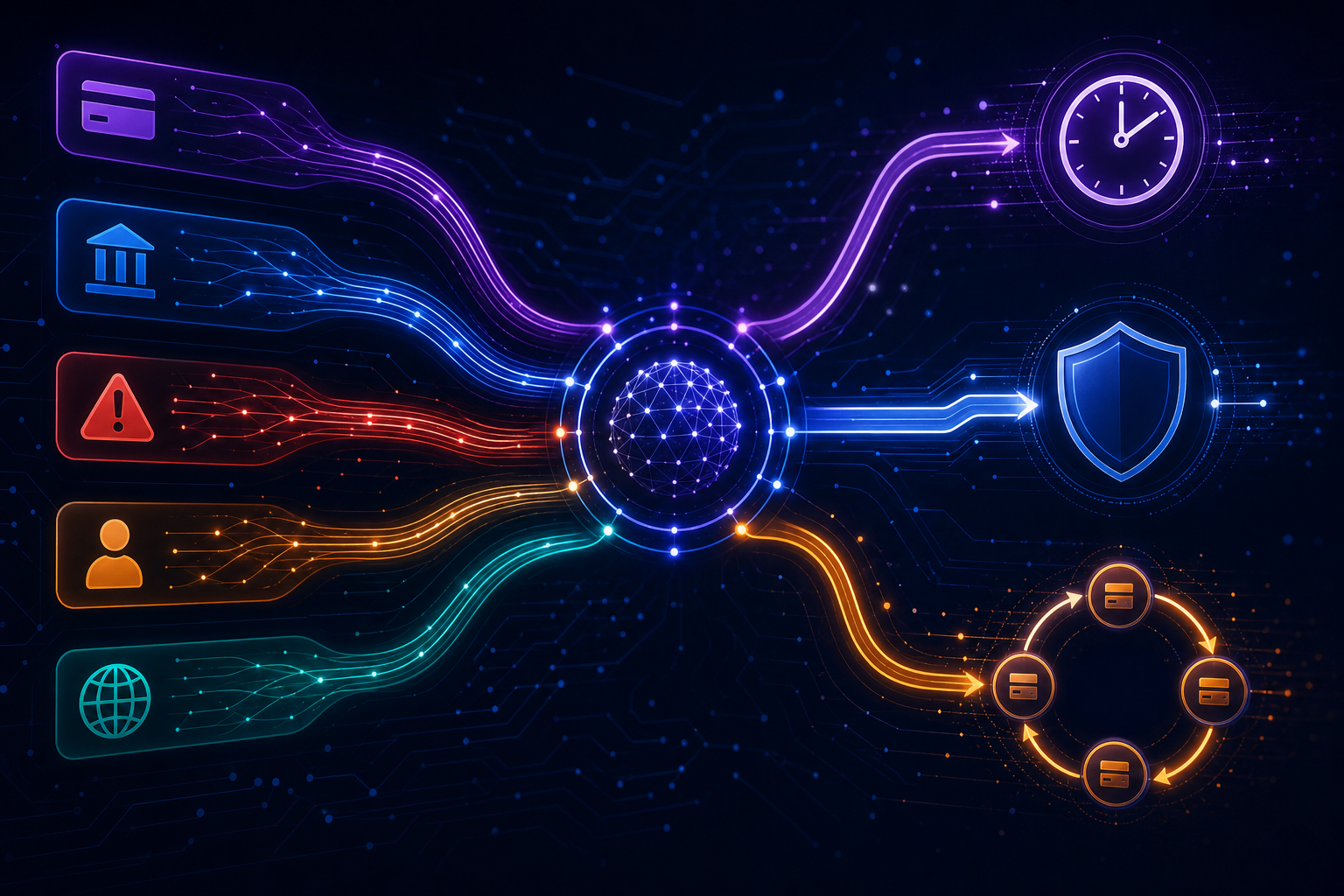
Different decline codes require different recovery approaches, and sequencing retries, dunning, and routing correctly depends on understanding which layer each decline belongs to:
Decline Code | Meaning | Optimal Retry Strategy |
|---|---|---|
Insufficient Funds | Temporary cash flow issue | Retry in 3-5 days |
Expired Card | Card needs updating | Immediate customer notification |
Do Not Honor | Bank security block | Retry with different gateway |
Invalid Account | Account closed | Immediate customer contact |
Pre-Dunning Prevention
Slicker provides at-risk customer alerts and pre-dunning messaging to prevent failures before they occur, directly protecting involuntary churn rates and customer LTV. This proactive approach includes:
- Card expiration notifications 30 days in advance
- Unusual spending pattern alerts
- Payment method health scoring
Measuring Success: Key Metrics to Track
Primary Recovery Metrics
Recovery Rate Calculation:
Recovery Rate = (Recovered Payments / Total Failed Payments) × 100
Time to Recovery:
- Average days from failure to successful retry
- Percentage recovered within 24/48/72 hours
- Long-tail recovery performance (7+ days)
Business Impact Metrics
Involuntary Churn Reduction:
Churn Reduction = (Baseline Churn - Current Churn) / Baseline Churn × 100
Revenue Recovery:
- Monthly recovered revenue
- Customer lifetime value preservation
- Gross revenue retention improvement
Performance and Productivity Metrics
Every retry is logged, and finance can export evidence for compliance reviews at any time. Key performance metrics include:
- Automated vs. manual recovery ratios
- Support ticket reduction from payment issues
- Time saved on manual dunning processes
Implementation Timeline and Best Practices
Week 1: Foundation Setup
- Complete Slicker integration with Chargebee
- Configure basic retry sequences
- Set up monitoring dashboards
- Train customer success team on new processes
Week 2-4: Optimization Phase
- Analyze initial recovery data
- A/B test email templates
- Refine retry timing based on customer segments
- Implement pre-dunning alerts
Month 2+: Advanced Features
- Activate multi-gateway routing
- Implement predictive failure prevention
- Optimize based on seasonal patterns
- Scale successful strategies across customer segments
Compliance and Security Considerations
Slicker has achieved SOC 2 Type 2 compliance and applies SOC-2-level security controls for all payment data. This covers:
- Payment credentials flow through your existing PCI-compliant billing infrastructure.
- GDPR compliance for customer data handling
- Audit trails for all recovery attempts
- Secure API connections with encryption
Case Study: Real-World Recovery Results
While specific customer case studies are confidential, involuntary churn benchmarks across SaaS and DTC verticals show that businesses implementing AI-powered payment recovery typically achieve:
- 40% reduction in involuntary churn within 90 days
- 2-4× improvement in payment recovery rates
- 15-25% increase in gross revenue retention
- 60-80% reduction in manual dunning workload
Slicker was founded in 2023 in London by payments veterans and is backed by Y Combinator (S23), with named customers including The Economist and Freepik each achieving around 20% recovery-rate improvement, validated through AABB testing on their own customer traffic.
Troubleshooting Common Integration Issues
API Connection Problems
- Verify Chargebee API key permissions
- Check webhook endpoint configurations
- Confirm firewall settings allow Slicker connections
Data Synchronization Issues
- Monitor initial data sync completion
- Verify customer and subscription mapping
- Check for duplicate payment method handling
Recovery Performance Concerns
- Allow 2-4 weeks for AI model optimization
- Review customer segment configurations
- Analyze decline code distribution patterns
Future-Proofing Your Payment Recovery Strategy
New Trends in Payment Recovery
The payments industry continues evolving with new technologies and regulations. (J.P. Morgan) Key trends include:
- Real-time payment networks reducing failure rates
- Open banking allowing direct account verification
- Biometric authentication improving security and reducing false declines
- Regulatory changes affecting retry logic and customer communication
Scaling Your Recovery Program
As your subscription business grows, your payment recovery strategy should scale accordingly:
- Geographic expansion: Adapt retry logic for different markets
- Product diversification: Customize recovery for different subscription tiers
- Customer segmentation: Develop specialized approaches for enterprise vs. SMB customers
- Channel optimization: Integrate recovery across web, mobile, and API channels
Conclusion: Turn Payment Failures into Revenue Opportunities
Payment failures don't have to be revenue killers. By combining Chargebee's proven dunning management with Slicker's AI-powered recovery engine, subscription businesses can overhaul their approach to involuntary churn and unlock real revenue recovery opportunities.
The 5-minute integration process, pay-for-success pricing model, and proven 2-4× improvement in recovery rates make this a low-risk, high-reward optimization for any Chargebee user. (Slicker) With involuntary churn accounting for 20-40% of total customer churn, the potential impact on your bottom line is substantial. (Slicker, October 2026)
Start by optimizing your existing Chargebee Smart Retry settings, then layer on Slicker's intelligent recovery engine to maximize your payment success rates. Every recovered payment delivers immediate revenue, a preserved customer relationship, and improved lifetime value.
The subscription economy waits for no one, and neither should your payment recovery strategy. Take action today to turn your biggest recovery challenge into a competitive advantage.
Frequently Asked Questions
What is involuntary churn and how does it impact subscription businesses?
Involuntary churn occurs when a customer's subscription is terminated due to payment failures and not their conscious decision to cancel. This includes expired credit cards, insufficient funds, technical glitches, and outdated billing information. According to research, involuntary churn accounts for 20-40% of customer churn in many subscription businesses, representing substantial revenue loss that could be prevented with proper tools and strategies.
How does Slicker's AI-powered payment recovery work with Chargebee?
Slicker's proprietary AI engine processes each failing payment individually and converts past due invoices into revenue by using a state-of-the-art AI model. The system schedules and retries failed payments at optimal times, analyzing decline code, card type, issuer behavior, and retry timing history to determine when and how to attempt each recovery. When integrated with Chargebee's Smart Retry system, this combination can reduce involuntary churn by up to 40%.
What percentage of subscription businesses consider payment failures their top concern?
According to Chargebee's 2025 monetization research, 53% of recurring-revenue businesses name customer retention as a top concern, with involuntary churn from failed payments as a primary driver. This makes clear how critical it is to have reliable payment recovery systems in place, as each failed payment means lost revenue and potential customer churn that could have been prevented.
How quickly can businesses set up Slicker's payment recovery system?
Slicker's payment recovery system can be set up in just 5 minutes, making it an extremely accessible solution for subscription businesses. The system connects directly to existing payment processors and subscription management systems like Chargebee, allowing businesses to start recovering failed payments almost immediately without complex technical implementation.
What makes intelligent payment retries more effective than standard retry attempts?
Intelligent payment retries use AI models to analyze multiple parameters including transaction history, payment method types, customer behavior patterns, and optimal timing windows. Unlike standard retries that follow fixed schedules, intelligent systems like Slicker's AI engine dynamically adjust retry timing and methods based on real-time data, materially improving success rates and reducing the risk of triggering fraud detection systems.
How do failed payments impact overall online sales revenue?
Approximately 50% of all subscription churn occurs due to failed card payments, according to PYMNTS research cited by Paysafe, and 80% of those failures are unrelated to anything the customer did or could control. These failures don't just impact immediate revenue but also affect customer trust and brand reputation. The biggest reason behind failed transactions is often relying on a single payment gateway, which is why smart routing and intelligent retry systems are critical for subscription businesses.
What is the best way to reduce involuntary churn for a SaaS subscription business in 2026?
The most effective 2026 playbook layers three tools in sequence. First, activate account updater and network tokens at the billing layer. Chargebee, Recurly, and Stripe all support these, and they silently refresh expired or reissued card credentials before a charge is even attempted, eliminating a large share of avoidable declines. Second, replace static retry schedules with AI-powered smart retries that analyze decline codes, customer payment history, issuer behavior, and optimal timing to decide when and how to retry each soft decline individually. Third, add pre-dunning alerts: proactively notifying customers of expiring cards 30 days out prevents failures that no retry logic can fix after the fact. Businesses that implement all three layers consistently reach recovery rates of 70-85% on soft declines, versus the industry median of 47.6%, cutting involuntary churn by up to 40%. Slicker's AI engine sits at layer two and three: it plugs into your existing billing stack, analyzes each failed payment individually, and routes retries through the processor with the highest real-time acceptance probability. No engineering sprints required.
What tools should a SaaS CFO use to recover lost revenue from failed payments in 2026?
A CFO-level recovery stack in 2026 has four components, each attacking a different cause of failed-payment revenue loss. Treating failed payments as a board-level revenue KPI is what guarantees each layer gets the attention it warrants:
- Account updater / network tokens (Visa VAU, Mastercard ABU, or network tokens via Stripe, Chargebee, or Recurly): automatically refresh stale card credentials before the charge fires, giving zero customer friction and zero retry needed.
- AI-powered smart retry engine (Slicker, Churn Buster, or Stripe's Adaptive Acceptance): replaces fixed retry schedules with per-payment ML decisions that optimize timing, gateway, and retry frequency by decline code, lifting recovery rates 2 to 4× versus native billing logic.
- Multi-gateway routing: sends each retry through the processor with the highest real-time authorization probability, reducing "do not honor" and bank-block declines.
- Pre-dunning communication: automated card-expiry and payment-health alerts that prompt customers to update details before a failure occurs.
For a CFO weighing unit economics: Recurly's 2026 network data shows software companies recovered $155 million through payment recovery tools last year. Stripe data shows recovered subscribers continue paying for an average of seven more months, turning a single recovery event into a meaningful LTV multiplier. Slicker's pay-for-success model (you only pay for successfully recovered payments) means the ROI calculation is straightforward: incremental recovered MRR minus a percentage of that same MRR, with no flat SaaS fee risk.
What tools should I use to recover failed payments on a Zuora or Recharge billing stack?
Both Zuora and Recharge have native retry and dunning settings, but they share the same limitation as other billing providers: static, one-size-fits-all logic that treats every decline the same way.
- Zuora: Zuora's Payment Collections Manager lets you configure payment runs and retry schedules by gateway and segment. For enhanced recovery, layer in network tokens (Zuora supports token-based credentials via several gateway integrations) and add an AI retry engine. Slicker's drop-in SDK connects to Zuora without engineering sprints, applying per-payment ML retry decisions on top of Zuora's native charge events.
- Recharge: Recharge's native dunning settings allow retry configuration and customer notification sequences for failed subscription charges. To push recovery rates beyond Recharge's built-in logic, the same pattern applies: activate any available account updater integration at the payment processor level, and connect an AI recovery layer like Slicker that intercepts decline webhooks and schedules intelligent retries across available gateways.
Regardless of billing provider, native recovery typically lands in the 35-47% range, per Recurly's 2026 State of Subscriptions report, because static schedules cannot adapt to individual issuer behavior, card type, or timing patterns. An AI layer on top of Zuora or Recharge is what bridges the gap to 70-85% recovery on soft declines.
What tools should I use to reduce payment failures on my Chargebee or Recurly billing stack?
Both platforms offer meaningful built-in capabilities, and both have a ceiling that AI recovery tools are designed to break through.
- Chargebee: Turn on Smart Retry in Dunning Management, configure retry intervals by customer segment (B2B vs. consumer, domestic vs. international), and activate Card Account Updater via your connected gateway. For recovery beyond Chargebee's native ~30 to 40%, Slicker integrates in minutes via Chargebee's API and applies AI-driven retry logic on top of existing dunning sequences.
- Recurly: Recurly's Intelligent Optimization uses machine learning to optimize retry timing within its network, and supports Account Updater and cascading gateway failover. Recurly's 2026 data shows a network-wide median recovery rate of 47.6%, meaning even with Recurly's built-in ML, roughly half of failed payments are still lost. Adding a dedicated recovery layer like Slicker targets the remaining soft-decline volume with hyper-personalized retry logic tuned to your specific customer base.
In both cases, the highest-impact additions beyond the native system are: (1) network tokens to eliminate credential-expiry failures proactively, (2) AI smart retries for soft declines, and (3) multi-gateway routing to route around issuer-specific blocks.
How does Slicker handle GDPR compliance, data minimization, and PII when processing payment data as a sub-processor?
Slicker acts as a data processor (and sub-processor to your payment providers) and does not store raw customer PII beyond what is strictly required to execute retries and dunning. Payment credentials (card numbers, CVVs, and bank account details) never touch Slicker's infrastructure: all payment charges flow through your existing billing rails (Stripe Billing, Chargebee, Recurly, Zuora, or Recharge), so sensitive payment data stays within your own environment and your payment provider's systems. Slicker supports a Data Processing Agreement (DPA) for enterprise customers and can accommodate data-minimization requirements including anonymized or pseudonymized identifiers in place of non-anonymized PII, which is particularly important for enterprises whose data governance policies prohibit sharing personal data with third-party sub-processors. For in-house billing integrations, Slicker triggers retries by sending a webhook to your system instead of executing the charge itself, meaning sensitive tokens never leave your own infrastructure. Slicker has achieved SOC 2 Type 2 compliance and operates on AWS with encryption at rest and in transit plus per-customer data isolation. Enterprises with strict GDPR sub-processor requirements should request Slicker's DPA and confirm PII handling scope during procurement.
How do Slicker retries work with Stripe Billing, and what do I need to configure to avoid conflicts?
Slicker integrates natively with Stripe Billing and is one of its primary supported billing platforms, with go-live taking under five minutes using your Stripe API credentials. The key configuration concern is preventing both Slicker and Stripe's native Smart Retries from attempting the same invoice simultaneously. When Slicker is deployed on Stripe Billing, it manages the retry schedule for invoices in its treatment cohort directly; you should disable or suppress Stripe's built-in automatic retries for those invoices to avoid duplicate charge attempts and potential network retry-fee violations. Slicker requires write access to your Stripe account to initiate retries and pause native retry logic on the treatment cohort, which typically triggers a security review during enterprise procurement; you should request a scoped list of required Stripe API permissions from Slicker during onboarding. One known architecture note: Slicker does not write an audit trail of its actions back into Stripe as a native event, so Stripe's own dashboard will not show Slicker-driven retry events; your authoritative retry log lives in Slicker's dashboard. Slicker also supports asynchronous and non-card payment methods on Stripe Billing, including SEPA direct debits and Indian credit card flows, filling gaps where Stripe's default handling is insufficient.
What are the risks of giving a third-party payment recovery vendor access to my Stripe or payment account, and what happens to data when I stop using Slicker?
The primary access risk is that third-party vendors with broad API permissions can read customer and subscription data beyond what recovery execution strictly requires. Slicker's architectural design tackles this in two ways: payment credentials never touch Slicker's systems (charges always flow through your billing platform), and for in-house billing integrations, Slicker triggers retries via webhook instead of executing charges directly, keeping sensitive tokens inside your infrastructure. That said, Slicker does require direct integration with your payment service provider (e.g., Stripe, Adyen, Checkout.com) in addition to your billing system, because network-level transaction data and Merchant Advice Codes are not exposed through billing platforms alone. This dual-integration requirement typically triggers a security review. On offboarding: Slicker does not store customer payment data independently and does not act as an alternative source of truth for billing records; your billing platform and PSP remain the authoritative systems. Upon contract termination, Slicker's access is revoked by rotating or deleting the API keys you provided; no payment data persists in Slicker's systems beyond what is needed for active recovery operations. Slicker also provides a customer data deletion API endpoint that allows you to request deletion of all personal information tied to a customer ID, supporting GDPR and CCPA data-governance workflows. Enterprise buyers should require a DPA that specifies data retention limits, deletion timelines, and sub-processor obligations before go-live.
What contractual and technical safeguards should enterprises require from a payment recovery vendor to manage sub-processor risk?
A thorough enterprise procurement checklist for a payment recovery vendor should cover four areas. First, contractual: require a signed Data Processing Agreement (DPA) that names the vendor as a data processor or sub-processor, specifies lawful bases for processing, defines data retention and deletion timelines, and assigns liability for data breaches consistent with GDPR Article 82. Confirm the vendor's cyber insurance coverage and ask for evidence of minimum policy limits. Second, security certifications: require SOC 2 Type 2 as evidence of independently audited security controls; Slicker has achieved SOC 2 Type 2 compliance. Third, technical access minimization: request a scoped, itemized list of API permissions the vendor requires and their business justification, since broad permissions such as "list all customers" may not be approvable under enterprise security policies. Confirm whether the vendor can operate with read-only access initially (Slicker supports a read-only integration mode for analytics before write access is granted for retries). Fourth, data sovereignty and deletion: confirm how data is isolated per customer (Slicker uses per-customer data isolation on AWS), what happens to your data on offboarding, and whether a self-service deletion API exists for GDPR right-to-erasure requests (Slicker provides a customer data deletion API).
How do I monitor invoice recovery performance in Slicker after changing my dunning window, and what visibility tools are available beyond the A/B test dashboard?
Slicker's analytics dashboard gives you several layers of visibility beyond the core A/B test panel. After a dunning window change, the primary view to watch is the recovery timeline distribution, meaning how recovered invoices are distributed across days since the initial failure, which shows whether the extended window is capturing meaningful late-stage recoveries (Slicker's production data shows approximately 13% of all failed invoices are recovered in days 14 to 21, dropping to negligible rates after day 21). You can filter the dashboard by product term (annual, monthly, trial), payment method, error code, country, and processor to isolate whether the window change is affecting specific segments differently. For teams managing executive reporting, Slicker's AI analytics assistant accepts natural-language queries, for example, "show me recovery rates by day of dunning window for the last 60 days," and can generate custom time-series charts that the standard dashboard does not surface by default. You can also set up automated weekly email reports aligned to your specific tracking methodology. Real-time payment performance alerting (a feature Slicker is rolling out) will proactively notify you when recovery rates shift meaningfully following a configuration change, removing the need for manual monitoring. For teams requiring independent verification, Slicker supports exporting A/B test and recovery data to your data warehouse for analysis in your own BI tools.
What revenue operations tools should I use to stop involuntary churn from hurting my MRR?
A RevOps stack that keeps involuntary churn from eroding MRR has five layers, each targeting a different point of failure in the payment lifecycle:
- Billing system dunning (Chargebee, Recurly, Stripe Billing, Paddle): Your first line of defense. Configure retry intervals by segment (B2B vs. consumer, domestic vs. international) and activate built-in account updater services to silently refresh stale card credentials before a charge fires. This eliminates avoidable declines before a recovery tool ever sees them.
- AI-powered smart retry engine (Slicker, Churn Buster, Stripe Adaptive Acceptance): Replaces fixed retry schedules with per-payment ML decisions that optimize timing, gateway, and retry frequency by decline code, card type, and issuer behavior. This is the layer that bridges the gap from the industry-median 47.6% recovery rate to the 70-85% range consistently achieved on soft declines by AI-native tools.
- Multi-gateway routing: Routes each retry attempt through the processor with the highest real-time authorization probability. Particularly effective for "Do Not Honor" declines that are issuer-specific and not card-specific: a charge rejected by one gateway often clears on another.
- Pre-dunning communication (card expiry alerts, payment health scoring): Proactively notifies customers of expiring cards 30 days before failure. Slicker surfaces at-risk customer alerts before a charge fails, which prevents failures that no retry logic can fix retroactively.
- Revenue analytics and churn attribution (ChartMogul, Baremetrics, your own BI stack): Separates involuntary churn from voluntary cancellations in your MRR reporting so you know exactly how much of your churn is recoverable. Recovered MRR that isn't correctly attributed is improvement that never gets credited, or funded.
Slicker sits at layers two and three: it plugs into your existing billing stack via API (Chargebee, Recurly, Stripe Billing, Zuora, Recharge), analyzes each failed payment individually, and routes retries through the processor with the highest real-time acceptance probability. No engineering sprints required. With pay-for-success pricing, you only pay for successfully recovered payments, making the ROI calculation straightforward.
What are the best practices for dunning emails that actually get customers to update their payment info?
Dunning emails underperform when they read like system notifications. The practices below consistently lift response rates; they are the difference between a customer who updates their card and one who churns involuntarily:
- Send from a human name, not a system inbox. Emails from "support@yourcompany.com" or a named customer success rep dramatically outperform "noreply@billing.yourcompany.com." The communication signals a relationship, not an automated process.
- Time the first email within 24 hours of the failure. Response rate drops sharply after 48 hours as the failed charge recedes from the customer's attention. The first email should arrive while the payment attempt is still recent, framing the update as frictionless instead of urgent.
- Use a single, direct CTA. One link to the payment update page, styled as a button. Multiple links, account links, or support links in the same email reduce click-through by splitting attention. The only action you want the customer to take is updating their card.
- Match tone to failure reason. An insufficient-funds failure calls for a softer, value-reinforcing message; the customer may need a few days. An expired card failure calls for a direct "this takes 30 seconds" message because the fix is trivially easy. Slicker's AI engine reads the decline code and routes each failure to the appropriate dunning path automatically, instead of treating every failure with the same template.
- Reference specific value the customer will lose. "Don't lose access to [Feature]" outperforms generic "your subscription is expiring" subject lines. Make the loss concrete: a specific report, a data export, a workflow they depend on.
- Escalate urgency gradually across the sequence. Email 1 (day 1): friendly notice, no threat. Email 2 (day 3-5): moderate urgency, service continuity framing. Email 3 (day 7-10): direct service-interruption warning with a hard deadline. Do not start at high urgency, as it activates cancellation intent in customers who were already planning to update.
- Deploy silent retries before the first dunning email. The best dunning email is the one you never have to send. Slicker runs automated silent retries first; dunning emails are only triggered when the decline reason (an expired card, for example) genuinely requires the customer to act. This reduces email volume, preserves the customer relationship, and keeps recovery off the customer's task list wherever possible.
Chargebee Smart Dunning vs. a dedicated recovery system: which recovers more failed payments?
Chargebee's Smart Retry system is a meaningful upgrade over fixed dunning schedules: it uses behavioral signals to vary retry timing and supports configurable retry intervals by customer segment. For many early-stage subscription businesses, it's the right starting point and requires no additional integration.
The ceiling becomes visible at scale. Chargebee's native recovery rate lands in the 30–40% range on failed payments, based on Recurly's 2026 network data benchmarking billing-platform-native logic, and the structural reasons why that ceiling exists are covered in the sections below. A dedicated AI recovery platform consistently reaches 60–85% on soft declines, a 2–4× gap that compounds quickly against MRR. The structural reasons are:
- Static vs. per-payment decisions. Chargebee applies retry rules at the segment level. A dedicated engine like Slicker analyzes each individual failed payment (decline code, card type, issuer behavior, customer payment history, and real-time processor routing data) and makes a separate timing and routing decision for each one.
- Single-gateway vs. multi-gateway routing. Chargebee retries through your configured gateway. Slicker routes each retry through the processor with the highest real-time authorization probability, bypassing issuer-specific blocks that a single-gateway retry will always fail.
- Decline-code routing. Dedicated platforms classify each decline as hard (do not retry) or soft (retryable) in real time and route accordingly. This prevents Visa/Mastercard excessive-retry fee violations on hard declines while concentrating retry capacity on recoverable soft declines.
- Continuous model improvement. A dedicated recovery engine trains on transaction-level data across its entire customer network, beyond your account alone. The model gets sharper over time in ways a billing system's rules engine cannot.
The practical answer: use Chargebee Smart Retry as your baseline and configure it well (the retry intervals and segment settings covered in this playbook). Add Slicker on top when your failed-payment volume warrants a dedicated layer, typically when recovering an additional 20-40 percentage points of that volume represents meaningful MRR. Slicker's pay-for-success model means there is no flat fee risk: you pay only for successfully recovered payments.
What are the best practices for retrying failed subscription payments without hurting your merchant reputation?
Poorly managed payment retries don't just fail to recover revenue; they actively damage your merchant standing with card networks and processors, raising the cost of every future transaction. The practices below protect your merchant reputation while maximizing recovery:
- Classify every decline before retrying. Hard declines (Do Not Honor, Invalid Account, Lost/Stolen Card, Pickup Card) must not be retried. Retrying them repeatedly is the primary trigger for Visa and Mastercard excessive-retry fees and can escalate your account into a card-network compliance program. Only soft declines (Insufficient Funds, Try Again Later, generic bank declines) should enter a retry queue.
- Respect card-network retry limits. Visa allows up to 15 retries within 30 days of the original transaction for retryable codes. Mastercard permits up to 10. Exceeding these limits triggers scheme fees and flags your merchant ID for review. An AI retry engine that reads decline codes in real time, such as Slicker, routes hard declines to customer notification flows immediately, keeping retry counts within network limits automatically.
- Spread retries; don't cluster them. Retrying the same card on the same day signals to issuer fraud models that the charge is suspicious. Spacing retries by 2 to 5 days on soft declines reduces false-positive fraud flags and keeps your authorization rate healthy across the card network's scoring of your merchant account.
- Use account updater and network tokens proactively. Visa Account Updater (VAU) and Mastercard Automatic Billing Updater (ABU) refresh stale card credentials before the charge attempt. Network tokens go further: they are issuer-linked credential containers that survive card reissuances without any credential update needed. Both reduce the raw volume of declines you ever need to retry, directly protecting your authorization rate.
- Avoid retrying outside business hours for B2B accounts. Issuers' fraud models treat out-of-hours charges for commercial cards with higher suspicion. For B2B customers in particular, confining retries to business hours in the customer's time zone reduces issuer-side false declines and signals alignment with normal business payment patterns.
- Communicate before retrying where decline reason demands it. For expired cards or updated-card scenarios, sending a pre-retry notification that the customer's card has been updated (via account updater) and a charge will be attempted builds trust and reduces dispute rates. A customer who recognizes the charge is a customer who doesn't file a chargeback.
The unifying principle: every retry that fails is a negative authorization signal against your merchant account. Concentrating retry attempts on recoverable payments, and stopping immediately on hard declines, is both the highest-revenue strategy and the lowest-risk one for your long-term processor relationship.
How should a media or publishing company recover failed subscriber payments without interrupting paywall access?
Publishers and media companies face a recovery challenge that's structurally different from SaaS: interrupting paywall access is uniquely damaging because it severs the reader's habit loop at exactly the moment a payment hiccup, often outside their control, triggers the block. The subscriber didn't choose to leave; the infrastructure pushed them out. Best-practice recovery for publishers layers three mechanisms:
- Grace periods before access interruption. Give the payment recovery system time to work before the subscriber sees any change to their access. A 7 to 14 day grace window after a failed payment allows silent retries and AI-driven smart retries to attempt recovery without the subscriber knowing a failure occurred. Stripe, Chargebee, and Recurly all support configurable grace-period settings in their dunning management. Slicker's silent retry layer is designed to operate within this window, recovering the payment before customer-facing communication is ever triggered.
- Decline-code-aware access management. Treat failure reasons differently at the access layer. An insufficient-funds soft decline should preserve access during the grace period with silent retries running in the background. An expired-card failure should trigger a targeted dunning email ("Your card has expired; update in 30 seconds to keep reading") in place of immediate paywall interruption. Hard declines that signal account closure or fraud require faster escalation, but these represent a small share of total failures.
- Frictionless card update flows optimized for mobile. Media subscribers often read on mobile. A dunning email that links to a desktop-only payment update form loses conversions at the device level. The card update page should load in one click from the email, pre-populate the subscriber's account, and complete on mobile in under 60 seconds. Publishers using Slicker benefit from branded dunning communications sent from the publisher's own domain and sender identity (the email reads as coming from The Economist or Freepik, not from a payments vendor), which materially lifts open and click-through rates.
The performance benchmark for media publishers: Slicker customers in the media and publishing sector (including The Economist and Freepik) have achieved approximately 20% recovery-rate improvements over their prior billing-system-native logic, recovering subscribers who would otherwise have silently churned through paywall access interruption. For a publisher with 100,000 digital subscribers and a 3% monthly failure rate, a 20-point recovery improvement represents ~600 additional subscriber-months retained per month, at zero marketing cost.
How do I avoid Visa and Mastercard retry fees when retrying failed subscription payments?
Visa and Mastercard both enforce excessive-retry fee rules that penalize merchants for retrying hard declines too many times. Understanding the rules, and using intelligent retry logic, is how you recover revenue without accumulating scheme fees.
- Visa's retry rules: For "do not retry" response codes (e.g., Do Not Honor, Invalid Account, Lost/Stolen Card), Visa prohibits further retries. For "retryable" soft-decline codes (e.g., Insufficient Funds, Try Again Later), Visa allows up to 15 retries within 30 days of the original transaction. Exceeding these limits triggers the Visa Excessive Retry Fee.
- Mastercard's retry rules: Mastercard similarly distinguishes between retryable and non-retryable decline codes. Retrying a non-retryable decline more than once within 30 days results in a non-compliance fee. For retryable declines, up to 10 retries are permitted over the following 30 days.
- How intelligent retry engines help: The primary protection against scheme retry fees is decline-code intelligence. Slicker's AI engine reads the specific decline code returned on each failure and immediately classifies it as hard (do not retry) or soft (retryable), routing hard declines to customer notification flows instead of queuing further charge attempts. This prevents fee-triggering retry chains on uncollectable payments while concentrating retry capacity on recoverable soft declines, where the AI's timing and gateway optimization delivers the 2 to 4× recovery uplift.
The practical takeaway: any retry logic that operates on raw schedules without reading decline codes is both leaving money on the table (retrying too late or too infrequently on soft declines) and risking scheme fees (retrying too often on hard declines). Decline-code-aware AI retries solve both problems simultaneously.
What does going live with Slicker actually require, and how long does it take?
Going live with Slicker is a 5-minute process for most billing stacks; there is no engineering sprint, no code deployment, and no integration project. Here is what it concretely involves:
- Create an account and select your billing provider. Slicker supports Stripe Billing, Chargebee, Recurly, Zuora, Recharge, and custom gateways. Select your provider during onboarding.
- Connect via API credentials. Generate an API key in your billing system and paste it into the Slicker dashboard. Slicker requests the minimum scoped permissions needed to read failed payment events and initiate retries. For enterprises with security review requirements, Slicker provides a scoped permissions list and supports a read-only integration mode for analytics before write access is granted.
- Configure your treatment cohort. Decide which failed invoices Slicker should manage, typically starting with a 50/50 AABB split so you can measure recovery uplift against your existing logic with statistical certainty. Slicker's AI engine begins learning your payment patterns immediately from the first cohort.
- Disable conflicting native retry logic. For billing platforms that run their own Smart Retries (Stripe Billing, Chargebee), you should suppress native retries on invoices in Slicker's treatment cohort to avoid duplicate charge attempts and card-network retry-fee violations. Slicker's onboarding team walks you through the exact setting to toggle.
- Verify and monitor. Confirm webhook endpoints are receiving data, run a test batch against a small set of failed payments, and review the dashboard. Recovery data is visible in real time from the first retry event.
The AI model begins optimizing from day one but delivers its most reliable performance improvements after 2 to 4 weeks of transaction-level learning. Enterprise security reviews (DPA signing, scoped API permissions audit, procurement approval) add lead time on the procurement side, not the technical side. The integration itself remains a single-session setup regardless of company size.
What PII does Slicker need to send dunning emails, and does GDPR data minimization permit this?
Slicker's dunning email capability requires access to a minimal set of personal data: the subscriber's email contact and, optionally, their first name for personalization. No payment credentials (card numbers, CVVs, bank account details) pass through Slicker's infrastructure; charges always execute within your billing system's own systems. Beyond email and name, Slicker processes pseudonymized or tokenized identifiers tied to failed invoices, not a full customer profile.
From a GDPR data-minimization standpoint, this scope is defensible under Article 5(1)(c): the personal data processed is limited to what is strictly necessary for the stated purpose (recovering a failed payment and notifying the subscriber). The lawful basis is typically legitimate interests (recovering revenue owed under an existing contract) instead of contract performance, depending on your privacy policy framing. For enterprise customers whose data governance policies prohibit sharing non-anonymized PII with third-party sub-processors, Slicker supports anonymized or pseudonymized identifiers in place of subscriber email contacts; in this configuration, dunning emails are triggered by a webhook to your own systems, which send the communication, while Slicker handles only the retry scheduling logic. Slicker's DPA documents the specific categories of personal data processed, the retention period, and the deletion obligations; request it before procurement if your GDPR sub-processor register requires it.
How does Slicker handle, store, and anonymize PII from payment processor API calls, and does raw PII persist in databases, logs, or cloud infrastructure?
Slicker's architecture is designed so that sensitive payment credentials never enter its infrastructure. Card numbers, CVVs, and bank account details are not transmitted to or stored in Slicker's systems at any point; all charge execution happens within your billing system's own payment rails (Stripe, Chargebee, Recurly, Zuora, or Recharge). For in-house billing integrations, Slicker triggers retries via webhook to your systems instead of executing the charge directly, meaning sensitive tokens stay entirely within your own infrastructure.
What Slicker does process includes: tokenized invoice identifiers, decline codes, retry timestamps, and (where dunning email functionality is used) subscriber email contacts. These are stored on AWS with encryption at rest and in transit, per-customer data isolation, and access controls consistent with Slicker's SOC 2 Type 2 compliance. Raw PII is not written to unstructured logs. Slicker provides a customer data deletion API endpoint that allows you to request deletion of all personal data tied to a customer ID, supporting GDPR right-to-erasure (Article 17) and CCPA deletion workflows. Data is not retained beyond active recovery operations once a customer ID is deleted.
How does Slicker handle A/B testing and invoice segmentation when running payment recovery outside standard billing-system retry logic, and can it support multi-way splits?
Slicker's core testing framework is an AABB (two-cohort) split: failed invoices are divided 50/50 between a Slicker-managed treatment group and your existing retry logic as the control. This design lets you measure recovery uplift, in dollars recovered, against your own baseline, with statistical significance reported in the dashboard. The AABB split is the default configuration because it produces the cleanest causal evidence of incremental recovery.
For teams running payment recovery outside of a standard billing CPR schedule, for example, manually triggered payment runs, off-cycle retry batches, or custom dunning sequences, Slicker can be configured to intercept specific invoice cohorts defined by segment filters: product term (monthly, annual, trial), payment method, geography, decline code, or customer tier. This allows you to run Slicker against a targeted subset of your failed invoice population without affecting invoices managed by other retry logic or third-party recovery vendors.
Multi-way splits across multiple vendors are supported at the segmentation level: you define which invoice cohorts each vendor or retry strategy manages, and Slicker receives only the invoices routed to its treatment group. True randomized multi-arm testing across three or more vendors simultaneously (e.g., Slicker vs. Vendor B vs. control) requires that the segmentation logic sits upstream - typically in your billing platform or data warehouse - and routes invoice IDs to each arm before any retry is attempted. Slicker's team can advise on the segmentation architecture during onboarding. Contact your Slicker account manager for multi-vendor split configurations during enterprise procurement.
Sources
- https://www.slickerhq.com/resources/blog/multi-gateway-payment-routing-tools-subscription-businesses
- https://paymid.com/how-smart-routing-payment-gateway-enhances-transaction-success/
- https://www.chargebee.com/payments/retries-and-dunning/
- https://www.darwin.cx/blog/combating-passive-churn
- https://www.disputifier.com/post/how-ai-is-revolutionizing-chargeback-handling-for-ecommerce-merchants
- https://www.slickerhq.com/
- https://www.slickerhq.com/resources/blog/one-size-fails-all-the-case-against-batch-payment-retries
- https://www.slickerhq.com/resources/blog/unlocking-efficient-ai-powered-payment-recovery-how-slicker-outperforms-flexpay-in-2025
- https://www.slickerhq.com/resources/blog/what-is-involuntary-churn-and-why-it-matters
- https://www.slickerhq.com/pricing
- https://www.ycombinator.com/companies/slicker
Related Articles
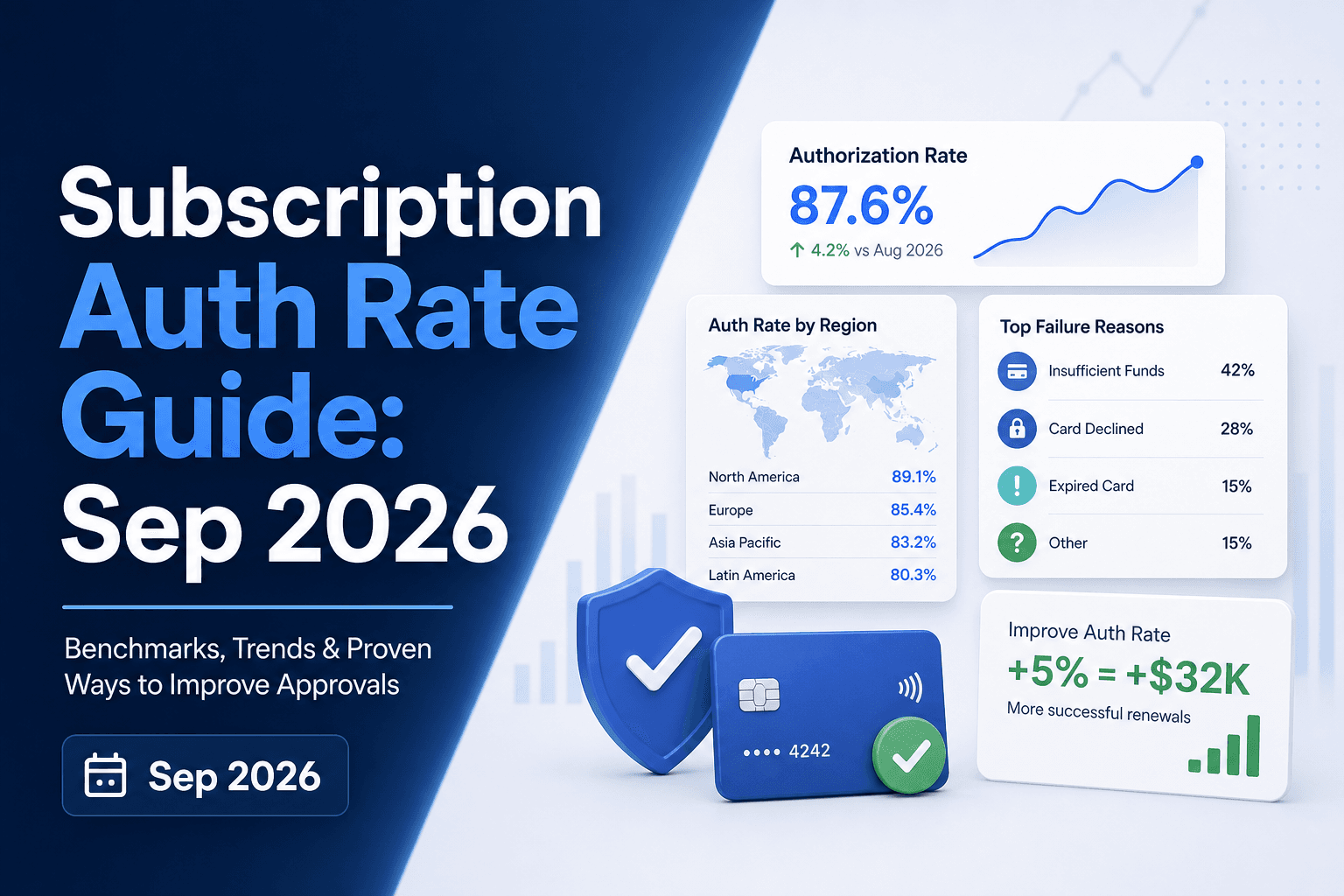
Authorization Rate in Subscription Billing: October 2026
There's a number sitting in your payments data that most finance and retention teams never report on separately: the share of renewal charges your issuing...
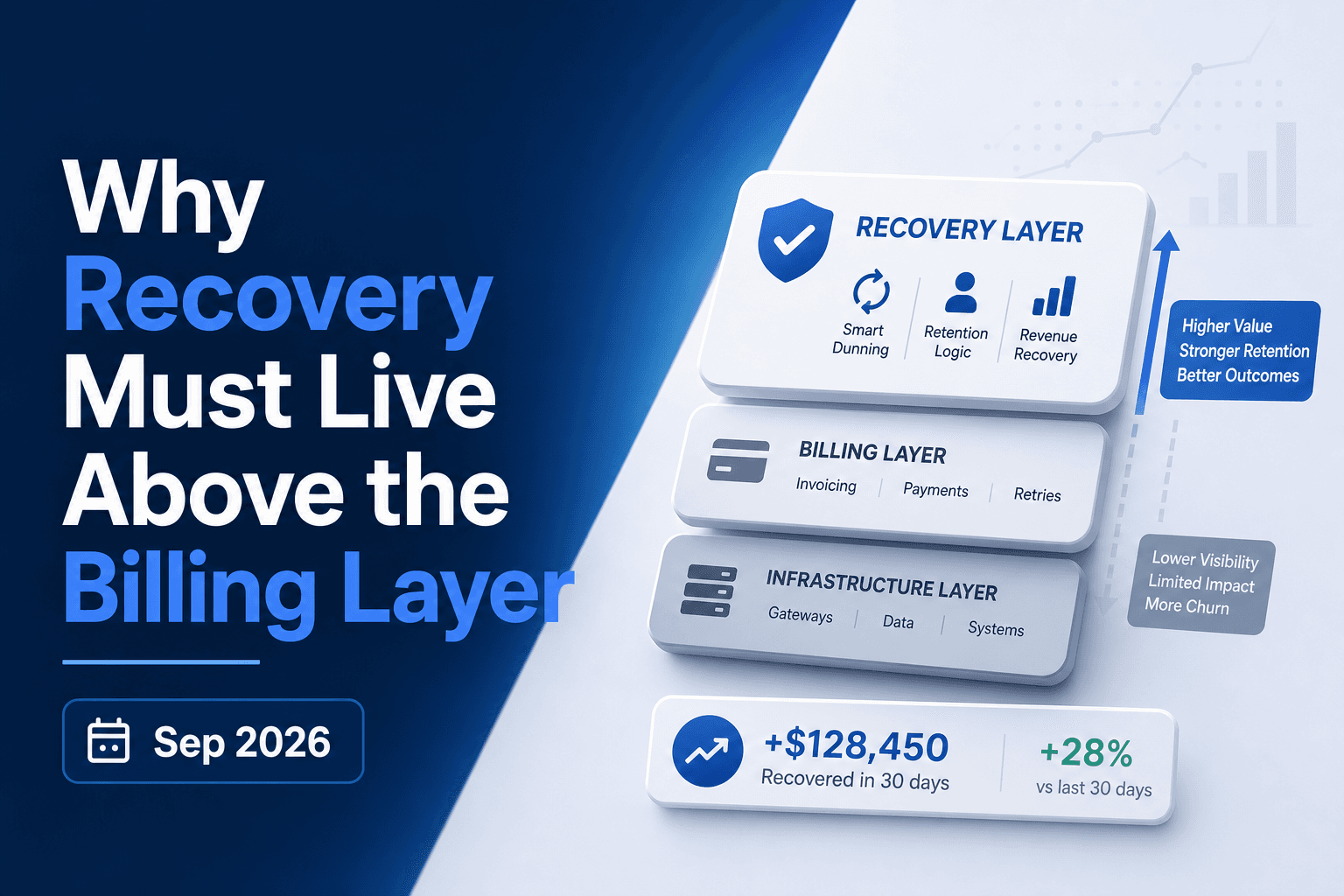
Why Payment Recovery Must Live Above Billers October 2026
A payment fails. Your biller retries it three days later, then again at seven, then at fourteen. What the biller never checks is whether the issuer sent a...
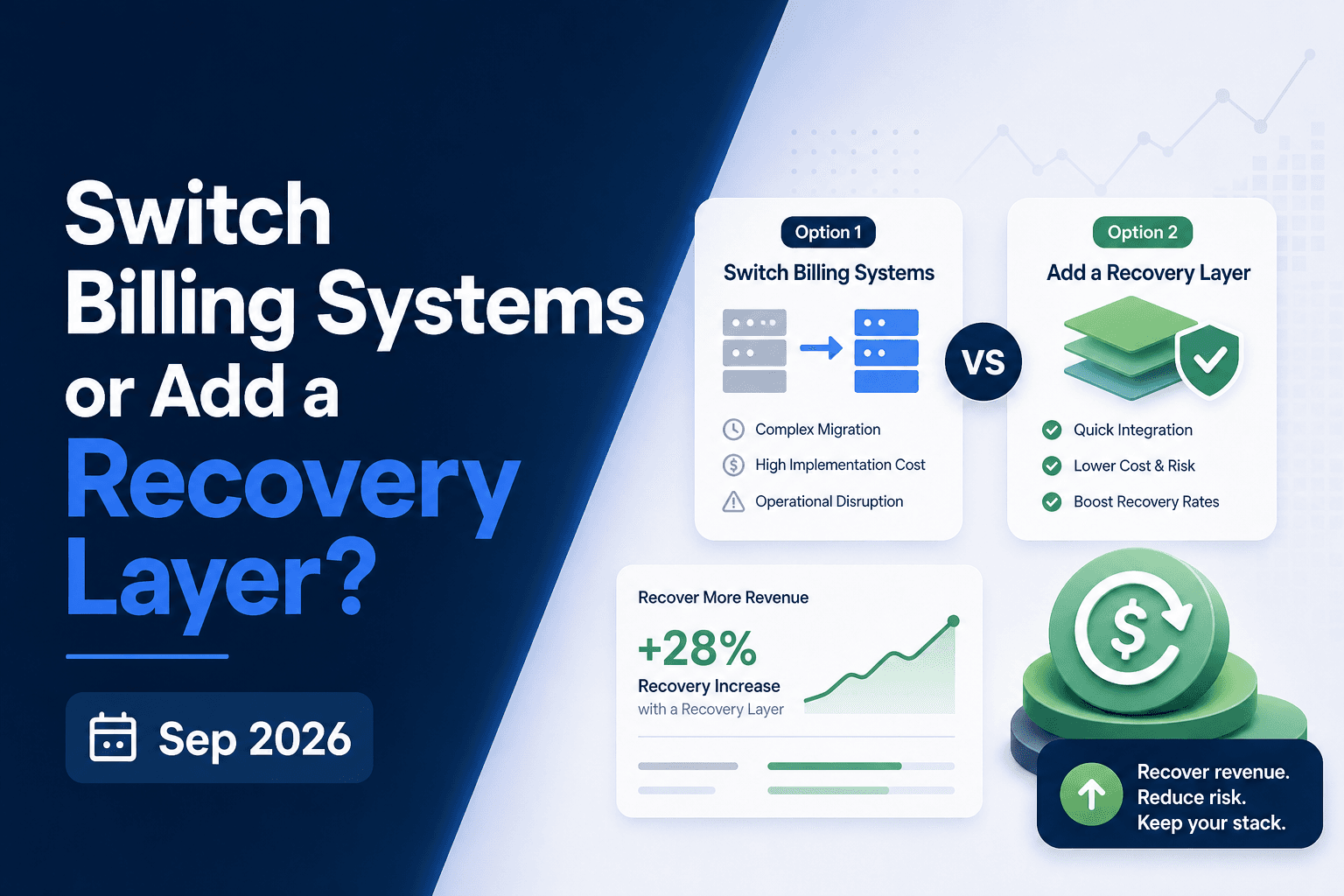
Billing Migration vs Recovery Layer: The Right Call October 2026
Switching billing systems feels like the right move when revenue collection starts breaking down. Sometimes it is. But soft declines, weak retry logic, and...
Stop losing revenue to failed payments
Join leading subscription businesses using Slicker to recover failed payments automatically.
Get Started