Recurly Revenue Recovery Tactics That Win (Sep 2026)

Forty percent of lost subscribers across subscription businesses never decided to leave. Their card expired, their bank blocked a charge, or a billing credential went stale. If you're using Recurly's default dunning setup, you're probably recovering some of them, but a fixed retry schedule leaves a measurable share behind. The parts of Recurly revenue recovery that actually move the number are more specific than most teams realize.
TLDR:
- Involuntary churn accounts for up to 40% of lost subscribers; these customers never chose to leave, they need their payment processed.
- Recurly's dunning cycle applies the same retry schedule regardless of decline type, so hard declines get retried when they should stop, and soft declines fire on the wrong day.
- Retrying after a MAC 03 response costs $0.10 per attempt; exceeding Visa's 15-retry cap triggers penalties starting at $5,000 per month.
- About 13% of failed invoices recover in days 14 to 21 of dunning, with recovery rates dropping to near zero after day 21, making window length a direct revenue decision.
- Slicker runs an AABB (A/B/B holdout) test against Recurly's existing retry logic, measuring recovery in actual dollars with p-values; customers have achieved roughly 20% recovery-rate improvement, validated through AABB testing on customer traffic.
What Recurly Revenue Recovery Actually Covers
Recurly's revenue recovery stack has three native components: a configurable dunning cycle that schedules payment retries after a failure, an Account Updater service that refreshes stale card credentials through Visa and Mastercard networks, and the Revenue Optimization Engine that layers some AI-driven logic on top of both.
The scale of what these tools exist to solve is substantial. The global subscription market surpassed $1.5 trillion in 2025, with an estimated $129 billion lost to involuntary churn that year alone. That revenue disappeared because a card expired, a bank declined a charge, or a billing credential went stale. These are customers who intended to stay subscribed.
Understanding what Recurly's built-in tools cover, and where coverage ends, is what separates a recovery rate that plateaus from one that keeps climbing.
Involuntary vs. Voluntary Churn: Why the Distinction Matters for Recovery
Voluntary churn has a cause you can study: the customer decided to leave. Maybe the product didn't fit, the price felt wrong, or a competitor won them over. The fix lives somewhere in product, pricing, or experience.
Involuntary churn is different. The customer never made a decision. A card expired, a bank blocked a charge, a billing credential went stale. Access disappeared anyway. Payment industry data shows payment failures and involuntary churn account for as much as 40% of lost subscribers across SaaS and B2B businesses: people who still want what you're selling.
The practical problem is that both types show up identically in your churn dashboard. You can't separate them, so you misread the signal: investing in product roadmap changes or discount campaigns to win back customers who never chose to leave. Smarter retries and targeted outreach never get resourced because the diagnosis pointed the wrong direction.
Treating involuntary churn as a payment infrastructure problem is what unlocks recovery. These subscribers don't need convincing. They need their payment processed.
How Recurly's Dunning Cycle Works
Recurly's dunning cycle is a fixed retry schedule you configure once per subscription plan and currency. When a payment fails, the system moves the invoice to a past-due state and begins working through your configured retry days, sending reminder emails in parallel at each attempt. Once the retry window closes without a successful charge, Recurly cancels the subscription.
Retry timing is set by day count, not by any analysis of why the payment failed. A card declined for insufficient funds gets the same schedule as one blocked for a suspected fraud flag. As Revova's breakdown of the dunning cycle notes, a fixed cycle treats every decline the same way, with email templates that don't change based on the failure reason.
Account Updater runs quietly alongside this, querying the Visa and Mastercard networks to refresh expired or reissued card credentials before a retry fires. It handles that specific slice of failures cleanly, but only when the card issuer participates and the credential has simply changed, not when the underlying failure is a funds or authorization problem.
The system covers the mechanical basics. What it can't do is adjust based on failure reason, issuer behavior, or the subscriber's payment timing patterns.
Hard Declines vs. Soft Declines: Routing Every Failed Payment Correctly
Not every failed payment is the same problem, and routing them identically wastes attempts on unrecoverable charges while missing recoverable ones.
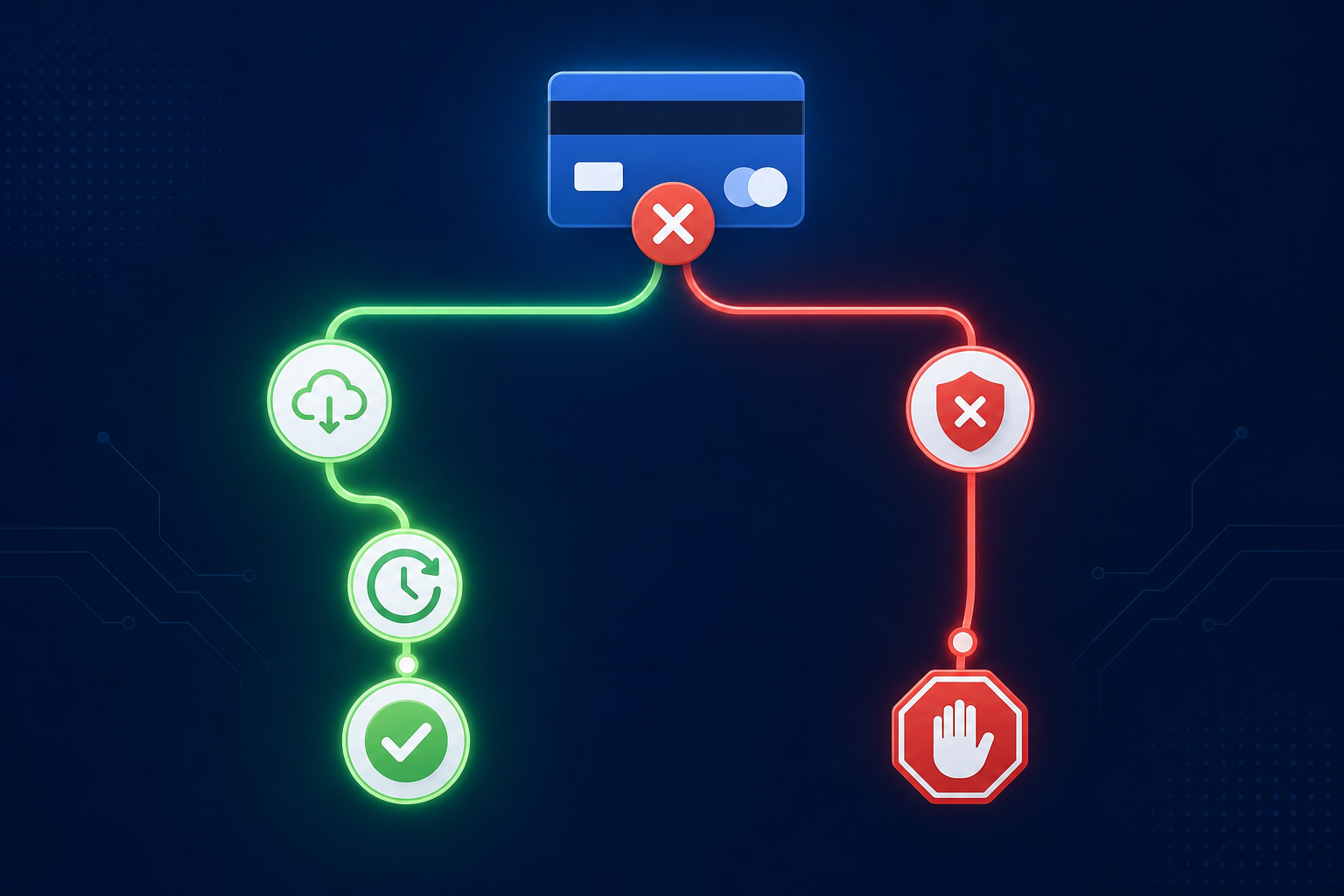
Soft declines are temporary: insufficient funds, network timeouts, processor errors. The card is valid, the customer is real, and a well-timed retry will likely succeed. Hard declines are permanent at the instrument level. A stolen card, closed account, or active fraud flag won't resolve on its own. Retrying anyway burns retry attempts, damages your merchant reputation with issuers, and triggers card network penalties. For hard declines, cancel the retry queue immediately and route to a dunning email requesting a new payment method.
Mastercard's Merchant Advice Codes (MACs) give per-transaction guidance on next steps. MAC 03 means do not retry. MAC 21 means stop all recurring charges on that account entirely. MAC 24 through 30 prescribe specific wait windows before the next attempt. Retrying against a MAC 03 costs $0.10 per attempt under Mastercard's Do Not Retry penalty, and a degraded merchant reputation from excessive hard-decline retries lowers authorization rates on future charges across your entire subscriber base.
Recurly's dunning cycle doesn't distinguish at this level. The same retry schedule fires regardless of decline type, so hard declines get retried when they should be stopped, and soft declines may get retried on the wrong day instead of when a cardholder's account is most likely to have funds. Every misrouted attempt is either a wasted opportunity or an active cost.
Card Network Retry Rules and Compliance Guardrails
Visa and Mastercard payment retry rules cap Visa retries at 20 attempts per card per 30-day window on soft declines. Mastercard, following its updated Excessive Authorization policy in January 2026, applies stricter oversight and increased penalties for excessive retries that repeatedly retry declined transactions, particularly when the same card, merchant, and amount are reattempted after issuer-declined responses.
Exceeding Visa's threshold triggers penalties starting at $5,000 per month, escalating to $50,000 to $100,000 at high volume. Mastercard charges $0.10 per attempt when you retry after receiving MAC 03.
These limits are compliance floors, not retry targets. Most recoverable soft declines resolve in the first two or three well-timed attempts. Running a full 20-attempt schedule on every failed payment burns attempts on cards that won't recover, accumulates fees, and degrades your merchant reputation with issuers in ways that reduce authorization rates across your entire subscriber base.
Retry Timing: Why When You Retry Matters as Much as Whether You Retry
Retry timing is where most billing systems leave money sitting. A payment declined for insufficient funds on a Thursday isn't necessarily lost; intelligent payday retries can capture it Friday morning when payroll clears. The difference between those two attempts isn't luck; it's knowing when a specific cardholder's account is most likely to be funded.
Geography compounds this. Here's how optimal retry windows break down by region:

Region | Payroll Cycle | Optimal Retry Window |
|---|---|---|
United States | Biweekly (1st & 15th common) | 2 to 3 days after the 1st or 15th; consumer debit cards peak at 12:01am when payroll settles |
Western Europe & UK | Monthly | Within 48 hours of the last working day of the month |
Australia | Weekly or fortnightly | 3 to 5 days after the initial decline |
A calendar-based dunning cycle can't account for any of this. It applies the same schedule across every subscriber regardless of card type, issuer, or geography, which means retry timing is right by accident at best. That gap between a fixed schedule and a well-timed retry translates directly into recovered or lost revenue.
Dunning Email Strategy: Failure-Reason-Specific Messaging That Converts
Generic dunning emails fail because they treat every payment failure as the same problem. The subscriber who needs to call their bank about a fraud flag and the subscriber whose prepaid card ran low are in completely different situations, but most dunning sequences send both the same message.
A failure-reason dunning cadence fixes this. A few examples of how branching works in practice:
- Expired card: direct the subscriber to update their card details, with a one-click link to a mobile-optimized payment update page.
- Insufficient funds on a debit or prepaid card: frame the message around service continuity, not payment failure. Time the send to payday windows, not immediately after the decline.
- Fraud-flagged card: tell the subscriber to contact their issuing bank directly. Asking them to re-enter card details won't resolve an active fraud block.
- Stolen or cancelled card: prompt a full payment method replacement, not a card update.
Dunning outreach should only fire when customer action is actually required. Sending an email the moment an insufficient-funds decline occurs, before any retries have run, creates unnecessary friction with a subscriber whose account may clear by morning. Reserve emails for failure types where automated recovery is exhausted or the failure code signals the customer must act.
Framing the message around what the subscriber loses, not the payment event, consistently outperforms transactional copy. "Your access to X will pause on [date]" lands differently than "Your payment failed."
Account Updater and Card-on-File Hygiene
A meaningful share of Recurly failed payments trace back to nothing more than a changed card number or updated expiration date. The card is valid, the customer intends to pay, but the credential on file no longer matches what the issuer holds. Retry logic can't fix this on its own.
Visa Account Updater and Mastercard's Automatic Billing Updater (ABU) create a secure communication loop between merchants, processors, card networks, and issuing banks. When a card is reissued or an expiration date changes, the updated credential is pushed to merchants before the next charge attempt, preventing a decline that would otherwise trigger your dunning cycle unnecessarily.
Recurly's Account Updater integration queries these networks automatically, but coverage has real limits:
- Digital wallet tokens (Apple Pay, Google Pay) operate on their own credential infrastructure and aren't covered by standard updater services.
- Prepaid cards are largely excluded, as most prepaid issuers don't participate in updater programs.
- Regional and smaller issuers outside the US may have limited or no participation, so international subscribers carry higher stale-credential risk.
Account updater handles one specific slice of your failure mix cleanly. Prepaid and international declines from stale credentials need a different path toward recovering failed Recurly payments, usually dunning outreach requesting a manual card update. Knowing where updater services fall short tells you where to direct additional recovery effort.
Optimizing Recurly's Grace Period and Dunning Window Length
Most subscription businesses set their grace period once during implementation and never revisit it. That leaves measurable recovery on the table.
The dunning window is a tradeoff. A longer window creates more retry and dunning opportunities, but every additional day a subscriber stays in a failed-payment state is a day they may be consuming services without generating revenue. At large subscriber volumes, that cost compounds quickly.
Production data from Slicker deployments shows that roughly 13% of all failed invoices are recovered in the third week of dunning (days 14 to 21), with recovery rates after day 21 dropping to near zero. A 14-day window leaves a material share of recoverable revenue uncaptured, while extending beyond 21 days adds service cost with negligible return.
One practical consideration: shorter dunning windows also affect which retry attempts can fire. If Merchant Advice Codes (MACs) prescribe a 10-day wait before retrying, a 12-day window may close before that attempt executes. Test two cohorts on different grace period lengths, measure both recovery rates and service cost exposure, and let your own subscriber behavior set the window. A structured dunning management recovery process makes this optimization systematic.
Measuring Recurly Recovery Performance: Metrics That Actually Matter
Recovery rate, recovery dollar volume, and time-to-recovery each answer a different question, and you need all three to know whether your Recurly setup is actually working.
Recovery rate is the percentage of failed invoices that eventually collect payment within the dunning window. Recovery dollar volume tells you the actual revenue impact, since a high recovery rate on low-value invoices may matter far less than a moderate rate on annual or high-ticket plans. Time-to-recovery measures how long subscribers stay in a failed-payment state before resolution, which carries its own cost in service exposure and customer-experience risk.
One reporting detail that distorts the picture: counting at the transaction level instead of the invoice level. A single invoice with three retry attempts that eventually succeeds will appear as three transactions in most payment processor reports, inflating both attempt counts and apparent recovery volume. Track unique invoices resolved, not total payment attempts, when building numbers for finance or executive reporting.
Week-over-week spikiness in recovery rates is worth investigating. A sudden drop often traces to an error mix shift, a card portfolio change after a large acquisition, or a seasonal billing concentration like month-end insufficient-funds declines tied to payday cycles. Normalizing recovery rate by failure type separates genuine performance changes from compositional noise.
For stakeholder reporting, track recovery rate by failure category, dollar volume recovered per dunning cohort, and median days-to-recovery. Those three numbers, measured monthly against a stable baseline, give finance and executive teams a reliable view of how much involuntary churn is being stopped and where recovery capacity is being left unused.
What Recurly's Built-In Recovery Leaves on the Table
Recurly's built-in recovery handles the basics reliably. The gaps show up at the edges, and at scale, the edges are where most of the money is.
The dunning cycle applies the same retry schedule across every failed payment in a plan and currency segment. There's no per-transaction analysis of issuer behavior, no adjustment based on subscriber tenure, no time-of-day precision. A card declined at 11pm for insufficient funds gets the same retry timing as a fraud-flagged corporate card. Fixed schedules also degrade silently: as card portfolios age and issuer behaviors shift, the rules don't recalibrate. A well-built subscription payment retry strategy accounts for this drift. Recovery rates erode without a clear signal explaining why.
Dunning emails in Recurly's native setup are tied 1:1 to retry attempts, so subscribers who would have recovered automatically receive outreach they didn't need, and cumulative send volume increases spam risk. There's also no branching by decline code. A subscriber with an insufficient-funds decline on a prepaid card and one with a fraud-flagged card receive structurally identical messages, even though the required action is completely different.
The deeper problem is measurement. Recurly's built-in system has no mechanism for proving whether its recovery logic is actually performing, or what a different approach would have recovered instead. Without a control group and a statistically valid comparison, you're working from reported recovery rates with no way to know how much revenue a better-sequenced strategy would have captured. That uncertainty compounds with every billing cycle.
How Slicker Extends Recovery Performance on Recurly
Slicker connects to Recurly in under five minutes, no engineering required. Once live, it runs an AABB test that splits failed invoices 50/50 between Recurly's existing retry logic and Slicker's AI-powered retry timing, measuring recovery in actual dollars with p-values and confidence intervals. If Slicker doesn't outperform with statistical significance, you don't pay.
The retry logic operates at the transaction level, not the plan segment. Each failed invoice gets its own analysis based on decline code, card type, issuer behavior, geography, and payday timing before a retry is scheduled. Soft declines get hour-precise retry windows aligned to when that specific cardholder's account is most likely to have funds. Hard declines and MAC 03 responses stop immediately. Customers including Freepik and The Economist have achieved roughly 20% recovery-rate improvement, validated through AABB testing on their own Recurly traffic.
Dunning emails and retry attempts are fully decoupled, which eliminates the spam risk that builds when outreach fires 1:1 with every retry event. Emails send only when customer action is the remaining recovery path, with each message tailored to the specific failure reason, not a generic payment-update prompt. All recoveries flow through Recurly's own billing rails and appear indistinguishable from regular payments.
Final Thoughts on Maximizing Recurly Failed Payment Recovery
Fixed retry schedules and generic dunning emails are a starting point, not a ceiling. The recovery left on the table is real, and the failure reasons tell you exactly where to focus. Connect with Slicker to run a statistically valid test against your current Recurly setup and see the dollar difference for yourself.
FAQs
How does Slicker's delta-based pricing work compared to charging a percentage of all Recurly recoveries?
Delta-based pricing means you pay only on the recoveries Slicker generates above your existing Recurly baseline, not on revenue you would have recovered anyway. If Recurly's built-in retry logic already recovers a portion of your failed invoices, standard revenue-share pricing charges a percentage of that entire pool; delta-based pricing charges only on the incremental lift Slicker proves through AABB testing, making it a fairer model for subscription businesses that already have some recovery in place.
What metrics should a SaaS revenue operations team track to measure Recurly involuntary churn recovery performance?
Track three numbers monthly: recovery rate by failure category (soft declines, hard declines, stale credentials), dollar volume recovered per dunning cohort, and median days-to-recovery. Count at the invoice level, not the transaction level, since a single invoice retried three times before collecting will inflate transaction counts and distort the picture for finance and executive reporting. Week-over-week spikiness usually traces to an error mix shift or a seasonal billing concentration, so normalizing by failure type separates genuine performance changes from compositional noise.
What causes week-on-week spikiness in Recurly payment recovery rates?
Recovery rate variance typically comes from changes in your error mix, not changes in retry performance. A spike in month-end insufficient-funds declines tied to payday cycles, a card portfolio change after a large subscriber acquisition, or a higher proportion of hard declines from a specific issuer can all swing your reported rate without any change in how recovery logic is executing. Normalizing recovery rate by failure type and tracking it against a stable baseline is the most reliable way to separate real performance movement from compositional noise.
How does Slicker connect to Recurly, and what does setup require from your engineering team?
Slicker connects to Recurly using read and write API keys scoped to invoices, subscriptions, and billing info, and no webhook configuration or custom code is needed from your side. Once live, it runs an AABB test that splits failed invoices between Recurly's existing retry logic and Slicker's AI-powered retry timing, measuring recovery in actual dollars recovered with p-values and confidence intervals. All recoveries flow through Recurly's own billing rails and appear indistinguishable from regular payments, so there are no changes to your finance workflows or reconciliation processes.
What are the strongest alternatives to Churn Buster for AI-powered dunning and payment retries on Recurly in 2026?
Churn Buster has strong email campaigns but limited retry intelligence and no gateway routing, making it a dunning-first tool. Slicker combines AI-powered retry timing with failure-reason-specific dunning emails and multi-gateway routing, and unlike Churn Buster, proves incremental lift through AABB testing on your own Recurly traffic before any payment commitment. Freepik and The Economist have each achieved roughly 20% recovery-rate improvement using this approach.
Related Articles

Zuora Retry Logic: CPR Limits and Layering (September 2026)
There's a version of Zuora retry logic that works well, and a version that looks fine in the settings but quietly misfires on soft declines, closes invoices...

Build vs Buy: Payment Retry Logic Deep Dive (September 2026)
Your engineering team can build retry logic. The harder question is whether they should. The gap between a basic retry schedule and something that actually...

Where 20% More Payment Recovery Comes From (Sep 2026)
A 20% recovery uplift sounds like a headline until you try to figure out what it actually means for your baseline. Relative improvement, absolute percentage...
Stop losing revenue to failed payments
Join leading subscription businesses using Slicker to recover failed payments automatically.
Get Started