Gateway Failover: Routing the Right Failures October 2026
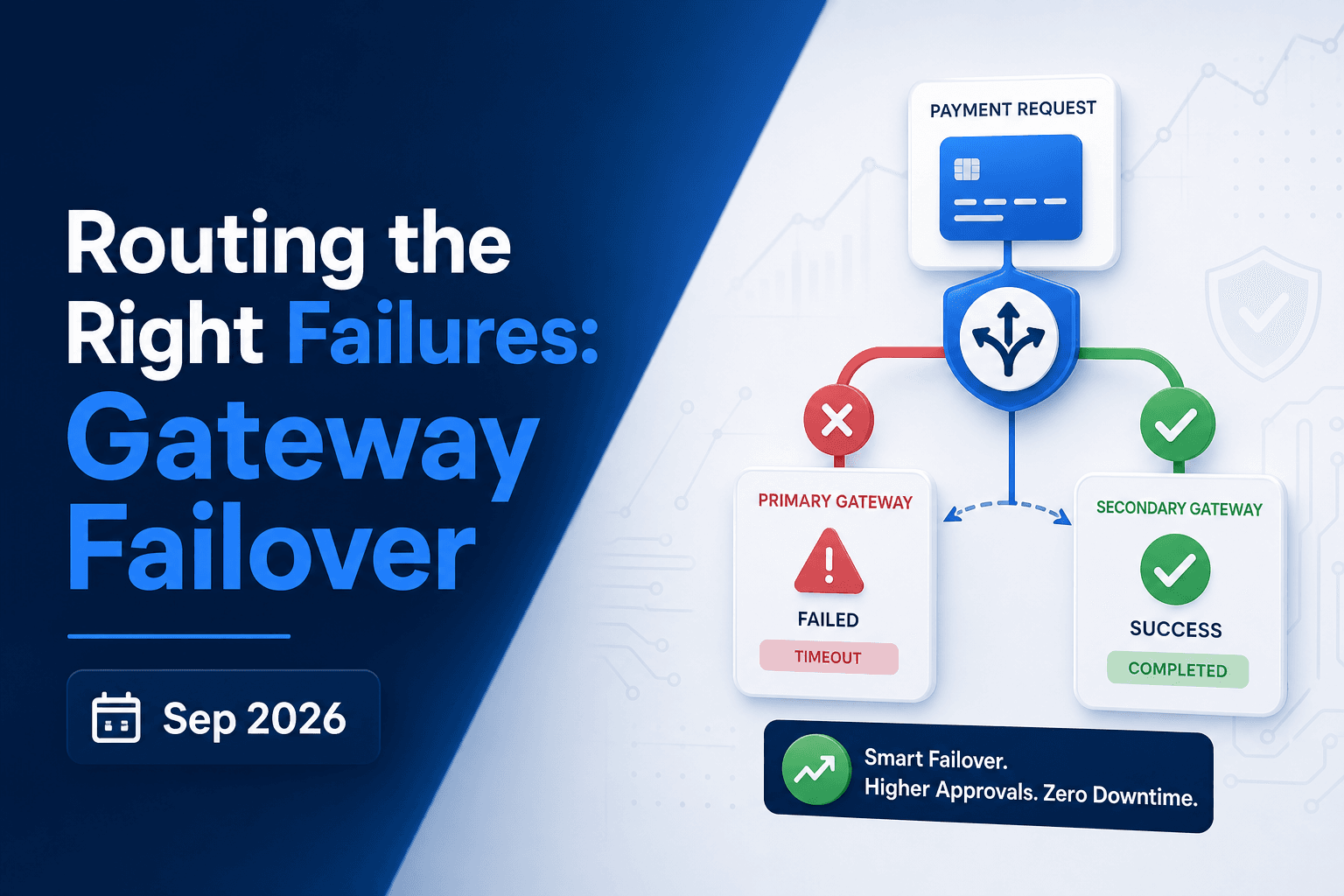
A gateway outage and an issuer decline look identical in your failed payment count, but they call for completely different responses. Rerouting an issuer decline to a backup processor wastes an attempt and edges you toward card network retry limits. Getting that classification right before routing is what actually drives recovery during an outage.
TLDR:
- Gateway failover auto-reroutes transactions to a backup processor when your primary fails; 92% of enterprise merchants experienced at least one outage in the past two years.
- Failover, cascading, smart routing, and orchestration are distinct: conflating them leaves your authorization rate exposed when the primary processor goes dark.
- Only gateway-level failures warrant rerouting; issuer declines return the same result on any processor, so switching gateways burns retry budget without recovering the charge.
- Visa caps subscription retries at 15 per card per 30 days; each gateway hop in a cascade counts as a separate attempt, not one.
- Slicker routes post-decline recurring payment attempts across connected gateways based on card type, issuer, and geography, sitting alongside your existing infrastructure with zero engineering lift required.
What Is Payment Gateway Failover
Payment gateway failover is the automatic rerouting of a transaction to a backup gateway when the primary one fails, goes offline, or returns errors that prevent authorization. The payment attempt doesn't stop. It moves to a backup.
Think of it as a contingency built into your payment infrastructure: if gateway A can't process a charge, gateway B picks it up without requiring manual intervention. The customer sees nothing. The sale doesn't drop.
According to research from BR-DGE, 92% of enterprise e-commerce merchants experienced at least one payment outage in the past two years, with half of those losing over £1.1 million per incident.
The key word is "automatic." A manual process where someone notices downtime, files a ticket, and reroutes traffic is too slow. Research shows consumers abandon a purchase after roughly 7 minutes, while the average outage lasts 2 hours. Failover only works if it happens before the customer leaves.
Why Single-Gateway Setups Expose Revenue to Risk
According to Orchestra, 71% of enterprise merchants run the majority of their volume through a single processor, yet only 32% have automated backup routing. That gap is where revenue disappears.
A single gateway is a single point of failure. Outages, rate spikes, and issuer-side routing problems don't announce themselves in advance. When your only processor goes down, every transaction in flight either fails or waits, and most customers won't wait.
The business continuity framing matters here. Payment downtime affects cash flow, subscription renewal rates, and customer trust simultaneously. A checkout that silently fails during a gateway outage looks identical to a broken product, and customers respond accordingly.
Why Payment Failures Happen
Not every payment failure points to the same problem. Routing a charge to a backup gateway makes sense when your primary processor goes dark. It does the wrong thing when the issuer is the one declining, because switching gateways won't change the issuer's answer.
The main failure categories:
- Gateway outages and degraded performance: the processor is down, returning 5xx errors, or responding too slowly to complete authorization before timeout.
- Network-level errors: connectivity failures between your system and the gateway, often producing ambiguous results where you don't know if the charge was attempted.
- Issuer-side declines: the gateway is working fine, but the card-issuing bank is rejecting the transaction. Insufficient funds, do-not-honor codes, and fraud blocks all originate here.
- Timeouts with unclear outcomes: the request went out, but no response came back. The charge may or may not have processed.
- Authentication failures: 3D Secure (3DS) challenges that weren't completed, or exemptions that weren't applied correctly.
Infrastructure failures and issuer declines need different responses. A gateway outage calls for rerouting. An issuer decline needs either a retry at a better time, a different payment method, or a dunning email if the customer has to act. Sending a declined transaction to a second gateway wastes an attempt and can erode your standing with card networks if it tips you into excessive retry territory.
Failover, Cascading, Smart Routing, and Orchestration Are Not the Same
These terms appear in the same vendor conversations, but they describe different things.
Failover is reactive. A gateway fails mid-transaction and traffic reroutes to a backup. The trigger is a problem that already happened.
Cascading goes one step further: if the primary gateway declines or errors, the transaction is submitted sequentially to a second, then a third processor until one authorizes. It is a recovery chain, not a single backup.
Smart routing is proactive. Before a transaction is submitted, logic determines which gateway is most likely to authorize it based on card type, issuer, geography, or real-time performance data. The goal is a higher authorization rate on the first attempt.
Orchestration is the layer that can hold all three. It sits above your processors, handles routing decisions, monitors gateway health, and executes failover or cascading when needed. Multi-gateway payment routing tools vary widely in how they implement this layer. Orchestration describes the infrastructure; the other three describe specific behaviors within it.
Term | When it acts | What triggers it |
|---|---|---|
Failover | During a failure | Gateway outage or hard error |
Cascading | During a failure | Decline or error, sequential |
Smart routing | Before submission | Proactive optimization logic |
Orchestration | Always | Manages all of the above |
Conflating these creates real architectural gaps. A team that believes they have failover because they have smart routing will find out the difference when their primary processor goes dark.
How Payment Gateway Failover Works
Health monitoring runs continuously in the background, checking gateway response times, error rates, and HTTP status codes. The system registers degradation against a defined threshold. For example: error rate above 5% over a rolling 60-second window, or response latency crossing 3 seconds. Once that threshold is crossed, the failover trigger fires.
The rerouting step happens at the transaction router layer. Incoming payment requests shift to the next available gateway based on pre-configured priority or real-time performance scoring. Transactions already in flight that returned ambiguous results get flagged for idempotency checks before any retry.
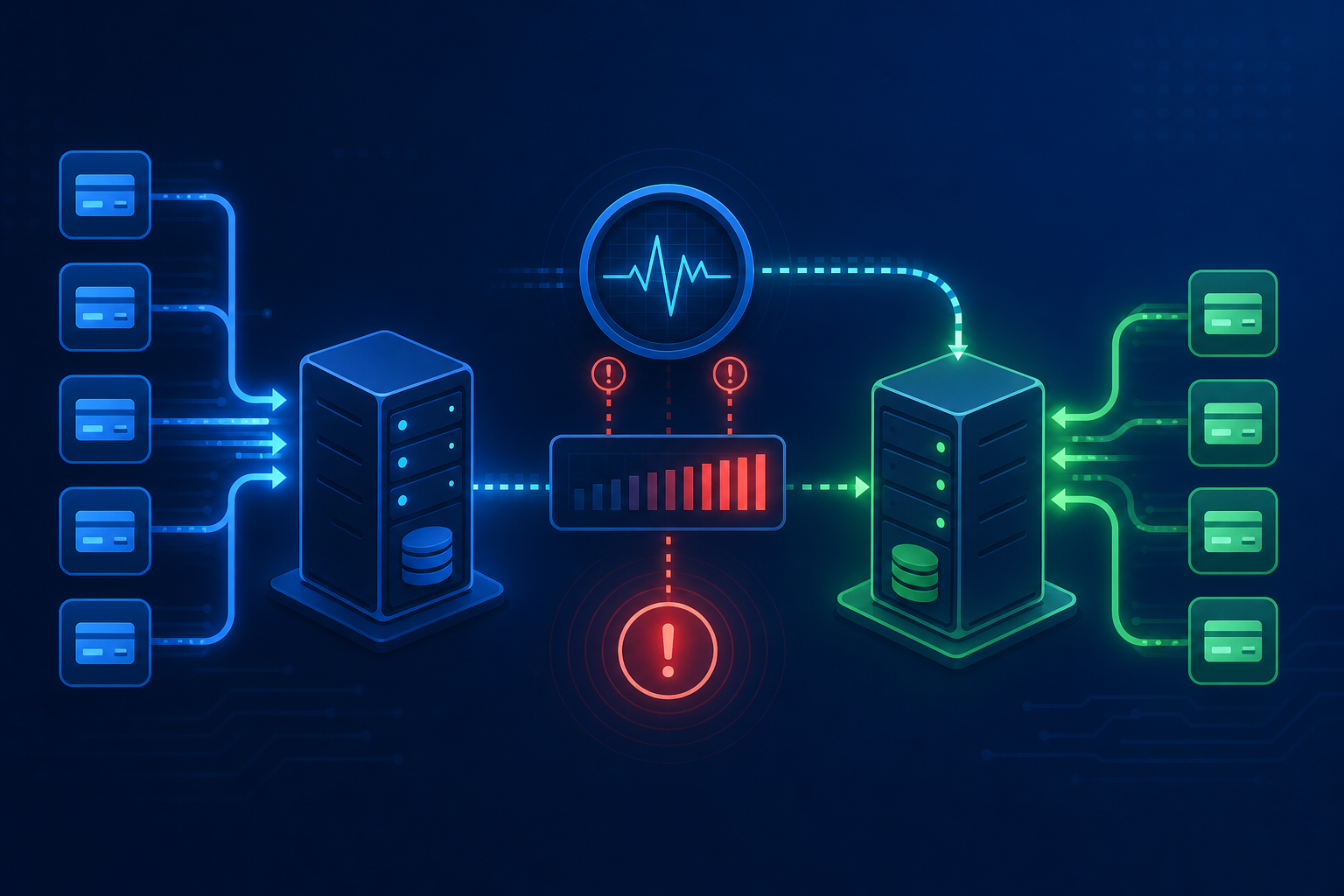
Research shows the revenue loss curve peaks between minutes 8 and 13 of an outage, well before most engineering teams can triage the alert. Manual failover is structurally too slow for that window, which is why automation is non-negotiable.
Once the primary gateway recovers, traffic moves back gradually, scaled up as error rates normalize. A hard cutback without health validation risks cycling the same outage twice.
Active-Passive vs. Active-Active Failover Architectures
The difference between these two architectures comes down to when your backup gateways do any work.
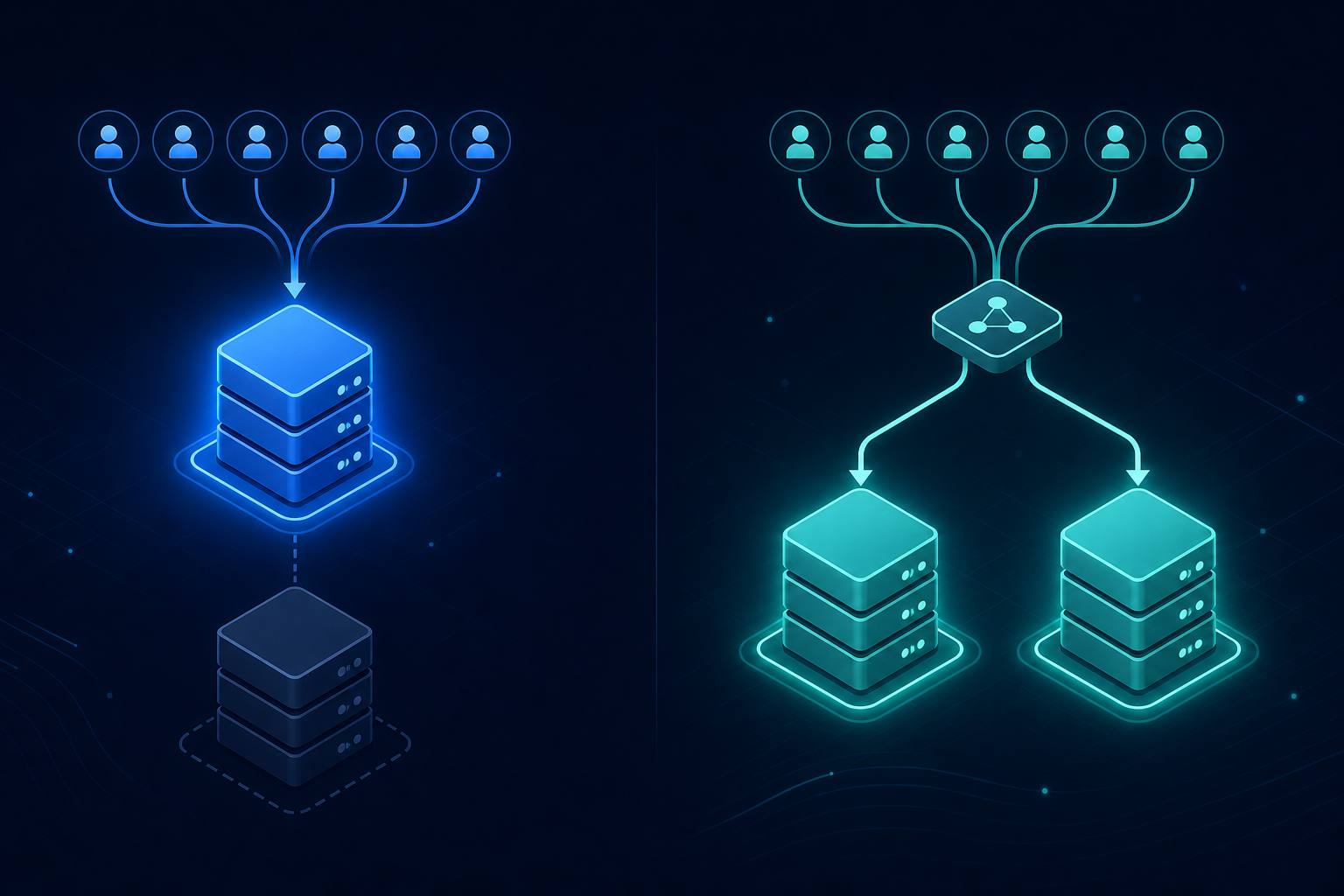
In active-passive setups, one gateway handles all traffic while the others sit idle. The appeal is simplicity: one integration is live at a time, reconciliation is straightforward, and there is no need to split or balance traffic. The cost is response time. The backup gateway is not warm, so the failover switch introduces latency, and you may not know it is healthy until you actually need it.
In active-active setups, traffic runs across multiple gateways simultaneously. If one degrades, the others absorb the volume without a discrete switchover moment.
The tradeoff is complexity: routing logic that distributes load intelligently, real-time health scoring across all gateways, and reconciliation that accounts for transactions spread across processors. Duplicate-charge risk during handoff also rises, making idempotency handling more demanding.
Active-Passive | Active-Active | |
|---|---|---|
Failover speed | Slower (requires switchover) | Near-instant (already live) |
Implementation complexity | Lower | Higher |
Reconciliation effort | Simpler | More complex |
Backup health visibility | Limited until needed | Continuous |
Best fit | Simpler stacks, lower transaction volume | High-volume, multi-market operations |
For most subscription businesses processing recurring volume across markets, active-active is the stronger choice. The routing complexity is real, but the alternative is a failover gap precisely when transaction volume is highest.
Which Payment Failures Should Trigger Failover
Not every failure is a gateway problem, and treating them all the same way is where most failover implementations go wrong.
Gateway-level failures are the right trigger: confirmed outages, persistent 5xx errors, response timeouts where the gateway never acknowledged the request, or degraded performance crossing your health threshold. In these cases, the processor is the obstacle and a backup gateway can clear it.
Issuer-side declines are a different category. If a card is blocked for fraud, the account is closed, or the cardholder's bank returns a do-not-honor code, a second gateway returns the same result. The issuer doesn't care which processor you use.
A rough decision framework:
- Gateway outage or 5xx errors: trigger failover to your backup processor.
- Response timeout with no acknowledgment: flag for an idempotency check, then consider failover.
- Soft issuer decline (insufficient funds, try again later): retry logic, not failover.
- Hard issuer decline (fraud block, closed account, do-not-retry Merchant Advice Code): stop or escalate to dunning.
- Authentication failure: a 3DS challenge that wasn't completed is a customer action problem, not infrastructure. Rerouting it doesn't close that gap.
Threshold-based triggers tied to error rate and latency are more reliable than binary up/down detection. That signal quality determines whether failover fires on the right events and protects your authorization standing on legitimate transactions.
Idempotency and Transaction Safety During Failover
When a gateway times out without returning a clear success or failure response, your system faces an unresolved state. The charge may have already processed. Retrying that same request against a backup gateway without a safety mechanism can produce a duplicate charge, one that is expensive to reverse and damaging to customer trust.
Idempotency keys are the standard answer. Each payment request carries a unique identifier. If the same key hits a gateway twice, the second attempt returns the result of the first without processing another charge. The key must be generated before the request is sent, preserved through the failover handoff, and recognized by the receiving gateway.
Two additional complications arise in real failover setups:
- Vault token portability: card tokens issued by Gateway A are not valid at Gateway B. If your failover scenario involves a stored card, your backup processor needs either a shared vault or a separate tokenized credential for the same card. Without that, failover on recurring payments fails before it starts.
- Cross-gateway state visibility: during an active-active setup, knowing whether a transaction settled on the primary before traffic shifted requires real-time status resolution, beyond error-rate monitoring alone.
The duplicate charge problem often surfaces after the fact during reconciliation, which makes it harder to remediate at scale and compounds the revenue impact of the original outage.
Special Considerations for Subscription and Recurring Payments
Failover for recurring payments operates under tighter constraints than checkout flows, and the differences matter for how you design the system.
Subscription charges are merchant-initiated transactions (MITs). The cardholder agreed once; every subsequent charge happens without them present. That changes what a gateway can do when a transaction fails. You cannot prompt the customer to re-enter credentials at the point of failure, and network rules governing retry frequency are stricter than most teams realize.
Visa and Mastercard payment retry rules set hard limits: Visa allows at most 15 retry attempts per card and amount within a 30-day window; Mastercard caps soft decline retries at 10 within any 24-hour period, a different time horizon and not a direct parallel. Exceed those retry velocity limits and you face per-attempt fees and potential issuer flagging that suppresses your authorization rate across the entire merchant account. Failover rerouting counts as an attempt, so a cascade hitting three gateways on the same declined card consumes three of your allowed retries, not one.
Token portability is the other constraint that bites hardest in subscription contexts. Gateway A's vault token is useless at Gateway B. Without a multi-gateway vault or shared tokenization layer, failover on a recurring charge means you can only reroute to gateways that hold a valid credential for that card. Gaps here only surface during an actual outage.
The decline type still determines the right response:
- A gateway outage on a renewal charge warrants rerouting to a backup processor.
- A soft issuer decline warrants smart retry timing, not a gateway switch.
- A hard decline retry penalty applies when a do-not-retry Merchant Advice Code (MAC) is ignored; stop automated attempts and move to dunning.
Failover logic that ignores decline source burns retry budget on issuer problems that no gateway switch can fix, directly reducing the revenue you recover from an already-earned subscription.
Measuring Whether Failover Is Actually Working
Knowing failover is configured is not the same as knowing it works. These are the signals worth tracking:
- Authorization rate by gateway: baseline each processor separately. A drop on one gateway that doesn't appear on others confirms a processor-specific problem and not an issuer trend.
- Failover trigger accuracy: what share of failover events were caused by actual gateway failures versus issuer declines? A high false-positive rate means your threshold logic is misfiring and consuming retry budget on unchargeable cards. Smart payment retries using decline codes can help distinguish infrastructure failures from issuer rejections.
- Recovery time per incident: from first degraded response to full traffic reroute. Anything beyond two minutes warrants tighter thresholds.
- Reconciliation error rate: duplicate or unresolved transactions per failover event. Spikes here signal idempotency gaps in the handoff logic.
- Failover event frequency: tracked over time, outside of incidents as well. Increasing frequency from a single gateway often signals a deteriorating processor relationship before a full outage arrives.
The false-positive rate deserves particular attention. Teams often optimize for fast failover triggers without accounting for the cost of rerouting issuer declines that no gateway switch can fix. Measuring trigger accuracy separately from failover speed keeps both sides of that tradeoff visible.
Common Failover Implementation Mistakes
Each of these mistakes follows the same pattern: the staging environment passed, and the incident happened anyway.
- Health checks that test availability only: a gateway returning 200 OK on a health endpoint can still be processing transactions slowly enough to drop authorizations. Monitor error rates and response latency on real transaction traffic, and go beyond ping responses.
- Vault tokens that don't travel (covered above): audit token coverage before you need it.
- Retries without idempotency keys: the most common post-incident reconciliation problem. See the idempotency section above for the full mechanism.
- No distinction between gateway and issuer failures: see the failure taxonomy above for the decision framework on when to reroute versus retry or escalate to dunning.
Each of these gaps is invisible until transaction volume is high enough to expose them, at which point the revenue cost is already real.
How Slicker's Gateway Selection Fits Into a Failover Strategy
Once you know your failover setup is working, the next question is recovery quality. That is where Slicker's gateway selection operates at a different layer than the checkout failover architecture this article has covered. Where real-time failover intercepts a failing transaction mid-flight, Slicker works after a recurring payment has already declined, deciding which connected gateway to route the next attempt through based on card type, issuer, geography, and gateway performance.
For subscription businesses, that layer matters as much as infrastructure failover does. Industry data shows roughly 9% of recurring revenue is lost annually to failed payments (industry data). The checkout rarely fails; the renewal does, quietly, at scale.
Slicker connects across Stripe, Braintree, Adyen, Checkout.com, PayPal, Worldpay, Cybersource, and Authorize.net via a single integration to recover failed subscription payments across gateways, and works alongside existing payment orchestrators through the merchant's current infrastructure with zero engineering lift required. Gateway selection is one input in the recovery decision alongside timing, decline classification, and whether the failure warrants a retry at all or a dunning email. A subscription payment retry strategy covers how these inputs combine into a complete recovery approach.
Recovery improves by reading each failure correctly before routing, not by firing every declined charge at every available gateway.
Final Thoughts on Getting Payment Gateway Failover Right
A failover setup that fires on every decline type looks thorough until you see what it does to your retry standing with issuers. The real work is building logic that routes the right failures to the right response, gateway switch, smart retry, or dunning, without conflating the three. Your subscription revenue depends more on that distinction than most teams realize until an outage surfaces the gap. Talk to the Slicker team if your recovery setup is due for a closer look.
FAQs
What's the difference between payment gateway failover and smart retry logic for subscription payments?
Gateway failover reroutes a transaction to a backup processor when your primary gateway goes down mid-charge; it solves an infrastructure problem. Smart retry logic solves a different problem: deciding whether, when, and on which gateway to re-attempt a recurring charge that declined for an issuer-side reason. For subscription businesses, both layers matter, but they operate independently. An outage during checkout warrants failover. A soft decline on a renewal charge warrants timing the next attempt to when the cardholder is most likely to have funds, not switching processors.
How do I prove a payment recovery vendor is actually improving my recovery rate, instead of taking credit for payments that would have succeeded anyway?
The only reliable method is a controlled test that separates the vendor's recoveries from your existing baseline. Look for crossover AABB testing, where your traffic is split into matched groups and statistical significance is calculated on dollars recovered, and on percentage points too. Slicker runs this test on your own traffic before charging anything; the Lift Evaluation Protocol (slickerhq.com/resources/lift-evaluation-protocol) publishes the full methodology, including how it controls for selection bias and cherry-picked windows.
Should I use payment gateway cascading or smart routing for recurring subscription charges?
Cascading works well for checkout flows, where a decline from one processor gets sequentially retried at another in real time. For merchant-initiated recurring charges, the better approach is reading the decline reason first, then deciding whether to retry at all, when to retry, and which gateway to use. Firing a declined renewal charge at three gateways in sequence consumes retry budget under Visa and Mastercard network limits (15 and 10 attempts respectively) without improving the outcome if the issuer is the one blocking the charge.
Can a payment recovery platform work across Stripe, Adyen, and Braintree without rebuilding your payment stack?
Yes. Slicker connects to Stripe, Adyen, Braintree, Checkout.com, PayPal, Worldpay, Cybersource, and Authorize.net, and works alongside orchestration layers like Primer through your existing infrastructure. On supported billing platforms (Stripe Billing, Chargebee, Recurly, Zuora, Recharge, Piano), setup requires no engineering work and is typically live within days. Recoveries run through your existing rails, so reconciliation and billing records stay unchanged.
What metrics should revenue operations teams track to measure involuntary churn recovery performance in 2026?
Track authorization rate by gateway separately so processor-specific drops don't get masked by blended figures, recovery rate by decline code cohort so you can see whether soft declines and hard declines are being handled differently, and recovery timing (how many days after the initial failure the charge succeeded). Reconciliation error rate per failover event catches idempotency gaps before they compound. For ongoing reporting, Slicker Analytics maps decline codes from every processor into a single taxonomy and lets finance teams query recovery performance by issuer, BIN range, country, and payment method without manual exports.
Related Articles
Stripe Dunning Configuration Guide (September 2026)
A surprising share of the subscribers leaving your list every month never chose to cancel. Their payment failed, your retry window ran out, and Stripe...
Stripe Recovery Add-On Evaluation Guide (September 2026)
Stripe's built-in recovery tools cover real ground. Smart Retries, Account Updater, dunning emails. For a lot of subscription businesses, that's a reasonable...
What Subscription Operators Miss About Built-In Retries (Oct 2026)
If your billing platform retries run on a fixed 14-to-21-day countdown from the failure date, they have no idea when your subscriber's paycheck actually...
Stop losing revenue to failed payments
Join leading subscription businesses using Slicker to recover failed payments automatically.
Get Started